Reading view

How can cloud-native security be transformed by Agentic AI?

How do Non-Human Identities Shape the Future of Cloud Security? Have you ever wondered how machine identities influence cloud security? Non-Human Identities (NHIs) are crucial for maintaining robust cybersecurity frameworks, especially in cloud environments. These identities demand a sophisticated understanding, when they are essential for secure interactions between machines and their environments. The Critical Role […]

The post How can cloud-native security be transformed by Agentic AI? appeared first on Entro.

The post How can cloud-native security be transformed by Agentic AI? appeared first on Security Boulevard.

  •  

What future-proof methods do Agentic AIs use in data protection?

How Secure Is Your Organization’s Cloud Environment? How secure is your organization’s cloud environment? With the digital transformation accelerates, gaps in security are becoming increasingly noticeable. Non-Human Identities (NHIs), representing machine identities, are pivotal in these frameworks. In cybersecurity, they are formed by integrating a ‘Secret’—like an encrypted password or key—and the permissions allocated by […]

The post What future-proof methods do Agentic AIs use in data protection? appeared first on Entro.

The post What future-proof methods do Agentic AIs use in data protection? appeared first on Security Boulevard.

  •  

Is Agentic AI driven security scalable for large enterprises?

How Can Non-Human Identities (NHIs) Transform Scalable Security for Large Enterprises? One might ask: how can large enterprises ensure scalable security without compromising on efficiency and compliance? The answer lies in the effective management of Non-Human Identities (NHIs) and secrets security management. With machine identities, NHIs are pivotal in crafting a robust security framework, especially […]

The post Is Agentic AI driven security scalable for large enterprises? appeared first on Entro.

The post Is Agentic AI driven security scalable for large enterprises? appeared first on Security Boulevard.

  •  

Survey: Most Security Incidents Involve Identity Attacks

A survey of 512 cybersecurity professionals finds 76% report that over half (54%) of the security incidents that occurred in the past 12 months involved some issue relating to identity management. Conducted by Permiso Security, a provider of an identity security platform, the survey also finds 95% are either very confident (52%) or somewhat confident..

The post Survey: Most Security Incidents Involve Identity Attacks appeared first on Security Boulevard.

  •  

Check Point Unveils a New Security Strategy for Enterprises in the AI Age

AI technology, security, AI security, visibility, insights, security platform, Arctic Wolf, zero-trust encrypted AI Trend Micro cybersecurity poverty line, data-centric, SUSE cloud Wiz Torq AirTag Skyhawk SASE security cloud security visibility PwC Survey Finds C-Level Execs Now View Cybersecurity as Biggest Risk

Check Point is rolling out a new four-pillar cybersecurity strategy to give security teams an edge in the ongoing AI arms race with threat actors and is making three acquisitions that will play a critical role in getting it going.

The post Check Point Unveils a New Security Strategy for Enterprises in the AI Age appeared first on Security Boulevard.

  •  

The Cyber Express Weekly Roundup: Escalating Breaches, Regulatory Crackdowns, and Global Cybercrime Developments

The Cyber Express Weekly Roundup

As February 2026 progresses, this week’s The Cyber Express Weekly Roundup examines a series of cybersecurity incidents and enforcement actions spanning Europe, Africa, Australia, and the United States.   The developments include a breach affecting the European Commission’s mobile management infrastructure, a ransomware attack disrupting Senegal’s national identity systems, a landmark financial penalty imposed on an Australian investment firm, and the sentencing of a fugitive linked to a multimillion-dollar cryptocurrency scam.  From suspected exploitation of zero-day vulnerabilities to prolonged breach detection failures and cross-border financial crime, these cases highlights the operational, legal, and systemic dimensions of modern cyber risk.  

The Cyber Express Weekly Roundup 

European Commission Mobile Infrastructure Breach Raises Supply Chain Questions 

The European Commission reported a cyberattack on its mobile device management (MDM) system on January 30, potentially exposing staff names and mobile numbers, though no devices were compromised, and the breach was contained within nine hours. Read more... 

Ransomware Disrupts Senegal’s National Identity Systems 

In West Africa, a major cyberattack hit Senegal’s Directorate of File Automation (DAF), halting identity card production and disrupting national ID, passport, and electoral services. While authorities insist no personal data was compromised, the ransomware group. The full extent of the breach is still under investigation. Read more... 

Australian Court Imposes Landmark Cybersecurity Penalty 

In Australia, FIIG Securities was fined AU$2.5 million for failing to maintain adequate cybersecurity protections, leading to a 2023 ransomware breach that exposed 385GB of client data, including IDs, bank details, and tax numbers. The firm must also pay AU$500,000 in legal costs and implement an independent compliance program. Read more... 

Crypto Investment Scam Leader Sentenced in Absentia 

U.S. authorities sentenced Daren Li in absentia to 20 years for a $73 million cryptocurrency scam targeting American victims. Li remains a fugitive after fleeing in December 2025. The Cambodia-based scheme used “pig butchering” tactics to lure victims to fake crypto platforms, laundering nearly $60 million through U.S. shell companies. Eight co-conspirators have pleaded guilty. The case was led by the U.S. Secret Service. Read more... 

India Brings AI-Generated Content Under Formal Regulation 

India has regulated AI-generated content under notification G.S.R. 120(E), effective February 20, 2026, defining “synthetically generated information” (SGI) as AI-created content that appears real, including deepfakes and voiceovers. Platforms must label AI content, embed metadata, remove unlawful content quickly, and verify user declarations. Read More... 

Weekly Takeaway 

Taken together, this weekly roundup highlights the expanding attack surface created by digital transformation, the persistence of ransomware threats to national infrastructure, and the intensifying regulatory scrutiny facing financial institutions.  From zero-day exploitation and supply chain risks to enforcement actions and transnational crypto fraud, organizations are confronting an environment where operational resilience, compliance, and proactive monitoring are no longer optional; they are foundational to trust and continuity in the digital economy. 
  •  

The Law of Cyberwar is Pretty Discombobulated

cyberwar, cyber, SLA, cyberattack, retailers, Ai, applications, sysdig, attack, cisco, AI, AI-powered, attacks, attackers, security, BreachRx, Cisco, Nexus, security, challenges, attacks, cybersecurity, risks, industry, Cisco Talos hackers legitimate tools used in cyberattacks

This article explores the complexities of cyberwarfare, emphasizing the need to reconsider how we categorize cyber operations within the framework of the Law of Armed Conflict (LOAC). It discusses the challenges posed by AI in transforming traditional warfare notions and highlights the potential risks associated with the misuse of emerging technologies in conflicts.

The post The Law of Cyberwar is Pretty Discombobulated appeared first on Security Boulevard.

  •  

Securing Agentic AI Connectivity


Securing Agentic AI Connectivity

AI agents are no longer theoretical, they are here, powerful, and being connected to business systems in ways that introduce cybersecurity risks! They’re calling APIs, invoking MCPs, reasoning across systems, and acting autonomously in production environments, right now.

And here’s the problem nobody has solved: identity and access controls tell you WHO is acting, but not WHY.

An AI agent can be fully authenticated, fully authorized, and still be completely misaligned with the intent that justified its access. That’s not a failure of your tools. That’s a gap in the entire security model.

This is the problem ArmorIQ was built to solve.

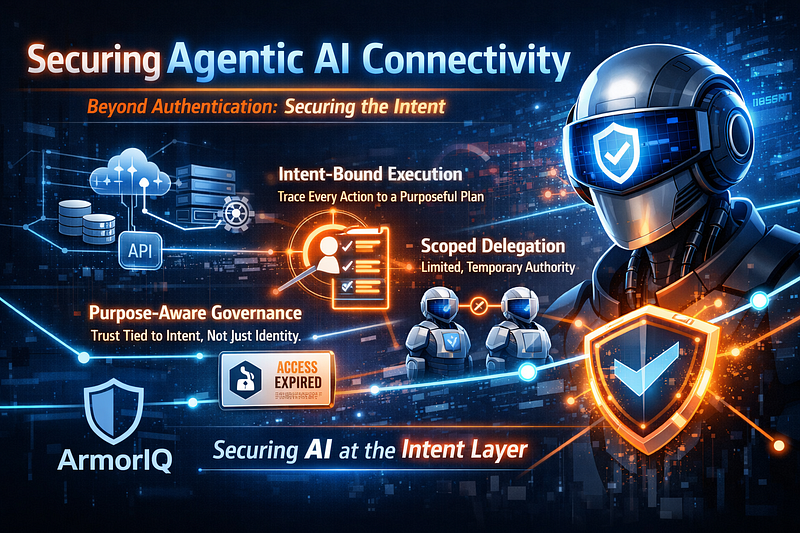
ArmorIQ secures agentic AI at the intent layer, where it actually matters:

· Intent-Bound Execution: Every agent action must trace back to an explicit, bounded plan. If the reasoning drifts, trust is revoked in real time.

· Scoped Delegation Controls: When agents delegate to other agents or invoke tools via MCPs and APIs, authority is constrained and temporary. No inherited trust. No implicit permissions.

· Purpose-Aware Governance: Access isn’t just granted and forgotten. It expires when intent expires. Trust is situational, not permanent.

If you’re a CISO, security architect, or board leader navigating agentic AI risk — this is worth your attention.

See what ArmorIQ is building: https://armoriq.io

The post Securing Agentic AI Connectivity appeared first on Security Boulevard.

  •  

Can AI-driven architecture significantly enhance SOC team efficiency?

How Can Non-Human Identities Revolutionize Cybersecurity? Have you ever considered the challenges that arise when managing thousands of machine identities? Where organizations migrate to the cloud, the need for robust security systems becomes paramount. Enter Non-Human Identities (NHIs) — the unsung heroes of cybersecurity that can revolutionize how secure our clouds are. Managing NHIs, which […]

The post Can AI-driven architecture significantly enhance SOC team efficiency? appeared first on Entro.

The post Can AI-driven architecture significantly enhance SOC team efficiency? appeared first on Security Boulevard.

  •  

How do Agentic AI systems ensure robust cloud security?

How Can Non-Human Identities Transform Cloud Security? Is your organization leveraging the full potential of Non-Human Identities (NHIs) to secure your cloud infrastructure? While we delve deeper into increasingly dependent on digital identities, NHIs are pivotal in shaping robust cloud security frameworks. Unlike human identities, NHIs are digital constructs that transcend traditional login credentials, encapsulating […]

The post How do Agentic AI systems ensure robust cloud security? appeared first on Entro.

The post How do Agentic AI systems ensure robust cloud security? appeared first on Security Boulevard.

  •  

4 Tools That Help Students Focus

Educators recognize the dual reality of educational technology (EdTech): its potential to sharpen student focus and detract from it. Schools must proactively leverage technology’s advantages while mitigating its risks to student productivity. Read on as we unpack the evolving importance and challenge of supporting student focus. We also detail four categories of classroom focus tools, ...

The post 4 Tools That Help Students Focus appeared first on ManagedMethods Cybersecurity, Safety & Compliance for K-12.

The post 4 Tools That Help Students Focus appeared first on Security Boulevard.

  •  

AI is Supercharging Romance Scams with Deepfakes and Bots

cambodia, laundering, scams, vishing, romance scams generative AI pig butchering

AI is giving online romance scammers even more ways to hide and accelerate their schemes while making it more difficult for people to detect fraud operations that are resulting in billions of dollars being stolen every year from millions of victims.

The post AI is Supercharging Romance Scams with Deepfakes and Bots appeared first on Security Boulevard.

  •  

Reducing Alert Fatigue Using AI: From Overwhelmed SOCs to Autonomous Precision

How Artificial Intelligence Transforms Security Operations Security Operations Centers (SOCs) face a growing operational challenge: overwhelming alert volumes. Modern enterprise environments generate thousands of security notifications daily across endpoint, network, identity, cloud, and application layers. This continuous stream of alerts creates what the industry describes as alert fatigue, a condition where analysts are overwhelmed by

The post Reducing Alert Fatigue Using AI: From Overwhelmed SOCs to Autonomous Precision appeared first on Seceon Inc.

The post Reducing Alert Fatigue Using AI: From Overwhelmed SOCs to Autonomous Precision appeared first on Security Boulevard.

  •  

India Brings AI-Generated Content Under Formal Regulation with IT Rules Amendment

AI-generated Content

The Central Government has formally brought AI-generated content within India’s regulatory framework for the first time. Through notification G.S.R. 120(E), issued by the Ministry of Electronics and Information Technology (MeitY) and signed by Joint Secretary Ajit Kumar, amendments were introduced to the Information Technology (Intermediary Guidelines and Digital Media Ethics Code) Rules, 2021. The revised rules take effect from February 20, 2026.  The move represents a new shift in the Indian cybersecurity and digital governance policy. While the Information Technology Act, 2000, has long addressed unlawful online conduct, these amendments explicitly define and regulate “synthetically generated information” (SGI), placing AI-generated content under structured compliance obligations. 

What the Law Now Defines as “Synthetically Generated Information” 

The notification inserts new clauses into Rule 2 of the 2021 Rules. It defines “audio, visual or audio-visual information” broadly to include any audio, image, photograph, video, sound recording, or similar content created, generated, modified, or altered through a computer resource.  More critically, clause (wa) defines “synthetically generated information” as content that is artificially or algorithmically created or altered in a manner that appears real, authentic, or true and depicts or portrays an individual or event in a way that is likely to be perceived as indistinguishable from a natural person or real-world occurrence.  This definition clearly encompasses deep-fake videos, AI-generated voiceovers, face-swapped images, and other forms of AI-generated content designed to simulate authenticity. The framing is deliberate: the concern is not merely digital alteration, but deception, content that could reasonably be mistaken for reality.  At the same time, the amendment carves out exceptions. Routine or good-faith editing, such as color correction, formatting, transcription, compression, accessibility improvements, translation, or technical enhancement, does not qualify as synthetically generated information, provided the underlying substance or meaning is not materially altered. Educational materials, draft templates, or conceptual illustrations also fall outside the SGI category unless they create a false document or false electronic record. This distinction attempts to balance innovation in Information Technology with protection against misuse. 

New Duties for Intermediaries 

The amendments substantially revise Rule 3, expanding intermediary obligations. Platforms must inform users, at least once every three months and in English or any Eighth Schedule language, that non-compliance with platform rules or applicable laws may lead to suspension, termination, removal of content, or legal liability. Where violations relate to criminal offences, such as those under the Bharatiya Nagarik Suraksha Sanhita, 2023, or the Protection of Children from Sexual Offences Act, 2012, mandatory reporting requirements apply.  A new clause (ca) introduces additional obligations for intermediaries that enable or facilitate the creation or dissemination of synthetically generated information. These platforms must inform users that directing their services to create unlawful AI-generated content may attract penalties under laws including the Information Technology Act, the Bharatiya Nyaya Sanhita, 2023, the Representation of the People Act, 1951, the Indecent Representation of Women (Prohibition) Act, 1986, the Sexual Harassment of Women at Workplace Act, 2013, and the Immoral Traffic (Prevention) Act, 1956.  Consequences for violations may include immediate content removal, suspension or termination of accounts, disclosure of the violator’s identity to victims, and reporting to authorities where offences require mandatory reporting. The compliance timelines have also been tightened. Content removal in response to valid orders must now occur within three hours instead of thirty-six hours. Certain grievance response windows have been reduced from fifteen days to seven days, and some urgent compliance requirements now demand action within two hours. 

Due Diligence and Labelling Requirements for AI-generated Content 

A new Rule 3(3) imposes explicit due diligence obligations for AI-generated content. Intermediaries must deploy reasonable and appropriate technical measures, including automated tools, to prevent users from creating or disseminating synthetically generated information that violates the law.  This includes content containing child sexual abuse material, non-consensual intimate imagery, obscene or sexually explicit material, false electronic records, or content related to explosive materials or arms procurement. It also includes deceptive portrayals of real individuals or events intended to mislead.  For lawful AI-generated content that does not violate these prohibitions, the rules mandate prominent labelling. Visual content must carry clearly visible notices. Audio content must include a prefixed disclosure. Additionally, such content must be embedded with permanent metadata or other provenance mechanisms, including a unique identifier linking the content to the intermediary computer resource, where technically feasible. Platforms are expressly prohibited from enabling the suppression or removal of these labels or metadata. 

Enhanced Obligations for Social Media Intermediaries 

Rule 4 introduces an additional compliance layer for significant social media intermediaries. Before allowing publication, these platforms must require users to declare whether content is synthetically generated. They must deploy technical measures to verify the accuracy of that declaration. If confirmed as AI-generated content, it must be clearly labelled before publication.  If a platform knowingly permits or fails to act on unlawful synthetically generated information, it may be deemed to have failed its due diligence obligations. The amendments also align terminology with India’s evolving criminal code, replacing references to the Indian Penal Code with the Bharatiya Nyaya Sanhita, 2023. 

Implications for Indian Cybersecurity and Digital Platforms 

The February 2026 amendment reflects a decisive step in Indian cybersecurity policy. Rather than banning AI-generated content outright, the government has opted for traceability, transparency, and technical accountability. The focus is on preventing deception, protecting individuals from reputational harm, and ensuring rapid response to unlawful synthetic media. For platforms operating within India’s Information Technology ecosystem, compliance will require investment in automated detection systems, content labelling infrastructure, metadata embedding, and accelerated grievance redressal workflows. For users, the regulatory signal is clear: generating deceptive synthetic media is no longer merely unethical; it may trigger direct legal consequences. As AI tools continue to scale, the regulatory framework introduced through G.S.R. 120(E) marks India’s formal recognition that AI-generated content is not a fringe concern but a central governance challenge in the digital age. 
  •  

Healthcare Networks, Financial Regulators, and Industrial Systems on the Same Target List

More than 25 million individuals are now tied to the Conduent Business Services breach as investigations continue to expand its scope. In Canada, approximately 750,000 investors were affected in the CIRO data breach. During roughly the same period, 2,451 vulnerabilities specific to industrial control systems were disclosed by 152 vendors. The latest ColorTokens Threat Advisory […]

The post Healthcare Networks, Financial Regulators, and Industrial Systems on the Same Target List appeared first on ColorTokens.

The post Healthcare Networks, Financial Regulators, and Industrial Systems on the Same Target List appeared first on Security Boulevard.

  •  

AI is Rewriting the Rules of Risk: Three Ways CISOs Can Lead the Next Chapter 

BLAs, API attacks, verification, API, API fraud Cybereason CISOs Can Boost Their Credibility

AI is revolutionizing cybersecurity, raising the stakes for CISOs who must balance innovation with risk management. As adversaries leverage AI to enhance attacks, effective cybersecurity requires visibility, adaptive strategies, and leadership alignment at the board level.

The post AI is Rewriting the Rules of Risk: Three Ways CISOs Can Lead the Next Chapter  appeared first on Security Boulevard.

  •  

The FBI Recovered “Deleted” Nest Cam Footage — Here’s Why Every CISO Should Panic

IoT, connectivity, AndroxGh0st malware cloud CISA FBI

The Nancy Guthrie case reveals data retention issues in cloud technology, as investigators recovered footage from a Google Nest camera that should have been deleted, emphasizing the need for stronger cybersecurity measures for IoT devices

The post The FBI Recovered “Deleted” Nest Cam Footage — Here’s Why Every CISO Should Panic appeared first on Security Boulevard.

  •  

Hackers Use LLM to Create React2Shell Malware, the Latest Example of AI-Generated Threat

Microsoft bug bounty AI LockBit ransomware

Darktrace researchers caught a sample of malware that was created by AI and LLMs to exploit the high-profiled React2Shell vulnerability, putting defenders on notice that the technology lets even lesser-skilled hackers create malicious code and build complex exploit frameworks.

The post Hackers Use LLM to Create React2Shell Malware, the Latest Example of AI-Generated Threat appeared first on Security Boulevard.

  •  

Why are experts optimistic about future AI security technologies

Are Non-Human Identities the Key to Enhancing AI Security Technologies? Digital has become an intricate web of connections, powered not only by human users but also by a myriad of machine identities, commonly known as Non-Human Identities (NHIs). These mysterious yet vital components are rapidly becoming central to AI security technologies, sparking optimism among experts […]

The post Why are experts optimistic about future AI security technologies appeared first on Entro.

The post Why are experts optimistic about future AI security technologies appeared first on Security Boulevard.

  •  

How to ensure Agentic AI security fits your budget

Are Organizations Equipped to Handle Agentic AI Security? Where artificial intelligence and machine learning have become integral parts of various industries, securing these advanced technologies is paramount. One crucial aspect that often gets overlooked is the management of Non-Human Identities (NHIs) and their associated secrets—a key factor in ensuring robust Agentic AI security and fitting […]

The post How to ensure Agentic AI security fits your budget appeared first on Entro.

The post How to ensure Agentic AI security fits your budget appeared first on Security Boulevard.

  •  

Survey: Widespread Adoption of AI Hasn’t Yet Reduced Cybersecurity Burnout

A global survey of 1,813 IT and cybersecurity professionals finds that despite the rise of artificial intelligence (AI) and automation, cybersecurity teams still spend on average 44% of their time on manual or repetitive work. Conducted by Sapio Research on behalf of Tines, a provider of an automation platform, the survey also notes that as..

The post Survey: Widespread Adoption of AI Hasn’t Yet Reduced Cybersecurity Burnout appeared first on Security Boulevard.

  •  

Survey Sees Little Post-Quantum Computing Encryption Progress

A global survey of 4,149 IT and security practitioners finds that while three-quarters (75%) expect a quantum computer will be capable of breaking traditional public key encryption within five years, only 38% at this point in time are preparing to adopt post-quantum cryptography. Conducted by the Ponemon Institute on behalf of Entrust, a provider of..

The post Survey Sees Little Post-Quantum Computing Encryption Progress appeared first on Security Boulevard.

  •  

Versa SASE Platform Now Prevents Sensitive Data From Being Shared With AI

Versa has enhanced its SASE platform by integrating text analysis and optical character recognition (OCR) capabilities to better identify sensitive data and improve cybersecurity. The updates aim to provide deeper insights for teams dealing with AI-related data risks, reduce false positives, and enable effective incident response through AI-driven alert correlation.

The post Versa SASE Platform Now Prevents Sensitive Data From Being Shared With AI appeared first on Security Boulevard.

  •  

How the Supreme Court’s “Third Party” Subpoena Doctrine Empowers Governments to Seize Sensitive Information Without Your Knowledge

personal, information, geofence, Google, data, data privacy, data revenue, abstract, telemetry, data, security, classification, risk, TikTok, Clover, dope.security, sensitive data, Chorology, ACE, Baffle, data, Capitol Hill staffers data leak

This article examines the widespread collection of personal data and the legal challenges individuals face from third-party subpoenas. It discusses key court rulings on government access to personal information and highlights the complexities of data privacy in the digital age.

The post How the Supreme Court’s “Third Party” Subpoena Doctrine Empowers Governments to Seize Sensitive Information Without Your Knowledge appeared first on Security Boulevard.

  •  

FIIG Securities Fined AU$2.5 Million Following Prolonged Cybersecurity Failures

FIIG cyberattack

Australian fixed-income firm FIIG Securities has been fined AU$2.5 million after the Federal Court found it failed to adequately protect client data from cybersecurity threats over a period exceeding four years. The penalty follows a major FIIG cyberattack in 2023 that resulted in the theft and exposure of highly sensitive personal and financial information belonging to thousands of clients.  It is the first time the Federal Court has imposed civil penalties for cybersecurity failures under the general obligations of an Australian Financial Services (AFS) license.   In addition to the fine, the court ordered FIIG Securities to pay AU$500,000 toward the Australian Securities and Investments Commission’s (ASIC) enforcement costs. FIIG must also implement a compliance program, including the engagement of an independent expert to ensure its cybersecurity and cyber resilience systems are reasonably managed going forward. 

FIIG Cyberattack Exposed Sensitive Client Data After Years of Security Gaps 

The enforcement action stems from a ransomware attack that occurred in 2023. ASIC alleged that between March 2019 and June 2023, FIIG Securities failed to implement adequate cybersecurity measures, leaving its systems vulnerable to intrusion. On May 19, 2023, a hacker gained access to FIIG’s IT network and remained undetected for nearly three weeks.  During that time, approximately 385 gigabytes of confidential data were exfiltrated. The stolen data included names, addresses, dates of birth, driver’s licences, passports, bank account details, tax file numbers, and other sensitive information. FIIG later notified around 18,000 clients that their personal data may have been compromised as a result of the FIIG cyberattack.  Alarmingly, FIIG Securities did not discover the breach on its own. The company became aware of the incident only after being contacted by the Australian Signals Directorate’s Australian Cyber Security Centre (ASD’s ACSC) on June 2. Despite receiving this warning, FIIG did not launch a formal internal investigation until six days later.  FIIG admitted it had failed to comply with its AFS licence obligations and acknowledged that adequate cybersecurity controls would have enabled earlier detection and response. The firm also conceded that adherence to its own policies and procedures could have prevented much of the client information from being downloaded. 

Regulatory Action Against FIIG Securities Sets Precedent for Cybersecurity Enforcement 

ASIC Deputy Chair Sarah Court said the case highlights the growing risks posed by cyber threats and the consequences of inadequate controls. “Cyber-attacks and data breaches are escalating in both scale and sophistication, and inadequate controls put clients and companies at real risk,” she said. “ASIC expects financial services licensees to be on the front foot every day to protect their clients. FIIG wasn’t – and they put thousands of clients at risk.”  ASIC Chair Joe Longo described the matter as a broader warning for Australian businesses. “This matter should serve as a wake-up call to all companies on the dangers of neglecting cybersecurity systems,” he said, emphasizing that cybersecurity is not a “set and forget” issue but one that requires continuous monitoring and improvement.  ASIC alleged that FIIG Securities failed to implement basic cybersecurity protection, including properly configured firewalls, regular patching of software and operating systems, mandatory cybersecurity training for staff, and sufficient allocation of financial and human resources to manage cyber risk.  Additional deficiencies cited by ASIC included the absence of an up-to-date incident response plan, ineffective privileged access management, lack of regular vulnerability scanning, failure to deploy endpoint detection and response tools, inadequate use of multi-factor authentication, and a poorly configured Security Information and Event Management (SIEM) system. 

Lessons From the FIIG Cyberattack for Australia’s Financial Sector 

Cybersecurity experts have pointed out that the significance of the FIIG cyberattack lies not only in the breach itself but in the prolonged failure to implement reasonable protections. Annie Haggar, Partner and Head of Cybersecurity at Norton Rose Fulbright Australia, noted in a LinkedIn post that ASIC’s case provides clarity on what regulators consider “adequate” cybersecurity. Key factors include the nature of the business, the sensitivity of stored data, the value of assets under management, and the potential impact of a successful attack.  The attack on FIIG Securities was later claimed by the ALPHV/BlackCat ransomware group, which stated on the dark web that it had stolen approximately 385GB of data from FIIG’s main server. The group warned the company that it had three days to make contact regarding the consequences of what it described as a failure by FIIG’s IT department.  According to FBI and Center for Internet Security reports, the ALPHV/BlackCat group gains initial access using compromised credentials, deploys PowerShell scripts and Cobalt Strike to disable security features, and uses malicious Group Policy Objects to spread ransomware across networks.  The breach was discovered after an employee reported being locked out of their email account. Further investigation revealed that files had been encrypted and backups wiped. While FIIG managed to restore some systems, other data could not be recovered. 
  •  

ENISA Updates Its International Strategy to Strengthen EU’s Cybersecurity Cooperation

ENISA International Strategy

The European Union Agency for Cybersecurity has released an updated international strategy to reinforce the EU’s cybersecurity ecosystem and strengthen cooperation beyond Europe’s borders. The revised ENISA International Strategy refreshes the agency’s approach to working with global partners while ensuring stronger alignment with the European Union’s international cybersecurity policies, core values, and long-term objectives.  Cybersecurity challenges today rarely stop at national or regional borders. Digital systems, critical infrastructure, and data flows are deeply intertwined across continents, making international cooperation a necessity rather than a choice. Against this backdrop, ENISA has clarified that it will continue to engage strategically with international partners outside the European Union, but only when such cooperation directly supports its mandate to improve cybersecurity within Europe. Cyble Annual Threat Landscape Report, Annual Threat Landscape Report, Cyble Annual Threat Landscape Report 2025, Threat Landscape Report 2025, Cyble, Ransomware, Hacktivism, AI attacks, Vulnerabilities, APT, ICS Vulnerabilities

ENISA International Strategy Aligns Global Cooperation With Europe’s Cybersecurity Priorities 

Under the updated ENISA International Strategy, the agency’s primary objective remains unchanged: raising cybersecurity levels across the EU. International cooperation is therefore pursued selectively and strategically, focusing on areas where collaboration can deliver tangible benefits to EU Member States and strengthen Europe’s overall cybersecurity resilience. ENISA Executive Director Juhan Lepassaar highlighted the importance of international engagement in achieving this goal. He stated: “International cooperation is essential in cybersecurity. It complements and strengthens the core tasks of ENISA to achieve a high common level of cybersecurity across the Union.   Together with our Management Board, ENISA determines how we engage at an international level to achieve our mission and mandate. ENISA stands fully prepared to cooperate on the global stage to support the EU Member States in doing so.”  The strategy is closely integrated with ENISA’s broader organizational direction, including its recently renewed stakeholders’ strategy. A central focus is cooperation with international partners that share the EU’s values and maintain strategic relationships with the Union.

Expanding Cybersecurity Partnerships Beyond Europe While Supporting EU Policy Objectives 

The revised ENISA International Strategy outlines several active areas of international cooperation. These include more tailored working arrangements with specific countries, notably Ukraine and the United States. These partnerships are designed to focus on capacity-building, best practice exchange, and structured information and knowledge sharing in the field of cybersecurity.  ENISA will also continue supporting the European Commission and the European External Action Service (EEAS) in EU cyber dialogues with partners such as Japan and the United Kingdom. Through this role, ENISA provides technical expertise to inform discussions and to help align international cooperation with Europe’s cybersecurity priorities.  Another key element of the strategy involves continued support for EU candidate countries in the Western Balkans region. From 2026 onward, this support is planned to expand through the extension of specific ENISA frameworks and tools. These may include the development of comparative cyber indexes, cybersecurity exercise methodologies, and the delivery of targeted training programs aimed at strengthening national capabilities. 

Strengthening Europe’s Cybersecurity Resilience Through Multilateral Frameworks 

The updated strategy also addresses the operationalization of the EU Cybersecurity Reserve, established under the 2025 EU Cyber Solidarity Act. ENISA plans to support making the reserve operational for third countries associated with the Digital Europe Programme, including Moldova, thereby extending coordinated cybersecurity response mechanisms while maintaining alignment with EU standards.  In addition, ENISA will continue contributing to the cybersecurity work of the G7 Cybersecurity Working Group. In this context, the agency provides EU-level cybersecurity expertise when required, supporting cooperation on shared cyber threats and resilience efforts. The strategy also leaves room for exploring further cooperation with other like-minded international partners where mutual interests align.  Finally, the ENISA International Strategy reaffirms the principles guiding ENISA’s international cooperation and clarifies working modalities with the European Commission, the EEAS, and EU Member States. These principles were first established following the adoption of ENISA’s initial international strategy in 2021 and have since been consolidated and refined based on practical experience and best practices. 
  •  

Zscaler Bolsters Zero-Trust Arsenal with Acquisition of Browser Security Firm SquareX

Cloud security titan Zscaler Inc. has acquired SquareX, a pioneer in browser-based threat protection, in an apparent move to step away from traditional, clunky security hardware and toward a seamless, browser-native defense. The acquisition, which did not include financial terms, integrates SquareX’s browser detection and response technology into Zscaler’s Zero Trust Exchange platform. Unlike traditional..

The post Zscaler Bolsters Zero-Trust Arsenal with Acquisition of Browser Security Firm SquareX appeared first on Security Boulevard.

  •  

AI Revolution Reshapes CISO Spending for 2026: Security Leaders Prioritize Defense Automation

CISOs Pump Up Political Prowess

The cybersecurity landscape is undergoing a fundamental shift as chief information security officers (CISOs) shift their 2026 budgets to artificial intelligence (AI) and realign traditional defense strategies. Nearly 80% of senior security executives are prioritizing AI-driven solutions to counter increasingly sophisticated threats, a new report from Glilot Capital Partners reveals. The survey, which polled leaders..

The post AI Revolution Reshapes CISO Spending for 2026: Security Leaders Prioritize Defense Automation appeared first on Security Boulevard.

  •  

Flaw in Anthropic Claude Extensions Can Lead to RCE in Google Calendar: LayerX

Cybersecurity Appsec

LayerX researchers say that a security in Anthropic's Claude Desktop Extensions can be exploited to allow threat actors to place a RCE vulnerability into Google Calendar, the latest report to highlight the risks that come with giving AI models with full system privileges unfettered access to sensitive data.

The post Flaw in Anthropic Claude Extensions Can Lead to RCE in Google Calendar: LayerX appeared first on Security Boulevard.

  •  

What CISA KEV Is and Isn’t – and a Tool to Help Guide Security Teams

What CISA KEV Is and Isn’t - and a Tool to Help Guide Security Teams

A new paper gives an insider’s perspective into CISA’s Known Exploited Vulnerability catalog – and also offers a free tool to help security teams use the CISA KEV catalog more effectively. The paper, by former CISA KEV Section Chief and current runZero VP of Security Research Tod Beardsley, applies commonly used enrichment signals like CVSS, EPSS and SSVC, public exploit tooling from Metasploit and Nuclei, MITRE ATT&CK mappings, and “time-sequenced relationships” to help security teams prioritize vulnerabilities based on urgency. The paper’s findings led to the development of KEV Collider, a web application and dataset “that encourages readers to explore, recombine, and validate KEV enrichment data to better leverage the KEV in their daily operations,” the paper said. One interesting finding in the paper is that only 32% of CISA KEV vulnerabilities are “immediately exploitable for initial access.”

CISA KEV Is Not a List of the Worst Vulnerabilities

CISA KEV is not a list of the worst vulnerabilities, and the criteria for inclusion in the KEV catalog is perhaps surprisingly narrow. “The KEV is often misunderstood as a government-curated list of the most severe vulnerabilities ever discovered, or as a catalog of hyper-critical remote code execution flaws actively being used by foreign adversaries against U.S. government systems,” the paper said. “This casual interpretation is incorrect on several counts. While KEV-listed vulnerabilities do represent confirmed exploitation, the catalog exists primarily as an operational prioritization tool rather than as a comprehensive inventory of exploited vulnerabilities.” Inclusion in the KEV Catalog is limited to vulnerabilities that meet four conditions:
  • The vulnerability must have an assigned Common Vulnerabilities and Exposures (CVE) identifier.
  • There must be a reasonable mitigation. “This means that vulnerabilities with no realistic path to mitigation will not reach the KEV,” the paper said. The lack of a straightforward fix has kept CVE-2022-21894, aka “BlackLotus,” off the list even though the NSA has provided mitigation guidance.
  • There must be evidence of exploitation. “This exploitation must be observed by CISA, either directly or through trusted reporting channels,” the paper said.
  • The vulnerability must be relevant to the U.S. Federal Civilian Executive Branch (FCEB).
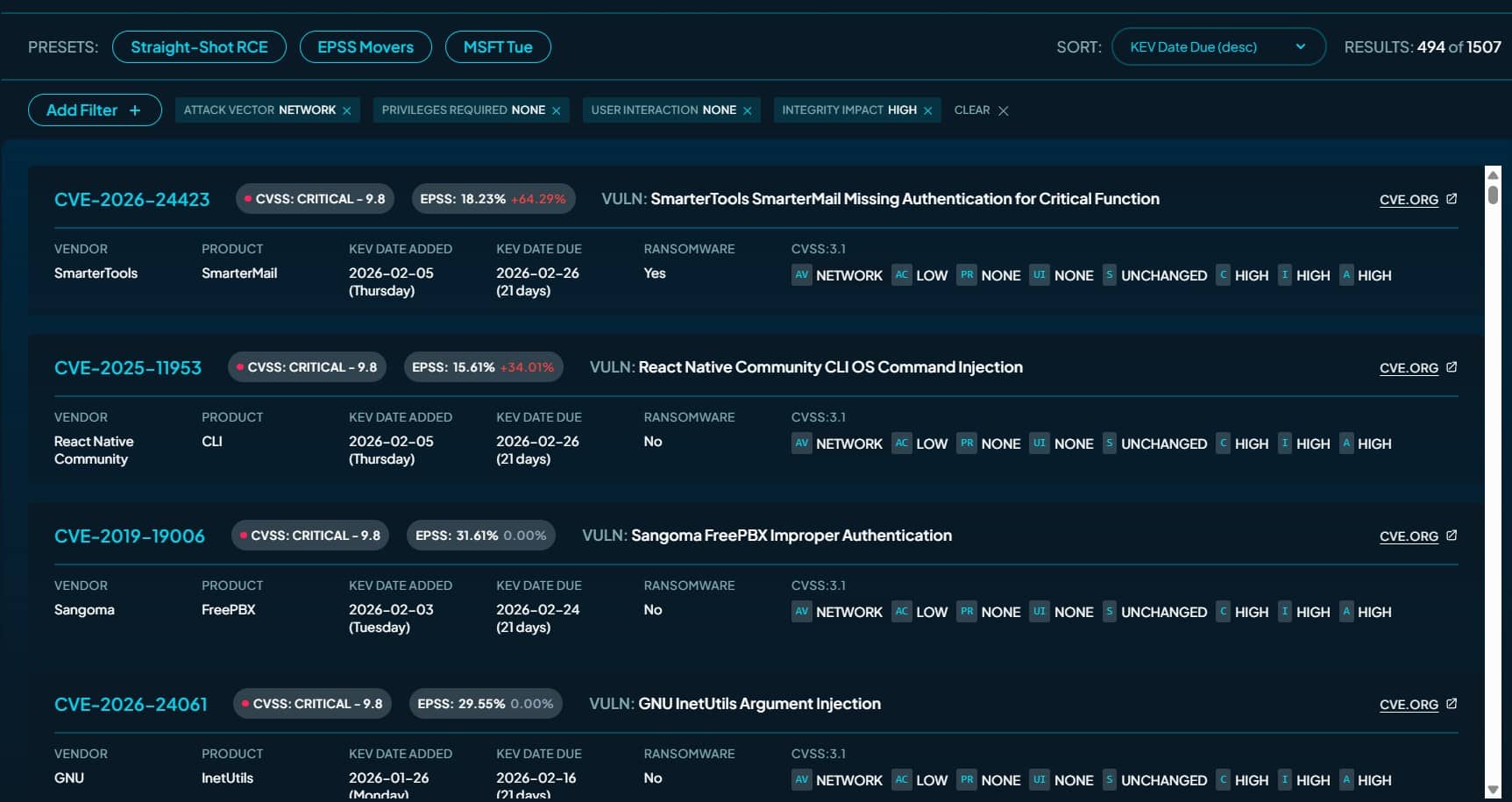
CISA KEV is not the only list of known exploited vulnerabilities, the paper said. Another is the VulnCheck KEV, which is three times bigger than CISA KEV. “It often adds vulnerabilities to its KEV in closer-to-real-time as exploitation evidence surfaces, sometimes beating the CISA KEV as first to publish exploitation notifications,” the paper said – and would also be an interesting place to apply the paper’s criteria. CISA KEV isn’t a list of the most severe vulnerabilities: “the vulnerabilities there are not all unauthenticated, remotely exploitable, initial intrusion vulnerabilities,” the paper said. Looking at just the last 12 vulnerabilities added to the KEV catalog in December, only four met the criteria for a “straight shot RCE bug.” Those criteria are:
  • Access Vector of “Network” (as opposed to “Adjacent,” “Local,” or “Physical”)
  • Privileges Required of “None” (as opposed to “Low” or “High”)
  • User Interaction of “None” (as opposed to “Required”)
  • Integrity Impact of “High” (as opposed to “None” or “Low”)
“These are the vulnerabilities that listen on an internet socket, don’t require a login, don’t require the victim to act, and the attacker ends up with total control over the affected system,” the paper said. Interestingly, the four straight-shot RCE vulnerabilities are all rated Critical, while the rest are rated High or Medium. Out of 1,488 KEV vulnerabilities as of January 14, 2026, only 483, or 32%, “are useful for immediate initial access,” the paper said. Using the Straight-Shot RCE filter in KEV Collider, 494 of 1,507 KEV vulnerabilities in the catalog as of Feb. 6 qualify, or 32.7 Looking at EPSS scores suggests that some of the vulnerabilities have a low probability of being exploited again in the future. There are 545 KEV vulnerabilities with very high EPSS scores – and 353 in the sub-10% category. Examining Metasploit Framework exploits, 464 KEV vulnerabilities were associated with at least one Metasploit module. “This means that just about a third of all KEVs are trivially exploitable today, as Metasploit modules are free, easy to use, and well-understood by attackers and defenders alike,” the paper said. There were 398 Nuclei templates “suitable for testing KEV vulnerabilities,” and 235 vulnerabilities with both Metasploit and Nuclei exploits. The paper also looked at the correlation of MITRE ATT&CK mappings with Metasploit and Nuclei exploit development and found that vulnerabilities associated with T1190 (Exploit Public-Facing Application) and T1059 (Command and Scripting Interpreter) “are more likely to attract the attention of public exploit developers.” Also read: CISA Silently Updates Vulnerabilities Exploited by Ransomware Groups

Perfect Vulnerability Coverage ‘Unrealistic’

The paper noted that “perfect vulnerability coverage is an increasingly unrealistic goal, particularly when organizations are constrained by finite tooling, staffing, or budget. This is even true when the focus is narrowed to merely the CISA KEV catalog.” “Many KEVs now affect assets that are difficult to inventory, difficult to scan, or difficult to patch using conventional enterprise tooling,” and can’t be covered by a single product. The paper’s goal is to help security practitioners “reason about uncertainty and prioritize effort when full coverage is unattainable. In practice, organizations must decide how to sequence remediation, where to apply detection and monitoring first, and when to escalate resource allocation to meet particularly aggressive deadlines.” All source JSON files used by the KEV Collider application are available in a public GitHub repository.

  •  

Attackers Used AI to Breach an AWS Environment in 8 Minutes

LLMs, AI, cyberattacks, access, identity, 1Password, Exabeam, LogRhythm, GenAI, censorship, model, RBAC, secure, Fortinet, SASE, Opal, access privileges, cloud security, GenAI, generative AI cloud compromise LLM

Threat actors using LLMs needed only eight minutes to move from initial access to full admin privileges in an attack on a company's AWS cloud environment in the latest example of cybercriminals expanding their use of AI in their operations, Sysdig researchers said.

The post Attackers Used AI to Breach an AWS Environment in 8 Minutes appeared first on Security Boulevard.

  •  

Microsoft Unveils LiteBox, a Rust-Based Approach to Secure Sandboxing

SlashNext vm2 sandbox bucket travel

Microsoft has released LiteBox, an experimental open-source library OS designed to sandbox applications while reducing their exposure to host systems. Written in Rust and published under the MIT license, LiteBox reflects the company’s efforts to upgrade software security as confidential computing gains adoption. LiteBox takes a different path from traditional virtualization or container technologies. Rather..

The post Microsoft Unveils LiteBox, a Rust-Based Approach to Secure Sandboxing appeared first on Security Boulevard.

  •  

Fraud Prevention Is a Latency Game

There is a time window for every act of online fraud. When a transaction occurs, a fraud system must review it and decide if it’s legitimate before the payment clears or if the account could be compromised. That window happens in a blink, often one-tenth of a second or less. During that time, models must..

The post Fraud Prevention Is a Latency Game appeared first on Security Boulevard.

  •  

The Cyber Express Weekly Roundup: Global Cybersecurity Incidents and Policy Shifts

TCE weekly roundup

As the first week of February 2026 concludes, The Cyber Express weekly roundup examines the developments shaping today’s global cybersecurity landscape. Over the past several days, governments, technology companies, and digital platforms have confronted a wave of cyber incidents ranging from disruptive attacks on public infrastructure to large-scale data exposures and intensifying regulatory scrutiny of artificial intelligence systems.  This week’s cybersecurity reporting reflects a broader pattern: rapid digital expansion continues to outpace security maturity. High-profile breaches, misconfigured cloud environments, and powerful AI tools are creating both defensive opportunities and significant new risks.  

The Cyber Express Weekly Roundup 

Cyberattack Disrupts Spain’s Ministry of Science Operations 

Spain’s Ministry of Science, Innovation, and Universities confirmed that a cyberattack forced a partial shutdown of its IT systems, disrupting digital services relied upon by researchers, universities, students, and businesses nationwide. Initially described as a technical incident, the disruption was later acknowledged as a cybersecurity event that required the temporary closure of the ministry’s electronic headquarters. Read more.. 

OpenAI Expands Controlled Access to Advanced Cyber Defense Models 

OpenAI announced the launch of Trusted Access for Cyber, a new initiative designed to strengthen defensive cybersecurity capabilities while limiting the potential misuse of highly capable AI systems. The program provides vetted security professionals with controlled access to advanced models such as GPT-5.3-Codex, which OpenAI identifies as its most cyber-capable reasoning model to date. Read more.. 

French Authorities Escalate Investigations Into X and Grok AI 

French police raided offices belonging to the social media platform X as European investigations expanded into alleged abuses involving its Grok AI chatbot. Authorities are examining claims that Grok generated nonconsensual sexual deepfakes, child sexual abuse material (CSAM), and content denying crimes against humanity, including Holocaust denial. Read more.. 

AI-Generated Platform Moltbook Exposes Millions of Credentials 

Security researchers disclosed that Moltbook, a viral social network built entirely using AI-generated code, exposed 1.5 million API authentication tokens, 35,000 user email addresses, and thousands of private messages due to a database misconfiguration. Wiz Security identified the issue after discovering an exposed Supabase API key embedded in client-side JavaScript, which granted unrestricted access to the platform’s production database. Read more.. 

Substack Discloses Breach Months After Initial Compromise 

Substack revealed that attackers accessed user email addresses, phone numbers, and internal metadata in October 2025, though the breach went undetected until February 3, 2026. CEO Chris Best notified affected users, stating, “I’m incredibly sorry this happened. We take our responsibility to protect your data and your privacy seriously, and we came up short here.” Read more.. 

Weekly Takeaway 

This Cyber Express weekly roundup highlights a clear takeaway for the global cybersecurity community: digital expansion without equivalent security investment increases organizational and systemic risk. AI-built platforms, advanced security tooling, and large-scale public-sector systems are being deployed rapidly, often without adequate access controls, monitoring, or testing. As recent incidents show, these gaps lead to data exposure, prolonged breach detection, and service disruption. To reduce risk, organizations must embed security controls, clear ownership, and continuous monitoring into system design and daily operations, rather than relying on post-incident fixes or policy statements.
  •  

Why Attackers no Longer Need to Break in: The Rise of Identity-Based Attacks 

decentralized identity, data, authentication, security, systhetic identity fraud, user management CyberArk identity authentication biometricsidentity AMaaS identity fraud authentication Stealthbits

In 2026 stolen credentials and unmanaged machine identities drive breaches—small buys, phone scams, and weak IAM make identity the real perimeter; prioritize inventory, least privilege, and stronger auth.

The post Why Attackers no Longer Need to Break in: The Rise of Identity-Based Attacks  appeared first on Security Boulevard.

  •  

Threat Group Running Espionage Operations Against Dozens of Governments

cyber ,espionage, asia,

Unit 42 researchers say an Asian threat group behind what they call the Shadow Campaigns has targeted government agencies in 37 countries in a wide-ranging global cyberespionage campaign that has involved phishing attacks and the exploitation of a more than a dozen known vulnerabilities.

The post Threat Group Running Espionage Operations Against Dozens of Governments appeared first on Security Boulevard.

  •  

Operant AI’s Agent Protector Aims to Secure Rising Tide of Autonomous AI

As the enterprise world shifts from chatbots to autonomous systems, Operant AI on Thursday launched Agent Protector, a real-time security solution designed to govern and shield artificial intelligence (AI) agents. The launch comes at a critical inflection point for corporate technology. Gartner predicts that by the end of 2026, 40% of enterprise applications will feature..

The post Operant AI’s Agent Protector Aims to Secure Rising Tide of Autonomous AI appeared first on Security Boulevard.

  •  

Asset Intelligence as Context Engineering for Cybersecurity Operations

Chief Enterprise Intelligence Officer

Action depends on truth. Truth is hard to come by. There’s an old trope: “You can’t protect what you can’t see.” This burning need for total visibility has led to an abundance of security data across every domain. But abundance doesn’t equal clarity. One tool says a device is patched, another says it’s vulnerable. HR..

The post Asset Intelligence as Context Engineering for Cybersecurity Operations appeared first on Security Boulevard.

  •  

IT Gives, Security Takes Away, and Configuration Drift Is the Hidden Cost

There’s an old joke in enterprise tech: IT giveth, and security taketh away. At its best, IT exists to empower people – to give employees faster, better, smarter tools to do their jobs. As we know no good deed goes unpunished, though, and security inevitably shows up afterward to clean up the risk created by..

The post IT Gives, Security Takes Away, and Configuration Drift Is the Hidden Cost appeared first on Security Boulevard.

  •  

The ‘Absolute Nightmare’ in Your DMs: OpenClaw Marries Extreme Utility with ‘Unacceptable’ Risk

AI, risk, IT/OT, security, catastrophic, cyber risk, catastrophe, AI risk managed detection and response

It is the artificial intelligence (AI) assistant that users love and security experts fear. OpenClaw, the agentic AI platform created by Peter Steinberger, is tearing through the tech world, promising a level of automation that legacy chatbots like ChatGPT can’t match. But as cloud giants rush to host it, industry analysts are issuing a blunt..

The post The ‘Absolute Nightmare’ in Your DMs: OpenClaw Marries Extreme Utility with ‘Unacceptable’ Risk appeared first on Security Boulevard.

  •  

When Documents Become the Attack Vector: Inside APT28’s Latest Microsoft Office Exploit

Email attachments remain one of the most trusted entry points into enterprise environments. Despite years of awareness training and secure email gateways, attackers continue to rely on documents because they blend seamlessly into everyday workflows. New reporting from The Hacker News details how APT28, a Russia-linked threat actor, is actively exploiting a newly disclosed Microsoft

The post When Documents Become the Attack Vector: Inside APT28’s Latest Microsoft Office Exploit appeared first on Seceon Inc.

The post When Documents Become the Attack Vector: Inside APT28’s Latest Microsoft Office Exploit appeared first on Security Boulevard.

  •  

CISA Silently Updates Vulnerabilities Exploited by Ransomware Groups

CISA Silently Updates Vulnerabilities Exploited by Ransomware Groups

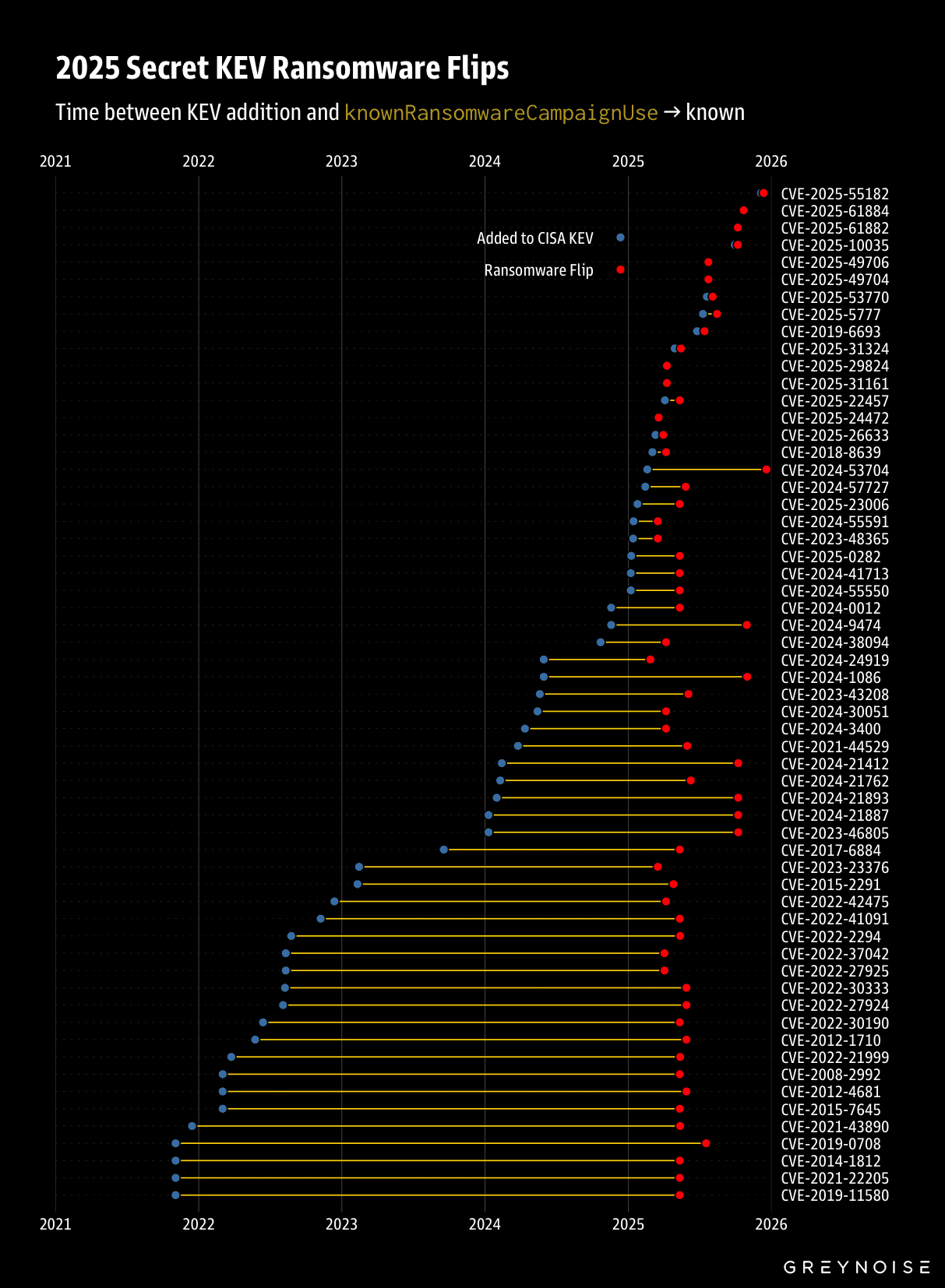
The U.S. Cybersecurity and Infrastructure Security Agency (CISA) has been “silently” updating its Known Exploited Vulnerabilities (KEV) catalog when it concludes that vulnerabilities have been exploited by ransomware groups, according to a security researcher. CISA adds a “known” or “unknown” field next to the “Known To Be Used in Ransomware Campaigns?” entry in its KEV catalog. The problem, according to a blog post by Glenn Thorpe of GreyNoise, is the agency doesn’t send out advisories when a vulnerability changes from “unknown” to “known” vulnerabilities exploited by ransomware groups. Thorpe downloaded daily CISA KEV snapshots for all of 2025 and found that the agency had flipped 59 vulnerabilities in 2025 from “unknown” to “known” evidence of exploitation by ransomware groups. “When that field flips from ‘Unknown’ to ‘Known,’ CISA is saying: ‘We have evidence that ransomware operators are now using this vulnerability in their campaigns,’" Thorpe wrote. “That's a material change in your risk posture. Your prioritization calculus should shift. But there's no alert, no announcement. Just a field change in a JSON file. This has always frustrated me.” In a statement shared with The Cyber Express, CISA Executive Assistant Director for Cybersecurity Nick Andersen suggested that the agency is considering Thorpe’s input. “We continue to streamline processes and enrich vulnerability data through initiatives like the KEV catalog, the Common Vulnerabilities and Exposures (CVE) Program, and Vulnrichment,” Andersen said. “Feedback from the cybersecurity community is essential as CISA works to enhance the KEV catalog and advance vulnerability prioritization across the ecosystem.”

Microsoft Leads in Vulnerabilities Exploited by Ransomware Groups

Of the 59 CVEs that flipped to “known” exploitation by ransomware groups last year, 27% were Microsoft vulnerabilities, Thorpe said. Just over a third (34%) involved edge and network CVEs, and 39% were for CVEs before 2023. And 41% of the flipped vulnerabilities occurred in a single month, May 2025. The “Fastest time-to-ransomware flip” was one day, while the longest lag between CISA KEV addition and the change to “known” ransomware exploitation status was 1,353 days. The “Most flipped vulnerability type” was Authentication Bypass at 14% of occurrences.

Ransomware Groups Target Edge Devices

Edge devices accounted for a high number of the flipped vulnerabiities, Thorpe said. Fortinet, Ivanti, Palo Alto and Check Point Security edge devices were among the flipped CVEs. “Ransomware operators are building playbooks around your perimeter,” he said. Thorpe said that 19 of the 59 flipped vulnerabilities “target network security appliances, the very devices deployed to protect organizations.” But he added: “Legacy bugs show up too; Adobe Reader vulnerabilities from years ago suddenly became ransomware-relevant.” Authentication bypasses and RCE vulnerabilities were the most common, “as ransomware operators prioritize ‘get in and go’ attack chains.” The breakdown by vendor of the 59 vulnerabilities “shouldn't surprise anyone,” he said. Microsoft was responsible for 16 of the flipped CVEs, affecting SharePoint, Print Spooler, Group Policy, Mark-of-the-Web bypasses, and more. Ivanti products were affected by 6 of the flipped CVEs, Fortinet by 5 (with FortiOS SSL-VPN heap overflows standing out), and Palo Alto Networks and Zimbra were each affected by 3 of the CVEs. “Ransomware operators are economic actors after all,” Thorpe said. “They invest in exploit development for platforms with high deployment and high-value access. Firewalls, VPN concentrators, and email servers fit that profile perfectly.” He also noted that the pace of vulnerability exploitation by ransomware groups accelerated in 2025. “Today, ransomware operators are integrating fresh exploits into their playbooks faster than defenders are patching,” he said. Thorpe created an RSS feed to track the flipped vulnerabilities; it’s updated hourly.
  •