Reading view

Patch Tuesday - February 2026

Microsoft is publishing 55 vulnerabilities this February 2026 Patch Tuesday. Microsoft is aware of exploitation in the wild for six of today’s vulnerabilities, and notes public disclosure for three of those. Earlier in the month, Microsoft provided patches to address three browser vulnerabilities, which are not included in the Patch Tuesday count above.

Windows/Office triple trouble: zero-day security feature bypass vulns

All three of the publicly disclosed zero-day vulnerabilities published today are security feature bypasses, and Microsoft acknowledges the same cast of reporters in each case.

CVE-2026-21510 describes a zero-day Windows Shell security feature bypass vulnerability which is already exploited in the wild. Not to be confused with PowerShell, most people will use the Windows Shell without ever learning its name or even really contemplating its existence. The Windows Shell is Microsoft’s term for the GUI interaction logic for the entire OS provided by explorer.exe and associated libraries and APIs.

CVE-2026-21510 provides an attacker with a way to dodge those pesky Smart Screen or other “are you sure?” prompts. The advisory sets out that “an attacker must convince a user to open a malicious link or shortcut file”. We could parse this wording more than one way, and while shortcut files with a .lnk extension are certainly a prime suspect here, it’s possible that .url files might also be a vector.

The venerable MSHTML/Trident web rendering engine is still present in Windows as a daily driver for Office and Explorer, many years after most people stopped using Internet Explorer.  Accordingly, every so often Microsoft has to patch another zero-day vulnerability in the browser it can’t quite bring itself to rip out of its flagship operating system. Today’s example is CVE-2026-21513, a security feature bypass which starts with the attacker convincing a user to open a malicious HTML file or shortcut file.

If good things come in threes, then perhaps CVE-2026-21514 makes security bypass zero-day vulnerabilities a good thing. Exploitation involves bypassing Object Linking & Embedding (OLE) mitigations by convincing the user to open a malicious Word document. The advisory only lists remediations for LTSC versions of Office and on-prem Microsoft 365 Apps for Enterprise, without mentioning the standard Microsoft 365 suite.

It’s curious that Microsoft has evaluated the attack vector for CVE-2026-21514 as local, because MSRC typically assesses any vulnerability which boils down to “remote attacker tricks user into opening malicious payload” as a remote attack, based on the location of the attacker. However, the advisory specifically calls out that “reliance on untrusted inputs in a security decision in Microsoft Office Word allows an unauthorized attacker to bypass a security feature locally.” It’s not clear whether this is a deviation from prior practice by MSRC, an inadvertent mis-assessment, or an unusual-but-correct assessment of an attack vector that relies on details which Microsoft has not made public. Happily, the Preview Pane is not a vector, which raises the bar slightly for an attacker, since the user must explicitly open the malicious file or web page.

Ultimately, although none of the advisories for CVE-2026-21510, CVE-2026-21513, or CVE-2026-21514 explicitly come out and say it, it’s likely that exploitation in each case involves tricking Windows into participating in another Mark-of the Web laundering scheme using flaws in old components.

Windows DWM: zero-day elevation of privilege

For the second month in a row, the Windows Desktop Windows Manager (DWM) is the site of an exploited-in-the-wild zero-day vulnerability. Last month’s CVE-2026-20805 was an information disclosure vulnerability, effectively a treasure map for threat actors seeking the otherwise obfuscated in-memory address of the kernel-space DWM process. The publication of zero-day elevation of privilege (EoP) vulnerability CVE-2026-21519 today very likely reflects MSTIC and MSRC working to thwart the same threat actor in both cases. As Rapid7 has noted in the past, initial access coupled with local elevation of privilege vulnerabilities is the staple diet of many successful attackers, so the lower CVSS v3 base score of 7.8 seen here versus a broadly equivalent remote code execution is not a sign to delay patching.

Remote Desktop Services: zero-day elevation of privilege

Remote Desktop Services (RDP) are designed to allow a duly authorized remote user to interact with the server, but CVE-2026-21533 allows an unauthorized local user to elevate privileges to SYSTEM. Every Windows Server product back as far as Server 2012 receives patches, so this one has been present for a while. It’s possible that today’s patches close off a long-running exploitation story for at least one threat actor.

RasMan: zero-day denial of service

Exploited in the wild, but perhaps of less concern is CVE-2026-21525, a local denial of service vulnerability in the Windows Remote Access Connection Manager (RasMan). Somewhat unusually for a local vulnerability, the advisory sets out that no privileges are required at all, so even a guest account can exploit this one. You have disabled those guest accounts, right?

Microsoft lifecycle update

There are no significant Microsoft product lifecycle changes this month.

Summary Charts
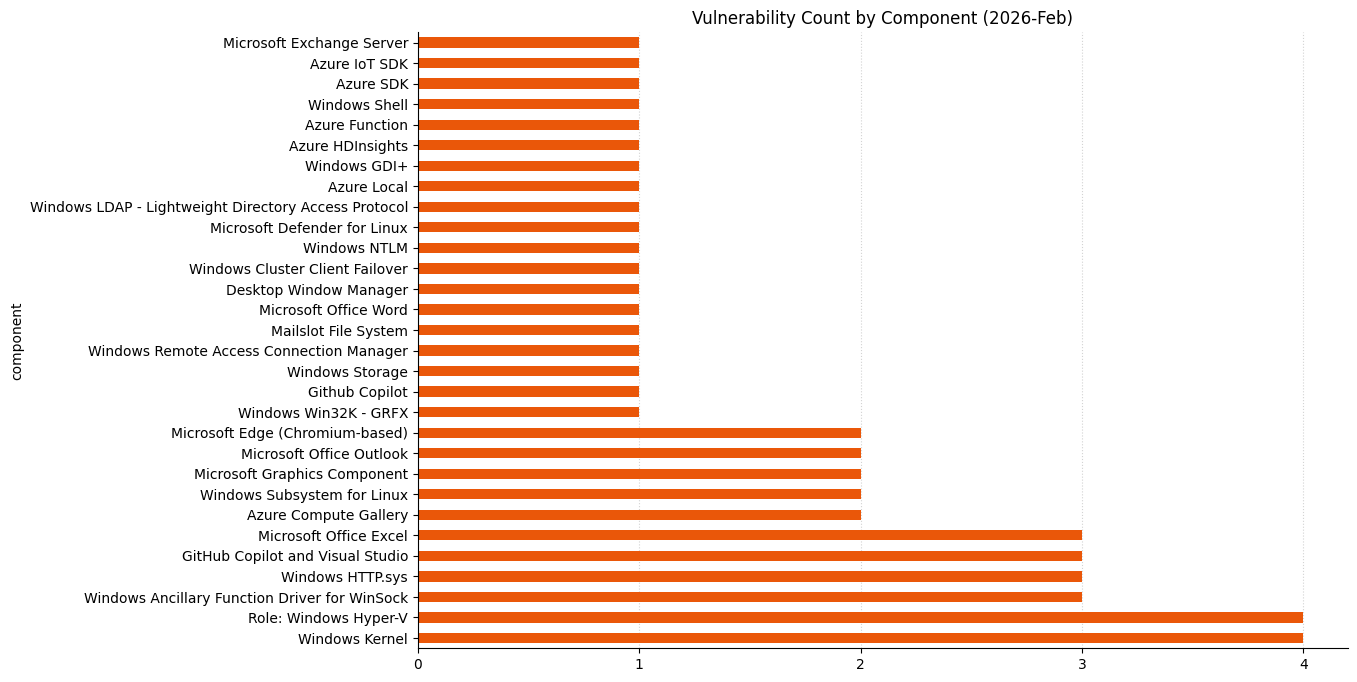
A bar chart showing vulnerability count by component for Microsoft Patch Tuesday 2026-Feb
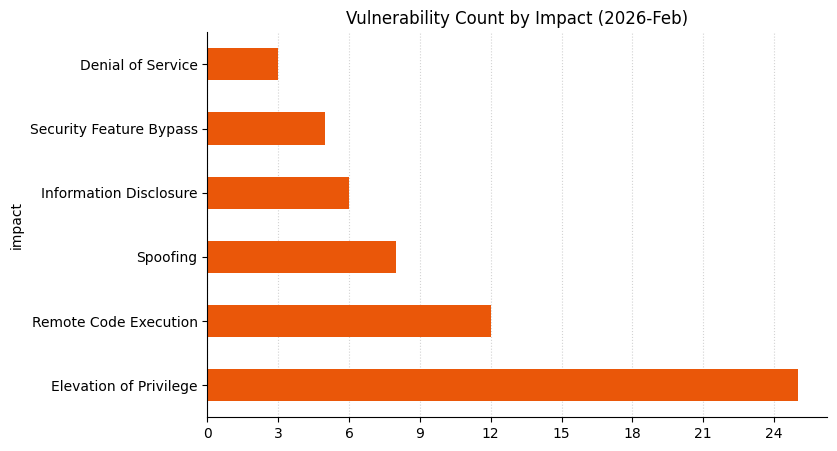
A bar chart showing vulnerability count by impact for Microsoft Patch Tuesday 2026-Feb
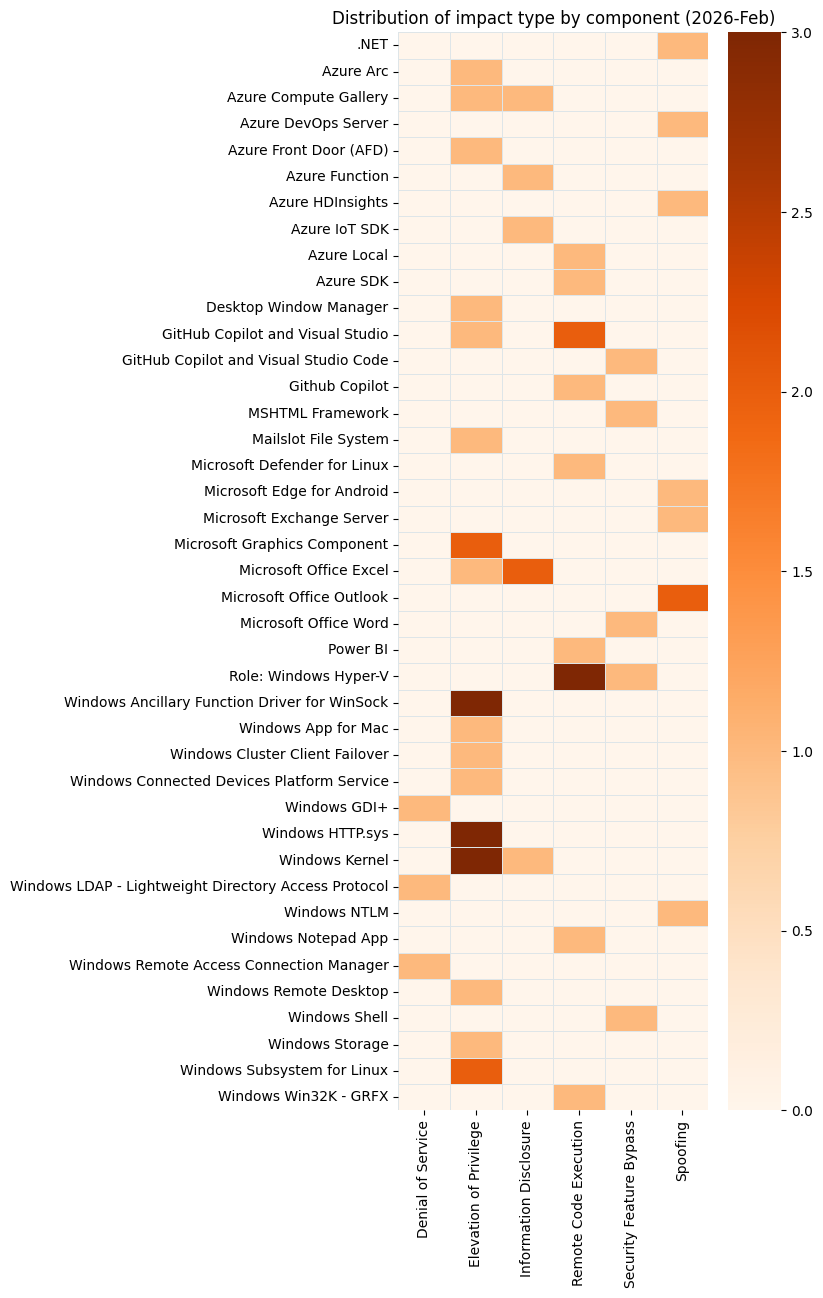
A bar chart showing distribution of impact type by component for Microsoft Patch Tuesday 2026-Feb

Summary Tables

Apps vulnerabilities

CVE

Title

Exploitation status

Publicly disclosed?

CVSS v3 base score

CVE-2026-20841

Windows Notepad App Remote Code Execution Vulnerability

Exploitation Less Likely

No

8.8

Azure vulnerabilities

CVE

Title

Exploitation status

Publicly disclosed?

CVSS v3 base score

CVE-2026-21512

Azure DevOps Server Cross-Site Scripting Vulnerability

Exploitation Less Likely

No

6.5

CVE-2026-21529

Azure HDInsight Spoofing Vulnerability

Exploitation Unlikely

No

5.7

CVE-2026-21528

Azure IoT Explorer Information Disclosure Vulnerability

Exploitation Unlikely

No

6.5

CVE-2026-21228

Azure Local Remote Code Execution Vulnerability

Exploitation Less Likely

No

8.1

CVE-2026-21531

Azure SDK for Python Remote Code Execution Vulnerability

Exploitation Less Likely

No

9.8

CVE-2026-21522

Microsoft ACI Confidential Containers Elevation of Privilege Vulnerability

Exploitation Less Likely

No

6.7

CVE-2026-23655

Microsoft ACI Confidential Containers Information Disclosure Vulnerability

Exploitation Less Likely

No

6.5

Developer Tools vulnerabilities

CVE

Title

Exploitation status

Publicly disclosed?

CVSS v3 base score

CVE-2026-21218

.NET Spoofing Vulnerability

Exploitation Unlikely

No

7.5

CVE-2026-21523

GitHub Copilot and Visual Studio Code Remote Code Execution Vulnerability

Exploitation Less Likely

No

8.0

CVE-2026-21518

GitHub Copilot and Visual Studio Code Security Feature Bypass Vulnerability

Exploitation Less Likely

No

6.5

CVE-2026-21257

GitHub Copilot and Visual Studio Elevation of Privilege Vulnerability

Exploitation Less Likely

No

8.0

CVE-2026-21256

GitHub Copilot and Visual Studio Remote Code Execution Vulnerability

Exploitation Less Likely

No

8.8

ESU vulnerabilities

CVE

Title

Exploitation status

Publicly disclosed?

CVSS v3 base score

CVE-2026-21519

Desktop Window Manager Elevation of Privilege Vulnerability

Exploitation Detected

No

7.8

CVE-2026-20846

GDI+ Denial of Service Vulnerability

Exploitation Less Likely

No

7.5

CVE-2026-21253

Mailslot File System Elevation of Privilege Vulnerability

Exploitation More Likely

No

7.0

CVE-2026-21527

Microsoft Exchange Server Spoofing Vulnerability

Exploitation Less Likely

No

6.5

CVE-2026-21513

MSHTML Framework Security Feature Bypass Vulnerability

Exploitation Detected

Yes

8.8

CVE-2026-21236

Windows Ancillary Function Driver for WinSock Elevation of Privilege Vulnerability

Exploitation Unlikely

No

7.8

CVE-2026-21238

Windows Ancillary Function Driver for WinSock Elevation of Privilege Vulnerability

Exploitation More Likely

No

7.8

CVE-2026-21234

Windows Connected Devices Platform Service Elevation of Privilege Vulnerability

Exploitation Unlikely

No

7.0

CVE-2026-21246

Windows Graphics Component Elevation of Privilege Vulnerability

Exploitation Unlikely

No

7.8

CVE-2026-21235

Windows Graphics Component Elevation of Privilege Vulnerability

Exploitation Less Likely

No

7.3

CVE-2026-21240

Windows HTTP.sys Elevation of Privilege Vulnerability

Exploitation Less Likely

No

7.8

CVE-2026-21248

Windows Hyper-V Remote Code Execution Vulnerability

Exploitation Less Likely

No

7.3

CVE-2026-21247

Windows Hyper-V Remote Code Execution Vulnerability

Exploitation Less Likely

No

7.3

CVE-2026-21244

Windows Hyper-V Remote Code Execution Vulnerability

Exploitation Less Likely

No

7.3

CVE-2026-21255

Windows Hyper-V Security Feature Bypass Vulnerability

Exploitation Less Likely

No

8.8

CVE-2026-21239

Windows Kernel Elevation of Privilege Vulnerability

Exploitation Less Likely

No

7.8

CVE-2026-21231

Windows Kernel Elevation of Privilege Vulnerability

Exploitation More Likely

No

7.8

CVE-2026-21222

Windows Kernel Information Disclosure Vulnerability

Exploitation Less Likely

No

5.5

CVE-2026-21249

Windows NTLM Spoofing Vulnerability

Exploitation Less Likely

No

3.3

CVE-2026-21525

Windows Remote Access Connection Manager Denial of Service Vulnerability

Exploitation Detected

No

6.2

CVE-2026-21533

Windows Remote Desktop Services Elevation of Privilege Vulnerability

Exploitation Detected

No

7.8

CVE-2026-21510

Windows Shell Security Feature Bypass Vulnerability

Exploitation Detected

Yes

8.8

CVE-2026-21508

Windows Storage Elevation of Privilege Vulnerability

Exploitation Less Likely

No

7.0

CVE-2026-21242

Windows Subsystem for Linux Elevation of Privilege Vulnerability

Exploitation Less Likely

No

7.0

CVE-2026-21237

Windows Subsystem for Linux Elevation of Privilege Vulnerability

Exploitation Less Likely

No

7.0

Microsoft Office vulnerabilities

CVE

Title

Exploitation status

Publicly disclosed?

CVSS v3 base score

CVE-2026-21259

Microsoft Excel Elevation of Privilege Vulnerability

Exploitation Less Likely

No

7.8

CVE-2026-21258

Microsoft Excel Information Disclosure Vulnerability

Exploitation Less Likely

No

5.5

CVE-2026-21261

Microsoft Excel Information Disclosure Vulnerability

Exploitation Less Likely

No

5.5

CVE-2026-21260

Microsoft Outlook Spoofing Vulnerability

Exploitation Unlikely

No

7.5

CVE-2026-21511

Microsoft Outlook Spoofing Vulnerability

Exploitation More Likely

No

7.5

CVE-2026-21514

Microsoft Word Security Feature Bypass Vulnerability

Exploitation Detected

Yes

7.8

Other vulnerabilities

CVE

Title

Exploitation status

Publicly disclosed?

CVSS v3 base score

CVE-2026-21516

GitHub Copilot for Jetbrains Remote Code Execution Vulnerability

Exploitation Less Likely

No

8.8

Server Software vulnerabilities

CVE

Title

Exploitation status

Publicly disclosed?

CVSS v3 base score

CVE-2026-21527

Microsoft Exchange Server Spoofing Vulnerability

Exploitation Less Likely

No

6.5

SQL Server vulnerabilities

CVE

Title

Exploitation status

Publicly disclosed?

CVSS v3 base score

CVE-2026-21229

Power BI Remote Code Execution Vulnerability

Exploitation Unlikely

No

8.0

System Center vulnerabilities

CVE

Title

Exploitation status

Publicly disclosed?

CVSS v3 base score

CVE-2026-21537

Microsoft Defender for Endpoint Linux Extension Remote Code Execution Vulnerability

Exploitation Less Likely

No

8.8

Windows vulnerabilities

CVE

Title

Exploitation status

Publicly disclosed?

CVSS v3 base score

CVE-2026-21251

Cluster Client Failover (CCF) Elevation of Privilege Vulnerability

Exploitation Unlikely

No

7.8

CVE-2026-21519

Desktop Window Manager Elevation of Privilege Vulnerability

Exploitation Detected

No

7.8

CVE-2026-20846

GDI+ Denial of Service Vulnerability

Exploitation Less Likely

No

7.5

CVE-2026-21253

Mailslot File System Elevation of Privilege Vulnerability

Exploitation More Likely

No

7.0

CVE-2026-21513

MSHTML Framework Security Feature Bypass Vulnerability

Exploitation Detected

Yes

8.8

CVE-2023-2804

Red Hat, Inc. CVE-2023-2804: Heap Based Overflow libjpeg-turbo

Exploitation Less Likely

No

6.5

CVE-2026-21236

Windows Ancillary Function Driver for WinSock Elevation of Privilege Vulnerability

Exploitation Unlikely

No

7.8

CVE-2026-21241

Windows Ancillary Function Driver for WinSock Elevation of Privilege Vulnerability

Exploitation More Likely

No

7.0

CVE-2026-21238

Windows Ancillary Function Driver for WinSock Elevation of Privilege Vulnerability

Exploitation More Likely

No

7.8

CVE-2026-21517

Windows App for Mac Installer Elevation of Privilege Vulnerability

Exploitation Less Likely

No

7.0

CVE-2026-21234

Windows Connected Devices Platform Service Elevation of Privilege Vulnerability

Exploitation Unlikely

No

7.0

CVE-2026-21246

Windows Graphics Component Elevation of Privilege Vulnerability

Exploitation Unlikely

No

7.8

CVE-2026-21235

Windows Graphics Component Elevation of Privilege Vulnerability

Exploitation Less Likely

No

7.3

CVE-2026-21250

Windows HTTP.sys Elevation of Privilege Vulnerability

Exploitation Unlikely

No

7.8

CVE-2026-21240

Windows HTTP.sys Elevation of Privilege Vulnerability

Exploitation Less Likely

No

7.8

CVE-2026-21232

Windows HTTP.sys Elevation of Privilege Vulnerability

Exploitation Less Likely

No

7.8

CVE-2026-21248

Windows Hyper-V Remote Code Execution Vulnerability

Exploitation Less Likely

No

7.3

CVE-2026-21247

Windows Hyper-V Remote Code Execution Vulnerability

Exploitation Less Likely

No

7.3

CVE-2026-21244

Windows Hyper-V Remote Code Execution Vulnerability

Exploitation Less Likely

No

7.3

CVE-2026-21255

Windows Hyper-V Security Feature Bypass Vulnerability

Exploitation Less Likely

No

8.8

CVE-2026-21245

Windows Kernel Elevation of Privilege Vulnerability

Exploitation Less Likely

No

7.8

CVE-2026-21239

Windows Kernel Elevation of Privilege Vulnerability

Exploitation Less Likely

No

7.8

CVE-2026-21231

Windows Kernel Elevation of Privilege Vulnerability

Exploitation More Likely

No

7.8

CVE-2026-21222

Windows Kernel Information Disclosure Vulnerability

Exploitation Less Likely

No

5.5

CVE-2026-21243

Windows Lightweight Directory Access Protocol (LDAP) Denial of Service Vulnerability

Exploitation Unlikely

No

7.5

CVE-2026-21249

Windows NTLM Spoofing Vulnerability

Exploitation Less Likely

No

3.3

CVE-2026-21525

Windows Remote Access Connection Manager Denial of Service Vulnerability

Exploitation Detected

No

6.2

CVE-2026-21533

Windows Remote Desktop Services Elevation of Privilege Vulnerability

Exploitation Detected

No

7.8

CVE-2026-21510

Windows Shell Security Feature Bypass Vulnerability

Exploitation Detected

Yes

8.8

CVE-2026-21508

Windows Storage Elevation of Privilege Vulnerability

Exploitation Less Likely

No

7.0

CVE-2026-21242

Windows Subsystem for Linux Elevation of Privilege Vulnerability

Exploitation Less Likely

No

7.0

CVE-2026-21237

Windows Subsystem for Linux Elevation of Privilege Vulnerability

Exploitation Less Likely

No

7.0

Zero-Day Vulnerabilities: Known Exploited

CVE

Title

Exploitation status

Publicly disclosed?

CVSS v3 base score

CVE-2026-21519

Desktop Window Manager Elevation of Privilege Vulnerability

Exploitation Detected

No

7.8

CVE-2026-21514

Microsoft Word Security Feature Bypass Vulnerability

Exploitation Detected

Yes

7.8

CVE-2026-21513

MSHTML Framework Security Feature Bypass Vulnerability

Exploitation Detected

Yes

8.8

CVE-2026-21525

Windows Remote Access Connection Manager Denial of Service Vulnerability

Exploitation Detected

No

6.2

CVE-2026-21533

Windows Remote Desktop Services Elevation of Privilege Vulnerability

Exploitation Detected

No

7.8

CVE-2026-21510

Windows Shell Security Feature Bypass Vulnerability

Exploitation Detected

Yes

8.8

Critical Remote Code Execution/Elevation of Privilege

CVE

Title

Exploitation status

Publicly disclosed?

CVSS v3 base score

CVE-2026-21531

Azure SDK for Python Remote Code Execution Vulnerability

Exploitation Less Likely

No

9.8

  •  

Patch Tuesday and the Enduring Challenge of Windows’ Backwards Compatibility

Introduction

If you received an email with the subject “I LOVE YOU” and an attachment called “LOVE-LETTER-FOR-YOU.TXT”, would you open it? Probably not, but back in the year 2000, plenty of people did exactly that. The internet learned a hard lesson about the disproportionate power available to a university dropout with some VBScript skills, and millions of ordinary people suffered the anguish of deleted family photos or even reputational damage as the worm propagated itself across their entire Outlook address book.

In the quarter century since ILOVEYOU rampaged across global networks, cybersecurity has moved from a niche topic to an “everyone” problem, and many users are wary of all sorts of threats. In recent years, the increasing ubiquity and urgency of AI adoption across the business landscape has attracted the attention of both security researchers and threat actors.

Of course, recency bias and shiny object fixation are real. Even as AI and automation continue to drive down time to known exploitation (TTKE), an attacker who abuses a traditional exploit chain to achieve SYSTEM privileges on a sensitive server still has the keys to the kingdom.

Wormable remote code execution (RCE) vulnerabilities remain rare, but well over half of the 25 exploited-in-the-wild zero-day vulnerabilities published by Microsoft during 2025 provided attackers with elevation of privilege opportunities on Windows assets. Some of those flaws are older than the iPhone, let alone ChatGPT.

Microsoft's decades-long commitment to backwards compatibility creates a conveyor belt supply of déjà vu vulnerabilities. Ultimately, the most pressing threats faced by defenders managing Microsoft estates remain essentially unchanged. Rather than a new wave of AI-related flaws, the chief danger stems from the towering tech debt within core Windows components.

A whirlwind tour of exploited-in-the-wild Microsoft vulnerabilities (2025 edition)

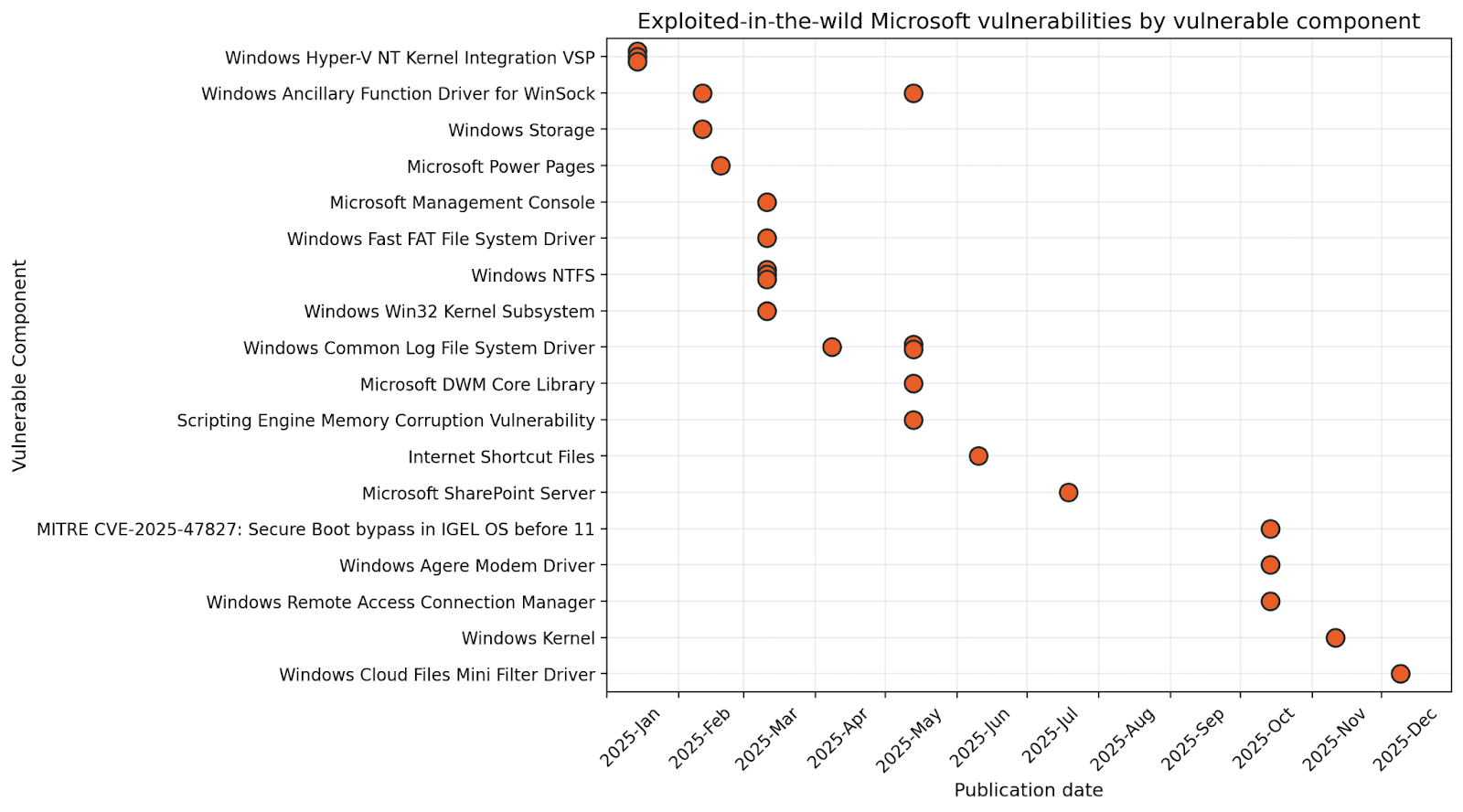
If we really want to know which Microsoft vulnerabilities will provide the most value to attackers in 2026, we should ask a threat actor. Since that might prove difficult to arrange, we’ll do the next best thing: review vulnerabilities exploited in the wild during 2025.

Chart-exploited-in-the-wild-eitw-microsoft-by-vulnerable-component-rapid7.png
Chart 1: Exploited-in-the-wild Microsoft vulnerabilities, by vulnerable component

January: The great escape

The vast Microsoft ecosystem has something for everyone, whether customer or threat actor. Patch Tuesday January 2025 brought us a trio of exploited-in-the-wild Hyper-V kernel vulnerabilities. By September 2025, at least one plausible public proof-of-concept (PoC) for CVE-2025-21333 was published by a vulnerability researcher who apparently shares a name with a Kazakhstani Olympic gymnast. The only safe assumption is that a well-resourced threat actor could develop a private exploit far in advance of that.

Starting from a child VM or Windows Sandbox, exploitation first requires setting out a banquet of benign requests for the hypervisor, delivered via the Hyper-V Virtualization Service Provider (VSP). The goal: mass-allocating objects to arrange large swathes of hypervisor memory in a predictable pattern (aka “heap feng shui”). Next, the attacker sends a malicious request with an oversized buffer, which an unpatched VSP merrily copies into kernel memory, overwriting the header of the adjacent object, whose relative position is now easily surmised. Once the kernel subsequently references the artfully corrupted sibling object, execution as SYSTEM jumps to a portion of memory where the attacker has planted shellcode to exfiltrate a token. The compromised hypervisor could be anything from a developer laptop running a malicious container all the way up to enterprise private cloud infrastructure.

So far, January 2025 is the only time that Microsoft has ever published vulnerabilities in the Hyper-V VSP. Generally speaking, a significant degree of sophistication is required to develop successful exploits of this nature. This goes double if the name of the game is stealth and stability, since a wave of unexplained BSOD events on critical production infrastructure tends to attract blue team attention. Still, once a viable proof of concept hits the public internet, ransomware crews will fold it into their toolkits, and someone, somewhere, is either sitting on an unknown Hyper-V VSP exploit, or hard at work creating the next one.

February: Socket to me

It’s hard to imagine a modern computer without storage or networking capabilities. In fact, it’s hard to imagine a computer from several decades ago without storage or networking. Microsoft is now middle-aged, and that means that buried deep within your shiny new PC are a variety of architectural decisions and logic paths born in the 1980s. If this sounds far-fetched, take a minute to find yourself a fully-patched Windows 11 25H2 machine, and then try to rename any file or directory CON, NUL or PRN. I’ll wait.

Generally speaking, user-mode applications are prevented from wreaking havoc on the kernel through a careful separation of concerns. On Windows, when a user mode application wants to communicate over the network, it talks to WinSock, which in turn talks to the ancillary function driver (AFD), which sits on the kernel side, and coordinates with the kernel network drivers which handle the actual traffic. The AFD is a security boundary between user space and kernel space, and it must be universally accessible to local processes, because even a browser tab in a sandbox needs to make network calls. Any defect in the way AFD parses input from user space can thus provide a way to influence the kernel in unexpected ways. A number of advanced exploit development courses, including offerings from SANS and OffSec, cover AFD in detail.

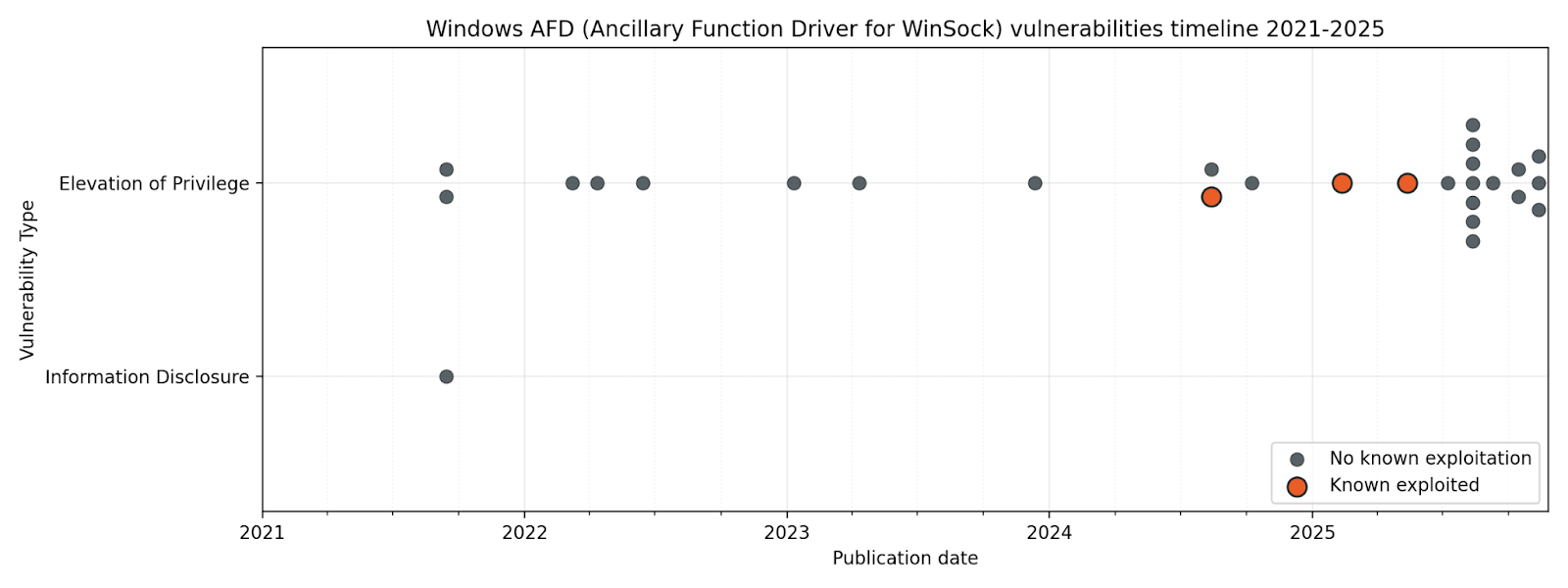
chart-Windows-AFD-vulnerabilities-timeline-rapid7.png
Chart 2: Windows AFD vulnerabilities timeline, 2021-2025

Patch Tuesday February 2025 brought us CVE-2025-21418, which Microsoft credited to Anonymous. We don’t know whether the unnamed tipster provided evidence of exploitation in the wild, or whether Microsoft threat hunters subsequently tracked down their own trail of suspicious bread crumbs, but notorious threat actors such as North Korea’s Lazarus are known to be enthusiastic students of AFD exploits. With several high-profile zero-day vulnerabilities emerging from AFD from late 2024 onwards, it tracks that Microsoft subsequently published and patched a cluster of AFD vulnerabilities in the latter half of 2025.

March: File system shenanigans

Any defenders who had enjoyed a quieter start to the year were rudely awakened by Patch Tuesday March 2025, when six exploited-in-the-wild vulnerabilities all dropped at once. Exploitation of most of the zero-day vulnerabilities published in March starts with the user mounting a malicious Virtual Hard Disk (VHD) image or plugging in a malicious USB stick so that the attacker can exploit a weakness in a filesystem driver, including NTFS and FastFAT.

Remember that information security training which asked you to imagine finding a USB stick with an “IMPORTANT (CONFIDENTIAL)” label on the floor outside the office? The one which asked if you would A) plug the mystery stick into your work PC B) use your boss’ personal laptop in case the files are business critical C) try it in all the PCs in the office until someone asks you to stop or D) report it immediately to the security officer? This is why.

Meanwhile, the true villain of the month was almost certainly CVE-2025-24983, a no-user-interaction-required elevation of privilege vulnerability in the Win32 kernel subsystem. At the time, we pondered why Windows 11 and Server 2019 onwards didn’t receive patches for what looks like a fairly severe vulnerability, but since Microsoft is gradually reimplementing portions of the kernel in memory-safe Rust, we can hope that the vulnerability simply doesn’t exist in modern Windows.

April: Common Log File System driver vulns are quite common

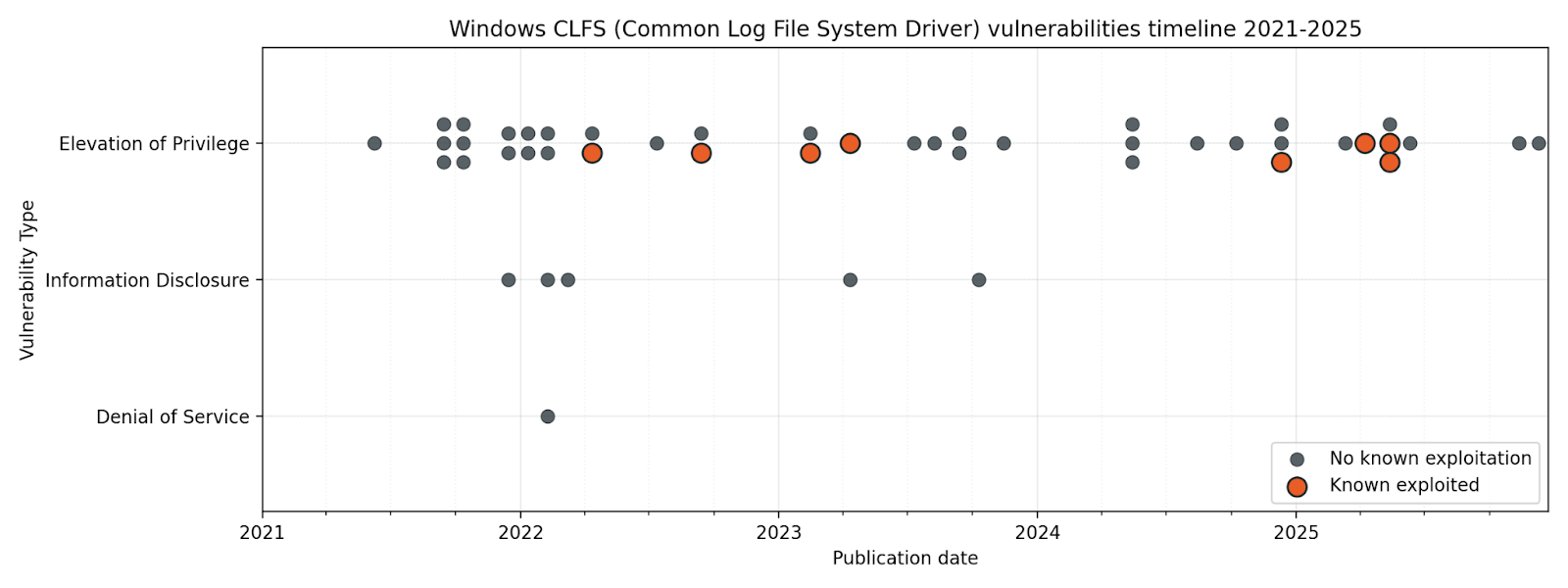
If anyone ever corners you at a party and talks at length about the Ancillary Function Driver as a bounteous source of elevation of privilege vulnerabilities, you will probably have to concede that they are technically correct. While your options include “doing a lap” and then climbing out of the bathroom window, the power move here is to hold your ground, and point to the Common Log File System driver as a far richer vein of exploitable goodness.

As of Patch Tuesday April 2025, CLFS boasts almost twice the number of total vulnerabilities over the past five years vs. AFD, and more than double the number of known-exploited zero-day vulnerabilities. It really is the gift which keeps on giving.

chart-windows-CLFS-vulnerabilities-timeline-rapid7.png
Windows CLFS vulnerabilities timeline, 2021-2025

It makes sense that something like the Ancillary Function Driver lives in kernel space. After all, something has to sit inside the perimeter to marshall all those network requests from dozens of Chrome tabs. What about the Common Log File System driver though?

It would be tempting to imagine that anything which simply handles log files shouldn’t need direct kernel access at all. When exploring this concept, it’s useful to understand that not only was CLFS designed a long time ago, when high performance in user mode was harder to achieve than it is today, but also that CLFS is much more than simply a means to interact with log files. CLFS is the home of still-essential building blocks like Transactional NTFS (TxF), first introduced almost 25 years ago in Windows Vista, which provides a means for applications to guarantee the integrity of data on disk.

For the past several years, Microsoft has strongly recommended that developers avoid the use of TxF, and while Microsoft is gradually providing modern alternatives to TxF functionality, essential Windows functions such as Windows Update still rely on it to manage critical file integrity. Moreover, CLFS is more than just TxF, and is so tightly integrated into Windows that it’s here to stay for the foreseeable future.

May: The month of expectation, wishes, hope, and classic Windows zero-days [1]

A few days after Patch Tuesday May 2025, Satya Nadella took to the stage at Microsoft Build 2025 to pitch his vision of the open agentic web, although exactly who this version of the future would be open to remains an open question, like: What if a cloud email service was vulnerable to a zero-click prompt injection attack, but could also now buy things with your credit card?

While critical reception for the open agentic web has been mixed, threat actors will be glad of the new attack surface. Meanwhile, defenders worried about in-the-wild exploitation were hard at work patching some more frequent fliers, including another pair of CLFS vulnerabilities and an MSHTML/Trident arbitrary code execution bug. That last one will be familiar to regular Patch Tuesday watchers, but it might come as a surprise to anyone who thought Internet Explorer had gone to live on a nice farm upstate years ago.

The Ancillary Function Driver made another appearance, although it couldn’t quite summon the same main character energy this time around. The May 2025 episode of “AFD vulns exploited in the wild” offered elevation to Administrator, rather than SYSTEM, and a lower exploit code maturity rating. We can always be grateful for small mercies.

[1]: With apologies to Emily Brontë.

June: I’m afraid I can’t let you do that, WebDAV

Windows archeologists and internet users of a certain age may remember WebDAV, a standard originally dreamed up to support interactivity on the web. It was employed by versions of Microsoft Exchange up to and including 2010 to handle interactions with mailboxes and public folders.

Surprising no-one, Windows still more or less supports WebDAV, and it was only a matter of time before that turned out to be a bit of a problem, in the form of CVE-2025-33053 published as part of Patch Tuesday June 2025. Microsoft acknowledged Check Point Research (CPR) on the advisory; CPR in turn attributes exploitation to an APT (Advanced Persistent Threat), which they track as the objectively cool-sounding Stealth Falcon, an established threat actor with a long-running interest in governments and government-adjacent entities across the Middle East and beyond.

June 2025 also saw the publication of CVE-2025-32711, a critical information disclosure vulnerability in Microsoft 365 Copilot. Microsoft is not aware of exploitation in the wild. The researchers named it EchoLeak, describing it as “the first real-world zero-click prompt injection exploit in a production LLM system,” although other researchers arguably got there first.

EchoLeak relies on hidden white-text-on-white-background instructions in an email, which are then ingested into the LLM via RAG (Retrieval-Augmented Generation) when the user asks an entirely pedestrian question (e.g. “Summarize my emails from the past two days”) which requires Copilot to scan the inbox. The malicious instructions have two parts: First, dig up some juicy info, and then retrieve an image from an attacker-controlled server with the sensitive data exfiltrated as a URL parameter.

EchoLeak circumvented Copilot’s Content Security Policy by making the request via a trusted Microsoft service: a now-patched Teams image preview proxy. History suggests that attackers will find other ways out of the walled garden. The Microsoft advisory makes a virtue of minimalism by providing almost no information about the nature of the vulnerability, although Microsoft is surely to be commended for assigning CVEs for cloud service vulnerabilities.

July: The call is coming from inside the intranet

When Patch Tuesday July 2025 came and went without a single exploited-in-the-wild vulnerability published, many people may have breathed a sigh of relief. Possibly this was a valid move, at least for anyone not responsible for a SharePoint instance.

SharePoint defenders will remember July as the month of ToolShell, an actively-exploited vulnerability chain in SharePoint which Microsoft published out of band ten days after Patch Tuesday. Out of band patches for Microsoft flagship products are rare, since they inevitably cause downstream disruption. Once MSTIC publicly attributes exploitation to two Chinese nation-state actors, that line has been crossed.

The vulnerability described by the out-of-band CVE-2025-53770 turned out to be a bypass for the patch introduced by CVE-2025-49704 earlier in the month, which was itself a response to a successful Pwn2Own Berlin entry from May.

August: It’s almost too quiet

Microsoft was not aware of exploitation in the wild for any of the vulnerabilities published as part of Patch Tuesday August 2025. SharePoint admins may have been dealing with the fallout from last month’s ToolShell and bracing for a possible repeat, but August might otherwise have made for an eerily quiet month. Still, the Windows implementation of Kerberos managed to cough up a publicly-disclosed elevate-to-domain-admin vulnerability.

Separately, we learned that simply saving a JPEG could be enough to hand an attacker RCE capabilities, because the internet never sleeps. If the vulnerable codepath had been within JPEG decoding, rather than encoding, this one could have been the biggest vuln of the year.

September: Almost too quiet, part 2

Patch Tuesday September 2025 was the second month in a row with no known-exploited vulnerabilities, but vuln spotters will appreciate that this month saw the publication of a fairly rare beast: a Microsoft vulnerability with a perfect(?) CVSS v3 base score of 10.0, albeit a cloud service vulnerability discovered by Microsoft and patched prior to publication. No customer action required, but also no customer verification possible, and since the impacted cloud service was Azure Networking, the blast radius could have been stupendous.

October: Dial M for exploitation

These days, there are plenty of seasoned IT professionals who don’t even know what a dialup modem negotiation song sounds like, simply because broadband has been around for that long. For younger readers, “broadband” is what we used to call “internet fast enough that you don’t have to wait to download a single email attachment”.

By this point, we all know where this is going: Windows still ships with modem capabilities well beyond their sell-by date, and someone found a good old elevation of privilege vulnerability. The vulnerable fax modem driver was developed almost 30 years ago by a long-defunct third party, and Microsoft has now taken uncharacteristically bold action by removing it from Windows altogether, perhaps recognizing that traditional landlines are no longer available at all in many places. Are there other fax modem drivers still lurking in Windows? You betcha.

Patch Tuesday October 2025 also marked the end of Windows 10, unless you count the cash-for-patches Extended Security Updates (ESU) program.

November: Kernel vuln? Popcorn time

Patch Tuesday November 2025 included an exploited-in-the-wild vulnerability in the Windows kernel itself. While the advisory was light with details, exploitation of CVE-2025-62215 led to elevation to SYSTEM, presumably via a complex bit of memory management three card monte. Those kernel Rust rewrites can’t come soon enough.

December: A cloud of suspicion

After a year filled with variations of the same old exploitable vulns, it might almost be refreshing to consider the altogether more modern-sounding exploited-in-the-wild vulnerability published on Patch Tuesday December 2025. CVE-2025-62221 describes an elevation of privilege vulnerability in the Windows Cloud Files Mini Filter Driver.

On Windows, a file or directory can contain a reparse point, a collection of user-controlled metadata designed to be interpreted by a file filter driver. An example would be a file which appears present in a local folder, but where the actual contents of the file are stored remotely on OneDrive. The user double-clicks on the file, the file filter driver intercepts the request, reads the metadata, and calls out to OneDrive, while the user gets the experience of opening the file as though it had been stored locally. Of course, the file filter driver needs kernel access to perform its duties. Find an exploitable flaw in the way a file filter driver parses the metadata, and you can trick it into doing things like overwriting protected system files.

What’s next?

Everything gets faster, including bad things

As Rapid7 has observed repeatedly, time to known exploitation for widely-exploited vulnerabilities has been shrinking year-on-year. By 2022, the time to exploitation after public disclosure for some of the most notable security vulnerabilities was as low as 24 hours. With exploit development now widely augmented by automation and AI, there is every reason to suppose that the window will continue to shrink further.

Threat actors will stay best friends with elevation of privilege vulns

A wormable unauthenticated RCE vulnerability remains the scariest scenario, but mercifully these are historically rare. The one-two combo of minimally-privileged initial access and local privilege escalation presents a much more clear and present danger in most modern threat models. Sure, you could parachute in from a helicopter, abseil down from the roof, and crawl through an air vent to steal the diamond, but why bother when you could simply tailgate a delivery driver, and then distract a maintenance worker while you swipe their all-access keycard?

AI is here to stay, but tech debt is the real killer

In 2026, Microsoft will regularly publish AI-related vulnerabilities, and AI-wielding threat actors will hammer Microsoft’s cloud services. Blue teams managing significant Windows estates will still spend more time worrying about on-prem vulnerabilities where the root cause is a classic software engineering snafu.

Final thoughts

Arguably the biggest takeaway from 2025 is that the more things change, the more they stay the same. The scariest Microsoft vulnerabilities tend to emerge from the same few familiar places: core Windows components with codebases older than many of the humans who rely on them.

Microsoft’s wildly successful business model is founded on a decades-long insistence on ironclad backwards compatibility. Why? Enterprise customers with deep pockets and deeper catalogues of ancient business applications. These retro capabilities come at a high price: a supervolcano of tech debt potentially unmatched in all of human history, and a seemingly endless supply of sort-of-new but depressingly familiar vulnerabilities.

For anyone responsible for defending a significant Microsoft footprint in 2026, tomorrow’s biggest problem remains today’s secrets exposed by yesterday’s software design choices.

  •  

Patch Tuesday - January 2026

Microsoft is publishing 114 vulnerabilities this January 2026 Patch Tuesday. Today’s menu includes just one vulnerability marked as exploited in the wild, as well as two vulnerabilities where Microsoft is aware of public disclosure. There are no critical remote code execution or elevation of privilege vulnerabilities. So far this month, Microsoft has already provided patches to address one browser vulnerability and around a dozen vulnerabilities in open source products, which are not included in the Patch Tuesday count above.

Windows DWM: exploited-in-the-wild information disclosure

The Windows Desktop Windows Manager (DWM) is a high value target for vulnerability researchers and threat actors, and CVE-2026-20805 is the latest in an occasional series of exploited-in-the-wild zero-day vulnerabilities to have emerged from it. DWM is responsible for drawing everything on the display of a Windows system, which means it offers an enticing combination of privileged access and universal availability, since just about any process might need to display something. In this case, exploitation leads to improper disclosure of an ALPC port section address, which is a section of user mode memory where Windows components coordinate various actions between themselves.

The CVSS v3 score of 5.5 evaluates to medium severity, which wouldn’t typically scream “patch me first”, but Microsoft evaluates CVE-2026-20805 as important on their proprietary severity scale, and information disclosure vulnerabilities by their very nature tend to end up with lower CVSS scores, since there’s no direct impact on integrity or availability. Also, Microsoft information disclosure vulnerabilities very rarely end up marked as exploited in the wild; any that do are very likely to be part of a longer exploit chain. In this case, it’s likely that the improperly disclosed memory address gives an attacker a starting point in the hunt for the in-memory address of the DWM process, sidestepping Address Space Layout Randomization (ASLR), and greatly increasing the chance of developing a stable elevation of privilege exploit for DWM rather than a flakey blue screen of death generator.

Windows Agere modem driver: publicly disclosed elevation of privilege

Back in October 2025, Microsoft removed a specific modem driver ltmdm64.sys from all versions of Windows, after it was implicated in CVE-2025-24052, an exploited-in-the-wild elevation of privilege vulnerability. Today sees another couple of modem drivers removed from Windows for a broadly similar reason: Microsoft is aware of functional exploit code for an elevation of privilege vulnerability in a very similar modem driver, tracked as CVE-2023-31096. That’s not a typo; this vulnerability was originally published via MITRE over two years ago, along with a credible public writeup by the original researcher. Today’s Windows patches remove agrsm64.sys and agrsm.sys. All three modem drivers were originally developed by the same now-defunct third party, and have been included in Windows for decades. These driver removals will pass unnoticed for most people, but you might find active modems still in a few contexts, including some industrial control systems.

Two questions remain: how many more legacy modem drivers are still present on a fully-patched Windows asset, and how many more elevation-to-SYSTEM vulnerabilities will emerge from them before Microsoft cuts off attackers who have been enjoying living off the land[line] by exploiting an entire class of dusty old device drivers? Although Microsoft doesn’t claim evidence of exploitation for CVE-2023-31096, the relevant 2023 write-up and the 2025 removal of the other Agere modem driver have provided two strong signals for anyone looking for Windows exploits in the meantime. In case you were wondering, there is no need to have a modem connected; the mere presence of the driver is enough to render an asset vulnerable.

Secure Boot: critical security feature bypass

Today sees the publication of CVE-2026-21265, which is a critical security feature bypass vulnerability affecting Windows Secure Boot. Fifteen years is a very long time indeed in information security, but the clock is running out on the Microsoft root certificates which have been signing essentially everything in the Secure Boot ecosystem since the days of Stuxnet. Microsoft issued replacement certificates back in 2023, alongside CVE-2023-24932 which covered relevant Windows patches as well as subsequent steps to remediate the Secure Boot bypass exploited by the BlackLotus bootkit.

Once the ancient 2011 certificates expire later this year, Windows devices that do not have the new 2023 certificates can no longer receive Secure Boot security fixes. When updating the bootloader and BIOS, it is essential to prepare fully ahead of time for the specific OS and BIOS combination you’re working with, since incorrect remediation steps can lead to an unbootable system.

Microsoft lifecycle update

Visual Studio 2022 LTSC 17.10 reaches end of support today, so now is a good time to upgrade to a newer minor version. Dynamics CRM 2016 (also known as Dynamics 365) also reaches end of life. There are no other significant Microsoft product lifecycle changes this month.

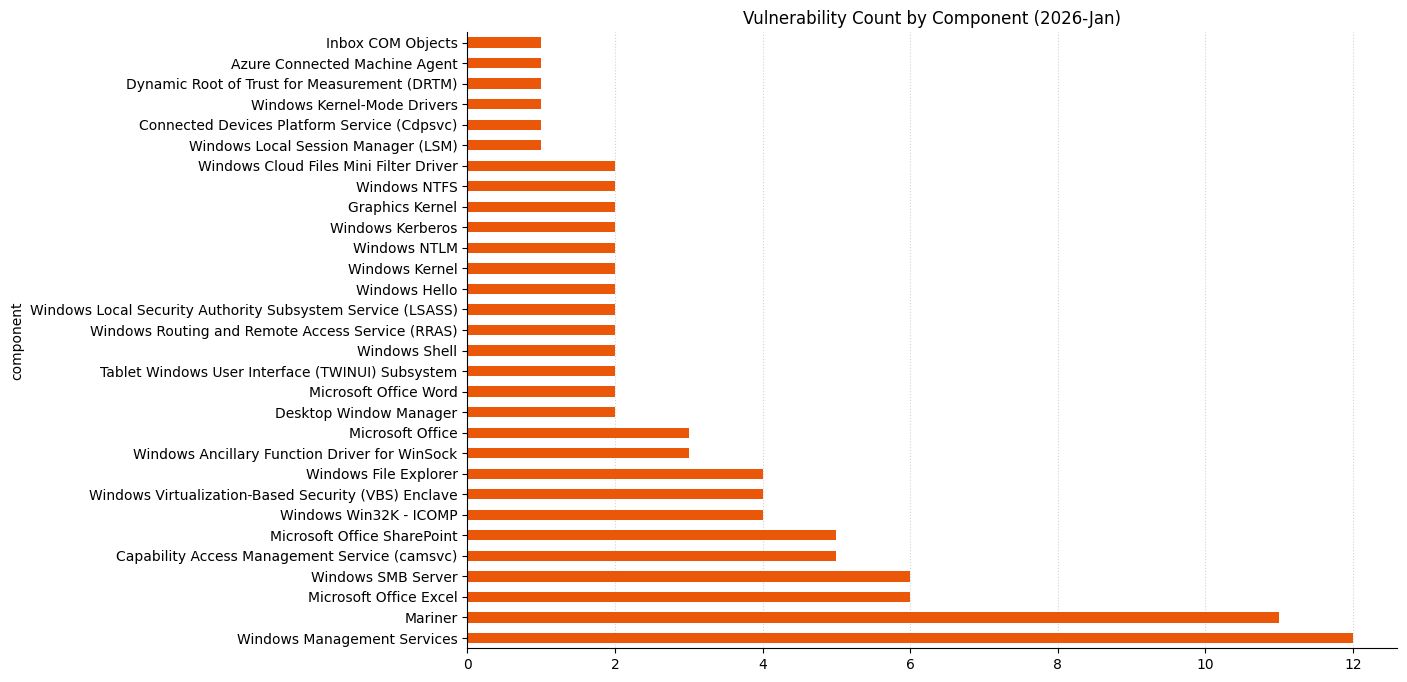
A bar chart showing vulnerability count by component for Microsoft Patch Tuesday 2026-Jan
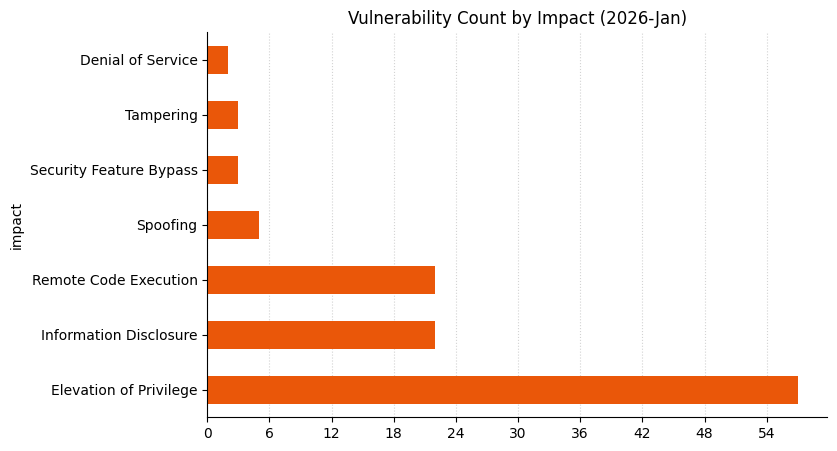
A bar chart showing vulnerability count by impact for Microsoft Patch Tuesday 2026-Jan
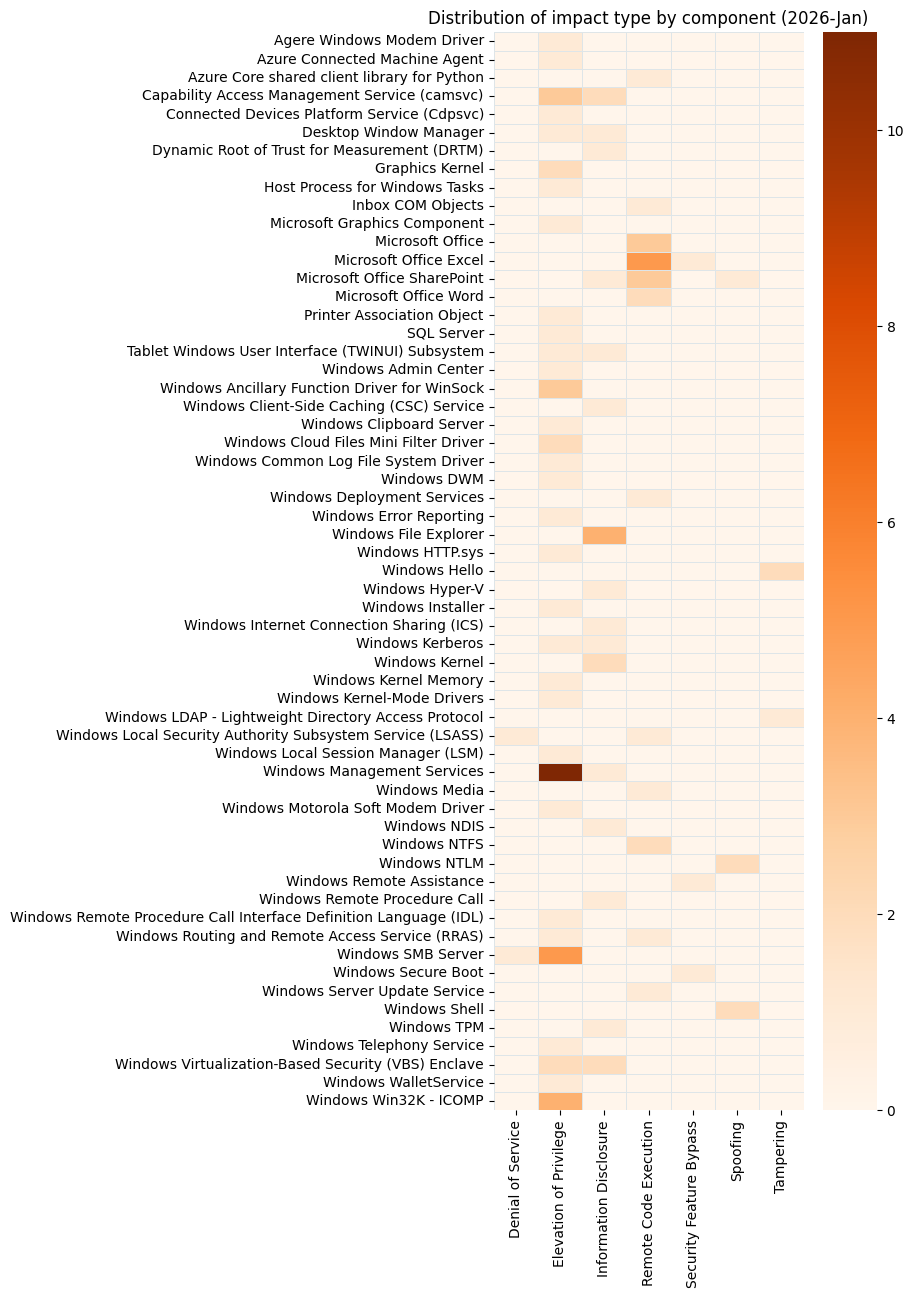
A bar chart showing distribution of impact type by component for Microsoft Patch Tuesday 2026-Jan

Vulnerabilities by Product Family

Azure vulnerabilities

CVE

Title

Exploitation status

Publicly disclosed?

CVSS v3 base score

CVE-2026-21224

Azure Connected Machine Agent Elevation of Privilege Vulnerability

Exploitation Less Likely

No

7.8

CVE-2026-21226

Azure Core shared client library for Python Remote Code Execution Vulnerability

Exploitation Less Likely

No

7.5

CVE-2026-20965

Windows Admin Center Elevation of Privilege Vulnerability

Exploitation Less Likely

No

7.5

Developer Tools vulnerabilities

CVE

Title

Exploitation status

Publicly disclosed?

CVSS v3 base score

CVE-2026-21219

Inbox COM Objects (Global Memory) Remote Code Execution Vulnerability

Exploitation Unlikely

No

7.0

ESU vulnerabilities

CVE

Title

Exploitation status

Publicly disclosed?

CVSS v3 base score

CVE-2026-20805

Desktop Window Manager Information Disclosure Vulnerability

Exploitation Detected

No

5.5

CVE-2026-20847

Microsoft Windows File Explorer Spoofing Vulnerability

Exploitation Unlikely

No

6.5

CVE-2023-31096

MITRE: CVE-2023-31096 Windows Agere Soft Modem Driver Elevation of Privilege Vulnerability

Exploitation More Likely

Yes

7.8

CVE-2026-20925

NTLM Hash Disclosure Spoofing Vulnerability

Exploitation Less Likely

No

6.5

CVE-2026-20872

NTLM Hash Disclosure Spoofing Vulnerability

Exploitation Less Likely

No

6.5

CVE-2026-20821

Remote Procedure Call Information Disclosure Vulnerability

Exploitation Unlikely

No

6.2

CVE-2026-21265

Secure Boot Certificate Expiration Security Feature Bypass Vulnerability

Exploitation Less Likely

Yes

6.4

CVE-2026-20831

Windows Ancillary Function Driver for WinSock Elevation of Privilege Vulnerability

Exploitation Less Likely

No

7.8

CVE-2026-20860

Windows Ancillary Function Driver for WinSock Elevation of Privilege Vulnerability

Exploitation More Likely

No

7.8

CVE-2026-20839

Windows Client-Side Caching (CSC) Service Information Disclosure Vulnerability

Exploitation Unlikely

No

5.5

CVE-2026-20940

Windows Cloud Files Mini Filter Driver Elevation of Privilege Vulnerability

Exploitation Unlikely

No

7.8

CVE-2026-20820

Windows Common Log File System Driver Elevation of Privilege Vulnerability

Exploitation More Likely

No

7.8

CVE-2026-0386

Windows Deployment Services Remote Code Execution Vulnerability

Exploitation Unlikely

No

7.5

CVE-2026-20929

Windows HTTP.sys Elevation of Privilege Vulnerability

Exploitation Unlikely

No

7.5

CVE-2026-20816

Windows Installer Elevation of Privilege Vulnerability

Exploitation More Likely

No

7.8

CVE-2026-20849

Windows Kerberos Elevation of Privilege Vulnerability

Exploitation Unlikely

No

7.5

CVE-2026-20833

Windows Kerberos Information Disclosure Vulnerability

Exploitation Less Likely

No

5.5

CVE-2026-20809

Windows Kernel Memory Elevation of Privilege Vulnerability

Exploitation Less Likely

No

7.8

CVE-2026-20875

Windows Local Security Authority Subsystem Service (LSASS) Denial of Service Vulnerability

Exploitation Less Likely

No

7.5

CVE-2026-20869

Windows Local Session Manager (LSM) Elevation of Privilege Vulnerability

Exploitation Less Likely

No

7.0

CVE-2024-55414

Windows Motorola Soft Modem Driver Elevation of Privilege Vulnerability

Exploitation Unlikely

No

7.8

CVE-2026-20936

Windows NDIS Information Disclosure Vulnerability

Exploitation Unlikely

No

4.3

CVE-2026-20840

Windows NTFS Remote Code Execution Vulnerability

Exploitation More Likely

No

7.8

CVE-2026-20922

Windows NTFS Remote Code Execution Vulnerability

Exploitation More Likely

No

7.8

CVE-2026-20824

Windows Remote Assistance Security Feature Bypass Vulnerability

Exploitation Less Likely

No

5.5

CVE-2026-20828

Windows rndismp6.sys Information Disclosure Vulnerability

Exploitation Less Likely

No

4.6

CVE-2026-20843

Windows Routing and Remote Access Service (RRAS) Elevation of Privilege Vulnerability

Exploitation More Likely

No

7.8

CVE-2026-20868

Windows Routing and Remote Access Service (RRAS) Remote Code Execution Vulnerability

Exploitation Less Likely

No

8.8

CVE-2026-20856

Windows Server Update Service (WSUS) Remote Code Execution Vulnerability

Exploitation Less Likely

No

8.1

CVE-2026-20927

Windows SMB Server Denial of Service Vulnerability

Exploitation Unlikely

No

5.3

CVE-2026-20919

Windows SMB Server Elevation of Privilege Vulnerability

Exploitation Unlikely

No

7.5

CVE-2026-20921

Windows SMB Server Elevation of Privilege Vulnerability

Exploitation Unlikely

No

7.5

CVE-2026-20926

Windows SMB Server Elevation of Privilege Vulnerability

Exploitation Unlikely

No

7.5

CVE-2026-20934

Windows SMB Server Elevation of Privilege Vulnerability

Exploitation Unlikely

No

7.5

CVE-2026-20848

Windows SMB Server Elevation of Privilege Vulnerability

Exploitation Unlikely

No

7.5

CVE-2026-20834

Windows Spoofing Vulnerability

Exploitation Less Likely

No

4.6

CVE-2026-20931

Windows Telephony Service Elevation of Privilege Vulnerability

Exploitation Unlikely

No

8.0

Microsoft Office vulnerabilities

CVE

Title

Exploitation status

Publicly disclosed?

CVSS v3 base score

CVE-2026-20946

Microsoft Excel Remote Code Execution Vulnerability

Exploitation Less Likely

No

7.8

CVE-2026-20955

Microsoft Excel Remote Code Execution Vulnerability

Exploitation Less Likely

No

7.8

CVE-2026-20956

Microsoft Excel Remote Code Execution Vulnerability

Exploitation Less Likely

No

7.8

CVE-2026-20950

Microsoft Excel Remote Code Execution Vulnerability

Exploitation Less Likely

No

7.8

CVE-2026-20957

Microsoft Excel Remote Code Execution Vulnerability

Exploitation Less Likely

No

7.8

CVE-2026-20949

Microsoft Excel Security Feature Bypass Vulnerability

Exploitation Less Likely

No

7.8

CVE-2026-20943

Microsoft Office Click-To-Run Elevation of Privilege Vulnerability

Exploitation Less Likely

No

7.0

CVE-2026-20953

Microsoft Office Remote Code Execution Vulnerability

Exploitation Less Likely

No

8.4

CVE-2026-20952

Microsoft Office Remote Code Execution Vulnerability

Exploitation Less Likely

No

8.4

CVE-2026-20958

Microsoft SharePoint Information Disclosure Vulnerability

Exploitation Less Likely

No

5.4

CVE-2026-20963

Microsoft SharePoint Remote Code Execution Vulnerability

Exploitation Less Likely

No

8.8

CVE-2026-20951

Microsoft SharePoint Server Remote Code Execution Vulnerability

Exploitation Less Likely

No

7.8

CVE-2026-20947

Microsoft SharePoint Server Remote Code Execution Vulnerability

Exploitation Unlikely

No

8.8

CVE-2026-20959

Microsoft SharePoint Server Spoofing Vulnerability

Exploitation Less Likely

No

4.6

CVE-2026-20944

Microsoft Word Remote Code Execution Vulnerability

Exploitation Less Likely

No

8.4

CVE-2026-20948

Microsoft Word Remote Code Execution Vulnerability

Exploitation Less Likely

No

7.8

SQL Server vulnerabilities

CVE

Title

Exploitation status

Publicly disclosed?

CVSS v3 base score

CVE-2026-20803

Microsoft SQL Server Elevation of Privilege Vulnerability

Exploitation Less Likely

No

7.2

Windows vulnerabilities

CVE

Title

Exploitation status

Publicly disclosed?

CVSS v3 base score

CVE-2026-20815

Capability Access Management Service (camsvc) Elevation of Privilege Vulnerability

Exploitation Less Likely

No

7.0

CVE-2026-20830

Capability Access Management Service (camsvc) Elevation of Privilege Vulnerability

Exploitation Unlikely

No

7.0

CVE-2026-21221

Capability Access Management Service (camsvc) Elevation of Privilege Vulnerability

Exploitation Unlikely

No

7.0

CVE-2026-20835

Capability Access Management Service (camsvc) Information Disclosure Vulnerability

Exploitation Less Likely

No

5.5

CVE-2026-20851

Capability Access Management Service (camsvc) Information Disclosure Vulnerability

Exploitation Less Likely

No

6.2

CVE-2026-20805

Desktop Window Manager Information Disclosure Vulnerability

Exploitation Detected

No

5.5

CVE-2026-20871

Desktop Windows Manager Elevation of Privilege Vulnerability

Exploitation More Likely

No

7.8

CVE-2026-20814

DirectX Graphics Kernel Elevation of Privilege Vulnerability

Exploitation Less Likely

No

7.0

CVE-2026-20836

DirectX Graphics Kernel Elevation of Privilege Vulnerability

Exploitation Less Likely

No

7.0

CVE-2026-20962

Dynamic Root of Trust for Measurement (DRTM) Information Disclosure Vulnerability

Exploitation Less Likely

No

4.4

CVE-2026-20941

Host Process for Windows Tasks Elevation of Privilege Vulnerability

Exploitation Less Likely

No

7.8

CVE-2026-20812

LDAP Tampering Vulnerability

Exploitation Less Likely

No

6.5

CVE-2026-20842

Microsoft DWM Core Library Elevation of Privilege Vulnerability

Exploitation Less Likely

No

7.0

CVE-2026-20847

Microsoft Windows File Explorer Spoofing Vulnerability

Exploitation Unlikely

No

6.5

CVE-2023-31096

MITRE: CVE-2023-31096 Windows Agere Soft Modem Driver Elevation of Privilege Vulnerability

Exploitation More Likely

Yes

7.8

CVE-2026-20925

NTLM Hash Disclosure Spoofing Vulnerability

Exploitation Less Likely

No

6.5

CVE-2026-20872

NTLM Hash Disclosure Spoofing Vulnerability

Exploitation Less Likely

No

6.5

CVE-2026-20821

Remote Procedure Call Information Disclosure Vulnerability

Exploitation Unlikely

No

6.2

CVE-2026-21265

Secure Boot Certificate Expiration Security Feature Bypass Vulnerability

Exploitation Less Likely

Yes

6.4

CVE-2026-20826

Tablet Windows User Interface (TWINUI) Subsystem Information Disclosure Vulnerability

Exploitation Less Likely

No

7.8

CVE-2026-20827

Tablet Windows User Interface (TWINUI) Subsystem Information Disclosure Vulnerability

Exploitation Unlikely

No

5.5

CVE-2026-20829

TPM Trustlet Information Disclosure Vulnerability

Exploitation Less Likely

No

5.5

CVE-2026-20811

Win32k Elevation of Privilege Vulnerability

Exploitation Less Likely

No

7.8

CVE-2026-20920

Win32k Elevation of Privilege Vulnerability

Exploitation Unlikely

No

7.8

CVE-2026-20863

Win32k Elevation of Privilege Vulnerability

Exploitation Less Likely

No

7.0

CVE-2026-20810

Windows Ancillary Function Driver for WinSock Elevation of Privilege Vulnerability

Exploitation Less Likely

No

7.8

CVE-2026-20831

Windows Ancillary Function Driver for WinSock Elevation of Privilege Vulnerability

Exploitation Less Likely

No

7.8

CVE-2026-20860

Windows Ancillary Function Driver for WinSock Elevation of Privilege Vulnerability

Exploitation More Likely

No

7.8

CVE-2026-20839

Windows Client-Side Caching (CSC) Service Information Disclosure Vulnerability

Exploitation Unlikely

No

5.5

CVE-2026-20844

Windows Clipboard Server Elevation of Privilege Vulnerability

Exploitation Less Likely

No

7.4

CVE-2026-20857

Windows Cloud Files Mini Filter Driver Elevation of Privilege Vulnerability

Exploitation Unlikely

No

7.8

CVE-2026-20940

Windows Cloud Files Mini Filter Driver Elevation of Privilege Vulnerability

Exploitation Unlikely

No

7.8

CVE-2026-20820

Windows Common Log File System Driver Elevation of Privilege Vulnerability

Exploitation More Likely

No

7.8

CVE-2026-20864

Windows Connected Devices Platform Service Elevation of Privilege Vulnerability

Exploitation Unlikely

No

7.8

CVE-2026-0386

Windows Deployment Services Remote Code Execution Vulnerability

Exploitation Unlikely

No

7.5

CVE-2026-20817

Windows Error Reporting Service Elevation of Privilege Vulnerability

Exploitation More Likely

No

7.8

CVE-2026-20808

Windows File Explorer Elevation of Privilege Vulnerability

Exploitation Less Likely

No

7.0

CVE-2026-20823

Windows File Explorer Information Disclosure Vulnerability

Exploitation Unlikely

No

5.5

CVE-2026-20932

Windows File Explorer Information Disclosure Vulnerability

Exploitation Unlikely

No

5.5

CVE-2026-20937

Windows File Explorer Information Disclosure Vulnerability

Exploitation Unlikely

No

5.5

CVE-2026-20939

Windows File Explorer Information Disclosure Vulnerability

Exploitation Unlikely

No

5.5

CVE-2026-20822

Windows Graphics Component Elevation of Privilege Vulnerability

Exploitation Less Likely

No

7.8

CVE-2026-20804

Windows Hello Tampering Vulnerability

Exploitation Unlikely

No

7.7

CVE-2026-20852

Windows Hello Tampering Vulnerability

Exploitation Less Likely

No

7.7

CVE-2026-20929

Windows HTTP.sys Elevation of Privilege Vulnerability

Exploitation Unlikely

No

7.5

CVE-2026-20825

Windows Hyper-V Information Disclosure Vulnerability

Exploitation Less Likely

No

4.4

CVE-2026-20816

Windows Installer Elevation of Privilege Vulnerability

Exploitation More Likely

No

7.8

CVE-2026-20849

Windows Kerberos Elevation of Privilege Vulnerability

Exploitation Unlikely

No

7.5

CVE-2026-20833

Windows Kerberos Information Disclosure Vulnerability

Exploitation Less Likely

No

5.5

CVE-2026-20818

Windows Kernel Information Disclosure Vulnerability

Exploitation Unlikely

No

6.2

CVE-2026-20838

Windows Kernel Information Disclosure Vulnerability

Exploitation Less Likely

No

5.5

CVE-2026-20809

Windows Kernel Memory Elevation of Privilege Vulnerability

Exploitation Less Likely

No

7.8

CVE-2026-20859

Windows Kernel-Mode Driver Elevation of Privilege Vulnerability

Exploitation Less Likely

No

7.8

CVE-2026-20875

Windows Local Security Authority Subsystem Service (LSASS) Denial of Service Vulnerability

Exploitation Less Likely

No

7.5

CVE-2026-20854

Windows Local Security Authority Subsystem Service (LSASS) Remote Code Execution Vulnerability

Exploitation Less Likely

No

7.5

CVE-2026-20869

Windows Local Session Manager (LSM) Elevation of Privilege Vulnerability

Exploitation Less Likely

No

7.0

CVE-2026-20858

Windows Management Services Elevation of Privilege Vulnerability

Exploitation Less Likely

No

7.8

CVE-2026-20865

Windows Management Services Elevation of Privilege Vulnerability

Exploitation Less Likely

No

7.8

CVE-2026-20877

Windows Management Services Elevation of Privilege Vulnerability

Exploitation Less Likely

No

7.8

CVE-2026-20918

Windows Management Services Elevation of Privilege Vulnerability

Exploitation Unlikely

No

7.8

CVE-2026-20923

Windows Management Services Elevation of Privilege Vulnerability

Exploitation Less Likely

No

7.8

CVE-2026-20924

Windows Management Services Elevation of Privilege Vulnerability

Exploitation Less Likely

No

7.8

CVE-2026-20861

Windows Management Services Elevation of Privilege Vulnerability

Exploitation Less Likely

No

7.8

CVE-2026-20866

Windows Management Services Elevation of Privilege Vulnerability

Exploitation Less Likely

No

7.8

CVE-2026-20867

Windows Management Services Elevation of Privilege Vulnerability

Exploitation Unlikely

No

7.8

CVE-2026-20873

Windows Management Services Elevation of Privilege Vulnerability

Exploitation Less Likely

No

7.8

CVE-2026-20874

Windows Management Services Elevation of Privilege Vulnerability

Exploitation Less Likely

No

7.8

CVE-2026-20862

Windows Management Services Information Disclosure Vulnerability

Exploitation Unlikely

No

5.5

CVE-2026-20837

Windows Media Remote Code Execution Vulnerability

Exploitation Less Likely

No

7.8

CVE-2024-55414

Windows Motorola Soft Modem Driver Elevation of Privilege Vulnerability

Exploitation Unlikely

No

7.8

CVE-2026-20936

Windows NDIS Information Disclosure Vulnerability

Exploitation Unlikely

No

4.3

CVE-2026-20840

Windows NTFS Remote Code Execution Vulnerability

Exploitation More Likely

No

7.8

CVE-2026-20922

Windows NTFS Remote Code Execution Vulnerability

Exploitation More Likely

No

7.8

CVE-2026-20824

Windows Remote Assistance Security Feature Bypass Vulnerability

Exploitation Less Likely

No

5.5

CVE-2026-20832

Windows Remote Procedure Call Interface Definition Language (IDL) Elevation of Privilege Vulnerability

Exploitation Less Likely

No

7.8

CVE-2026-20828

Windows rndismp6.sys Information Disclosure Vulnerability

Exploitation Less Likely

No

4.6

CVE-2026-20843

Windows Routing and Remote Access Service (RRAS) Elevation of Privilege Vulnerability

Exploitation More Likely

No

7.8

CVE-2026-20868

Windows Routing and Remote Access Service (RRAS) Remote Code Execution Vulnerability

Exploitation Less Likely

No

8.8

CVE-2026-20856

Windows Server Update Service (WSUS) Remote Code Execution Vulnerability

Exploitation Less Likely

No

8.1

CVE-2026-20927

Windows SMB Server Denial of Service Vulnerability

Exploitation Unlikely

No

5.3

CVE-2026-20919

Windows SMB Server Elevation of Privilege Vulnerability

Exploitation Unlikely

No

7.5

CVE-2026-20921

Windows SMB Server Elevation of Privilege Vulnerability

Exploitation Unlikely

No

7.5

CVE-2026-20926

Windows SMB Server Elevation of Privilege Vulnerability

Exploitation Unlikely

No

7.5

CVE-2026-20934

Windows SMB Server Elevation of Privilege Vulnerability

Exploitation Unlikely

No

7.5

CVE-2026-20848

Windows SMB Server Elevation of Privilege Vulnerability

Exploitation Unlikely

No

7.5

CVE-2026-20834

Windows Spoofing Vulnerability

Exploitation Less Likely

No

4.6

CVE-2026-20931

Windows Telephony Service Elevation of Privilege Vulnerability

Exploitation Unlikely

No

8.0

CVE-2026-20876

Windows Virtualization-Based Security (VBS) Enclave Elevation of Privilege Vulnerability

Exploitation Less Likely

No

6.7

CVE-2026-20938

Windows Virtualization-Based Security (VBS) Enclave Elevation of Privilege Vulnerability

Exploitation Less Likely

No

7.8

CVE-2026-20819

Windows Virtualization-Based Security (VBS) Information Disclosure Vulnerability

Exploitation Less Likely

No

5.5

CVE-2026-20935

Windows Virtualization-Based Security (VBS) Information Disclosure Vulnerability

Exploitation Less Likely

No

6.2

CVE-2026-20853

Windows WalletService Elevation of Privilege Vulnerability

Exploitation Less Likely

No

7.4

CVE-2026-20870

Windows Win32 Kernel Subsystem Elevation of Privilege Vulnerability

Exploitation Less Likely

No

7.8


  •  

Patch Tuesday - December 2025

Microsoft is publishing a relatively light 54 new vulnerabilities this December 2025 Patch Tuesday, which is significantly lower than we have come to expect over the past couple of years. Today’s list includes two publicly disclosed remote code vulnerabilities, and a single exploited-in-the-wild vulnerability. Three critical remote code execution (RCE) vulnerabilities are also patched today; Microsoft currently assesses those as less likely or even unlikely to see exploitation. During December, Microsoft has already patched 14 browser vulnerabilities and more than 80 vulnerabilities in open source products, which are not included in the Patch Tuesday count above.

Windows Cloud Files minifilter: zero-day EoP

Microsoft has evidence that attackers are already making full use of CVE-2025-62221, a zero-day local elevation of privilege (EoP) vulnerability in the Windows Cloud Files Mini Filter Driver leading to SYSTEM privileges. File system filter drivers, aka minifilters, attach to the system software stack, and intercept requests targeted at a file system, and extend or replace the functionality provided by the original target. Typical use cases include data encryption, automated backup, on-the-fly compression, and cloud storage.

The Cloud Files minifilter is used by OneDrive, Google Drive, iCloud, and others, although as a core Windows component, it would still be present on a system where none of those apps were installed. Microsoft ranks CVE-2025-62221 as important rather than critical, since an attacker would need to have an existing foothold on the target system, but since it’s already exploited in the wild and leads to SYSTEM privileges, all but the most optimistic blue team threat models will surely treat CVE-2025-62221 as a top priority for remediation.

PowerShell: zero-day RCE

Under normal circumstances, PowerShell does a decent job of looking out for the unwary end user, and will wait for confirmation or even outright block unexpected attempts to run code from the internet that isn’t signed by a trusted publisher. Windows Mark-of-the-Web (MotW) functionality tracks files that were downloaded from the internet, but CVE-2025-54100 is a zero-day vulnerability which allows attackers to sidestep security controls that rely on MotW by the simple expedient of relying on code execution before the file is ever written. Microsoft is aware of public disclosure.

The Windows security updates published today address CVE-2025-54100 by altering the default functionality of Invoke-WebRequest in PowerShell 5.1 so that it will prompt the user, instead of simply executing potentially malicious code as it processes the full Document Object Model of the requested remote resource. Scripts that rely on the impacted functionality may hang indefinitely when encountering the new prompt, unless updated to pass the -UseBasicParsing parameter to Invoke-WebRequest, since this explicitly avoids the potential for script execution. PowerShell 7 avoids all of this by moving beyond dependency on the legacy MSHTML/Trident engine, which used to power Internet Explorer. However, PowerShell 5.1 is what’s installed by default with a fresh Windows installation, even for Server 2025 and Windows 11 25H2, because Microsoft has a hard time telling enterprise customers that continuing support for legacy business applications comes with an ever-increasing security cost.

Copilot: zero-day

The GitHub Copilot for Jetbrains plugin promises users that they can take control of their code using Copilot Edit Mode. Unfortunately, an attacker exploiting CVE-2025-64671 will be aiming to do something very similar. Microsoft is aware of public disclosure. In this scenario, cross-prompt injection, where an attacker hides malicious instructions inside a malicious file or within MCP server data, can lead to arbitrary command execution, where unsafe commands sneak past security boundaries while appended to safe, allowlisted commands. This issue is by no means specific to Copilot or Jetbrains; as the original researcher points out, this is an example of an entire class of vulnerabilities, where the addition of agentic AI to an IDE extends and alters the attack surface. Other well-known IDE vendors have assigned CVEs and/or published patches for broadly similar issues.

Office: two critical no-click RCEs

Microsoft Office is widely deployed, and it’s a rare Patch Tuesday when it doesn’t receive at least a few security updates. Two Office RCEs are particularly noteworthy this month. The advisory FAQs for both CVE-2025-62554 and CVE-2025-62557 mention that the Preview Pane is a vector, so a user who scrolls past a malicious email in Outlook or a sketchy file in Explorer could trigger exploitation without doing anything obviously wrong. However, it gets worse, because even receiving a specially-crafted email could trigger exploitation, without any requirement that the user open, read, or click on the malicious link within it. CVE-2023-23397, a widely-discussed critical Outlook vulnerability from some two-and-a-half years ago shares these characteristics. In that case, Microsoft detected in-the-wild exploitation by a Russia-based threat actor targeting government, military, and critical infrastructure targets in Europe. While there’s no suggestion that either of the vulnerabilities patched today necessarily result in NTLM hash disclosure in the same vein as CVE-2023-23397, the potential for exploitation without the need for any user interaction is a serious concern.

Microsoft lifecycle update

There are no significant Microsoft product lifecycle changes this month. Visual Studio 2022 LTSC 17.10 will reach end of life in January.

Summary charts

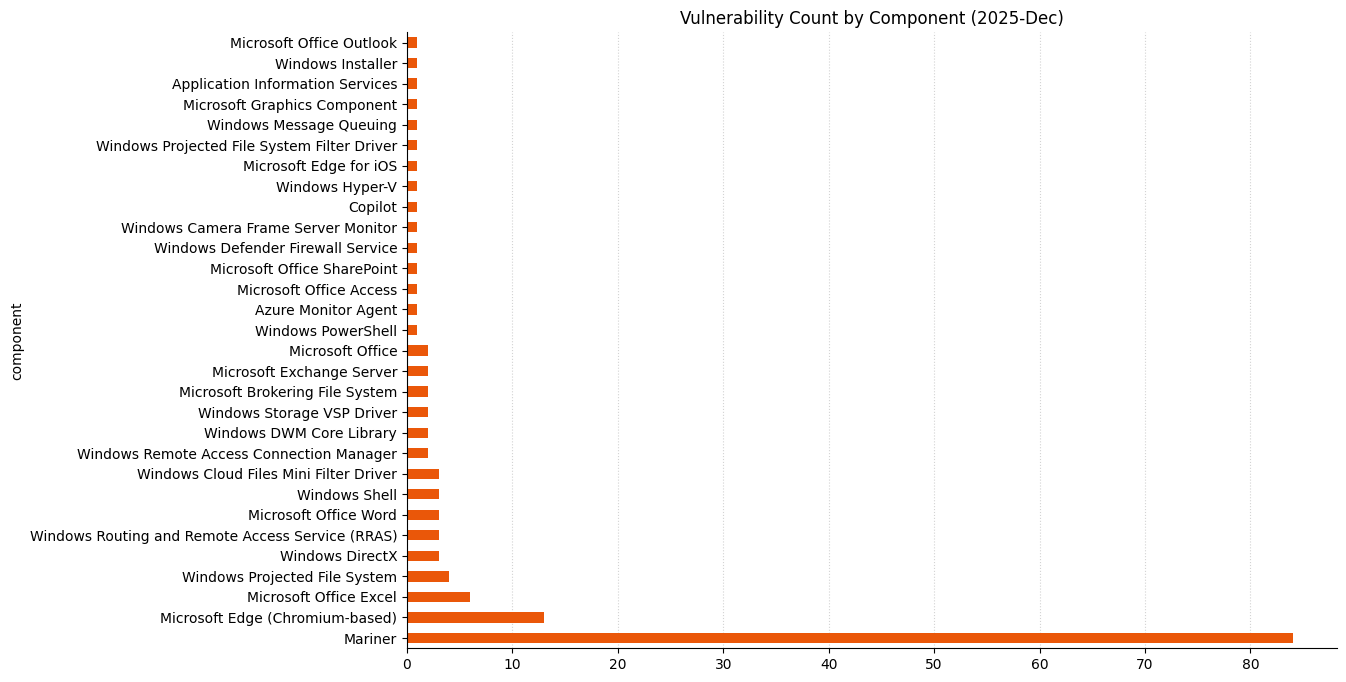
A bar chart showing vulnerability count by component for Microsoft Patch Tuesday 2025-Dec
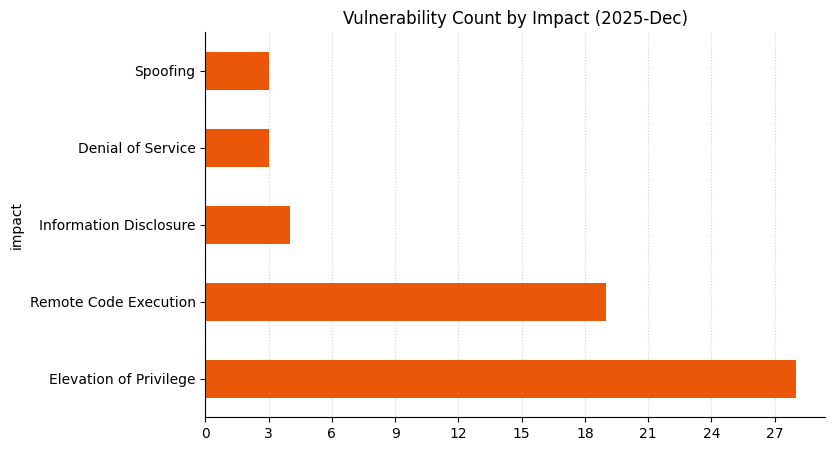
A bar chart showing vulnerability count by impact for Microsoft Patch Tuesday 2025-Dec
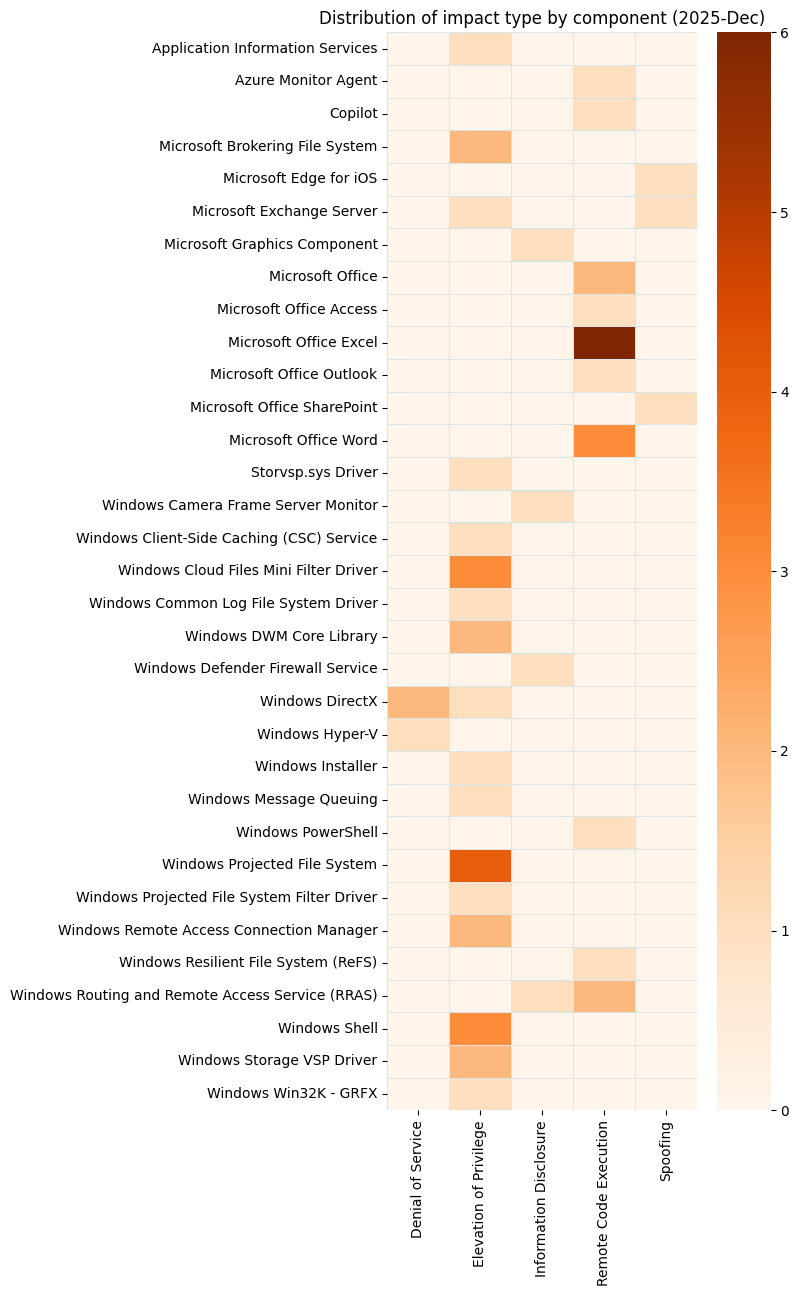
A bar chart showing distribution of impact type by component for Microsoft Patch Tuesday 2025-Dec

Summary tables

Azure vulnerabilities

CVE

Title

Exploited?

Publicly disclosed?

CVSSv3 base score

CVE-2025-62550

Azure Monitor Agent Remote Code Execution Vulnerability

No

No

8.8

Browser vulnerabilities

CVE

Title

Exploited?

Publicly disclosed?

CVSSv3 base score

CVE-2025-62223

Microsoft Edge (Chromium-based) for Mac Spoofing Vulnerability

No

No

4.3

CVE-2025-13721

Chromium: CVE-2025-13721 Race in v8

No

No

N/A

CVE-2025-13720

Chromium: CVE-2025-13720 Bad cast in Loader

No

No

N/A

CVE-2025-13640

Chromium: CVE-2025-13640 Inappropriate implementation in Passwords

No

No

N/A

CVE-2025-13639

Chromium: CVE-2025-13639 Inappropriate implementation in WebRTC

No

No

N/A

CVE-2025-13638

Chromium: CVE-2025-13638 Use after free in Media Stream

No

No

N/A

CVE-2025-13637

Chromium: CVE-2025-13637 Inappropriate implementation in Downloads

No

No

N/A

CVE-2025-13636

Chromium: CVE-2025-13636 Inappropriate implementation in Split View

No

No

N/A

CVE-2025-13635

Chromium: CVE-2025-13635 Inappropriate implementation in Downloads

No

No

N/A

CVE-2025-13634

Chromium: CVE-2025-13634 Inappropriate implementation in Downloads

No

No

N/A

CVE-2025-13633

Chromium: CVE-2025-13633 Use after free in Digital Credentials

No

No

N/A

CVE-2025-13632

Chromium: CVE-2025-13632 Inappropriate implementation in DevTools

No

No

N/A

CVE-2025-13631

Chromium: CVE-2025-13631 Inappropriate implementation in Google Updater

No

No

N/A

CVE-2025-13630

Chromium: CVE-2025-13630 Type Confusion in V8

No

No

N/A

Mariner vulnerabilities

CVE

Title

Exploited?

Publicly disclosed?

CVSSv3 base score

CVE-2025-12819

Untrusted search path in auth_query connection in PgBouncer

No

No

7.5

CVE-2025-59775

Apache HTTP Server: NTLM Leakage on Windows through UNC SSRF

No

No

7.5

CVE-2025-65082

Apache HTTP Server: CGI environment variable override

No

No

6.5

CVE-2025-66200

Apache HTTP Server: mod_userdir+suexec bypass via AllowOverride FileInfo

No

No

5.4

Microsoft Office vulnerabilities

CVE

Title

Exploited?

Publicly disclosed?

CVSSv3 base score

CVE-2025-64672

Microsoft SharePoint Server Spoofing Vulnerability

No

No

8.8

CVE-2025-62554

Microsoft Office Remote Code Execution Vulnerability

No

No

8.4

CVE-2025-62557

Microsoft Office Remote Code Execution Vulnerability

No

No

8.4

CVE-2025-62558

Microsoft Word Remote Code Execution Vulnerability

No

No

7.8

CVE-2025-62559

Microsoft Word Remote Code Execution Vulnerability

No

No

7.8

CVE-2025-62562

Microsoft Outlook Remote Code Execution Vulnerability

No

No

7.8

CVE-2025-62561

Microsoft Excel Remote Code Execution Vulnerability

No

No

7.8

CVE-2025-62563

Microsoft Excel Remote Code Execution Vulnerability

No

No

7.8

CVE-2025-62564

Microsoft Excel Remote Code Execution Vulnerability

No

No

7.8

CVE-2025-62553

Microsoft Excel Remote Code Execution Vulnerability

No

No

7.8

CVE-2025-62556

Microsoft Excel Remote Code Execution Vulnerability

No

No

7.8

CVE-2025-62560

Microsoft Excel Remote Code Execution Vulnerability

No

No

7.8

CVE-2025-62552

Microsoft Access Remote Code Execution Vulnerability

No

No

7.8

CVE-2025-62555

Microsoft Word Remote Code Execution Vulnerability

No

No

7

Open Source Software vulnerabilities

CVE

Title

Exploited?

Publicly disclosed?

CVSSv3 base score

CVE-2025-40244

hfsplus: fix KMSAN uninit-value issue in __hfsplus_ext_cache_extent()

No

No

9.8

CVE-2025-40242

gfs2: Fix unlikely race in gdlm_put_lock

No

No

9.8

CVE-2025-40251

devlink: rate: Unset parent pointer in devl_rate_nodes_destroy

No

No

9.8

CVE-2025-40262

Input: imx_sc_key - fix memory corruption on unload

No

No

9.8

CVE-2025-40240

sctp: avoid NULL dereference when chunk data buffer is missing

No

No

8.6

CVE-2025-40314

usb: cdns3: gadget: Use-after-free during failed initialization and exit of cdnsp gadget

No

No

7.8

CVE-2025-40223

most: usb: Fix use-after-free in hdm_disconnect

No

No

7.8

CVE-2025-40272

mm/secretmem: fix use-after-free race in fault handler

No

No

7.8

CVE-2025-40319

bpf: Sync pending IRQ work before freeing ring buffer

No

No

7.8

CVE-2025-66476

Vim for Windows Uncontrolled Search Path Element Remote Code Execution Vulnerability

No

No

7.8

CVE-2025-40277

drm/vmwgfx: Validate command header size against SVGA_CMD_MAX_DATASIZE

No

No

7.3

CVE-2023-53749

x86: fix clear_user_rep_good() exception handling annotation

No

No

7.1

CVE-2025-40233

ocfs2: clear extent cache after moving/defragmenting extents

No

No

7.1

CVE-2025-40312

jfs: Verify inode mode when loading from disk

No

No

7.1

CVE-2025-40322

fbdev: bitblit: bound-check glyph index in bit_putcs*

No

No

7.1

CVE-2025-40266

KVM: arm64: Check the untrusted offset in FF-A memory share

No

No

7.1

CVE-2025-40301

Bluetooth: hci_event: validate skb length for unknown CC opcode

No

No

7.1

CVE-2025-40283

Bluetooth: btusb: reorder cleanup in btusb_disconnect to avoid UAF

No

No

7.1

CVE-2025-40292

virtio-net: fix received length check in big packets

No

No

7

CVE-2025-40280

tipc: Fix use-after-free in tipc_mon_reinit_self().

No

No

7

CVE-2025-40281

sctp: prevent possible shift-out-of-bounds in sctp_transport_update_rto

No

No

7

CVE-2025-40297

net: bridge: fix use-after-free due to MST port state bypass

No

No

7

CVE-2025-40258

mptcp: fix race condition in mptcp_schedule_work()

No

No

7

CVE-2025-40273

NFSD: free copynotify stateid in nfs4_free_ol_stateid()

No

No

7

CVE-2025-40305

9p/trans_fd: p9_fd_request: kick rx thread if EPOLLIN

No

No

7

CVE-2025-40261

nvme: nvme-fc: Ensure ->ioerr_work is cancelled in nvme_fc_delete_ctrl()

No

No

6.6

CVE-2025-40243

hfs: fix KMSAN uninit-value issue in hfs_find_set_zero_bits()

No

No

6.6

CVE-2025-40321

wifi: brcmfmac: fix crash while sending Action Frames in standalone AP Mode

No

No

6.5

CVE-2025-40248

vsock: Ignore signal/timeout on connect() if already established

No

No

6.3

CVE-2025-40257

mptcp: fix a race in mptcp_pm_del_add_timer()

No

No

6.3

CVE-2025-40259

scsi: sg: Do not sleep in atomic context

No

No

6.2

CVE-2025-40252

net: qlogic/qede: fix potential out-of-bounds read in qede_tpa_cont() and qede_tpa_end()

No

No

6.1

CVE-2025-40215

xfrm: delete x->tunnel as we delete x

No

No

5.5

CVE-2025-40315

usb: gadget: f_fs: Fix epfile null pointer access after ep enable.

No

No

5.5

CVE-2025-40285

smb/server: fix possible refcount leak in smb2_sess_setup()

No

No

5.5

CVE-2025-40286

smb/server: fix possible memory leak in smb2_read()

No

No

5.5

CVE-2025-40253

s390/ctcm: Fix double-kfree

No

No

5.5

CVE-2025-40317

regmap: slimbus: fix bus_context pointer in regmap init calls

No

No

5.5

CVE-2025-40217

pidfs: validate extensible ioctls

No

No

5.5

CVE-2025-40306

orangefs: fix xattr related buffer overflow...

No

No

5.5

CVE-2025-40313

ntfs3: pretend $Extend records as regular files

No

No

5.5

CVE-2025-40245

nios2: ensure that memblock.current_limit is set when setting pfn limits

No

No

5.5

CVE-2025-40278

net: sched: act_ife: initialize struct tc_ife to fix KMSAN kernel-infoleak

No

No

5.5

CVE-2025-40279

net: sched: act_connmark: initialize struct tc_ife to fix kernel leak

No

No

5.5

CVE-2025-40254

net: openvswitch: remove never-working support for setting nsh fields

No

No

5.5

CVE-2025-40250

net/mlx5: Clean up only new IRQ glue on request_irq() failure

No

No

5.5

CVE-2025-40293

iommufd: Don't overflow during division for dirty tracking

No

No

5.5

CVE-2025-40220

fuse: fix livelock in synchronous file put from fuseblk workers

No

No

5.5

CVE-2025-40304

fbdev: Add bounds checking in bit_putcs to fix vmalloc-out-of-bounds

No

No

5.5

CVE-2025-40323

fbcon: Set fb_display[i]->mode to NULL when the mode is released

No

No

5.5

CVE-2025-40307

exfat: validate cluster allocation bits of the allocation bitmap

No

No

5.5

CVE-2025-40287

exfat: fix improper check of dentry.stream.valid_size

No

No

5.5

CVE-2025-40247

drm/msm: Fix pgtable prealloc error path

No

No

5.5

CVE-2025-40289

drm/amdgpu: hide VRAM sysfs attributes on GPUs without VRAM

No

No

5.5

CVE-2025-40268

cifs: client: fix memory leak in smb3_fs_context_parse_param

No

No

5.5

CVE-2025-40303

btrfs: ensure no dirty metadata is written back for an fs with errors

No

No

5.5

CVE-2025-40264

be2net: pass wrb_params in case of OS2BMC

No

No

5.5

CVE-2025-40310

amd/amdkfd: resolve a race in amdgpu_amdkfd_device_fini_sw

No

No

5.5

CVE-2025-40311

accel/habanalabs: support mapping cb with vmalloc-backed coherent memory

No

No

5.5

CVE-2025-40219

PCI/IOV: Add PCI rescan-remove locking when enabling/disabling SR-IOV

No

No

5.5

CVE-2025-40324

NFSD: Fix crash in nfsd4_read_release()

No

No

5.5

CVE-2025-40263

Input: cros_ec_keyb - fix an invalid memory access

No

No

5.5

CVE-2025-40308

Bluetooth: bcsp: receive data only if registered

No

No

5.5

CVE-2025-40309

Bluetooth: SCO: Fix UAF on sco_conn_free

No

No

5.5

CVE-2025-40284

Bluetooth: MGMT: cancel mesh send timer when hdev removed

No

No

5.5

CVE-2025-40294

Bluetooth: MGMT: Fix OOB access in parse_adv_monitor_pattern()

No

No

5.5

CVE-2025-40282

Bluetooth: 6lowpan: reset link-local header on ipv6 recv path

No

No

5.5

CVE-2025-40275

ALSA: usb-audio: Fix NULL pointer dereference in snd_usb_mixer_controls_badd

No

No

5.5

CVE-2025-40288

drm/amdgpu: Fix NULL pointer dereference in VRAM logic for APU devices

No

No

4.7

CVE-2025-40269

ALSA: usb-audio: Fix potential overflow of PCM transfer buffer

No

No

4.3

CVE-2025-40218

mm/damon/vaddr: do not repeat pte_offset_map_lock() until success

No

No

4.1

CVE-2025-12385

Improper validation of  tag size in Text component parser

No

No

N/A

Open Source Software Mariner vulnerabilities

CVE

Title

Exploited?

Publicly disclosed?

CVSSv3 base score

CVE-2025-61729

Excessive resource consumption when printing error string for host certificate validation in crypto/x509

No

No

7.5

CVE-2025-66293

LIBPNG has an out-of-bounds read in png_image_read_composite

No

No

7.1

CVE-2025-61727

Improper application of excluded DNS name constraints when verifying wildcard names in crypto/x509

No

No

6.5

CVE-2025-65637

A denial-of-service vulnerability exists in github.com/sirupsen/logrus when using Entry.Writer() to log a single-line payload larger than 64KB without newline characters.

No

No

5.9

CVE-2025-12084

Quadratic complexity in node ID cache clearing

No

No

N/A

CVE-2025-13837

Out-of-memory when loading Plist

No

No

N/A

CVE-2025-34297

KissFFT Integer Overflow Heap Buffer Overflow via kiss_fft_alloc

No

No

N/A

CVE-2025-13836

Excessive read buffering DoS in http.client

No

No

N/A

Other vulnerabilities

CVE

Title

Exploited?

Publicly disclosed?

CVSSv3 base score

CVE-2025-64671

GitHub Copilot for Jetbrains Remote Code Execution Vulnerability

No

Yes

8.4

Server Software ESU vulnerabilities

CVE

Title

Exploited?

Publicly disclosed?

CVSSv3 base score

CVE-2025-64666

Microsoft Exchange Server Elevation of Privilege Vulnerability

No

No

7.5

CVE-2025-64667

Microsoft Exchange Server Spoofing Vulnerability

No

No

5.3

Windows vulnerabilities

CVE

Title

Exploited?

Publicly disclosed?

CVSSv3 base score

CVE-2025-62456

Windows Resilient File System (ReFS) Remote Code Execution Vulnerability

No

No

8.8

CVE-2025-64673

Windows Storage VSP Driver Elevation of Privilege Vulnerability

No

No

7.8

CVE-2025-59516

Windows Storage VSP Driver Elevation of Privilege Vulnerability

No

No

7.8

CVE-2025-59517

Windows Storage VSP Driver Elevation of Privilege Vulnerability

No

No

7.8

CVE-2025-64661

Windows Shell Elevation of Privilege Vulnerability

No

No

7.8

CVE-2025-62461

Windows Projected File System Elevation of Privilege Vulnerability

No

No

7.8

CVE-2025-62462

Windows Projected File System Elevation of Privilege Vulnerability

No

No

7.8

CVE-2025-62464

Windows Projected File System Elevation of Privilege Vulnerability

No

No

7.8

CVE-2025-55233

Windows Projected File System Elevation of Privilege Vulnerability

No

No

7.8

CVE-2025-62467

Windows Projected File System Elevation of Privilege Vulnerability

No

No

7.8

CVE-2025-64679

Windows DWM Core Library Elevation of Privilege Vulnerability

No

No

7.8

CVE-2025-64680

Windows DWM Core Library Elevation of Privilege Vulnerability

No

No

7.8

CVE-2025-62454

Windows Cloud Files Mini Filter Driver Elevation of Privilege Vulnerability

No

No

7.8

CVE-2025-62457

Windows Cloud Files Mini Filter Driver Elevation of Privilege Vulnerability

No

No

7.8

CVE-2025-62221

Windows Cloud Files Mini Filter Driver Elevation of Privilege Vulnerability

Yes

No

7.8

CVE-2025-62572

Application Information Service Elevation of Privilege Vulnerability

No

No

7.8

CVE-2025-64658

Windows File Explorer Elevation of Privilege Vulnerability

No

No

7.5

CVE-2025-62565

Windows File Explorer Elevation of Privilege Vulnerability

No

No

7.3

CVE-2025-62570

Windows Camera Frame Server Monitor Information Disclosure Vulnerability

No

No

7.1

CVE-2025-62469

Microsoft Brokering File System Elevation of Privilege Vulnerability

No

No

7

CVE-2025-62569

Microsoft Brokering File System Elevation of Privilege Vulnerability

No

No

7

CVE-2025-62573

DirectX Graphics Kernel Elevation of Privilege Vulnerability

No

No

7

CVE-2025-64670

Windows DirectX Information Disclosure Vulnerability

No

No

6.5

CVE-2025-62463

DirectX Graphics Kernel Denial of Service Vulnerability

No

No

6.5

CVE-2025-62465

DirectX Graphics Kernel Denial of Service Vulnerability

No

No

6.5

CVE-2025-62468

Windows Defender Firewall Service Information Disclosure Vulnerability

No

No

4.4

Windows ESU vulnerabilities

CVE

Title

Exploited?

Publicly disclosed?

CVSSv3 base score

CVE-2025-62549

Windows Routing and Remote Access Service (RRAS) Remote Code Execution Vulnerability

No

No

8.8

CVE-2025-64678

Windows Routing and Remote Access Service (RRAS) Remote Code Execution Vulnerability

No

No

8.8

CVE-2025-62472

Windows Remote Access Connection Manager Elevation of Privilege Vulnerability

No

No

7.8

CVE-2025-62474

Windows Remote Access Connection Manager Elevation of Privilege Vulnerability

No

No

7.8

CVE-2025-62571

Windows Installer Elevation of Privilege Vulnerability

No

No

7.8

CVE-2025-62470

Windows Common Log File System Driver Elevation of Privilege Vulnerability

No

No

7.8

CVE-2025-62466

Windows Client-Side Caching Elevation of Privilege Vulnerability

No

No

7.8

CVE-2025-62458

Win32k Elevation of Privilege Vulnerability

No

No

7.8

CVE-2025-54100

PowerShell Remote Code Execution Vulnerability

No

Yes

7.8

CVE-2025-62455

Microsoft Message Queuing (MSMQ) Elevation of Privilege Vulnerability

No

No

7.8

CVE-2025-62473

Windows Routing and Remote Access Service (RRAS) Information Disclosure Vulnerability

No

No

6.5

CVE-2025-62567

Windows Hyper-V Denial of Service Vulnerability

No

No

5.3

  •  

Patch Tuesday - November 2025

Microsoft is publishing 66 new vulnerabilities today, which is far fewer than we’ve come to expect in recent months. There’s a lone exploited-in-the-wild zero-day vulnerability, which Microsoft assesses as critical severity, although there’s apparently no public disclosure yet. Three critical remote code execution (RCE) vulnerabilities are patched today; happily, Microsoft currently assesses all three as less likely to see exploitation. Five browser vulnerabilities and a dozen or so fixes for Azure Linux (aka Mariner) have already been published separately this month, and are not included in the total.

Windows GDI+: critical 0-day RCE

Faced with a fresh stack of Patch Tuesday vulns, there are a few different ways to prioritize our analysis. Do we start with vulns exploited in the wild? Pre-authentication RCEs? The vuln with the highest CVSS base score? The vuln which is likely to affect just about every asset running Microsoft software? Any of these are sensible avenues of approach, and today, all roads lead to CVE-2025-60724. As the advisory notes, in the worst-case scenario, an attacker could exploit this vulnerability by uploading a malicious document to a vulnerable web service. The advisory doesn’t spell out the context of code execution, but if all the stars align for the attacker, the prize could be remote code execution as SYSTEM via the network without any need for an existing foothold. While this vuln almost certainly isn’t wormable, it’s clearly very serious and is surely a top priority for just about anyone considering how to approach this month’s patches.

The weakness underlying CVE-2025-60724 is CWE-122: Heap-based buffer overflow, a concept which celebrated its 50th birthday several years ago. As the authors of the original 1972 paper noted: “If the code makes use of an internal buffer, there is a possibility that a user could input enough data to overwrite other portions of the program's private storage.” Regarding computer security in general, they opined that “this problem is neither hopeless nor solved. It is, however, perfectly clear [...] that solutions to the problem will not occur spontaneously, nor will they come from the various well-intentioned attempts to provide security as an add-on to existing systems.”

Office: critical ACE

Once again, we find ourselves wondering: “when is remote code execution really remote?” CVE-2025-62199 describes a critical RCE vulnerability in Microsoft Office, where exploitation relies on the user downloading and opening a malicious file. The attacker is remote, and that’s enough to satisfy the definition, even if the action is taken on the local system by the unwitting user. Anyone hoping that the Preview Pane is not a vector will be sadly disappointed, and this certainly increases the probability of real-world exploitation, since there’s no need for the attacker to craft a way around those pesky warnings about enabling dangerous content. Just scrolling through a list of emails in Outlook could be enough.

Visual Studio: critical RCE

Some attacks are straightforward, with only a single step needed to reach the finish line. Others, like Visual Studio critical RCE CVE-2025-62214, require that the attacker execute a complex chain of events. In this case, exploitation demands multi-stage abuse of recent advances in Visual Studio AI development capabilities, including prompt injection, Agent interaction, and triggering a build. The advisory doesn’t describe the context of code execution. If the prize is simply code execution on an asset in the context of the user, there’s no obvious advancement for the attacker, since exploitation already requires code execution on the asset by the attacker or the targeted user. The brief description of the attack chain does mention that the attacker would need to trigger a build. On that basis, possible outcomes might include execution in an elevated context, or compromised build artifacts, although the advisory does not provide enough information to be certain either way.

SQL Server: critical EoP

SQL Server admins should take note of CVE-2025-59499, which describes an elevation of privilege (EoP) vulnerability. Although some level existing privileges are required, successful exploitation will permit an attacker to run arbitrary Transact-SQL (T-SQL) commands. T-SQL is the language which SQL Server databases and clients use to communicate with one another. Although the default configuration for SQL Server disables the xp_cmdshell functionality which allows direct callouts to the underlying OS, there’s more than one way to shine a penny, and the only safe assumption here is that exploitation will lead to code execution in the context of SQL Server itself. Patches are available for all supported versions of SQL Server.

Microsoft lifecycle update

Following the sweeping lifecycle changes seen in October 2025, Microsoft is taking it fairly easy this month. The only significant transition today is the end of support for Windows 11 Home and Pro 23H2. Unlike the demise of Windows 10, this much smaller change won’t affect most people; a small number of older CPUs might not make the cut, since Windows 11 24H2 introduces a requirement for a couple of newer CPU instruction sets. Microsoft provides lists of compatible Intel, AMD, and Qualcomm CPU series.

Summary charts

A bar chart showing vulnerability count by component for Microsoft Patch Tuesday 2025-Nov

A bar chart showing vulnerability count by impact for Microsoft Patch Tuesday 2025-Nov

A heat map showing impact type by component for Microsoft Patch Tuesday 2025-Nov

Summary tables

Azure vulnerabilities

CVE

Title

Exploited?

Publicly disclosed?

CVSSv3 base score

CVE-2025-59504

Azure Monitor Agent Remote Code Execution Vulnerability

No

No

7.3

Browser vulnerabilities

CVE

Title

Exploited?

Publicly disclosed?

CVSSv3 base score

CVE-2025-12729

Chromium: CVE-2025-12729 Inappropriate implementation in Omnibox

No

No

N/A

CVE-2025-12728

Chromium: CVE-2025-12728 Inappropriate implementation in Omnibox

No

No

N/A

CVE-2025-12727

Chromium: CVE-2025-12727 Inappropriate implementation in V8

No

No

N/A

CVE-2025-12726

Chromium: CVE-2025-12726 Inappropriate implementation in Views.

No

No

N/A

CVE-2025-12725

Chromium: CVE-2025-12725 Out of bounds write in WebGPU

No

No

N/A

Developer Tools vulnerabilities

CVE

Title

Exploited?

Publicly disclosed?

CVSSv3 base score

CVE-2025-62222

Agentic AI and Visual Studio Code Remote Code Execution Vulnerability

No

No

8.8

CVE-2025-62449

Microsoft Visual Studio Code CoPilot Chat Extension Security Feature Bypass Vulnerability

No

No

6.8

CVE-2025-62214

Visual Studio Remote Code Execution Vulnerability

No

No

6.7

CVE-2025-62453

GitHub Copilot and Visual Studio Code Security Feature Bypass Vulnerability

No

No

5

Mariner Open Source Software vulnerabilities

CVE

Title

Exploited?

Publicly disclosed?

CVSSv3 base score

CVE-2024-25621

containerd affected by a local privilege escalation via wide permissions on CRI directory

No

No

7.3

CVE-2025-10966

missing SFTP host verification with wolfSSH

No

No

6.8

CVE-2025-64329

containerd CRI server: Host memory exhaustion through Attach goroutine leak

No

No

N/A

Microsoft Dynamics vulnerabilities

CVE

Title

Exploited?

Publicly disclosed?

CVSSv3 base score

CVE-2025-62210

Dynamics 365 Field Service (online) Spoofing Vulnerability

No

No

8.7

CVE-2025-62211

Dynamics 365 Field Service (online) Spoofing Vulnerability

No

No

8.7

CVE-2025-62206

Microsoft Dynamics 365 (On-Premises) Information Disclosure Vulnerability

No

No

6.5

Microsoft Office vulnerabilities

CVE

Title

Exploited?

Publicly disclosed?

CVSSv3 base score

CVE-2025-62204

Microsoft SharePoint Remote Code Execution Vulnerability

No

No

8

CVE-2025-62199

Microsoft Office Remote Code Execution Vulnerability

No

No

7.8

CVE-2025-62216

Microsoft Office Remote Code Execution Vulnerability

No

No

7.8

CVE-2025-62205

Microsoft Office Remote Code Execution Vulnerability

No

No

7.8

CVE-2025-60727

Microsoft Excel Remote Code Execution Vulnerability

No

No

7.8

CVE-2025-62200

Microsoft Excel Remote Code Execution Vulnerability

No

No

7.8

CVE-2025-62201

Microsoft Excel Remote Code Execution Vulnerability

No

No

7.8

CVE-2025-62203

Microsoft Excel Remote Code Execution Vulnerability

No

No

7.8

CVE-2025-60726

Microsoft Excel Information Disclosure Vulnerability

No

No

7.1

CVE-2025-62202

Microsoft Excel Information Disclosure Vulnerability

No

No

7.1

CVE-2025-60722

Microsoft OneDrive for Android Elevation of Privilege Vulnerability

No

No

6.5

CVE-2025-59240

Microsoft Excel Information Disclosure Vulnerability

No

No

5.5

CVE-2025-60728

Microsoft Excel Information Disclosure Vulnerability

No

No

4.3

Open Source Software vulnerabilities

CVE

Title

Exploited?

Publicly disclosed?

CVSSv3 base score

CVE-2025-62220

Windows Subsystem for Linux GUI Remote Code Execution Vulnerability

No

No

8.8

CVE-2025-12863

Libxml2: namespace use-after-free in xmlsettreedoc() function of libxml2

No

No

7.5

CVE-2025-64433

KubeVirt Arbitrary Container File Read

No

No

6.5

CVE-2025-40107

can: hi311x: fix null pointer dereference when resuming from sleep before interface was enabled

No

No

5.5

CVE-2025-60753

An issue was discovered in libarchive bsdtar before version 3.8.1 in function apply_substitution in file tar/subst.c when processing crafted -s substitution rules. This can cause unbounded memory allocation and lead to denial of service (Out-of-Memory crash).

No

No

5.5

CVE-2025-12875

mruby array.c ary_fill_exec out-of-bounds write

No

No

5.3

CVE-2025-64435

KubeVirt VMI Denial-of-Service (DoS) Using Pod Impersonation

No

No

5.3

CVE-2025-64437

KubeVirt Isolation Detection Flaw Allows Arbitrary File Permission Changes

No

No

5

CVE-2025-64434

KubeVirt Improper TLS Certificate Management Handling Allows API Identity Spoofing

No

No

4.7

CVE-2025-64432

KubeVirt Affected by an Authentication Bypass in Kubernetes Aggregation Layer

No

No

4.7

CVE-2025-40109

crypto: rng - Ensure set_ent is always present

No

No

4.2

CVE-2025-52881

runc: LSM labels can be bypassed with malicious config using dummy procfs files

No

No

N/A

CVE-2025-31133

runc container escape via "masked path" abuse due to mount race conditions

No

No

N/A

CVE-2025-52565

container escape due to /dev/console mount and related races

No

No

N/A

CVE-2025-64436

KubeVirt Excessive Role Permissions Could Enable Unauthorized VMI Migrations Between Nodes

No

No

N/A

Other vulnerabilities

CVE

Title

Exploited?

Publicly disclosed?

CVSSv3 base score

CVE-2025-30398

Nuance PowerScribe 360 Information Disclosure Vulnerability

No

No

8.1

SQL Server vulnerabilities

CVE

Title

Exploited?

Publicly disclosed?

CVSSv3 base score

CVE-2025-59499

Microsoft SQL Server Elevation of Privilege Vulnerability

No

No

8.8

System Center vulnerabilities

CVE

Title

Exploited?

Publicly disclosed?

CVSSv3 base score

CVE-2025-47179

Configuration Manager Elevation of Privilege Vulnerability

No

No

6.7

Windows vulnerabilities

CVE

Title

Exploited?

Publicly disclosed?

CVSSv3 base score

CVE-2025-59511

Windows WLAN Service Elevation of Privilege Vulnerability

No

No

7.8

CVE-2025-60713

Windows Routing and Remote Access Service (RRAS) Elevation of Privilege Vulnerability

No

No

7.8

CVE-2025-60718

Windows Administrator Protection Elevation of Privilege Vulnerability

No

No

7.8

CVE-2025-60721

Windows Administrator Protection Elevation of Privilege Vulnerability

No

No

7.8

CVE-2025-60707

Multimedia Class Scheduler Service (MMCSS) Driver Elevation of Privilege Vulnerability

No

No

7.8

CVE-2025-60710

Host Process for Windows Tasks Elevation of Privilege Vulnerability

No

No

7.8

CVE-2025-59507

Windows Speech Runtime Elevation of Privilege Vulnerability

No

No

7

CVE-2025-59508

Windows Speech Recognition Elevation of Privilege Vulnerability

No

No

7

CVE-2025-62215

Windows Kernel Elevation of Privilege Vulnerability

Yes

No

7

CVE-2025-59515

Windows Broadcast DVR User Service Elevation of Privilege Vulnerability

No

No

7

CVE-2025-60717

Windows Broadcast DVR User Service Elevation of Privilege Vulnerability

No

No

7

CVE-2025-62218

Microsoft Wireless Provisioning System Elevation of Privilege Vulnerability

No

No

7

CVE-2025-62219

Microsoft Wireless Provisioning System Elevation of Privilege Vulnerability

No

No

7

CVE-2025-60716

DirectX Graphics Kernel Elevation of Privilege Vulnerability

No

No

7

CVE-2025-60708

Storvsp.sys Driver Denial of Service Vulnerability

No

No

6.5

CVE-2025-60723

DirectX Graphics Kernel Denial of Service Vulnerability

No

No

6.3

CVE-2025-59509

Windows Speech Recognition Information Disclosure Vulnerability

No

No

5.5

CVE-2025-62208

Windows License Manager Information Disclosure Vulnerability

No

No

5.5

CVE-2025-62209

Windows License Manager Information Disclosure Vulnerability

No

No

5.5

CVE-2025-60706

Windows Hyper-V Information Disclosure Vulnerability

No

No

5.5

CVE-2025-60724

GDI+ Remote Code Execution Vulnerability

Yes

No

9.8

Windows ESU vulnerabilities

CVE

Title

Exploited?

Publicly disclosed?

CVSSv3 base score

CVE-2025-62452

Windows Routing and Remote Access Service (RRAS) Remote Code Execution Vulnerability

No

No

8

CVE-2025-60715

Windows Routing and Remote Access Service (RRAS) Remote Code Execution Vulnerability

No

No

8

CVE-2025-60720

Windows Transport Driver Interface (TDI) Translation Driver Elevation of Privilege Vulnerability

No

No

7.8

CVE-2025-59505

Windows Smart Card Reader Elevation of Privilege Vulnerability

No

No

7.8

CVE-2025-60703

Windows Remote Desktop Services Elevation of Privilege Vulnerability

No

No

7.8

CVE-2025-60714

Windows OLE Remote Code Execution Vulnerability

No

No

7.8

CVE-2025-60709

Windows Common Log File System Driver Elevation of Privilege Vulnerability

No

No

7.8

CVE-2025-60705

Windows Client-Side Caching Elevation of Privilege Vulnerability

No

No

7.8

CVE-2025-59514

Microsoft Streaming Service Proxy Elevation of Privilege Vulnerability

No

No

7.8

CVE-2025-59512

Customer Experience Improvement Program (CEIP) Elevation of Privilege Vulnerability

No

No

7.8

CVE-2025-60704

Windows Kerberos Elevation of Privilege Vulnerability

No

No

7.5

CVE-2025-60719

Windows Ancillary Function Driver for WinSock Elevation of Privilege Vulnerability

No

No

7

CVE-2025-62217

Windows Ancillary Function Driver for WinSock Elevation of Privilege Vulnerability

No

No

7

CVE-2025-62213

Windows Ancillary Function Driver for WinSock Elevation of Privilege Vulnerability

No

No

7

CVE-2025-59506

DirectX Graphics Kernel Elevation of Privilege Vulnerability

No

No

7

CVE-2025-59510

Windows Routing and Remote Access Service (RRAS) Denial of Service Vulnerability

No

No

5.5

CVE-2025-59513

Windows Bluetooth RFCOM Protocol Driver Information Disclosure Vulnerability

No

No

5.5

CVE-2025-60724

GDI+ Remote Code Execution Vulnerability

Yes

No

9.8

Windows Microsoft Office ESU vulnerabilities

CVE

Title

Exploited?

Publicly disclosed?

CVSSv3 base score

CVE-2025-60724

GDI+ Remote Code Execution Vulnerability

No

No

9.8

Updates

  • 2025-11-11: clarified the description of CVE-2025-62214.

  •