Reading view

Once-hobbled Lumma Stealer is back with lures that are hard to resist

Last May, law enforcement authorities around the world scored a key win when they hobbled the infrastructure of Lumma, an infostealer that infected nearly 395,000 Windows computers over just a two-month span leading up to the international operation. Researchers said Wednesday that Lumma is once again “back at scale” in hard-to-detect attacks that pilfer credentials and sensitive files.

Lumma, also known as Lumma Stealer, first appeared in Russian-speaking cybercrime forums in 2022. Its cloud-based malware-as-a-service model provided a sprawling infrastructure of domains for hosting lure sites offering free cracked software, games, and pirated movies, as well as command-and-control channels and everything else a threat actor needed to run their infostealing enterprise. Within a year, Lumma was selling for as much as $2,500 for premium versions. By the spring of 2024, the FBI counted more than 21,000 listings on crime forums. Last year, Microsoft said Lumma had become the “go-to tool” for multiple crime groups, including Scattered Spider, one of the most prolific groups.

Takedowns are hard

The FBI and an international coalition of its counterparts took action early last year. In May, they said they seized 2,300 domains, command-and-control infrastructure, and crime marketplaces that had enabled the infostealer to thrive. Recently, however, the malware has made a comeback, allowing it to infect a significant number of machines again.

Read full article

Comments

© Getty Images

  •  

Fake extension crashes browsers to trick users into infecting themselves

Researchers have found another method used in the spirit of ClickFix: CrashFix.

ClickFix campaigns use convincing lures—historically “Human Verification” screens—to trick the user into pasting a command from the clipboard. After fake Windows update screens, video tutorials for Mac users, and many other variants, attackers have now introduced a browser extension that crashes your browser on purpose.

Researchers found a rip-off of a well-known ad blocker and managed to get it into the official Chrome Web Store under the name “NexShield – Advanced Web Protection.” Strictly speaking, crashing the browser does provide some level of protection, but it’s not what users are typically looking for.

If users install the browser extension, it phones home to nexsnield[.]com (note the misspelling) to track installs, updates, and uninstalls. The extension uses Chrome’s built-in Alarms API (application programming interface) to wait 60 minutes before starting its malicious behavior. This delay makes it less likely that users will immediately connect the dots between the installation and the following crash.

After that pause, the extension starts a denial-of-service loop that repeatedly opens chrome.runtime port connections, exhausting the device’s resources until the browser becomes unresponsive and crashes.

After restarting the browser, users see a pop-up telling them the browser stopped abnormally—which is true but not unexpected— and offering instructions on how to prevent it from happening in the future.

It presents the user with the now classic instructions to open Win+R, press Ctrl+V, and hit Enter to “fix” the problem. This is the typical ClickFix behavior. The extension has already placed a malicious PowerShell or cmd command on the clipboard. By following the instructions, the user executes that malicious command and effetively infects their own computer.

Based on fingerprinting checks to see whether the device is domain-joined, there are currently two possible outcomes.

If the machine is joined to a domain, it is treated as a corporate device and infected with a Python remote access trojan (RAT) dubbed ModeloRAT. On non-domain-joined machines, the payload is currently unknown as the researchers received only a “TEST PAYLOAD!!!!” response. This could imply ongoing development or other fingerprinting which made the test machine unsuitable.

How to stay safe

The extension was no longer available in the Chrome Web Store at the time of writing, but it will undoubtedly resurface with an other name. So here are a few tips to stay safe:

  • If you’re looking for an ad blocker or other useful browser extensions, make sure you are installing the real deal. Cybercriminals love to impersonate trusted software.
  • Never run code or commands copied from websites, emails, or messages unless you trust the source and understand the action’s purpose. Verify instructions independently. If a website tells you to execute a command or perform a technical action, check through official documentation or contact support before proceeding.
  • Secure your devices. Use an up-to-date real-time anti-malware solution with a web protection component.
  • Educate yourself on evolving attack techniques. Understanding that attacks may come from unexpected vectors and evolve helps maintain vigilance. Keep reading our blog!

Pro tip: the free Malwarebytes Browser Guard extension is a very effective ad blocker and protects you from malicious websites. It also warns you when a website copies something to your clipboard and adds a small snippet to render any commands useless.


We don’t just report on threats—we remove them

Cybersecurity risks should never spread beyond a headline. Keep threats off your devices by downloading Malwarebytes today.

  •  

New ClickFix wave infects users with hidden malware in images and fake Windows updates

Several researchers have flagged a new development in the ongoing ClickFix campaign: Attackers are now mimicking a Windows update screen to trick people into running malware.

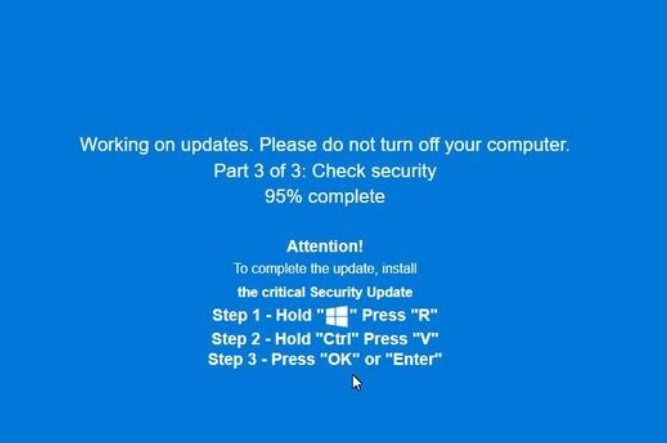
ClickFix campaigns use convincing lures, historically “Human Verification” screens, and now a fake “Windows Update” splash page that exactly mimics the real Windows update interface. Both require the user to paste a command from the clipboard, making the attack depend heavily on user interaction.

As shown by Joe Security, ClickFix now displays its deceptive instructions on a page designed to look exactly like a Windows update.

In full-screen mode, visitors running Windows see instructions telling them to copy and paste a malicious command into the Run box.

Fake Windows update

“Working on updates. Please do not turn off your computer.
Part 3 of 3: Check security
95% complete

Attention!
To complete the update, install
the critical Security Update

[… followed by the steps to open the Run box, paste “something” from your clipboard, and press OK to run it]

The “something” the attackers want you to run is an mshta command that downloads and runs a malware dropper. Usually, the final payload is the Rhadamanthys infostealer.

Technical details

If the user follows the displayed instructions this launches a chain of infection steps:

  • Stage 1: mshta.exe downloads a script (usually JScript). URLs consistently use hex-encoding for the second octet and often rotate URI paths to evade signature-based blocklists
  • Stage 2: The script runs PowerShell code, which is obfuscated with junk code to confuse analysis.
  • Stage 3: PowerShell decrypts and loads a .NET assembly acting as a loader.
  • Stage 4: The loader extracts the next stage (malicious shellcode) hidden within a resource image using custom steganography. In essence, we use the name steganography for every technique that conceals secret messages in something that doesn’t immediately cause suspicion. In this case, the malware is embedded in specific pixel color data within PNG files, making detection difficult.
  • Stage 5: The shellcode is injected into a trusted Windows process (like explorer.exe), using classic in-memory techniques like VirtualAllocEx, WriteProcessMemory, and CreateRemoteThread.
  • Final payload: Recent attacks delivered info-stealing malware like LummaC2 (with configuration extractors provided by Huntress) and the Rhadamanthys information stealer.

Details about the steganography used by ClickFix:

Malicious payloads are encoded directly into PNG pixel color channels (especially the red channel). A custom steganographic algorithm is used to extract the shellcode from the raw PNG file.

  • The attackers secretly insert parts of the malware into the image’s pixels, especially by carefully changing the color values in the red channel (which controls how red each pixel is).
  • To anyone viewing the picture, it still looks totally normal. No clues that it’s something more than just an image.
  • But when the malware script runs, it knows exactly where to “look” inside the image to find those hidden bits.
  • The script extracts and decrypts this pixel data, stitches the pieces together, and reconstructs the malware directly in your computer’s memory.
  • Since the malware is never stored as an obvious file on disk and is hidden inside an innocent-looking picture, it’s much harder for anti-malware or security programs to catch.

How to stay safe

With ClickFix running rampant—and it doesn’t look like it’s going away anytime soon—it’s important to be aware, careful, and protected.

  • Slow down. Don’t rush to follow instructions on a webpage or prompt, especially if it asks you to run commands on your device or copy-paste code. Attackers rely on urgency to bypass your critical thinking, so be cautious of pages urging immediate action. Sophisticated ClickFix pages add countdowns, user counters, or other pressure tactics to make you act quickly.
  • Avoid running commands or scripts from untrusted sources. Never run code or commands copied from websites, emails, or messages unless you trust the source and understand the action’s purpose. Verify instructions independently. If a website tells you to execute a command or perform a technical action, check through official documentation or contact support before proceeding.
  • Limit the use of copy-paste for commands. Manually typing commands instead of copy-pasting can reduce the risk of unknowingly running malicious payloads hidden in copied text.
  • Secure your devices. Use an up-to-date real-time anti-malware solution with a web protection component.
  • Educate yourself on evolving attack techniques. Understanding that attacks may come from unexpected vectors and evolve helps maintain vigilance. Keep reading our blog!

Pro tip: Did you know that the free Malwarebytes Browser Guard extension warns you when a website tries to copy something to your clipboard?


We don’t just report on scams—we help detect them

Cybersecurity risks should never spread beyond a headline. If something looks dodgy to you, check if it’s a scam using Malwarebytes Scam Guard, a feature of our mobile protection products. Submit a screenshot, paste suspicious content, or share a text or phone number, and we’ll tell you if it’s a scam or legit. Download Malwarebytes Mobile Security for iOS or Android and try it today!

  •  

Fake CAPTCHA sites now have tutorial videos to help victims install malware

Early on in 2025, I described how criminals used fake CAPTCHA sites and a clipboard hijacker to provide instructions for website visitors that would effectively infect their own machines with an information stealer known as the Lumma Stealer.

ClickFix is the name researchers have since given to this type of campaign—one that uses the clipboard and fake CAPTCHA sites to trick users into running malicious commands themselves.

Later, we found that the cybercriminals behind it seemed to be running some A/B tests to figure out which infection method worked best: ClickFix, or the more traditional file download that disguises malware as a useful application.

The criminals probably decided to go with ClickFix, because they soon came up with a campaign that targeted Mac users to spread the infamous Atomic Stealer.

Now, as reported by researchers from Push Security, the attackers behind ClickFix have tried to make the campaign more “user-friendly.”  The latest fake CAPTCHA pages include embedded video tutorials showing exactly how to run the malicious code.

instructions for Mac users
Image courtesy of Push Security

The site automatically detects the visitor’s operating system and provides matching instructions, copying the right code for that OS straight to the clipboard—making typos less likely and infection more certain.

A countdown timer adds urgency, pressuring users to complete the “challenge” within a minute. When people rush instead of thinking things through, social engineering wins.

Unsurprisingly, most of these pages spread through SEO-poisoned Google search results, although they also circulate via email, social media, and in-app ads too.

How to stay safe

With ClickFix running rampant—and it doesn’t look like it’s going away anytime soon—it’s important to be aware, careful, and protected.

  • Slow down. Don’t rush to follow instructions on a webpage or prompt, especially if it asks you to run commands on your device or copy-paste code. Attackers rely on urgency to bypass your critical thinking, so be cautious of pages urging immediate action. Sophisticated ClickFix pages add countdowns, user counters, or other pressure tactics to make you act quickly.
  • Avoid running commands or scripts from untrusted sources. Never run code or commands copied from websites, emails, or messages unless you trust the source and understand the action’s purpose. Verify instructions independently. If a website tells you to execute a command or perform a technical action, check through official documentation or contact support before proceeding.
  • Limit the use of copy-paste for commands. Manually typing commands instead of copy-pasting can reduce the risk of unknowingly running malicious payloads hidden in copied text.
  • Secure your devices. Use an up-to-date real-time anti-malware solution with a web protection component.
  • Educate yourself on evolving attack techniques. Understanding that attacks may come from unexpected vectors and evolve helps maintain vigilance. Keep reading our blog!

Pro tip: Did you know that the free Malwarebytes Browser Guard extension warns you when a website tries to copy something to your clipboard?


We don’t just report on threats—we remove them

Cybersecurity risks should never spread beyond a headline. Keep threats off your devices by downloading Malwarebytes today.

  •