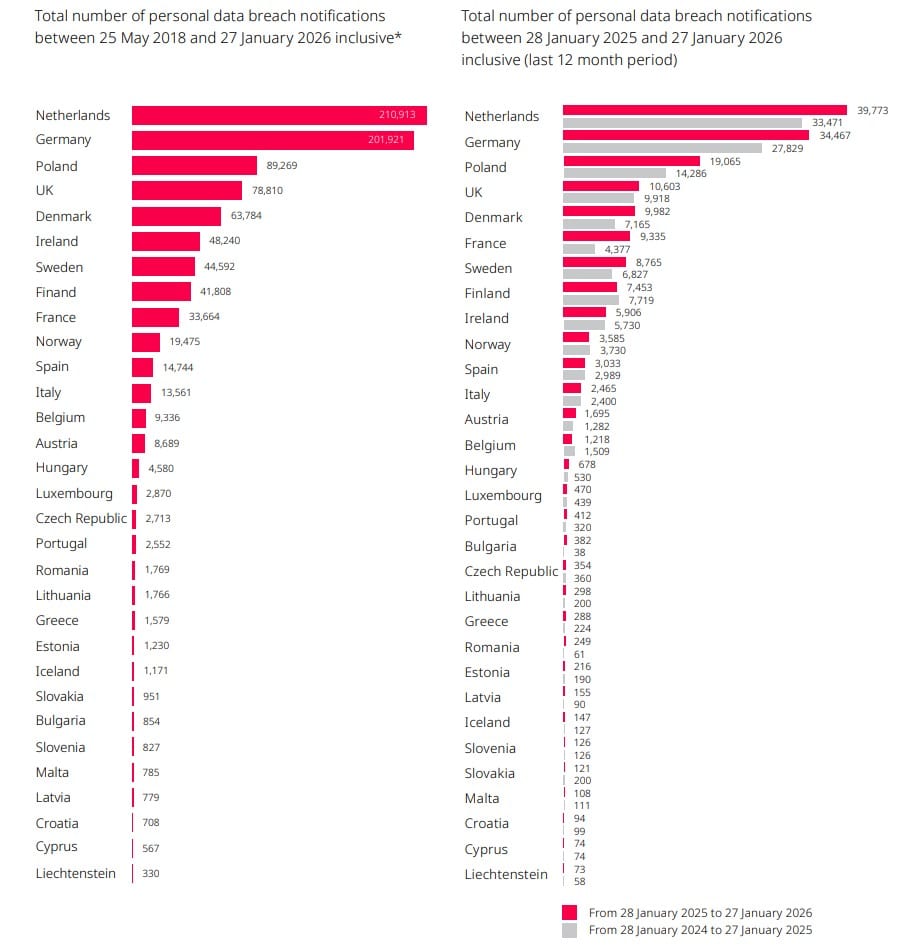
EU data breach notifications have surged 22% in the last year and GDPR fines remain high, according to a new report from law firm DLA Piper.
The “sustained high level of data enforcement activity across Europe” noted in the
report occurs amid the EU Digital Omnibus legislative process that critics say could
substantially weaken the GDPR’s data privacy provisions.
Given the high number of data breach notifications, the report noted, “It is perhaps not surprising that the EU Digital Omnibus is proposing to raise the bar for incident notification to regulators, to capture only breaches which are likely to cause a high risk to the rights and freedoms of data subjects. Supervisory authorities have been inundated with notifications and understandably want to stem the flood so they can focus on the genuinely serious incidents.”
The success of the Digital Omnibus process may depend on how EU legislative bodies address the concerns of data privacy advocates, said the report, whose publication coincided with
Data Privacy Week.
“If simplification is perceived as undermining fundamental rights, the outcome could be legal uncertainty, increased litigation, and political backlash – the very opposite of the simplification and clarity businesses seek,” the law firm said. “The Omnibus therefore faces a delicate balancing act: simplifying rules without eroding trust or core rights. It is expected that the proposals will change as they are debated among the European Commission, the European Parliament, and the EU Council during the trialogue process in 2026.”
EU Data Breach Notifications Top 400 Per Day
The report found that for the first time since May 25, 2018 – the GDPR’s implementation date – average
data breach notifications per day topped 400, “breaking the plateauing trend we have seen in recent years.”
Between January 28, 2025 and January 27, 2026, the average number of breach notifications per day increased from 363 to 443, a jump of 22%.
“It is not clear what is driving this uptick in breach notifications, but the geo-political landscape driving more cyber-attacks, as well as the focus on
cyber incidents in the media and the raft of new laws including incident notification requirements ... may be focusing minds on breach notifications,” the law firm said.
Laws and regulations that may be driving the increase in EU data breach notifications include NIS2, the Network and Information
Security Directive, and DORA, the Digital Operation Resilience Act, the firm said.
GDPR Fines Reverse Downward Trend
GDPR fines remained high, with European supervisory authorities issuing fines totaling approximately EUR1.2 billion in 2025, in line with 2024 levels.
“While there is no year-on-year increase in aggregate GDPR fines, this figure marks a reversal of last year’s downward trend and underscores that European
data protection supervisory authorities remain willing to impose substantial monetary penalties,” the law firm said.
The aggregate total fines since the implementation of GDPR across the jurisdictions surveyed stands at EUR7.1 billion as of January 27, 2026 – EUR4.04 billion of which were issued by the Irish Data Protection Commission.
The Irish Data Protection Commission also imposed the highest fine in 2025, a
EUR530 million fine in April 2025 against TikTok for violating GDPR's international data transfer restrictions.
Fines resulting from breaches of the GDPR integrity and confidentiality principle, also known as the security principle, continue to be prominent, the report said. “Supply chain security and compliance is increasingly attracting the attention of data protection supervisory authorities,” the law firm said. “Supervisory authorities expect robust security controls to prevent personal data breaches and processors, as well as controllers, are directly liable for breaches of the security principle resulting in several fines being imposed directly on processors this year.”
Non-Material Damage Allowed Under GDPR Compensation Claims
Follow-on GDPR compensation claims also saw some notable developments, the law firm found. “This year has brought several notable rulings from the Court of Justice of the European Union (CJEU) and European courts on GDPR-related compensation claims – particularly regarding the criteria for pursuing claims for non-material damage.”
One notable CJEU ruling found that non-material damage referred to in Article 82(1) GDPR “can include negative feelings, such as fear or annoyance, provided the data subject can demonstrate that they are experiencing such feelings,” the report said. “This was a win for claimants. However, in the same decision, the CJEU ruled that the mere assertion of negative feelings is insufficient for compensation; national courts must assess evidence of such feelings and be satisfied that they arise from the breach of GDPR. This provides some comfort for defendants as theoretical distress is insufficient to sound in compensation.”
Ross McKean, Chair of the DLA Piper UK Data,
Privacy and Cybersecurity practice, said in a statement that “Most evident in this year's report is the validation that the cybersecurity threat landscape has reached an unprecedented level. ... Coupled with the slew of new
cybersecurity laws impacting business, some of which impose personal liability on members of management bodies, our report underscores the urgency and need for organisations to optimise cyber defences and operational resilience.”
 Login
Login
