Rachel Reeves’s inheritance tax changes encourage more people to invest in previously unloved product
The government’s “inheritance tax raid” on pensions has helped drive sales of retirement annuities to new highs.
Industry data this week revealed they enjoyed a “record-breaking” 2025, with sales growing by 4% to £7.4bn and the average amount invested in an annuity surpassing £80,000 for the first time.
A survey of 512 cybersecurity professionals finds 76% report that over half (54%) of the security incidents that occurred in the past 12 months involved some issue relating to identity management. Conducted by Permiso Security, a provider of an identity security platform, the survey also finds 95% are either very confident (52%) or somewhat confident..
Check Point is rolling out a new four-pillar cybersecurity strategy to give security teams an edge in the ongoing AI arms race with threat actors and is making three acquisitions that will play a critical role in getting it going.
The founder of Amazon, Jeff Bezos, does not often post on the social media site owned by his rival Elon Musk. But on Monday, Bezos did, sharing a black-and-white image of a turtle emerging from the shadows on X.
The photo, which included no text, may have stumped some observers. Yet for anyone familiar with Bezos' privately owned space company, Blue Origin, the message was clear. The company’s coat of arms prominently features two turtles, a reference to one of Aesop’s Fables, "The Tortoise and the Hare," in which the slow and steady tortoise wins the race over a quicker but overconfident hare.
Bezos' foray into social media turtle trolling came about 12 hours after Musk made major waves in the space community by announcing that SpaceX was pivoting toward the Moon, rather than Mars, as a near-term destination. It represented a huge shift in Musk's thinking, as the SpaceX founder has long spoken of building a multi-planetary civilization on Mars.
Mentions of reading in Tinder bios are up 29% in the last year. But is searching for a fellow fan of one’s favourite author really a shortcut to compatibility?
‘One of my Hinge prompts is: ‘What’s the best book you read this year?’ and I swipe left on anyone who says a book I don’t like,” says 29-year-old Ayo*. “Someone once replied with a book by Jordan Peterson, which was a massive ick.”
It’s a blunt approach to romance, but Ayo is far from alone. Books have long functioned as cultural shorthand for personality – signals of taste and worldview – but dating apps have accelerated and intensified that process. In an attention economy that rewards speed, these signifiers have to be legible at a glance.
(Atlantic) Casting off her Bratty cigarettes and sunglasses, the pop visionary channels the torments of Heathcliff and Cathy and the tumult of the Velvet Underground on her latest captivating pivot
In the catalogues of rock and pop artists, film soundtracks usually seem like interstitial releases. For every career highlight Shaft or Superfly, there’s a plethora of soundtrack albums that carry the tang of the side-hustle. It was doubtless flattering to be asked in the first place – who doesn’t want to feel like a polymath? – but the results are doomed to languish in the footnotes, alongside the compilations of B-sides and outtakes, where only diehard fans spend extended amounts of time.
But the release of House, the first single taken from Charli xcx’s soundtrack to Wuthering Heights, strongly suggested that its author saw Emerald Fennell’s take on Emily Brontë as a chance for a reset. In 2024’s Brat, she made an album you could genuinely call era-defining without fear of embarrassment: if an album makes an impact on the US presidential campaign and its title ends up refashioned as an adjective in the Collins English Dictionary, then it’s definitely era-defining.
Roblox says it has removed account after massacre that left nine people including the shooter dead
The 18-year-old suspect in a high school shooting in British Columbia had previously created a mass shooting simulator on the gaming platform Roblox, it has been revealed.
The simulator, set in what appeared to be a virtual shopping mall, allowed users – represented as Roblox-style avatars – to pick up weapons and shoot other players, 404 Media reported on Thursday.
This article was amended on 14 February 2026. An earlier version said there was more than one attacker in the Christchurch attack and incorrectly named the platform the attacker streamed on as Twitch.
The team behind Tyr started 2025 with little to show in our quest to produce a Rust GPU driver for Arm Mali hardware, and by the end of the year, we were able to play SuperTuxKart (a 3D open-source racing game) at the Linux Plumbers Conference (LPC). Our prototype was a joint effort between Arm, Collabora, and Google; it ran well for the duration of the event, and the performance was more than adequate for players. Thankfully, we picked up steam at precisely the right moment: Dave Airlie just announced in the Maintainers Summit that the DRM subsystem is only “about a year away” from disallowing new drivers written in C and requiring the use of Rust. Now it is time to lay out a possible roadmap for 2026 in order to upstream all of this work.
This article explores the complexities of cyberwarfare, emphasizing the need to reconsider how we categorize cyber operations within the framework of the Law of Armed Conflict (LOAC). It discusses the challenges posed by AI in transforming traditional warfare notions and highlights the potential risks associated with the misuse of emerging technologies in conflicts.
On Sunday night the Seattle Seahawks beat the New England Patriots in Super Bowl LX, Bad Bunny put on a spectacular half-time show, and multiple players all walked down the tunnel from the car park to the dressing rooms carrying the same logo’d bag. The bag in question, by luxury French brand Goyard, isn’t part of any official uniform – and isn’t really known outside of its 0.1% customer base. But it has become as ubiquitous a status symbol among American football players as their AirPods Max headphones and Richard Mille watches – and is part of a brave new world of tunnel fits.
Most primetime NFL games’ coverage start hours before kick-off, as photographers, fans and pundits alike pore over players’ sartorial choices just as they would their missed tackles and spectacular catches.
AI is giving online romance scammers even more ways to hide and accelerate their schemes while making it more difficult for people to detect fraud operations that are resulting in billions of dollars being stolen every year from millions of victims.
Many social media posts by Tesla CEO on his platform are indiscernible from those of white supremacists, say experts
Elon Musk’s longtime fixation on a white racial majority is intensifying. The richest man in the world posted about how the white race was under threat, made allusions to race science or promoted anti-immigrant conspiracy content on 26 out of 31 days in January, according to the Guardian’s analysis of his social media output. The posts, made on his platform X, reflect a renewed embrace of what extremism experts describe as white supremacist material.
“Whites are a rapidly dying minority,” Musk said on 22 January, a short time before taking the stage at the World Economic Forum in Davos, while reposting an Irish anti-immigrant influencer’s video about demographic change.
AI is revolutionizing cybersecurity, raising the stakes for CISOs who must balance innovation with risk management. As adversaries leverage AI to enhance attacks, effective cybersecurity requires visibility, adaptive strategies, and leadership alignment at the board level.
The Nancy Guthrie case reveals data retention issues in cloud technology, as investigators recovered footage from a Google Nest camera that should have been deleted, emphasizing the need for stronger cybersecurity measures for IoT devices
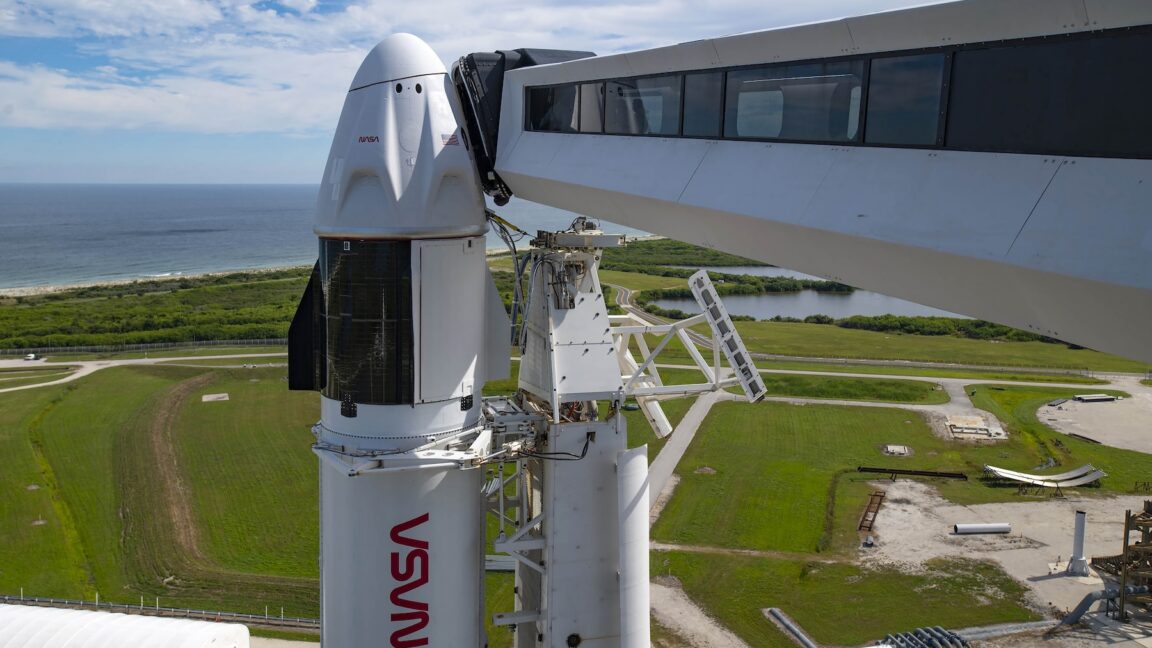
Launch Complex 39A at NASA's Kennedy Space Center in Florida is accustomed to getting makeovers. It got another one Wednesday with the removal of the Crew Access Arm used by astronauts to board their rides to space.
Construction workers first carved the footprint for the launch pad from the Florida wetlands more than 60 years ago. NASA used the site to launch Saturn V rockets dispatching astronauts to the Moon, then converted the pad for the Space Shuttle program. The last shuttle flight lifted off from Pad 39A in 2011, and the agency leased the site to SpaceX for use as the departure point for the company's Falcon 9 and Falcon Heavy rockets.
SpaceX started launching from Pad 39A in 2017, then installed a new Crew Access Arm on the pad's tower the following year, replacing the aging shuttle-era arm that connected to the hatches of NASA's orbiters. SpaceX added the new arm ahead of the first test flight of the company's human-rated Crew Dragon spacecraft in 2019. Astronauts started using the pathway, suspended more than 200 feet above the pad surface, beginning with the first crew flight on a Dragon spacecraft in 2020.
Darktrace researchers caught a sample of malware that was created by AI and LLMs to exploit the high-profiled React2Shell vulnerability, putting defenders on notice that the technology lets even lesser-skilled hackers create malicious code and build complex exploit frameworks.
A global survey of 1,813 IT and cybersecurity professionals finds that despite the rise of artificial intelligence (AI) and automation, cybersecurity teams still spend on average 44% of their time on manual or repetitive work. Conducted by Sapio Research on behalf of Tines, a provider of an automation platform, the survey also notes that as..
BrianFagioli writes: The Linux Mint developers say they are considering adopting a longer development cycle, arguing that the project's current six month cadence plus LMDE releases leaves too little room for deeper work. In a recent update, the team reflected on its incremental philosophy, independence from upstream decisions like Snap, and heavy investment in Cinnamon and XApp. While the release process "works very well" and delivers steady improvements, they admit it consumes significant time in testing, fixing, and shipping, potentially capping ambition.
Mint's next release will be based on a new Ubuntu LTS, and the team says it is seriously interested in stretching the development window. The stated goal is to free up resources for more substantial development rather than constant release management. Whether this signals bigger technical changes or simply acknowledges bandwidth limits for a small team remains unclear, but it marks a notable rethink of one of desktop Linux's most consistent release rhythms.
Last May, law enforcement authorities around the world scored a key win when they hobbled the infrastructure of Lumma, an infostealer that infected nearly 395,000 Windows computers over just a two-month span leading up to the international operation. Researchers said Wednesday that Lumma is once again “back at scale” in hard-to-detect attacks that pilfer credentials and sensitive files.
Lumma, also known as Lumma Stealer, first appeared in Russian-speaking cybercrime forums in 2022. Its cloud-based malware-as-a-service model provided a sprawling infrastructure of domains for hosting lure sites offering free cracked software, games, and pirated movies, as well as command-and-control channels and everything else a threat actor needed to run their infostealing enterprise. Within a year, Lumma was selling for as much as $2,500 for premium versions. By the spring of 2024, the FBI counted more than 21,000 listings on crime forums. Last year, Microsoft said Lumma had become the “go-to tool” for multiple crime groups, including Scattered Spider, one of the most prolific groups.
Takedowns are hard
The FBI and an international coalition of its counterparts took action early last year. In May, they said they seized 2,300 domains, command-and-control infrastructure, and crime marketplaces that had enabled the infostealer to thrive. Recently, however, the malware has made a comeback, allowing it to infect a significant number of machines again.
The National Labor Relations Board abandoned a Biden-era complaint against SpaceX after a finding that the agency does not have jurisdiction over Elon Musk's space company. The US labor board said SpaceX should instead be regulated under the Railway Labor Act, which governs labor relations at railroad and airline companies.
The Railway Labor Act is enforced by a separate agency, the National Mediation Board, and has different rules than the National Labor Relations Act enforced by the NLRB. For example, the Railway Labor Act has an extensive dispute-resolution process that makes it difficult for railroad and airline employees to strike. Employers regulated under the Railway Labor Act are exempt from the National Labor Relations Act.
In January 2024, an NLRB regional director alleged in a complaint that SpaceX illegally fired eight employees who, in an open letter, criticized CEO Musk as a “frequent source of embarrassment." The complaint sought reinstatement of the employees, back pay, and letters of apology to the fired employees.
I won’t beat around the bush (although I will suggest some devices that can do that for you veryefficiently): Valentine’s Day is coming up, so you may well be looking for some saucy gift suggestions for your other half.
As an award-winning expert who’s worked in the sexual wellbeing and pleasure sector for more than two decades, I’ve trialled thousands of vibrators and stimulators, lotions and potions, and a whole A-Z of BDSM bits and bobs. In fact, I have an entire loft room in my house dedicated to storing all my X-rated testers, samples and prototypes. I’m a trustworthy source when it comes to sauciness, so here are my top Valentine’s gift suggestions, whether mild or wild – all tried and tested. From a turmeric latte massage bar to a crotchless teddy, let’s get stuck in.
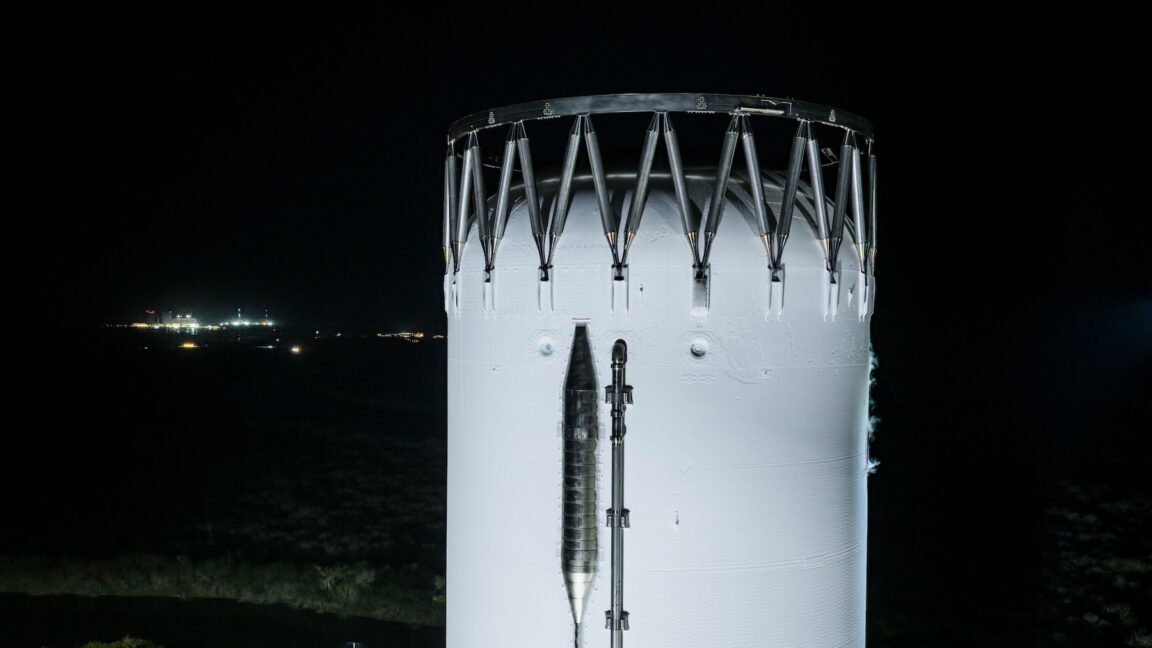
The upgraded Super Heavy booster slated to launch SpaceX's next Starship flight has completed cryogenic proof testing, clearing a hurdle that resulted in the destruction of the company's previous booster.
SpaceX announced the milestone in a social media post Tuesday: "Cryoproof operations complete for the first time with a Super Heavy V3 booster. This multi-day campaign tested the booster's redesigned propellant systems and its structural strength."
Ground teams at Starbase, Texas, rolled the 237-foot-tall (72.3-meter) stainless-steel booster out of its factory and transported it a few miles away to Massey's Test Site last week. The test crew first performed a pressure test on the rocket at ambient temperatures, then loaded super-cold liquid nitrogen into the rocket four times over six days, putting the booster through repeated thermal and pressurization cycles. The nitrogen is a stand-in for the cryogenic methane and liquid oxygen that will fill the booster's propellant tanks on launch day.
A global survey of 4,149 IT and security practitioners finds that while three-quarters (75%) expect a quantum computer will be capable of breaking traditional public key encryption within five years, only 38% at this point in time are preparing to adopt post-quantum cryptography. Conducted by the Ponemon Institute on behalf of Entrust, a provider of..
For me, vim is a combination of genuine improvements in vi’s core editing behavior (cf), frustrating (to me) bits of trying too hard to be smart (which I mostly disable when I run across them), and an extension mechanism I ignore but people use to make vim into a superintelligent editor with things like LSP integrations.
Some of the improvements and additions to vi’s core editing may be things that Bill Joy either didn’t think of or didn’t think were important enough. However, I feel strongly that some or even many of omitted features and differences are a product of the limited environments vi had to operate in. The poster child for this is vi’s support of only a single level of undo, which drastically constrains the potential memory requirements (and implementation complexity) of undo, especially since a single editing operation in vi can make sweeping changes across a large file (consider a whole-file ‘:…s/../../’ substitution, for example).
I have only very limited needs when it comes to command-line text editors, and as such, I absolutely swear by the simplicity of nano. In other words, I’m probably not the right person to dive into the editor debate that’s been raging for decades, but reading Siebenmann’s points I can’t help but agree. In this day and age, defaulting an editor that has only one level of undo is insanity, and I can’t imagine doing the kind of complex work people who use command-line editors do while being limited to just one window.
As for the debate about operating systems that symlink the vi command to vim or a similar improved variant of vi, I feel like that’s the wrong thing to do. Much like how I absolutely despise how macOS hides its UNIX-y file system structure from the GUI, leading to bizarre ls results in the terminal, I don’t think you should be tricking users. If a user enters vi, it should launch vi, and not something that kind of looks like vi but isn’t. Computers shouldn’t be lying to users.
If they don’t want their users to be using vi, they shouldn’t be installing vi in the first place.
PlayStation 5 (version tested), Xbox, PC; Grasshopper Manufacture/Marvelous Inc After some dumb fun hacking at zombies, legendary developer Suda51’s first original game in a decade sadly only delivers a host of incoherent disappointments
Ever since he baffled GameCube owners with 2005’s Killer7, Japanese game director Suda51 has had a reputation for turning heads. From parodying the banality of open-world games with 2007’s No More Heroes to collaborating with James Gunn for 2012’s pulpy Lollipop Chainsaw, his games often offer a welcome reprieve from soulless, half-a-billion-dollar-budget gaming blockbusters. It was with considerable excitement that I fired up Suda’s first new game in 10 years.
The game kicks off with a slick cartoon that shows our hero, Romeo Stargazer, being eaten by a zombie. Hastily resurrected by his zany scientist grandfather, Romeo returns from the brink imbued with new powers – and then we’re off. Almost immediately I am bombarded by an impenetrable wall of proper-noun nonsense. It’s like this for the next 20 hours.
Versa has enhanced its SASE platform by integrating text analysis and optical character recognition (OCR) capabilities to better identify sensitive data and improve cybersecurity. The updates aim to provide deeper insights for teams dealing with AI-related data risks, reduce false positives, and enable effective incident response through AI-driven alert correlation.
This article examines the widespread collection of personal data and the legal challenges individuals face from third-party subpoenas. It discusses key court rulings on government access to personal information and highlights the complexities of data privacy in the digital age.
An anonymous reader writes: Linus Torvalds has confirmed the next major kernel series as Linux 7.0, reports Linux news website 9to5Linux.com: "So there you have it, the Linux 6.x era has ended with today's Linux 6.19 kernel release, and a new one will begin with Linux 7.0, which is expected in mid-April 2026. The merge window for Linux 7.0 will open tomorrow, February 9th, and the first Release Candidate (RC) milestone is expected on February 22nd, 2026."
Cloud security titan Zscaler Inc. has acquired SquareX, a pioneer in browser-based threat protection, in an apparent move to step away from traditional, clunky security hardware and toward a seamless, browser-native defense. The acquisition, which did not include financial terms, integrates SquareX’s browser detection and response technology into Zscaler’s Zero Trust Exchange platform. Unlike traditional..
The cybersecurity landscape is undergoing a fundamental shift as chief information security officers (CISOs) shift their 2026 budgets to artificial intelligence (AI) and realign traditional defense strategies. Nearly 80% of senior security executives are prioritizing AI-driven solutions to counter increasingly sophisticated threats, a new report from Glilot Capital Partners reveals. The survey, which polled leaders..
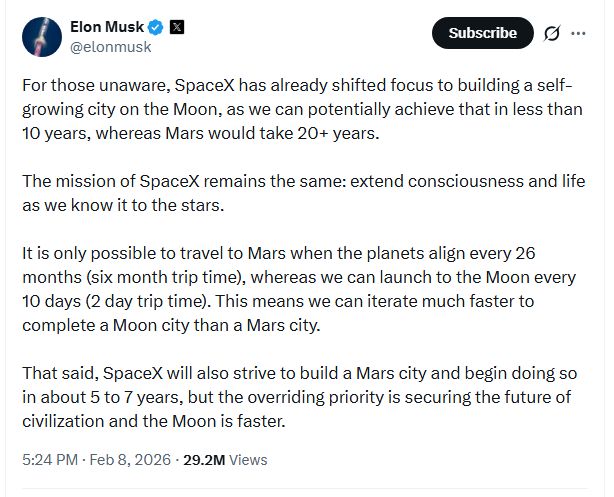
As more than 120 million people tuned in to the Super Bowl for kickoff on Sunday evening, SpaceX founder Elon Musk turned instead to his social network. There, he tapped out an extended message in which he revealed that SpaceX is pivoting from the settlement of Mars to building a "self-growing" city on the Moon.
"For those unaware, SpaceX has already shifted focus to building a self-growing city on the Moon, as we can potentially achieve that in less than 10 years, whereas Mars would take 20+ years," Musk wrote, in part.
Elon Musk tweet at 6:24 pm ET on Sunday.
Credit:
X/Elon Musk
This is simultaneously a jolting and practical decision coming from Musk.
LayerX researchers say that a security in Anthropic's Claude Desktop Extensions can be exploited to allow threat actors to place a RCE vulnerability into Google Calendar, the latest report to highlight the risks that come with giving AI models with full system privileges unfettered access to sensitive data.
We talked about Nemin’s first impressions of the Guix System as someone coming from a Nix environment, but today they’ve got a follow-up article diving into the experience of creating new packages for Guix.
I spent about a week packaging WezTerm and learning the ropes of being a Guix contributor along the way.
During the packaging process I stumble many times, only to stand back up and figure out a solution. I also explain some of my complaints about the peculiarities of the process, but also provide plenty of praise about of how much the system tries to enable you to do your job. Finally, I also touch on how positive the experience of the code review was.
These are the kinds of content a rather niche system like Guix needs. Guix isn’t exactly one of the popular picks out there, so having level-headed, honest, but well-written introductions to its core concepts and user experience, written by a third party is going to do wonders for people interested in trying it out.
After a sexually frustrating marriage led to divorce, I chased increasingly extreme BDSM encounters. But I never felt truly satisfied. Had I been looking for the wrong thing all along?
To everyone else, it probably looked like a regular summer’s evening. Couples and families enjoying the beer garden, people playing cricket on the green – and I was being handcuffed in the passenger seat of a 4x4 by a man I barely knew.
Move over Snoopy, because NASA has a new character helping to promote its deep space exploration plans. His name is Uncle Traveling Matt.
No really, move over.
Fraggle Rock: A Space-y Adventure has taken over the same theater the Kennedy Space Center Visitor Complex in Florida previously used for All Systems Are Go, featuring the comic strip beagle. The new stage show stars the Jim Henson Company's subterranean Muppets as they discover outer (outer) space for the first time.
Threat actors using LLMs needed only eight minutes to move from initial access to full admin privileges in an attack on a company's AWS cloud environment in the latest example of cybercriminals expanding their use of AI in their operations, Sysdig researchers said.
Microsoft has released LiteBox, an experimental open-source library OS designed to sandbox applications while reducing their exposure to host systems. Written in Rust and published under the MIT license, LiteBox reflects the company’s efforts to upgrade software security as confidential computing gains adoption. LiteBox takes a different path from traditional virtualization or container technologies. Rather..
There is a time window for every act of online fraud. When a transaction occurs, a fraud system must review it and decide if it’s legitimate before the payment clears or if the account could be compromised. That window happens in a blink, often one-tenth of a second or less. During that time, models must..
Welcome to Edition 8.28 of the Rocket Report! The big news in rocketry this week was that NASA still hasn't solved the problem with hydrogen leaks on the Space Launch System. The problem caused months of delays before the first SLS launch in 2022, and the fuel leaks cropped up again Monday during a fueling test on NASA's second SLS rocket. It is a continuing problem, and NASA's sparse SLS launch rate makes every countdown an experiment, as my colleague Eric Berger wrote this week. NASA will conduct another fueling test in the coming weeks after troubleshooting the rocket's leaky fueling line, but the launch of the Artemis II mission is off until March.
As always, we welcome reader submissions. If you don't want to miss an issue, please subscribe using the box below (the form will not appear on AMP-enabled versions of the site). Each report will include information on small-, medium-, and heavy-lift rockets, as well as a quick look ahead at the next three launches on the calendar.
Blue Origin "pauses" New Shepard flights. Blue Origin has "paused" its New Shepard program for the next two years, a move that likely signals a permanent end to the suborbital space tourism initiative, Ars reports. The small rocket and capsule have been flying since April 2015 and have combined to make 38 launches, all but one of which were successful, and 36 landings. In its existence, the New Shepard program flew 98 people to space, however briefly, and launched more than 200 scientific and research payloads into the microgravity environment.
In 2026 stolen credentials and unmanaged machine identities drive breaches—small buys, phone scams, and weak IAM make identity the real perimeter; prioritize inventory, least privilege, and stronger auth.
By 2026 humans remain cybersecurity’s weakest—and most vital—link as AI-enabled social engineering rises; prioritize behavioral design, real‑time interventions, and leadership.
Start PQC pilots now—not to prove readiness but to surface interoperability, vendor, inventory, and skills gaps so organizations can manage post-quantum migration risks.
Alan discovers how the Super Bowl acts as a live-fire exercise in cybersecurity, requiring seamless coordination to manage massive attack surfaces and ensure integrity and trust in real time.
OpenAI has announced a new initiative aimed at strengthening digital defenses while managing the risks that come with capable artificial intelligence systems. The effort, called Trusted Access for Cyber, is part of a broader strategy to enhance baseline protection for all users while selectively expanding access to advanced cybersecurity capabilities for vetted defenders. The initiative centers on the use of frontier models such as GPT-5.3-Codex, which OpenAI identifies as its most cyber-capable reasoning model to date, and tools available through ChatGPT.
What is Trusted Access for Cyber?
Over the past several years, AI systems have evolved rapidly. Models that once assisted with simple tasks like auto-completing short sections of code can now operate autonomously for extended periods, sometimes hours or even days, to complete complex objectives. In cybersecurity, this shift is especially important. According to OpenAI, advanced reasoning models can accelerate vulnerability discovery, support faster remediation, and improve resilience against targeted attacks. At the same time, these same capabilities could introduce serious risks if misused.Trusted Access for Cyber is intended to unlock the defensive potential of models like GPT-5.3-Codex while reducing the likelihood of abuse. As part of this effort, OpenAI is also committing $10 million in API credits to support defensive cybersecurity work.
Expanding Frontier AI Access for Cyber Defense
OpenAI argues that the rapid adoption of frontier cyber capabilities is critical to making software more secure and raising the bar for security best practices. Highly capable models accessed through ChatGPT can help organizations of all sizes strengthen their security posture, shorten incident response times, and better detect cyber threats. For security professionals, these tools can enhance analysis and improve defenses against severe and highly targeted attacks.The company notes that many cyber-capable models will soon be broadly available from a range of providers, including open-weight models. Against that backdrop, OpenAI believes it is essential that its own models strengthen defensive capabilities from the outset. This belief has shaped the decision to pilot Trusted Access for Cyber, which prioritizes placing OpenAI’s most capable models in the hands of defenders first.A long-standing challenge in cybersecurity is the ambiguity between legitimate and malicious actions. Requests such as “find vulnerabilities in my code” can support responsible patching and coordinated disclosure, but they can also be used to identify weaknesses for exploitation. Because of this overlap, restrictions designed to prevent harm have often slowed down good-faith research. OpenAI says the trust-based approach is meant to reduce that friction while still preventing misuse.
How Trusted Access for Cyber Works
Frontier models like GPT-5.3-Codex are trained with protection methods that cause them to refuse clearly malicious requests, such as attempts to steal credentials. In addition to this safety training, OpenAI uses automated, classifier-based monitoring to detect potential signals of suspicious cyber activity. During this calibration phase, developers and security professionals using ChatGPT for cybersecurity tasks may still encounter limitations.Trusted Access for Cyber introduces additional pathways for legitimate users. Individual users can verify their identity through a dedicated cyber access portal. Enterprises can request trusted access for entire teams through their OpenAI representatives. Security researchers and teams that require even more permissive or cyber-capable models to accelerate defensive work can apply to an invite-only program. All users granted trusted access must continue to follow OpenAI’s usage policies and terms of use.The framework is designed to prevent prohibited activities, including data exfiltration, malware creation or deployment, and destructive or unauthorized testing, while minimizing unnecessary barriers for defenders. OpenAI expects both its mitigation strategies and Trusted Access for Cyber itself to evolve as it gathers feedback from early participants.
Scaling the Cybersecurity Grant Program
To further support defensive use cases, OpenAI is expanding its Cybersecurity Grant Program with a $10 million commitment in API credits. The program is aimed at teams with a proven track record of identifying and remediating vulnerabilities in open source software and critical infrastructure systems. By pairing financial support with controlled access to advanced models like GPT-5.3-Codex through ChatGPT, OpenAI seeks to accelerate legitimate cybersecurity research without broadly exposing powerful tools to misuse.
On Thursday, Anthropic and OpenAI shipped products built around the same idea: instead of chatting with a single AI assistant, users should be managing teams of AI agents that divide up work and run in parallel. The simultaneous releases are part of a gradual shift across the industry, from AI as a conversation partner to AI as a delegated workforce, and they arrive during a week when that very concept reportedly helped wipe $285 billion off software stocks.
Whether that supervisory model works in practice remains an open question. Current AI agents still require heavy human intervention to catch errors, and no independent evaluation has confirmed that these multi-agent tools reliably outperform a single developer working alone.
Even so, the companies are going all-in on agents. Anthropic's contribution is Claude Opus 4.6, a new version of its most capable AI model, paired with a feature called "agent teams" in Claude Code. Agent teams let developers spin up multiple AI agents that split a task into independent pieces, coordinate autonomously, and run concurrently.
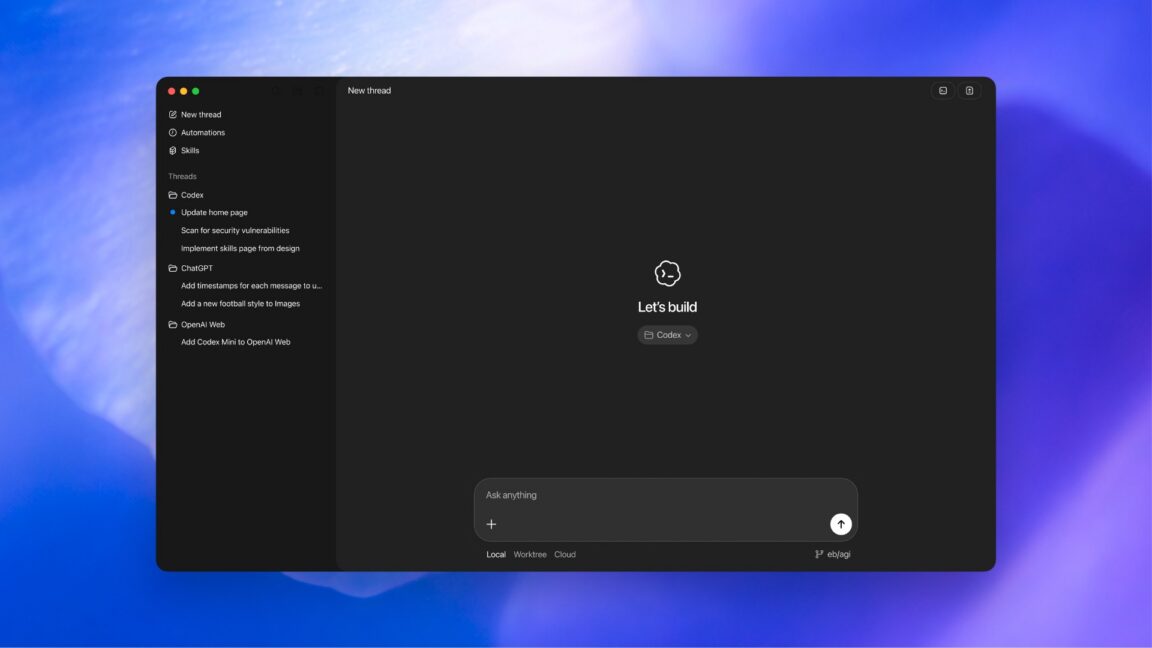
Today, OpenAI announced GPT-5.3-Codex, a new version of its frontier coding model that will be available via the command line, IDE extension, web interface, and the new macOS desktop app. (No API access yet, but it's coming.)
GPT-5.3-Codex outperforms GPT-5.2-Codex and GPT-5.2 in SWE-Bench Pro, Terminal-Bench 2.0, and other benchmarks, according to the company's testing.
There are already a few headlines out there saying "Codex built itself," but let's reality-check that, as that's an overstatement. The domains OpenAI described using it for here are similar to the ones you see in some other enterprise software development firms now: managing deployments, debugging, and handling test results and evaluations. There is no claim here that GPT-5.3-Codex built itself.
Unit 42 researchers say an Asian threat group behind what they call the Shadow Campaigns has targeted government agencies in 37 countries in a wide-ranging global cyberespionage campaign that has involved phishing attacks and the exploitation of a more than a dozen known vulnerabilities.
Orchid Security today added an ability to conduct audits to its platform that enables cybersecurity teams to track behaviors of specific identities. Company CEO Roy Katmor said Identity Audit is designed to make it possible to unify proprietary audit data captured from unmanaged applications with audit logs data collected from third-party identity and access management..
As the enterprise world shifts from chatbots to autonomous systems, Operant AI on Thursday launched Agent Protector, a real-time security solution designed to govern and shield artificial intelligence (AI) agents. The launch comes at a critical inflection point for corporate technology. Gartner predicts that by the end of 2026, 40% of enterprise applications will feature..

 Login
Login














































 Elon Musk tweet at 6:24 pm ET on Sunday.
Credit:
X/Elon Musk
Elon Musk tweet at 6:24 pm ET on Sunday.
Credit:
X/Elon Musk