Reading view

Discord Introduces Stronger Teen Safety Controls Worldwide

Discord teen-by-default settings

Discord teen-by-default settings are now rolling out globally, marking a major shift in how the popular communication platform handles safety for users aged 13 to 17. The move signals a clear message from Discord: protecting teens online is no longer optional, it is expected. The Discord update applies to all new and existing users worldwide and introduces age-appropriate defaults, restricted access to sensitive content, and stronger safeguards around messaging and interactions. While Discord positions this as a safety-first upgrade, the announcement also arrives at a time when gaming and social platforms are under intense regulatory and public scrutiny.

What Discord Teen-by-Default Settings Actually Change

Discord, headquartered in San Francisco and used by more than 200 million monthly active users, says the new Discord teen-by-default settings are designed to create safer experiences without breaking the sense of community that defines the platform. Cyble Annual Threat Landscape Report, Annual Threat Landscape Report, Cyble Annual Threat Landscape Report 2025, Threat Landscape Report 2025, Cyble, Ransomware, Hacktivism, AI attacks, Vulnerabilities, APT, ICS Vulnerabilities Under the new system, teen users automatically receive stricter communication settings. Sensitive content remains blurred, access to age-restricted servers is blocked, and direct messages from unknown users are routed to a separate inbox. Only age-verified adults can change these defaults. The company says these measures are meant to protect teens while still allowing them to connect around shared interests like gaming, music, and online communities.

Age Verification, But With Privacy Guardrails

Age assurance sits at the core of the Discord teen-by-default settings rollout. Starting in early March, users may be asked to verify their age if they want to access certain content or change safety settings. Discord is offering multiple options: facial age estimation processed directly on a user’s device, or submission of government-issued ID through approved vendors. The company has also introduced an age inference model that runs quietly in the background to help classify accounts without always forcing verification. Discord stresses that privacy remains central. Video selfies never leave the device, identity documents are deleted quickly, and a user’s age status is never visible to others. In most cases, verification is a one-time process.

Why it Matters Now Than Ever Before

The timing of the Discord teen-by-default settings rollout is no coincidence. In October 2025, Discord disclosed a data breach involving a third-party vendor that handled customer support and age verification. While Discord’s own systems were not breached, attackers accessed government ID photos submitted for age verification, limited billing data, and private support conversations. The incident reignited concerns about whether platforms can safely handle sensitive identity data—especially when minors are involved. For many users, that trust has not fully recovered. At the same time, regulators are tightening the screws. The U.S. Federal Trade Commission has publicly urged companies to adopt age verification tools faster. Platforms like Roblox are rolling out facial AI and ID-based age estimation, while Australia has gone further by banning social media use for children under 16. Similar discussions are underway across Europe.

Teen Safety Meets Public Skepticism

Not everyone is convinced. Online reaction, particularly on Reddit, has been harsh. Some users accuse Discord of hypocrisy, pointing to past breaches and questioning the wisdom of asking users to upload IDs to third-party vendors. Others see the changes as the beginning of the end for Discord’s open community model. There is also concern among game studios and online communities that rely heavily on Discord. If access becomes more restricted, some fear engagement could drop—or migrate elsewhere.

Giving Teens a Voice, Not Just Rules

To balance control with understanding, Discord is launching its first Teen Council, a group of 10–12 teens aged 13 to 17 who will advise the company on safety, product design, and policy decisions. The goal is to avoid guessing what teens need and instead hear it directly from them. This approach acknowledges a hard truth: safety tools only work if teens understand them and trust the platform using them.

A Necessary Shift, Even If It’s Uncomfortable

The Discord teen-by-default settings rollout reflects a broader industry reality. Platforms built for connection can no longer rely on self-reported ages and loose moderation. Governments, parents, and regulators are demanding stronger protections—and they are willing to step in if companies do not act. Discord’s approach won’t please everyone. But in today’s climate, doing nothing would be far riskier. Whether this move strengthens trust or fuels backlash will depend on how well Discord protects user data—and how honestly it continues to engage with its community.
  •  

UAE Cyber Security Council Warns Stolen Logins Fuel Majority of Financial Cyberattacks

UAE Cyber Security Council

The UAE Cyber Security Council has issued a renewed warning about the growing threat of financial cybercrime, cautioning that stolen login credentials remain the most common entry point for attacks targeting individuals, companies, and institutions. According to the council, around 60% of financial cyberattacks begin with the theft of usernames and passwords, making compromised credentials a primary gateway for fraud, identity theft, and unauthorized access to sensitive financial information.  In comments to the Emirates News Agency (WAM), the UAE Cyber Security Council said that financial data remains one of the most sought-after assets for cybercriminals, particularly as digital banking and online transactions become more deeply embedded in daily life. The council stressed that while threat actors are increasingly sophisticated, many successful attacks still exploit basic security weaknesses that can be mitigated through stronger digital hygiene. Cyble Annual Threat Landscape Report, Annual Threat Landscape Report, Cyble Annual Threat Landscape Report 2025, Threat Landscape Report 2025, Cyble, Ransomware, Hacktivism, AI attacks, Vulnerabilities, APT, ICS Vulnerabilities The council urged individuals and organizations to exercise greater caution when handling financial information online, emphasizing that simple preventive steps can reduce exposure to cyber risks. Users were advised against storing sensitive passwords on unsecured or inadequately protected devices, and were encouraged to regularly review privacy settings, remove untrusted applications, and ensure operating systems and software are kept up to date. 
Also read: The Top 25 Women Cybersecurity Leaders in the UAE in 2025

Emirates News Agency Reports 60% of Attacks Begin with Compromised Credentials 

Speaking to the Emirates News Agency, the UAE Cyber Security Council highlighted two-factor authentication as one of the most effective defenses against unauthorized access. The council described multi-factor security controls as a critical layer of protection in an environment where stolen credentials are frequently traded, reused, or exploited across multiple platforms. “Every step taken to protect personal and financial data contributes directly to reducing the likelihood of falling victim to online fraud,” the council said.  The council also warned that cybercriminals often gain access to financial information indirectly. Rather than attacking banking systems outright, attackers may first compromise email or social media accounts and then use those accounts to reset passwords or harvest banking details. This method enables fraudsters to remain undetected while expanding their access to more sensitive systems.  To counter this, the UAE Cyber Security Council called on users to adopt safer digital habits, including using secure payment methods, avoiding the storage of financial data on mobile phones or personal computers, and monitoring bank accounts regularly for suspicious activity. The council also recommended enabling instant bank alerts to receive real-time notifications of account activity, allowing for rapid response and immediate reporting in the event of a breach. 

Council Urges Stronger Digital Habits to Protect Banking and Financial Data 

The council further cautioned against engaging with fake advertisements, phishing messages, or unverified online entities. According to the Emirates News Agency, fraudsters are increasingly using advanced technologies to imitate the logos, branding, and messaging styles of banks and trusted financial institutions, making fraudulent communications harder to identify. Users were urged to carefully verify messages, avoid clicking on suspicious links, and refrain from sharing personal or financial information outside official banking channels.  As part of its ongoing weekly cybersecurity awareness efforts, the UAE Cyber Security Council emphasized the importance of constant vigilance to prevent attacks targeting financial and banking data. It noted that cyber threats may take the form of direct attacks on bank accounts or indirect identity theft through unauthorized access to personal accounts, often resulting in financial losses.  The council also advised against using open or free Wi-Fi networks for banking activities or financial transactions, warning that such networks are often unsecured and vulnerable to interception. It stressed the importance of creating strong, unique passwords for banking and financial service accounts, noting that password reuse increases the risk of compromise. 
Also read: UAE Cyber Security Council Flags 70% Smart Home Devices as Vulnerable
  •  

EU and Singapore Deepen Tech Ties, Prioritize AI Safety and Cybersecurity

European Union

The European Union and Singapore are intensifying their digital collaboration, following the second meeting of the Digital Partnership Council in Brussels. The discussions stressed strategic priorities across critical technology sectors, including artificial intelligence (AI), cybersecurity, semiconductors, and digital trade.   The Digital Partnership Council was co-chaired by Henna Virkkunen, Executive Vice-President of the European Commission for Tech Sovereignty, Security and Democracy, and Josephine Teo, Singapore’s Minister for Digital Development and Information. Since the European Union and Singapore partnership was launched in February 2023, the council has monitored progress and adjusted its focus to reflect current technological and market developments. 

European Union and Singapore on AI and Digital Safety 

AI remained a central topic, with both the European Union and Singapore reaffirming the importance of existing frameworks that ensure the safe development and deployment of AI technologies. Future cooperation was discussed in areas such as language AI models, linking the EU’s Alliance for Language Technologies European Digital Infrastructure Consortium (ALT-EDIC) with Singapore’s Sea-Lion model.   Online safety and scam prevention were also highlighted as growing priorities. Both parties expressed a commitment to protecting vulnerable groups, particularly minors, by exploring tools such as age-verification mechanisms and digital protection that enhance user trust online. 

Digital Trust and Identity 

Strengthening digital trust remains a key goal under the EU–Singapore Digital Partnership. The council explored the development of interoperable trust services and verifiable credentials that could enable secure cross-border digital identity use cases. This approach aims to simplify regulatory compliance and facilitate smoother digital transactions across sectors, supporting both public and private initiatives.  Cybersecurity remains a cornerstone of the Digital Partnership Council’s agenda. Both the European Union and Singapore emphasized the importance of assessing new cyber threats and reinforcing resilience through coordinated bilateral and multilateral actions. The ongoing focus reflects recognition of cybersecurity’s vital role in sustaining market confidence and protecting digital infrastructure. 

Data, Semiconductors, and New Technologies 

The council also reviewed strategies to enhance cross-border data flows and explored potential collaboration in shared data spaces. Both parties expressed interest in research partnerships in semiconductors and quantum technologies, recognizing the value of cross-border investments and scientific collaboration under frameworks such as Horizon Research. These initiatives aim to strengthen innovation capabilities and ensure long-term technological competitiveness.  The EU and Singapore reaffirmed their goal for digital trade, building on the Digital Trade Agreement signed in May 2025. This agreement sets binding rules that enhance legal certainty, protect consumers, and remove unnecessary barriers to digital commerce. Through this framework, the Digital Partnership Council seeks to foster economic security and innovation while reinforcing international digital standards. 

A Strategic Framework for Future Cooperation 

Since its inception in 2023, the EU–Singapore Digital Partnership has aimed to empower businesses and citizens to fully leverage technological opportunities. The partnership has focused on bridging the digital divide, promoting trusted data flows, developing digital identities, and fostering skills and research excellence.   By continuing to align strategies and advance joint projects, the European Union and Singapore are setting a model for international digital cooperation, ensuring that both economies remain competitive and secure in the technology-driven world. 
  •  

London Councils Hit by Cyber Incident, Services Temporarily Disrupted

London councils

Three London councils are responding to a major cybersecurity incident that has disrupted public services and triggered alerts across the capital. The Royal Borough of Kensington and Chelsea (RBKC), Westminster City Council (WCC), and Hammersmith and Fulham Council confirmed on Tuesday evening (November 25) that they were investigating a serious Account Takeover Fraud–related cyber issue affecting shared systems. The situation has raised concerns as local authorities increase monitoring and coordinate with national agencies to understand the scale of the London councils cyberattack.

London Councils Confirm Cybersecurity Incident

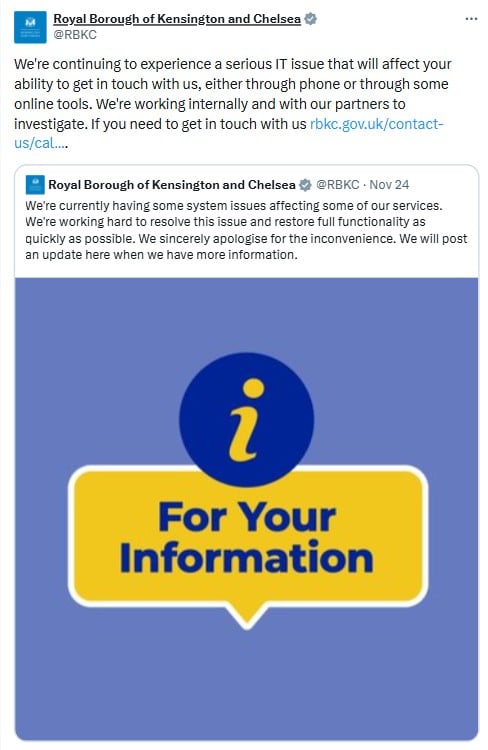
RBKC issued an official statement revealing that both its systems and those of Westminster City Council were impacted by what it described as a “cyber security issue.” The London councils cyberattack incident, detected early on Monday morning (November 24), prompted both councils to notify the UK Information Commissioner’s Office (ICO) and work closely with the National Cyber Security Centre (NCSC) and specialist cyber incident responders. Officials said the focus remains on securing systems, protecting data, and restoring essential services. The first public indication of disruption came when RBKC posted on X around 1pm on Monday, warning of “system issues” affecting online services. By Tuesday morning, the council described the situation as a “serious IT issue,” confirming wider service interruptions as investigations continued. [caption id="attachment_107162" align="aligncenter" width="488"]London Councils Cyberattack Source: X[/caption] WCC issued a similar update, explaining that its computer networks were temporarily shut down as a precaution. The council apologised to residents for the inconvenience but emphasised that immediate action was necessary to prevent further impact. “We are taking swift and effective action to bring all our systems back online as soon as possible,” the council stated on its website. Emergency contact numbers were provided for urgent issues.

Multiple London Authorities Heighten Threat Levels

In the wake of the London councils cyberattack, Hackney Council circulated an internal “urgent communication,” warning staff that intelligence indicated multiple London councils had been targeted by cyberattacks within the last 24 to 48 hours. As a result, the borough escalated its internal cyber threat level to Critical. Hackney officials have experience responding to major cybersecurity incidents, following a severe attack in 2020 that affected hundreds of thousands of residents and staff. Hammersmith and Fulham Council also reported that it had responded to a serious cybersecurity incident, although the local authority stated that, so far, there was no evidence that its systems had been breached. Across the affected boroughs, several IT systems, online portals, and phone lines remain disrupted. To maintain essential services, councils activated business continuity and emergency plans, prioritising support for vulnerable residents. Additional staff have been assigned to monitor phone lines and emails while restoration work continues.

Authorities Investigating Potential Data Exposure

RBKC and WCC noted that it is still too early to determine the root cause, the extent of the incident, or whether any personal data has been compromised. However, officials confirmed that investigations are underway to determine whether the attack involved techniques similar to Account Takeover Fraud or other targeted compromise attempts. “We don’t have all the answers yet,” RBKC said, “but we know people will have concerns, so we will be updating residents and partners further over the coming days.” Council IT teams worked overnight on Monday to apply several mitigation measures, and officials said they remain vigilant for any potential follow-up attempts.

National Agencies Monitoring the Situation

A spokesperson for the National Cyber Security Centre confirmed awareness of the incident and said the agency is “working to understand any potential impact.” The NCSC continues to support local authorities in managing the wider threat. The Metropolitan Police Cyber Crime Unit also confirmed it received a referral from Action Fraud on Monday following reports of a suspected cyber-attack against several London borough councils. “Enquiries remain in the early stages,” a spokesperson said, adding that no arrests have been made so far. All affected councils apologised for the disruption and urged residents to expect delays in accessing some services. They also committed to providing further updates as system recovery progresses. For concerns related to Westminster or Hammersmith and Fulham, residents were advised to contact those authorities directly.
  •