Reading view

Senegal Confirms Cyberattack on Agency Managing National ID and Biometric Data

Senegal cyberattack

The recent Senegal cyberattack on the Directorate of File Automation (DAF) has done more than disrupt government services. It has exposed how vulnerable the country’s most sensitive data systems really are, and why cybersecurity can no longer be treated as a technical issue handled quietly in the background. DAF, the government agency responsible for managing national ID cards, passports, biometric records, and electoral data, was forced to temporarily shut down operations after detecting a cyber incident. For millions of Senegalese citizens, this means delays in accessing essential identity services. For the country, it raises far bigger concerns about data security and national trust.

Senegal Cyberattack Brings Identity Services to a Standstill

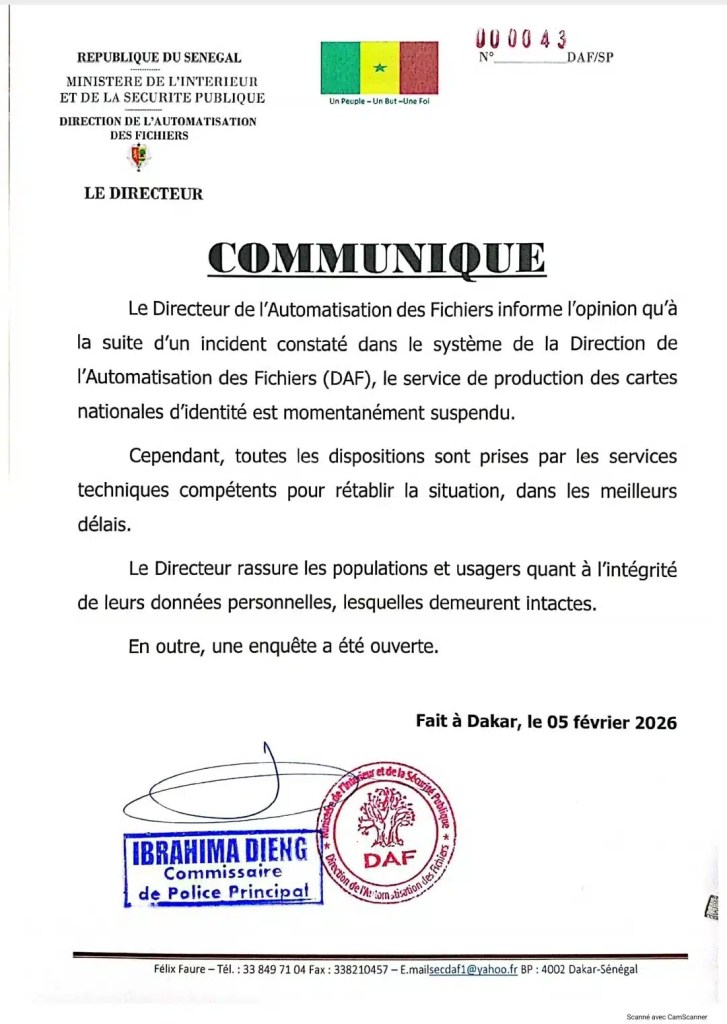
In an official public notice, DAF confirmed that the production of national identity cards had been suspended following the cyberattack. Authorities assured citizens that personal data had not been compromised and that systems were being restored. However, as days passed and the DAF website remained offline, doubts began to grow. A Senegal cyberattack affecting such a critical agency is not something that can be brushed off quickly, especially when biometric and identity data are involved. [caption id="attachment_109392" align="aligncenter" width="500"]Senegal Cyberattack Image Source: X[/caption]

Hackers Claim Theft of Massive Biometric Data

The situation escalated when a ransomware group calling itself The Green Blood Group claimed responsibility for the attack. The group says it stole 139 terabytes of data, including citizen records, biometric information, and immigration documents. To back up its claims, the hackers released data samples on the dark web. They also shared an internal email from IRIS Corporation Berhad, a Malaysian company working with Senegal on its digital national ID system. In the email, a senior IRIS executive warned that two DAF servers had been breached and that card personalization data may have been accessed. Emergency steps were taken, including cutting network connections and shutting access to external offices. Even if authorities insist that data integrity remains intact, the scale of the alleged breach makes the Senegal cyberattack impossible to ignore.

Implications of the Senegal Cyberattack

DAF is not just another government office. It manages the digital identities of Senegalese citizens. Any compromise—real or suspected—creates long-term risks, from identity fraud to misuse of biometric data. What makes this incident more worrying is that it is not the first major breach. Just months ago, Senegal’s tax authority also suffered a cyberattack. Together, these incidents point to a larger problem: critical systems are being targeted, and attackers are finding ways in. Cybercrime groups are no longer experimenting in Africa. They are operating with confidence, speed, and clear intent. The Green Blood Group, which appeared only recently, has reportedly targeted just two countries so far—Senegal and Egypt. That alone should be taken seriously.

Disputes, Outsourcing, and Cybersecurity Blind Spots

The cyberattack also comes during a payment dispute between the Senegalese government and IRIS Corporation. While no official link has been confirmed, the situation highlights a key issue: when governments rely heavily on third-party vendors, cybersecurity responsibility can become blurred. The lesson from this Senegal cyberattack is simple and urgent. Senegal needs a dedicated National Cybersecurity Agency, along with a central team to monitor, investigate, and respond to cyber incidents across government institutions. Cyberattacks in Africa are no longer rare or unexpected. They are happening regularly, and they are hitting the most sensitive systems. Alongside better technology, organizations must focus on insider threats, staff awareness, and leadership accountability. If sensitive data from this attack is eventually leaked, the damage will be permanent. Senegal still has time to act—but only if this warning is taken seriously.

  •  

The Cyber Express Weekly Roundup: FortiOS Exploits, Ransomware, Hacktivist Surge, and EU Telecom Rules

The Cyber Express cybersecurity roundup

The third week of 2026 highlights a series of cybersecurity events affecting businesses, critical infrastructure, and regulatory compliance. This week, network administrators are grappling with the exploitation of a previously patched FortiOS vulnerability, while ransomware attacks continue to expose sensitive data across major corporations.   Meanwhile, hacktivist groups are targeting industrial systems and government networks, and the European Union has introduced new rules to phase out high-risk telecom and ICT products from non-EU suppliers.  These incidents demonstrate that cybersecurity risks are no longer confined to IT systems. They now intersect with national security, operational continuity, and regulatory oversight, requiring organizations to adopt both technical defenses and strategic risk management measures.  

The Cyber Express Weekly Roundup 

Active Exploits Hit “Patched” FortiOS 7.4.9 

Administrators report active exploitation of CVE-2025-59718 on FortiGate devices running FortiOS 7.4.9. Attackers bypass authentication through forged FortiCloud SSO logins, creating local admin accounts to maintain access. Evidence suggests that the patch may be incomplete or bypassed. Experts advise manually disabling FortiCloud SSO via CLI and auditing logs for unusual SSO activity, new admin accounts, and configuration exports. Read more… 

Ingram Micro Data Breach Exposes 42,521 Individuals 

A ransomware attack in July 2025 compromised sensitive employee and job applicant data at Ingram Micro, affecting 42,521 individuals. Exposed information includes names, contact details, dates of birth, Social Security numbers, and employment records. The attack disrupted logistics operations for about a week and was discovered in December 2025. Affected individuals have been notified and offered two years of credit monitoring and identity protection. Read more… 

One in Ten UK Businesses Could Fail After Major Cyberattack 

A Vodafone Business survey found over 10% of UK business leaders fear their organizations could fail after a major cyberattack. While 63% acknowledge rising cyber risks and 89% say high-profile breaches increased alertness, only 45% provide basic cyber-awareness training to all staff. Weak passwords, phishing, and emerging AI/deepfake scams heighten vulnerabilities. Read more… 

EU Proposes Rules on “High-Risk” Telecom Products 

The European Commission proposed updates to the Cybersecurity Act to phase out “high-risk” ICT products from mobile, fixed, and satellite networks supplied by risky countries, including China and Russia. Mobile networks have 36 months to comply; timelines for other networks will follow. Read more… 

Hacktivist Activity Surges, Targeting Critical Infrastructure 

The Cyble 2025 Threat Landscape report shows hacktivists targeting ICS, OT, and HMI/SCADA systems. Groups like Z-Pentest, Dark Engine, and NoName057(16) focused on industrial sectors in Europe and Asia. Hacktivist activity rose 51% in 2025, driven largely by pro-Russian and pro-Palestinian collectives. Many groups aligned with state interests, including GRU-backed Russian operations and Iranian-linked teams. Read more… 

NCSC Warns UK Organizations of Russian-Aligned Hacktivists 

The UK National Cyber Security Centre (NCSC) warned that Russian-aligned hacktivists, including NoName057(16), increasingly target UK organizations with denial-of-service attacks on local government and critical infrastructure. While technically simple, these attacks can severely disrupt services. Read more… 

Weekly Roundup Takeaway 

This week’s events highlight that cybersecurity in 2026 continues to influence business continuity, infrastructure integrity, and regulatory compliance. From FortiOS exploits and large-scale ransomware breaches to rising hacktivist activity and evolving EU telecom rules, organizations must integrate operational, technical, and strategic measures to mitigate risk and protect assets across sectors. 
  •  

European Space Agency Confirms Cybersecurity Breach on External Servers

European Space Agency Confirms Cybersecurity Breach

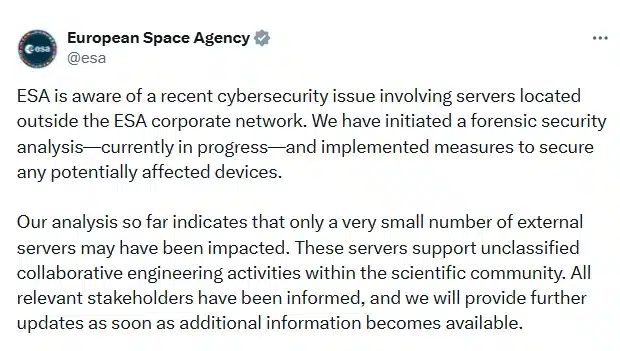
The European Space Agency (ESA) has confirmed a cybersecurity breach involving servers located outside its corporate network. This confirmation comes following threat actor claim that they had compromised ESA systems and stolen a large volume of internal data. While ESA maintains that only unclassified information was affected. In an official statement shared on social media, the European Space Agency said it is aware of the cybersecurity issue and has already launched a forensic security investigation, which remains ongoing. According to ESA, preliminary findings indicate that only a very small number of external servers were impacted. “These servers support unclassified collaborative engineering activities within the scientific community,” ESA stated, emphasizing that the affected infrastructure does not belong to its internal corporate network. The agency added that containment measures have been implemented to secure potentially affected devices and that all relevant stakeholders have been informed. [caption id="attachment_108221" align="aligncenter" width="620"]European Space Agency Source: ESA Twitter Handle[/caption] ESA said it will provide further updates as additional details become available.
Threat Actor Claims Data Theft

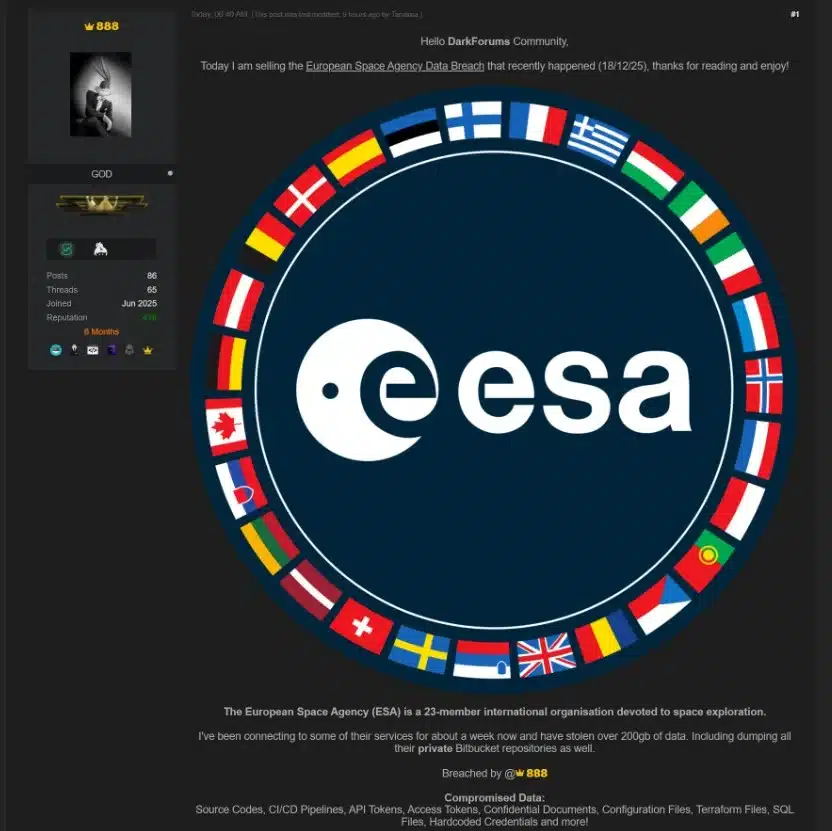
The confirmation follows claims posted on BreachForums and DarkForums, where a hacker using the alias “888” alleges responsibility for the cybersecurity breach. According to the posts, the attack occurred on December 18, 2025, and resulted in the full exfiltration of internal ESA development assets. The threat actor claims to have stolen over 200 GB of data, including private Bitbucket repositories, source code, CI/CD pipelines, API tokens, access tokens, configuration files, Terraform files, SQL files, confidential documents, and hardcoded credentials. “I’ve been connecting to some of their services for about a week now and have stolen over 200GB of data, including dumping all their private Bitbucket repositories,” the actor wrote in one forum post. The stolen data is reportedly being offered as a one-time sale, with payment requested exclusively in Monero (XMR), a cryptocurrency commonly associated with underground cybercrime marketplaces. [caption id="attachment_108222" align="aligncenter" width="832"]ESA Threat Actor Claim Source: Data Breach Fourm[/caption] ESA has not verified the authenticity or scope of the claims made by the threat actor. So far, ESA has not disclosed which specific external servers were compromised or whether any credentials or development assets referenced by the threat actor were confirmed to be exposed. Founded 50 years ago and headquartered in Paris, the European Space Agency is an intergovernmental organization that coordinates space activities across 23 member states. Given ESA’s role in space exploration, satellite systems, and scientific research, cybersecurity incidents involving the agency carry heightened strategic and reputational significance.

Previous European Space Agency Cybersecurity Incidents 

This is not the first cybersecurity breach involving ESA in recent years. In December 2024, the agency’s official web shop was compromised after attackers injected malicious JavaScript code designed to steal customer information and payment card data during checkout. That incident raised concerns around third-party systems and external-facing infrastructure, an issue that appears relevant again in the current breach involving non-corporate servers.

What Happens Next

While ESA insists the compromised systems hosted only unclassified data, the ongoing forensic investigation will be critical in determining the true scope and impact of the breach. As threat actors continue to publish claims on hacking forums, the incident highlights the growing cybersecurity risks facing large scientific and governmental organizations that rely heavily on collaborative and distributed digital environments. ESA has said further updates will be shared once more information becomes available.
  •