Reading view

Defending Access to Abortion Information Online: 2025 in Review

As reproductive rights face growing attacks globally, access to content about reproductive healthcare and abortion online has never been more critical. The internet has essential information on topics like where and how to access care, links to abortion funds, and guidance on ways to navigate potential legal risks. Reproductive rights activists use the internet to organize and build community, and healthcare providers rely on it to distribute accurate information to people in need. And for those living in one of the 20+ states where abortion is banned or heavily restricted, the internet is often the only place to find these potentially life-saving resources.  

Nonetheless, both the government and private platforms are increasingly censoring abortion-related speech, at a time when we need it most. Anti-abortion legislators are actively trying to pass laws to limit online speech about abortion, making it harder to share critical resources, discuss legal options, seek safe care, and advocate for reproductive rights. At the same time, social media platforms have increasingly cracked down on abortion-related content, leading to the suppression, shadow-banning, and outright removal of posts and accounts.  

This year, we worked tirelessly to fight censorship of abortion-related information online—whether it originated from the largest social media platforms or the largest state in the U.S.   

As defenders of free expression and access to information online, we have a role to play in understanding where and how this is happening, shining a light on practices that endanger these rights, and taking action to ensure they’re protected. This year, we worked tirelessly to fight censorship of abortion-related information online—whether it originated from the largest social media platforms or the largest state in the U.S.   

Exposing Social Media Censorship 

At the start of 2025, we launched the #StopCensoringAbortion campaign to collect and spotlight the growing number of stories from users that have had abortion-related content censored by social media platforms. Our goal was to better understand how and why this is happening, raise awareness, and hold the platforms accountable.  

Thanks to nearly 100 submissions from educators, advocates, clinics, researchers, and influencers around the world, we confirmed what many already suspected: this speech is being removed and restricted by platforms at an alarming rate. Across the submissions we received, we saw a pattern of over enforcement, lack of transparency, and arbitrary moderation decisions aimed at reproductive health and reproductive justice advocates.  

Notably, almost none of the submissions we reviewed actually violated the platforms’ stated policies. The most common reason Meta gave for removing abortion-related content was that it violated policies on Restricted Goods and Services, which prohibit any “attempts to buy, sell, trade, donate, gift or ask for pharmaceutical drugs.” But the content being removed wasn’t selling medications. Most of the censored posts simply provided factual, educational information—content that’s expressly allowed by Meta.  

In a month-long 10-part series, we broke down our findings. We examined the trends we saw, including stories of individuals and organizations who needed to rely on internal connections at Meta to get wrongfully censored posts restored, examples of account suspensions without sufficient warnings, and an exploration of Meta policies and how they are wrongly applied. We provided practical tips for users to protect their posts from being removed, and we called on platforms to adopt steps to ensure transparency, a functional appeals process, more human review of posts, and consistent and fair enforcement of rules.  

Social media platforms have a First Amendment right to curate the content on their sites—they can remove whatever content they want—and we recognize that. But companies like Meta claim they care about free speech, and their policies explicitly claim to allow educational information and discussions about abortion. We think they have a duty to live up to those promises. Our #StopCensoringAbortion campaign clearly shows that this isn’t happening and underscores the urgent need for platforms to review and consistently enforce their policies fairly and transparently.  

Combating Legislative Attacks on Free Speech  

On top of platform censorship, lawmakers are trying to police what people can say and see about abortion online. So in 2025, we also fought against censorship of abortion information on the legislative front.  

EFF opposed Texas Senate Bill (S.B.) 2880, which would not only outlaw the sale and distribution of abortion pills, but also make it illegal to “provide information” on how to obtain an abortion-inducing drug. Simply having an online conversation about mifepristone or exchanging emails about it could run afoul of the law.  

On top of going after online speakers who create and post content themselves, the bill also targeted social media platforms, websites, email services, messaging apps, and any other “interactive computer service” simply for hosting or making that content available. This was a clear attempt by Texas legislators to keep people from learning about abortion drugs, or even knowing that they exist, by wiping this information from the internet altogether.  

We laid out the glaring free-speech issues with S.B. 2880 and explained how the consequences would be dire if passed. And we asked everyone who cares about free speech to urge lawmakers to oppose this bill, and others like it. Fortunately, these concerns were heard, and the bill never became law.

Our team also spent much of the year fighting dangerous age verification legislation, often touted as “child safety” bills, at both the federal and state level. We raised the alarm on how age verification laws pose significant challenges for users trying to access critical content—including vital information about sexual and reproductive health. By age-gating the internet, these laws could result in websites requiring users to submit identification before accessing information about abortion or reproductive healthcare. This undermines the ability to remain private and anonymous while searching for abortion information online. 

Protecting Life-Saving Information Online 

Abortion information saves lives, and the internet is a primary (and sometimes only) source where people can access it.  

As attacks on abortion information intensify, EFF will continue to fight so that users can post, host, and access abortion-related content without fear of being silenced. We’ll keep pushing for greater accountability from social media platforms and fighting against harmful legislation aimed at censoring these vital resources. The fight is far from over, but we will remain steadfast in ensuring that everyone, regardless of where they live, can access life-saving information and make informed decisions about their health and rights.

This article is part of our Year in Review series. Read other articles about the fight for digital rights in 2025.

  •  

Flock Safety and Texas Sheriff Claimed License Plate Search Was for a Missing Person. It Was an Abortion Investigation.

New documents and court records obtained by EFF show that Texas deputies queried Flock Safety's surveillance data in an abortion investigation, contradicting the narrative promoted by the company and the Johnson County Sheriff that she was “being searched for as a missing person,” and that “it was about her safety.” 

The new information shows that deputies had initiated a "death investigation" of a "non-viable fetus," logged evidence of a woman’s self-managed abortion, and consulted prosecutors about possibly charging her. 

Johnson County Sheriff Adam King repeatedly denied the automated license plate reader (ALPR) search was related to enforcing Texas's abortion ban, and Flock Safety called media accounts "false," "misleading" and "clickbait." However, according to a sworn affidavit by the lead detective, the case was in fact a death investigation in response to a report of an abortion, and deputies collected documentation of the abortion from the "reporting person," her alleged romantic partner. The death investigation remained open for weeks, with detectives interviewing the woman and reviewing her text messages about the abortion. 

The documents show that the Johnson County District Attorney's Office informed deputies that "the State could not statutorily charge [her] for taking the pill to cause the abortion or miscarriage of the non-viable fetus."

An excerpt from the police report, in which the detective talks about receiving evidence and calling the District Attorney's Office

An excerpt from the JCSO detective's sworn affidavit.

The records include previously unreported details about the case that shocked public officials and reproductive justice advocates across the country when it was first reported by 404 Media in May. The case serves as a clear warning sign that when data from ALPRs is shared across state lines, it can put people at risk, including abortion seekers. And, in this case, the use may have run afoul of laws in Washington and Illinois.

A False Narrative Emerges

Last May, 404 Media obtained data revealing the Johnson County Sheriff’s Office conducted a nationwide search of more than 83,000 Flock ALPR cameras, giving the reason in the search log: “had an abortion, search for female.” Both the Sheriff's Office and Flock Safety have attempted to downplay the search as akin to a search for a missing person, claiming deputies were only looking for the woman to “check on her welfare” and that officers found a large amount of blood at the scene – a claim now contradicted by the responding investigator’s affidavit. Flock Safety went so far as to assert that journalists and advocates covering the story intentionally misrepresented the facts, describing it as "misreporting" and "clickbait-driven." 

As Flock wrote of EFF's previous commentary on this case (bold in original statement): 

Earlier this month, there was purposefully misleading reporting that a Texas police officer with the Johnson County Sheriff’s Office used LPR “to target people seeking reproductive healthcare.” This organization is actively perpetuating narratives that have been proven false, even after the record has been corrected.

According to the Sheriff in Johnson County himself, this claim is unequivocally false.

… No charges were ever filed against the woman and she was never under criminal investigation by Johnson County. She was being searched for as a missing person, not as a suspect of a crime.

That sheriff has since been arrested and indicted on felony counts in an unrelated sexual harassment and whistleblower retaliation case. He has also been charged with aggravated perjury for allegedly lying to a grand jury. EFF filed public records requests with Johnson County to obtain a more definitive account of events.

The newly released incident report and affidavit unequivocally describe the case as a "death investigation" of a "non-viable fetus." These documents also undermine the claim that the ALPR search was in response to a medical emergency, since, in fact, the abortion had occurred more than two weeks before deputies were called to investigate. 

In recent years, anti-abortion advocates and prosecutors have increasingly attempted to use “fetal homicide” and “wrongful death” statutes – originally intended to protect pregnant people from violence – to criminalize abortion and pregnancy loss. These laws, which exist in dozens of states, establish legal personhood of fetuses and can be weaponized against people who end their own pregnancies or experience a miscarriage. 

In fact, a new report from Pregnancy Justice found that in just the first two years since the Supreme Court’s decision in Dobbs, prosecutors initiated at least 412 cases charging pregnant people with crimes related to pregnancy, pregnancy loss, or birth–most under child neglect, endangerment, or abuse laws that were never intended to target pregnant people. Nine cases included allegations around individuals’ abortions, such as possession of abortion medication or attempts to obtain an abortion–instances just like this one. The report also highlights how, in many instances, prosecutors use tangentially related criminal charges to punish people for abortion, even when abortion itself is not illegal.

By framing their investigation of a self-administered abortion as a “death investigation” of a “non-viable fetus,” Texas law enforcement was signaling their intent to treat the woman’s self-managed abortion as a potential homicide, even though Texas law does not allow criminal charges to be brought against an individual for self-managing their own abortion. 

The Investigator's Sworn Account

Over two days in April, the woman went through the process of taking medication to induce an abortion. Two weeks later, her partner–who would later be charged with domestic violence against her–reported her to the sheriff's office. 

The documents confirm that the woman was not present at the home when the deputies “responded to the death (Non-viable fetus).” As part of the investigation, officers collected evidence that the man had assembled of the self-managed abortion, including photographs, the FedEx envelope the medication arrived in, and the instructions for self-administering the medication. 

Another Johnson County official ran two searches through the ALPR database with the note "had an abortion, search for female," according to Flock Safety search logs obtained by EFF. The first search, which has not been previously reported, probed 1,295 Flock Safety networks–composed of 17,684 different cameras–going back one week. The second search, which was originally exposed by 404 Media, was expanded to a full month of data across 6,809 networks, including 83,345 cameras. Both searches listed the same case number that appears on the death investigation/incident report obtained by EFF. 

After collecting the evidence from the woman’s partner, the investigators say they consulted the district attorney’s office, only to be told they could not press charges against the woman. 
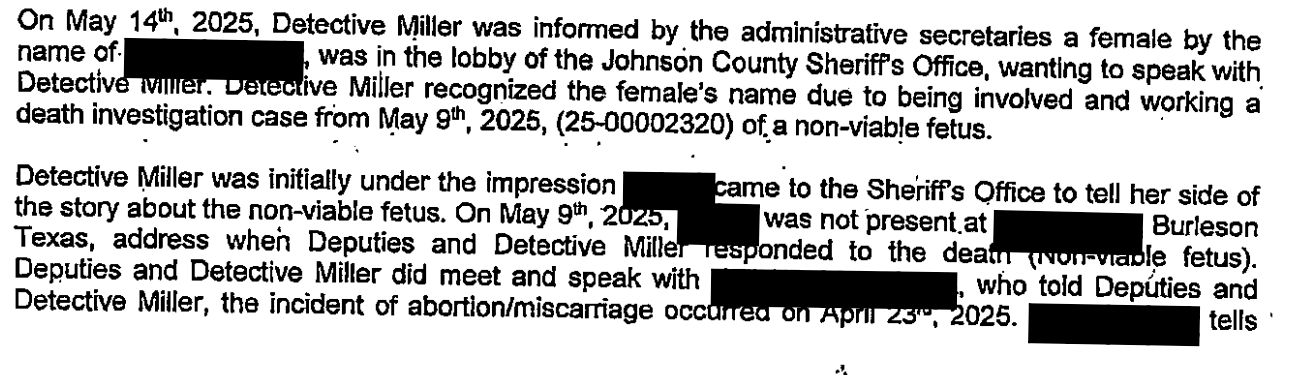
An excerpt from the detective's affidavit about investigating the abortion

An excerpt from the JCSO detective's sworn affidavit.

Nevertheless, when the subject showed up at the Sheriff’s office a week later, officers were under the impression that she came to “to tell her side of the story about the non-viable fetus.” They interviewed her, inspected text messages about the abortion on her phone, and watched her write a timeline of events. 

Only after all that did they learn that she actually wanted to report a violent assault by her partner–the same individual who had called the police to report her abortion. She alleged that less than an hour after the abortion, he choked her, put a gun to her head, and made her beg for her life. The man was ultimately charged in connection with the assault, and the case is ongoing. 

This documented account runs completely counter to what law enforcement and Flock have said publicly about the case. 

Johnson County Sheriff Adam King told 404 media: "Her family was worried that she was going to bleed to death, and we were trying to find her to get her to a hospital.” He later told the Dallas Morning News: “We were just trying to check on her welfare and get her to the doctor if needed, or to the hospital."

The account by the detective on the scene makes no mention of concerned family members or a medical investigator. To the contrary, the affidavit says that they questioned the man as to why he "waited so long to report the incident," and he responded that he needed to "process the event and call his family attorney." The ALPR search was recorded 2.5 hours after the initial call came in, as documented in the investigation report.

The Desk Sergeant's ReportOne Month Later

EFF obtained a separate "case supplemental report" written by the sergeant who says he ran the May 9 ALPR searches. 

The sergeant was not present at the scene, and his account was written belatedly on June 5, almost a month after the incident and nearly a week after 404 Media had already published the sheriff’s alternative account of the Flock Safety search, kicking off a national controversy. The sheriff's office provided this sergeant's report to Dallas Morning News. 

In the report, the sergeant claims that the officers on the ground asked him to start "looking up" the woman due to there being "a large amount of blood" found at the residencean unsubstantiated claim that is in conflict with the lead investigator’s affidavit. The sergeant repeatedly expresses that the situation was "not making sense." He claims he was worried that the partner had hurt the woman and her children, so "to check their welfare," he used TransUnion's TLO commercial investigative database system to look up her address. Once he identified her vehicle, he ran the plate through the Flock database, returning hits in Dallas.
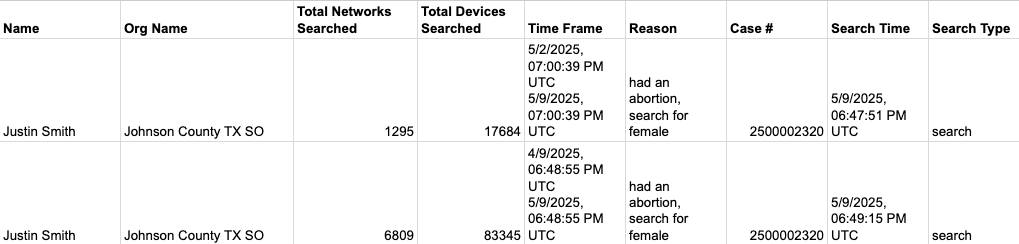
A data table showing the log of searches

Two abortion-related searches in the JCSO's Flock Safety ALPR audit log

The sergeant's report, filed after the case attracted media attention, notably omits any mention of the abortion at the center of the investigation, although it does note that the caller claimed to have found a fetus. The report does not explain, or even address, why the sergeant used the phrase "had an abortion, search for female” as the official reason for the ALPR searches in the audit log. 

It's also unclear why the sergeant submitted the supplemental report at all, weeks after the incident. By that time, the lead investigator had already filed a sworn affidavit that contradicted the sergeant's account. For example, the investigator, who was on the scene, does not describe finding any blood or taking blood samples into evidence, only photographs of what the partner believed to be the fetus. 

One area where they concur: both reports are clearly marked as a "death investigation." 

Correcting the Record

Since 404 Media first reported on this case, King has perpetuated the false narrative, telling reporters that the woman was never under investigation, that officers had not considered charges against her, and that "it was all about her safety."

But here are the facts: 

  • The reports that have been released so far describe this as a death investigation.
  • The lead detective described himself as "working a death investigation… of a non-viable fetus" at the time he interviewed the woman (a week after the ALPR searches).
  • The detective wrote that they consulted the district attorney's office about whether they could charge her for "taking the pill to cause the abortion or miscarriage of the non-viable fetus." They were told they could not.
  • Investigators collected a lot of data, including photos and documentation of the abortion, and ran her through multiple databases. They even reviewed her text messages about the abortion. 
  • The death investigation was open for more than a month.

The death investigation was only marked closed in mid-June, weeks after 404 Media's article and a mere days before the Dallas Morning News published its report, in which the sheriff inaccurately claimed the woman "was not under investigation at any point."

Flock has promoted this unsupported narrative on its blog and in multimedia appearances. We did not reach out to Flock for comment on this article, as their communications director previously told us the company will not answer our inquiries until we "correct the record and admit to your audience that you purposefully spread misinformation which you know to be untrue" about this case. 

Consider the record corrected: It turns out the truth is even more damning than initially reported.

The Aftermath

In the aftermath of the original reporting, government officials began to take action. The networks searched by Johnson County included cameras in Illinois and Washington state, both states where abortion access is protected by law. Since then: 

  • The Illinois Secretary of State has announced his intent to “crack down on unlawful use of license plate reader data,” and urged the state’s Attorney General to investigate the matter. 
  • In California, which also has prohibitions on sharing ALPR out of state and for abortion-ban enforcement, the legislature cited the case in support of pending legislation to restrict ALPR use.
  • Ranking Members of the House Oversight Committee and one of its subcommittees launched a formal investigation into Flock’s role in “enabling invasive surveillance practices that threaten the privacy, safety, and civil liberties of women, immigrants, and other vulnerable Americans.” 
  • Senator Ron Wyden secured a commitment from Flock to protect Oregonians' data from out-of-state immigration and abortion-related queries.

In response to mounting pressure, Flock announced a series of new features supposedly designed to prevent future abuses. These include blocking “impermissible” searches, requiring that all searches include a “reason,” and implementing AI-driven audit alerts to flag suspicious activity. But as we've detailed elsewhere, these measures are cosmetic at best—easily circumvented by officers using vague search terms or reusing legitimate case numbers. The fundamental architecture that enabled the abuse remains unchanged. 

Meanwhile, as the news continued to harm the company's sales, Flock CEO Garrett Langley embarked on a press tour to smear reporters and others who had raised alarms about the usage. In an interview with Forbes, he even doubled down and extolled the use of the ALPR in this case. 

So when I look at this, I go “this is everything’s working as it should be.” A family was concerned for a family member. They used Flock to help find her, when she could have been unwell. She was physically okay, which is great. But due to the political climate, this was really good clickbait.

Nothing about this is working as it should, but it is working as Flock designed. 

The Danger of Unchecked Surveillance
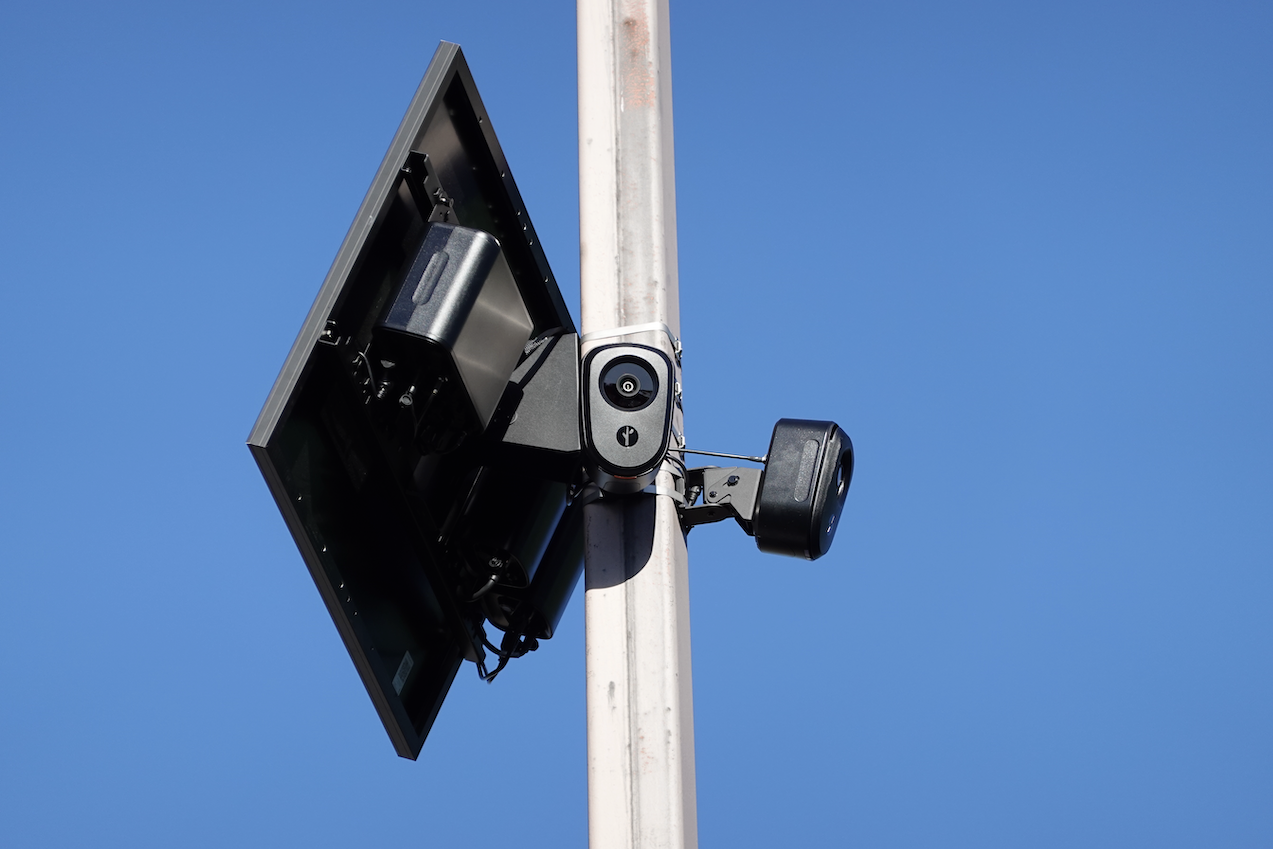
A pair of Flock Safety cameras on a pole, with a solar panel

Flock Safety ALPR cameras

This case reveals the fundamental danger of allowing companies like Flock Safety to build massive, interconnected surveillance networks that can be searched across state lines with minimal oversight. When a single search query can access more than 83,000 cameras spanning almost the entire country, the potential for abuse is staggering, particularly when weaponized against people seeking reproductive healthcare. 

The searches in this case may have violated laws in states like Washington and Illinois, where restrictions exist specifically to prevent this kind of surveillance overreach. But those protections mean nothing when a Texas deputy can access cameras in those states with a few keystrokes, without external review that the search is legal and legitimate under local law. In this case, external agencies should have seen the word "abortion" and questioned the search, but the next time an officer is investigating such a case, they may use a more vague or misleading term to justify the search. In fact, it's possible it has already happened. 

ALPRs were marketed to the public as tools to find stolen cars and locate missing persons. Instead, they've become a dragnet that allows law enforcement to track anyone, anywhere, for any reason—including investigating people's healthcare decisions. This case makes clear that neither the companies profiting from this technology nor the agencies deploying it can be trusted to tell the full story about how it's being used.

States must ban law enforcement from using ALPRs to investigate healthcare decisions and prohibit sharing data across state lines. Local governments may try remedies like reducing data retention period to minutes instead of weeks or months—but, really, ending their ALPR programs altogether is the strongest way to protect their most vulnerable constituents. Without these safeguards, every license plate scan becomes a potential weapon against a person seeking healthcare.

  •  

#StopCensoringAbortion: What We Learned and Where We Go From Here

This is the tenth and final installment in a blog series documenting EFF's findings from the Stop Censoring Abortion campaign. You can read additional posts here. 

When we launched Stop Censoring Abortion, our goals were to understand how social media platforms were silencing abortion-related content, gather data and lift up stories of censorship, and hold social media companies accountable for the harm they have caused to the reproductive rights movement.

Thanks to nearly 100 submissions from educators, advocates, clinics, researchers, and individuals around the world, we confirmed what many already suspected: this speech is being removed, restricted, and silenced by platforms at an alarming rate. Together, our findings paint a clear picture of censorship in action: platforms’ moderation systems are not only broken, but are actively harming those seeking and sharing vital reproductive health information.

Here are the key lessons from this campaign: what we uncovered, how platforms can do better, and why pushing back against this censorship matters more now than ever.

Lessons Learned

Across our submissions, we saw systemic over-enforcement, vague and convoluted policies, arbitrary takedowns, sudden account bans, and ignored appeals. And in almost every case we reviewed, the posts and accounts in question did not violate any of the platform’s stated rules.

The most common reason Meta gave for removing abortion-related content was that it violated policies on Restricted Goods and Services, which prohibit any “attempts to buy, sell, trade, donate, gift or ask for pharmaceutical drugs.” But most of the content submitted simply provided factual, educational information that clearly did not violate those rules. As we saw in the M+A Hotline’s case, this kind of misclassification deprives patients, advocates, and researchers of reliable information, and chills those trying to provide accurate and life-saving reproductive health resources.

In one submission, we even saw posts sharing educational abortion resources get flagged under the “Dangerous Organizations and Individuals” policy, a rule intended to prevent terrorism and criminal activity. We’ve seen this policy cause problems in the past, but in the reproductive health space, treating legal and accurate information as violent or unlawful only adds needless stigma and confusion.

Meta’s convoluted advertising policies add another layer of harm. There are specific, additional rules users must navigate to post paid content about abortion. While many of these rules still contain exceptions for purely educational content, Meta is vague about how and when those exceptions apply. And ads that seem like they should have been allowed were frequently flagged under rules about “prescription drugs” or “social issues.” This patchwork of unclear policies forces users to second-guess what content they can post or promote for fear of losing access to their networks.

In another troubling trend, many of our submitters reported experiencing shadowbanning and de-ranking, where posts weren’t removed but were instead quietly suppressed by the algorithm. This kind of suppression leaves advocates without any notice, explanation, or recourse—and severely limits their ability to reach people who need the information most.  

Many users also faced sudden account bans without warning or clear justification. Though Meta’s policies dictate that an account should only be disabled or removed after “repeated” violations, organizations like Women Help Women received no warning before seeing their critical connections cut off overnight.

Finally, we learned that Meta’s enforcement outcomes were deeply inconsistent. Users often had their appeals denied and accounts suspended until someone with insider access to Meta could intervene. For example, the Red River’s Women’s Clinic, RISE at Emory, and Aid Access each had their accounts restored only after press attention or personal contacts stepped in. This reliance on backchannels underscores the inequity in Meta’s moderation processes: without connections, users are left unfairly silenced.

It’s Not Just Meta

Most of our submissions detailed suppression that took place on one of Meta’s platforms (Facebook, Instagram, Whatsapp and Threads), so we decided to focus our analysis on Meta’s moderation policies and practices. But we should note that this problem is by no means confined to Meta.

On LinkedIn, for example, Stephanie Tillman told us about how she had her entire account permanently taken down, with nothing more than a vague notice that she had violated LinkedIn’s User Agreement. When Stephanie reached out to ask what violation she committed, LinkedIn responded that “due to our Privacy Policy we are unable to release our findings,” leaving her with no clarity or recourse. Stephanie suspects that the ban was related to her work with Repro TLC, an advocacy and clinical health care organization, and/or her posts relating to her personal business, Feminist Midwife LLC. But LinkedIn’s opaque enforcement meant she had no way to confirm these suspicions, and no path to restoring her account.

Screenshot submitted by Stephanie Tillman to EFF (with personal information redacted by EFF)

And over on Tiktok, Brenna Miller, a creator who works in health care and frequently posts about abortion, posted a video of her “unboxing” an abortion pill care package from Carafem. Though Brenna’s video was factual and straightforward, TikTok removed it, saying that she had violated TikTok’s Community Guidelines.

Screenshot submitted by Brenna Miller to EFF

Brenna appealed the removal successfully at first, but a few weeks later the video was permanently deleted—this time, without any explanation or chance to appeal again.

Brenna’s far from the only one experiencing censorship on TikTok. Even Jessica Valenti, award-winning writer, activist, and author of the Abortion Every Day newsletter, recently had a video taken down from TikTok for violating its community guidelines, with no further explanation. The video she posted was about the Trump administration calling IUDs and the Pill ‘abortifacients.’ Jessica wrote:

Which rule did I break? Well, they didn’t say: but I wasn’t trying to sell anything, the video didn’t feature nudity, and I didn’t publish any violence. By process of elimination, that means the video was likely taken down as "misinformation." Which is…ironic.

These are not isolated incidents. In the Center for Intimacy Justice’s survey of reproductive rights advocates, health organizations, sex educators, and businesses, 63% reported having content removed on Meta platforms, 55% reported the same on TikTok, and 66% reported having ads rejected from Google platforms (including YouTube). Clearly, censorship of abortion-related content is a systemic problem across platforms.

How Platforms Can Do Better on Abortion-Related Speech

Based on our findings, we're calling on platforms to take these concrete steps to improve moderation of abortion-related speech:

  • Publish clear policies. Users should not have to guess whether their speech is allowed or not.
  • Enforce rules consistently. If a post does not violate a written standard, it should not be removed.
  • Provide real transparency. Enforcement decisions must come with clear, detailed explanations and meaningful opportunities to appeal.
  • Guarantee functional appeals. Users must be able to challenge wrongful takedowns without relying on insider contacts.
  • Expand human review. Reproductive rights is a nuanced issue and can be too complex to be left entirely to error-prone automated moderation systems.

Practical Tips for Users

Don’t get it twisted: Users should not have to worry about their posts being deleted or their accounts getting banned when they share factual information that doesn’t violate platform policies. The onus is on platforms to get it together and uphold their commitments to users. But while platforms continue to fail, we’ve provided some practical tips to reduce the risk of takedowns, including:

  • Consider limiting commonly flagged words and images. Posts with pill images or certain keyword combinations (like “abortion,” “pill,” and “mail”) were often flagged.
  • Be as clear as possible. Vague phrases like “we can help you get what you need” might look like drug sales to an algorithm.
  • Be careful with links. Direct links to pill providers were often flagged. Spell out the links instead.
  • Expect stricter rules for ads. Boosted posts face harsher scrutiny than regular posts.
  • Appeal wrongful enforcement decisions. Requesting an appeal might get you a human moderator or, even better, review from Meta’s independent Oversight Board.
  • Document everything and back up your content. Screenshot all communications and enforcement decisions so you can share them with the press or advocacy groups, and export your data regularly in case your account vanishes overnight.

Keep Fighting

Abortion information saves lives, and social media is the primary—and sometimes only—way for advocates and providers to get accurate information out to the masses. But now we have evidence that this censorship is widespread, unjustified, and harming communities who need access to this information most.

Platforms must be held accountable for these harms, and advocates must continue to speak out. The more we push back—through campaigns, reporting, policy advocacy, and user action—the harder it will be for platforms to look away.

So keep speaking out, and keep demanding accountability. Platforms need to know we're paying attention—and we won't stop fighting until everyone can share information about abortion freely, safely, and without fear of being silenced.

This is the tenth and final post in our blog series documenting the findings from our Stop Censoring Abortion campaign. Read more at https://www.eff.org/pages/stop-censoring-abortion.  

Affected by unjust censorship? Share your story using the hashtag #StopCensoringAbortion. Amplify censored posts and accounts, share screenshots of removals and platform messages—together, we can demonstrate how these policies harm real people. 

  •  

Tips to Protect Your Posts About Reproductive Health From Being Removed

This is the ninth installment in a blog series documenting EFF’s findings from the Stop Censoring Abortion campaign. You can read additional posts here.  

Meta has been getting content moderation wrong for years, like most platforms that host user-generated content. Sometimes it’s a result of deliberate design choices—privacy rollbacks, opaque policies, features that prioritize growth over safety—made even when the company knows that those choices could negatively impact users. Other times, it’s simply the inevitable outcome of trying to govern billions of posts with a mix of algorithms and overstretched human reviewers. Importantly, users shouldn’t have to worry about their posts being deleted or their accounts getting banned when they share factual health information that doesn’t violate the platforms' policies. But knowing more about what the algorithmic moderation is likely to flag can help you to avoid its mistakes. 

We analyzed the roughly one-hundred survey submissions we received from social media users in response to our Stop Censoring Abortion campaign. Their stories revealed some clear patterns: certain words, images, and phrases seemed to trigger takedowns, even when posts didn’t come close to violating Meta’s rules. 

For example, your post linking to information on how people are accessing abortion pills online clearly is not an offer to buy or sell pills, but an algorithm, or a human content reviewer who doesn’t know for sure, might wrongly flag it for violating Meta’s policies on promoting or selling “restricted goods.” 

That doesn’t mean you’re powerless. For years, people have used “algospeak”—creative spelling, euphemisms, or indirection—to sidestep platform filters. Abortion rights advocates are now forced into similar strategies, even when their speech is perfectly legal. It’s not fair, but it might help you keep your content online. Here are some things we learned from our survey: 

Practical Tips to Reduce the Risk of Takedowns 

While traditional social media platforms can help people reach larger audiences, using them also generally means you have to hand over control of what you and others are able to see to the people who run the company. This is the deal that large platforms offer—and while most of us want platforms to moderate some content (even if that moderation is imperfect), current systems of moderation often reflect existing societal power imbalances and impact marginalized voices the most. 

There are ways companies and governments could better balance the power between users and platforms. In the meantime, there are steps you can take right now to break the hold these platforms have:   

  • Images and keywords matter. Posts with pill images, or accounts with “pill” in their names, were flagged often—even when the posts weren’t offering to sell medication. Before posting, consider whether you need to include an image of, or the word “pill,” or whether there’s another way to communicate your message. 
  • Clarity beats vagueness. Saying “we can help you find what you need” or “contact me for more info” might sound innocuous, but to an algorithm, it can look like an offer to sell drugs. Spell out what kind of support you do and don’t provide—for example: “We can talk through options and point you toward trusted resources. We don’t provide medical services or medication.” 
  • Be careful with links. Direct links to organizations or services that provide abortion pills were often flagged, even if the organizations operate legally. Instead of linking, try spelling out the name of the site or account. 
  • Certain word combos are red flags. Posts that included words like “mifepristone,” “abortion,” and “mail” together were frequently removed. You may still want to use them—they’re accurate and important—but know they make your post more likely to be flagged. 

Alternatives and Backups 

Big platforms give you reach, but they also set the rules—and those rules usually favor corporate interests over human rights. You don’t have to accept that as the only way forward: 

  • Keep a backup. Export your data regularly so you’re not left empty-handed if your account disappears overnight. 
  • Build your own space. Hosting a website isn’t free, but it puts you in control. 
  • Push for interoperability. Imagine being able to take your audience with you when you leave a platform. That’s the future we should be fighting for. (For more on interoperability and Meta, check out this video where Cory Doctorow explains what an interoperable Facebook would look like.) 

Protect Your Privacy 

If you’re working in abortion access—whether as a provider, activist, or volunteer—your privacy and security matter. The same is true for patients. Check out EFF’s Surveillance Self-Defense for tailored guides. Look at resources from groups like Digital Defense Fund and learn how location tracking tools can endanger abortion access. If you run an organization, consider some of the ways you can minimize what information you collect about patients, clients, or customers, in our guide to Online Privacy for Nonprofits. 

Platforms like Meta insist they want to balance free expression and safety, but their blunt systems consistently end up reinforcing existing inequalities—silencing the very people who most need to be heard. Until they do better, it’s on us to protect ourselves, share our stories, and keep building the kind of internet that respects our rights. 

This is the ninth post in our blog series documenting the findings from our Stop Censoring Abortion campaign. Read more in the series: https://www.eff.org/pages/stop-censoring-abortion 

Affected by unjust censorship? Share your story using the hashtag #StopCensoringAbortion. Amplify censored posts and accounts, share screenshots of removals and platform messages—together, we can demonstrate how these policies harm real people. 

  •  

Platforms Have Failed Us on Abortion Content. Here's How They Can Fix It.

This is the eighth installment in a blog series documenting EFF's findings from the Stop Censoring Abortion campaign. You can read additional posts here. 

In our Stop Censoring Abortion series, we’ve documented the many ways that reproductive rights advocates have faced arbitrary censorship on Meta platforms. Since social media is the primary—and sometimes the only—way that providers, advocates, and communities can safely and effectively share timely and accurate information about abortion, it’s vitally important that platforms take steps to proactively protect this speech.

Yet, even though Meta says its moderation policies allow abortion-related speech, its enforcement of those policies tells a different story. Posts are being wrongfully flagged, accounts are disappearing without warning, and important information is being removed without clear justification.

So what explains the gap between Meta’s public commitments and its actions? And how can we push platforms to be better—to, dare we say, #StopCensoringAbortion?

After reviewing nearly one-hundred submissions and speaking with Meta to clarify their moderation practices, here’s what we’ve learned.

Platforms’ Editorial Freedom to Moderate User Content

First, given the current landscape—with some states trying to criminalize speech about abortion—you may be wondering how much leeway platforms like Facebook and Instagram have to choose their own content moderation policies. In other words, can social media companies proactively commit to stop censoring abortion?

The answer is yes. Social media companies, including Meta, TikTok, and X, have the constitutionally protected First Amendment right to moderate user content however they see fit. They can take down posts, suspend accounts, or suppress content for virtually any reason.

The Supreme Court explicitly affirmed this right in 2023 in Moody v. Netchoice, holding that social media platforms, like newspapers, bookstores, and art galleries before them, have the First Amendment right to edit the user speech that they host and deliver to other users on their platforms. The Court also established that the government has a very limited role in dictating what social media platforms must (or must not) publish. This editorial discretion, whether granted to individuals, traditional press, or online platforms, is meant to protect these institutions from government interference and to safeguard the diversity of the public sphere—so that important conversations and movements like this one have the space to flourish.

Meta’s Broken Promises

Unfortunately, Meta is failing to meet even these basic standards. Again and again, its policies say one thing while its actual enforcement says another.

Meta has stated its intent to allow conversations about abortion to take place on its platforms. In fact, as we’ve written previously in this series, Meta has publicly insisted that posts with educational content about abortion access should not be censored, even admitting in several public statements to moderation mistakes and over-enforcement. One spokesperson told the New York Times: “We want our platforms to be a place where people can access reliable information about health services, advertisers can promote health services and everyone can discuss and debate public policies in this space. . . . That’s why we allow posts and ads about, discussing and debating abortion.”

Meta’s platform policies largely reflect this intent. But as our campaign reveals, Meta’s enforcement of those policies is wildly inconsistent. Time and again, users—including advocacy organizations, healthcare providers, and individuals sharing personal stories—have had their content taken down even though it did not actually violate any of Meta’s stated guidelines. Worse, they are often left in the dark about what happened and how to fix it.

Arbitrary enforcement like this harms abortion activists and providers by cutting them off from their audiences, wasting the effort they spend creating resources and building community on these platforms, and silencing their vital reproductive rights advocacy. And it goes without saying that it hurts users, who need access to timely, accurate, and sometimes life-saving information. At a time when abortion rights are under attack, platforms with enormous resources—like Meta—have no excuse for silencing this important speech.  

Our Call to Platforms

Our case studies have highlighted that when users can’t rely on platforms to apply their own rules fairly, the result is a widespread chilling effect on online speech. That’s why we are calling on Meta to adopt the following urgent changes.

1. Publish clear and understandable policies.

Too often, platforms’ vague rules force users to guess what content might be flagged in order to avoid shadowbanning or worse, leading to needless self-censorship. To prevent this chilling effect, platforms should strive to offer users the greatest possible transparency and clarity on their policies. The policies should be clear enough that users know exactly what is allowed and what isn’t so that, for example, no one is left wondering how exactly a clip of women sharing their abortion experiences could be mislabeled as violent extremism.

2. Enforce rules consistently and fairly.

If content doesn’t violate a platform’s stated policies, it should not be removed. And, per Meta’s own policies, an account should not be suspended for abortion-related content violations if it has not received any prior warnings or “strikes.” Yet as we’ve seen throughout this campaign, abortion advocates repeatedly face takedowns or even account suspensions of posts that fall entirely within Meta’s Community Standards. On such a massive scale, this selective enforcement erodes trust and chills entire communities from participating in critical conversations. 

3. Provide meaningful transparency in enforcement actions.

When content is removed, Meta tends to give vague, boilerplate explanations—or none at all. Instead, users facing takedowns or suspensions deserve detailed and accurate explanations that state the policy violated, reflect the reasoning behind the actual enforcement decision, and ways to appeal the decision. Clear explanations are key to preventing wrongful censorship and ensuring that platforms remain accountable to their commitments and to their users.

4. Guarantee functional appeals.

Every user deserves a real chance to challenge improper enforcement decisions and have them reversed. But based on our survey responses, it seems Meta’s appeals process is broken. Many users reported that they do not receive responses to appeals, even when the content did not violate Meta’s policies, and thus have no meaningful way to challenge takedowns. Alarmingly, we found that a user’s best (and sometimes only) chance at success is to rely on a personal connection at Meta to right wrongs and restore content. This is unacceptable. Users should have a reliable and efficient appeal process that does not depend on insider access.   

5. Expand human review.

Finally, automated systems cannot always handle the nuance of sensitive issues like reproductive health and advocacy. They misinterpret words, miss important cultural or political context, and wrongly flag legitimate advocacy as “dangerous.” Therefore, we call upon platforms to expand the role that human moderators play in reviewing auto-flagged content violations—especially when posts involve sensitive healthcare information or political expression.

Users Deserve Better

Meta has already made the choice to allow speech about abortion on its platforms, and it has not hesitated to highlight that commitment whenever it has faced scrutiny. Now it’s time for Meta to put its money where its mouth is.

Users deserve better than a system where rules are applied at random, appeals go nowhere, and vital reproductive health information is needlessly (or negligently) silenced. If Meta truly values free speech, it must commit to moderating with fairness, transparency, and accountability.

This is the eighth post in our blog series documenting the findings from our Stop Censoring Abortion campaign. Read more at https://www.eff.org/pages/stop-censoring-abortion   

Affected by unjust censorship? Share your story using the hashtag #StopCensoringAbortion. Amplify censored posts and accounts, share screenshots of removals and platform messages—together, we can demonstrate how these policies harm real people. 

  •  

The Abortion Hotline Meta Wants to Go Dark

This is the sixth installment in a blog series documenting EFF's findings from the Stop Censoring Abortion campaign. You can read additional posts here. 

When we started our Stop Censoring Abortion campaign, we heard from activists, advocacy organizations, researchers, and even healthcare providers who had all experienced having abortion-related content removed or suppressed on social media. One of the submissions we received was from an organization called the Miscarriage and Abortion Hotline.

The Miscarriage and Abortion Hotline (M+A Hotline) formed in 2019, is staffed by a team of healthcare providers who wanted to provide free and confidential “expert advice on various aspects of miscarriage and abortion, ensuring individuals receive accurate information and compassionate support throughout their journey.” By 2022, the hotline was receiving between 25 to 45 calls and texts a day. 

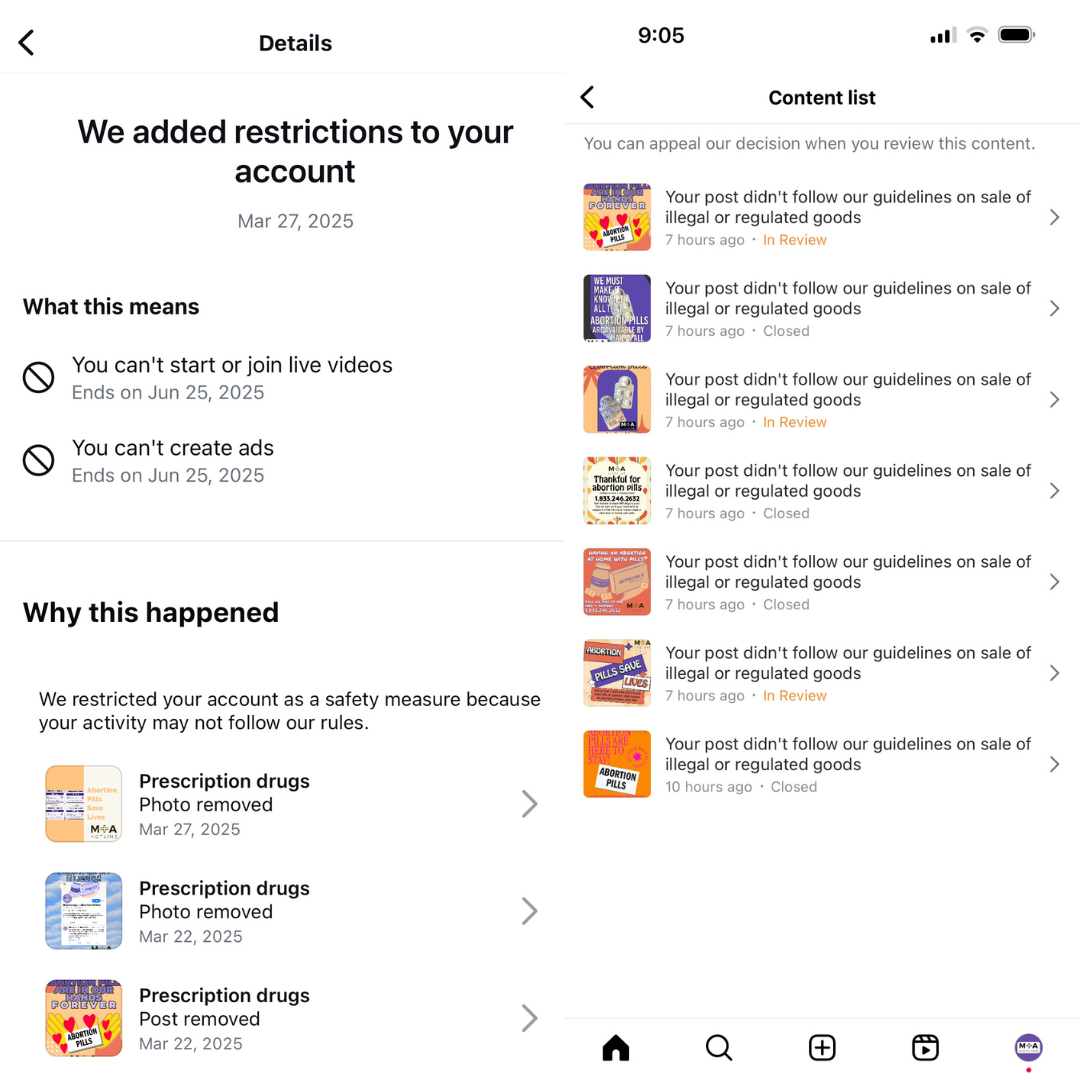
Like many reproductive health, rights, and justice groups, the M+A Hotline is active on social media, sharing posts that affirm the voices and experiences of abortion seekers, assert the safety of medication abortion, and spread the word about the expert support that the hotline offers. However, in late March of this year, the M+A Hotline’s Instagram suddenly had numerous posts taken down and was hit with restrictions that prevented the account from starting or joining livestreams or creating ads until June 25, 2025.

Screenshots provided to EFF from M+A Hotline

The reason behind the restrictions and takedowns, according to Meta, was that the M+A Hotline’s Instagram account failed to follow Meta’s guidelines on the sale of illegal or regulated goods. The “guidelines” refer to Meta’s Community Standards which dictate the types of content that are allowed on Facebook, Instagram, Messenger, and Threads. But according to Meta, it is not against these Community Standards to provide guidance on how to legally access pharmaceutical drugs, and this is treated differently than an offer to buy, sell, or trade pharmaceuticals (though there are additional compliance requirements for paid ads). 

Under these rules, the M+A Hotline’s content should have been fine: The Hotline does not sell medication abortion and simply educates on the efficacy and safety of medication abortion while providing guidance on how abortion seekers could legally access the pills. Despite this, around 10 posts from the account were removed by Instagram, none of which were ads.

For how little the topic is mentioned in these Standards, content about abortion seems to face extremely high scrutiny from Meta.

In a letter to Amnesty International in February 2024, Meta publicly clarified that organic content on its platforms that educates users about medication abortion is not in violation of the Community Standards. The company claims that the policies are “based on feedback from people and the advice of experts in fields like technology, public safety and human rights.” The Community Standards are thorough and there are sections covering everything from bullying and harassment to account integrity to restricted goods and services. Notably, within the several webpages that make up the Community Standards, there are very few mentions of the words “abortion” and “reproductive health.” For how little the topic is mentioned in these Standards, content about abortion seems to face extremely high scrutiny from Meta.

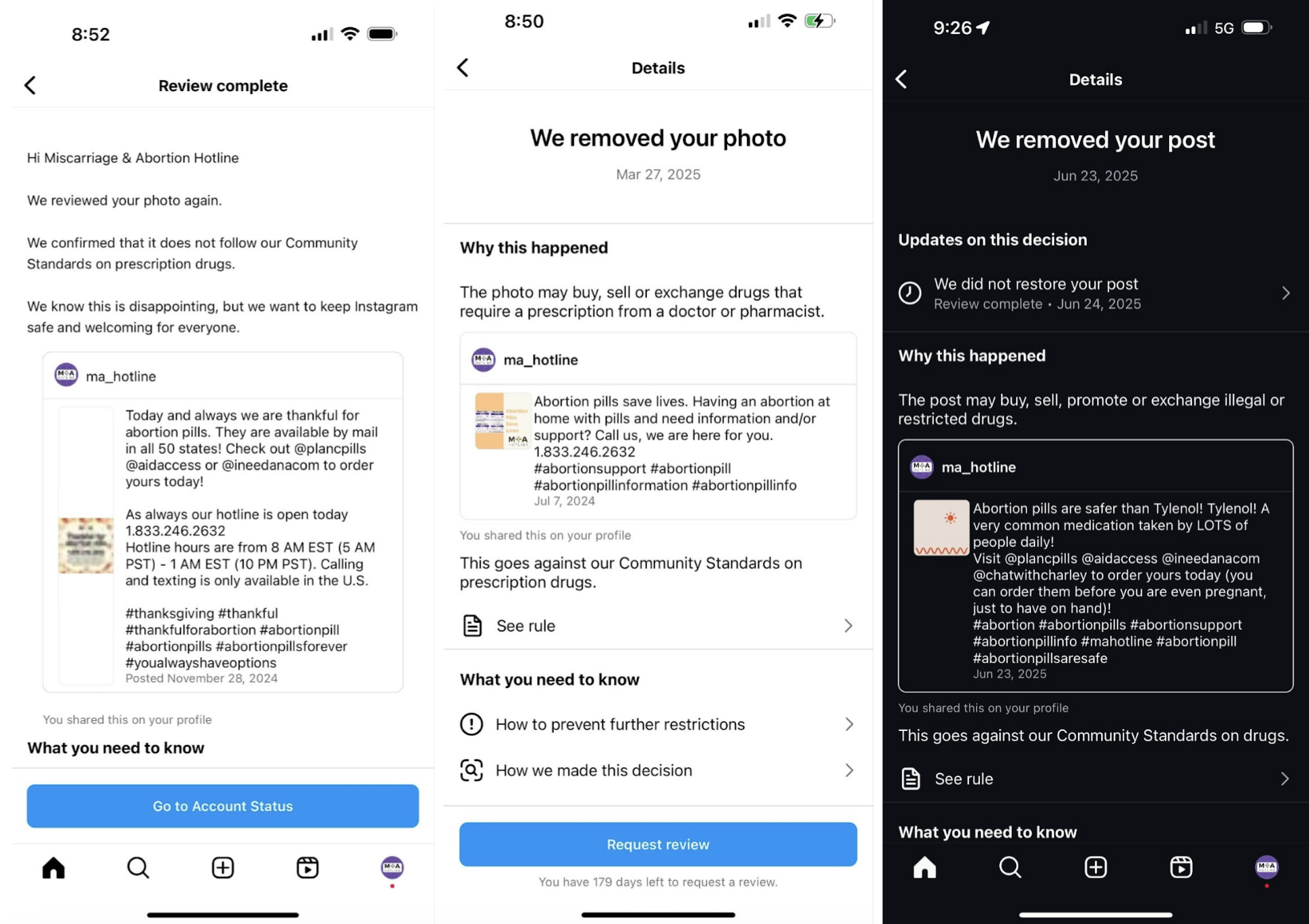
Screenshots provided to EFF from M+A Hotline

Not only were posts removed, but even after further review, many were not restored. The M+A Hotline was once again told that their content violates the Community Standards on drugs. While it’s understandable that moderation systems may make mistakes, it’s unacceptable for those mistakes to be repeated consistently with little transparency or direct communication with the users whose speech is being restricted and erased. This problem is only made worse by lack of helpful recourse. As seen here, even when users request review and identify these moderation errors, Meta may still refuse to restore posts that are permitted under the Community Standards.

The removal of the M+A Hotline’s educational content demonstrates that Meta must be more accurate, consistent, and transparent in the enforcement of their Community Standards, especially in regard to reproductive health information. Informing users that medical professionals are available to support those navigating a miscarriage or abortion is plainly not an attempt to buy or sell pharmaceutical drugs. Meta must clearly defineand then fairly enforce–what is and isn’t permitted under its Standards. This includes ensuring there is a meaningful way to quickly rectify any moderation errors through the review process. 

At a time when attacks on online access to information—and particularly abortion information—are intensifying, Meta must not exacerbate the problem by silencing healthcare providers and suppressing vital health information. We must all continue to fight back against online censorship.

 This is the sixth post in our blog series documenting the findings from our Stop Censoring Abortion campaign. Read more in the series: https://www.eff.org/pages/stop-censoring-abortion

  •