❌

Normal view

Sleeping Beauties by David Byrne review – a quirky journey through the afterlife of invention

5 October 2026 at 02:00

The Talking Heads frontman considers dormant ideas that made a comeback – from Indian irrigation to Kafka

There’s barely been a moment in  the last half-century when David Byrne hasn’t been zinging about, dancing forward, opting odd. The art-school dropout frontman of Talking Heads, he moved sideways into ballet, dance and experimental theatre, collaborated on the proto-ambient LP My Life in the Bush of Ghosts with his fellow polymath Brian Eno, directed films, wrote musicals (on – of course – Imelda Marcos), co-founded a label (Luaka Bop) that introduced the likes of Os Mutantes and William Onyeabor to a new generation, brought out books of tree drawings, and designed bicycle racks.

Byrne’s career – by most measures a remarkably successful one – has been built from code-switching, fidgety intelligence, stylistic infidelity. At first glance then, it’s surprising that Sleeping Beauties is devoted to failure – to artists who were ignored, laughed at, forgotten; to ideas deemed batty or heretical; to ways of thinking about the world – sustaining it, replenishing it – that, often for political reasons, were found wanting, and wiped from our collective memory banks. Sleeping beauties is (of course) a term he first encountered in an academic paper by Leiden University scientometrics professor Ton van Raan. That was in 2004: this book, like a lot of the ideas and energies it animates, needed time to ferment.

Continue reading...

© Photograph: Jody Rogac

© Photograph: Jody Rogac

© Photograph: Jody Rogac

Argentine court clears return of Nazi-looted portrait worth $400,000

29 September 2026 at 00:37
Argentine court clears return of Nazi-looted portrait worth $400,000 Australian. A portrait looted from a Jewish art dealer in WWII will be given back to the owner's heir, after a deal where the daughter of a fugitive Nazi official agreed to drop her claim. Portrait of a Lady, by Italian baroque painter Giacomo Ceruti, had been missing for eight decades. But its existence was revealed last year, after being photographed hanging in the home of the daughter of a senior Nazi officer, who had fled to Argentina after World War II.

The Expressions of Tethys

24 September 2026 at 10:19
Installation by Julius Von Bismarck . Die Mimik der Tethys (The Expressions of Tethys) "...a buoy hung over the Palais de Tokyo's Palier d'honneur, corroded by sea salt and covered by dry seaweed. In perpetual motion, the buoy reproduces the movements of its original setting, off the Atlantic coast. It is in this way that the visitors find themselves metaphorically under the ocean, and can directly perceive the sway of its waves, which can be either gentle, or wild." quoted from this article.

Photos from the artist's own site showing the making of the piece.

The woman who made Vincent van Gogh famous

21 September 2026 at 09:38
What makes art famous and valuable? Who makes art famous and valuable? Those questions can feel impossible to answer. But in the case of Vincent (someone often referred to by only his first name more than 125 years after his death), we know the answer. It was Jo (pronounced "Yo" in Dutch), his 28-year-old sister-in-law, who inherited hundreds of his paintings that, at the time, had little market value. Jo is the reason that we see Vincent's art absolutely everywhere today. We should all know her name.

1893 in the Margins

18 September 2026 at 17:05
Pamela Toler (History in the Margins, 9/5/26), "The Great Panic of 1893": "occasionally an event, or person, or book, or idea ... shows up in footnotes or casual asides ... if it's interesting or important enough, I share it ... Lately, the Great Panic of 1893 has become insistent." Neil Flanagan (The Birth of a Capital, 9/4/26), "How often do you think about the 1893 World's Fair?": "what draws us to an event, story, or image depends less on the context of the events than the context we inhabit." Photos / maps / VR of the fair. Foods, sweet treats, and "orange cider" of the fair. Pall Mall Magazine and RIBA Journal on the fair. And other magazines that began in 1893 feature Ida Tarbell on "Pasteur at Home," famous prints, rules for psychic / occult investigators, articles on orchidology and astronomy, "Last Week's Paris" followup on anarchists, and the first story of Sexton Blake.

Data Broker Radaris Loses Domains in Privacy Fight

16 September 2026 at 14:14

The consumer data broker Radaris.com has long had a reputation for ignoring requests to remove personal information from its vast empire of people-search services online. That reputation caught up with the company recently in a lawsuit alleging Radaris violated a New Jersey privacy law that provides for hefty fines against data brokers that publish personal information on state law enforcement officials. In the face of repeated stonewalling and prevarication by attorneys for Radaris, the judge in the case ordered that radaris.com and more than a dozen other data broker domains be transferred to the plaintiffs.

The radaris.com website, prior to the domain transfer to Atlas.

In February 2024, Radaris was sued by Atlas Data Privacy Corp, a company that has been pursuing data brokers alleged to be violating a New Jersey statute called Daniel’s Law. The statute allows state law enforcement officials, government personnel, judges and their families to have their information completely removed from commercial data brokers and people-search services, and provides for fines of $1,000 per violation against companies that ignore removal requests.

Less than a month after Atlas sued Radaris, KrebsOnSecurity published a deep dive into the Radaris co-founders — Igor and Dmitry Lubarsky (also spelled Lybarsky) — Russian-born brothers living in Massachusetts who operate a dizzying array of people-search companies as well as a number of Russian language dating services and affiliate programs.

Attorneys for the Lubarsky brothers threatened to sue for defamation if the story wasn’t removed and an apology issued. Their attorney asserted that our reporting was wildly inaccurate, and that the true owners of the company were Ukrainians living in Ukraine.

The Lubarsky brothers Dmitry or “Dan” (left) and Gary/Igor.

KrebsOnSecurity doubled down and showed how the Lubarsky brothers built and operated Radaris and other data broker companies using a fictitious CEO’s name. Our follow-up story noted that Radaris’s attorney — a lawyer with the Boston Law Group named Val Gurvits — admitted his clients had invented the CEO pseudonym “Gary Norden,” and that Radaris also had issued multiple press releases over the years that quoted the fake CEO while seeking money from potential investors.

Attorneys for Radaris waited until the last minute to appear in court and contest what was all but certain to be a default judgment in favor of the plaintiffs, and then told the court that Atlas had failed to serve the real owners and operators of Radaris and several of its sister data broker companies.

Atlas re-filed the lawsuit in June 2025, this time dramatically expanding the number of Radaris family data brokers accused of violating Daniel’s Law. Matt Adkisson, president and CEO of Atlas, said Radaris turned to a tried-and-true playbook: Delaying in court until the last possible minute, and playing shell games with Radaris’s true country of origin and the individuals listed as owners and operators of these sites.

“We refer to this period as their island-hopping phase. Privacy policies changed constantly, and new entities kept appearing from places like the Marshall Islands, the British Virgin Islands, and Seychelles,” Adkisson told KrebsOnSecurity. “Behind the scenes, it felt like a shell game. Defense lawyers told the court that certain entities merely operated the domains and were the proper parties to sue. But by the time a judgment neared, those entities would be discarded and new entities would appear. Meanwhile, the lawyers claimed the other entities that actually owned the domains should not be held responsible.”

Adkisson said when the defendants updated their terms of service to state that Radaris was suddenly managed by a company in the Marshall Islands, Atlas hired an investigator in that country and soon learned the brand new entity that Radaris claimed was managing the company didn’t even exist yet.

Mr. Gurvits stepped forward as Radaris’s attorney in a class action lawsuit the company temporarily lost in 2017 because it never contested the claim in court. When the plaintiffs told the judge they couldn’t collect on the $7.5 million default judgment, the court ordered the domain registry Verisign to transfer the radaris.com domain name to the plaintiffs.

Mr. Gurvits appealed that verdict, arguing the lawsuit hadn’t named the actual owners of the Radaris domain name — a Cyprus company called Bitseller Expert Limited — and thus taking the domain away would be a violation of their due process rights.

The judge in the 2017 case ruled in Radaris’ favor — halting the domain transfer — and told the plaintiffs they could refile their complaint. Soon after, the operator of Radaris changed from Bitseller to Andtop Company, an entity formed (PDF) in the Marshall Islands in Oct. 2020. The plaintiffs never re-filed their lawsuit.

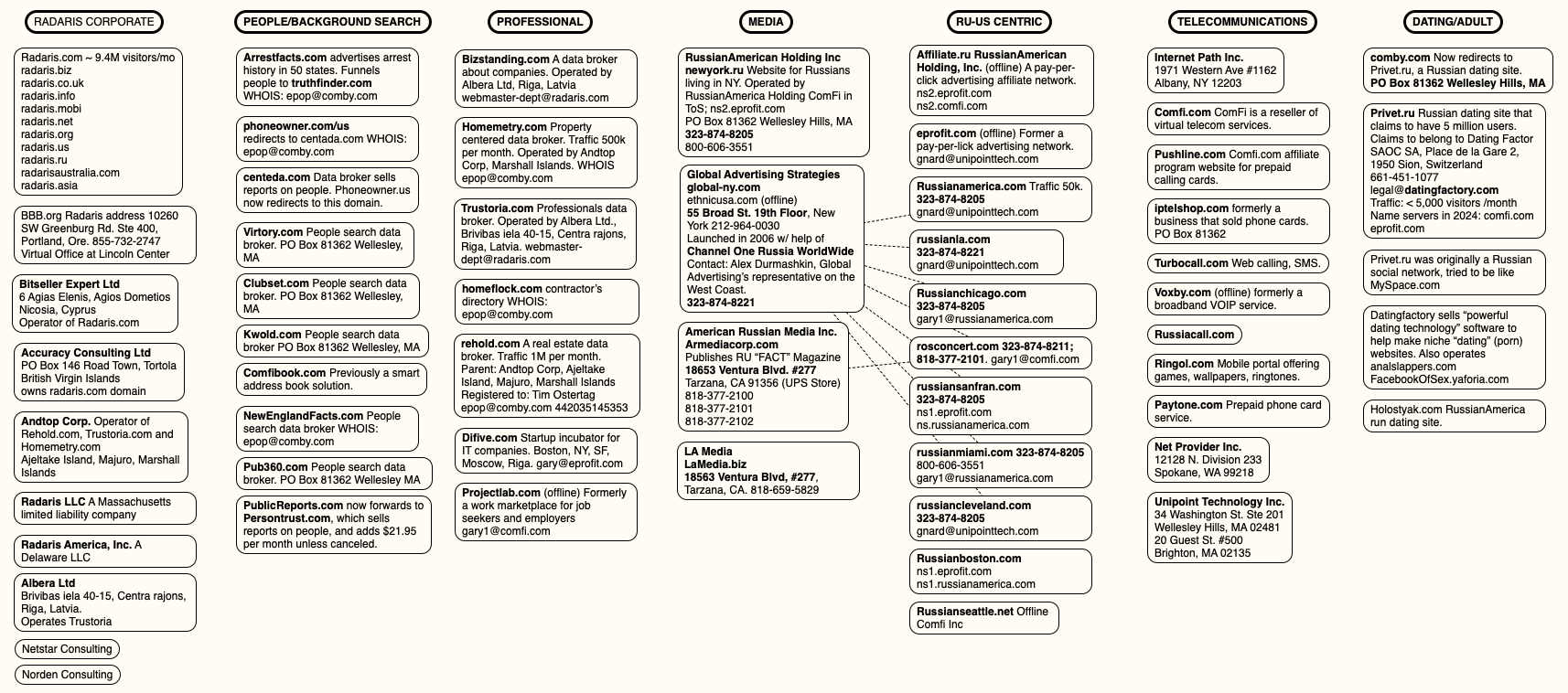
A mind map of various entities tied to Radaris and the company’s co-founders. Click to enlarge.

“That seemed to be their modus operandi,” said Raj Parikh, a partner at PEM Law in New Jersey who handles most of the Daniel’s Law litigation for Atlas. “In the past, they won by attrition. Plaintiffs’ attorneys tired of the procedural games and just gave up. That strategy worked for a decade, and it probably would have worked in this case too, since any financial recovery from foreign actors will be difficult. But we were acutely aware of the threat this website posed to law enforcement officers and other public officials in New Jersey, and decided early on to commit whatever time and resources were necessary to remove that threat.”

On August 26, the judge in the New Jersey case found the defendants were given multiple chances to appear and defend the claims against them but had failed to do so. Mr. Gurvits declined to comment on the case, saying it had been assigned to another attorney, a Mr. Victor Worms. In response to questions, Mr. Worms asserted the New Jersey court transferred Radaris.com to Atlas as part of a default judgment against Radaris.com, which is not a legal entity.

“We have made a motion to vacate that default judgment on the grounds that it is void since a non-entity has no legal capacity to sue or be sued,” Worms replied. “We also intend to pursue all appropriate appeals because we believe the transfer of Radaris.com amounts to a forfeiture in violation of various constitutional principles.”

While radaris.com still comes up prominently in results when searching online for U.S. residents by name, the domain no longer sells detailed personal dossiers on millions of Americans. Its homepage now displays a notice from Atlas, as well as links to our previous reporting on Radaris.

EMAIL CONFIRMATIONS

Atlas told KrebsOnSecurity that it has obtained more than 10,000 emails and documents in the course of litigation, and that those messages confirm our previous reporting on the owners and operators of Radaris and its myriad companies.

Atlas said the emails clearly establish that the nominal legal vehicles — Radaris America, Inc.; Bitseller Expert Limited; Digital Orbit Corp; Core Solutions Group Inc; Lucky Solutions Inc; Virtura Corp; Veripages Inc.; Nuform Solutions Inc.; Growth Data Advisors Inc.; Property Experts, Inc — are all administered by the same three or four people from the same mailboxes, share one bank or payment card set, and are all managed from one virtual office address.

“The corpus establishes, with documentary evidence generated independently by banks, payment processors, hosting providers, registrars, software-as-a-service vendors and the operators’ own systems, that radaris.com and at least twenty-five other people-search websites are one operation run by a small Boston-area group whose administrative, financial and technical functions sit on the difive.com mail domain and its successors (centerex.com, scienteco.com, eprofit.com, realmo.com, pub360.com),” reads a summary shared by Atlas.

Atlas said the emails show Radaris.com earns approximately $42,000 a month, while Veripages.com earns around $45,000 monthly via its partnership with the Lifetime Value Company, a marketing and advertising firm whose brands include PeopleLooker, PeopleSmart, NumberGuru, and Bumper, a car history site.

According to Atlas, the emails also showed the Radaris family of websites earns as much as $25,000 each month from their partnership with Onerep, a company that claims to help people remove their information from people-search sites. In March 2024, KrebsOnSecurity revealed how the Belarusian founder of Onerep had launched and operated dozens of people-search sites over the years and was continuing to operate one of them (Nuwber), effectively spreading the disease and selling the cure.

The domain radaris.com now redirects to this notice from Atlas about the court-ordered domain transfer.

The domain radaris.com now redirects to this notice from Atlas about the court-ordered domain transfer.

All told, the New Jersey court has so far transferred 14 domain names from the Radaris family of companies to Atlas. Radaris.com now redirects to a notice of the court-ordered domain transfer.

THE ROAD AHEAD

The Radaris family of companies is still potentially facing fines of $1,000 per alleged violation of Daniel’s Law. For the time being, however, Daniel’s Law is facing a constitutional challenge from virtually all of the 150 other consumer data broker firms being sued by Atlas.

The data broker industry responded by having at least 70 of the Atlas lawsuits moved to federal court, challenging the New Jersey statute as overly broad and a violation of the First Amendment. The U.S. Court of Appeals for the Third Circuit has not yet issued a decision on the constitutional challenge, but either way the case is widely expected to be appealed all the way to the U.S. Supreme Court.

Meanwhile, at least 14 other states have now passed laws modeled after the New Jersey statute, with more states considering similar measures. However, West Virginia’s Daniel’s Law was ruled facially unconstitutional under the First Amendment by a federal district court in August 2025.

Justin Sherman is a privacy expert and author of the forthcoming book “The Middlemen,” which examines how the data broker industry powers modern surveillance. Sherman said federal lawmakers have long faced intense lobbying by the technology industry against more restrictive U.S. data privacy laws, but that many powerful industries are now working against passing comprehensive data privacy legislation.

“These days at the federal level, add in the intense amount of lobbying against these laws from social media companies, big tech, cryptocurrency firms, and now AI proponents in the mix who claim that limiting their data scraping is somehow going to collapse the whole U.S. economy under Chinese rule,” he said.

Sherman said people-search companies will continue to thrive unless and until Congress enacts meaningful consumer privacy and data protection laws that are relevant to life in the 21st century. That’s because virtually all state privacy laws exempt records that might be considered “public” or “government” documents, including voting registries, property filings, marriage certificates, motor vehicle records, criminal records, court documents, death records, professional licenses, bankruptcy filings, and more.

At least 25 states have passed or implemented laws requiring age verification for residents seeking to access adult content online, but there is no federal law that limits how the companies that are scanning everyone’s drivers license can use, share or keep the data provided. Had such restrictions been enshrined in law, we may have avoided the recent breach at IDScan.net, which exposed the drivers license information on more than 153 million Americans when the records were briefly turned into a point-and-click identity theft service on the dark web.

“The average person can look at Daniel’s Law and have a perfectly normal reaction, which is that everyone should be covered, not just police and judges,” Sherman said. “But we don’t need more wake-up calls. We’ve had eight million wake-up calls already on the need for better privacy laws. The lack of comprehensive federal privacy law is not for a lack of knowledge, and anyone claiming otherwise is either not reading the news or kidding themselves.”

Nintendo Switch Flaw Lets Nearby Attackers Run Code, Steal Data

15 September 2026 at 03:06

Nintendo Switch Vulnerability

A newly disclosed Nintendo Switch vulnerability is pushing owners of the original console toward an urgent firmware update, particularly those who tend to play in public spaces. Nintendo confirmed the vulnerability in Nintendo Switch systems in a PDF advisory released Sept. 10, just a day after quietly shipping firmware version 23.0.0 to address the problem.  Importantly, this vulnerability in Nintendo Switch hardware is limited to the original console. The Nintendo Switch 2 is not affected in any way. 

How the Nintendo Switch Vulnerability Works? 

The flaw centers on the Send to Smartphone feature, a tool original Switch owners use to move screenshots and game captures onto a phone by scanning a QR code generated on the console. That same QR-code mechanism is also used by Super Mario Kart: Home Circuit when played on its physical cartridge, since the game relies on a QR code to establish a wireless connection between nearby players.  The danger arises when someone other than the intended user scans that QR code first. Doing so lets a stranger's device link up with the Switch console, opening the door to running unauthorized code on the machine or pulling data straight off it. Because account information lives on the console itself, that's a real risk for anyone exposed to this Nintendo Switch vulnerability while gaming around others.  Nintendo has not offered additional detail beyond its advisory. A company representative did not immediately respond when asked for further comment on the matter.  The vulnerability in Nintendo Switch firmware has been formally logged as CVE-2026-82079. It's described as a stack-based buffer overflow, a type of flaw that can allow an attacker within wireless range to execute code on the device. The issue only exists on original Switch consoles running firmware older than version 23.0.0; anything on that version or newer is already protected. 

Fixing the Nintendo Switch Vulnerability 

Nintendo's remedy is straightforward: install firmware 23.0.0, which the company released Sept. 9, one day before publicly disclosing the flaw. To do so, owners should navigate to System Settings, then System, then System Update, and follow any prompts that appear on screen to complete the installation.  For anyone who can't update right away, Nintendo has outlined a few stopgap measures. The company suggests only using the Send to Smartphone feature at home, where a stranger isn't in scanning range, and avoiding public sessions of Super Mario Kart: Home Circuit until the update is applied. More broadly, Nintendo advises against ever scanning a QR code using a device that isn't your own.  Players who exclusively game at home are already shielded from this particular vulnerability in Nintendo Switch systems and don't need to take any further action, since the exploit depends on a nearby attacker being in physical wireless range to intercept the QR code.  Given how quickly Nintendo moved from patch release to public disclosure — releasing the fix Sept. 9 and detailing the vulnerability the very next day — owners are being urged to update sooner rather than later, especially if they regularly play in cafes, transit, or other shared spaces where an unfamiliar device could realistically pick up a stray QR code. 

Pocket-sized Power: A Feminist History of Portrait Miniatures

13 September 2026 at 04:37
The Barber Institute of Fine Arts in Birmingham has put online an exhibition of portrait miniatures. The exhibition displays the work of women portrait artists (and some men) working from the seventeenth century to the early twentieth century, and discusses themes of power and empire.

The Barber was established by a woman, Lady Martha Constance Hattie Barber (1869–1933). There is some information about her here, and a short review of an exhibition about her life here. The miniatures exhibition includes a portrait of her by Nellie Hepburn-Edmunds.

How Did a Heart Drug With So Much Promise Fall So Flat?

11 September 2026 at 12:31
Cardiologists are struggling to figure out why a drug that should have prevented heart attacks didn’t work at all.

© Science Photo Library, via Alamy

An illustration of a lipoprotein A particle. Scientists are asking themselves: If Lp(a) is a marker, what is it marking? Is there another cause of heart disease that no one has thought of?

More than 100,000 fake stores are out to steal your card details

9 September 2026 at 11:02

Researchers at German cybersecurity company Nebty have identified “DoppelCart,” a cluster of almost 119,000 domains linked to copied online stores.

The researchers describe it as the largest publicly documented fake-shop network by associated domain count. They found 118,787 .shop domains in the cluster, representing 2.72% of the .shop top-level domain (TLD) population they examined.

The operation copies legitimate retailers’ product catalogs, descriptions, branding, and images, sometimes even loading images directly from the real companies’ infrastructure.

As we have reported in the past, AI-powered website builders make it easy to clone major brands. However, Nebty’s findings are based on shared website and infrastructure characteristics, rather than evidence that every domain is operated by a single identified group.

BleepingComputer reports an important checkout-level detail: 96% of confirmed DoppelCart shops reportedly shared identical build files and used just 27 ecommerce backends.

The fake shops mimic more than 44,000 brands, with a median of two clones for each brand.

“However, some brands like SodaStream, Velasca, CurrentBody, Daniel Wellington, Dreame, Horze, MOVA, and SPARK PAWS received more attention, with over 30 shops each.”

Nebty observed advertised discounts of up to 65%, a tactic designed to encourage shoppers to act before closely checking the domain, company details, or payment process.

The fraudulent checkout pages collect cardholder data and transmit it to attacker-controlled servers over WebSockets in real time. That may include card numbers, expiry dates, CVVs (card verification values), billing information, and even one-time confirmation codes issued by banks.

Capturing an authentication code in real time can help criminals to complete a payment while the victim is still going through the checkout flow.

How shoppers can stay safe

A professional-looking store, the use of HTTPS, authentic product images, and a familiar logo do not prove that a website is legitimate. Before entering payment details, shoppers should take a few minutes to verify where they are buying from.

  • Check the web address carefully. If possible, reach the retailer through its official app, a saved bookmark, or a web address you already know, rather than sponsored search results or ads on social media.
  • Be wary of unusually large discounts. A low price does not prove that a store is fake, but it is a reason to check the site more carefully.
  • Search for the exact web address alongside terms such as “scam” or “reviews.” Check that the contact details, returns policy, and company information match the real retailer.
  • Pay by credit card or another service with buyer protection. Avoid cryptocurrency, bank transfers, gift cards, and other payments that are difficult to reverse.
  • Check every bank verification request carefully. Make sure the merchant and amount are correct, and never give a one-time code to a retailer or anyone who contacts you.
  • Use an up-to-date, real-time anti-malware solution with web protection.
  • If you’re unsure whether a store is genuine, use Malwarebytes Scam Guard to help you assess it.

If you’ve already paid, act quickly. Contact your card issuer, report the suspected fraud, ask about replacing or monitoring your card, and save screenshots, order confirmations, web addresses, and correspondence.


Stop threats before they can do any harm.

Malwarebytes Browser Guard blocks phishing pages and malicious sites automatically. Free, one click to install. Add it to your browser →

Attackers Exploit Unpatched Magento Zero-Day to Backdoor Online Stores

7 September 2026 at 08:32

Magento, Magento Vulnerability

Attackers are exploiting an unpatched remote code execution flaw in Adobe Commerce and Magento Open Source to install persistent backdoors on e-commerce sites, Dutch security firm Sansec reported, with the first intrusions observed Sept. 4 and no vendor fix available as of Sept. 6.

Sansec's forensics team, in an advisory, named the flaw StyleSmuggler. No CVE identifier has been assigned. As of Sept. 7, Adobe's Magento security bulletin index listed no September advisory, and the flaw does not appear in CISA's Known Exploited Vulnerabilities catalog, leaving an unknown number of merchants exposed during a window in which working exploit traffic is already circulating.

Magento underpins a large share of mid-market online retail, and Adobe has sold it as Adobe Commerce since acquiring the platform in 2018. The codebase has been a durable target for payment-skimming crews: Sansec has tracked Magecart-style card theft against Magento storefronts for close to a decade, and the platform's checkout position makes any unauthenticated code execution flaw unusually valuable.

According to Sansec's analysis, StyleSmuggler is a two-stage chain that abuses the platform's GraphQL interface. Attackers first inject PHP code into files Magento writes on its own, such as failure reports, then trigger execution through the platform's "Payment Transaction Failed Reminder" email routine. Because the trigger fires when the reminder is generated, no recipient has to open the message for the payload to run.

The vulnerability was confirmed on Magento Open Source 2.4.7, 2.4.8 and 2.4.9. The detail likely to unsettle merchants most is the first known victim: a store running 2.4.6-p15 with all available patches applied. Being current on Adobe's release cycle did not prevent compromise.

The implant Sansec documented is built to survive routine inspection. It runs under a process name mimicking a Linux kernel thread, [kworker/u:8:0], with the binary written to ~/.local/share/.gvfsd/gvfsd-user and a cron entry relaunching it every five minutes. Sansec also listed the domain 247.cdnflare.xyz among its indicators of compromise.

Sansec advised merchants to disable GraphQL where the storefront can tolerate it, disable the PHP proc_open function, and mount /tmp, /var/tmp and /dev/shm with the noexec option. Unofficial community patches have been published by Disrex Group, ProxiBlue and Graycore. Disrex said it independently identified two compromised stores and a third that was attacked without being breached.

Adobe's most recent scheduled Commerce bulletin, APSB26-92, was published Aug. 11 and addressed critical and important flaws across the 2.4.4 through 2.4.9 branches. The company's next scheduled security release is Sept. 8. Adobe did not appear to have commented publicly on StyleSmuggler.

Also read: Adobe Issues Urgent Patch for ‘SessionReaper’ Vulnerability in Commerce and Magento

The Heart Drug Pelacarsen Fails, Shocking Novartis and Cardiologists

4 September 2026 at 19:42
Doctors were hopeful the drug, which was being tested in a large clinical trial by Novartis, was going to be a powerful new tool to fight heart disease.

© Juan Gaertner/Science Source

An illustration of lipoprotein(a), a low-density lipoprotein. Every study short of a randomized clinical trial had indicated that the drug would lower Lp(a) and help protect people from heart disease.

How to fake a data trail (and maybe lower prices) (Lock and Code S07E16)

10 August 2026 at 13:11

It may sound entirely bizarre but the prices you once paid for hotels, educational classes, or staplers could have all been higher because you used a Mac computer, lived in a certain zip code, or lacked an Office Depot in your neighborhood.

No, really.

In 2012, The Wall Street Journal reported that the travel booking site Orbitz showed Mac users pricier hotel options than PC users, because the company had determined that Mac users spend, on average, 30% more a night on hotels. That same year, The Wall Street Journal (once again) reported that Staples.com showed higher prices to visitors who lived farther away from a competitor like Office Depot. And in 2015, the reporting outfit ProPublica revealed that customers in certain zip codes were shown higher prices for college test prep courses offered by The Princeton Review.

As that investigation found, if customers:

“type some zip codes into the company’s website, they are offered The Princeton Review’s premier course for as little as $6,600. For other zip codes, the same course cost as much as $8,400. One unexpected effect of the company’s geographic approach to pricing is that Asians are almost twice as likely to be offered a higher price than non-Asians.”

This is surveillance pricing put into action.

Under surveillance pricing, companies collect as much data as possible about consumers so that they can alter the literal prices those consumers pay for the exact same goods as everyone else. It is reportedly what caused some customers to see higher prices for televisions in the Target app when those customers were physically located in a Target parking lot. It is also allegedly why Home Depot customers in wealthy neighborhoods oddly paid less. And it is what Delta Airlines walked away from after public backlash.

The near-omnipresence of surveillance pricing is also why so many videos can be found online today that claim that minor alterations to a person’s data trail—like changing an IP address using a VPN or shopping for airline tickets on a public library’s computer—can lead to lower prices online.

The proof behind these claims, however, is harder to test.

Thankfully, one person has already tried.

Video journalist Chris Parr, known on YouTube as Chris the Producer, ran a wild experiment into whether he could “stress-test” surveillance pricing. Far beyond changing his IP address or making online purchases from different locations, Parr started from scratch. By first registering an LLC in the state of Wyoming, Parr granted that LLC both a credit card and a phone, effectively creating a brand new consumer persona to be tracked. But creating a realistic data trail for his LLC would require a little extra help—help that Parr received from an actor he hired for the part.

Today, on the Lock and Code podcast with host David Ruiz, we speak with Parr about his experiment into surveillance pricing, including a high-wire drone act to purchase a White Castle Crave Case in the air space above his home state’s wealthiest neighborhood:

“To the data collectors, they don’t know that this phone is floating in the air, like 200 feet in the air. They just see a geolocation on it.”

Tune in today to listen to the full conversation.

Show notes and credits:

Intro Music: “Spellbound” by Kevin MacLeod (incompetech.com)
Licensed under Creative Commons: By Attribution 4.0 License
http://creativecommons.org/licenses/by/4.0/
Outro Music: “Good God” by Wowa (unminus.com)


Listen up—Malwarebytes doesn’t just talk cybersecurity, we provide it.

Protect yourself from online attacks that threaten your identity, your files, your system, and your financial well-being with our exclusive offer for Malwarebytes Premium for Lock and Code listeners.

Don’t get fooled by TikTok resin art scams

24 July 2026 at 10:56

Resin art has become a popular corner of TikTok, with some videos attracting millions of views. But not every glossy, colorful post is what it claims to be. Scammers are using the look of handmade resin art to trick buyers, collectors, and even fellow artists into sending money for work that either doesn’t exist or wasn’t created by the person posting it.

There are plenty of genuine resin artists on TikTok. Unfortunately, the platform has also attracted scammers who steal videos and impersonate legitimate creators.

  • Fake resin art
  • Fake resin art
  • Fake resin art
  • Fake resin art
  • Fake resin art
  • Fake resin art

The scam is fairly straightforward. A TikTok account presents itself as a resin artist, posts satisfying videos, and invites people to “DM to order.” In some cases, the videos are stolen from other creators, the account has no real process footage, and the seller disappears after receiving payment.

One resin artist discovered that scammers were using their videos to impersonate them and scam TikTok users. They shared the following comment:

Ridiculous TikTok scammer…lol. Profile says they’re a resin artist and to DM them to order, but none of the videos are theirs. When I wrote to them asking them to take down the many videos of mine that they posted, passing them off as their own with no credit, their answer was that they aren’t a resin artist and are just sharing videos they like 🤣🤣 Literally about 1/4 of “their” videos are mine 🙄

These scams often rely on trust and urgency. The account may show polished clips of poured resin, finished coasters, trays, jewelry, or wall art, then push buyers to move the conversation into direct messages. Once the buyer moves to a different platform, the scammer typically requests a deposit, full payment, or personal details with little chance of being held accountable.

And real artists don’t just get their work ripped off. A scammer may contact a creator claiming to want to buy, feature, or license their work, but the real goal is to extract fees, banking information, or other sensitive data. Social media art scams are often repetitive because they are built from the same templates and scripts.

Script is similar across many videos in resin art scams
Different videos, same script

How to spot a TikTok resin art scam

The safest approach is the boring one: verify before you pay. If the artwork looks amazing but the seller’s identity is vague, the risk is real.

Check the TikTok account

Before ordering, look for signs that the artist is genuine:

  • The account didn’t appear overnight and has a history of original posts.
  • The same videos don’t appear under multiple creator names or belong to another artist.
  • The creator shows themselves making the artwork, with consistent process videos, a recognizable workspace, and works in progress.
  • The videos don’t contain obvious AI artifacts, such as impossible resin effects or objects moving after they’ve supposedly been sealed inside hardened resin.
  • Comments raising concerns haven’t been deleted or buried under generic praise.
  • The seller isn’t pushing you to order only through direct messages or asking for payment before you’ve verified who they are.

Check the website

If you do click through to a website, spend a few minutes checking it before you buy:

  • Look for a genuine returns and refunds policy, a physical business address, company or VAT details (where applicable), and consistent contact information.
  • Check how old the website is. Scam sites often use domains that were registered only weeks or months ago, especially when they claim to have been selling handmade products for years.
  • Search for recent independent reviews rather than relying on testimonials published on the site itself.
  • Run a reverse image search on the product photos to see whether they’ve been copied from another artist.
  • Only pay using a method that offers buyer protection, such as a credit card or PayPal. If a seller insists on a bank transfer, cryptocurrency, or another irreversible payment method, walk away.

Not every resin art account is a scam. Many belong to genuine artists, and that’s why impersonation scams can be so convincing.

If you’re unsure, paste the website address into Malwarebytes Scam Guard and ask whether it shows signs of being fraudulent. It can help identify suspiciously new domains and other common scam indicators.

Use Malwarebytes Scam Guard to check whether a social media post or website is part of a scam.

Use real-time web protection to block known fraudulent and malicious websites, like Browser Guard did for this web shop:

Browser Guard blocks the web shop due to likely fraud
Browser Guard blocks the fraudulent website

Both are free—making them much cheaper than sending money to a scammer.


Something feel off? Check it before you click.  

Malwarebytes Scam Guard helps you analyze suspicious links, texts, and screenshots instantly.  

Available with Malwarebytes Premium Security for all your devices, and in the Malwarebytes app for iOS and Android.  

Try it free → 

❌