Login
Login
Cyber Incidents at Prosper Marketplace and 700Credit Impact Millions Across the U.S.


“Well, I can say that Indian Companies so far has been rather negligent of customer's privacy. Anywhere you go, they ask for your mobile number.”The DPDP Act is designed to ensure that such casual indifference to personal data does not survive the next decade. Below are eight fundamental ways the DPDP Act will change how Indian companies handle data in 2026, with real-world implications for businesses, consumers, and the digital economy.
According to Shashank Bajpai, CISO & CTSO at YOTTA, “The DPDP Act (2023) becomes operational through Rules notified in November 2025; the result is a staggered compliance timetable that places 2026 squarely in the execution phase. That makes 2026 the inflection year when planning becomes measurable operational work and when regulators will expect visible progress.”In 2026, privacy decisions will increasingly sit with boards, CXOs, and risk committees. Metrics such as consent opt-out rates, breach response time, and third-party risk exposure will become leadership-level conversations, not IT footnotes.
As Gauravdeep Singh, State Head (Digital Transformation), e-Mission Team, MeitY, explains, “Data Principal = YOU.”Whether it’s a food delivery app requesting location access or a fintech platform processing transaction history, individuals gain the right to control how their data is used—and to change their mind later.
Shukla highlights how deeply embedded poor practices have been, “Hotels take your aadhaar card or driving license and copy and keep it in the drawers inside files without ever telling the customer about their policy regarding the disposal of such PII data safely and securely.”In 2026, undefined retention is no longer acceptable.
As Shukla notes, “The shops, E-commerce establishments, businesses, utilities collect so much customer PII, and often use third party data processor for billing, marketing and outreach. We hardly ever get to know how they handle the data.”In 2026, companies will be required to audit vendors, strengthen contracts, and ensure processors follow DPDP-compliant practices, because liability remains with the fiduciary.
As Bajpai notes, “The practical effect is immediate: companies must move from policy documents to implemented consent systems, security controls, breach workflows, and vendor governance.”Tabletop exercises, breach simulations, and forensic readiness will become standard—not optional.
As Bajpai observes, “This is not just regulation; it is an economic strategy to build domestic capability in cloud, identity, security and RegTech.”Consent Managers, auditors, privacy tech vendors, and compliance platforms will grow rapidly in 2026. For Indian startups, DPDP compliance itself becomes a business opportunity.
One Reddit user captured the risk succinctly, “On paper, the DPDP Act looks great… But a law is only as strong as public awareness around it.”Companies that communicate transparently and respect user choice will win trust. Those that don’t will lose customers long before regulators step in.
As Hareesh Tibrewala, CEO at Anhad, notes, “Organizations now have the opportunity to prepare a roadmap for DPDP implementation.”For many businesses, however, the challenge lies in turning awareness into action, especially when clarity around timelines and responsibilities is still evolving. The concern extends beyond citizens to companies themselves, many of which are still grappling with core concepts such as consent management, data fiduciary obligations, and breach response requirements. With penalties tiered by the nature and severity of violations—ranging from significant fines to amounts running into hundreds of crores, this lack of understanding could prove costly. In 2026, regulators will no longer be looking for intent, they will be looking for evidence of execution. As Bajpai points out, “That makes 2026 the inflection year when planning becomes measurable operational work and when regulators will expect visible progress.”
As Sandeep Shukla cautions, “It will probably take years before a proper implementation at all levels of organizations would be seen.”But the direction is clear. Personal data in India can no longer be treated casually. The DPDP Act marks the end of informal data handling, and the beginning of a more disciplined, transparent, and accountable digital economy.

The FBI Anchorage Field Office has issued a public warning after seeing a sharp increase in fraud cases targeting residents across Alaska. According to federal authorities, scammers are posing as law enforcement officers and government officials in an effort to extort money or steal sensitive personal information from unsuspecting victims.
The warning comes as reports continue to rise involving unsolicited phone calls where criminals falsely claim to represent agencies such as the FBI or other local, state, and federal law enforcement bodies operating in Alaska. These scams fall under a broader category of law enforcement impersonation scams, which rely heavily on fear, urgency, and deception.
Scammers typically contact victims using spoofed phone numbers that appear legitimate. In many cases, callers accuse individuals of failing to report for jury duty or missing a court appearance. Victims are then told that an arrest warrant has been issued in their name.
To avoid immediate arrest or legal consequences, the caller demands payment of a supposed fine. Victims are pressured to act quickly, often being told they must resolve the issue immediately. According to the FBI, these criminals may also provide fake court documents or reference personal details about the victim to make the scam appear more convincing.
In more advanced cases, scammers may use artificial intelligence tools to enhance their impersonation tactics. This includes generating realistic voices or presenting professionally formatted documents that appear to come from official government sources. These methods have contributed to the growing sophistication of government impersonation scams nationwide.
Authorities note that these scams most often occur through phone calls and emails. Criminals commonly use aggressive language and insist on speaking only with the targeted individual. Victims are often told not to discuss the call with family members, friends, banks, or law enforcement agencies.
Payment requests are another key red flag. Scammers typically demand money through methods that are difficult to trace or reverse. These include cash deposits at cryptocurrency ATMs, prepaid gift cards, wire transfers, or direct cryptocurrency payments. The FBI has emphasized that legitimate government agencies never request payment through these channels.
The FBI has reiterated that it does not call members of the public to demand payment or threaten arrest over the phone. Any call claiming otherwise should be treated as fraudulent. This clarification is a central part of the FBI’s broader FBI scam warning Alaska residents are being urged to take seriously.
Data from the FBI’s Internet Crime Complaint Center (IC3) highlights the scale of the problem. In 2024 alone, IC3 received more than 17,000 complaints related to government impersonation scams across the United States. Reported losses from these incidents exceeded $405 million nationwide.
Alaska has not been immune. Reported victim losses in the state surpassed $1.3 million, underscoring the financial and emotional impact these scams can have on individuals and families.
To reduce the risk of falling victim, the FBI urges residents to “take a beat” before responding to any unsolicited communication. Individuals should resist pressure tactics and take time to verify claims independently.
The FBI strongly advises against sharing or confirming personally identifiable information with anyone contacted unexpectedly. Alaskans are also cautioned never to send money, gift cards, cryptocurrency, or other assets in response to unsolicited demands.
Anyone who believes they may have been targeted or victimized should immediately stop communicating with the scammer. Victims should notify their financial institutions, secure their accounts, contact local law enforcement, and file a complaint with the FBI’s Internet Crime Complaint Center at www.ic3.gov. Prompt reporting can help limit losses and prevent others from being targeted.


 Source: eSafety Commissioner[/caption]
 Source: Created using Google Gemini[/caption]
Research supports these concerns. A Pew Research Center study found:
Source: Created using Google Gemini[/caption]
Research supports these concerns. A Pew Research Center study found:
“The social media ban only really addresses on set of risks for young people, which is algorithmic amplification of inappropriate content and the doomscrolling or infinite scroll. Many risks remain. The ban does nothing to address cyberbullying since messaging platforms are exempt from the ban, so cyberbullying will simply shift from one platform to another.”
Leaver also noted that restricting access to popular platforms will not drive children offline. Due to ban on social media young users will explore whatever digital spaces remain, which could be less regulated and potentially riskier.
“Young people are not leaving the digital world. If we take some apps and platforms away, they will explore and experiment with whatever is left. If those remaining spaces are less known and more risky, then the risks for young people could definitely increase. Ideally the ban will lead to more conversations with parents and others about what young people explore and do online, which could mitigate many of the risks.”
From a broader perspective, Leaver emphasized that the ban on social media will only be fully beneficial if accompanied by significant investment in digital literacy and digital citizenship programs across schools:
“The only way this ban could be fully beneficial is if there is a huge increase in funding and delivery of digital literacy and digital citizenship programs across the whole K-12 educational spectrum. We have to formally teach young people those literacies they might otherwise have learnt socially, otherwise the ban is just a 3 year wait that achieves nothing.”
He added that platforms themselves should take a proactive role in protecting children:
“There is a global appetite for better regulation of platforms, especially regarding children and young people. A digital duty of care which requires platforms to examine and proactively reduce or mitigate risks before they appear on platforms would be ideal, and is something Australia and other countries are exploring. Minimizing risks before they occur would be vastly preferable to the current processes which can only usually address harm once it occurs.”
Looking at the global stage, Leaver sees Australia ban on social media as a potential learning opportunity for other nations:
“There is clearly global appetite for better and more meaningful regulation of digital platforms. For countries considered their own bans, taking the time to really examine the rollout in Australia, to learn from our mistakes as much as our ambitions, would seem the most sensible path forward.”
Other specialists continue to warn that the ban on social media could isolate vulnerable teenagers or push them toward more dangerous, unregulated corners of the internet.


 This year, attackers are using:


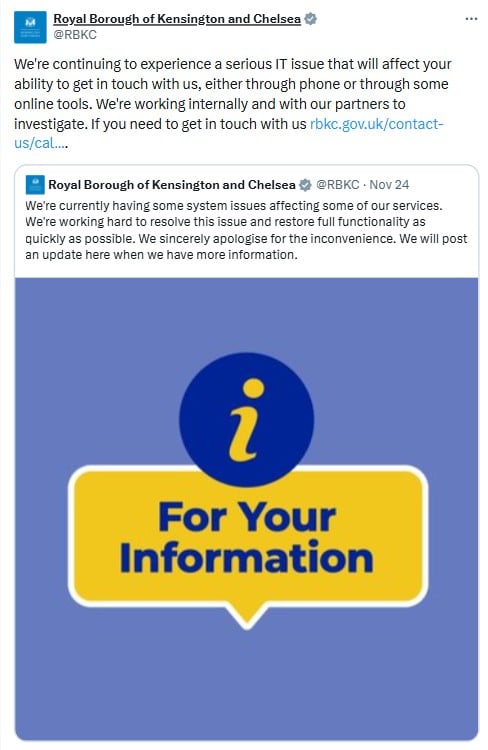 Source: X[/caption]
WCC issued a similar update, explaining that its computer networks were temporarily shut down as a precaution. The council apologised to residents for the inconvenience but emphasised that immediate action was necessary to prevent further impact. “We are taking swift and effective action to bring all our systems back online as soon as possible,” the council stated on its website. Emergency contact numbers were provided for urgent issues.
Source: X[/caption]
WCC issued a similar update, explaining that its computer networks were temporarily shut down as a precaution. The council apologised to residents for the inconvenience but emphasised that immediate action was necessary to prevent further impact. “We are taking swift and effective action to bring all our systems back online as soon as possible,” the council stated on its website. Emergency contact numbers were provided for urgent issues.


 Source: SitusAMC[/caption]
In the letter, the company reiterated that the incident is contained, services remain fully operational, and no encrypting malware was used. Clients were encouraged to reach out to the company’s security team for additional queries.
Source: SitusAMC[/caption]
In the letter, the company reiterated that the incident is contained, services remain fully operational, and no encrypting malware was used. Clients were encouraged to reach out to the company’s security team for additional queries.

 Source: FBI[/caption]


 Source: Salesforce[/caption]


Amid these ongoing threats, many shoppers are also expressing frustration with deceptive pricing tactics seen during the Black Friday period. One Reddit user described the experience as increasingly misleading:
“I'm officially over the Black Friday hype. It used to feel like a sale, now it feels like a prank.
I was tracking a coffee machine at $129. When the ‘Black Friday early deal’ showed up, it became ‘$159 now $139 LIMITED TIME.’ I saw $129 two weeks ago. The kids’ tablet went from $79 to $89 with a Holiday Deal tag — paying extra for a yellow label.
I've been doing Black Friday hunting for 10+ years and it's only gotten worse. Fake doorbusters, fake urgency, fake ‘original’ prices. Feels like they're A/B testing how cooked our brains are as long as the button screams ‘53% OFF.’
Now I only buy when needed and let a Chrome extension track my Amazon orders. It clawed back $72 last month from so-called ‘preview pricing’ after prices dropped again.”
This sentiment reflects a growing concern: while scam campaigns imitate trusted brands, the pressure-driven marketing tactics surrounding Black Friday can also make consumers more vulnerable to fraud.



 Source: X[/caption]
Officials confirmed that the situation has since been contained, with systems placed under continuous monitoring to prevent further disruption. Citizens have been encouraged to reach out to the National KE-CIRT if they have information relevant to the breach.
Source: X[/caption]
Officials confirmed that the situation has since been contained, with systems placed under continuous monitoring to prevent further disruption. Citizens have been encouraged to reach out to the National KE-CIRT if they have information relevant to the breach.
 Source: X[/caption]


| Name | Designation | Company |
| Matthew Rosenquist | CISO and Cybersecurity Strategist | Mercury Risk and Compliance, Inc |
| Kris Virtue | VP Cybersecurity | Qualcomm |
| Joe Suareo, CISA | CISO, VP Information Security | Restaurant Brands International Inc. (RBI) |
| Seema Patel | CISO | Maricopa County |
| Monica Keeneth | CISO | Inovalon |
| Nick Lovrien, CPP | Chief Global Security officer-Vice President | Meta Platforms Inc (Facebook) |
| David Dunn | CISO | Kroll |
| Jamie Giroux | CISO | Platinum Equity |
| Matt Martin | CISO/ Director IT | Sidley Austin LLP |
| Stacey S. Smith | VP, CISO | Gainwell Technologies |
| Sai Iyer | CISO | Ziff Davis |
| Harsha Reddy | Head of information security | Veterinary Emergency Group LLC (VEG) |
| Preetham Nayak | CISO | OVT |
| Joshy Alappat | CISO | Oncouse Home Solutions |
| Prakash Kalaiah | Head of Security | Enphase Energy |
| Dave Martin | Chief Security Officer | ADP |
| Donna Hart | CISO | Ally Financial Inc |
| Chris Hastings | Information Security Leader | American Family Insurance |
| Paul Conlon | CISO, VP of IT infrastructure and Operations | Aptiv |
| Bashar Abouseido | SVP, CISO | Charles Schwab |
| Kurt John | CISO | Consolidated Edison Company |
| John Dickson | VP, CISO | Colonial Pipeline Company |
| Hilik Kotler | SVP, CISO and IT | Expedia |
| Niraj Patel | VP and CISO | Horizon Blue Cross Blue Shield of New Jersey |
| Steve Grossman | CISO | National Basketball Association (NBA) |
| Tod Mitchinson | VP, Chief Information Security Officer | New York Life Insurance Company |
| Alexandria S. (Alexandria San Miguel) | Head of information security | CHANEL |
| Daniel Nuñez | CISO | New York City Employees' Retirement System |
| David Spizzirro | CISO | InvestCloud, Inc |
| Nick Vigier | CISO | Oscar Health Insurance |
| George Stathakopoulos | VP of Corporate Information Security | Apple |
| Jerry Geisler | EVP & Global CISO | Walmart |
| Peter Rosario | CISO | USI Insurance Services |
| Liza (Mermegas) Russell | CISO, Consumer Banking & Payments | Barclays |
| Jeffrey Walker | CSO | International Flavors & Fragrances |
| Kylie Watson | CISO | Sumitomo Mitsui Banking Corporation. |
| Brian Wilkins | VP & CISO | TradeStation |
| Mahmood Khan | SVP & Global Chief Information Security Officer | CNA Insurance |
| Ken Athanasiou | VP, CISO | VF Corporation |
| Brad Jones | CISO | Snowflake |
| Amit Basu | VP, CIO & CISO | International Seaways, Inc. |
| Stephen Luterman | CTIO | ExodusPoint Capital Management, LP |
| Nick Sherwood | CISO | Moody's Corporation |
| Lauren Dana | VP, CISO | PSEG |
| Sohaib Syeed Ahmed | AVP | First National Financial |
| Thomas Mager | CISO | Springer Nature Group |
| Patricia "Patty" Voight | Executive Managing Director; CISO and Tech Risk Management | Webster Bank |
| Tammy Klotz | CISO | Trinseo |
| Donna Ross | CISO | Radian |
| Rob Suárez | VP.& CISO | CareFirst BlueCross BlueShield |
| Dr. Elizabeth Di Bene | CISO | Loudoun County Government |
| Vivek Kumar | Global CISO | Alter Domus |
| Andrew Cal | CISO | WestCap |
| Jay B. Mody | CISO & Head of IT Infrastructure | Chimera Investment Corporation |
| Phani Dasari | CISO | HGS - Hinduja Global Solutions |
| Abie George John | CISO | Halliburton |
| Parthasarathi Chakraborty | VP, Global Head of Security Engineering | Broadridge |
| Vivek S. Menon | CISO & Head of Data | Digital Turbine |
| Yogesh Badwe | Chief Security Officer | Druva |
| Sangram Dash | CISO and VP of IT | Sisense |
| Mahesh A. | CISO and Data Officer | Hidden Road |
| Rohan Singla | CISO | ChargePoint |
| Anurana Saluja | VP (CISO) - Global Head of Information Security, Privacy & Business Continuity | Sutherland |
| Chirag Shah | Global Information Security Officer & DPO | Model N |
| Navarasu Dhanasekar | CISO | Schneider Electric Digital Grid |
| Vasanth Madhure | CISO | Couchbase |
| Josh Stabiner | CISO | Vista Equity Partners |
| Chanda Dutta | Head of Information Security | William Blair |
| Brian Redler | SVP, CISO | Penguin Random House |
| James Anderson | CISO | Genworth Financial |
| Jim Desmond | SVP, Chief Security Officer | Asurion |
| Jerry Kowalski | CISO | Jefferies |
| Carl Scaffidi | Chief Information Security Officer - Senior Vice President | Vystar Credit Union |
| Jody Jenkins | VP & CISO | Catalent Pharma Solutions |
| Lilian Seidaros | CISO and Vice President, IT Infrastructure | 360insights.com |
| Zeeshan Sheikh | SVP, Chief Information & Digital Officer | PSEG |
| Brian L. | Director, Amazon Security - Global, Media & Entertainment & Ads | Amazon Prime Video & Studios. |
| Martin Thibodeau | SVP &CIO | RONA |
| George Michalitsianos | VP & CISO | Ansell |
| Nalin Narayanam | Chief Information Officer and CISO | AdaptHealth |
| Manmohan Singh | Assistant Vice President - Information Security & Deputy CISO | UT Southwestern Medical Center |
| Milan Parikh | Global Head, Infrastructure, Security and Network | PTC Therapeutics |
| Nitin Raina | SVP, Chief Information Security Officer | Thoughtworks |
| Parthiv Shah | Chief Information Security Officer, SVP | Customer Bank |
| Mohana Balakrishnan | CISO & CTO | Schools Insurance Authority: SIA |
| Devon Bryan | Global Chief Security Officer | Booking Holdings Inc |
| Avi Ben-Menahem | CISO | NYDIG |
| Bala Rajagopalan | Managing Director, Global CISO | TradeWeb Markets |
| Jigar Shah | Chief Information Security Officer | Medusind |
| Gautam Nijhawan | Head of CyberSecurity | Eikon Therapeutics |
| Charan Singh | Chief Information Security Officer | Zelis |
| Upendra Mardikar | Chief Information Security Officer | TIAA |
| Raja Eswar | Chief Information Security Officer | State of California |
| Rohit Rajpara | CISO | Goldman Sachs Advisor Solutions |
| Chander M | CISO and CTO | Lazydays |
| Anupma Bhatia | Head of Information Security | TRANZACT |
| Vikas Mahajan | VP & CISO | American Red Cross |
| Stephen Harrison | SVP, CISO | MGM Resorts International |
| David Shaw | CISO | Transact Campus |


 Source: NCSC[/caption]
Victims were directed to a fake website that closely mirrored the legitimate Canton of Zurich portal. After providing personal details such as their address, IBAN, date of birth, and telephone number, users were shown a confirmation page and then redirected to the real website — reinforcing the illusion of authenticity.
[caption id="attachment_106721" align="aligncenter" width="1000"]
Source: NCSC[/caption]
Victims were directed to a fake website that closely mirrored the legitimate Canton of Zurich portal. After providing personal details such as their address, IBAN, date of birth, and telephone number, users were shown a confirmation page and then redirected to the real website — reinforcing the illusion of authenticity.
[caption id="attachment_106721" align="aligncenter" width="1000"] Source: NCSC[/caption]
[caption id="attachment_106722" align="aligncenter" width="1000"]
Source: NCSC[/caption]
[caption id="attachment_106722" align="aligncenter" width="1000"] Source: NCSC[/caption]
Although the stolen data might not seem highly sensitive, authorities warn that it can be misused in follow-up scams. For instance, fraudsters may later call victims pretending to be bank representatives, using the collected personal details to sound credible and gain further access.
Source: NCSC[/caption]
Although the stolen data might not seem highly sensitive, authorities warn that it can be misused in follow-up scams. For instance, fraudsters may later call victims pretending to be bank representatives, using the collected personal details to sound credible and gain further access.
 Source: NCSC[/caption]
Such campaigns highlight the shift from random spam emails to targeted phishing, where scammers invest more effort in psychological manipulation and social engineering.
Source: NCSC[/caption]
Such campaigns highlight the shift from random spam emails to targeted phishing, where scammers invest more effort in psychological manipulation and social engineering.

 Source: Department of the Treasury’s Office of Foreign Assets Control (OFAC)[/caption]


The GRC platform market is witnessing strong growth as organizations across the globe focus on strengthening governance, mitigating risks, and meeting evolving compliance demands. According to recent estimates, the market was valued at USD 49.2 billion in 2024 and is projected to reach USD 127.7 billion by 2033, growing at a CAGR of 11.18% between 2025 and 2033.
This GRC platform market growth reflects the increasing need to protect sensitive data, manage cyber risks, and streamline regulatory compliance processes.
As cyberthreats continue to rise, enterprises are turning to GRC platforms to gain centralized visibility into their risk posture. These solutions help organizations identify, assess, and respond to potential risks, ensuring stronger governance and reduced operational disruption.
The market’s momentum is also fueled by heightened regulatory scrutiny and the introduction of new compliance frameworks worldwide. Businesses are under pressure to maintain transparency, accuracy, and accountability in their governance and reporting processes — areas where a GRC platform adds significant value.
By integrating governance, risk, and compliance management into one system, companies can make informed decisions, reduce human error, and ensure consistent adherence to evolving regulations.
The GRC platform market is segmented based on deployment model, solution, component, end-user, and industry vertical.
Deployment Model: The on-premises deployment model dominates the market due to enhanced security and customization options. It is preferred by organizations handling sensitive data or operating under strict regulatory environments.
Solution Type: Compliance management holds the largest market share as businesses prioritize automation of documentation, tracking, and reporting to stay audit-ready.
Component: Software solutions lead the market by offering analytics, policy management, and workflow automation to streamline risk processes.
End User: Medium enterprises represent the largest segment, focusing on scalable solutions that balance security and efficiency.
Industry Vertical: The BFSI sector remains a key adopter due to its complex regulatory landscape and high data security requirements.
Several factors contribute to the rapid expansion of the GRC platform market:
Escalating Cyber Risks: As cyber incidents become more frequent and sophisticated, organizations seek to integrate cybersecurity measures within GRC frameworks. These integrations improve detection, response, and recovery capabilities.
Evolving Compliance Standards: Increasing regulatory pressure drives adoption of GRC solutions to ensure businesses stay aligned with global standards like GDPR, HIPAA, and ISO 27001.
Automation and Efficiency: Advanced GRC software reduces manual reporting and enhances accuracy, enabling faster audit responses and improved decision-making.
Operational Resilience: A robust GRC system ensures business continuity by minimizing vulnerabilities and improving crisis management strategies.
North America currently leads the GRC platform market, supported by mature digital infrastructure and strong regulatory frameworks. Meanwhile, the Asia-Pacific region is emerging as a key growth area, driven by increased cloud adoption and a rising focus on data privacy.
In the coming years, integration with AI, analytics, and threat intelligence tools will transform how organizations approach governance and risk. The market is expected to evolve toward more predictive and adaptive compliance solutions.
As organizations expand their digital ecosystems, threat intelligence has become a vital part of effective risk management. Platforms like Cyble help enterprises identify, monitor, and mitigate emerging cyber risks before they escalate. Integrating such intelligence-driven insights into a GRC platform strengthens visibility and helps build a proactive security posture.
For security leaders aiming to align governance with real-time intelligence, exploring a quick free demo of integrated risk and compliance tools can offer valuable perspective on enhancing organizational resilience.


 Source: https://www.staffnews.in/2025/11/[/caption]