Reading view

ICE issues deportation order for Belarusian woman extradited by FBI

Yana Leonova faces multiple charges including fraud and conspiracy for smuggling US aviation parts to Russia

An ongoing FBI investigation into a Belarusian woman accused of smuggling US aviation parts and electronics to Russia is teetering on the brink of collapse after being caught in what one judge called a “Kafkaesque” case brought on by the Trump administration’s attempts to deport her before she faces trial.

Federal prosecutors had worked for over a year to secure the extradition of Yana Leonova, who faces multiple charges including fraud, conspiracy, and money laundering. But their efforts unraveled when immigration officials abruptly issued an order to detain and deport her soon after she was flown into the US last month, a move that plunged the case into legal chaos.

Continue reading...

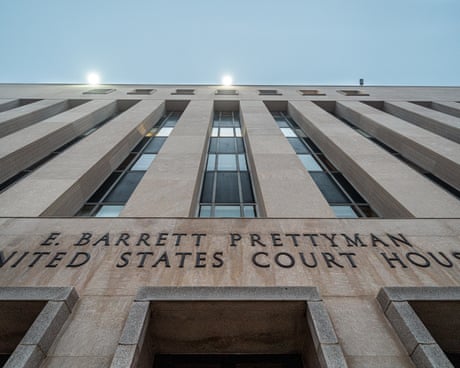
© Photograph: J David Ake/Getty Images

© Photograph: J David Ake/Getty Images

© Photograph: J David Ake/Getty Images

  •  

FBI Warns of Fake Video Scams

The FBI is warning of AI-assisted fake kidnapping scams:

Criminal actors typically will contact their victims through text message claiming they have kidnapped their loved one and demand a ransom be paid for their release. Oftentimes, the criminal actor will express significant claims of violence towards the loved one if the ransom is not paid immediately. The criminal actor will then send what appears to be a genuine photo or video of the victim’s loved one, which upon close inspection often reveals inaccuracies when compared to confirmed photos of the loved one. Examples of these inaccuracies include missing tattoos or scars and inaccurate body proportions. Criminal actors will sometimes purposefully send these photos using timed message features to limit the amount of time victims have to analyze the images.

Images, videos, audio: It can all be faked with AI. My guess is that this scam has a low probability of success, so criminals will be figuring out how to automate it.

  •  

Exploitation Efforts Against Critical React2Shell Flaw Accelerate

SLA, cyberattack, retailers, Ai, applications, sysdig, attack, cisco, AI, AI-powered, attacks, attackers, security, BreachRx, Cisco, Nexus, security, challenges, attacks, cybersecurity, risks, industry, Cisco Talos hackers legitimate tools used in cyberattacks

The exploitation efforts by China-nexus groups and other bad actors against the critical and easily abused React2Shell flaw in the popular React and Next.js software accelerated over the weekend, with threats ranging from stolen credentials and initial access to downloaders, crypto-mining, and the NoodleRat backdoor being executed.

The post Exploitation Efforts Against Critical React2Shell Flaw Accelerate appeared first on Security Boulevard.

  •  

Holiday shoppers targeted as Amazon and FBI warn of surge in account takeover attacks

The FBI has issued a public service announcement warning about a surge in account takeover (ATO) fraud, and the timing lines up with a major alert Amazon has just sent to its 300 million customers about brand impersonation scams.

How ATO fraud works

Account takeover fraud is just what it says: Scammers figure out a way to hijack your account and use it for their own gain. It affects everything from email and social media to retailer, travel, and banking accounts. Criminals use plenty of tactics, including malware on your computer or phone, or “credential stuffing,” where they try compromised passwords across lots of sites.

The FBI’s new alert focuses on attackers who impersonate customer support or tech support from your bank. Amazon’s warning describes almost identical techniques, but aimed at Amazon shoppers instead of banking customers.

Attackers send texts, emails and make phone calls designed to fool you into giving away your username and password, and even your multi-factor authentication (MFA) codes. Once they’re in the account, scammers quickly reset passwords or other access controls, locking you out of your own account.

Fake websites, fake alerts, and fake customer support

The FBI highlights another technique used for similar purposes: website-based phishing. The scammer will direct you to a fake site that looks just like your bank’s login page. The moment you enter your details, the criminals steal them and use them on the real banking site.

Amazon says the same thing is happening to its customers. In a warning email sent November 24, it listed the attacks it is seeing most often:

  • Fake delivery notices or account-issue messages
  • Third-party ads offering unbelievable deals
  • Messages via unofficial channels requesting login or payment information
  • Links to look-alike websites
  • Unsolicited “Amazon support” phone calls

One of the FBI’s examples mirrors this almost exactly: Attackers claim there has been fraudulent activity on your account and urge you to click a link to “fix” it, but it sends you straight to a phishing site.

How do the scammers get you to these sites?

Search engine optimization (SEO) poisoning is one common technique, the FBI says. Scammers buy ads with search engines that direct users to their malicious sites. Many mimic household names with tiny variations that are easy to miss when you’re in a hurry.

Amazon’s warning is backed up by research from FortiGuard Labs, which found that 19,000+ new domains set up to imitate major retail brands. 2,900 of those were proven to be malicious.

This wave of impersonation attacks isn’t limited to search ads and look-alike domains. Researchers have also uncovered a system called Matrix Push C2 that abuses browser push notifications to deliver fake alerts designed to look like they’re from trusted brands such as Netflix, PayPal, and Cloudflare. Once clicked, those alerts lead victims to phishing pages or malware, giving attackers yet another path to steal login details or take over accounts.

A growing epidemic

This type of fraud is on the rise. According to TransUnion, digital account takeover climbed 21% from H1 2024 to H1 2025, and 141% since H1 2021. It’s big business; the FBI has received over 5,100 complaints since January, and says that losses have hit $262 million.

This is a popular time for scammers to ramp up ATO fraud. Amazon’s alert comes at one of the busiest online shopping periods of the year—Black Friday and the run-up to the holidays.

And while MFA is important, it doesn’t always save you. Proofpoint found that 65% of compromised accounts had MFA enabled. But if you give up your secrets to a scammer, they have the keys to the kingdom.

Passwordless options such as passkeys promise better security because then there’s no MFA code to give up (you just use biometric access or click on a browser prompt to log in). However, those are still relatively uncommon compared to passwords, and when they do exist, people don’t often use them.

How to protect yourself

Cybercriminals prey on the vulnerable and the distracted. Brand impersonation works because attackers lean hard on urgency. They claim your account has been breached, or a large transaction has gone through, or a delivery can’t be completed.

Scammers are experts at using fear to get past your emotional defenses. In one inventive twist highlighted by the FBI, scammers told victims their details were used for firearms purchases, then transferred them to a fake “law enforcement” accomplice. Once fear kicks in, people act fast.

Whether the scammer is posing as Amazon, your bank, or a courier service, the same rules apply:

  • Bookmark your bank and retailer login pages. Don’t search for them, as results can be spoofed.
  • Use official apps. Download your bank or Amazon app directly from an official link, not through a search engine.
  • Be stingy with personal info. Pet names, schools, and birthdays can help criminals with “security questions.”
  • Be skeptical of caller ID. It can be spoofed. Hang up, then call back using a verified number.
  • Use passkeys if offered. They cut out SMS codes entirely and help prevent phishing.
  • Never share one-time codes. No legitimate company will ask.

Amazon also reminds users:

  • It will never ask for payment information over the phone.
  • It will never send emails asking customers to verify login details.
  • All account changes, tracking, and refunds should go through the Amazon app or website only.

If you do think you’ve been hit by an ATO scam, contact your bank immediately to try and recall or reverse any fraudulent transactions. It might still not be too late, but every second counts. Also, file a complaint with the FBI’s IC3 online crime unit.


We don’t just report on scams—we help detect them

Cybersecurity risks should never spread beyond a headline. If something looks dodgy to you, check if it’s a scam using Malwarebytes Scam Guard, a feature of our mobile protection products. Submit a screenshot, paste suspicious content, or share a text or phone number, and we’ll tell you if it’s a scam or legit. Download Malwarebytes Mobile Security for iOS or Android and try it today!

  •  

Account Takeover Scams Surge as FBI Reports Over $262 Million in Losses

Account Takeover fraud

The Account Takeover fraud threat is accelerating across the United States, prompting the Federal Bureau of Investigation (FBI) to issue a new alert warning individuals, businesses, and organizations of all sizes to stay vigilant. According to the FBI Internet Crime Complaint Center (IC3), more than 5,100 complaints related to ATO fraud have been filed since January 2025, with reported losses exceeding $262 million. The bureau warns that cyber criminals are increasingly impersonating financial institutions to steal money or sensitive information. As the annual Black Friday sale draws millions of shoppers online, the FBI notes that the surge in digital purchases creates an ideal environment for Account Takeover fraud. With consumers frequently visiting unfamiliar retail websites and acting quickly to secure limited-time deals, cyber criminals deploy fake customer support calls, phishing pages, and fraudulent ads disguised as payment or discount portals. The increased online activity during Black Friday makes it easier for attackers to blend in and harder for victims to notice red flags, making the shopping season a lucrative window for ATO scams.

How Account Takeover Fraud Works

In an ATO scheme, cyber criminals gain unauthorized access to online financial, payroll, or health savings accounts. Their goal is simple: steal funds or gather personal data that can be reused for additional fraudulent activities. The FBI notes that these attacks often start with impersonation, either of a financial institution’s staff, customer support teams, or even the institution’s official website. To carry out their schemes, criminals rely heavily on social engineering and phishing websites designed to look identical to legitimate portals. These tactics create a false sense of trust, encouraging account owners to unknowingly hand over their login credentials.

Social Engineering Tactics Increase in Frequency

The FBI highlights that most ATO cases begin with social engineering, where cyber criminals manipulate victims into sharing sensitive information such as passwords, multi-factor authentication (MFA) codes, or one-time passcodes (OTP). Common techniques include:
  • Fraudulent text messages, emails, or calls claiming unusual activity or unauthorized charges. Victims are often directed to click on phishing links or speak to fake customer support representatives.
  • Attackers posing as bank employees or technical support agents who convince victims to share login details under the guise of preventing fraudulent transactions.
  • Scenarios where cyber criminals claim the victim’s identity was used to make unlawful purchases—sometimes involving firearms, and escalate the scam by introducing another impersonator posing as law enforcement.
Once armed with stolen credentials, criminals reset account passwords and gain full control, locking legitimate users out of their own accounts.

Phishing Websites and SEO Poisoning Drive More Losses

Another growing trend is the use of sophisticated phishing domains and websites that perfectly mimic authentic financial institution portals. Victims believe they are logging into their bank or payroll system, but instead, they are handing their details directly to attackers. The FBI also warns about SEO poisoning, a method in which cyber criminals purchase search engine ads or manipulate search rankings to make fraudulent sites appear legitimate. When victims search for their bank online, these deceptive ads redirect them to phishing sites that capture their login information. Once attackers secure access, they rapidly transfer funds to criminal-controlled accounts—many linked to cryptocurrency wallets—making transactions difficult to trace or recover.

How to Stay Protected Against ATO Fraud

The FBI urges customers and businesses to take proactive measures to defend against ATO fraud attempts:
  • Limit personal information shared publicly, especially on social media.
  • Monitor financial accounts regularly for missing deposits, unauthorized withdrawals, or suspicious wire transfers.
  • Use unique, complex passwords and enable MFA on all accounts.
  • Bookmark financial websites and avoid clicking on search engine ads or unsolicited links.
  • Treat unexpected calls, emails, or texts claiming to be from a bank with skepticism.

What To Do If You Experience an Account Takeover

Victims of ATO fraud are advised to act quickly:
  1. Contact your financial institution immediately to request recalls or reversals, and report the incident to IC3.gov.
  2. Reset all compromised credentials, including any accounts using the same passwords.
  3. File a detailed complaint at IC3.gov with all relevant information, such as impersonated institutions, phishing links, emails, or phone numbers used.
  4. Notify the impersonated company so it can warn others and request fraudulent sites be taken down.
  5. Stay informed through updated alerts and advisories published on IC3.gov.
  •  

IC3 Impersonation Scams Surge, FBI Issues Public Alert

IC3 impersonation scams

The FBI has issued a fresh alert warning the public about a growing wave of IC3 impersonation scams, where fraudsters pose as officials from the Internet Crime Complaint Center (IC3) to deceive individuals into sharing sensitive information or paying fraudulent fees. According to the Bureau, more than 100 such cases were reported between December 2023 and February 2025, signaling a concerning rise in criminal attempts disguised as official outreach.

IC3 Impersonation Scams Are Increasing Nationwide

In its latest public communication, the FBI emphasized that the IC3 does not directly contact victims for money, personal data, or case updates. Yet, scammers continue to exploit the trust associated with the organization, using emails, phone calls, social media, and messaging apps to trick victims, often by claiming they have recovered previously lost funds. A particularly troubling variant of IC3 impersonation scams involves scammers posing as financial fraud victims online. They create fake female profiles, join support groups, and recommend contacting a supposed “Chief Director” of IC3 named Jaime Quin on Telegram. Once victims reach out, the scammer claims to have recovered their stolen money but uses this pretext to gather financial information and re-target victims who have already suffered losses.

How the Scam Works

Reports show that initial contact methods vary, but the tactic generally follows a predictable pattern:
  • Scammers falsely claim to work with IC3 or the FBI.
  • They offer assistance in recovering lost funds or say money has already been recovered.
  • Once trust is gained, they request personal or financial details.
  • Victims are then pressured into sending additional payments or revealing sensitive data.
Authorities reiterate that the Internet Crime Complaint Center does not charge fees, does not work with third-party recovery companies, and never reaches out to individuals via social platforms or messaging apps. [caption id="attachment_107108" align="aligncenter" width="975"]IC3 Impersonation Scams Source: FBI[/caption]

How to Protect Yourself

The FBI advises the public to stay vigilant and follow these safety guidelines:
  • IC3 will never contact individuals directly via phone, social media, or email.
  • Do not share personal or financial information with people you meet online or through unsolicited communication.
  • Avoid sending money, cryptocurrency, or gift cards to unknown individuals.
  • Be cautious of anyone claiming to be an IC3 representative, especially if they ask for payment.

Report Suspicious Activity Immediately

Victims are urged to report suspected fraud to ic3.gov, providing details such as communication methods, financial transaction records, and information about the individual or company involved. Individuals aged 60 and above who need help filing a complaint can contact the Department of Justice’s Elder Justice Hotline at 1-833-FRAUD-11.
  •  

CBI Arrests Fugitive Cybercrime Kingpin, Busts Fifth Illegal Call Center Targeting US Nationals

CBI, CBI Dismantles Cybercrime, Cybercrime, FBI, Online Fraud, Call Center Scam, Cybercrime Kingpin

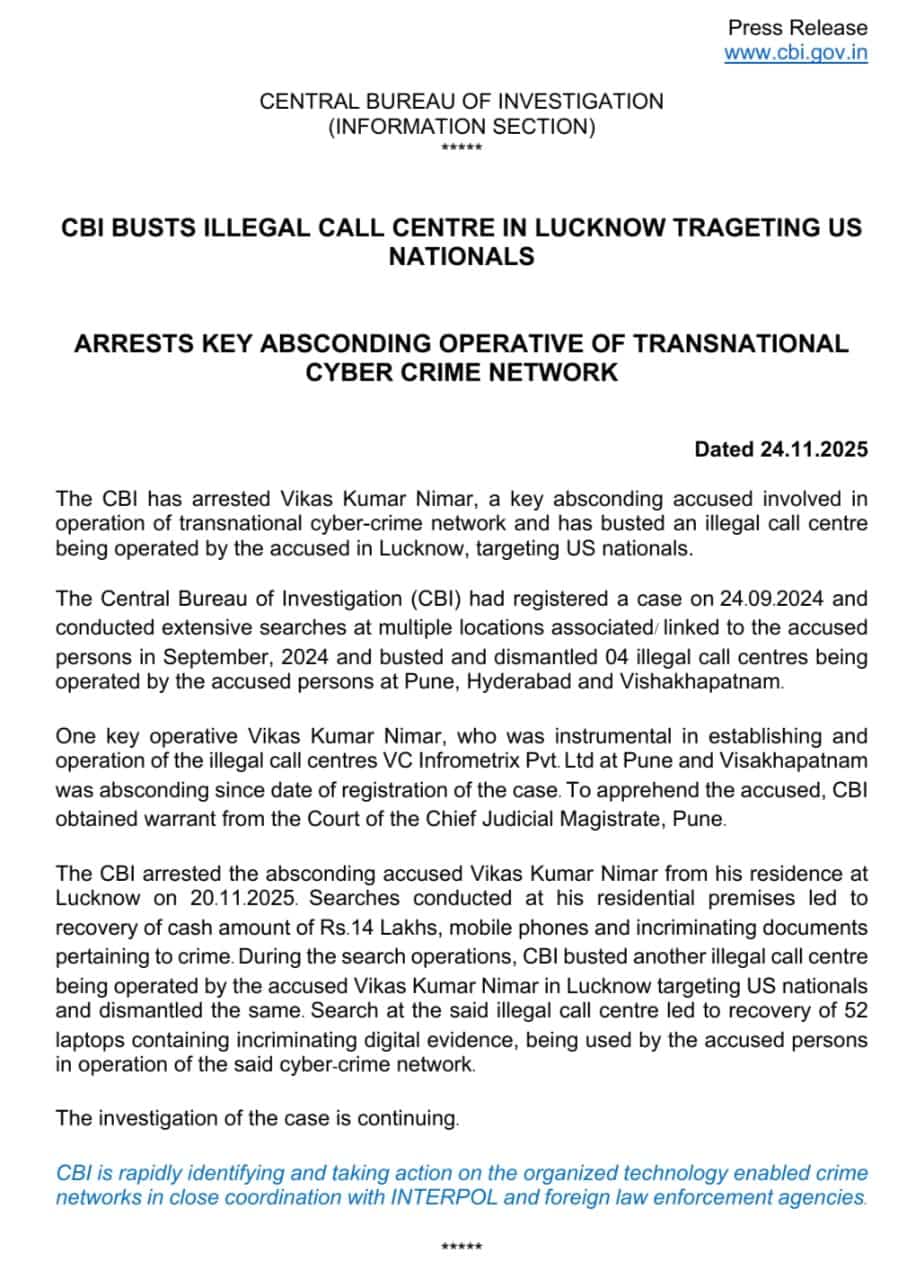
Indian authorities recovered Rs. 14 lakh (approximately $16,500) along with 52 laptops containing incriminating digital evidence when they arrested Vikas Kumar Nimar, a key cybercrime kingpin and fugitive who had evaded capture for two months while continuing to operate an illegal call center defrauding American citizens.

The arrest by India's Central Bureau of Investigation (CBI) marks the latest disruption in Operation Chakra, a coordinated international crackdown targeting transnational tech support scam networks that have stolen more than $40 million from victims in the United States, United Kingdom, Australia, and European Union countries.

The CBI registered the case against Nimar on September 24, 2024, conducting extensive searches at multiple locations in September that dismantled four illegal call centers operated by the accused in Pune, Hyderabad, and Visakhapatnam. Nimar, who was instrumental in establishing and operating the illegal call center VC Informetrix Pvt. Ltd at Pune and Visakhapatnam, went into hiding following the initial raids.

Read: CBI’s Coordinated Strike Takes Down Transnational Cybercrime Network in India

Discovery of Fifth Call Center Operation

The CBI obtained an arrest warrant from the Chief Judicial Magistrate Court in Pune and tracked Nimar to his residential premises in Lucknow. Searches conducted during the November 20, 2025, arrest led to recovery of cash, mobile phones, and incriminating documents pertaining to the crimes.

During search operations, investigators discovered Nimar had established another illegal call center in Lucknow continuing to target US nationals despite being a fugitive. The CBI immediately dismantled this fifth operation, seizing 52 laptops containing digital evidence used in the cybercrime network's operations.

The agency said investigations continue with efforts to identify additional accomplices and trace stolen funds through cryptocurrency channels.

[caption id="attachment_107086" align="aligncenter" width="350"]CBI, Cybercrime Kingping, ONline fraud, Fraudulent Call Center, Fraud Call Center, Fraud Call Centre, Source: CBI on X platform[/caption]

Pattern of Tech Support Scams

The cybercrime networks dismantled through Operation Chakra employ social engineering tactics to defraud victims. Criminals contact targets claiming their bank accounts have been compromised, exploiting fear of financial loss to manipulate victims into taking immediate action.

Under the guise of providing technical assistance, fraudsters gain remote access to victims' computers and convince them to transfer money into cryptocurrency wallets they control. The operations targeted US nationals from 2023 to 2025, with one network alone defrauding American citizens of more than $40 million through these tactics.

Read: Indo-U.S. Agencies Dismantle Cybercrime Network Targeting U.S. Nationals

The illegal call centers operate under legitimate-sounding company names to establish credibility. Previous raids uncovered operations running as "M/s Digipaks The Future of Digital" in Amritsar, "FirstIdea" in Delhi's Special Economic Zone, and VC Informetrix Pvt. Ltd in Pune and Visakhapatnam.

Operation Chakra represents extensive collaboration between Indian authorities and international law enforcement agencies. The CBI works closely with INTERPOL, the US Federal Bureau of Investigation, the UK's National Crime Agency, Homeland Security Investigations, and private sector partners including Microsoft Corporation.

Intelligence sharing from US authorities triggered the earlier investigation that led to raids uncovering the large-scale illegal call center in Amritsar. That operation intercepted 34 individuals engaged in active fraud, seizing 85 hard drives, 16 laptops, and 44 mobile phones loaded with incriminating digital evidence.

Operation Chakra-III's September raids last year across Mumbai, Kolkata, Pune, Hyderabad, Ahmedabad, and Visakhapatnam resulted in 26 arrests and seizure of 57 gold bars, Rs. 60 lakh in cash, 951 electronic devices, and three luxury vehicles. The coordinated strikes targeted call centers where over 170 individuals engaged in various forms of online fraud primarily targeting US citizens.

Cryptocurrency Laundering Networks

The networks rely heavily on cryptocurrency to launder stolen funds, presenting challenges for traditional financial crime investigations. Virtual asset transactions allow criminals to quickly move funds across borders with perceived anonymity, complicating recovery efforts.

One investigation revealed that key suspect Vishnu Rathi's group had scammed a US citizen into transferring nearly half a million dollars into cryptocurrency wallets under the guise of tech support services. The victim, led to believe her bank account was compromised, unknowingly handed control to criminals who manipulated her into making the large transfer.

The CBI coordinates with INTERPOL and foreign law enforcement bodies to follow money trails through virtual asset transactions, working to dismantle associated laundering networks alongside the operational infrastructure.

The CBI reiterated its commitment to rapidly identifying and taking action against organized technology-enabled crime networks. Authorities arrested individuals face charges under India's Information Technology Act of 2000 and the BNSS Act of 2023.

Previous Operation Chakra actions included the August arrest of a fugitive kingpin at Delhi's international airport while attempting to flee to Kathmandu, Nepal. Immigration officers intercepted the suspect based on CBI intelligence, preventing escape through a route previously exploited by wanted fugitives.

The multi-phase operation demonstrates India's strengthening cybersecurity posture through real-time intelligence sharing with global counterparts, moving beyond domestic law enforcement to tackle cybercriminals exploiting technological vulnerabilities across borders.

  •  

U.S., UK, Australia Sanction Russian Bulletproof Hosting Provider

U.S., UK, Australia Sanction Russian Bulletproof Hosting Provider

U.S., Australian and UK officials today announced sanctions against Media Land, a Russian bulletproof hosting (BPH) provider, citing Media Land’s “role in supporting ransomware operations and other forms of cybercrime.” “These so-called bulletproof hosting service providers like Media Land provide cybercriminals essential services to aid them in attacking businesses in the United States and in allied countries,” stated U.S. Under Secretary of the Treasury for Terrorism and Financial Intelligence John K. Hurley. “Today’s trilateral action with Australia and the United Kingdom, in coordination with law enforcement partners, demonstrates our collective commitment to combatting cybercrime and protecting our citizens.” UK Foreign Secretary Yvette Cooper added, “Cyber criminals think that they can act in the shadows, targeting hard working British people and ruining livelihoods with impunity. But they are mistaken – together with our allies, we are exposing their dark networks and going after those responsible.” Today’s announcements came from the U.S. Department of Treasury’s Office of Foreign Assets Control (OFAC), Australia’s Department of Foreign Affairs and Trade, and the UK’s Foreign Commonwealth and Development Office. OFAC and the FBI also designated three members of Media Land’s leadership team and three of its sister companies. In the U.S., OFAC sanctions require blocking and mandatory reporting of all property and interests of the designated persons and entities and prohibit all transactions involving any property or interests of designated or blocked persons. BPH service providers offer access to specialized servers and infrastructure designed to evade detection and disruption by law enforcement.

Russian Bulletproof Hosting Provider and Individuals Sanctioned

Media Land LLC, headquartered in St. Petersburg, Russia, has provided BPH services to criminal marketplaces and ransomware actors, including “prolific ransomware actors such as LockBit, BlackSuit, and Play,” the U.S. statement alleges. Media Land infrastructure has also been used in DDoS attacks, the U.S. says. Media Land, ML Cloud (a Media Land sister company), Aleksandr Volosovik (general director of Media Land who has allegedly advertised the business on cybercrime forums under the alias “Yalishanda”), and Kirill Zatolokin (a Media Land employee allegedly responsible for collecting payment and coordinating with cyber actors) were designated by OFAC for their cyber activities. The UK alleges that Volosovik “has been active in the cyber underground since at least 2010, and is known to have worked with some of the most notorious cyber criminal groups, including Evil Corp, LockBit and Black Basta.” Yulia Pankova was designated by OFAC for allegedly assisting Volosovik with legal issues and finances. Also designated are Media Land Technology (MLT) and Data Center Kirishi (DC Kirishi), fully-owned subsidiaries of Media Land.

U.S. and UK Sanction Alleged Aeza Entities

OFAC and the UK also designated Hypercore Ltd., an alleged front company of Aeza Group LLC, a BPH service provider designated by OFAC earlier this year, and two additional individuals and entities that have allegedly led, materially supported, or acted for Aeza Group. OFAC said that after its designations of Aeza Group and its leadership on July 1, 2025, “Aeza leadership initiated a rebranding strategy focusing on removing any connections between Aeza and their new technical infrastructure. OFAC’s designations today serve as a reminder that OFAC will take all possible steps to counter sanctions evasion activity by malicious cyber actors and their enablers.” Maksim Vladimirovich Makarov, allegedly the new director of Aeza, and Ilya Vladislavovich Zakirov, who allegedly helped establish new companies and payment methods to obfuscate Aeza’s activity, were also designated. Smart Digital Ideas DOO and Datavice MCHJ – Serbian and Uzbek companies allegedly utilized by Aeza to evade sanctions and set up technical infrastructure not publicly associated with the Aeza brand – were also designated.

Five Eyes Guidance for Defending Against BPH Providers

Also today, the U.S. and other “Five Eyes” countries issued guidance for defending against risks from bulletproof hosting providers. “Organizations with unprotected or misconfigured systems remain at high risk of compromise, as malicious actors leverage BPH infrastructure for activities such as ransomware, phishing, malware delivery, and denial-of-service (DoS) attacks,” the U.S. Cybersecurity and Infrastructure Security Agency (CISA) stated in announcing the guidance. “BPH providers pose a significant threat to the resilience and security of critical systems and services.” Included in the guidance are recommendations for a “nuanced approach to dynamically filter ASNs, IP ranges, or individual IP addresses to effectively reduce the risk of compromise from BPH provider-enabled activity.”
  •  

Akira Ransomware Group Poses ‘Imminent Threat’ to Critical Infrastructure: CISA

Akira ransomware group CISA advisory

The Akira ransomware group poses an “imminent threat to critical infrastructure,” the U.S. Cybersecurity and Infrastructure Security Agency (CISA) warned today. CISA joined with the FBI, other U.S. agencies and international counterparts to issue a lengthy updated advisory on the ransomware group, adding many new Akira tactics, techniques and procedures (TTPs), indicators of compromise (IoCs), and vulnerabilities exploited by the group. Akira is consistently one of the most active ransomware groups, so the update from CISA and other agencies is significant. As of late September, Akira has netted about $244.17 million in ransom payments, CISA said. The Akira ransomware group information was sourced from “FBI investigations and trusted third-party reporting,” the agency said. In a busy two days for the agency, CISA also added three vulnerabilities to its Known Exploited Vulnerabilities (KEV) catalog (CVE-2025-9242, a WatchGuard Firebox Out-of-Bounds Write vulnerability, CVE-2025-12480, a Gladinet Triofox Improper Access Control vulnerability, and CVE-2025-62215, a Microsoft Windows Race Condition vulnerability), and reissued orders to federal agencies to patch Cisco vulnerabilities CVE-2025-20333 and CVE-2025-20362.

Akira Ransomware Group Targets Vulnerabilities for Initial Access

The CISA Akira advisory notes that in a June 2025 incident, Akira encrypted Nutanix Acropolis Hypervisor (AHV) virtual machine (VM) disk files for the first time, expanding the ransomware group’s abilities beyond VMware ESXi and Hyper-V by abusing CVE-2024-40766, a SonicWall vulnerability. The updated advisory adds six new vulnerabilities exploited by Akira threat actors for initial access, including:
  • CVE-2020-3580, a cross-site scripting (XSS) vulnerability in Cisco Adaptive Security Appliance (ASA) Software and Cisco Firepower Threat Defense (FTD)
  • CVE-2023-28252, a Windows Common Log File System Driver Elevation of Privilege vulnerability
  • CVE-2024-37085, a VMware ESXi authentication bypass vulnerability
  • CVE-2023-27532, a Veeam Missing Authentication for Critical Function vulnerability
  • CVE-2024-40711, a Veeam Deserialization of Untrusted Data vulnerability
  • CVE-2024-40766, a SonicWall Improper Access Control vulnerability
“Akira threat actors gain access to VPN products, such as SonicWall, by stealing login credentials or exploiting vulnerabilities like CVE-2024-40766,” the CISA advisory said. In some cases, they gain initial access with compromised VPN credentials, possibly by using initial access brokers or brute-forcing VPN endpoints. The group also uses password spraying techniques and tools such as SharpDomainSpray to gain access to account credentials. Akira threat actors have also gained initial access through the Secure Shell (SSH) protocol by exploiting a router’s IP address. “After tunneling through a targeted router, Akira threat actors exploit publicly available vulnerabilities, such as those found in the Veeam Backup and Replication component of unpatched Veeam backup servers,” the advisory said.

Akira’s Latest Discovery, Persistence and Evasion Tactics

Visual Basic (VB) scripts are frequently used by the group to execute malicious commands, and nltest /dclist: and nltest /DOMAIN_TRUSTS are used for network and domain discovery. Akira threat actors abuse remote access tools such as AnyDesk and LogMeIn for persistence and to “blend in with administrator activity,” and Impacket is used to execute the remote command wmiexec.py and obtain an interactive shell. Akira threat actors also uninstall endpoint detection and response (EDR) systems to evade detection. In one incident, Akira threat actors bypassed Virtual Machine Disk (VMDK) file protection by powering down the domain controller’s VM and copying the VMDK files to a newly created VM, CISA said. “This sequence of actions enabled them to extract the NTDS.dit file and the SYSTEM hive, ultimately compromising a highly privileged domain administrator’s account,” the advisory said. Veeam.Backup.MountService.exe has also been used for privilege escalation (CVE-2024-40711), and AnyDesk, LogMeIn, RDP, SSH and MobaXterm have been used for lateral movement. Akira actors have used tunneling utilities such as Ngrok for command and control (C2) communications, initiating encrypted sessions that bypass perimeter monitoring. PowerShell and Windows Management Instrumentation Command-line (WMIC) have also been used to disable services and execute malicious scripts. Akira threat actors have been able to exfiltrate data in just over two hours from initial access, CISA said. The new Akira_v2 variant appends encrypted files with an .akira or .powerranges extension, or with .akiranew or .aki. A ransom note named fn.txt or akira_readme.txt appears in both the root directory (C:) and each user’s home directory (C:\Users). CISA recommended a number of security best practices for combatting the Akira ransomware threat, including prioritizing remediating known exploited vulnerabilities, enforcing phishing-resistant multifactor authentication (MFA), and maintaining regular, tested offline backups of critical data.
  •  

US Imposes Sanctions on Burma Over Cyber Scam Operations

US Treasury Sanctions Burma

The US Treasury Sanctions Burma armed group and several related companies for their alleged involvement in cyber scam centers targeting American citizens. The Department of the Treasury’s Office of Foreign Assets Control (OFAC) announced the designations as part of a broader effort to combat organized crime, human trafficking, and cybercriminal activities operating out of Southeast Asia. According to the Treasury Department, OFAC has sanctioned the Democratic Karen Benevolent Army (DKBA), a Burmese armed group, and four of its senior leaders for supporting cyber scam centers in Burma. These operations reportedly defraud Americans through fraudulent investment schemes.

US Treasury Sanctions Burma: OFAC Targets Armed Group and Associated Firms

The agency also designated Trans Asia International Holding Group Thailand Company Limited, Troth Star Company Limited, and Thai national Chamu Sawang, citing links to Chinese organized crime networks. These entities were found to be working with the DKBA and other armed groups to establish and expand scam compounds in the region. Under Secretary of the Treasury for Terrorism and Financial Intelligence John K. Hurley stated, “criminal networks operating out of Burma are stealing billions of dollars from hardworking Americans through online scams.” He emphasized that such activities not only exploit victims financially but also contribute to Burma’s civil conflict by funding armed organizations.

Scam Center Strike Force Established

In coordination with agencies including the Federal Bureau of Investigation (FBI), U.S. Secret Service (USSS), and Department of Justice, a new Scam Center Strike Force has been launched to counter cyber scams originating from Burma, Cambodia, and Laos. This task force will focus on investigating and disrupting the most harmful Southeast Asian scam centers, while also supporting U.S. victims through education and restitution programs. The initiative aims to combine law enforcement, financial action, and diplomatic efforts to curb illicit online operations. [caption id="attachment_106706" align="aligncenter" width="432"]US Treasury Sanctions Burma Source: Department of the Treasury’s Office of Foreign Assets Control (OFAC)[/caption]

An Ongoing Effort to Protect Victims

The US Treasury Sanctions Burma action builds on previous measures targeting illicit actors in the region. Earlier in 2025, the Karen National Army (KNA) and several related companies were sanctioned for their roles in human trafficking and cyber scam activities. Additional designations in Cambodia and Burma followed, targeting groups such as the Prince Group and Huione Group for operating scam compounds and laundering proceeds from virtual currency investment scams. According to government reports, Americans lost over $10 billion in 2024 to Southeast Asia-based cyber scam operations, marking a 66 percent increase from the previous year.

Cyber Scams and Human Trafficking Links

Investigations revealed that many individuals working in scam centers are victims of human trafficking, coerced into online fraud through threats and violence. Some compounds, including Tai Chang and KK Park in Burma’s Karen State, are known hubs for cyber scams. The DKBA reportedly provides protection for these compounds while also participating in violent acts against trafficked workers. These scam networks often use messaging apps and fake investment platforms to deceive Americans. Victims are manipulated into transferring funds to scam-controlled accounts under the guise of legitimate investments.

Sanctions and Legal Implications

Following today’s actions, all property and interests of the designated individuals and entities within the United States are now blocked. The sanctions prohibit any U.S. person from engaging in transactions involving these blocked parties. Violations of OFAC regulations could lead to civil or criminal penalties. The US Treasury Sanctions Burma initiative underscores the United States’ continued commitment to disrupting global cyber scam operations, holding organized crime networks accountable, and safeguarding victims of human trafficking and financial exploitation.
  •  

Mobile Phishers Target Brokerage Accounts in ‘Ramp and Dump’ Cashout Scheme

Cybercriminal groups peddling sophisticated phishing kits that convert stolen card data into mobile wallets have recently shifted their focus to targeting customers of brokerage services, new research shows. Undeterred by security controls at these trading platforms that block users from wiring funds directly out of accounts, the phishers have pivoted to using multiple compromised brokerage accounts in unison to manipulate the prices of foreign stocks.

Image: Shutterstock, WhataWin.

This so-called ‘ramp and dump‘ scheme borrows its name from age-old “pump and dump” scams, wherein fraudsters purchase a large number of shares in some penny stock, and then promote the company in a frenzied social media blitz to build up interest from other investors. The fraudsters dump their shares after the price of the penny stock increases to some degree, which usually then causes a sharp drop in the value of the shares for legitimate investors.

With ramp and dump, the scammers do not need to rely on ginning up interest in the targeted stock on social media. Rather, they will preposition themselves in the stock that they wish to inflate, using compromised accounts to purchase large volumes of it and then dumping the shares after the stock price reaches a certain value. In February 2025, the FBI said it was seeking information from victims of this scheme.

“In this variation, the price manipulation is primarily the result of controlled trading activity conducted by the bad actors behind the scam,” reads an advisory from the Financial Industry Regulatory Authority (FINRA), a private, non-profit organization that regulates member brokerage firms. “Ultimately, the outcome for unsuspecting investors is the same—a catastrophic collapse in share price that leaves investors with unrecoverable losses.”

Ford Merrill is a security researcher at SecAlliance, a CSIS Security Group company. Merrill said he has tracked recent ramp-and-dump activity to a bustling Chinese-language community that is quite openly selling advanced mobile phishing kits on Telegram.

“They will often coordinate with other actors and will wait until a certain time to buy a particular Chinese IPO [initial public offering] stock or penny stock,” said Merrill, who has been chronicling the rapid maturation and growth of the China-based phishing community over the past three years.

“They’ll use all these victim brokerage accounts, and if needed they’ll liquidate the account’s current positions, and will preposition themselves in that instrument in some account they control, and then sell everything when the price goes up,” he said. “The victim will be left with worthless shares of that equity in their account, and the brokerage may not be happy either.”

Merrill said the early days of these phishing groups — between 2022 and 2024 — were typified by phishing kits that used text messages to spoof the U.S. Postal Service or some local toll road operator, warning about a delinquent shipping or toll fee that needed paying. Recipients who clicked the link and provided their payment information at a fake USPS or toll operator site were then asked to verify the transaction by sharing a one-time code sent via text message.

In reality, the victim’s bank is sending that code to the mobile number on file for their customer because the fraudsters have just attempted to enroll that victim’s card details into a mobile wallet. If the visitor supplies that one-time code, their payment card is then added to a new mobile wallet on an Apple or Google device that is physically controlled by the phishers.

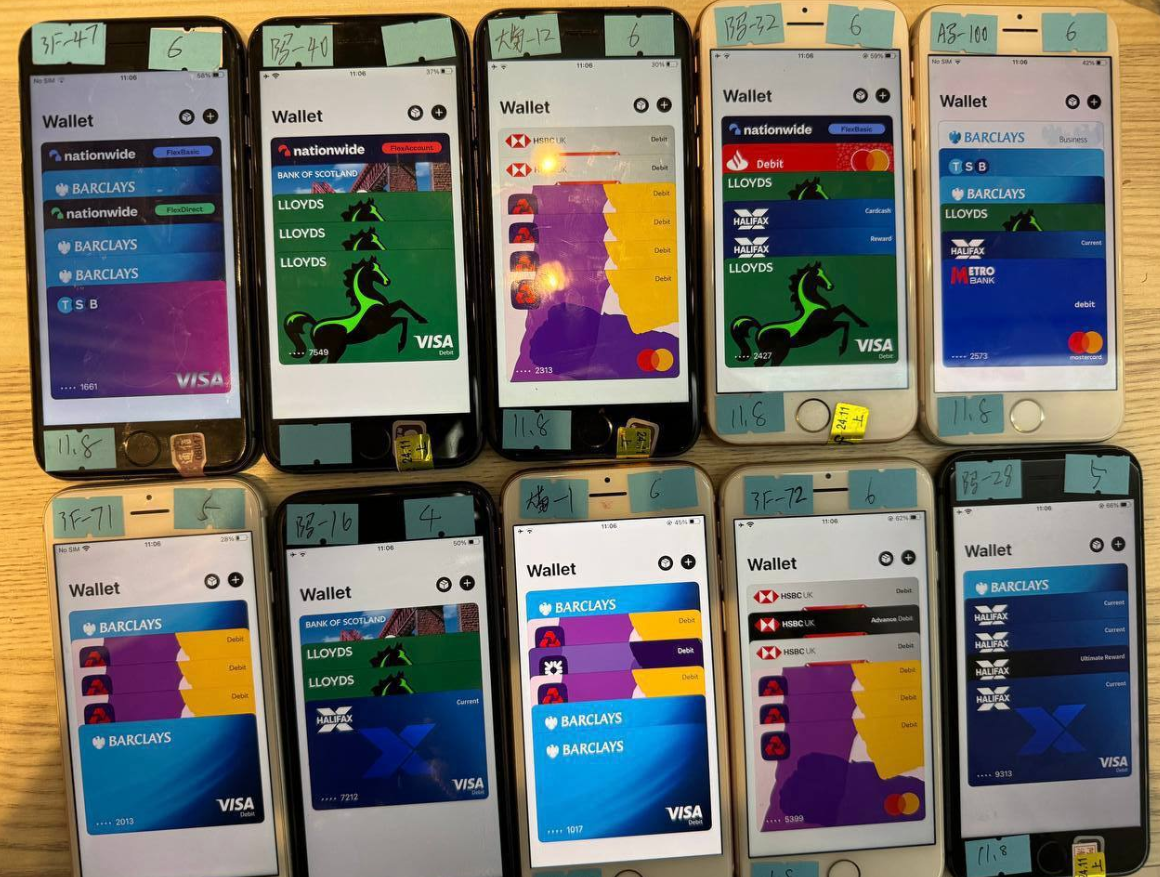
The phishing gangs typically load multiple stolen cards to digital wallets on a single Apple or Android device, and then sell those phones in bulk to scammers who use them for fraudulent e-commerce and tap-to-pay transactions.

An image from the Telegram channel for a popular Chinese mobile phishing kit vendor shows 10 mobile phones for sale, each loaded with 4-6 digital wallets from different financial institutions.

This China-based phishing collective exposed a major weakness common to many U.S.-based financial institutions that already require multi-factor authentication: The reliance on a single, phishable one-time token for provisioning mobile wallets. Happily, Merrill said many financial institutions that were caught flat-footed on this scam two years ago have since strengthened authentication requirements for onboarding new mobile wallets (such as requiring the card to be enrolled via the bank’s mobile app).

But just as squeezing one part of a balloon merely forces the air trapped inside to bulge into another area, fraudsters don’t go away when you make their current enterprise less profitable: They just shift their focus to a less-guarded area. And lately, that gaze has settled squarely on customers of the major brokerage platforms, Merrill said.

THE OUTSIDER

Merrill pointed to several Telegram channels operated by some of the more accomplished phishing kit sellers, which are full of videos demonstrating how every feature in their kits can be tailored to the attacker’s target. The video snippet below comes from the Telegram channel of “Outsider,” a popular Mandarin-speaking phishing kit vendor whose latest offering includes a number of ready-made templates for using text messages to phish brokerage account credentials and one-time codes.

According to Merrill, Outsider is a woman who previously went by the handle “Chenlun.” KrebsOnSecurity profiled Chenlun’s phishing empire in an October 2023 story about a China-based group that was phishing mobile customers of more than a dozen postal services around the globe. In that case, the phishing sites were using a Telegram bot that sent stolen credentials to the “@chenlun” Telegram account.

Chenlun’s phishing lures are sent via Apple’s iMessage and Google’s RCS service and spoof one of the major brokerage platforms, warning that the account has been suspended for suspicious activity and that recipients should log in and verify some information. The missives include a link to a phishing page that collects the customer’s username and password, and then asks the user to enter a one-time code that will arrive via SMS.

The new phish kit videos on Outsider’s Telegram channel only feature templates for Schwab customers, but Merrill said the kit can easily be adapted to target other brokerage platforms. One reason the fraudsters are picking on brokerage firms, he said, has to do with the way they handle multi-factor authentication.

Schwab clients are presented with two options for second factor authentication when they open an account. Users who select the option to only prompt for a code on untrusted devices can choose to receive it via text message, an automated inbound phone call, or an outbound call to Schwab. With the “always at login” option selected, users can choose to receive the code through the Schwab app, a text message, or a Symantec VIP mobile app.

In response to questions, Schwab said it regularly updates clients on emerging fraud trends, including this specific type, which the company addressed in communications sent to clients earlier this year.

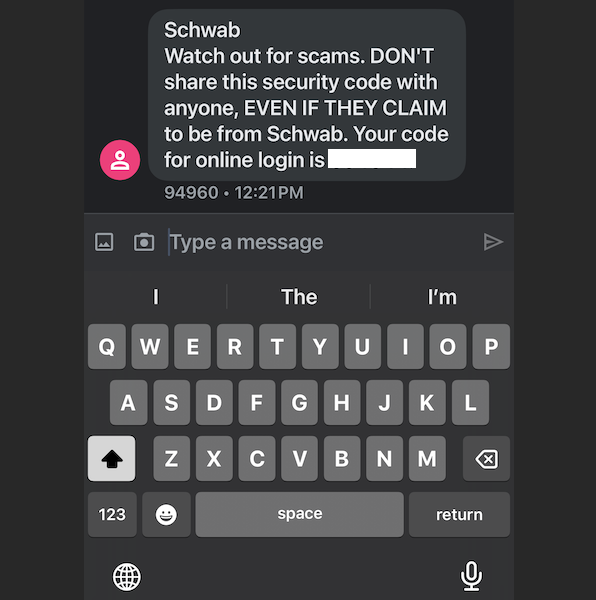
The 2FA text message from Schwab warns recipients against giving away their one-time code.

“That message focused on trading-related fraud, highlighting both account intrusions and scams conducted through social media or messaging apps that deceive individuals into executing trades themselves,” Schwab said in a written statement. “We are aware and tracking this trend across several channels, as well as others like it, which attempt to exploit SMS-based verification with stolen credentials. We actively monitor for suspicious patterns and take steps to disrupt them. This activity is part of a broader, industry-wide threat, and we take a multi-layered approach to address and mitigate it.”

Other popular brokerage platforms allow similar methods for multi-factor authentication. Fidelity requires a username and password on initial login, and offers the ability to receive a one-time token via SMS, an automated phone call, or by approving a push notification sent through the Fidelity mobile app. However, all three of these methods for sending one-time tokens are phishable; even with the brokerage firm’s app, the phishers could prompt the user to approve a login request that they initiated in the app with the phished credentials.

Vanguard offers customers a range of multi-factor authentication choices, including the option to require a physical security key in addition to one’s credentials on each login. A security key implements a robust form of multi-factor authentication known as Universal 2nd Factor (U2F), which allows the user to complete the login process simply by connecting an enrolled USB or Bluetooth device and pressing a button. The key works without the need for any special software drivers, and the nice thing about it is your second factor cannot be phished.

THE PERFECT CRIME?

Merrill said that in many ways the ramp-and-dump scheme is the perfect crime because it leaves precious few connections between the victim brokerage accounts and the fraudsters.

“It’s really genius because it decouples so many things,” he said. “They can buy shares [in the stock to be pumped] in their personal account on the Chinese exchanges, and the price happens to go up. The Chinese or Hong Kong brokerages aren’t going to see anything funky.”

Merrill said it’s unclear exactly how those perpetrating these ramp-and-dump schemes coordinate their activities, such as whether the accounts are phished well in advance or shortly before being used to inflate the stock price of Chinese companies. The latter possibility would fit nicely with the existing human infrastructure these criminal groups already have in place.

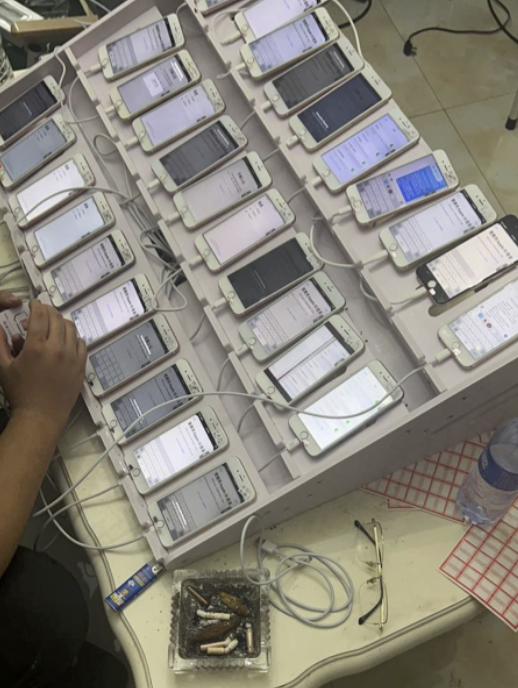
For example, KrebsOnSecurity recently wrote about research from Merrill and other researchers showing the phishers behind these slick mobile phishing kits employed people to sit for hours at a time in front of large banks of mobile phones being used to send the text message lures. These technicians were needed to respond in real time to victims who were supplying the one-time code sent from their financial institution.

The ashtray says: You’ve been phishing all night.

“You can get access to a victim’s brokerage with a one-time passcode, but then you sort of have to use it right away if you can’t set new security settings so you can come back to that account later,” Merrill said.

The rapid pace of innovations produced by these China-based phishing vendors is due in part to their use of artificial intelligence and large language models to help develop the mobile phishing kits, he added.

“These guys are vibe coding stuff together and using LLMs to translate things or help put the user interface together,” Merrill said. “It’s only a matter of time before they start to integrate the LLMs into their development cycle to make it more rapid. The technologies they are building definitely have helped lower the barrier of entry for everyone.”

  •  

UK Arrests Four in ‘Scattered Spider’ Ransom Group

Authorities in the United Kingdom this week arrested four people aged 17 to 20 in connection with recent data theft and extortion attacks against the retailers Marks & Spencer and Harrods, and the British food retailer Co-op Group. The breaches have been linked to a prolific but loosely-affiliated cybercrime group dubbed “Scattered Spider,” whose other recent victims include multiple airlines.

The U.K.’s National Crime Agency (NCA) declined verify the names of those arrested, saying only that they included two males aged 19, another aged 17, and 20-year-old female.

Scattered Spider is the name given to an English-speaking cybercrime group known for using social engineering tactics to break into companies and steal data for ransom, often impersonating employees or contractors to deceive IT help desks into granting access. The FBI warned last month that Scattered Spider had recently shifted to targeting companies in the retail and airline sectors.

KrebsOnSecurity has learned the identities of two of the suspects. Multiple sources close to the investigation said those arrested include Owen David Flowers, a U.K. man alleged to have been involved in the cyber intrusion and ransomware attack that shut down several MGM Casino properties in September 2023. Those same sources said the woman arrested is or recently was in a relationship with Flowers.

Sources told KrebsOnSecurity that Flowers, who allegedly went by the hacker handles “bo764,” “Holy,” and “Nazi,” was the group member who anonymously gave interviews to the media in the days after the MGM hack. His real name was omitted from a September 2024 story about the group because he was not yet charged in that incident.

The bigger fish arrested this week is 19-year-old Thalha Jubair, a U.K. man whose alleged exploits under various monikers have been well-documented in stories on this site. Jubair is believed to have used the nickname “Earth2Star,” which corresponds to a founding member of the cybercrime-focused Telegram channel “Star Fraud Chat.”

In 2023, KrebsOnSecurity published an investigation into the work of three different SIM-swapping groups that phished credentials from T-Mobile employees and used that access to offer a service whereby any T-Mobile phone number could be swapped to a new device. Star Chat was by far the most active and consequential of the three SIM-swapping groups, who collectively broke into T-Mobile’s network more than 100 times in the second half of 2022.

Jubair allegedly used the handles “Earth2Star” and “Star Ace,” and was a core member of a prolific SIM-swapping group operating in 2022. Star Ace posted this image to the Star Fraud chat channel on Telegram, and it lists various prices for SIM-swaps.

Sources tell KrebsOnSecurity that Jubair also was a core member of the LAPSUS$ cybercrime group that broke into dozens of technology companies in 2022, stealing source code and other internal data from tech giants including Microsoft, Nvidia, Okta, Rockstar Games, Samsung, T-Mobile, and Uber.

In April 2022, KrebsOnSecurity published internal chat records from LAPSUS$, and those chats indicated Jubair was using the nicknames Amtrak and Asyntax. At one point in the chats, Amtrak told the LAPSUS$ group leader not to share T-Mobile’s logo in images sent to the group because he’d been previously busted for SIM-swapping and his parents would suspect he was back at it again.

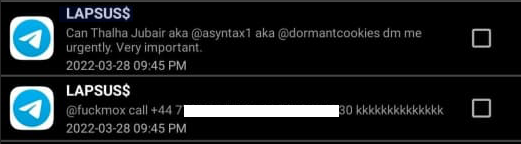
As shown in those chats, the leader of LAPSUS$ eventually decided to betray Amtrak by posting his real name, phone number, and other hacker handles into a public chat room on Telegram.

In March 2022, the leader of the LAPSUS$ data extortion group exposed Thalha Jubair’s name and hacker handles in a public chat room on Telegram.

That story about the leaked LAPSUS$ chats connected Amtrak/Asyntax/Jubair to the identity “Everlynn,” the founder of a cybercriminal service that sold fraudulent “emergency data requests” targeting the major social media and email providers. In such schemes, the hackers compromise email accounts tied to police departments and government agencies, and then send unauthorized demands for subscriber data while claiming the information being requested can’t wait for a court order because it relates to an urgent matter of life and death.

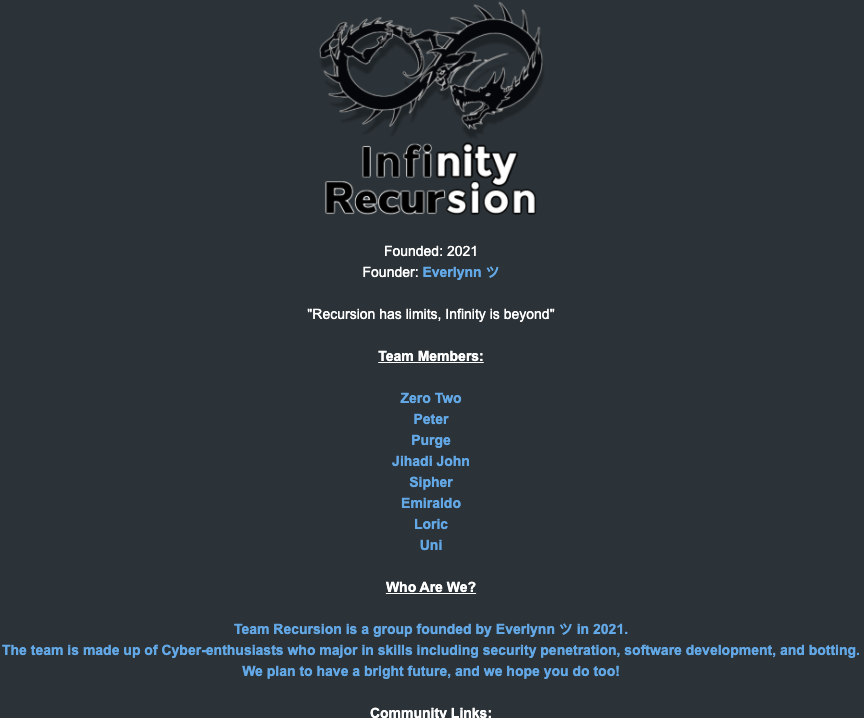
The roster of the now-defunct “Infinity Recursion” hacking team, from which some member of LAPSUS$ hail.

Sources say Jubair also used the nickname “Operator,” and that until recently he was the administrator of the Doxbin, a long-running and highly toxic online community that is used to “dox” or post deeply personal information on people. In May 2024, several popular cybercrime channels on Telegram ridiculed Operator after it was revealed that he’d staged his own kidnapping in a botched plan to throw off law enforcement investigators.

In November 2024, U.S. authorities charged five men aged 20 to 25 in connection with the Scattered Spider group, which has long relied on recruiting minors to carry out its most risky activities. Indeed, many of the group’s core members were recruited from online gaming platforms like Roblox and Minecraft in their early teens, and have been perfecting their social engineering tactics for years.

“There is a clear pattern that some of the most depraved threat actors first joined cybercrime gangs at an exceptionally young age,” said Allison Nixon, chief research officer at the New York based security firm Unit 221B. “Cybercriminals arrested at 15 or younger need serious intervention and monitoring to prevent a years long massive escalation.”

  •  

Oops: DanaBot Malware Devs Infected Their Own PCs

The U.S. government today unsealed criminal charges against 16 individuals accused of operating and selling DanaBot, a prolific strain of information-stealing malware that has been sold on Russian cybercrime forums since 2018. The FBI says a newer version of DanaBot was used for espionage, and that many of the defendants exposed their real-life identities after accidentally infecting their own systems with the malware.

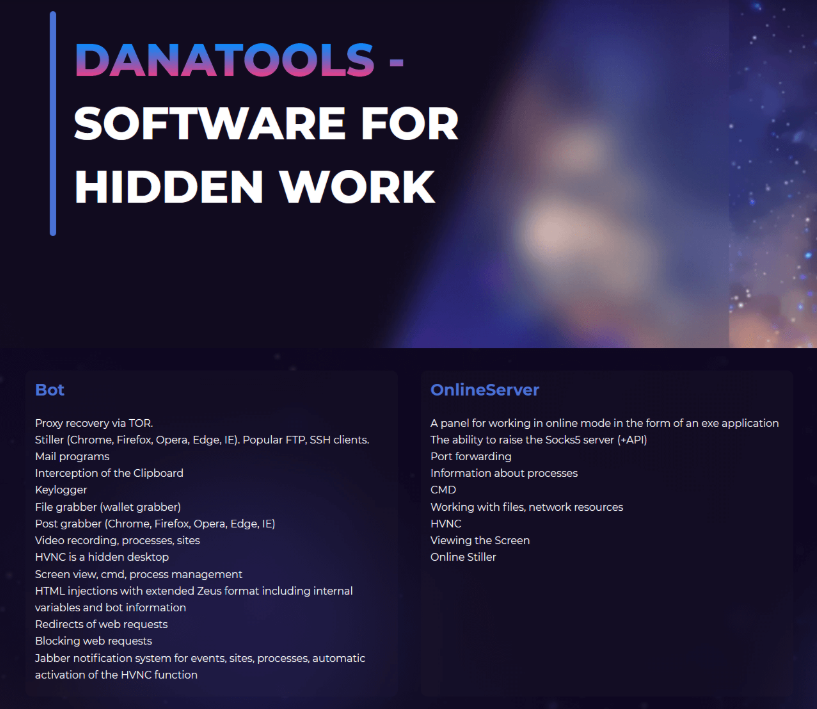
DanaBot’s features, as promoted on its support site. Image: welivesecurity.com.

Initially spotted in May 2018 by researchers at the email security firm Proofpoint, DanaBot is a malware-as-a-service platform that specializes in credential theft and banking fraud.

Today, the U.S. Department of Justice unsealed a criminal complaint and indictment from 2022, which said the FBI identified at least 40 affiliates who were paying between $3,000 and $4,000 a month for access to the information stealer platform.

The government says the malware infected more than 300,000 systems globally, causing estimated losses of more than $50 million. The ringleaders of the DanaBot conspiracy are named as Aleksandr Stepanov, 39, a.k.a. “JimmBee,” and Artem Aleksandrovich Kalinkin, 34, a.k.a. “Onix”, both of Novosibirsk, Russia. Kalinkin is an IT engineer for the Russian state-owned energy giant Gazprom. His Facebook profile name is “Maffiozi.”

According to the FBI, there were at least two major versions of DanaBot; the first was sold between 2018 and June 2020, when the malware stopped being offered on Russian cybercrime forums. The government alleges that the second version of DanaBot — emerging in January 2021 — was provided to co-conspirators for use in targeting military, diplomatic and non-governmental organization computers in several countries, including the United States, Belarus, the United Kingdom, Germany, and Russia.

“Unindicted co-conspirators would use the Espionage Variant to compromise computers around the world and steal sensitive diplomatic communications, credentials, and other data from these targeted victims,” reads a grand jury indictment dated Sept. 20, 2022. “This stolen data included financial transactions by diplomatic staff, correspondence concerning day-to-day diplomatic activity, as well as summaries of a particular country’s interactions with the United States.”

The indictment says the FBI in 2022 seized servers used by the DanaBot authors to control their malware, as well as the servers that stored stolen victim data. The government said the server data also show numerous instances in which the DanaBot defendants infected their own PCs, resulting in their credential data being uploaded to stolen data repositories that were seized by the feds.

“In some cases, such self-infections appeared to be deliberately done in order to test, analyze, or improve the malware,” the criminal complaint reads. “In other cases, the infections seemed to be inadvertent – one of the hazards of committing cybercrime is that criminals will sometimes infect themselves with their own malware by mistake.”

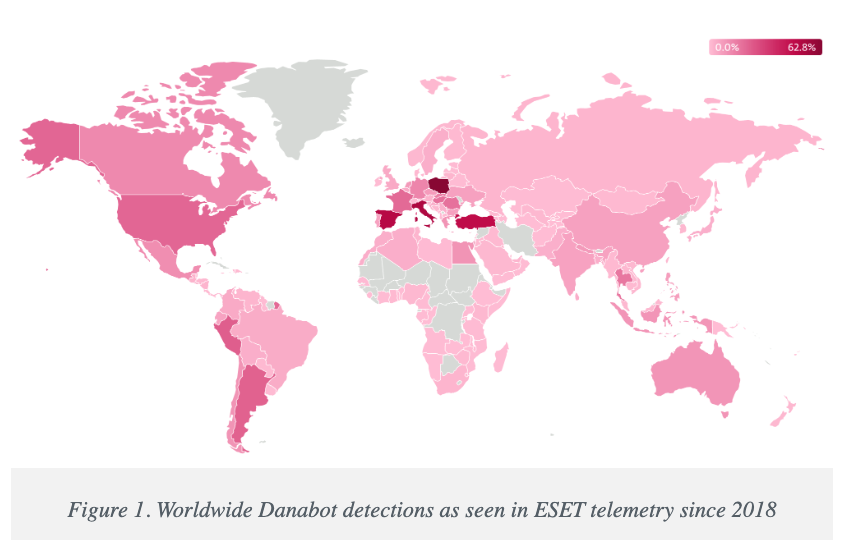
Image: welivesecurity.com

A statement from the DOJ says that as part of today’s operation, agents with the Defense Criminal Investigative Service (DCIS) seized the DanaBot control servers, including dozens of virtual servers hosted in the United States. The government says it is now working with industry partners to notify DanaBot victims and help remediate infections. The statement credits a number of security firms with providing assistance to the government, including ESET, Flashpoint, Google, Intel 471, Lumen, PayPal, Proofpoint, Team CYMRU, and ZScaler.

It’s not unheard of for financially-oriented malicious software to be repurposed for espionage. A variant of the ZeuS Trojan, which was used in countless online banking attacks against companies in the United States and Europe between 2007 and at least 2015, was for a time diverted to espionage tasks by its author.

As detailed in this 2015 story, the author of the ZeuS trojan created a custom version of the malware to serve purely as a spying machine, which scoured infected systems in Ukraine for specific keywords in emails and documents that would likely only be found in classified documents.

The public charging of the 16 DanaBot defendants comes a day after Microsoft joined a slew of tech companies in disrupting the IT infrastructure for another malware-as-a-service offering — Lumma Stealer, which is likewise offered to affiliates under tiered subscription prices ranging from $250 to $1,000 per month. Separately, Microsoft filed a civil lawsuit to seize control over 2,300 domain names used by Lumma Stealer and its affiliates.

Further reading:

Danabot: Analyzing a Fallen Empire

ZScaler blog: DanaBot Launches DDoS Attack Against the Ukrainian Ministry of Defense

Flashpoint: Operation Endgame DanaBot Malware

Team CYMRU: Inside DanaBot’s Infrastructure: In Support of Operation Endgame II

March 2022 criminal complaint v. Artem Aleksandrovich Kalinkin

September 2022 grand jury indictment naming the 16 defendants

  •  

KrebsOnSecurity Hit With Near-Record 6.3 Tbps DDoS

KrebsOnSecurity last week was hit by a near record distributed denial-of-service (DDoS) attack that clocked in at more than 6.3 terabits of data per second (a terabit is one trillion bits of data). The brief attack appears to have been a test run for a massive new Internet of Things (IoT) botnet capable of launching crippling digital assaults that few web destinations can withstand. Read on for more about the botnet, the attack, and the apparent creator of this global menace.

For reference, the 6.3 Tbps attack last week was ten times the size of the assault launched against this site in 2016 by the Mirai IoT botnet, which held KrebsOnSecurity offline for nearly four days. The 2016 assault was so large that Akamai – which was providing pro-bono DDoS protection for KrebsOnSecurity at the time — asked me to leave their service because the attack was causing problems for their paying customers.

Since the Mirai attack, KrebsOnSecurity.com has been behind the protection of Project Shield, a free DDoS defense service that Google provides to websites offering news, human rights, and election-related content. Google Security Engineer Damian Menscher told KrebsOnSecurity the May 12 attack was the largest Google has ever handled. In terms of sheer size, it is second only to a very similar attack that Cloudflare mitigated and wrote about in April.

After comparing notes with Cloudflare, Menscher said the botnet that launched both attacks bears the fingerprints of Aisuru, a digital siege machine that first surfaced less than a year ago. Menscher said the attack on KrebsOnSecurity lasted less than a minute, hurling large UDP data packets at random ports at a rate of approximately 585 million data packets per second.

“It was the type of attack normally designed to overwhelm network links,” Menscher said, referring to the throughput connections between and among various Internet service providers (ISPs). “For most companies, this size of attack would kill them.”
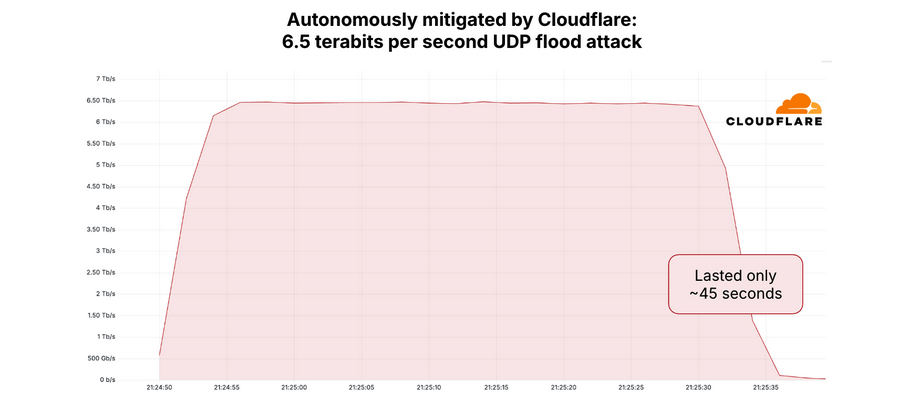
A graph depicting the 6.5 Tbps attack mitigated by Cloudflare in April 2025. Image: Cloudflare.

The Aisuru botnet comprises a globally-dispersed collection of hacked IoT devices, including routers, digital video recorders and other systems that are commandeered via default passwords or software vulnerabilities. As documented by researchers at QiAnXin XLab, the botnet was first identified in an August 2024 attack on a large gaming platform.

Aisuru reportedly went quiet after that exposure, only to reappear in November with even more firepower and software exploits. In a January 2025 report, XLab found the new and improved Aisuru (a.k.a. “Airashi“) had incorporated a previously unknown zero-day vulnerability in Cambium Networks cnPilot routers.

NOT FORKING AROUND

The people behind the Aisuru botnet have been peddling access to their DDoS machine in public Telegram chat channels that are closely monitored by multiple security firms. In August 2024, the botnet was rented out in subscription tiers ranging from $150 per day to $600 per week, offering attacks of up to two terabits per second.

“You may not attack any measurement walls, healthcare facilities, schools or government sites,” read a notice posted on Telegram by the Aisuru botnet owners in August 2024.

Interested parties were told to contact the Telegram handle “@yfork” to purchase a subscription. The account @yfork previously used the nickname “Forky,” an identity that has been posting to public DDoS-focused Telegram channels since 2021.

According to the FBI, Forky’s DDoS-for-hire domains have been seized in multiple law enforcement operations over the years. Last year, Forky said on Telegram he was selling the domain stresser[.]best, which saw its servers seized by the FBI in 2022 as part of an ongoing international law enforcement effort aimed at diminishing the supply of and demand for DDoS-for-hire services.

“The operator of this service, who calls himself ‘Forky,’ operates a Telegram channel to advertise features and communicate with current and prospective DDoS customers,” reads an FBI seizure warrant (PDF) issued for stresser[.]best. The FBI warrant stated that on the same day the seizures were announced, Forky posted a link to a story on this blog that detailed the domain seizure operation, adding the comment, “We are buying our new domains right now.”
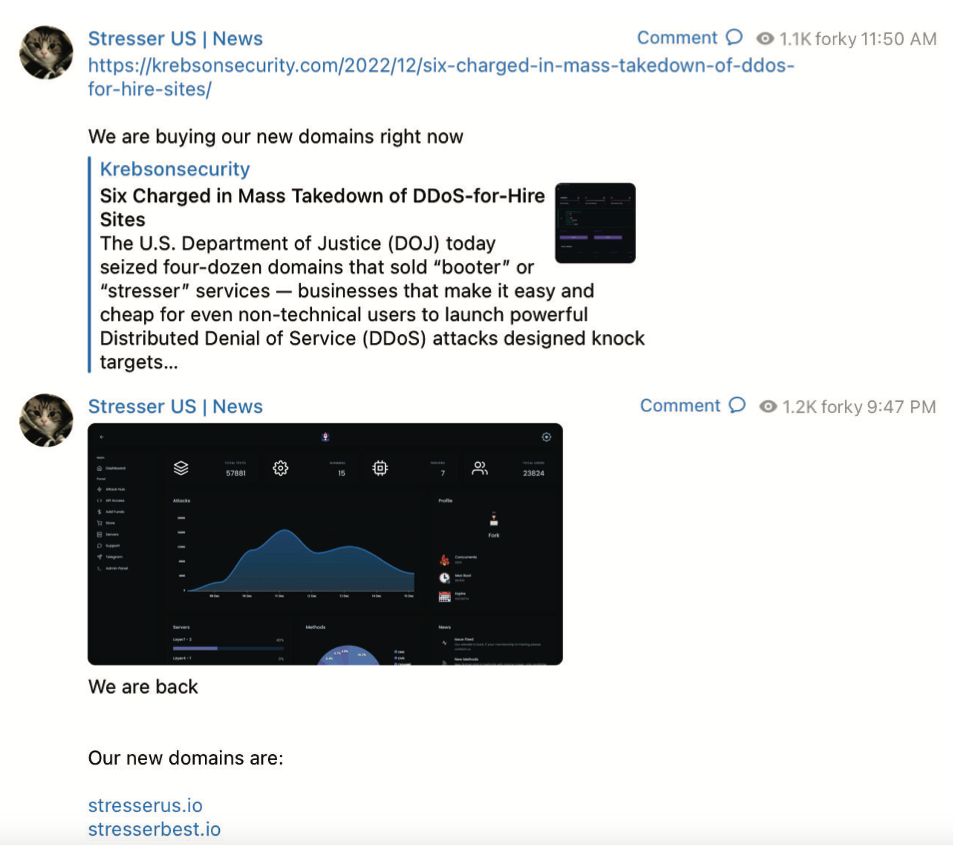
A screenshot from the FBI’s seizure warrant for Forky’s DDoS-for-hire domains shows Forky announcing the resurrection of their service at new domains.

Approximately ten hours later, Forky posted again, including a screenshot of the stresser[.]best user dashboard, instructing customers to use their saved passwords for the old website on the new one.

A review of Forky’s posts to public Telegram channels — as indexed by the cyber intelligence firms Unit 221B and Flashpoint — reveals a 21-year-old individual who claims to reside in Brazil [full disclosure: Flashpoint is currently an advertiser on this blog].

Since late 2022, Forky’s posts have frequently promoted a DDoS mitigation company and ISP that he operates called botshield[.]io. The Botshield website is connected to a business entity registered in the United Kingdom called Botshield LTD, which lists a 21-year-old woman from Sao Paulo, Brazil as the director. Internet routing records indicate Botshield (AS213613) currently controls several hundred Internet addresses that were allocated to the company earlier this year.

Domaintools.com reports that botshield[.]io was registered in July 2022 to a Kaike Southier Leite in Sao Paulo. A LinkedIn profile by the same name says this individual is a network specialist from Brazil who works in “the planning and implementation of robust network infrastructures, with a focus on security, DDoS mitigation, colocation and cloud server services.”

MEET FORKY

Image: Jaclyn Vernace / Shutterstock.com.

In his posts to public Telegram chat channels, Forky has hardly attempted to conceal his whereabouts or identity. In countless chat conversations indexed by Unit 221B, Forky could be seen talking about everyday life in Brazil, often remarking on the extremely low or high prices in Brazil for a range of goods, from computer and networking gear to narcotics and food.

Reached via Telegram, Forky claimed he was “not involved in this type of illegal actions for years now,” and that the project had been taken over by other unspecified developers. Forky initially told KrebsOnSecurity he had been out of the botnet scene for years, only to concede this wasn’t true when presented with public posts on Telegram from late last year that clearly showed otherwise.

Forky denied being involved in the attack on KrebsOnSecurity, but acknowledged that he helped to develop and market the Aisuru botnet. Forky claims he is now merely a staff member for the Aisuru botnet team, and that he stopped running the botnet roughly two months ago after starting a family. Forky also said the woman named as director of Botshield is related to him.

Forky offered equivocal, evasive responses to a number of questions about the Aisuru botnet and his business endeavors. But on one point he was crystal clear:

“I have zero fear about you, the FBI, or Interpol,” Forky said, asserting that he is now almost entirely focused on their hosting business — Botshield.

Forky declined to discuss the makeup of his ISP’s clientele, or to clarify whether Botshield was more of a hosting provider or a DDoS mitigation firm. However, Forky has posted on Telegram about Botshield successfully mitigating large DDoS attacks launched against other DDoS-for-hire services.

DomainTools finds the same Sao Paulo street address in the registration records for botshield[.]io was used to register several other domains, including cant-mitigate[.]us. The email address in the WHOIS records for that domain is forkcontato@gmail.com, which DomainTools says was used to register the domain for the now-defunct DDoS-for-hire service stresser[.]us, one of the domains seized in the FBI’s 2023 crackdown.

On May 8, 2023, the U.S. Department of Justice announced the seizure of stresser[.]us, along with a dozen other domains offering DDoS services. The DOJ said ten of the 13 domains were reincarnations of services that were seized during a prior sweep in December, which targeted 48 top stresser services (also known as “booters”).

Forky claimed he could find out who attacked my site with Aisuru. But when pressed a day later on the question, Forky said he’d come up empty-handed.

“I tried to ask around, all the big guys are not retarded enough to attack you,” Forky explained in an interview on Telegram. “I didn’t have anything to do with it. But you are welcome to write the story and try to put the blame on me.”

THE GHOST OF MIRAI

The 6.3 Tbps attack last week caused no visible disruption to this site, in part because it was so brief — lasting approximately 45 seconds. DDoS attacks of such magnitude and brevity typically are produced when botnet operators wish to test or demonstrate their firepower for the benefit of potential buyers. Indeed, Google’s Menscher said it is likely that both the May 12 attack and the slightly larger 6.5 Tbps attack against Cloudflare last month were simply tests of the same botnet’s capabilities.

In many ways, the threat posed by the Aisuru/Airashi botnet is reminiscent of Mirai, an innovative IoT malware strain that emerged in the summer of 2016 and successfully out-competed virtually all other IoT malware strains in existence at the time.

As first revealed by KrebsOnSecurity in January 2017, the Mirai authors were two U.S. men who co-ran a DDoS mitigation service — even as they were selling far more lucrative DDoS-for-hire services using the most powerful botnet on the planet.

Less than a week after the Mirai botnet was used in a days-long DDoS against KrebsOnSecurity, the Mirai authors published the source code to their botnet so that they would not be the only ones in possession of it in the event of their arrest by federal investigators.

Ironically, the leaking of the Mirai source is precisely what led to the eventual unmasking and arrest of the Mirai authors, who went on to serve probation sentences that required them to consult with FBI investigators on DDoS investigations. But that leak also rapidly led to the creation of dozens of Mirai botnet clones, many of which were harnessed to fuel their own powerful DDoS-for-hire services.

Menscher told KrebsOnSecurity that as counterintuitive as it may sound, the Internet as a whole would probably be better off if the source code for Aisuru became public knowledge. After all, he said, the people behind Aisuru are in constant competition with other IoT botnet operators who are all striving to commandeer a finite number of vulnerable IoT devices globally.

Such a development would almost certainly cause a proliferation of Aisuru botnet clones, he said, but at least then the overall firepower from each individual botnet would be greatly diminished — or at least within range of the mitigation capabilities of most DDoS protection providers.

Barring a source code leak, Menscher said, it would be nice if someone published the full list of software exploits being used by the Aisuru operators to grow their botnet so quickly.

“Part of the reason Mirai was so dangerous was that it effectively took out competing botnets,” he said. “This attack somehow managed to compromise all these boxes that nobody else knows about. Ideally, we’d want to see that fragmented out, so that no [individual botnet operator] controls too much.”

  •  

Cyber Forensic Expert in 2,000+ Cases Faces FBI Probe

A Minnesota cybersecurity and computer forensics expert whose testimony has featured in thousands of courtroom trials over the past 30 years is facing questions about his credentials and an inquiry from the Federal Bureau of Investigation (FBI). Legal experts say the inquiry could be grounds to reopen a number of adjudicated cases in which the expert’s testimony may have been pivotal.

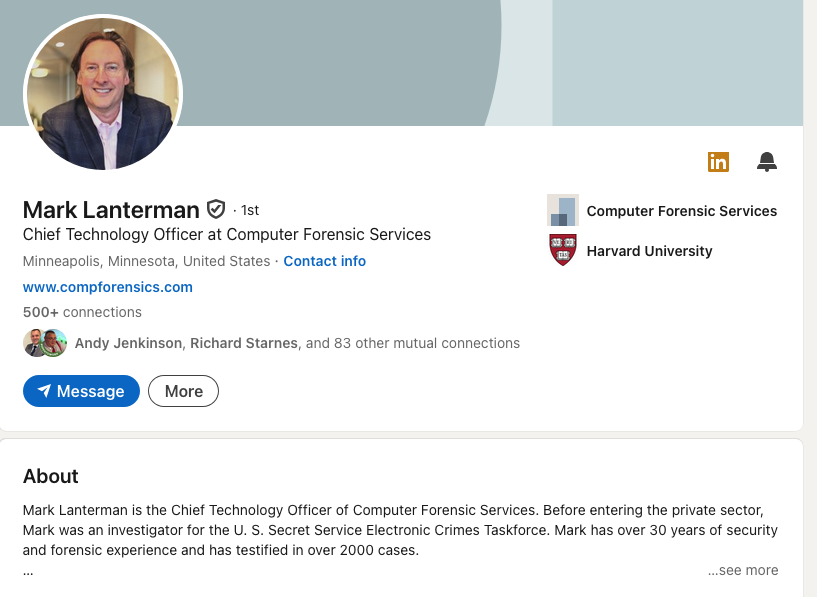
One might conclude from reading Mr. Lanterman’s LinkedIn profile that has a degree from Harvard University.

Mark Lanterman is a former investigator for the U.S. Secret Service Electronics Crimes Task Force who founded the Minneapolis consulting firm Computer Forensic Services (CFS). The CFS website says Lanterman’s 30-year career has seen him testify as an expert in more than 2,000 cases, with experience in cases involving sexual harassment and workplace claims, theft of intellectual property and trade secrets, white-collar crime, and class action lawsuits.

Or at least it did until last month, when Lanterman’s profile and work history were quietly removed from the CFS website. The removal came after Hennepin County Attorney’s Office said it was notifying parties to ten pending cases that they were unable to verify Lanterman’s educational and employment background. The county attorney also said the FBI is now investigating the allegations.

Those allegations were raised by Sean Harrington, an attorney and forensics examiner based in Prescott, Wisconsin. Harrington alleged that Lanterman lied under oath in court on multiple occasions when he testified that he has a Bachelor of Science and a Master’s degree in computer science from the now-defunct Upsala College, and that he completed his postgraduate work in cybersecurity at Harvard University.

Harrington’s claims gained steam thanks to digging by the law firm Perkins Coie LLP, which is defending a case wherein a client’s laptop was forensically reviewed by Lanterman. On March 14, Perkins Coie attorneys asked the judge (PDF) to strike Lanterman’s testimony because neither he nor they could substantiate claims about his educational background.

Upsala College, located in East Orange, N.J., operated for 102 years until it closed in 1995 after a period of declining enrollment and financial difficulties. Perkins Coie told the court that they’d visited Felician University, which holds the transcripts for Upsala College during the years Lanterman claimed to have earned undergraduate and graduate degrees. The law firm said Felician had no record of transcripts for Lanterman (PDF), and that his name was absent from all of the Upsala College student yearbooks and commencement programs during that period.

Reached for comment, Lanterman acknowledged he had no way to prove he attended Upsala College, and that his “postgraduate work” at Harvard was in fact an eight-week online cybersecurity class called HarvardX, which cautions that its certificates should not be considered equivalent to a Harvard degree or a certificate earned through traditional, in-person programs at Harvard University.

Lanterman has testified that his first job after college was serving as a police officer in Springfield Township, Pennsylvania, although the Perkins Coie attorneys noted that this role was omitted from his resume. The attorneys said when they tried to verify Lanterman’s work history, “the police department responded with a story that would be almost impossible to believe if it was not corroborated by Lanterman’s own email communications.”

As recounted in the March 14 filing, Lanterman was deposed on Feb. 11, and the following day he emailed the Springfield Township Police Department to see if he could have a peek at his old personnel file. On Feb. 14, Lanterman visited the Springfield Township PD and asked to borrow his employment record. He told the officer he spoke with on the phone that he’d recently been instructed to “get his affairs in order” after being diagnosed with a grave heart condition, and that he wanted his old file to show his family about his early career.

According to Perkins Coie, Lanterman left the Springfield Township PD with his personnel file, and has not returned it as promised.

“It is shocking that an expert from Minnesota would travel to suburban Philadelphia and abscond with his decades-old personnel file to obscure his background,” the law firm wrote. “That appears to be the worst and most egregious form of spoliation, and the deception alone is reason enough to exclude Lanterman and consider sanctions.”

Harrington initially contacted KrebsOnSecurity about his concerns in late 2023, fuming after sitting through a conference speech in which Lanterman shared documents from a ransomware victim and told attendees it was because they’d refused to hire his company to perform a forensic investigation on a recent breach.

“He claims he was involved in the Martha Stewart investigation, the Bernie Madoff trial, Paul McCartney’s divorce, the Tom Petters investigation, the Denny Hecker investigation, and many others,” Harrington said. “He claims to have been invited to speak to the Supreme Court, claims to train the ‘entire federal judiciary’ on cybersecurity annually, and is a faculty member of the United States Judicial Conference and the Judicial College — positions which he obtained, in part, on a house of fraudulent cards.”

In an interview this week, Harrington said court documents reveal that at least two of Lanterman’s previous clients complained CFS had held their data for ransom over billing disputes. In a declaration (PDF) dated August 2022, the co-founder of the law firm MoreLaw Minneapolis LLC said she hired Lanterman in 2014 to examine several electronic devices after learning that one of their paralegals had a criminal fraud history.

But the law firm said when it pushed back on a consulting bill that was far higher than expected, Lanterman told them CFS would “escalate” its collection efforts if they didn’t pay, including “a claim and lien against the data which will result in a public auction of your data.”

“All of us were flabbergasted by Mr. Lanterman’s email,” wrote MoreLaw co-founder Kimberly Hanlon. “I had never heard of any legitimate forensic company threatening to ‘auction’ off an attorney’s data, particularly knowing that the data is comprised of confidential client data, much of which is sensitive in nature.”

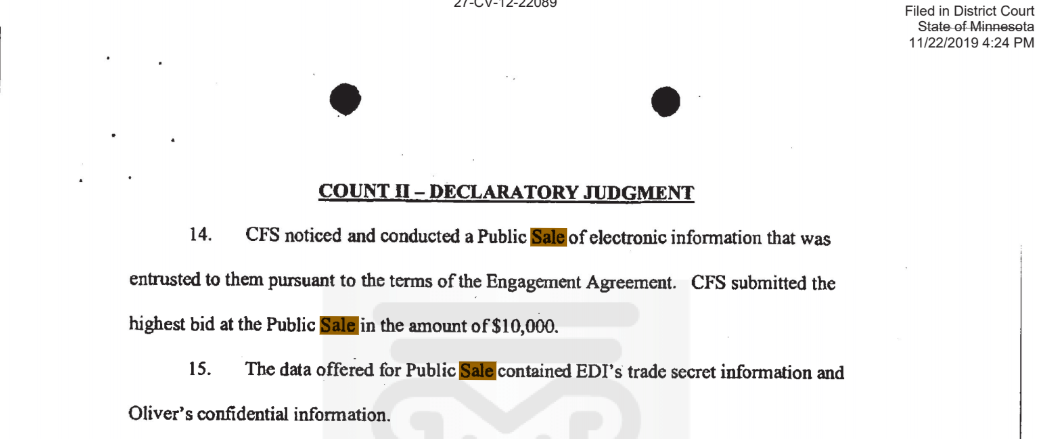
In 2009, a Wisconsin-based manufacturing company that had hired Lanterman for computer forensics balked at paying an $86,000 invoice from CFS, calling it “excessive and unsubstantiated.” The company told a Hennepin County court that on April 15, 2009, CFS conducted an auction of its trade secret information in violation of their confidentiality agreement.

“CFS noticed and conducted a Public Sale of electronic information that was entrusted to them pursuant to the terms of the engagement agreement,” the company wrote. “CFS submitted the highest bid at the Public Sale in the amount of $10,000.”

Lanterman briefly responded to a list of questions about his background (and recent heart diagnosis) on March 24, saying he would send detailed replies the following day. Those replies never materialized. Instead, Lanterman forwarded a recent memo he wrote to the court that attacked Harrington and said his accuser was only trying to take out a competitor. He has not responded to further requests for comment.

“When I attended Upsala, I was a commuter student who lived with my grandparents in Morristown, New Jersey approximately 30 minutes away from Upsala College,” Lanterman explained to the judge (PDF) overseeing a separate ongoing case (PDF) in which he has testified. “With limited resources, I did not participate in campus social events, nor did I attend graduation ceremonies. In 2023, I confirmed with Felician University — which maintains Upsala College’s records — that they could not locate my transcripts or diploma, a situation that they indicated was possibly due to unresolved money-related issues.”

Lanterman was ordered to appear in court on April 3 in the case defended by Perkins Coie, but he did not show up. Instead, he sent a message to the judge withdrawing from the case.

“I am 60 years old,” Lanterman told the judge. “I created my business from nothing. I am done dealing with the likes of individuals like Sean Harrington. And quite frankly, I have been planning at turning over my business to my children for years. That time has arrived.”

Lanterman’s letter leaves the impression that it was his decision to retire. But according to an affidavit (PDF) filed in a Florida case on March 28, Mark Lanterman’s son Sean said he’d made the difficult decision to ask his dad to step down given all the negative media attention.

Mark Rasch, a former federal cybercrime prosecutor who now serves as counsel to the New York cybersecurity intelligence firm Unit 221B, said that if an expert witness is discredited, any defendants who lost cases that were strongly influenced by that expert’s conclusions at trial could have grounds for appeal.

Rasch said law firms who propose an expert witness have a duty in good faith to vet that expert’s qualifications, knowing that those credentials will be subject to cross-examination.

“Federal rules of civil procedure and evidence both require experts to list every case they have testified in as an expert for the past few years,” Rasch said. “Part of that due diligence is pulling up the results of those cases and seeing what the nature of their testimony has been.”

Perhaps the most well-publicized case involving significant forensic findings from Lanterman was the 2018 conviction of Stephen Allwine, who was found guilty of killing his wife two years earlier after attempts at hiring a hitman on the dark net fell through. Allwine is serving a sentence of life in prison, and continues to maintain that he was framed, casting doubt on computer forensic evidence found on 64 electronic devices taken from his home.

On March 24, Allwine petitioned a Minnesota court (PDF) to revisit his case, citing the accusations against Lanterman and his role as a key witness for the prosecution.

  •  

Feds Link $150M Cyberheist to 2022 LastPass Hacks

In September 2023, KrebsOnSecurity published findings from security researchers who concluded that a series of six-figure cyberheists across dozens of victims resulted from thieves cracking master passwords stolen from the password manager service LastPass in 2022. In a court filing this week, U.S. federal agents investigating a spectacular $150 million cryptocurrency heist said they had reached the same conclusion.

On March 6, federal prosecutors in northern California said they seized approximately $24 million worth of cryptocurrencies that were clawed back following a $150 million cyberheist on Jan. 30, 2024. The complaint refers to the person robbed only as “Victim-1,” but according to blockchain security researcher ZachXBT the theft was perpetrated against Chris Larsen, the co-founder of the cryptocurrency platform Ripple. ZachXBT was the first to report on the heist.

This week’s action by the government merely allows investigators to officially seize the frozen funds. But there is an important conclusion in this seizure document: It basically says the U.S. Secret Service and the FBI agree with the findings of the LastPass breach story published here in September 2023.

That piece quoted security researchers who said they were witnessing six-figure crypto heists several times each month that all appeared to be the result of crooks cracking master passwords for the password vaults stolen from LastPass in 2022.

“The Federal Bureau of Investigation has been investigating these data breaches, and law enforcement agents investigating the instant case have spoken with FBI agents about their investigation,” reads the seizure complaint, which was written by a U.S. Secret Service agent. “From those conversations, law enforcement agents in this case learned that the stolen data and passwords that were stored in several victims’ online password manager accounts were used to illegally, and without authorization, access the victims’ electronic accounts and steal information, cryptocurrency, and other data.”

The document continues:

“Based on this investigation, law enforcement had probable cause to believe the same attackers behind the above-described commercial online password manager attack used a stolen password held in Victim 1’s online password manager account and, without authorization, accessed his cryptocurrency wallet/account.”

Working with dozens of victims, security researchers Nick Bax and Taylor Monahan found that none of the six-figure cyberheist victims appeared to have suffered the sorts of attacks that typically preface a high-dollar crypto theft, such as the compromise of one’s email and/or mobile phone accounts, or SIM-swapping attacks.

They discovered the victims all had something else in common: Each had at one point stored their cryptocurrency seed phrase — the secret code that lets anyone gain access to your cryptocurrency holdings — in the “Secure Notes” area of their LastPass account prior to the 2022 breaches at the company.

Bax and Monahan found another common theme with these robberies: They all followed a similar pattern of cashing out, rapidly moving stolen funds to a dizzying number of drop accounts scattered across various cryptocurrency exchanges.

According to the government, a similar level of complexity was present in the $150 million heist against the Ripple co-founder last year.

“The scale of a theft and rapid dissipation of funds would have required the efforts of multiple malicious actors, and was consistent with the online password manager breaches and attack on other victims whose cryptocurrency was stolen,” the government wrote. “For these reasons, law enforcement agents believe the cryptocurrency stolen from Victim 1 was committed by the same attackers who conducted the attack on the online password manager, and cryptocurrency thefts from other similarly situated victims.”

Reached for comment, LastPass said it has seen no definitive proof — from federal investigators or others — that the cyberheists in question were linked to the LastPass breaches.

“Since we initially disclosed this incident back in 2022, LastPass has worked in close cooperation with multiple representatives from law enforcement,” LastPass said in a written statement. “To date, our law enforcement partners have not made us aware of any conclusive evidence that connects any crypto thefts to our incident. In the meantime, we have been investing heavily in enhancing our security measures and will continue to do so.”

On August 25, 2022, LastPass CEO Karim Toubba told users the company had detected unusual activity in its software development environment, and that the intruders stole some source code and proprietary LastPass technical information. On Sept. 15, 2022, LastPass said an investigation into the August breach determined the attacker did not access any customer data or password vaults.

But on Nov. 30, 2022, LastPass notified customers about another, far more serious security incident that the company said leveraged data stolen in the August breach. LastPass disclosed that criminal hackers had compromised encrypted copies of some password vaults, as well as other personal information.

Experts say the breach would have given thieves “offline” access to encrypted password vaults, theoretically allowing them all the time in the world to try to crack some of the weaker master passwords using powerful systems that can attempt millions of password guesses per second.

Researchers found that many of the cyberheist victims had chosen master passwords with relatively low complexity, and were among LastPass’s oldest customers. That’s because legacy LastPass users were more likely to have master passwords that were protected with far fewer “iterations,” which refers to the number of times your password is run through the company’s encryption routines. In general, the more iterations, the longer it takes an offline attacker to crack your master password.

Over the years, LastPass forced new users to pick longer and more complex master passwords, and they increased the number of iterations on multiple occasions by several orders of magnitude. But researchers found strong indications that LastPass never succeeded in upgrading many of its older customers to the newer password requirements and protections.

Asked about LastPass’s continuing denials, Bax said that after the initial warning in our 2023 story, he naively hoped people would migrate their funds to new cryptocurrency wallets.

“While some did, the continued thefts underscore how much more needs to be done,” Bax told KrebsOnSecurity. “It’s validating to see the Secret Service and FBI corroborate our findings, but I’d much rather see fewer of these hacks in the first place. ZachXBT and SEAL 911 reported yet another wave of thefts as recently as December, showing the threat is still very real.”

Monahan said LastPass still hasn’t alerted their customers that their secrets—especially those stored in “Secure Notes”—may be at risk.

“Its been two and a half years since LastPass was first breached [and] hundreds of millions of dollars has been stolen from individuals and companies around the globe,” Monahan said. “They could have encouraged users to rotate their credentials. They could’ve prevented millions and millions of dollars from being stolen by these threat actors. But  instead they chose to deny that their customers were are risk and blame the victims instead.”

  •