Reading view

Axon Tests Face Recognition on Body-Worn Cameras

Axon Enterprise Inc. is working with a Canadian police department to test the addition of face recognition technology (FRT) to its body-worn cameras (BWCs). This is an alarming development in government surveillance that should put communities everywhere on alert. 

As many as 50 officers from the Edmonton Police Department (EPD) will begin using these FRT-enabled BWCs today as part of a proof-of-concept experiment. EPD is the first police department in the world to use these Axon devices, according to a report from the Edmonton Journal

This kind of technology could give officers instant identification of any person that crosses their path. During the current trial period, the Edmonton officers will not be notified in the field of an individual’s identity but will review identifications generated by the BWCs later on. 

“This Proof of Concept will test the technology’s ability to work with our database to make officers aware of individuals with safety flags and cautions from previous interactions,” as well as “individuals who have outstanding warrants for serious crime,” Edmonton Police described in a press release, suggesting that individuals will be placed on a watchlist of sorts.

FRT brings a rash of problems. It relies on extensive surveillance and collecting images on individuals, law-abiding or otherwise. Misidentifications can cause horrendous consequences for individuals, including prolonged and difficult fights for innocence and unfair incarceration for crimes never committed. In a world where police are using real-time face recognition, law-abiding individuals or those participating in legal, protected activity that police may find objectionable — like protest — could be quickly identified. 

With the increasing connections being made between disparate data sources about nearly every person, BWCs enabled with FRT can easily connect a person minding their own business, who happens to come within view of a police officer, with a whole slew of other personal information. 

Axon had previously claimed it would pause the addition of face recognition to its tools due to concerns raised in 2019 by the company’s AI and Policing Technology Ethics Board. However, since then, the company has continued to research and consider the addition of FRT to its products. 

This BWC-FRT integration signals possible other FRT integrations in the future. Axon is building an entire arsenal of cameras and surveillance devices for law enforcement, and the company grows the reach of its police surveillance apparatus, in part, by leveraging relationships with its thousands of customers, including those using its flagship product, the Taser. This so-called “ecosystem” of surveillance technologyq includes the Fusus system, a platform for connecting surveillance cameras to facilitate real-time viewing of video footage. It also involves expanding the use of surveillance tools like BWCs and the flying cameras of “drone as first responder” (DFR) programs.

Face recognition undermines individual privacy, and it is too dangerous when deployed by police. Communities everywhere must move to protect themselves and safeguard their civil liberties, insisting on transparency, clear policies, public accountability, and audit mechanisms. Ideally, communities should ban police use of the technology altogether. At a minimum, police must not add FRT to BWCs.

  •  

Washington Court Rules That Data Captured on Flock Safety Cameras Are Public Records

A Washington state trial court has shot down local municipalities’ effort to keep automated license plate reader (ALPR) data secret.

The Skagit County Superior Court in Washington rejected the attempt to block the public’s right to access data gathered by Flock Safety cameras, protecting access to information under the Washington Public Records Act (PRA). Importantly, the ruling from the court makes it clear that this access is protected even when a Washington city uses Flock Safety, a third-party vendor, to conduct surveillance and store personal data on behalf of a government agency.

"The Flock images generated by the Flock cameras...are public records," the court wrote in its ruling. "Flock camera images are created and used to further a governmental purpose. The Flock images created by the cameras located in Stanwood and Sedro-Woolley were paid for by Stanwood and Sedro Wooley [sic] and were generated for the benefit of Stanwood and Sedro-Woolley."

The cities’ move to exempt the records from disclosure was a dangerous attempt to deny transparency and reflects another problem with the massive amount of data that police departments collect through Flock cameras and store on Flock servers: the wiggle room cities seek when public data is hosted on a private company’s server.

Flock Safety's main product is ALPRs, camera systems installed throughout communities to track all drivers all the time. Privacy activists and journalists across the country recently have used public records requests to obtain data from the system, revealing a variety of controversial uses. This has included agencies accessing data for immigration enforcement and to investigate an abortion, the latter of which may have violated Washington law. A recent report from the University of Washington found that some cities in the state are also sharing the ALPR data from their Flock Safety systems with federal immigration agents. 

In this case, a member of the public in April filed a records request with a Flock customer, the City of Stanwood, for all footage recorded during a one-hour period in March. Shortly afterward, Stanwood and another Flock user, the City of Sedro-Woolley requested the local court rule that this data is not a public record, asserting that “data generated by Flock [automated license plate reader cameras (ALPRs)] and stored in the Flock cloud system are not public records unless and until a public agency extracts and downloads that data." 

If a government agency is conducting mass surveillance, EFF supports individuals’ access to data collected specifically on them, at the very least. And to address legitimate privacy concerns, governments can and should redact personal information in these records while still disclosing information about how the systems work and the data that they capture. 

This isn’t what these Washington cities offered, though. They tried a few different arguments against releasing any information at all. 

The contract between the City of Sedron-Woolley and Flock Safety clearly states that "As between Flock and Customer, all right, title and interest in the Customer Data, belong to and are retained solely by Customer,” and “Customer Data” is defined as "the data, media, and content provided by Customer through the Services. For the avoidance of doubt, the Customer Data will include the Footage." Other Flock-using police departments across the country have also relied on similar contract language to insist that footage captured by Flock cameras belongs to the jurisdiction in question. 

The contract language notwithstanding, officials in Washington attempted to restrict public access by claiming that video footage stored on Flock’s servers and requests for that information would constitute the generation of a new record. This part of the argument claimed that any information that was gathered but not otherwise accessed by law enforcement, including thousands of images taken every day by the agency’s 14 Flock ALPR cameras, had nothing to do with government business, would generate a new record, and should not be subject to records requests. The cities shut off their Flock cameras while the litigation was ongoing.

If the court had ruled in favor of the cities’ claim, police could move to store all their data — from their surveillance equipment and otherwise — on private company servers and claim that it's no longer accessible to the public. 

The cities threw another reason for withholding information at the wall to see if it would stick, claiming that even if the court found that data collected on Flock cameras are in fact public record, the cities should still be able to block the release of the requested one hour of footage either because all of the images captured by Flock cameras are sensitive investigation material or because they should be treated the same way as automated traffic safety cameras

EFF is particularly opposed to this line of reasoning. In 2017, the California Supreme Court sided with EFF and ACLU in a case arguing that “the license plate data of millions of law-abiding drivers, collected indiscriminately by police across the state, are not ‘investigative records’ that law enforcement can keep secret.” 

Notably, when Stanwood Police Chief Jason Toner made his pitch to the City Council to procure the Flock cameras in April 2024, he was adamant that the ALPRs would not be the same as traffic cameras. “Flock Safety Cameras are not ‘red light’ traffic cameras nor are they facial recognition cameras,” Chief Toner wrote at the time, adding that the system would be a “force multiplier” for the department. 

If the court had gone along with this part of the argument, cities could have been able to claim that the mass surveillance conducted using ALPRs is part of undefined mass investigations, pulling back from the public huge amounts of information being gathered without warrants or reason.

The cities seemed to be setting up contradictory arguments. Maybe the footage captured by the cities’ Flock cameras belongs to the city — or maybe it doesn’t until the city accesses it. Maybe the data collected by the cities’ taxpayer-funded cameras are unrelated to government business and should be inaccessible to the public — or maybe it’s all related to government business and, specifically, to sensitive investigations, presumably of every single vehicle that goes by the cameras. 

The requester, Jose Rodriguez, still won’t be getting his records, despite the court’s positive ruling. 

“The cities both allowed the records to be automatically deleted after I submitted my records requests and while they decided to have their legal council review my request. So they no longer have the records and can not provide them to me even though they were declared to be public records,” Rodriguez told 404 Media — another possible violation of that state’s public records laws. 

Flock Safety and its ALPR system have come under increased scrutiny in the last few months, as the public has become aware of illegal and widespread sharing of information. 

The system was used by the Johnson County Sheriff’s Office to track someone across the country who’d self-administered an abortion in Texas. Flock repeatedly claimed that this was inaccurate reporting, but materials recently obtained by EFF have affirmed that Johnson County was investigating that individual as part of a fetal death investigation, conducted at the request of her former abusive partner. They were not looking for her as part of a missing person search, as Flock said. 

In Illinois, the Secretary of State conducted an audit of Flock use within the state and found that the Flock Safety system was facilitating Customs and Border Protection access, in violation of state law. And in California, the Attorney General recently sued the City of El Cajon for using Flock to illegally share information across state lines.


Police departments are increasingly relying on third-party vendors for surveillance equipment and storage for the terabytes of information they’re gathering. Refusing the public access to this information undermines public records laws and the assurances the public has received when police departments set these powerful spying tools loose in their streets. While it’s great that these records remain public in Washington, communities around the country must be swift to reject similar attempts at blocking public access.

  •  

That Drone in the Sky Could Be Tracking Your Car

Police are using their drones as flying automated license plate readers (ALPRs), airborne police cameras that make it easier than ever for law enforcement to follow you. 

"The Flock Safety drone, specifically, are flying LPR cameras as well,” Rahul Sidhu, Vice President of Aviation at Flock Safety, recently told a group of potential law enforcement customers interested in drone-as-first-responder (DFR) programs

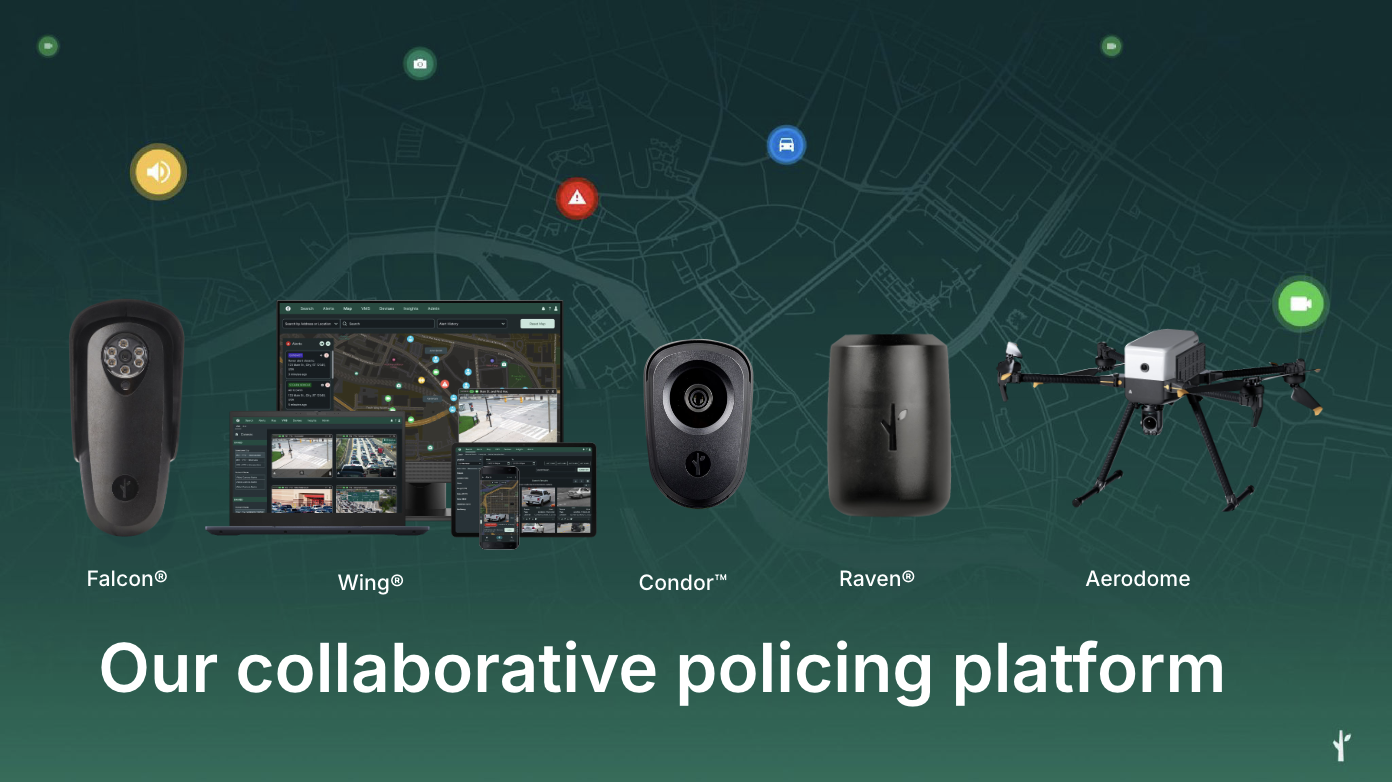
The integration of Flock Safety’s flagship ALPR technology with its Aerodome drone equipment is a police surveillance combo poised to elevate the privacy threats to civilians caused by both of these invasive technologies as drone adoption expands. 

A slide from a Flock Safety presentation to Rutherford County Sheriff's Office in North Carolina, obtained via public records, featuring Flock Safety products, including the Aerodome drone and the Wing product, which helps convert surveillance cameras into ALPR systems

The use of DFR programs has grown exponentially. The biggest police technology companies, like Axon, Flock Safety, and Motorola Solutions, are broadening their drone offerings, anticipating that drones could become an important piece of their revenue stream. 

Communities must demand restrictions on how local police use drones and ALPRs, let alone a dangerous hybrid of the two. Otherwise, we can soon expect that a drone will fly to any call for service and capture sensitive location information about every car in its flight path, capturing more ALPR data to add to the already too large databases of our movements. 

ALPR systems typically rely on cameras that have been fixed along roadways or attached to police vehicles. These cameras capture the image of a vehicle, then use artificial intelligence technology to log the license plate, make, model, color, and other unique identifying information, like dents and bumper stickers. This information is usually stored on the manufacturer’s servers and often made available on nationwide sharing networks to police departments from other states and federal agencies, including Immigration and Customs Enforcement. ALPRs are already used by most of the largest police departments in the country, and Flock Safety also now offers the ability for an agency to turn almost any internet-enabled cameras into an ALPR camera. 

ALPRs present a host of problems. ALPR systems vacuum up data—like the make, model, color, and location of vehicles—on people who will never be involved in a crime, used in gridding areas to systematically make a record of when and where vehicles have been. ALPRs routinely make mistakes, causing police to stop the wrong car and terrorize the driver. Officers have abused law enforcement databases in hundreds of cases. Police have used them to track across state lines people seeking legal health procedures. Even when there are laws against sharing data from these tools with other departments, some policing agencies still do.

Drones, meanwhile, give police a view of roofs, backyards, and other fenced areas where cops can’t casually patrol, and their adoption is becoming more common. Companies that sell drones have been helping law enforcement agencies to get certifications from the Federal Aviation Authority (FAA), and recently-implemented changes to the restrictions on flying drones beyond the visual line of sight will make it even easier for police to add this equipment. According to the FAA, since a new DFR waiver process was implemented in May 2025, the FAA has granted more than 410 such waivers, already accounting for almost a third of the approximately 1,400 DFR waivers that have been granted since such programs began in 2018.

Local officials should, of course, be informed that the drones they’re buying are equipped to do such granular surveillance from the sky, but it is not clear that this is happening. While the ALPR feature is available as part of Flock drone acquisitions, some government customers may not realize that to approve a drone from Flock Safety may also mean approving a flying ALPR. And though not every Flock safety drone is currently running the ALPR feature, some departments, like Redondo Beach Police Department, have plans to activate it in the near future. 

ALPRs aren’t the only so-called payloads that can be added to a drone. In addition to the high resolution and thermal cameras with which drones can already be equipped, drone manufacturers and police departments have discussed adding cell-site simulators, weapons, microphones, and other equipment. Communities must mobilize now to keep this runaway surveillance technology under tight control.

When EFF posed questions to Flock Safety about the integration of ALPR and its drones, the company declined to comment.

Mapping, storing, and tracking as much personal information as possibleall without warrantsis where automated police surveillance is heading right now. Flock has previously described its desire to connect ALPR scans to additional information on the person who owns the car, meaning that we don’t live far from a time when police may see your vehicle drive by and quickly learn that it’s your car and a host of other details about you. 

EFF has compiled a list of known drone-using police departments. Find out about your town’s surveillance tools at the Atlas of Surveillance. Know something we don't? Reach out at aos@eff.org.

  •  

Victory! Pen-Link's Police Tools Are Not Secret

In a victory for transparency, the government contractor Pen-Link agreed to disclose the prices and descriptions of surveillance products that it sold to a local California Sheriff's office.

The settlement ends a months-long California public records lawsuit with the Electronic Frontier Foundation and the San Joaquin County Sheriff’s Office. The settlement provides further proof that the surveillance tools used by governments are not secret and shouldn’t be treated that way under the law.

Last year, EFF submitted a California public records request to the San Joaquin County Sheriff’s Office for information about its work with Pen-Link and its subsidy Cobwebs Technology. Pen-Link went to court to try to block the disclosure, claiming the names of its products and prices were trade secrets. EFF later entered the case to obtain the records it requested.  

The Records Show the Sheriff Bought Online Monitoring Tools

The records disclosed in the settlement show that in late 2023, the Sheriff’s Office paid $180,000 for a two-year subscription to the Tangles “Web Intelligence Platform,” which is a Cobwebs Technologies product that allows the Sheriff to monitor online activity. The subscription allows the Sheriff to perform hundreds of searches and requests per month. The source of information includes the “Dark Web” and “Webloc,” according to the price quotation. According to the settlement, the Sheriff’s Office was offered but did not purchase a series of other add-ons including “AI Image processing” and “Webloc Geo source data per user/Seat.”

Have you been blocked from receiving similar information? We’d like to hear from you.

The intelligence platform overall has been described in other documents as analyzing data from the “open, deep, and dark web, to mobile and social.” And Webloc has been described as a platform that “provides access to vast amounts of location-based data in any specified geographic location.” Journalists at multiple news outlets have chronicled Pen-Link's technology and have published Cobwebs training manuals that demonstrate that its product can be used to target activists and independent journalists. Major local, state, and federal agencies use Pen-Link's technology.

The records also show that in late 2022 the Sheriff’s Office purchased some of Pen-Link’s more traditional products that help law enforcement execute and analyze data from wiretaps and pen-registers after a court grants approval. 

Government Surveillance Tools Are Not Trade Secrets

The public has a right to know what surveillance tools the government is using, no matter whether the government develops its own products or purchases them from private contractors. There are a host of policy, legal, and factual reasons that the surveillance tools sold by contractors like Pen-Link are not trade secrets.

Public information about these products and prices helps communities have informed conversations and make decisions about how their government should operate. In this case, Pen-Link argued that its products and prices are trade secrets partially because governments rely on the company to “keep their data analysis capabilities private.” The company argued that clients would “lose trust” and governments may avoid “purchasing certain services” if the purchases were made public. This troubling claim highlights the importance of transparency. The public should be skeptical of any government tool that relies on secrecy to operate.

Information about these tools is also essential for defendants and criminal defense attorneys, who have the right to discover when these tools are used during an investigation. In support of its trade secret claim, Pen-Link cited terms of service that purported to restrict the government from disclosing its use of this technology without the company’s consent. Terms like this cannot be used to circumvent the public’s right to know, and governments should not agree to them.

Finally, in order for surveillance tools and their prices to be protected as a trade secret under the law, they have to actually be secret. However, Pen-Link’s tools and their prices are already public across the internet—in previous public records disclosures, product descriptions, trademark applications, and government websites.

 Lessons Learned

Government surveillance contractors should consider the policy implications, reputational risks, and waste of time and resources when attempting to hide from the public the full terms of their sales to law enforcement.

Cases like these, known as reverse-public records act lawsuits, are troubling because a well-resourced company can frustrate public access by merely filing the case. Not every member of the public, researcher, or journalist can afford to litigate their public records request. Without a team of internal staff attorneys, it would have cost EFF tens of thousands of dollars to fight this lawsuit.

 Luckily in this case, EFF had the ability to fight back. And we will continue our surveillance transparency work. That is why EFF required some attorneys’ fees to be part of the final settlement.

  •