
 Login
Login
Yes, ‘USB condoms’ are real, and they protect your gadgets from danger
The odds say you won’t actually need your seatbelt today. The odds say that your phone won’t be hacked by a random USB-C wall charger, either. But, like a seatbelt, here’s why it’s worth investing in this cheap, easy protection device.
If you go on vacation or a business trip, chances are you’re going to need a data cable for your phone anyway, and an extra can’t hurt. But a power-only cable is a handy way of securing your phone no matter what out-of-the-way, dodgy hotel or airport you end up in.
Some people call these “USB condoms,” usually referring to a dongle that you can buy that blocks data from being transferred over the USB connection. In this case, “data” equals malware. Is a foreign government or hacker group building in standalone devices to push malware to your phone? Do credit-card skimmers exist? Okay then. If a malicious cable can be used to conceal malware, the wall port sure can.
I recently returned from a pair of trips to Arizona and Hawaii, and had planned to invest in a data-only USB-C cable anyway. As it turned out, Plugable alerted me about its entrance into the market, and asked if I’d like to try one out. The company offers a few cables of different lengths, and I think that Plugable’s $15.95 6-foot-cable works best, if only because it accommodates awkwardly placed outlets in airports, airplanes, and hotels. (There are also cheaper, shorter options.)
Mark Hachman / Foundry
Basically, you’re investing in a data cable that you know can be plugged into about anything. And no, you probably don’t need a wired data connection in this case, as Wi-Fi and cellular data can be used for anything that you need to download.
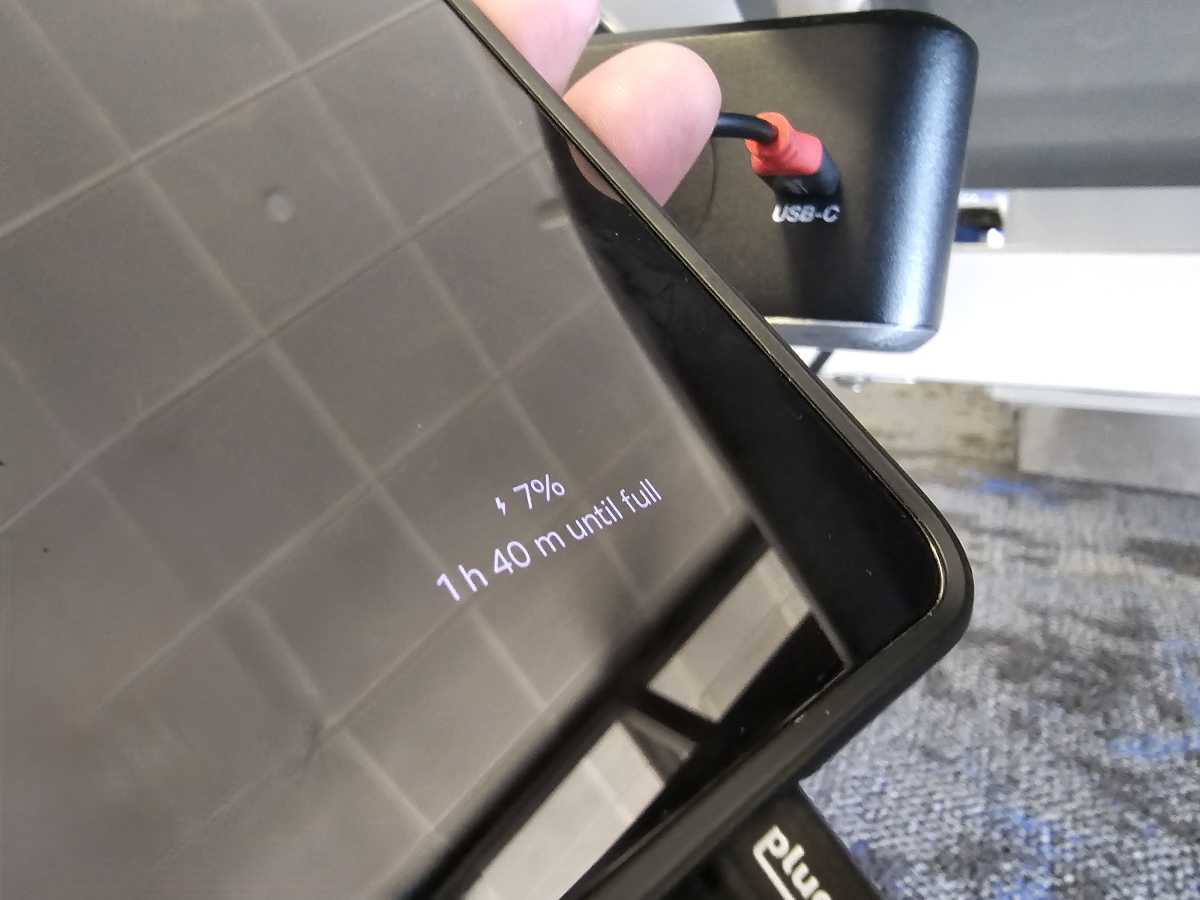
Plugable identifies its cables with a special red highlight so that you can distinguish it from other cables in your bag. As far as I can tell, it worked just fine, charging my phone on the road during some downtime and saving me from bringing another wall-wart charger. And since the cable handles power up to 240 watts, I could charge my phone, my tablet, and a laptop depending on which one needed some juice.
Admittedly, there was just one hitch. Virtually every phone on the planet uses USB-C for charging, now. But the chargers themselves were built years ago. In the airports in San Francisco (SFO), Kahului (Maui/OGG), and the Hyatt and Sheraton hotels I stayed at, every charger was USB-A, not USB-C. The exception? Sky Harbor Airport in Phoenix, which included both USB-C and USB-A connections.

Mark Hachman / Foundry
So did I bring the wrong cables? Maybe. Fortunately, USB-A to USB-C data-blocking cables exist, and PortaPow is a trusted name in that regard. PortaPow’s 3-foot cable is just $6.99, though the company doesn’t state how much power it can handle.
In any event, a small data-blocker cable or “cable condom” is cheap, small, secure, inexpensive, and fits easily into a bag or purse — and that red accent certainly helps it to be found when you’re fumbling with a bag in the overhead bin. It’s just a good thing to have on a trip, just in case.

