Reading view

Tips to Protect Your Posts About Reproductive Health From Being Removed

This is the ninth installment in a blog series documenting EFF’s findings from the Stop Censoring Abortion campaign. You can read additional posts here.  

Meta has been getting content moderation wrong for years, like most platforms that host user-generated content. Sometimes it’s a result of deliberate design choices—privacy rollbacks, opaque policies, features that prioritize growth over safety—made even when the company knows that those choices could negatively impact users. Other times, it’s simply the inevitable outcome of trying to govern billions of posts with a mix of algorithms and overstretched human reviewers. Importantly, users shouldn’t have to worry about their posts being deleted or their accounts getting banned when they share factual health information that doesn’t violate the platforms' policies. But knowing more about what the algorithmic moderation is likely to flag can help you to avoid its mistakes. 

We analyzed the roughly one-hundred survey submissions we received from social media users in response to our Stop Censoring Abortion campaign. Their stories revealed some clear patterns: certain words, images, and phrases seemed to trigger takedowns, even when posts didn’t come close to violating Meta’s rules. 

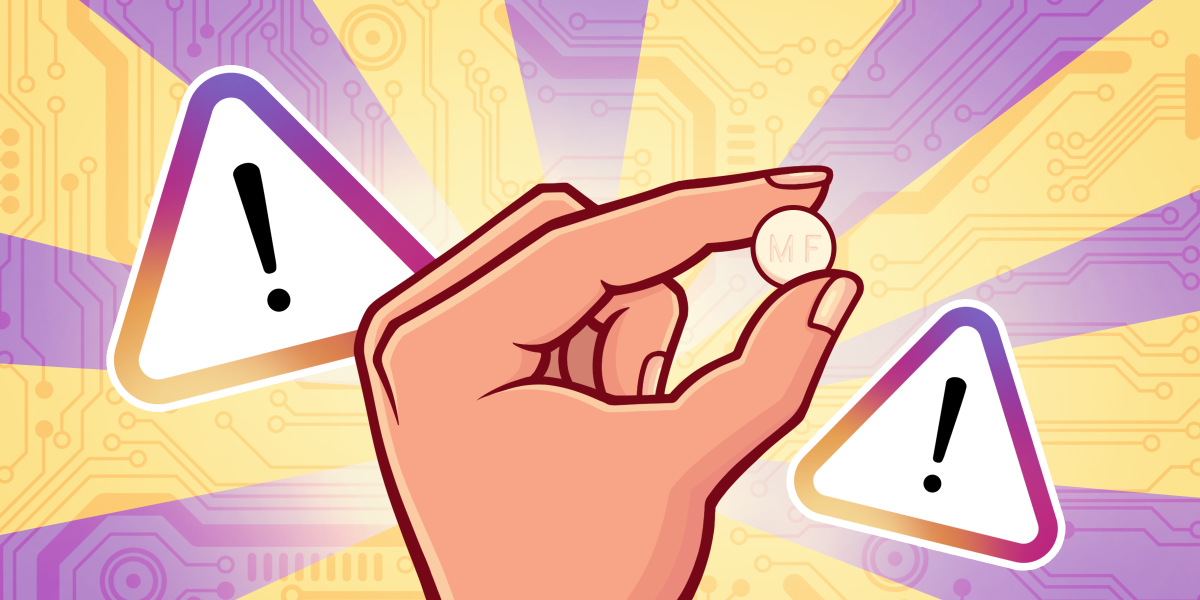
For example, your post linking to information on how people are accessing abortion pills online clearly is not an offer to buy or sell pills, but an algorithm, or a human content reviewer who doesn’t know for sure, might wrongly flag it for violating Meta’s policies on promoting or selling “restricted goods.” 

That doesn’t mean you’re powerless. For years, people have used “algospeak”—creative spelling, euphemisms, or indirection—to sidestep platform filters. Abortion rights advocates are now forced into similar strategies, even when their speech is perfectly legal. It’s not fair, but it might help you keep your content online. Here are some things we learned from our survey: 

Practical Tips to Reduce the Risk of Takedowns 

While traditional social media platforms can help people reach larger audiences, using them also generally means you have to hand over control of what you and others are able to see to the people who run the company. This is the deal that large platforms offer—and while most of us want platforms to moderate some content (even if that moderation is imperfect), current systems of moderation often reflect existing societal power imbalances and impact marginalized voices the most. 

There are ways companies and governments could better balance the power between users and platforms. In the meantime, there are steps you can take right now to break the hold these platforms have:   

  • Images and keywords matter. Posts with pill images, or accounts with “pill” in their names, were flagged often—even when the posts weren’t offering to sell medication. Before posting, consider whether you need to include an image of, or the word “pill,” or whether there’s another way to communicate your message. 
  • Clarity beats vagueness. Saying “we can help you find what you need” or “contact me for more info” might sound innocuous, but to an algorithm, it can look like an offer to sell drugs. Spell out what kind of support you do and don’t provide—for example: “We can talk through options and point you toward trusted resources. We don’t provide medical services or medication.” 
  • Be careful with links. Direct links to organizations or services that provide abortion pills were often flagged, even if the organizations operate legally. Instead of linking, try spelling out the name of the site or account. 
  • Certain word combos are red flags. Posts that included words like “mifepristone,” “abortion,” and “mail” together were frequently removed. You may still want to use them—they’re accurate and important—but know they make your post more likely to be flagged. 

Alternatives and Backups 

Big platforms give you reach, but they also set the rules—and those rules usually favor corporate interests over human rights. You don’t have to accept that as the only way forward: 

  • Keep a backup. Export your data regularly so you’re not left empty-handed if your account disappears overnight. 
  • Build your own space. Hosting a website isn’t free, but it puts you in control. 
  • Push for interoperability. Imagine being able to take your audience with you when you leave a platform. That’s the future we should be fighting for. (For more on interoperability and Meta, check out this video where Cory Doctorow explains what an interoperable Facebook would look like.) 

Protect Your Privacy 

If you’re working in abortion access—whether as a provider, activist, or volunteer—your privacy and security matter. The same is true for patients. Check out EFF’s Surveillance Self-Defense for tailored guides. Look at resources from groups like Digital Defense Fund and learn how location tracking tools can endanger abortion access. If you run an organization, consider some of the ways you can minimize what information you collect about patients, clients, or customers, in our guide to Online Privacy for Nonprofits. 

Platforms like Meta insist they want to balance free expression and safety, but their blunt systems consistently end up reinforcing existing inequalities—silencing the very people who most need to be heard. Until they do better, it’s on us to protect ourselves, share our stories, and keep building the kind of internet that respects our rights. 

This is the ninth post in our blog series documenting the findings from our Stop Censoring Abortion campaign. Read more in the series: https://www.eff.org/pages/stop-censoring-abortion 

Affected by unjust censorship? Share your story using the hashtag #StopCensoringAbortion. Amplify censored posts and accounts, share screenshots of removals and platform messages—together, we can demonstrate how these policies harm real people. 
  •  

From Book Bans to Internet Bans: Wyoming Lets Parents Control the Whole State’s Access to The Internet

If you've read about the sudden appearance of age verification across the internet in the UK and thought it would never happen in the U.S., take note: many politicians want the same or even more strict laws. As of July 1st, South Dakota and Wyoming enacted laws requiring any website that hosts any sexual content to implement age verification measures. These laws would potentially capture a broad range of non-pornographic content, including classic literature and art, and expose a wide range of platforms, of all sizes, to civil or criminal liability for not using age verification on every user. That includes social media networks like X, Reddit, and Discord; online retailers like Amazon and Barnes & Noble; and streaming platforms like Netflix and Rumble—essentially, any site that allows user-generated or published content without gatekeeping access based on age.

These laws expand on the flawed logic from last month’s troubling Supreme Court decision,  Free Speech Coalition v. Paxton, which gave Texas the green light to require age verification for sites where at least one-third (33.3%) of the content is sexual materials deemed “harmful to minors.” Wyoming and South Dakota seem to interpret this decision to give them license to require age verification—and potential legal liability—for any website that contains ANY image, video, or post that contains sexual content that could be interpreted as harmful to minors. Platforms or websites may be able to comply by implementing an “age gate” within certain sections of their sites where, for example, user-generated content is allowed, or at the point of entry to the entire site.

Although these laws are in effect, we do not believe the Supreme Court’s decision in FSC v. Paxton gives these laws any constitutional legitimacy. You do not need a law degree to see the difference between the Texas law—which targets sites where a substantial portion (one third) of content is “sexual material harmful to minors”—and these laws, which apply to any site that contains even a single instance of such material. In practice, it is the difference between burdening adults with age gates for websites that host “adult” content, and burdening the entire internet, including sites that allow user-generated content or published content.

The law invites parents in Wyoming to take enforcement for the entire state—every resident, and everyone else's children—into their own hands

But lawmakers, prosecutors, and activists in conservative states have worked for years to aggressively expand the definition of “harmful to minors” and use other methods to censor a broad swath of content: diverse educational materials, sex education resources, art, and even award-winning literature. Books like The Bluest Eye by Toni Morrison, The Handmaid’s Tale by Margaret Atwood, and And Tango Makes Three have all been swept up in these crusades—not because of their overall content, but because of isolated scenes or references.

Wyoming’s law is also particularly extreme: rather than provide enforcement by the Attorney General, HB0043 is a “bounty” law that deputizes any resident with a child to file civil lawsuits against websites they believe are in violation, effectively turning anyone into a potential content cop. There is no central agency, no regulatory oversight, and no clear standard. Instead, the law invites parents in Wyoming to take enforcement for the entire state—every resident, and everyone else's children—into their own hands by suing websites that contain a single example of objectionable content. Though most other state age-verification laws often allow individuals to make reports to state Attorneys General who are responsible for enforcement, and some include a private right of action allowing parents or guardians to file civil claims for damages, the Wyoming law is similar to laws in Louisiana and Utah that rely entirely on civil enforcement. 

This is a textbook example of a “heckler’s veto,” where a single person can unilaterally decide what content the public is allowed to access. However, it is clear that the Wyoming legislature explicitly designed the law this way in a deliberate effort to sidestep state enforcement and avoid an early constitutional court challenge, as many other bounty laws targeting people who assist in abortions, drag performers, and trans people have done. The result? An open invitation from the Wyoming legislature to weaponize its citizens, and the courts, against platforms, big or small. Because when nearly anyone can sue any website over any content they deem unsafe for minors, the result isn’t safety. It’s censorship.

That also means your personal website or blog—if it includes any “sexual content harmful to minors”—is also at risk. 

Imagine a Wyomingite stumbling across an NSFW subreddit or a Tumblr fanfic blog and deciding it violates the law. If they were a parent of a minor, that resident could sue the platform, potentially forcing those websites to restrict or geo-block access to the entire state in order to avoid the cost and risk of litigation. And because there’s no threshold for how much “harmful” content a site must host, a single image or passage could be enough. That also means your personal website or blog—if it includes any “sexual content harmful to minors”—is also at risk. 

This law will likely be challenged, and eventually, halted, by the courts. But given that the state cannot enforce it, those challenges will not come until a parent sues a website. Until then, its mere existence poses a serious threat to free speech online. Risk-averse platforms may over-correct, over-censor, or even restrict access to the state entirely just to avoid the possibility of a lawsuit, as Pornhub has already done. And should sites impose age-verification schemes to comply, they will be a speech and privacy disaster for all state residents.

And let’s be clear: these state laws are not outliers. They are part of a growing political movement to redefine terms like “obscene,” “pornographic,” and “sexually explicit”  as catchalls to restrict content for both adults and young people alike. What starts in one state and one lawsuit can quickly become a national blueprint. 

If we don’t push back now, the internet as we know it could disappear behind a wall of fear and censorship.

Age-verification laws like these have relied on vague language, intimidating enforcement mechanisms, and public complacency to take root. Courts may eventually strike them down, but in the meantime, users, platforms, creators, and digital rights advocacy groups need to stay alert, speak up against these laws, and push back while they can. When governments expand censorship and surveillance offline, it's our job at EFF to protect your access to a free and open internet. Because if we don’t push back now, the internet as we know it— the messy, diverse, and open internet we know—could disappear behind a wall of fear and censorship.

Ready to join us? Urge your state lawmakers to reject harmful age-verification laws. Call or email your representatives to oppose KOSA and any other proposed federal age-checking mandates. Make your voice heard by talking to your friends and family about what we all stand to lose if the age-gated internet becomes a global reality. Because the fight for a free internet starts with us.

  •  

Today's Supreme Court Decision on Age Verification Tramples Free Speech and Undermines Privacy

Today’s decision in Free Speech Coalition v. Paxton is a direct blow to the free speech rights of adults. The Court ruled that “no person—adult or child—has a First Amendment right to access speech that is obscene to minors without first submitting proof of age.” This ruling allows states to enact onerous age-verification rules that will block adults from accessing lawful speech, curtail their ability to be anonymous, and jeopardize their data security and privacy. These are real and immense burdens on adults, and the Court was wrong to ignore them in upholding Texas’ law.  

Importantly, the Court's reasoning applies only to age-verification rules for certain sexual material, and not to age limits in general. We will continue to fight against age restrictions on online access more broadly, such as on social media and specific online features.  

Still, the decision has immense consequences for internet users in Texas and in other states that have enacted similar laws. The Texas law forces adults to submit personal information over the internet to access entire websites that hold some amount of sexual material, not just pages or portions of sites that contain specific sexual materials. Many sites that cannot reasonably implement age verification measures for reasons such as cost or technical requirements will likely block users living in Texas and other states with similar laws wholesale.  

Importantly, the Court's reasoning applies only to age-verification rules for certain sexual material, and not to age limits in general. 

Many users will not be comfortable sharing private information to access sites that do implement age verification, for reasons of privacy or concern for data breaches. Many others do not have a driver’s license or photo ID to complete the age verification process. This decision will, ultimately, deter adult users from speaking and accessing lawful content, and will endanger the privacy of those who choose to go forward with verification. 

What the Court Said Today 

In the 6-3 decision, the Court ruled that Texas’ HB 1181 is constitutional. This law requires websites that Texas decides are composed of “one-third” or more of “sexual material harmful to minors” to confirm the age of users by collecting age-verifying personal information from all visitors—even to access the other two-thirds of material that is not adult content.   

In 1997, the Supreme Court struck down a federal online age-verification law in Reno v. American Civil Liberties Union. In that case the court ruled that many elements of the Communications Decency Act violated the First Amendment, including part of the law making it a crime for anyone to engage in online speech that is "indecent" or "patently offensive" if the speech could be viewed by a minor. Like HB 1181, that law would have resulted in many users being unable to view constitutionally protected speech, as many websites would have had to implement age verification, while others would have been forced to shut down.  

In Reno and in subsequent cases, the Supreme Court ruled that laws that burden adults’ access to lawful speech are subjected to the highest level of review under the First Amendment, known as strict scrutiny. This level of scrutiny requires a law to be very narrowly tailored or the least speech-restrictive means available to the government.  

That all changed with the Supreme Court’s decision today 

The Court now says that laws that burden adults access to sexual materials that are obscene to minors are subject to less-searching First Amendment review, known as intermediate scrutiny. And under that lower standard, the Texas law does not violate the First Amendment. The Court did not have to respond to arguments that there are less speech-restrictive ways of reaching the same goal—for example, encouraging parents to install content-filtering software on their children’s devices.

The court reached this decision by incorrectly assuming that online age verification is functionally equivalent to flashing an ID at a brick-and-mortar store. As we explained in our amicus brief, this ignores the many ways in which verifying age online is significantly more burdensome and invasive than doing so in person. As we and many others have previously explained, unlike with in-person age-checks, the only viable way for a website to comply with an age verification requirement is to require all users to upload and submit—not just momentarily display—a data-rich government-issued ID or other document with personal identifying information.  

This leads to a host of serious anonymity, privacy, and security concerns—all of which the majority failed to address. A person who submits identifying information online can never be sure if websites will keep that information or how that information might be used or disclosed. This leaves users highly vulnerable to data breaches and other security harms. Age verification also undermines anonymous internet browsing, even though courts have consistently ruled that anonymity is an aspect of the freedom of speech protected by the First Amendment.    

This Supreme Court broke a fundamental agreement between internet users and the state that has existed since its inception

The Court sidestepped its previous online age verification decisions by claiming the internet has changed too much to follow the precedent from Reno that requires these laws to survive strict scrutiny. Writing for the minority, Justice Kagan disagreed with the premise that the internet has changed: “the majority’s claim—again mistaken—that the internet has changed too much to follow our precedents’ lead.”   

But the majority argues that past precedent does not account for the dramatic expansion of the internet since the 1990s, which has led to easier and greater internet access and larger amounts of content available to teens online. The majority’s opinion entirely fails to address the obvious corollary: the internet’s expansion also has benefited adults. Age verification requirements now affect exponentially more adults than they did in the 1990s and burden vastly more constitutionally protected online speech. The majority's argument actually demonstrates that the burdens on adult speech have grown dramatically larger because of technological changes, yet the Court bizarrely interprets this expansion as justification for weaker constitutional protection. 

What It Means Going Forward 

This Supreme Court broke a fundamental agreement between internet users and the state that has existed since its inception: the government will not stand in the way of people accessing First Amendment-protected material. There is no question that multiple states will now introduce similar laws to Texas. Two dozen already have, though they are not all in effect. At least three of those states have no limit on the percentage of material required before the law applies—a sweeping restriction on every site that contains any material that the state believes the law includes. These laws will force U.S.-based adult websites to implement age-verification or block users in those states, as many have in the past when similar laws were in effect.  

Rather than submit to verification, research has found that people will choose a variety of other paths: using VPNs to indicate that they are outside of the state, accessing similar sites that don’t comply with the law, often because the site is operating in a different country. While many users will simply not access the content as a result, others may accept the risk, at their peril.   

We expect some states to push the envelope in terms of what content they consider “harmful to minors,” and to expand the type of websites that are covered by these laws, either through updated language or threats of litigation. Even if these attacks are struck down, operators of sites that involve sexual content of any type may be under threat, especially if that information is politically divisive. We worry that the point of some of these laws will be to deter queer folks and others from accessing lawful speech and finding community online by requiring them to identify themselves. We will continue to fight to protect against the disclosure of this critical information and for people to maintain their anonymity. 

EFF Will Continue to Fight for All Users’ Free Expression and Privacy 

That said, the ruling does not give states or Congress the green light to impose age-verification regulations on the broader internet. The majority’s decision rests on the fact that minors do not have a First Amendment right to access sexual material that would be obscene. In short, adults have a First Amendment right to access those sexual materials, while minors do not. Although it was wrong, the majority’s opinion ruled that because Texas is blocking minors from speech they have no constitutional right to access, the age-verification requirement only incidentally burdens adult’s First Amendment rights.  

But the same rationale does not apply to general-audience sites and services, including social media. Minors and adults have coextensive rights to both speak and access the speech of other users on these sites because the vast majority of the speech is not sexual materials that would be obscene to minors. Lawmakers should be careful not to interpret this ruling to mean that broader restrictions on minors’ First Amendment rights, like those included in the Kids Online Safety Act, would be deemed constitutional.  

Free Speech Coalition v. Paxton will have an effect on nearly every U.S. adult internet user for the foreseeable future. It marks a worrying shift in the ways that governments can restrict access to speech online. But that only means we must work harder than ever to protect privacy, security, and free speech as central tenets of the internet.  

  •