Reading view

The Abortion Hotline Meta Wants to Go Dark

This is the sixth installment in a blog series documenting EFF's findings from the Stop Censoring Abortion campaign. You can read additional posts here. 

When we started our Stop Censoring Abortion campaign, we heard from activists, advocacy organizations, researchers, and even healthcare providers who had all experienced having abortion-related content removed or suppressed on social media. One of the submissions we received was from an organization called the Miscarriage and Abortion Hotline.

The Miscarriage and Abortion Hotline (M+A Hotline) formed in 2019, is staffed by a team of healthcare providers who wanted to provide free and confidential “expert advice on various aspects of miscarriage and abortion, ensuring individuals receive accurate information and compassionate support throughout their journey.” By 2022, the hotline was receiving between 25 to 45 calls and texts a day. 

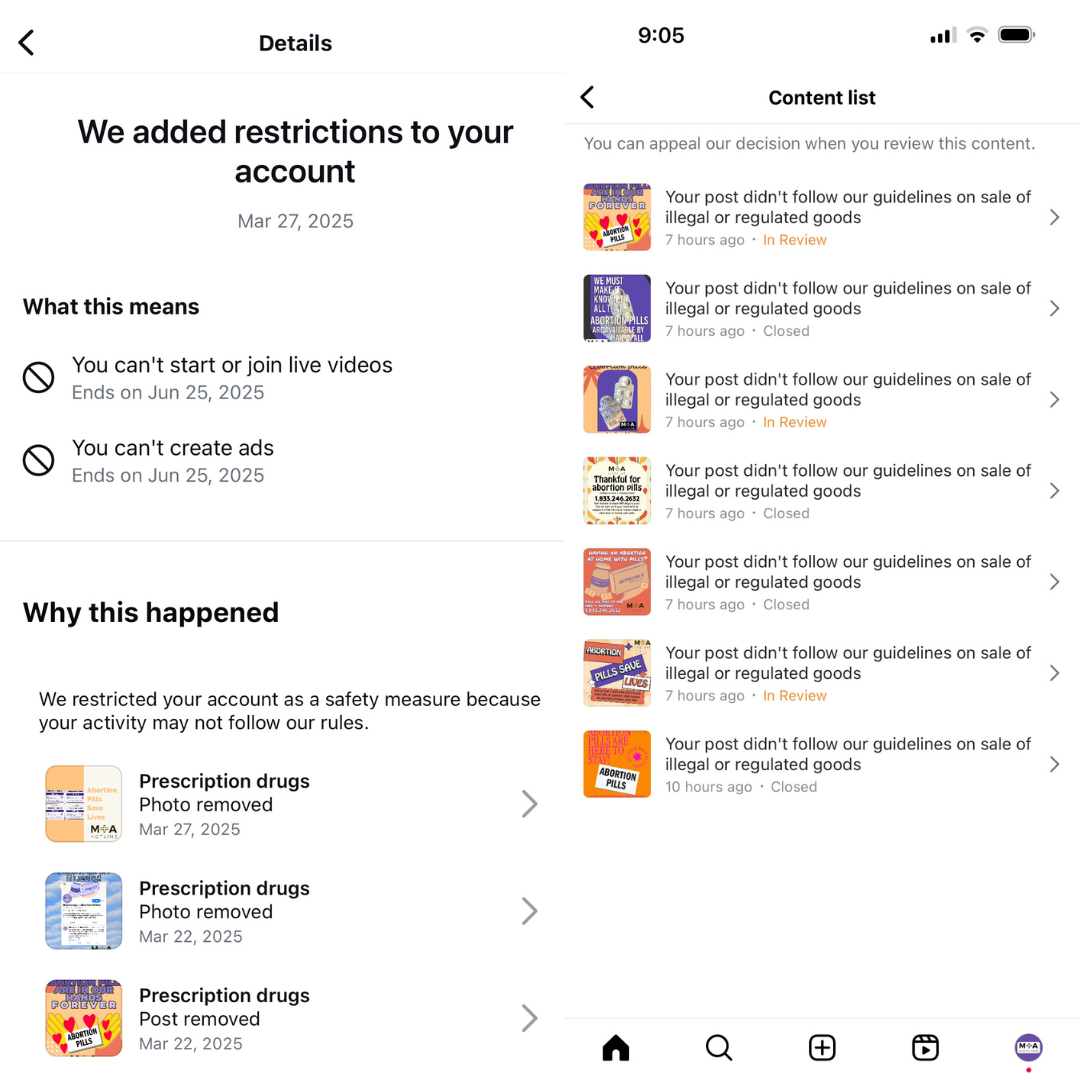
Like many reproductive health, rights, and justice groups, the M+A Hotline is active on social media, sharing posts that affirm the voices and experiences of abortion seekers, assert the safety of medication abortion, and spread the word about the expert support that the hotline offers. However, in late March of this year, the M+A Hotline’s Instagram suddenly had numerous posts taken down and was hit with restrictions that prevented the account from starting or joining livestreams or creating ads until June 25, 2025.
Screenshots provided to EFF from M+A Hotline

The reason behind the restrictions and takedowns, according to Meta, was that the M+A Hotline’s Instagram account failed to follow Meta’s guidelines on the sale of illegal or regulated goods. The “guidelines” refer to Meta’s Community Standards which dictate the types of content that are allowed on Facebook, Instagram, Messenger, and Threads. But according to Meta, it is not against these Community Standards to provide guidance on how to legally access pharmaceutical drugs, and this is treated differently than an offer to buy, sell, or trade pharmaceuticals (though there are additional compliance requirements for paid ads). 

Under these rules, the M+A Hotline’s content should have been fine: The Hotline does not sell medication abortion and simply educates on the efficacy and safety of medication abortion while providing guidance on how abortion seekers could legally access the pills. Despite this, around 10 posts from the account were removed by Instagram, none of which were ads.

For how little the topic is mentioned in these Standards, content about abortion seems to face extremely high scrutiny from Meta.
In a letter to Amnesty International in February 2024, Meta publicly clarified that organic content on its platforms that educates users about medication abortion is not in violation of the Community Standards. The company claims that the policies are “based on feedback from people and the advice of experts in fields like technology, public safety and human rights.” The Community Standards are thorough and there are sections covering everything from bullying and harassment to account integrity to restricted goods and services. Notably, within the several webpages that make up the Community Standards, there are very few mentions of the words “abortion” and “reproductive health.” For how little the topic is mentioned in these Standards, content about abortion seems to face extremely high scrutiny from Meta.

Screenshots provided to EFF from M+A Hotline

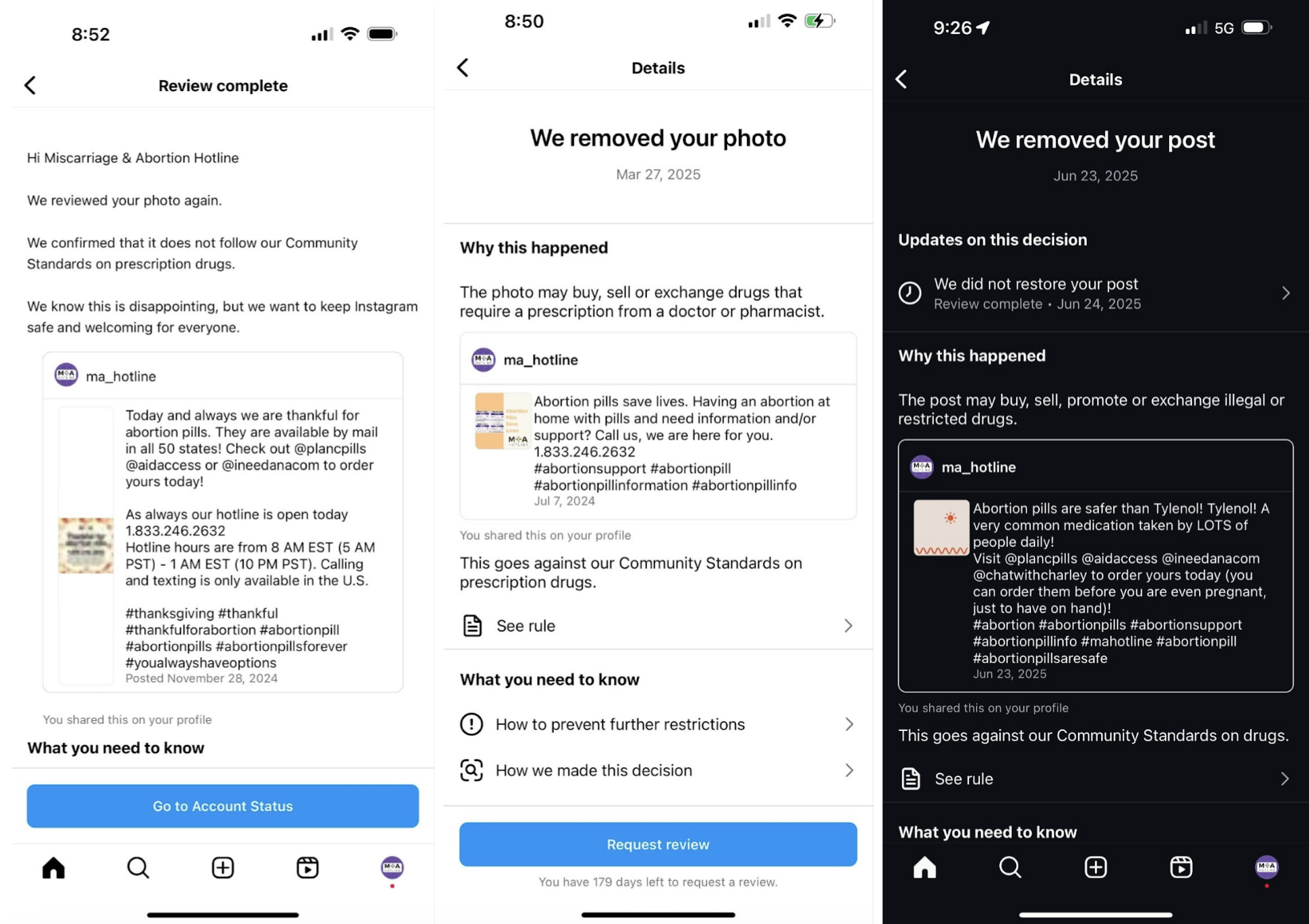
Not only were posts removed, but even after further review, many were not restored. The M+A Hotline was once again told that their content violates the Community Standards on drugs. While it’s understandable that moderation systems may make mistakes, it’s unacceptable for those mistakes to be repeated consistently with little transparency or direct communication with the users whose speech is being restricted and erased. This problem is only made worse by lack of helpful recourse. As seen here, even when users request review and identify these moderation errors, Meta may still refuse to restore posts that are permitted under the Community Standards.

The removal of the M+A Hotline’s educational content demonstrates that Meta must be more accurate, consistent, and transparent in the enforcement of their Community Standards, especially in regard to reproductive health information. Informing users that medical professionals are available to support those navigating a miscarriage or abortion is plainly not an attempt to buy or sell pharmaceutical drugs. Meta must clearly defineand then fairly enforce–what is and isn’t permitted under its Standards. This includes ensuring there is a meaningful way to quickly rectify any moderation errors through the review process. 

At a time when attacks on online access to information—and particularly abortion information—are intensifying, Meta must not exacerbate the problem by silencing healthcare providers and suppressing vital health information. We must all continue to fight back against online censorship.

 This is the sixth post in our blog series documenting the findings from our Stop Censoring Abortion campaign. Read more in the series: https://www.eff.org/pages/stop-censoring-abortion

  •  

California: Tweet at Governor Newsom to Get A.B. 566 Signed Into Law

We need your help to make a common-sense bill into California law. Despite the fact that California has one of the nation’s most comprehensive data privacy laws, it’s not always easy for people to exercise those privacy rights. A.B. 566 intends to make it easy by directing browsers to give all their users the option to tell companies they don’t want personal information that’s collected about them on the internet to be sold or shared. Now, we just need Governor Gavin Newsom to sign it into law by October 13, 2025, and this toolkit will help us put on the pressure. Tweet at Gov. Gavin Newsom and help us get A.B. 566 signed into law!

First, pick your platform of choice. Reach Gov. Newsom at any of his social media handles:

Then, pick a message that resonates with you. Or, feel free to remix!

Sample Posts

  • It should be easy for Californians to exercise our rights under the California Consumer Privacy Act, but major internet browser companies are making it difficult for us to do that. @CAgovernor, sign AB 566 and give power to the consumers to protect their privacy!
  • We are living in a time of mass surveillance and tracking. Californian consumers should be able to easily control their privacy and AB 566 would make that possible. @CAgovernor, sign AB 566 and ensure that millions of Californians can opt out of the sale and sharing of their private information!
  • People seeking abortion care, immigrants, and LGBTQ+ people are at risk of bad actors using their online activity against them. @CAgovernor could sign AB 566 and protect the privacy of vulnerable communities and all Californians.
  • AB 566 gives Californians a practical way to use their right to opt-out of websites selling or sharing their private info. @CAgovernor can sign it and give consumers power over their privacy choices under the California Consumer Privacy Act.
  • Hey @CAgovernor! AB 566 makes it easy for Californians to tell companies what they want to happen with their own private information. Sign it and make the California Consumer Privacy Act more user-friendly!
  • Companies haven’t made it easy for Californians to tell companies not to sell or share their personal information. We need AB 566 so that browsers MUST give users the option to easily opt out of this data sharing. @CAgovernor, sign AB 566!
  • Major browsers have made it hard for Californians to opt out of the share and sale of their private info. Right now, consumers must individually opt out at every website they visit. AB 566 can change that by requiring browsers to create one single opt-out preference, but @CAgovernor MUST sign it!
  • It should be easy for Californians to opt out of the share and sale of their private info, such as health info, immigration status, and political affiliation, but browsers have made it difficult. @CAgovernor can sign AB 566 and give power to consumers to more easily opt out of this data sharing.
  • Right now, if a Californian wants to tell companies not to sell or share their info, they must go through the processes set up by each company, ONE BY ONE, to opt out of data sharing. AB 566 can remove that burden. @CAgovernor, sign AB 566 to empower consumers!
  • Industry groups who want to keep the scales tipped in favor of corporations who want to profit off the sale of our private info have lobbied heavily against AB 566, a bill that will make it easy for Californians to tell companies what they want to happen with their own info. @CAgovernor—sign it!

  •  

Going Viral vs. Going Dark: Why Extremism Trends and Abortion Content Gets Censored

This is the fourth installment in a blog series documenting EFF's findings from the Stop Censoring Abortion campaign. You can read additional posts here. 

One of the goals of our Stop Censoring Abortion campaign was to put names, stories, and numbers to the experiences we’d been hearing about: people and organizations having their abortion-related content – or entire accounts – removed or suppressed on social media. In reviewing survey submissions, we found that multiple users reported experiencing shadowbanning. Shadowbanning (or “deranking”) is widely experienced and reported by content creators across various social media platforms, and it’s a phenomenon that those who create content about abortion and sexual and reproductive health know all too well.

Shadowbanning is the often silent suppression of certain types of content or creators in your social media feeds. It’s not something that a U.S-based creator is notified about, but rather something they simply find out when their posts stop getting the same level of engagement that they’re used to, or when people are unable to easily find their account using the platform’s search function. Essentially, it is when a platform or its algorithm decides that other users should see less of a creator or specific topic. Many platforms deny that shadowbanning exists; they will often blame reduced reach of posts on ‘bugs’ in the algorithm. At the same time, companies like Meta have admitted that content is ranked, but much about how this ranking system works remains unknown.  Meta says that there are five content categories that while allowed on its platforms, “may not be eligible for recommendation.” Content discussing abortion pills may fall under the umbrella of “Content that promotes the use of certain regulated products,” but posts that simply affirm abortion as a valid reproductive decision or are of storytellers sharing their experiences don’t match any of the criteria that would make it unable to be recommended by Meta.

Whether a creator relies on a platform for income or uses it to educate the public, shadowbanning can be devastating for the growth of an account. And this practice often seems to disproportionately affect people who are talking about ‘taboo’ topics like sex, abortion, and LGBTQ+ identities, such as Kim Adamski, a sexual health educator who shared her story with our Stop Censoring Abortion project. As you can see in the images below, Kim’s Instagram account does not show up as a suggestion when being searched, and can only be found after typing in the full username.


Earlier this year, the Center for Intimacy Justice shared their report, "The Digital Gag: Suppression of Sexual and Reproductive Health on Meta, TikTok, Amazon, and Google", which found that of the 159 nonprofits, content creators, sex educators, and businesses surveyed, 63% had content removed on Meta platforms and 55% had content removed on TikTok. This suppression is happening at the same time as platforms continue to allow and elevate videos of violence and gore and extremist hateful content. This pattern is troubling and is only becoming more prevalent as people turn to social media to find the information they need to make decisions about their health.

Reproductive rights and sex education have been under attack across the U.S. for decades. Since the Dobbs v. Jackson decision in 2022, 20 states have banned or limited access to abortion. Meanwhile, 16 states don’t require sex education in public schools to be medically accurate, 19 states have laws that stigmatize LGBTQ+ identities in their sex education curricula, and 17 states specifically stigmatize abortion in their sex education curricula.

In a world that is constantly finding ways to legislate away bodily autonomy and hide queer identities, social media platforms have an opportunity to stand as safe havens for access to community and knowledge.

Online platforms are critical lifelines for people seeking possibly life-saving information about their sexual and reproductive health. We know that when people are unable to find or access the information they need within their communities, they will turn to the internet and social media. This is especially important for abortion-seekers and trans youth living in states where healthcare is being criminalized.

In a world that is constantly finding ways to legislate away bodily autonomy and hide queer identities, social media platforms have an opportunity to stand as safe havens for access to community and knowledge. Limiting access to this information by suppressing the people and organizations who are providing it is an attack on free expression and a profound threat to freedom of information—principles that these platforms claim to uphold. Now more than ever, we must continue to push back against censorship of sexual and reproductive health information so that the internet can still be a place where all voices are heard and where all can learn.

This is the fourth post in our blog series documenting the findings from our Stop Censoring Abortion campaign. Read more in the series: https://www.eff.org/pages/stop-censoring-abortion

  •