Reading view

Why Isn’t Online Age Verification Just Like Showing Your ID In Person?


This blog also appears in our Age Verification Resource Hub: our one-stop shop for users seeking to understand what age-gating laws actually do, what’s at stake, how to protect yourself, and why EFF opposes all forms of age verification mandates. Head to EFF.org/Age to explore our resources and join us in the fight for a free, open, private, and yes—safe—internet.

One of the most common refrains we hear from age verification proponents is that online ID checks are nothing new. After all, you show your ID at bars and liquor stores all the time, right? And it’s true that many places age-restrict access in-person to various goods and services, such as tobacco, alcohol, firearms, lottery tickets, and even tattoos and body piercings.

But this comparison falls apart under scrutiny. There are fundamental differences between flashing your ID to a bartender and uploading government documents or biometric data to websites and third-party verification companies. Online age-gating is more invasive, affects far more people, and poses serious risks to privacy, security, and free speech that simply don't exist when you buy a six-pack at the corner store.

Online age verification burdens many more people.

Online age restrictions are imposed on many, many more users than in-person ID checks. Because of the sheer scale of the internet, regulations affecting online content sweep in an enormous number of adults and youth alike, forcing them to disclose sensitive personal data just to access lawful speech, information, and services. 

Additionally, age restrictions in the physical world affect only a limited number of transactions: those involving a narrow set of age-restricted products or services. Typically this entails a bounded interaction about one specific purchase.

Online age verification laws, on the other hand, target a broad range of internet activities and general purpose platforms and services, including social media sites and app stores. And these laws don’t just wall off specific content deemed harmful to minors (like a bookstore would); they age-gate access to websites wholesale. This is akin to requiring ID every time a customer walks into a convenience store, regardless of whether they want to buy candy or alcohol.

There are significant privacy and security risks that don’t exist offline.

In offline, in-person scenarios, a customer typically provides their physical ID to a cashier or clerk directly. Oftentimes, customers need only flash their ID for a quick visual check, and no personal information is uploaded to the internet, transferred to a third-party vendor, or stored. Online age-gating, on the other hand, forces users to upload—not just momentarily display—sensitive personal information to a website in order to gain access to age-restricted content. 

This creates a cascade of privacy and security problems that don’t exist in the physical world. Once sensitive information like a government-issued ID is uploaded to a website or third-party service, there is no guarantee it will be handled securely. You have no direct control over who receives and stores your personal data, where it is sent, or how it may be accessed, used, or leaked outside the immediate verification process. 

Data submitted online rarely just stays between you and one other party. All online data is transmitted through a host of third-party intermediaries, and almost all websites and services also host a network of dozens of private, third-party trackers managed by data brokers, advertisers, and other companies that are constantly collecting data about your browsing activity. The data is shared with or sold to additional third parties and used to target behavioral advertisements. Age verification tools also often rely on third parties just to complete a transaction: a single instance of ID verification might involve two or three different third-party partners, and age estimation services often work directly with data brokers to offer a complete product. Users’ personal identifying data then circulates among these partners. 

All of this increases the likelihood that your data will leak or be misused. Unfortunately, data breaches are an endemic part of modern life, and the sensitive, often immutable, personal data required for age verification is just as susceptible to being breached as any other online data. Age verification companies can be—and already have been—hacked. Once that personal data gets into the wrong hands, victims are vulnerable to targeted attacks both online and off, including fraud and identity theft.

Troublingly, many age verification laws don’t even protect user security by providing a private right of action to sue a company if personal data is breached or misused. This leaves you without a direct remedy should something bad happen. 

Some proponents claim that age estimation is a privacy-preserving alternative to ID-based verification. But age estimation tools still require biometric data collection, often demanding users submit a photo or video of their face to access a site. And again, once submitted, there’s no way for you to verify how that data is processed or stored. Requiring face scans also normalizes pervasive biometric surveillance and creates infrastructure that could easily be repurposed for more invasive tracking. Once we’ve accepted that accessing lawful speech requires submitting our faces for scanning, we’ve crossed a threshold that’s difficult to walk back.

Online age verification creates even bigger barriers to access.

Online age gates create more substantial access barriers than in-person ID checks do. For those concerned about privacy and security, there is no online analog to a quick visual check of your physical ID. Users may be justifiably discouraged from accessing age-gated websites if doing so means uploading personal data and creating a potentially lasting record of their visit to that site.

Given these risks, age verification also imposes barriers to remaining anonymous that don't typically exist in-person. Anonymity can be essential for those wishing to access sensitive, personal, or stigmatized content online. And users have a right to anonymity, which is “an aspect of the freedom of speech protected by the First Amendment.” Even if a law requires data deletion, users must still be confident that every website and online service with access to their data will, in fact, delete it—something that is in no way guaranteed.

In-person ID checks are additionally less likely to wrongfully exclude people due to errors. Online systems that rely on facial scans are often incorrect, especially when applied to users near the legal age of adulthood. These tools are also less accurate for people with Black, Asian, Indigenous, and Southeast Asian backgrounds, for users with disabilities, and for transgender individuals. This leads to discriminatory outcomes and exacerbates harm to already marginalized communities. And while in-person shoppers can speak with a store clerk if issues arise, these online systems often rely on AI models, leaving users who are incorrectly flagged as minors with little recourse to challenge the decision.

In-person interactions may also be less burdensome for adults who don’t have up-to-date ID. An older adult who forgets their ID at home or lacks current identification is not likely to face the same difficulty accessing material in a physical store, since there are usually distinguishing physical differences between young adults and those older than 35. A visual check is often enough. This matters, as a significant portion of the U.S. population does not have access to up-to-date government-issued IDs. This disproportionately affects Black Americans, Hispanic Americans, immigrants, and individuals with disabilities, who are less likely to possess the necessary identification.

We’re talking about First Amendment-protected speech.

It's important not to lose sight of what’s at stake here. The good or service age gated by these laws isn’t alcohol or cigarettes—it’s First Amendment-protected speech. Whether the target is social media platforms or any other online forum for expression, age verification blocks access to constitutionally-protected content. 

Access to many of these online services is also necessary to participate in the modern economy. While those without ID may function just fine without being able to purchase luxury products like alcohol or tobacco, requiring ID to participate in basic communication technology significantly hinders people’s ability to engage in economic and social life.

This is why it’s wrong to claim online age verification is equivalent to showing ID at a bar or store. This argument handwaves away genuine harms to privacy and security, dismisses barriers to access that will lock millions out of online spaces, and ignores how these systems threaten free expression. Ignoring these threats won’t protect children, but it will compromise our rights and safety.
  •  

No One Should Be Forced to Conform to the Views of the State

Should you have to think twice before posting a protest flyer to your Instagram story? Or feel pressure to delete that bald JD Vance meme that you shared? Now imagine that you could get kicked out of the country—potentially losing your job or education—based on the Trump administration’s dislike of your views on social media. 

That threat to free expression and dissent is happening now, but we won’t let it stand. 

"...they're not just targeting individuals—they're targeting the very idea of freedom itself."

The Electronic Frontier Foundation and co-counsel are representing the United Automobile Workers (UAW), Communications Workers of America (CWA), and American Federation of Teachers (AFT) in a lawsuit against the U.S. State Department and Department of Homeland Security for their viewpoint-based surveillance and suppression of noncitizens’ First Amendment-protected speech online.  The lawsuit asks a federal court to stop the government’s unconstitutional surveillance program, which has silenced citizens and noncitizens alike. It has even hindered unions’ ability to associate with their members. 

"When they spy on, silence, and fire union members for speaking out, they're not just targeting individuals—they're targeting the very idea of freedom itself,” said UAW President Shawn Fain. 

The Trump administration has built this mass surveillance program to monitor the constitutionally protected online speech of noncitizens who are lawfully present in the U.S. The program uses AI and automated technologies to scour social media and other online platforms to identify and punish individuals who express viewpoints the government considers "hostile" to "our culture" and "our civilization".  But make no mistake: no one should be forced to conform to the views of the state. 

The Foundation of Democracy 

Your free expression and privacy are fundamental human rights, and democracy crumbles without them. We have an opportunity to fight back, but we need you.  EFF’s team of lawyers, activists, researchers, and technologists have been on a mission to protect your freedom online since 1990, and we’re just getting started.

Donate and become a member of EFF today. Your support helps protect crucial rights, online and off, for everyone.

Give Today

  •  

Decoding Meta's Advertising Policies for Abortion Content

This is the seventh installment in a blog series documenting EFF's findings from the Stop Censoring Abortion campaign. You can read additional posts here. 

For users hoping to promote or boost an abortion-related post on Meta platforms, the Community Standards are just step one. While the Community Standards apply to all posts, paid posts and advertisements must also comply with Meta's Advertising Standards. It’s easy to understand why Meta places extra requirements on paid content. In fact, their “advertising policy principles” outline several important and laudable goals, including promoting transparency and protecting users from scams, fraud, and unsafe and discriminatory practices. 

But additional standards bring additional content moderation, and with that comes increased potential for user confusion and moderation errors. Meta’s ad policies, like its enforcement policies, are vague on a number of important questions. Because of this, it’s no surprise that Meta's ad policies repeatedly came up as we reviewed our Stop Censoring Abortion submissions. 

There are two important things to understand about these ad policies. First, the ad policies do indeed impose stricter rules on content about abortion—and specifically medication abortion—than Meta’s Community Standards do. To help users better understand what is and isn’t allowed, we took a closer look at the policies and what Meta has said about them. 

Second, despite these requirements, the ad policies do not categorically block abortion-related posts from being promoted as ads. In other words, while Meta’s ad policies introduce extra hurdles, they should not, in theory, be a complete barrier to promoting abortion-related posts as boosted content. Still, our analysis revealed that Meta is falling short in several areas. 

What’s Allowed Under the Drugs and Pharmaceuticals Policy? 

When EFF asked Meta about potential ad policy violations, the company first pointed to its Drugs and Pharmaceuticals policy. In the abortion care context, this policy applies to paid content specifically about medication abortion and use of abortion pills. Ads promoting these and other prescription drugs are permitted, but there are additional requirements: 

  • To reduce risks to consumers, Meta requires advertisers to prove they’re appropriately licensed and get prior authorization from Meta 
  • Authorization is limited to online pharmacies, telehealth providers, and pharmaceutical manufacturers.  
  • The ads also must only target people 18 and older, and only in the countries in which the user is licensed.  

Understanding what counts as “promoting prescription drugs” is where things get murky. Crucially, the written policy states that advertisers do not need authorization to run ads that “educate, advocate or give public service announcements related to prescription drugs” or that “promote telehealth services generally.” This should, in theory, leave a critical opening for abortion advocates focused on education and advocacy rather than direct prescription drug sales. 

But Meta told EFF that advertisers “must obtain authorization to post ads discussing medical efficacy, legality, accessibility, affordability, and scientific merits and restrict these ads to adults aged 18 or older.” Yet many of these topics—medical efficacy, legality, accessibility—are precisely what educational content and advocacy often address. Where’s the line? This vagueness makes it difficult for abortion pill advocates to understand what’s actually permitted. 

What’s Allowed Under the Social Issues Policy?  

Meta also told EFF that its Ads about Social Issues, Elections or Politics policy may apply to a range of abortion-related content. Under this policy, advertisers within certain countries—including the U.S.—must meet several requirements before running ads about certain “social issues.” Requirements include: 

  • Completing Meta’s social issues authorization process; 
  • Including a verified "Paid for by" disclaimer on the ad; and 
  • Complying with all applicable laws and regulations. 

While certain news publishers are exempt from the policy, it otherwise applies to a wide range of accounts, including activists, brands, non-profit groups and political organizations. 

Meta defines “social issues” as “sensitive topics that are heavily debated, may influence the outcome of an election or result in/relate to existing or proposed legislation.” What falls under this definition differs by country, and Meta provides country-specific topics lists and examples. In the U.S. and several other countries, ads that include “discussion, debate, or advocacy for or against...abortion services and pro-choice/pro-life advocacy” qualify as social issues ads under the “Civil and Social Rights” category.

Confusingly, Meta differentiates this from ads that primarily sell a product or promote a service, which do not require authorization or disclaimers, even if the ad secondarily includes advocacy for an issue. For instance, according to Meta's examples, an ad that says, “How can we address systemic racism?” counts as a social issues ad and requires authorization and disclaimers. On the other hand, an ad that says, “We have over 100 newly-published books about systemic racism and Black History now on sale” primarily promotes a product, and would not require authorization and disclaimers. But even with Meta's examples, the line is still blurry. This vagueness invites confusion and content moderation errors.

What About the Health and Wellness Policy? 

Oddly, Meta never specifically identified its Health and Wellness ad policy to EFF, though the policy is directly relevant to abortion-related paid content. This policy addresses ads about reproductive health and family planning services, and requires ads regarding “abortion medical consultation and related services” to be targeted at users 18 and older. It also expressly states that for paid content involving “[r]eproductive health and wellness drugs or treatments that require prescription,” accounts must comply with both this policy and the Drugs and Pharmaceuticals policy. 

This means abortion advocates must navigate the Drugs and Pharmaceuticals policy, the Social Issues policy, and the Health and Wellness policy—each with its own requirements and authorization processes. That Meta didn’t mention this highly relevant policy when asked about abortion advertising underscores how confusingly dispersed these rules are. 

Like the Drugs policy, the Health and Wellness policy contains an important education exception for abortion advocates: The age-targeting requirements do not apply to “[e]ducational material or information about family planning services without any direct promotion or facilitation of the services.”  

When Content Moderation Makes Mistakes 

Meta's complex policies create fertile ground for automated moderation errors. Our Stop Censoring Abortion survey submissions revealed that Meta's systems repeatedly misidentified educational abortion content as Community Standards violations. The same over-moderation problems are also a risk in the advertising context.  

On top of that, content moderation errors even on unpaid posts can trigger advertising restrictions and penalties. Meta's advertising restrictions policy states that Community Standards violations can result in restricted advertising features or complete advertising bans. This creates a compounding problem when educational content about abortion is wrongly flagged. Abortion advocates could face a double penalty: first their content is removed, then their ability to advertise is restricted. 

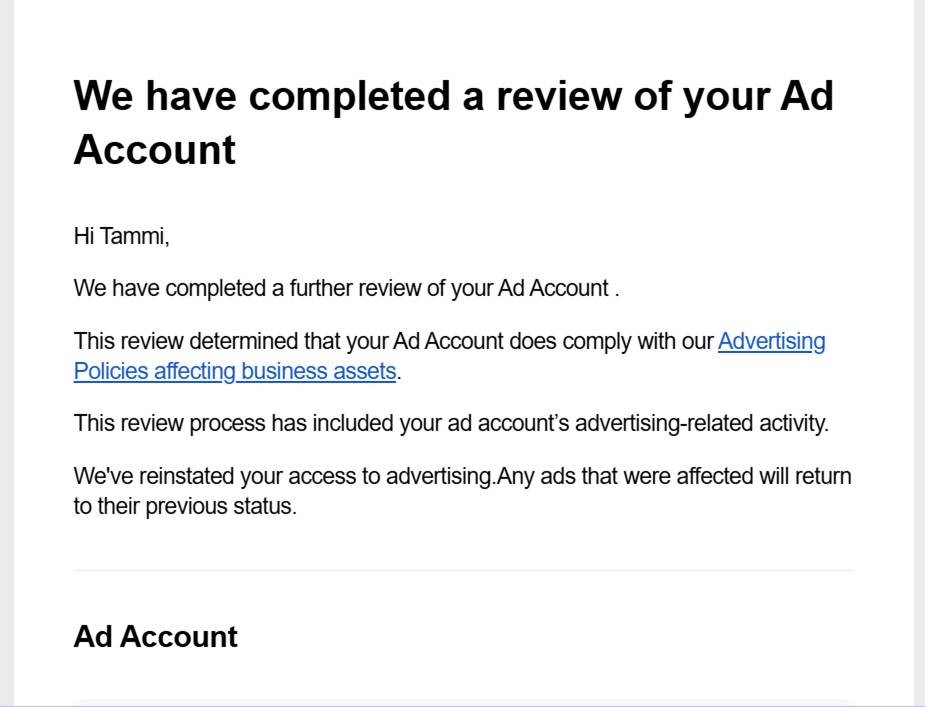
This may be, in part, what happened to Red River Women's Clinic, a Minnesota abortion clinic we wrote about earlier in this series. When its account was incorrectly suspended for violating the “Community Standards on drugs,” the clinic appealed and eventually reached out to a contact at Meta. When Meta finally removed the incorrect flag and restored the account, Red River received a message informing them they were no longer out of compliance with the advertising restrictions policy. 

Screenshot of message Meta sent Red River Women's Clinic

Screenshot submitted by Red River Women's Clinic to EFF

How Meta Can Improve 

Our review of the ad policies and survey submissions showed that there is room for improvement in how Meta handles abortion-related advertising. 

First, Meta should clarify what is permitted without prior authorization under the Drugs and Pharmaceuticals policy. As noted above, the policies say advertisers do not need authorization to “educate, advocate or give public service announcements,” but Meta told EFF authorization is needed to promote posts discussing “medical efficacy, legality, accessibility, affordability, and scientific merits.” Users should be able to more easily determine what content falls on each side of that line.  

Second, Meta should clarify when its Social Issues policy applies. Does discussing abortion at all trigger its application? Meta says the policy excludes posts primarily advertising a service, yet this is not what survey respondent Lynsey Bourke experienced. She runs the Instagram account Rouge Doulas, a global abortion support collective and doula training school. Rouge Doulas had a paid post removed under this very policy for advertising something that is clearly a service: its doula training program called “Rouge Abortion Doula School.” The policy’s current ambiguity makes it difficult for advocates to create compliant content with confidence.

Third, and as EFF has previously argued, Meta should ensure its automated system is not over-moderating. Meta must also provide a meaningful appeals process for when errors inevitably occur. Automated systems are blunt tools and are bound to make mistakes on complex topics like abortion. But simply using an image of a pill on an educational post shouldn’t automatically trigger takedowns. Improving automated moderation will help correct the cascading effect of incorrect Community Standards flags triggering advertising restrictions. 

With clearer policies, better moderation, and a commitment to transparency, Meta can make it easier for accounts to share and boost vital reproductive health information. 

This is the seventh post in our blog series documenting the findings from our Stop Censoring Abortion campaign. Read more at https://www.eff.org/pages/stop-censoring-abortion   

Affected by unjust censorship? Share your story using the hashtag #StopCensoringAbortion. Amplify censored posts and accounts, share screenshots of removals and platform messages—together, we can demonstrate how these policies harm real people. 

  •  

Meta is Removing Abortion Advocates' Accounts Without Warning

This is the fifth installment in a blog series documenting EFF's findings from the Stop Censoring Abortion campaign. You can read additional posts here. 

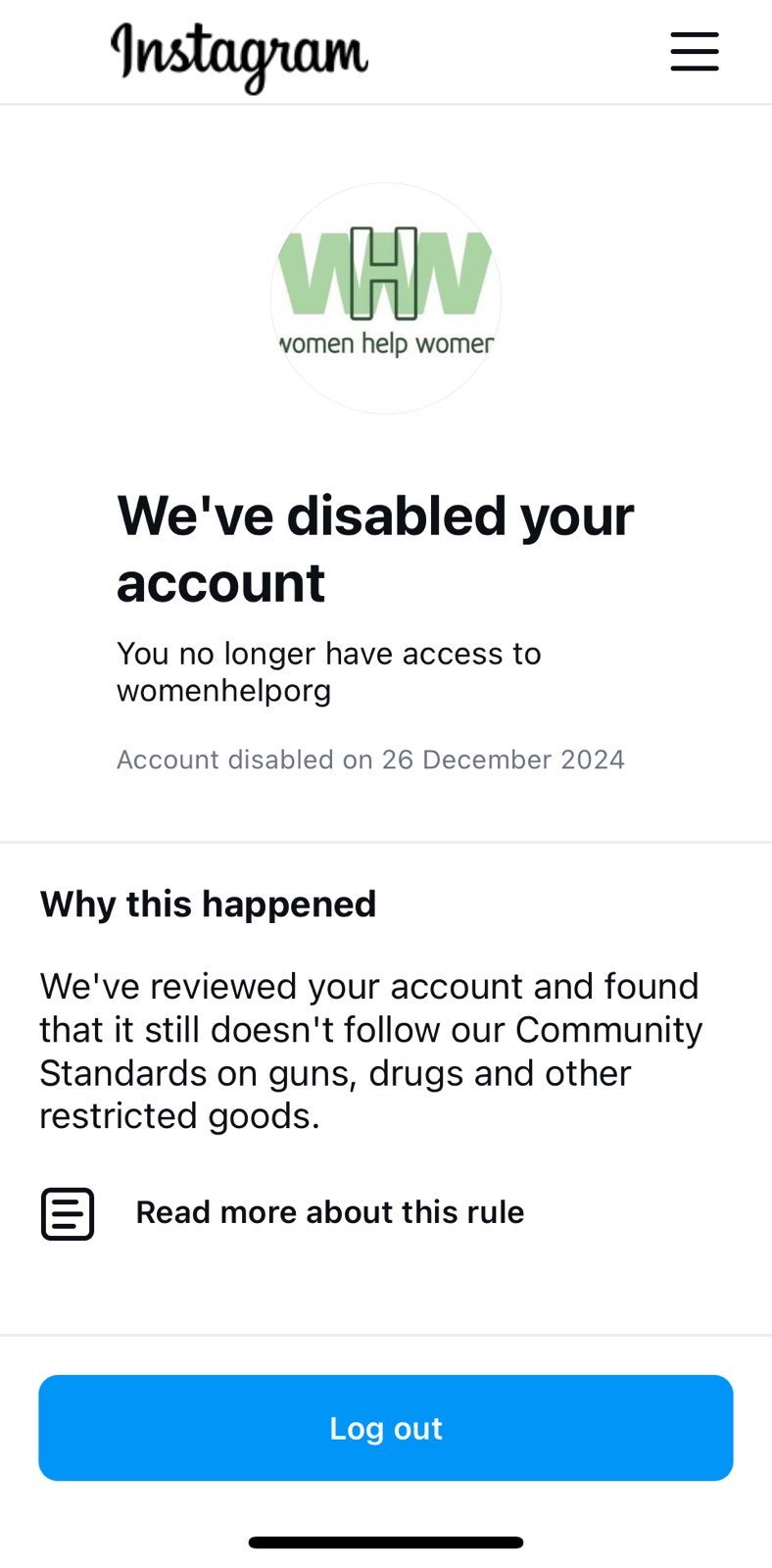
When the team at Women Help Women signed into Instagram last winter, they were met with a distressing surprise: without warning, Meta had disabled their account. The abortion advocacy non-profit organization found itself suddenly cut off from its tens of thousands of followers and with limited recourse. Meta claimed Women Help Women had violated its Community Standards on “guns, drugs, and other restricted goods,” but the organization told EFF it uses Instagram only to communicate about safe abortion practices, including sharing educational content and messages aimed at reducing stigma. Eventually, Women Help Women was able to restore its account—but only after launching a public campaign and receiving national news coverage. 

Unfortunately, Women Help Women’s experience is not unique. Around a quarter of our Stop Censoring Abortion campaign submissions reported that their entire account or page had been disabled or taken down after sharing abortion information—primarily on Meta platforms. This troubling pattern indicates that the censorship crisis goes beyond content removal. Accounts providing crucial reproductive health information are disappearing, often without warning, cutting users off from their communities and followers entirely.

What's worse, Meta appears to be imposing these negative account actions without clearly adhering to its own enforcement policies. Meta’s own Transparency Center stipulates that an account should receive multiple Community Standards violations or warnings before it is restricted or disabled. Yet many affected users told EFF they experienced negative account actions without any warning at all, or after only one alleged violation (many of which were incorrectly flagged, as we’ve explained elsewhere in this series). 

While Meta clearly has the right to remove accounts from its platforms, disabling or banning an account is an extreme measure. It completely silences a user, cutting off communication with their followers and preventing them from sharing any information, let alone abortion information. Because of this severity, Meta should be extremely careful to ensure fairness and accuracy when disabling or removing accounts. Rules governing account removal should be transparent and easy to understand, and Meta must enforce these policies consistently across different users and categories of content. But as our Stop Censoring Abortion results demonstrate, this isn't happening for many accounts sharing abortion information.  

Meta's Maze of Enforcement Policies 

If you navigate to Meta’s Transparency Center, you’ll find a page titled “How Meta enforces its policies.” This page contains a web of intersecting policies on when Meta will restrict accounts, disable accounts, and remove pages and groups. These policies overlap but don’t directly refer to each other, making it trickier for users to piece together how enforcement happens. 

At the heart of Meta's enforcement process is a strike system. Users receive strikes for posting content that violates Meta’s Community Standards. But not all Community Standards violations result in strikes, and whether Meta applies one depends on the “severity of the content” and the “context in which it was shared.” Meta provides little additional guidance on what violations are severe enough to amount to a strike or how context affects this assessment.  

According to Meta's Restricting Accounts policy, for most violations, 1 strike should only result in a warning—not any action against the account. How additional strikes affect an account differs between Facebook and Instagram (but Meta provides no specific guidance for Threads). Facebook relies on a progressive system, where additional strikes lead to increasing restrictions. Enforcement on Instagram is more opaque and leaves more to Meta’s discretion. Meta still counts strikes on Instagram, but it does not follow the same escalating structure of restrictions as it does on Facebook. 

Despite some vagueness in these policies, Meta is quite clear about one thing: On both Facebook and Instagram, an account should only be disabled or removed after “repeated” violations, warnings, or strikes. Meta states this multiple times throughout its enforcement policies. Its Disabling Accounts policy suggests that generally, an account needs to receive at least 5 strikes for Meta to disable or remove it from the platform. The only caveat is for severe violations, such as posting child sexual exploitation content or violating the dangerous individuals and organizations policy. In those extreme cases, Meta may disable an account after just one violation. 

Meta’s Practices Don’t Match Its Policies 

Our survey results detailed a different reality. Many survey respondents told EFF that Meta disabled or removed their account without warning and without indication that they had received repeated strikes.  It’s important to note that Meta does not have a unique enforcement process for prescription drug or abortion-related content. When EFF asked Meta about this issue, Meta confirmed that "enforcement actions on prescription drugs are subject to Meta's standard enforcement policies.” 

So here are a couple other possible explanations for this disconnect—each of them troubling in their own way:

Meta is Ignoring Its Own Strike System 

If Meta is taking down accounts without warning or after only one alleged Community Standards violation, the company is failing to follow its own strike system. This makes enforcement arbitrary and denies users the opportunity for correction that Meta's system supposedly provides. It’s also especially problematic for abortion advocates, given that Meta has been incorrectly flagging educational abortion content as violating its Community Standards. This means that a single content moderation error could result not only in the post coming down, but the entire account too.  

This may be what happened to Emory University’s RISE Center for Reproductive Health Research (a story we described in more detail earlier in this series). After sharing an educational post about mifepristone, RISE’s Instagram account was suddenly disabled. RISE received no earlier warnings from Meta before its account went dark. When RISE was finally able to get back into its account, it discovered only that this single post had been flagged. Again, according to Meta's own policies, one strike should only result in a warning. But this isn’t what happened here. 

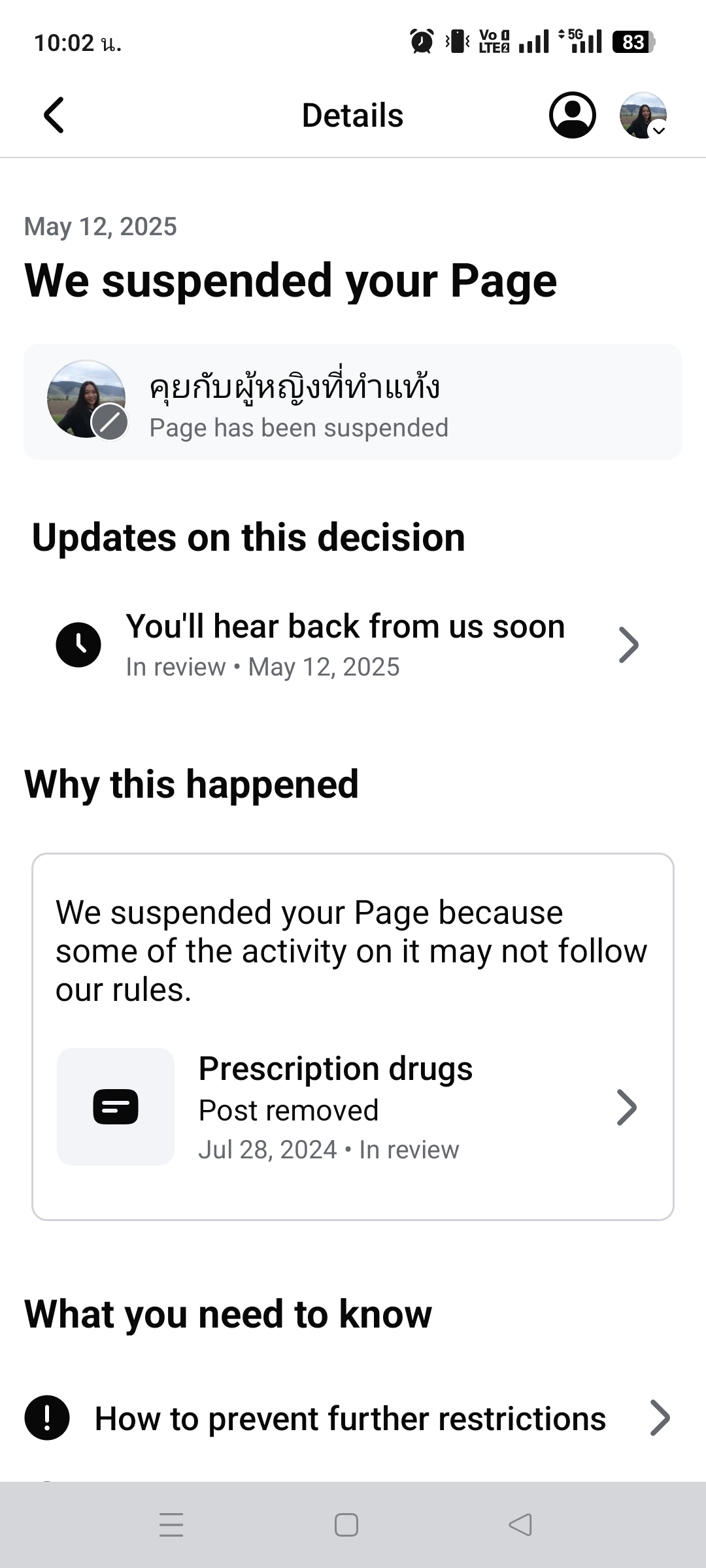
Similarly, the Tamtang Foundation, an abortion advocacy organization based in Thailand, had its Facebook account suddenly disabled earlier this year. Tamtang told EFF it had received a warning on only one flagged post that it had posted 10 months prior to its account being taken down. It received none of the other progressive strike restrictions Meta claims to apply Facebook accounts. 

Meta is Misclassifying Educational Content as "Extreme Violations" 

If Meta is accurately following its strike policy but still disabling accounts after only one violation, this points to an even more concerning possibility. Meta’s content moderation system may be categorizing educational abortion information as severe enough to warrant immediate disabling, treating university research posts and clinic educational materials as equivalent to child exploitation or terrorist content.  

This would be a fundamental and dangerous mischaracterization of legitimate medical information, and it is, we hope, unlikely. But it’s unfortunately not outside the realm of possibility. We already wrote about a similar disturbing mischaracterization earlier in this series. 

Users Are Unknowingly Receiving Multiple Strikes 

Finally, Meta may be giving users multiple strikes without notifying them. This raises several serious concerns.

First is the lack of transparency. Meta explicitly states in its "Restricting Accounts" policy that it will notify users when it “remove[s] your content or add[s] restrictions to your account, Page or group.” This policy is failing if users are not receiving these notifications and are not made aware there’s an issue with their account. 

It may also mean that Meta’s policies themselves are too vague to provide meaningful guidance to users. This lack of clarity is harmful. If users don’t know what's happening to their accounts, they can’t appeal Meta’s content moderation decisions, adjust their content, or understand Meta's enforcement boundaries moving forward. 

Finally—and most troubling—if Meta is indeed disabling accounts that share abortion information for receiving multiple violations, this points to an even broader censorship crisis. Users may not be aware just how many informational abortion-related posts are being incorrectly flagged and counted as strikes. This is especially concerning given that Meta places a one-year time limit on strikes, meaning the multiple alleged violations could not have accumulated over multiple years.  

The Broader Censorship Crisis 

These account suspensions represent just one facet of Meta's censorship of reproductive health information documented by our Stop Censoring Abortion campaign. When combined with post removals, shadowbanning, and content restrictions, the message is clear: Meta platforms are increasingly unfriendly environments for abortion advocacy and education. 

If Meta wants to practice what it preaches, then it must reform its enforcement policies to provide clear, transparent guidelines on when and how strikes apply, and then consistently and accurately apply those policies. Accounts should not be taken down for only one alleged violation when the policies state otherwise.  

The stakes couldn't be higher. In a post-Roe landscape where access to accurate reproductive health information is more crucial than ever, Meta's enforcement system is silencing the very voices communities need most. 

This is the fifth post in our blog series documenting the findings from our Stop Censoring Abortion campaign. Read more at https://www.eff.org/pages/stop-censoring-abortion  

Affected by unjust censorship? Share your story using the hashtag #StopCensoringAbortion. Amplify censored posts and accounts, share screenshots of removals and platform messages—together, we can demonstrate how these policies harm real people. 

  •  

You Shouldn’t Have to Make Your Social Media Public to Get a Visa

The Trump administration is continuing its dangerous push to surveil and suppress foreign students’ social media activity. The State Department recently announced an unprecedented new requirement that applicants for student and exchange visas must set all social media accounts to “public” for government review. The State Department also indicated that if applicants refuse to unlock their accounts or otherwise don’t maintain a social media presence, the government may interpret it as an attempt to evade the requirement or deliberately hide online activity.

The administration is penalizing prospective students and visitors for shielding their social media accounts from the general public or for choosing to not be active on social media. This is an outrageous violation of privacy, one that completely disregards the legitimate and often critical reasons why millions of people choose to lock down their social media profiles, share only limited information about themselves online, or not engage in social media at all. By making students abandon basic privacy hygiene as the price of admission to American universities, the administration is forcing applicants to expose a wealth of personal information to not only the U.S. government, but to anyone with an internet connection.

Why Social Media Privacy Matters

The administration’s new policy is a dangerous expansion of existing social media collection efforts. While the State Department has required since 2019 that visa applicants disclose their social media handles—a policy EFF has consistently opposed—forcing applicants to make their accounts public crosses a new line.

Individuals have significant privacy interests in their social media accounts. Social media profiles contain some of the most intimate details of our lives, such as our political views, religious beliefs, health information, likes and dislikes, and the people with whom we associate. Such personal details can be gleaned from vast volumes of data given the unlimited storage capacity of cloud-based social media platforms. As the Supreme Court has recognized, “[t]he sum of an individual’s private life can be reconstructed through a thousand photographs labeled with dates, locations, and descriptions”—all of which and more are available on social media platforms.

By requiring visa applicants to share these details, the government can obtain information that would otherwise be inaccessible or difficult to piece together across disparate locations. For example, while visa applicants are not required to disclose their political views in their applications, applicants might choose to post their beliefs on their social media profiles.

This information, once disclosed, doesn’t just disappear. Existing policy allows the government to continue surveilling applicants’ social media profiles even once the application process is over. And personal information obtained from applicants’ profiles can be collected and stored in government databases for decades.

What’s more, by requiring visa applicants to make their private social media accounts public, the administration is forcing them to expose troves of personal, sensitive information to the entire internet, not just the U.S. government. This could include various bad actors like identity thieves and fraudsters, foreign governments, current and prospective employers, and other third parties.

Those in applicants’ social media networks—including U.S. citizen family or friends—can also become surveillance targets by association. Visa applicants’ online activity is likely to reveal information about the users with whom they’re connected. For example, a visa applicant could tag another user in a political rant or posts photos of themselves and the other user at a political rally. Anyone who sees those posts might reasonably infer that the other user shares the applicant’s political beliefs. The administration’s new requirement will therefore publicly expose the personal information of millions of additional people, beyond just visa applicants.

There are Very Good Reasons to Keep Social Media Accounts Private

An overwhelming number of social media users maintain private accounts for the same reason we put curtains on our windows: a desire for basic privacy. There are numerous legitimate reasons people choose to share their social media only with trusted family and friends, whether that’s ensuring personal safety, maintaining professional boundaries, or simply not wanting to share personal profiles with the entire world.

Safety from Online Harassment and Physical Violence

Many people keep their accounts private to protect themselves from stalkers, harassers, and those who wish them harm. Domestic violence survivors, for example, use privacy settings to hide from their abusers, and organizations supporting survivors often encourage them to maintain a limited online presence.

Women also face a variety of gender-based online harms made worse by public profiles, including stalking, sexual harassment, and violent threats. A 2021 study reported that at least 38% of women globally had personally experienced online abuse, and at least 85% of women had witnessed it. Women are, in turn, more likely to activate privacy settings than men.

LGBTQ+ individuals similarly have good reasons to lock down their accounts. Individuals from countries where their identity puts them in danger rely on privacy protections to stay safe from state action. People may also reasonably choose to lock their accounts to avoid the barrage of anti-LGBTQ+ hate and harassment that is common on social media platforms, which can lead to real-world violence. Others, including LGBTQ+ youth, may simply not be ready to share their identity outside of their chosen personal network.

Political Dissidents, Activists, and Journalists

Activists working on sensitive human rights issues, political dissidents, and journalists use privacy settings to protect themselves from doxxing, harassment, and potential political persecution by their governments.

Rather than protecting these vulnerable groups, the administration’s policy instead explicitly targets political speech. The State Department has given embassies and consulates a vague directive to vet applicants’ social media for “hostile attitudes towards our citizens, culture, government, institutions, or founding principles,” according to an internal State Department cable obtained by multiple news outlets. This includes looking for “applicants who demonstrate a history of political activism.” The cable did not specify what, exactly, constitutes “hostile attitudes.”

Professional and Personal Boundaries

People use privacy settings to maintain boundaries between their personal and professional lives. They share family photos, sensitive updates, and personal moments with close friends—not with their employers, teachers, professional connections, or the general public.

The Growing Menace of Social Media Surveillance

This new policy is an escalation of the Trump administration’s ongoing immigration-related social media surveillance. EFF has written about the administration’s new “Catch and Revoke” effort, which deploys artificial intelligence and other data analytic tools to review the public social media accounts of student visa holders in an effort to revoke their visas. And EFF recently submitted comments opposing a USCIS proposal to collect social media identifiers from visa and green card holders already living in the U.S., including when they submit applications for permanent residency and naturalization.

The administration has also started screening many non-citizens' social media accounts for ambiguously-defined “antisemitic activity,” and previously announced expanded social media vetting for any visa applicant seeking to travel specifically to Harvard University for any purpose.

The administration claims this mass surveillance will make America safer, but there’s little evidence to support this. By the government’s own previous assessments, social media surveillance has not proven effective at identifying security threats.

At the same time, these policies gravely undermine freedom of speech, as we recently argued in our USCIS comments. The government is using social media monitoring to directly target and punish through visa denials or revocations foreign students and others for their digital speech. And the social media surveillance itself broadly chills free expression online—for citizens and non-citizens alike.

In defending the new requirement, the State Department argued that a U.S. visa is a “privilege, not a right.” But privacy and free expression should not be privileges. These are fundamental human rights, and they are rights we abandon at our peril.

  •  

Today's Supreme Court Decision on Age Verification Tramples Free Speech and Undermines Privacy

Today’s decision in Free Speech Coalition v. Paxton is a direct blow to the free speech rights of adults. The Court ruled that “no person—adult or child—has a First Amendment right to access speech that is obscene to minors without first submitting proof of age.” This ruling allows states to enact onerous age-verification rules that will block adults from accessing lawful speech, curtail their ability to be anonymous, and jeopardize their data security and privacy. These are real and immense burdens on adults, and the Court was wrong to ignore them in upholding Texas’ law.  

Importantly, the Court's reasoning applies only to age-verification rules for certain sexual material, and not to age limits in general. We will continue to fight against age restrictions on online access more broadly, such as on social media and specific online features.  

Still, the decision has immense consequences for internet users in Texas and in other states that have enacted similar laws. The Texas law forces adults to submit personal information over the internet to access entire websites that hold some amount of sexual material, not just pages or portions of sites that contain specific sexual materials. Many sites that cannot reasonably implement age verification measures for reasons such as cost or technical requirements will likely block users living in Texas and other states with similar laws wholesale.  

Importantly, the Court's reasoning applies only to age-verification rules for certain sexual material, and not to age limits in general. 

Many users will not be comfortable sharing private information to access sites that do implement age verification, for reasons of privacy or concern for data breaches. Many others do not have a driver’s license or photo ID to complete the age verification process. This decision will, ultimately, deter adult users from speaking and accessing lawful content, and will endanger the privacy of those who choose to go forward with verification. 

What the Court Said Today 

In the 6-3 decision, the Court ruled that Texas’ HB 1181 is constitutional. This law requires websites that Texas decides are composed of “one-third” or more of “sexual material harmful to minors” to confirm the age of users by collecting age-verifying personal information from all visitors—even to access the other two-thirds of material that is not adult content.   

In 1997, the Supreme Court struck down a federal online age-verification law in Reno v. American Civil Liberties Union. In that case the court ruled that many elements of the Communications Decency Act violated the First Amendment, including part of the law making it a crime for anyone to engage in online speech that is "indecent" or "patently offensive" if the speech could be viewed by a minor. Like HB 1181, that law would have resulted in many users being unable to view constitutionally protected speech, as many websites would have had to implement age verification, while others would have been forced to shut down.  

In Reno and in subsequent cases, the Supreme Court ruled that laws that burden adults’ access to lawful speech are subjected to the highest level of review under the First Amendment, known as strict scrutiny. This level of scrutiny requires a law to be very narrowly tailored or the least speech-restrictive means available to the government.  

That all changed with the Supreme Court’s decision today 

The Court now says that laws that burden adults access to sexual materials that are obscene to minors are subject to less-searching First Amendment review, known as intermediate scrutiny. And under that lower standard, the Texas law does not violate the First Amendment. The Court did not have to respond to arguments that there are less speech-restrictive ways of reaching the same goal—for example, encouraging parents to install content-filtering software on their children’s devices.

The court reached this decision by incorrectly assuming that online age verification is functionally equivalent to flashing an ID at a brick-and-mortar store. As we explained in our amicus brief, this ignores the many ways in which verifying age online is significantly more burdensome and invasive than doing so in person. As we and many others have previously explained, unlike with in-person age-checks, the only viable way for a website to comply with an age verification requirement is to require all users to upload and submit—not just momentarily display—a data-rich government-issued ID or other document with personal identifying information.  

This leads to a host of serious anonymity, privacy, and security concerns—all of which the majority failed to address. A person who submits identifying information online can never be sure if websites will keep that information or how that information might be used or disclosed. This leaves users highly vulnerable to data breaches and other security harms. Age verification also undermines anonymous internet browsing, even though courts have consistently ruled that anonymity is an aspect of the freedom of speech protected by the First Amendment.    

This Supreme Court broke a fundamental agreement between internet users and the state that has existed since its inception

The Court sidestepped its previous online age verification decisions by claiming the internet has changed too much to follow the precedent from Reno that requires these laws to survive strict scrutiny. Writing for the minority, Justice Kagan disagreed with the premise that the internet has changed: “the majority’s claim—again mistaken—that the internet has changed too much to follow our precedents’ lead.”   

But the majority argues that past precedent does not account for the dramatic expansion of the internet since the 1990s, which has led to easier and greater internet access and larger amounts of content available to teens online. The majority’s opinion entirely fails to address the obvious corollary: the internet’s expansion also has benefited adults. Age verification requirements now affect exponentially more adults than they did in the 1990s and burden vastly more constitutionally protected online speech. The majority's argument actually demonstrates that the burdens on adult speech have grown dramatically larger because of technological changes, yet the Court bizarrely interprets this expansion as justification for weaker constitutional protection. 

What It Means Going Forward 

This Supreme Court broke a fundamental agreement between internet users and the state that has existed since its inception: the government will not stand in the way of people accessing First Amendment-protected material. There is no question that multiple states will now introduce similar laws to Texas. Two dozen already have, though they are not all in effect. At least three of those states have no limit on the percentage of material required before the law applies—a sweeping restriction on every site that contains any material that the state believes the law includes. These laws will force U.S.-based adult websites to implement age-verification or block users in those states, as many have in the past when similar laws were in effect.  

Rather than submit to verification, research has found that people will choose a variety of other paths: using VPNs to indicate that they are outside of the state, accessing similar sites that don’t comply with the law, often because the site is operating in a different country. While many users will simply not access the content as a result, others may accept the risk, at their peril.   

We expect some states to push the envelope in terms of what content they consider “harmful to minors,” and to expand the type of websites that are covered by these laws, either through updated language or threats of litigation. Even if these attacks are struck down, operators of sites that involve sexual content of any type may be under threat, especially if that information is politically divisive. We worry that the point of some of these laws will be to deter queer folks and others from accessing lawful speech and finding community online by requiring them to identify themselves. We will continue to fight to protect against the disclosure of this critical information and for people to maintain their anonymity. 

EFF Will Continue to Fight for All Users’ Free Expression and Privacy 

That said, the ruling does not give states or Congress the green light to impose age-verification regulations on the broader internet. The majority’s decision rests on the fact that minors do not have a First Amendment right to access sexual material that would be obscene. In short, adults have a First Amendment right to access those sexual materials, while minors do not. Although it was wrong, the majority’s opinion ruled that because Texas is blocking minors from speech they have no constitutional right to access, the age-verification requirement only incidentally burdens adult’s First Amendment rights.  

But the same rationale does not apply to general-audience sites and services, including social media. Minors and adults have coextensive rights to both speak and access the speech of other users on these sites because the vast majority of the speech is not sexual materials that would be obscene to minors. Lawmakers should be careful not to interpret this ruling to mean that broader restrictions on minors’ First Amendment rights, like those included in the Kids Online Safety Act, would be deemed constitutional.  

Free Speech Coalition v. Paxton will have an effect on nearly every U.S. adult internet user for the foreseeable future. It marks a worrying shift in the ways that governments can restrict access to speech online. But that only means we must work harder than ever to protect privacy, security, and free speech as central tenets of the internet.  

  •