Reading view

10 (Not So) Hidden Dangers of Age Verification

It’s nearly the end of 2025, and half of the US and the UK now require you to upload your ID or scan your face to watch “sexual content.” A handful of states and Australia now have various requirements to verify your age before you can create a social media account.

Age-verification laws may sound straightforward to some: protect young people online by making everyone prove their age. But in reality, these mandates force users into one of two flawed systems—mandatory ID checks or biometric scans—and both are deeply discriminatory. These proposals burden everyone’s right to speak and access information online, and structurally excludes the very people who rely on the internet most. In short, although these laws are often passed with the intention to protect children from harm, the reality is that these laws harm both adults and children. 

Here’s who gets hurt, and how: 

   1.  Adults Without IDs Get Locked Out

Document-based verification assumes everyone has the right ID, in the right name, at the right address. About 15 million adult U.S. citizens don’t have a driver’s license, and 2.6 million lack any government-issued photo ID at all. Another 34.5 million adults don't have a driver's license or state ID with their current name and address.

Specifically:

  • 18% of Black adults don't have a driver's license at all.
  • Black and Hispanic Americans are disproportionately less likely to have current licenses.
  • Undocumented immigrants often cannot obtain state IDs or driver's licenses.
  • People with disabilities are less likely to have current identification.
  • Lower-income Americans face greater barriers to maintaining valid IDs.

Some laws allow platforms to ask for financial documents like credit cards or mortgage records instead. But they still overlook the fact that nearly 35% of U.S. adults also don't own homes, and close to 20% of households don't have credit cards. Immigrants, regardless of legal status, may also be unable to obtain credit cards or other financial documentation.

   2.  Communities of Color Face Higher Error Rates

Platforms that rely on AI-based age-estimation systems often use a webcam selfie to guess users’ ages. But these algorithms don’t work equally well for everyone. Research has consistently shown that they are less accurate for people with Black, Asian, Indigenous, and Southeast Asian backgrounds; that they often misclassify those adults as being under 18; and sometimes take longer to process, creating unequal access to online spaces. This mirrors the well-documented racial bias in facial recognition technologies. The result is that technology’s inherent biases can block people from speaking online or accessing others’ speech.

   3.  People with Disabilities Face More Barriers

Age-verification mandates most harshly affect people with disabilities. Facial recognition systems routinely fail to recognize faces with physical differences, affecting an estimated 100 million people worldwide who live with facial differences, and “liveness detection” can exclude folks with limited mobility. As these technologies become gatekeepers to online spaces, people with disabilities find themselves increasingly blocked from essential services and platforms with no specified appeals processes that account for disability.

Document-based systems also don't solve this problem—as mentioned earlier, people with disabilities are also less likely to possess current driver's licenses, so document-based age-gating technologies are equally exclusionary.

   4.  Transgender and Non-Binary People Are Put At Risk

Age-estimation technologies perform worse on transgender individuals and cannot classify non-binary genders at all. For the 43% of transgender Americans who lack identity documents that correctly reflect their name or gender, age verification creates an impossible choice: provide documents with dead names and incorrect gender markers, potentially outing themselves in the process, or lose access to online platforms entirely—a risk that no one should be forced to take just to use social media or access legal content.

   5.  Anonymity Becomes a Casualty

Age-verification systems are, at their core, surveillance systems. By requiring identity verification to access basic online services, we risk creating an internet where anonymity is a thing of the past. For people who rely on anonymity for safety, this is a serious issue. Domestic abuse survivors need to stay anonymous to hide from abusers who could track them through their online activities. Journalists, activists, and whistleblowers regularly use anonymity to protect sources and organize without facing retaliation or government surveillance. And in countries under authoritarian rule, anonymity is often the only way to access banned resources or share information without being silenced. Age-verification systems that demand government IDs or biometric data would strip away these protections, leaving the most vulnerable exposed.

   6.  Young People Lose Access to Essential Information 

Because state-imposed age-verification rules either block young people from social media or require them to get parental permission before logging on, they can deprive minors of access to important information about their health, sexuality, and gender. Many U.S. states mandate “abstinence only” sexual health education, making the internet a key resource for education and self-discovery. But age-verification laws can end up blocking young people from accessing that critical information. And this isn't just about porn, it’s about sex education, mental health resources, and even important literature. Some states and countries may start going after content they deem “harmful to minors,” which could include anything from books on sexual health to art, history, and even award-winning novels. And let’s be clear: these laws often get used to target anything that challenges certain political or cultural narratives, from diverse educational materials to media that simply includes themes of sexuality or gender diversity. What begins as a “protection” for kids could easily turn into a full-on censorship movement, blocking content that’s actually vital for minors’ development, education, and well-being. 

This is also especially harmful to homeschoolers, who rely on the internet for research, online courses, and exams. For many, the internet is central to their education and social lives. The internet is also crucial for homeschoolers' mental health, as many already struggle with isolation. Age-verification laws would restrict access to resources that are essential for their education and well-being.

   7.  LGBTQ+ Youth Are Denied Vital Lifelines

For many LGBTQ+ young people, especially those with unsupportive or abusive families, the internet can be a lifeline. For young people facing family rejection or violence due to their sexuality or gender identity, social media platforms often provide crucial access to support networks, mental health resources, and communities that affirm their identities. Age verification systems that require parental consent threaten to cut them from these crucial supports. 

When parents must consent to or monitor their children's social media accounts, LGBTQ+ youth who lack family support lose these vital connections. LGBTQ+ youth are also disproportionately likely to be unhoused and lack access to identification or parental consent, further marginalizing them. 

   8.  Youth in Foster Care Systems Are Completely Left Out

Age verification bills that require parental consent fail to account for young people in foster care, particularly those in group homes without legal guardians who can provide consent, or with temporary foster parents who cannot prove guardianship. These systems effectively exclude some of the most vulnerable young people from accessing online platforms and resources they may desperately need.

   9.  All of Our Personal Data is Put at Risk

An age-verification system also creates acute privacy risks for adults and young people. Requiring users to upload sensitive personal information (like government-issued IDs or biometric data) to verify their age creates serious privacy and security risks. Under these laws, users would not just momentarily display their ID like one does when accessing a liquor store, for example. Instead, they’d submit their ID to third-party companies, raising major concerns over who receives, stores, and controls that data. Once uploaded, this personal information could be exposed, mishandled, or even breached, as we've seen with past data hacks. Age-verification systems are no strangers to being compromised—companies like AU10TIX and platforms like Discord have faced high-profile data breaches, exposing users’ most sensitive information for months or even years. 

The more places personal data passes through, the higher the chances of it being misused or stolen. Users are left with little control over their own privacy once they hand over these immutable details, making this approach to age verification a serious risk for identity theft, blackmail, and other privacy violations. Children are already a major target for identity theft, and these mandates perversely increase the risk that they will be harmed.

   10.  All of Our Free Speech Rights Are Trampled

The internet is today’s public square—the main place where people come together to share ideas, organize, learn, and build community. Even the Supreme Court has recognized that social media platforms are among the most powerful tools ordinary people have to be heard.

Age-verification systems inevitably block some adults from accessing lawful speech and allow some young people under 18 users to slip through anyway. Because the systems are both over-inclusive (blocking adults) and under-inclusive (failing to block people under 18), they restrict lawful speech in ways that violate the First Amendment. 

The Bottom Line

Age-verification mandates create barriers along lines of race, disability, gender identity, sexual orientation, immigration status, and socioeconomic class. While these requirements threaten everyone’s privacy and free-speech rights, they fall heaviest on communities already facing systemic obstacles.

The internet is essential to how people speak, learn, and participate in public life. When access depends on flawed technology or hard-to-obtain documents, we don’t just inconvenience users, we deepen existing inequalities and silence the people who most need these platforms. As outlined, every available method—facial age estimation, document checks, financial records, or parental consent—systematically excludes or harms marginalized people. The real question isn’t whether these systems discriminate, but how extensively.

  •  

How Cops Are Using Flock Safety's ALPR Network to Surveil Protesters and Activists

It's no secret that 2025 has given Americans plenty to protest about. But as news cameras showed protesters filling streets of cities across the country, law enforcement officers—including U.S. Border Patrol agents—were quietly watching those same streets through different lenses: Flock Safety automated license plate readers (ALPRs) that tracked every passing car. 

Through an analysis of 10 months of nationwide searches on Flock Safety's servers, we discovered that more than 50 federal, state, and local agencies ran hundreds of searches through Flock's national network of surveillance data in connection with protest activity. In some cases, law enforcement specifically targeted known activist groups, demonstrating how mass surveillance technology increasingly threatens our freedom to demonstrate. 

Flock Safety provides ALPR technology to thousands of law enforcement agencies. The company installs cameras throughout their jurisdictions, and these cameras photograph every car that passes, documenting the license plate, color, make, model and other distinguishing characteristics. This data is paired with time and location, and uploaded to a massive searchable database. Flock Safety encourages agencies to share the data they collect broadly with other agencies across the country. It is common for an agency to search thousands of networks nationwide even when they don't have reason to believe a targeted vehicle left the region. 

Via public records requests, EFF obtained datasets representing more than 12 million searches logged by more than 3,900 agencies between December 2024 and October 2025. The data shows that agencies logged hundreds of searches related to the 50501 protests in February, the Hands Off protests in April, the No Kings protests in June and October, and other protests in between. 

The Tulsa Police Department in Oklahoma was one of the most consistent users of Flock Safety's ALPR system for investigating protests, logging at least 38 such searches. This included running searches that corresponded to a protest against deportation raids in February, a protest at Tulsa City Hall in support of pro-Palestinian activist Mahmoud Khalil in March, and the No Kings protest in June. During the most recent No Kings protests in mid-October, agencies such as the Lisle Police Department in Illinois, the Oro Valley Police Department in Arizona, and the Putnam County (Tenn.) Sheriff's Office all ran protest-related searches. 

While EFF and other civil liberties groups argue the law should require a search warrant for such searches, police are simply prompted to enter text into a "reason" field in the Flock Safety system. Usually this is only a few words–or even just one.

In these cases, that word was often just “protest.” 

Crime does sometimes occur at protests, whether that's property damage, pick-pocketing, or clashes between groups on opposite sides of a protest. Some of these searches may have been tied to an actual crime that occurred, even though in most cases officers did not articulate a criminal offense when running the search. But the truth is, the only reason an officer is able to even search for a suspect at a protest is because ALPRs collected data on every single person who attended the protest. 

Search and Dissent 

2025 was an unprecedented year of street action. In June and again in October, thousands across the country mobilized under the banner of the “No Kings” movement—marches against government overreach, surveillance, and corporate power. By some estimates, the October demonstrations ranked among the largest single-day protests in U.S. history, filling the streets from Washington, D.C., to Portland, OR. 

EFF identified 19 agencies that logged dozens of searches associated with the No Kings protests in June and October 2025. In some cases the "No Kings" was explicitly used, while in others the term "protest" was used but coincided with the massive protests.

Law Enforcement Agencies that Ran Searches Corresponding with "No Kings" Rallies

  • Anaheim Police Department, Calif.
  • Arizona Department of Public Safety
  • Beaumont Police Department, Texas
  • Charleston Police Department, SC
  • Flagler County Sheriff's Office, Fla.
  • Georgia State Patrol
  • Lisle Police Department, Ill.
  • Little Rock Police Department, Ark.
  • Marion Police Department, Ohio
  • Morristown Police Department, Tenn.
  • Oro Valley Police Department, Ariz.
  • Putnam County Sheriff's Office, Tenn.
  • Richmond Police Department, Va.
  • Riverside County Sheriff's Office, Calif.
  • Salinas Police Department, Calif.
  • San Bernardino County Sheriff's Office, Calif.
  • Spartanburg Police Department, SC
  • Tempe Police Department, Ariz.
  • Tulsa Police Department, Okla.
  • US Border Patrol

For example: 

  • In Washington state, the Spokane County Sheriff's Office listed "no kings" as the reason for three searches on June 15, 2025 [Note: date corrected]. The agency queried 95 camera networks, looking for vehicles matching the description of "work van," "bus" or "box truck." 
  • In Texas, the Beaumont Police Department ran six searches related to two vehicles on June 14, 2025, listing "KINGS DAY PROTEST" as the reason. The queries reached across 1,774 networks. 
  • In California, the San Bernardino County Sheriff's Office ran a single search for a vehicle across 711 networks, logging "no king" as the reason. 
  • In Arizona, the Tempe Police Department made three searches for "ATL No Kings Protest" on June 15, 2025 searching through 425 networks. "ATL" is police code for "attempt to locate." The agency appears to not have been looking for a particular plate, but for any red vehicle on the road during a certain time window.

But the No Kings protests weren't the only demonstrations drawing law enforcement's digital dragnet in 2025. 

For example:

  • In Nevada's state capital, the Carson City Sheriff's Office ran three searches that correspond to the February 50501 Protests against DOGE and the Trump administration. The agency searched for two vehicles across 178 networks with "protest" as the reason.
  • In Florida, the Seminole County Sheriff's Office logged "protest" for five searches that correspond to a local May Day rally.
  • In Alabama, the Homewood Police Department logged four searches in early July 2025 for three vehicles with "PROTEST CASE" and "PROTEST INV." in the reason field. The searches, which probed 1,308 networks, correspond to protests against the police shooting of Jabari Peoples.
  • In Texas, the Lubbock Police Department ran two searches for a Tennessee license plate on March 15 that corresponds to a rally to highlight the mental health impact of immigration policies. The searches hit 5,966 networks, with the logged reason "protest veh."
  • In Michigan, Grand Rapids Police Department ran five searches that corresponded with the Stand Up and Fight Back Rally in February. The searches hit roughly 650 networks, with the reason logged as "Protest."

Some agencies have adopted policies that prohibit using ALPRs for monitoring activities protected by the First Amendment. Yet many officers probed the nationwide network with terms like "protest" without articulating an actual crime under investigation.

In a few cases, police were using Flock’s ALPR network to investigate threats made against attendees or incidents where motorists opposed to the protests drove their vehicle into crowds. For example, throughout June 2025, an Arizona Department of Public Safety officer logged three searches for “no kings rock threat,” and a Wichita (Kan.) Police Department officer logged 22 searches for various license plates under the reason “Crime Stoppers Tip of causing harm during protests.”

Even when law enforcement is specifically looking for vehicles engaged in potentially criminal behavior such as threatening protesters, it cannot be ignored that mass surveillance systems work by collecting data on everyone driving to or near a protestnot just those under suspicion.

Border Patrol's Expanding Reach 

As U.S. Border Patrol (USBP), ICE, and other federal agencies tasked with immigration enforcement have massively expanded operations into major cities, advocates for immigrants have responded through organized rallies, rapid-response confrontations, and extended presences at federal facilities. 

USBP has made extensive use of Flock Safety's system for immigration enforcement, but also to target those who object to its tactics. In June, a few days after the No Kings Protest, USBP ran three searches for a vehicle using the descriptor “Portland Riots.” 

USBP has made extensive use of Flock Safety's system for immigration enforcement, but also to target those who object to its tactics.

USBP also used the Flock Safety network to investigate a motorist who had “extended his middle finger” at Border Patrol vehicles that were transporting detainees. The motorist then allegedly drove in front of one of the vehicles and slowed down, forcing the Border Patrol vehicle to brake hard. An officer ran seven searches for his plate, citing "assault on agent" and "18 usc 111," the federal criminal statute for assaulting, resisting or impeding a federal officer. The individual was charged in federal court in early August. 

USBP had access to the Flock system during a trial period in the first half of 2025, but the company says it has since paused the agency's access to the system. However, Border Patrol and other federal immigration authorities have been able to access the system’s data through local agencies who have run searches on their behalf or even lent them logins

Targeting Animal Rights Activists

Law enforcement's use of Flock's ALPR network to surveil protesters isn't limited to large-scale political demonstrations. Three agencies also used the system dozens of times to specifically target activists from Direct Action Everywhere (DxE), an animal-rights organization known for using civil disobedience tactics to expose conditions at factory farms.

Delaware State Police queried the Flock national network nine times in March 2025 related to DxE actions, logging reasons such as "DxE Protest Suspect Vehicle." DxE advocates told EFF that these searches correspond to an investigation the organization undertook of a Mountaire Farms facility. 

Additionally, the California Highway Patrol logged dozens of searches related to a "DXE Operation" throughout the day on May 27, 2025. The organization says this corresponds with an annual convening in California that typically ends in a direct action. Participants leave the event early in the morning, then drive across the state to a predetermined but previously undisclosed protest site. Also in May, the Merced County Sheriff's Office in California logged two searches related to "DXE activity." 

As an organization engaged in direct activism, DxE has experienced criminal prosecution for its activities, and so the organization told EFF they were not surprised to learn they are under scrutiny from law enforcement, particularly considering how industrial farmers have collected and distributed their own intelligence to police.

The targeting of DxE activists reveals how ALPR surveillance extends beyond conventional and large-scale political protests to target groups engaged in activism that challenges powerful industries. For animal-rights activists, the knowledge that their vehicles are being tracked through a national surveillance network undeniably creates a chilling effect on their ability to organize and demonstrate.

Fighting Back Against ALPR 

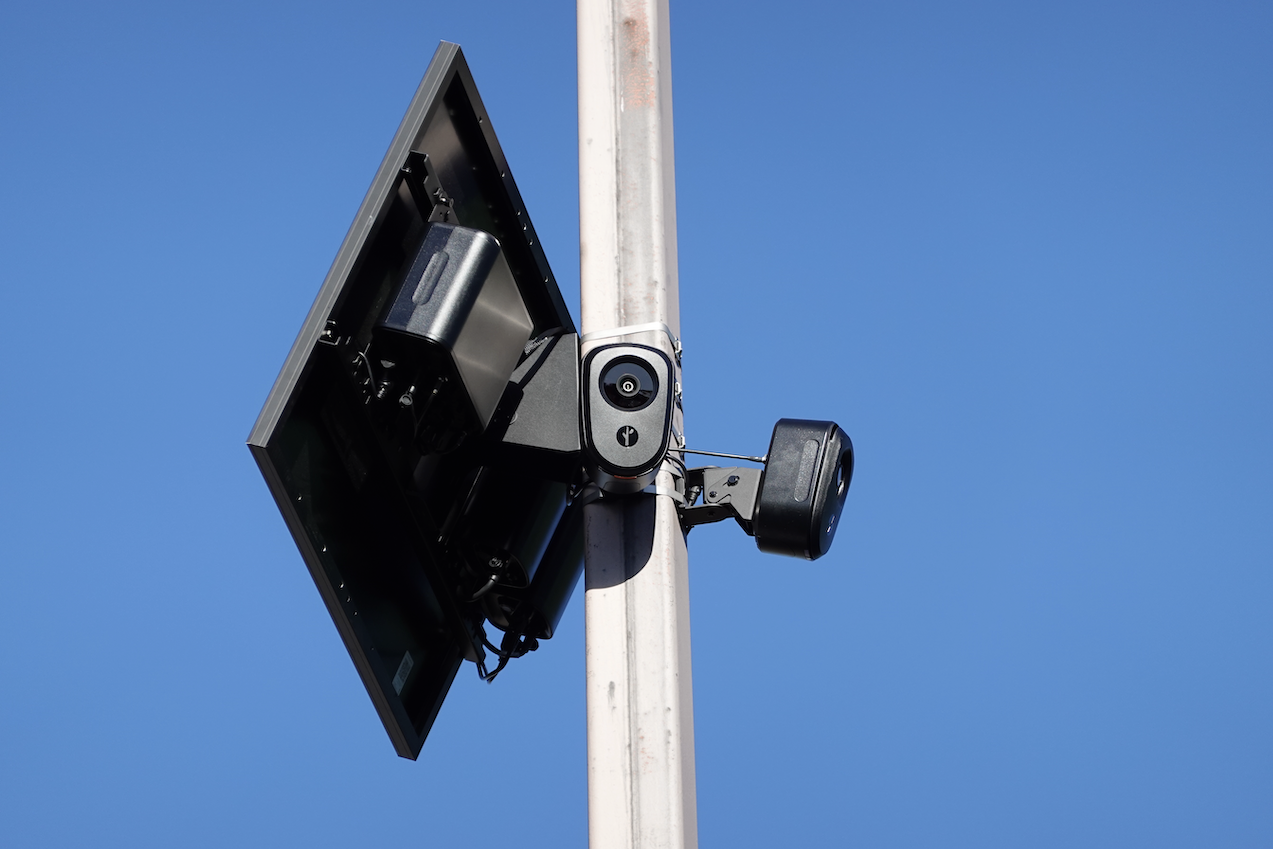
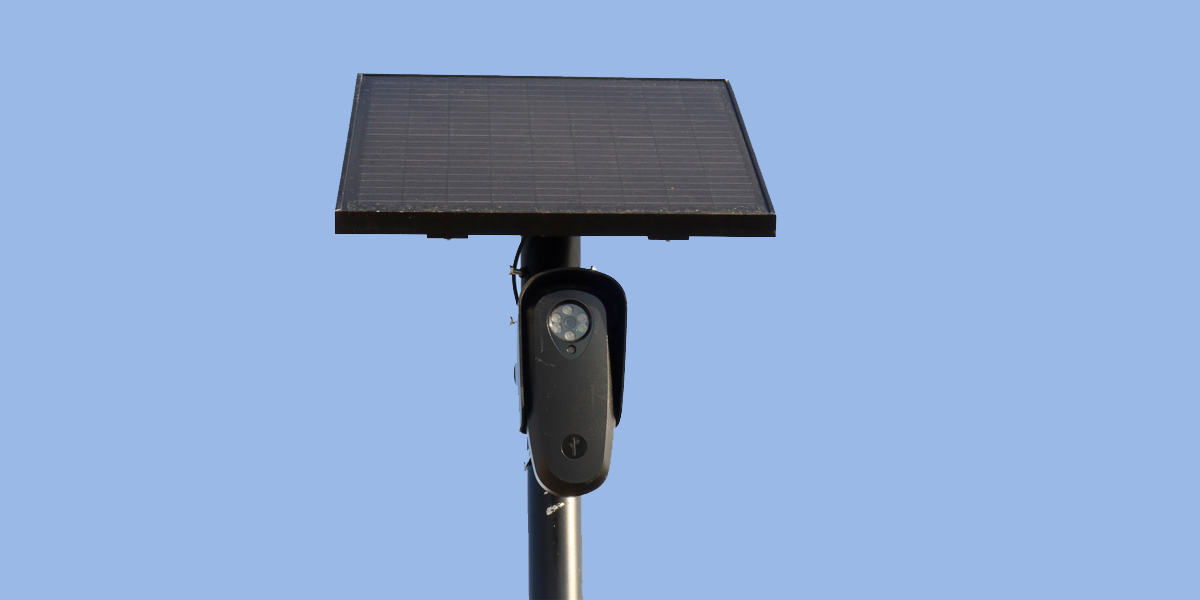
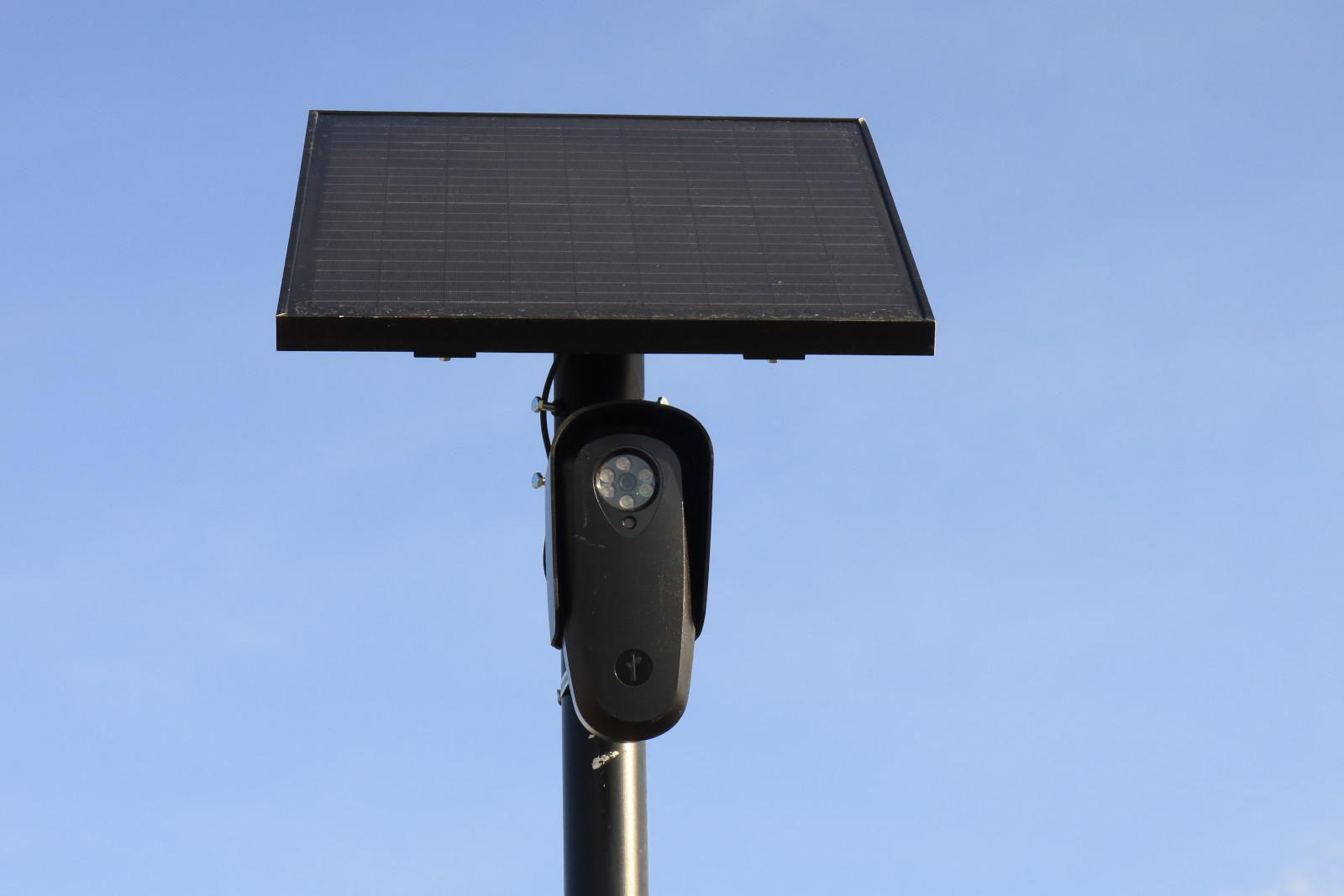
Two Flock Safety cameras on a pole

ALPR systems are designed to capture information on every vehicle that passes within view. That means they don't just capture data on "criminals" but on everyone, all the timeand that includes people engaged in their First Amendment right to publicly dissent. Police are sitting on massive troves of data that can reveal who attended a protest, and this data shows they are not afraid to use it. 

Our analysis only includes data where agencies explicitly mentioned protests or related terms in the "reason" field when documenting their search. It's likely that scores more were conducted under less obvious pretexts and search reasons. According to our analysis, approximately 20 percent of all searches we reviewed listed vague language like "investigation," "suspect," and "query" in the reason field. Those terms could well be cover for spying on a protest, an abortion prosecution, or an officer stalking a spouse, and no one would be the wiser–including the agencies whose data was searched. Flock has said it will now require officers to select a specific crime under investigation, but that can and will also be used to obfuscate dubious searches. 

For protestors, this data should serve as confirmation that ALPR surveillance has been and will be used to target activities protected by the First Amendment. Depending on your threat model, this means you should think carefully about how you arrive at protests, and explore options such as by biking, walking, carpooling, taking public transportation, or simply parking a little further away from the action. Our Surveillance Self-Defense project has more information on steps you could take to protect your privacy when traveling to and attending a protest.

For local officials, this should serve as another example of how systems marketed as protecting your community may actually threaten the values your communities hold most dear. The best way to protect people is to shut down these camera networks.  

Everyone should have the right to speak up against injustice without ending up in a database. 

  •  

Lawmakers Want to Ban VPNs—And They Have No Idea What They're Doing

Remember when you thought age verification laws couldn't get any worse? Well, lawmakers in Wisconsin, Michigan, and beyond are about to blow you away.

It's unfortunately no longer enough to force websites to check your government-issued ID before you can access certain content, because politicians have now discovered that people are using Virtual Private Networks (VPNs) to protect their privacy and bypass these invasive laws. Their solution? Entirely ban the use of VPNs. 

Yes, really.

As of this writing, Wisconsin lawmakers are escalating their war on privacy by targeting VPNs in the name of “protecting children” in A.B. 105/S.B. 130. It’s an age verification bill that requires all websites distributing material that could conceivably be deemed “sexual content” to both implement an age verification system and also to block the access of users connected via VPN. The bill seeks to broadly expand the definition of materials that are “harmful to minors” beyond the type of speech that states can prohibit minors from accessing—potentially encompassing things like depictions and discussions of human anatomy, sexuality, and reproduction. 

This follows a notable pattern: As we’ve explained previously, lawmakers, prosecutors, and activists in conservative states have worked for years to aggressively expand the definition of “harmful to minors” to censor a broad swath of content: diverse educational materials, sex education resources, art, and even award-winning literature

Wisconsin’s bill has already passed the State Assembly and is now moving through the Senate. If it becomes law, Wisconsin could become the first state where using a VPN to access certain content is banned. Michigan lawmakers have proposed similar legislation that did not move through its legislature, but among other things, would force internet providers to actively monitor and block VPN connections. And in the UK, officials are calling VPNs "a loophole that needs closing."

This is actually happening. And it's going to be a disaster for everyone.

Here's Why This Is A Terrible Idea 

VPNs mask your real location by routing your internet traffic through a server somewhere else. When you visit a website through a VPN, that website only sees the VPN server's IP address, not your actual location. It's like sending a letter through a P.O. box so the recipient doesn't know where you really live. 

So when Wisconsin demands that websites "block VPN users from Wisconsin," they're asking for something that's technically impossible. Websites have no way to tell if a VPN connection is coming from Milwaukee, Michigan, or Mumbai. The technology just doesn't work that way.

Websites subject to this proposed law are left with this choice: either cease operation in Wisconsin, or block all VPN users, everywhere, just to avoid legal liability in the state. One state's terrible law is attempting to break VPN access for the entire internet, and the unintended consequences of this provision could far outweigh any theoretical benefit.

Almost Everyone Uses VPNs

Let's talk about who lawmakers are hurting with these bills, because it sure isn't just people trying to watch porn without handing over their driver's license.

  1. Businesses run on VPNs. Every company with remote employees uses VPNs. Every business traveler connecting through sketchy hotel Wi-Fi needs one. Companies use VPNs to protect client and employee data, secure internal communications, and prevent cyberattacks. 
  2. Students need VPNs for school. Universities require students to use VPNs to access research databases, course materials, and library resources. These aren't optional, and many professors literally assign work that can only be accessed through the school VPN. The University of Wisconsin-Madison’s WiscVPN, for example, “allows UW–‍Madison faculty, staff and students to access University resources even when they are using a commercial Internet Service Provider (ISP).” 
  3. Vulnerable people rely on VPNs for safety. Domestic abuse survivors use VPNs to hide their location from their abusers. Journalists use them to protect their sources. Activists use them to organize without government surveillance. LGBTQ+ people in hostile environments—both in the US and around the world—use them to access health resources, support groups, and community. For people living under censorship regimes, VPNs are often their only connection to vital resources and information their governments have banned. 
  4. Regular people just want privacy. Maybe you don't want every website you visit tracking your location and selling that data to advertisers. Maybe you don't want your internet service provider (ISP) building a complete profile of your browsing history. Maybe you just think it's creepy that corporations know everywhere you go online. VPNs can protect everyday users from everyday tracking and surveillance.

It’s A Privacy Nightmare

Here's what happens if VPNs get blocked: everyone has to verify their age by submitting government IDs, biometric data, or credit card information directly to websites—without any encryption or privacy protection.

We already know how this story ends. Companies get hacked. Data gets breached. And suddenly your real name is attached to the websites you visited, stored in some poorly-secured database waiting for the inevitable leak. This has already happened, and is not a matter of if but when. And when it does, the repercussions will be huge.

Forcing people to give up their privacy to access legal content is the exact opposite of good policy. It's surveillance dressed up as safety.

"Harmful to Minors" Is Not a Catch-All 

Here's another fun feature of these laws: they're trying to broaden the definition of “harmful to minors” to sweep in a host of speech that is protected for both young people and adults.

Historically, states can prohibit people under 18 years old from accessing sexual materials that an adult can access under the First Amendment. But the definition of what constitutes “harmful to minors” is narrow — it generally requires that the materials have almost no social value to minors and that they, taken as a whole, appeal to a minors’ “prurient sexual interests.” 

Wisconsin's bill defines “harmful to minors” much more broadly. It applies to materials that merely describe sex or feature descriptions/depictions of human anatomy. This definition would likely encompass a wide range of literature, music, television, and films that are protected under the First Amendment for both adults and young people, not to mention basic scientific and medical content.

Additionally, the bill’s definition would apply to any websites where more than one third of the site’s material is "harmful to minors." Given the breadth of the definition and its one-third trigger, we anticipate that Wisconsin could argue that the law applies to most social media websites. And it’s not hard to imagine, as these topics become politicised, Wisconsin claiming it applies to websites containing LGBTQ+ health resources, basic sexual education resources, and reproductive healthcare information. 

This breadth of the bill’s definition isn't a bug, it's a feature. It gives the state a vast amount of discretion to decide which speech is “harmful” to young people, and the power to decide what's "appropriate" and what isn't. History shows us those decisions most often harm marginalized communities

It Won’t Even Work

Let's say Wisconsin somehow manages to pass this law. Here's what will actually happen:

People who want to bypass it will use non-commercial VPNs, open proxies, or cheap virtual private servers that the law doesn't cover. They'll find workarounds within hours. The internet always routes around censorship. 

Even in a fantasy world where every website successfully blocked all commercial VPNs, people would just make their own. You can route traffic through cloud services like AWS or DigitalOcean, tunnel through someone else's home internet connection, use open proxies, or spin up a cheap server for less than a dollar. 

Meanwhile, everyone else (businesses, students, journalists, abuse survivors, regular people who just want privacy) will have their VPN access impacted. The law will accomplish nothing except making the internet less safe and less private for users.

Nonetheless, as we’ve mentioned previously, while VPNs may be able to disguise the source of your internet activity, they are not foolproof—nor should they be necessary to access legally protected speech. Like the larger age verification legislation they are a part of, VPN-blocking provisions simply don't work. They harm millions of people and they set a terrifying precedent for government control of the internet. More fundamentally, legislators need to recognize that age verification laws themselves are the problem. They don't work, they violate privacy, they're trivially easy to circumvent, and they create far more harm than they prevent.

A False Dilemma

People have (predictably) turned to VPNs to protect their privacy as they watched age verification mandates proliferate around the world. Instead of taking this as a sign that maybe mass surveillance isn't popular, lawmakers have decided the real problem is that these privacy tools exist at all and are trying to ban the tools that let people maintain their privacy. 

Let's be clear: lawmakers need to abandon this entire approach.

The answer to "how do we keep kids safe online" isn't "destroy everyone's privacy." It's not "force people to hand over their IDs to access legal content." And it's certainly not "ban access to the tools that protect journalists, activists, and abuse survivors.”

If lawmakers genuinely care about young people's well-being, they should invest in education, support parents with better tools, and address the actual root causes of harm online. What they shouldn't do is wage war on privacy itself. Attacks on VPNs are attacks on digital privacy and digital freedom. And this battle is being fought by people who clearly have no idea how any of this technology actually works. 

If you live in Wisconsin—reach out to your Senator and urge them to kill A.B. 105/S.B. 130. Our privacy matters. VPNs matter. And politicians who can't tell the difference between a security tool and a "loophole" shouldn't be writing laws about the internet.

  •  

License Plate Surveillance Logs Reveal Racist Policing Against Romani People

More than 80 law enforcement agencies across the United States have used language perpetuating harmful stereotypes against Romani people when searching the nationwide Flock Safety automated license plate reader (ALPR) network, according to audit logs obtained and analyzed by the Electronic Frontier Foundation. 

When police run a search through the Flock Safety network, which links thousands of ALPR systems, they are prompted to leave a reason and/or case number for the search. Between June 2024 and October 2025, cops performed hundreds of searches for license plates using terms such as "roma" and "g*psy," and in many instances, without any mention of a suspected crime. Other uses include "g*psy vehicle," "g*psy group," "possible g*psy," "roma traveler" and "g*psy ruse," perpetuating systemic harm by demeaning individuals based on their race or ethnicity. 

These queries were run through thousands of police departments' systems—and it appears that none of these agencies flagged the searches as inappropriate. 

These searches are, by definition, racist. 

Word Choices and Flock Searches 

We are using the terms "Roma" and “Romani people” as umbrella terms, recognizing that they represent different but related groups. Since 2020, the U.S. federal government has officially recognized "Anti-Roma Racism" as including behaviors such as "stereotyping Roma as persons who engage in criminal behavior" and using the slur "g*psy." According to the U.S. Department of State, this language “leads to the treatment of Roma as an alleged alien group and associates them with a series of pejorative stereotypes and distorted images that represent a specific form of racism.” 

Nevertheless, police officers have run hundreds of searches for license plates using the terms "roma" and "g*psy." (Unlike the police ALPR queries we’ve uncovered, we substitute an asterisk for the Y to avoid repeating this racist slur). In many cases, these terms have been used on their own, with no mention of crime. In other cases, the terms have been used in contexts like "g*psy scam" and "roma burglary," when ethnicity should have no relevance to how a crime is investigated or prosecuted. 

A “g*psy scam” and “roma burglary” do not exist in criminal law separate from any other type of fraud or burglary. Several agencies contacted by EFF have since acknowledged the inappropriate use and expressed efforts to address the issue internally. 

"The use of the term does not reflect the values or expected practices of our department," a representative of the Palos Heights (IL) Police Department wrote to EFF after being confronted with two dozen searches involving the term "g*psy." "We do not condone the use of outdated or offensive terminology, and we will take this inquiry as an opportunity to educate those who are unaware of the negative connotation and to ensure that investigative notations and search reasons are documented in a manner that is accurate, professional, and free of potentially harmful language."

Of course, the broader issue is that allowing "g*psy" or "Roma" as a reason for a search isn't just offensive, it implies the criminalization an ethnic group. In fact, the Grand Prairie Police Department in Texas searched for "g*psy" six times while using Flock's "Convoy" feature, which allows an agency to identify vehicles traveling together—in essence targeting an entire traveling community of Roma without specifying a crime. 

At the bottom of this post is a list of agencies and the terms they used when searching the Flock system. 

Anti-Roma Racism in an Age of Surveillance 

Racism against Romani people has been a problem for centuries, with one of its most horrific manifestations  during the Holocaust, when the Third Reich and its allies perpetuated genocide by murdering hundreds of thousands of Romani people and sterilizing thousands more. Despite efforts by the UN and EU to combat anti-Roma discrimination, this form of racism persists. As scholars Margareta Matache and Mary T. Bassett explain, it is perpetuated by modern American policing practices: 

In recent years, police departments have set up task forces specialised in “G*psy crimes”, appointed “G*psy crime” detectives, and organised police training courses on “G*psy criminality”. The National Association of Bunco Investigators (NABI), an organisation of law enforcement professionals focusing on “non-traditional organised crime”, has even created a database of individuals arrested or suspected of criminal activity, which clearly marked those who were Roma.

Thus, it is no surprise that a 2020 Harvard University survey of Romani Americans found that 4 out of 10 respondents reported being subjected to racial profiling by police. This demonstrates the ongoing challenges they face due to systemic racism and biased policing. 

Notably, many police agencies using surveillance technologies like ALPRs have adopted some sort of basic policy against biased policing or the use of these systems to target people based on race or ethnicity. But even when such policies are in place, an agency’s failure to enforce them allows these discriminatory practices to persist. These searches were also run through the systems of thousands of other police departments that may have their own policies and state laws that prohibit bias-based policing—yet none of those agencies appeared to have flagged the searches as inappropriate. 

The Flock search data in question here shows that surveillance technology exacerbates racism, and even well-meaning policies to address bias can quickly fall apart without proper oversight and accountability. 

Cops In Their Own Words

EFF reached out to a sample of the police departments that ran these searches. Here are five representative responses we received from police departments in Illinois, California, and Virginia. They do not inspire confidence.

1. Lake County Sheriff's Office, IL 

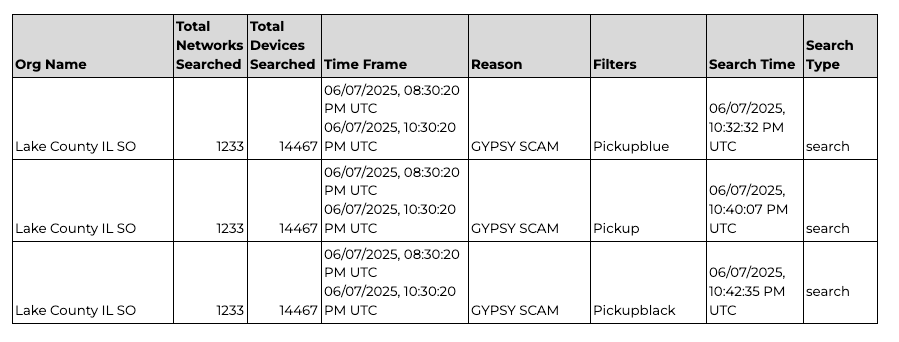
A screen grab of three searches

In June 2025, the Lake County Sheriff's Office ran three searches for a dark colored pick-up truck, using the reason: "G*PSY Scam." The search covered 1,233 networks, representing 14,467 different ALPR devices. 

In response to EFF, a sheriff's representative wrote via email:

“Thank you for reaching out and for bringing this to our attention.  We certainly understand your concern regarding the use of that terminology, which we do not condone or support, and we want to assure you that we are looking into the matter.

Any sort of discriminatory practice is strictly prohibited at our organization. If you have the time to take a look at our commitment to the community and our strong relationship with the community, I firmly believe you will see discrimination is not tolerated and is quite frankly repudiated by those serving in our organization. 

We appreciate you bringing this to our attention so we can look further into this and address it.”

2. Sacramento Police Department, CA

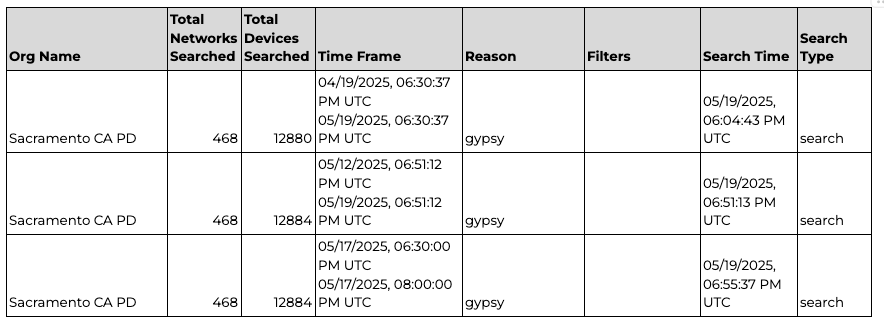
A screen grab of three searches

In May 2025, the Sacramento Police Department ran six searches using the term "g*psy."  The search covered 468 networks, representing 12,885 different ALPR devices. 

In response to EFF, a police representative wrote:

“Thank you again for reaching out. We looked into the searches you mentioned and were able to confirm the entries. We’ve since reminded the team to be mindful about how they document investigative reasons. The entry reflected an investigative lead, not a disparaging reference. 

We appreciate the chance to clarify.”

3. Palos Heights Police Department, IL

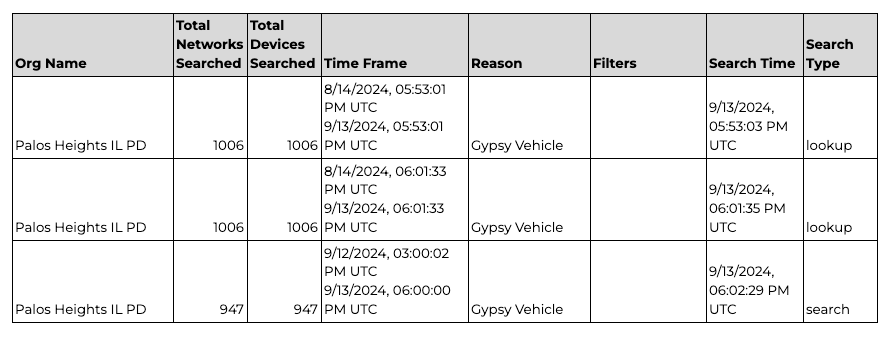
A screen grab of three searches

In September 2024, the Palos Heights Police Department ran more than two dozen searches using terms such as "g*psy vehicle," "g*psy scam" and "g*psy concrete vehicle." Most searches hit roughly 1,000 networks. 

In response to EFF, a police representative said the searches were related to a singular criminal investigation into a vehicle involved in a "suspicious circumstance/fraudulent contracting incident" and is "not indicative of a general search based on racial or ethnic profiling." However, the agency acknowledged the language was inappropriate: 

“The use of the term does not reflect the values or expected practices of our department. We do not condone the use of outdated or offensive terminology, and we will take this inquiry as an opportunity to educate those who are unaware of the negative connotation and to ensure that investigative notations and search reasons are documented in a manner that is accurate, professional, and free of potentially harmful language.

We appreciate your outreach on this matter and the opportunity to provide clarification.”

4. Irvine Police Department, CA

A screen grab of three searches

In February and May 2025, the Irvine Police Department ran eight searches using the term "roma" in the reason field. The searches covered 1,420 networks, representing 29,364 different ALPR devices. 

In a call with EFF, an IPD representative explained that the cases were related to a series of organized thefts. However, they acknowledged the issue, saying, "I think it's an opportunity for our agency to look at those entries and to use a case number or use a different term." 

5. Fairfax County Police Department, VA

A screen grab of three searches

Between December 2024 and April 2025, the Fairfax County Police Department ran more than 150 searches involving terms such as "g*psy case" and "roma crew burglaries." Fairfax County PD continued to defend its use of this language.

In response to EFF, a police representative wrote:

“Thank you for your inquiry. When conducting searches in investigative databases, our detectives must use the exact case identifiers, terms, or names connected to a criminal investigation in order to properly retrieve information. These entries reflect terminology already tied to specific cases and investigative files from other agencies, not a bias or judgment about any group of people. The use of such identifiers does not reflect bias or discrimination and is not inconsistent with our Bias-Based Policing policy within our Human Relations General Order.

A National Trend

Roma individuals and families are not the only ones being systematically and discriminatorily targeted by ALPR surveillance technologies. For example, Flock audit logs show agencies ran 400 more searches using terms targeting Traveller communities more generally, with a specific focus on Irish Travellers, often without any mention of a crime. 

Across the country, these tools are enabling and amplifying racial profiling by embedding longstanding policing biases into surveillance technologies. For example, data from Oak Park, IL, show that 84% of drivers stopped in Flock-related traffic incidents were Black—despite Black people making up only 19% of the local population. ALPR systems are far from being neutral tools for public safety and are increasingly being used to fuel discriminatory policing practices against historically marginalized people. 

The racially coded language in Flock's logs mirrors long-standing patterns of discriminatory policing. Terms like "furtive movements," "suspicious behavior," and "high crime area" have always been cited by police to try to justify stops and searches of Black, Latine, and Native communities. These phrases might not appear in official logs because they're embedded earlier in enforcement—in the traffic stop without clear cause, the undocumented stop-and-frisk, the intelligence bulletin flagging entire neighborhoods as suspect. They function invisibly until a body-worn camera, court filing, or audit brings them to light. Flock's network didn’t create racial profiling; it industrialized it, turning deeply encoded and vague language into scalable surveillance that can search thousands of cameras across state lines. 

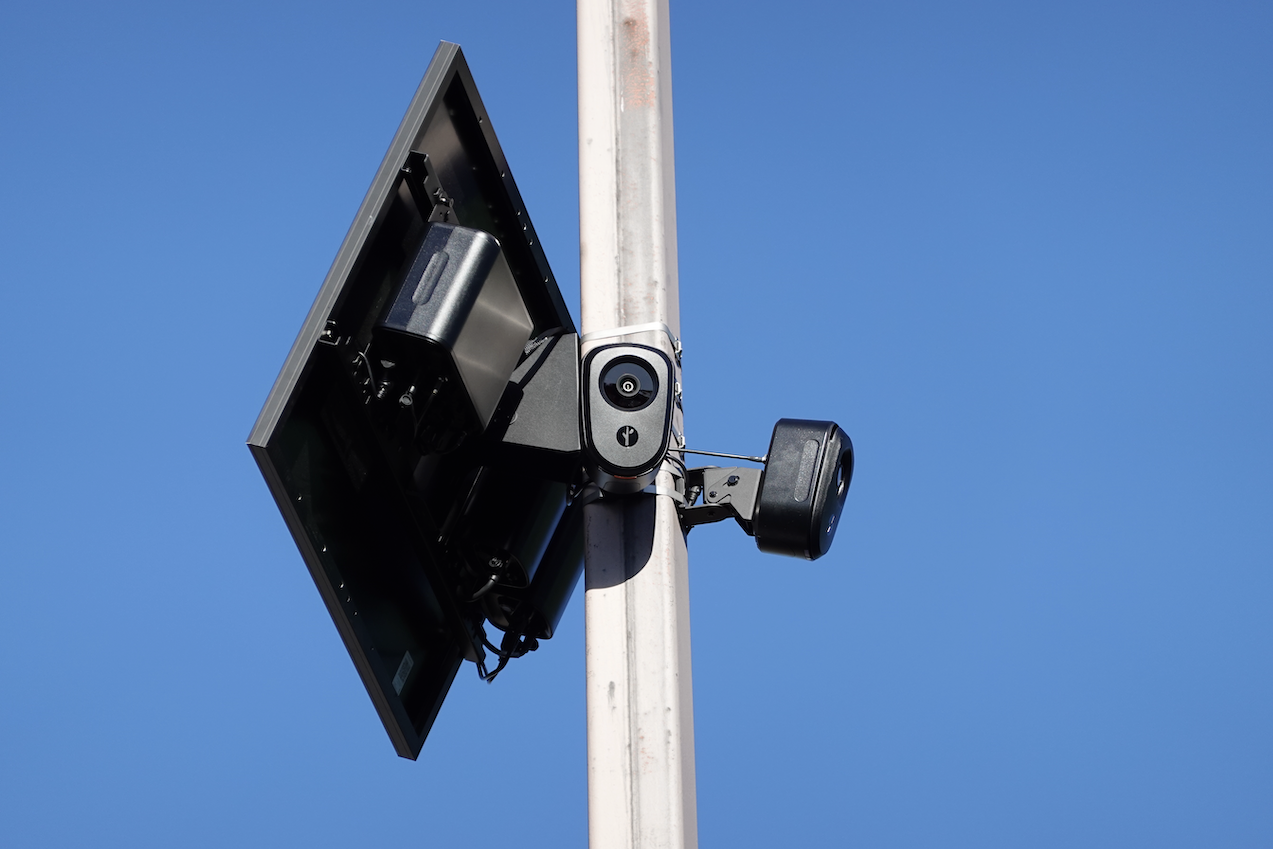
Two Flock safety cameras at 90 degrees on a pole with a solar panel

The Path Forward

U.S. Sen. Ron Wyden, D-OR, recently recommended that local governments reevaluate their decisions to install Flock Safety in their communities. We agree, but we also understand that sometimes elected officials need to see the abuse with their own eyes first. 

We know which agencies ran these racist searches, and they should be held accountable. But we also know that the vast majority of Flock Safety's clients—thousands of police and sheriffs—also allowed those racist searches to run through their Flock Safety systems unchallenged. 

Elected officials must act decisively to address the racist policing enabled by Flock's infrastructure. First, they should demand a complete audit of all ALPR searches conducted in their jurisdiction and a review of search logs to determine (a) whether their police agencies participated in discriminatory policing and (b) what safeguards, if any, exist to prevent such abuse. Second, officials should institute immediate restrictions on data-sharing through Flock's nationwide network. As demonstrated by California law, for example, police agencies should not be able to share their ALPR data with federal authorities or out-of-state agencies, thus eliminating a vehicle for discriminatory searches spreading across state lines.

Ultimately, elected officials must terminate Flock Safety contracts entirely. The evidence is now clear: audit logs and internal policies alone cannot prevent a surveillance system from becoming a tool for racist policing. The fundamental architecture of Flock—thousands of cameras feeding into a nationwide searchable network—makes discrimination inevitable when enforcement mechanisms fail.

As Sen. Wyden astutely explained, "local elected officials can best protect their constituents from the inevitable abuses of Flock cameras by removing Flock from their communities.”

Table Overview and Notes

The following table compiles terms used by agencies to describe the reasons for searching the Flock Safety ALPR database. In a small number of cases, we removed additional information such as case numbers, specific incident details, and officers' names that were present in the reason field. 

We removed one agency from the list due to the agency indicating that the word was a person's name and not a reference to Romani people. 

In general, we did not include searches that used the term "Romanian," although many of those may also be indicative of anti-Roma bias. We also did not include uses of "traveler" or “Traveller” when it did not include a clear ethnic modifier; however, we believe many of those searches are likely relevant.  

A text-based version of the spreadsheet is available here

November 12, 2025 update: Due to a clerical error a term was misattributed to Eugene Police Department in Oregon. We regret the error. 

  •  

Age Verification, Estimation, Assurance, Oh My! A Guide to the Terminology

If you've been following the wave of age-gating laws sweeping across the country and the globe, you've probably noticed that lawmakers, tech companies, and advocates all seem to be using different terms for what sounds like the same thing. Age verification, age assurance, age estimation, age gating—they get thrown around interchangeably, but they technically mean different things. And those differences matter a lot when we're talking about your rights, your privacy, your data, and who gets to access information online.

So let's clear up the confusion. Here's your guide to the terminology that's shaping these laws, and why you should care about the distinctions.

Age Gating: “No Kids Allowed”

Age gating refers to age-based restrictions on access to online services. Age gating can be required by law or voluntarily imposed as a corporate decision. Age gating does not necessarily refer to any specific technology or manner of enforcement for estimating or verifying a user’s age. It simply refers to the fact that a restriction exists. Think of it as the concept of “you must be this old to enter” without getting into the details of how they’re checking. 

Age Assurance: The Umbrella Term

Think of age assurance as the catch-all category. It covers any method an online service uses to figure out how old you are with some level of confidence. That's intentionally vague, because age assurance includes everything from the most basic check-the-box systems to full-blown government ID scanning.

Age assurance is the big tent that contains all the other terms we're about to discuss below. When a company or lawmaker talks about "age assurance," they're not being specific about how they're determining your age—just that they're trying to. For decades, the internet operated on a “self-attestation” system where you checked a box saying you were 18, and that was it. These new age-verification laws are specifically designed to replace that system. When lawmakers say they want "robust age assurance," what they really mean is "we don't trust self-attestation anymore, so now you need to prove your age beyond just swearing to it."

Age Estimation: Letting the Algorithm Decide

Age estimation is where things start getting creepy. Instead of asking you directly, the system guesses your age based on data it collects about you.

This might include:

  • Analyzing your face through a video selfie or photo
  • Examining your voice
  • Looking at your online behavior—what you watch, what you like, what you post
  • Checking your existing profile data

Companies like Instagram have partnered with services like Yoti to offer facial age estimation. You submit a video selfie, an algorithm analyzes your face, and spits out an estimated age range. Sounds convenient, right?

Here's the problem, “estimation” is exactly that: it’s a guess. And it is inherently imprecise. Age estimation is notoriously unreliable, especially for teenagers—the exact group these laws claim to protect. An algorithm might tell a website you're somewhere between 15 and 19 years old. That's not helpful when the cutoff is 18, and what's at stake is a young person's constitutional rights.

And it gets worse. These systems consistently fail for certain groups:

When estimation fails (and it often does), users get kicked to the next level: actual verification. Which brings us to…

Age Verification: “Show Me Your Papers”

Age verification is the most invasive option. This is where you have to prove your age to a certain date, rather than, for example, prove that you have crossed some age threshold (like 18 or 21 or 65). EFF generally refers to most age gates and mandates on young people’s access to online information as “age verification,” as most of them typically require you to submit hard identifiers like:

  • Government-issued ID (driver's license, passport, state ID)
  • Credit card information
  • Utility bills or other documents
  • Biometric data

This is what a lot of new state laws are actually requiring, even when they use softer language like "age assurance." Age verification doesn't just confirm you're over 18, it reveals your full identity. Your name, address, date of birth, photo—everything.

Here's the critical thing to understand: age verification is really identity verification. You're not just proving you're old enough—you're proving exactly who you are. And that data has to be stored, transmitted, and protected by every website that collects it.

We already know how that story ends. Data breaches are inevitable. And when a database containing your government ID tied to your adult content browsing history gets hacked—and it will—the consequences can be devastating.

Why This Confusion Matters

Politicians and tech companies love using these terms interchangeably because it obscures what they're actually proposing. A law that requires "age assurance" sounds reasonable and moderate. But if that law defines age assurance as requiring government ID verification, it's not moderate at all—it's mass surveillance. Similarly, when Instagram says it's using "age estimation" to protect teens, that sounds privacy-friendly. But when their estimation fails and forces you to upload your driver's license instead, the privacy promise evaporates.

Language matters because it shapes how we think about these systems. "Assurance" sounds gentle. "Verification" sounds official. "Estimation" sounds technical and impersonal, and also admits its inherent imprecision. 

Here's the uncomfortable truth: most lawmakers writing these bills have no idea how any of this technology actually works. They don't know that age estimation systems routinely fail for people of color, trans individuals, and people with disabilities. They don't know that verification systems have error rates. They don't even seem to understand that the terms they're using mean different things. The fact that their terminology is all over the place—using "age assurance," "age verification," and "age estimation" interchangeably—makes this ignorance painfully clear, and leaves the onus on platforms to choose whichever option best insulates them from liability.

Language matters because it shapes how we think about these systems. "Assurance" sounds gentle. "Verification" sounds official. "Estimation" sounds technical and impersonal, and also admits its inherent imprecision. But they all involve collecting your data and create a metaphysical age gate to the internet. The terminology is deliberately confusing, but the stakes are clear: it's your privacy, your data, and your ability to access the internet without constant identity checks. Don't let fuzzy language disguise what these systems really do.

  •  

Flock Safety and Texas Sheriff Claimed License Plate Search Was for a Missing Person. It Was an Abortion Investigation.

New documents and court records obtained by EFF show that Texas deputies queried Flock Safety's surveillance data in an abortion investigation, contradicting the narrative promoted by the company and the Johnson County Sheriff that she was “being searched for as a missing person,” and that “it was about her safety.” 

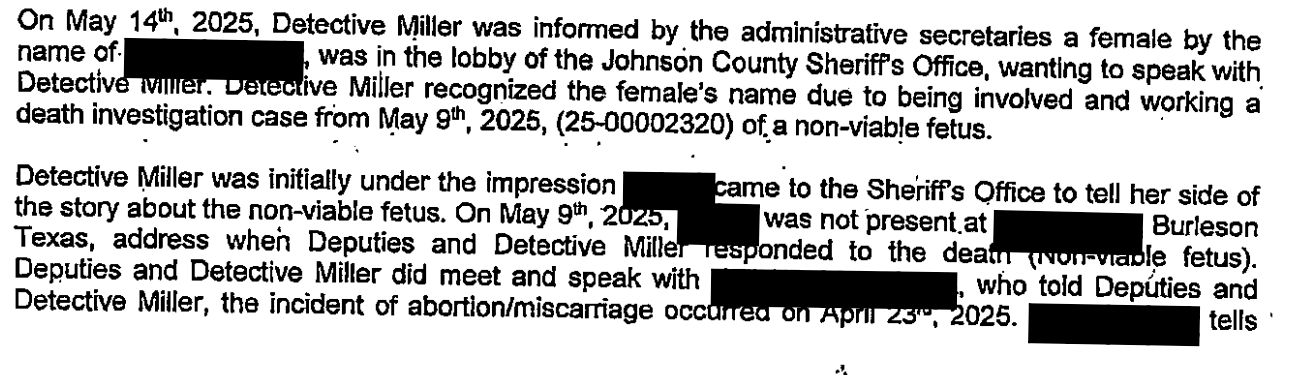
The new information shows that deputies had initiated a "death investigation" of a "non-viable fetus," logged evidence of a woman’s self-managed abortion, and consulted prosecutors about possibly charging her. 

Johnson County Sheriff Adam King repeatedly denied the automated license plate reader (ALPR) search was related to enforcing Texas's abortion ban, and Flock Safety called media accounts "false," "misleading" and "clickbait." However, according to a sworn affidavit by the lead detective, the case was in fact a death investigation in response to a report of an abortion, and deputies collected documentation of the abortion from the "reporting person," her alleged romantic partner. The death investigation remained open for weeks, with detectives interviewing the woman and reviewing her text messages about the abortion. 

The documents show that the Johnson County District Attorney's Office informed deputies that "the State could not statutorily charge [her] for taking the pill to cause the abortion or miscarriage of the non-viable fetus."

An excerpt from the police report, in which the detective talks about receiving evidence and calling the District Attorney's Office

An excerpt from the JCSO detective's sworn affidavit.

The records include previously unreported details about the case that shocked public officials and reproductive justice advocates across the country when it was first reported by 404 Media in May. The case serves as a clear warning sign that when data from ALPRs is shared across state lines, it can put people at risk, including abortion seekers. And, in this case, the use may have run afoul of laws in Washington and Illinois.

A False Narrative Emerges

Last May, 404 Media obtained data revealing the Johnson County Sheriff’s Office conducted a nationwide search of more than 83,000 Flock ALPR cameras, giving the reason in the search log: “had an abortion, search for female.” Both the Sheriff's Office and Flock Safety have attempted to downplay the search as akin to a search for a missing person, claiming deputies were only looking for the woman to “check on her welfare” and that officers found a large amount of blood at the scene – a claim now contradicted by the responding investigator’s affidavit. Flock Safety went so far as to assert that journalists and advocates covering the story intentionally misrepresented the facts, describing it as "misreporting" and "clickbait-driven." 

As Flock wrote of EFF's previous commentary on this case (bold in original statement): 

Earlier this month, there was purposefully misleading reporting that a Texas police officer with the Johnson County Sheriff’s Office used LPR “to target people seeking reproductive healthcare.” This organization is actively perpetuating narratives that have been proven false, even after the record has been corrected.

According to the Sheriff in Johnson County himself, this claim is unequivocally false.

… No charges were ever filed against the woman and she was never under criminal investigation by Johnson County. She was being searched for as a missing person, not as a suspect of a crime.

That sheriff has since been arrested and indicted on felony counts in an unrelated sexual harassment and whistleblower retaliation case. He has also been charged with aggravated perjury for allegedly lying to a grand jury. EFF filed public records requests with Johnson County to obtain a more definitive account of events.

The newly released incident report and affidavit unequivocally describe the case as a "death investigation" of a "non-viable fetus." These documents also undermine the claim that the ALPR search was in response to a medical emergency, since, in fact, the abortion had occurred more than two weeks before deputies were called to investigate. 

In recent years, anti-abortion advocates and prosecutors have increasingly attempted to use “fetal homicide” and “wrongful death” statutes – originally intended to protect pregnant people from violence – to criminalize abortion and pregnancy loss. These laws, which exist in dozens of states, establish legal personhood of fetuses and can be weaponized against people who end their own pregnancies or experience a miscarriage. 

In fact, a new report from Pregnancy Justice found that in just the first two years since the Supreme Court’s decision in Dobbs, prosecutors initiated at least 412 cases charging pregnant people with crimes related to pregnancy, pregnancy loss, or birth–most under child neglect, endangerment, or abuse laws that were never intended to target pregnant people. Nine cases included allegations around individuals’ abortions, such as possession of abortion medication or attempts to obtain an abortion–instances just like this one. The report also highlights how, in many instances, prosecutors use tangentially related criminal charges to punish people for abortion, even when abortion itself is not illegal.

By framing their investigation of a self-administered abortion as a “death investigation” of a “non-viable fetus,” Texas law enforcement was signaling their intent to treat the woman’s self-managed abortion as a potential homicide, even though Texas law does not allow criminal charges to be brought against an individual for self-managing their own abortion. 

The Investigator's Sworn Account

Over two days in April, the woman went through the process of taking medication to induce an abortion. Two weeks later, her partner–who would later be charged with domestic violence against her–reported her to the sheriff's office. 

The documents confirm that the woman was not present at the home when the deputies “responded to the death (Non-viable fetus).” As part of the investigation, officers collected evidence that the man had assembled of the self-managed abortion, including photographs, the FedEx envelope the medication arrived in, and the instructions for self-administering the medication. 

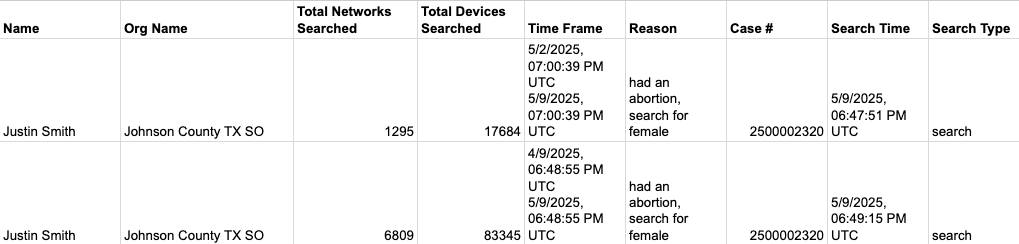
Another Johnson County official ran two searches through the ALPR database with the note "had an abortion, search for female," according to Flock Safety search logs obtained by EFF. The first search, which has not been previously reported, probed 1,295 Flock Safety networks–composed of 17,684 different cameras–going back one week. The second search, which was originally exposed by 404 Media, was expanded to a full month of data across 6,809 networks, including 83,345 cameras. Both searches listed the same case number that appears on the death investigation/incident report obtained by EFF. 

After collecting the evidence from the woman’s partner, the investigators say they consulted the district attorney’s office, only to be told they could not press charges against the woman. 

An excerpt from the detective's affidavit about investigating the abortion

An excerpt from the JCSO detective's sworn affidavit.

Nevertheless, when the subject showed up at the Sheriff’s office a week later, officers were under the impression that she came to “to tell her side of the story about the non-viable fetus.” They interviewed her, inspected text messages about the abortion on her phone, and watched her write a timeline of events. 

Only after all that did they learn that she actually wanted to report a violent assault by her partner–the same individual who had called the police to report her abortion. She alleged that less than an hour after the abortion, he choked her, put a gun to her head, and made her beg for her life. The man was ultimately charged in connection with the assault, and the case is ongoing. 

This documented account runs completely counter to what law enforcement and Flock have said publicly about the case. 

Johnson County Sheriff Adam King told 404 media: "Her family was worried that she was going to bleed to death, and we were trying to find her to get her to a hospital.” He later told the Dallas Morning News: “We were just trying to check on her welfare and get her to the doctor if needed, or to the hospital."

The account by the detective on the scene makes no mention of concerned family members or a medical investigator. To the contrary, the affidavit says that they questioned the man as to why he "waited so long to report the incident," and he responded that he needed to "process the event and call his family attorney." The ALPR search was recorded 2.5 hours after the initial call came in, as documented in the investigation report.

The Desk Sergeant's ReportOne Month Later

EFF obtained a separate "case supplemental report" written by the sergeant who says he ran the May 9 ALPR searches. 

The sergeant was not present at the scene, and his account was written belatedly on June 5, almost a month after the incident and nearly a week after 404 Media had already published the sheriff’s alternative account of the Flock Safety search, kicking off a national controversy. The sheriff's office provided this sergeant's report to Dallas Morning News. 

In the report, the sergeant claims that the officers on the ground asked him to start "looking up" the woman due to there being "a large amount of blood" found at the residencean unsubstantiated claim that is in conflict with the lead investigator’s affidavit. The sergeant repeatedly expresses that the situation was "not making sense." He claims he was worried that the partner had hurt the woman and her children, so "to check their welfare," he used TransUnion's TLO commercial investigative database system to look up her address. Once he identified her vehicle, he ran the plate through the Flock database, returning hits in Dallas.

A data table showing the log of searches

Two abortion-related searches in the JCSO's Flock Safety ALPR audit log

The sergeant's report, filed after the case attracted media attention, notably omits any mention of the abortion at the center of the investigation, although it does note that the caller claimed to have found a fetus. The report does not explain, or even address, why the sergeant used the phrase "had an abortion, search for female” as the official reason for the ALPR searches in the audit log. 

It's also unclear why the sergeant submitted the supplemental report at all, weeks after the incident. By that time, the lead investigator had already filed a sworn affidavit that contradicted the sergeant's account. For example, the investigator, who was on the scene, does not describe finding any blood or taking blood samples into evidence, only photographs of what the partner believed to be the fetus. 

One area where they concur: both reports are clearly marked as a "death investigation." 

Correcting the Record

Since 404 Media first reported on this case, King has perpetuated the false narrative, telling reporters that the woman was never under investigation, that officers had not considered charges against her, and that "it was all about her safety."

But here are the facts: 

  • The reports that have been released so far describe this as a death investigation.
  • The lead detective described himself as "working a death investigation… of a non-viable fetus" at the time he interviewed the woman (a week after the ALPR searches).
  • The detective wrote that they consulted the district attorney's office about whether they could charge her for "taking the pill to cause the abortion or miscarriage of the non-viable fetus." They were told they could not.
  • Investigators collected a lot of data, including photos and documentation of the abortion, and ran her through multiple databases. They even reviewed her text messages about the abortion. 
  • The death investigation was open for more than a month.

The death investigation was only marked closed in mid-June, weeks after 404 Media's article and a mere days before the Dallas Morning News published its report, in which the sheriff inaccurately claimed the woman "was not under investigation at any point."

Flock has promoted this unsupported narrative on its blog and in multimedia appearances. We did not reach out to Flock for comment on this article, as their communications director previously told us the company will not answer our inquiries until we "correct the record and admit to your audience that you purposefully spread misinformation which you know to be untrue" about this case. 

Consider the record corrected: It turns out the truth is even more damning than initially reported.

The Aftermath

In the aftermath of the original reporting, government officials began to take action. The networks searched by Johnson County included cameras in Illinois and Washington state, both states where abortion access is protected by law. Since then: 

  • The Illinois Secretary of State has announced his intent to “crack down on unlawful use of license plate reader data,” and urged the state’s Attorney General to investigate the matter. 
  • In California, which also has prohibitions on sharing ALPR out of state and for abortion-ban enforcement, the legislature cited the case in support of pending legislation to restrict ALPR use.
  • Ranking Members of the House Oversight Committee and one of its subcommittees launched a formal investigation into Flock’s role in “enabling invasive surveillance practices that threaten the privacy, safety, and civil liberties of women, immigrants, and other vulnerable Americans.” 
  • Senator Ron Wyden secured a commitment from Flock to protect Oregonians' data from out-of-state immigration and abortion-related queries.

In response to mounting pressure, Flock announced a series of new features supposedly designed to prevent future abuses. These include blocking “impermissible” searches, requiring that all searches include a “reason,” and implementing AI-driven audit alerts to flag suspicious activity. But as we've detailed elsewhere, these measures are cosmetic at best—easily circumvented by officers using vague search terms or reusing legitimate case numbers. The fundamental architecture that enabled the abuse remains unchanged. 

Meanwhile, as the news continued to harm the company's sales, Flock CEO Garrett Langley embarked on a press tour to smear reporters and others who had raised alarms about the usage. In an interview with Forbes, he even doubled down and extolled the use of the ALPR in this case. 

So when I look at this, I go “this is everything’s working as it should be.” A family was concerned for a family member. They used Flock to help find her, when she could have been unwell. She was physically okay, which is great. But due to the political climate, this was really good clickbait.

Nothing about this is working as it should, but it is working as Flock designed. 

The Danger of Unchecked Surveillance

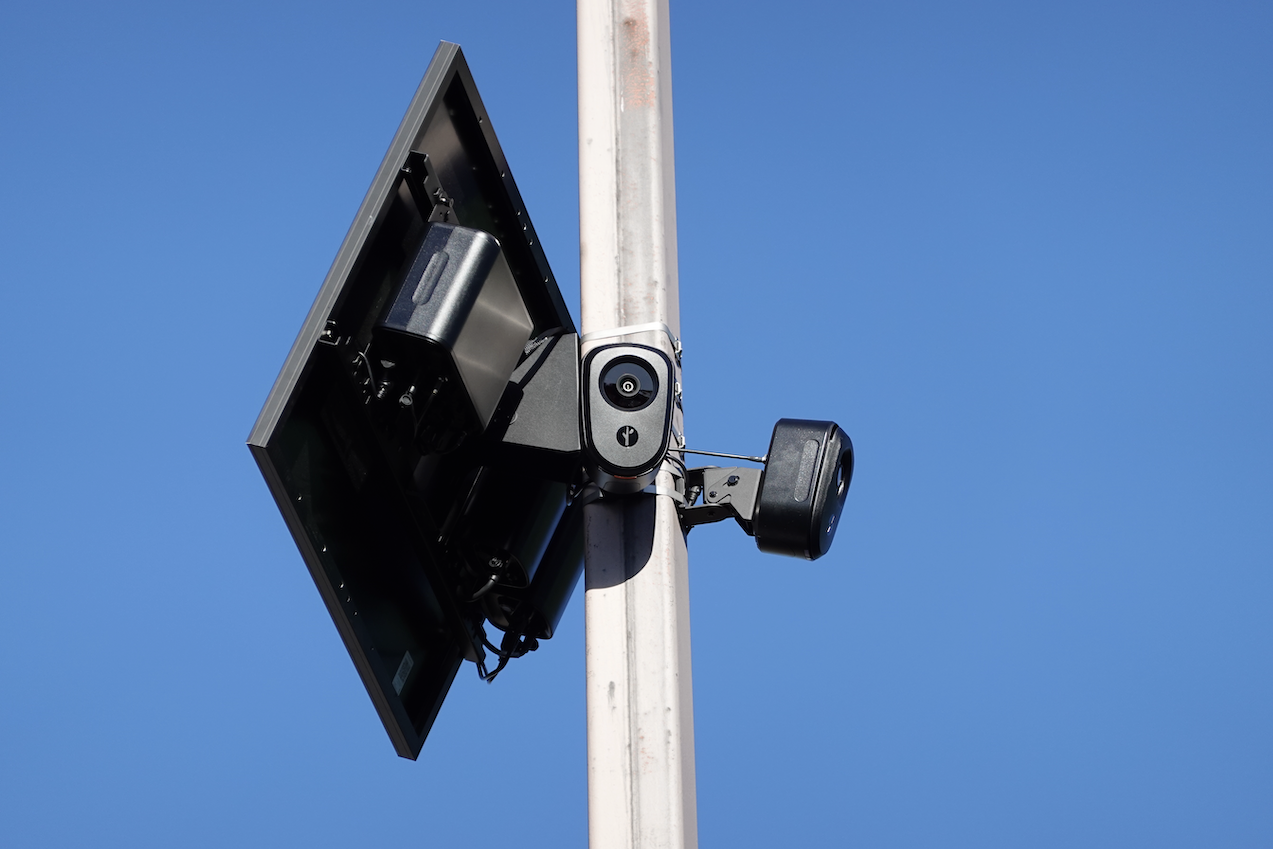
A pair of Flock Safety cameras on a pole, with a solar panel

Flock Safety ALPR cameras

This case reveals the fundamental danger of allowing companies like Flock Safety to build massive, interconnected surveillance networks that can be searched across state lines with minimal oversight. When a single search query can access more than 83,000 cameras spanning almost the entire country, the potential for abuse is staggering, particularly when weaponized against people seeking reproductive healthcare. 

The searches in this case may have violated laws in states like Washington and Illinois, where restrictions exist specifically to prevent this kind of surveillance overreach. But those protections mean nothing when a Texas deputy can access cameras in those states with a few keystrokes, without external review that the search is legal and legitimate under local law. In this case, external agencies should have seen the word "abortion" and questioned the search, but the next time an officer is investigating such a case, they may use a more vague or misleading term to justify the search. In fact, it's possible it has already happened. 

ALPRs were marketed to the public as tools to find stolen cars and locate missing persons. Instead, they've become a dragnet that allows law enforcement to track anyone, anywhere, for any reason—including investigating people's healthcare decisions. This case makes clear that neither the companies profiting from this technology nor the agencies deploying it can be trusted to tell the full story about how it's being used.

States must ban law enforcement from using ALPRs to investigate healthcare decisions and prohibit sharing data across state lines. Local governments may try remedies like reducing data retention period to minutes instead of weeks or months—but, really, ending their ALPR programs altogether is the strongest way to protect their most vulnerable constituents. Without these safeguards, every license plate scan becomes a potential weapon against a person seeking healthcare.

  •  

Opt Out October: Daily Tips to Protect Your Privacy and Security

Trying to take control of your online privacy can feel like a full-time job. But if you break it up into small tasks and take on one project at a time it makes the process of protecting your privacy much easier. This month we’re going to do just that. For the month of October, we’ll update this post with new tips every weekday that show various ways you can opt yourself out of the ways tech giants surveil you.

Online privacy isn’t dead. But the tech giants make it a pain in the butt to achieve. With these incremental tweaks to the services we use, we can throw sand in the gears of the surveillance machine and opt out of the ways tech companies attempt to optimize us into advertisement and content viewing machines. We’re also pushing companies to make more privacy-protective defaults the norm, but until that happens, the onus is on all of us to dig into the settings.

Support EFF!

All month long we’ll share tips, including some with the help from our friends at Consumer Reports’ Security Planner tool. Use the Table of Contents here to jump straight to any tip.

Table of Contents

Tip 1: Establish Good Digital Hygiene

Before we can get into the privacy weeds, we need to first establish strong basics. Namely, two security fundamentals: using strong passwords (a password manager helps simplify this) and two-factor authentication for your online accounts. Together, they can significantly improve your online privacy by making it much harder for your data to fall into the hands of a stranger.

Using unique passwords for every web login means that if your account information ends up in a data breach, it won’t give bad actors an easy way to unlock your other accounts. Since it’s impossible for all of us to remember a unique password for every login we have, most people will want to use a password manager, which generates and stores those passwords for you.

Two-factor authentication is the second lock on those same accounts. In order to login to, say, Facebook for the first time on a particular computer, you’ll need to provide a password and a “second factor,” usually an always-changing numeric code generated in an app or sent to you on another device. This makes it much harder for someone else to get into your account because it’s less likely they’ll have both a password and the temporary code.

This can be a little overwhelming to get started if you’re new to online privacy! Aside from our guides on Surveillance Self-Defense, we recommend taking a look at Consumer Reports’ Security Planner for ways to help you get started setting up your first password manager and turning on two-factor authentication.

Tip 2: Learn What a Data Broker Knows About You

Hundreds of data brokers you’ve never heard of are harvesting and selling your personal information. This can include your address, online activity, financial transactions, relationships, and even your location history. Once sold, your data can be abused by scammers, advertisers, predatory companies, and even law enforcement agencies.

Data brokers build detailed profiles of our lives but try to keep their own practices hidden. Fortunately, several state privacy laws give you the right to see what information these companies have collected about you. You can exercise this right by submitting a data access request to a data broker. Even if you live in a state without privacy legislation, some data brokers will still respond to your request.

There are hundreds of known data brokers, but here are a few major ones to start with:

Data brokers have been caught ignoring privacy laws, so there’s a chance you won’t get a response. If you do, you’ll learn what information the data broker has collected about you and the categories of third parties they’ve sold it to. If the results motivate you to take more privacy action, encourage your friends and family to do the same. Don’t let data brokers keep their spying a secret.

You can also ask data brokers to delete your data, with or without an access request. We’ll get to that later this month and explain how to do this with people-search sites, a category of data brokers.

Tip 3: Disable Ad Tracking on iPhone and Android

Picture this: you’re doomscrolling and spot a t-shirt you love. Later, you mention it to a friend and suddenly see an ad for that exact shirt in another app. The natural question pops into your head: “Is my phone listening to me?” Take a sigh of relief because, no, your phone is not listening to you. But advertisers are using shady tactics to profile your interests. Here’s an easy way to fight back: disable the ad identifier on your phone to make it harder for advertisers and data brokers to track you.

Disable Ad Tracking on iOS and iPadOS:

  • Open Settings > Privacy & Security > Tracking, and turn off “Allow Apps to Request to Track.”
  • Open Settings > Privacy & Security > Apple Advertising, and disable “Personalized Ads” to also stop some of Apple’s internal tracking for apps like the App Store. 
  • If you use Safari, go to Settings > Apps > Safari > Advanced and disable “Privacy Preserving Ad Measurement.”

Disable Ad Tracking on Android:

  • Open Settings > Security & privacy > Privacy controls > Ads, and tap “Delete advertising ID.”
  • While you’re at it, run through Google’s “Privacy Checkup” to review what info other Google services—like YouTube or your location—may be sharing with advertisers and data brokers.

These quick settings changes can help keep bad actors from spying on you. For a deeper dive on securing your iPhone or Android device, be sure to check out our full Surveillance Self-Defense guides.

Tip 4: Declutter Your Apps

Decluttering is all the rage for optimizers and organizers alike, but did you know a cleansing sweep through your apps can also help your privacy? Apps collect a lot of data, often in the background when you are not using them. This can be a prime way companies harvest your information, and then repackage and sell it to other companies you've never heard of. Having a lot of apps increases the peepholes that companies can gain into your personal life. 

Do you need three airline apps when you're not even traveling? Or the app for that hotel chain you stayed in once? It's best to delete that app and cut off their access to your information. In an ideal world, app makers would not process any of your data unless strictly necessary to give you what you asked for. Until then, to do an app audit:

  • Look through the apps you have and identify ones you rarely open or barely use. 
  • Long-press on apps that you don't use anymore and delete or uninstall them when a menu pops up. 
  • Even on apps you keep, take a swing through the location, microphone, or camera permissions for each of them. For iOS devices you can follow these instructions to find that menu. For Android, check out this instructions page.

If you delete an app and later find you need it, you can always redownload it. Try giving some apps the boot today to gain some memory space and some peace of mind.

Support EFF!

Tip 5: Disable Behavioral Ads on Amazon

Happy Amazon Prime Day! Let’s celebrate by taking back a piece of our privacy.

Amazon collects an astounding amount of information about your shopping habits. While the only way to truly free yourself from the company’s all-seeing eye is to never shop there, there is something you can do to disrupt some of that data use: tell Amazon to stop using your data to market more things to you (these settings are for US users and may not be available in all countries).

  • Log into your Amazon account, then click “Account & Lists” under your name. 
  • Scroll down to the “Communication and Content” section and click “Advertising preferences” (or just click this link to head directly there).
  • Click the option next to “Do not show me interest-based ads provided by Amazon.”
  • You may want to also delete the data Amazon already collected, so click the “Delete ad data” button.

This setting will turn off the personalized ads based on what Amazon infers about you, though you will likely still see recommendations based on your past purchases at Amazon.

Of course, Amazon sells a lot of other products. If you own an Alexa, now’s a good time to review the few remaining privacy options available to you after the company took away the ability to disable voice recordings. Kindle users might want to turn off some of the data usage tracking. And if you own a Ring camera, consider enabling end-to-end encryption to ensure you’re in control of the recording, not the company. 

Tip 6: Install Privacy Badger to Block Online Trackers

Every time you browse the web, you’re being tracked. Most websites contain invisible tracking code that lets companies collect and profit from your data. That data can end up in the hands of advertisers, data brokers, scammers, and even government agencies. Privacy Badger, EFF’s free browser extension, can help you fight back.

Privacy Badger automatically blocks hidden trackers to stop companies from spying on you online. It also tells websites not to share or sell your data by sending the “Global Privacy Control” signal, which is legally binding under some state privacy laws. Privacy Badger has evolved over the past decade to fight various methods of online tracking. Whether you want to protect your sensitive information from data brokers or just don’t want Big Tech monetizing your data, Privacy Badger has your back.

Visit privacybadger.org to install Privacy Badger.

It’s available on Chrome, Firefox, Edge, and Opera for desktop devices and Firefox and Edge for Android devices. Once installed, all of Privacy Badger’s features work automatically. There’s no setup required! If blocking harmful trackers ends up breaking something on a website, you can easily turn off Privacy Badger for that site while maintaining privacy protections everywhere else.

When you install Privacy Badger, you’re not just protecting yourself—you’re joining EFF and millions of other users in the fight against online surveillance.

Tip 7: Review Location Tracking Settings

Data brokers don’t just collect information on your purchases and browsing history. Mobile apps that have the location permission turned on will deliver your coordinates to third parties in exchange for insights or monetary kickbacks. Even when they don’t deliver that data directly to data brokers, if the app serves ad space, your location will be delivered in real-time bid requests not only to those wishing to place an ad, but to all participants in the ad auction—even if they lose the bid. Location data brokers take part in these auctions just to harvest location data en masse, without any intention of buying ad space.

Luckily, you can change a few settings to protect yourself against this hoovering of your whereabouts. You can use iOS or Android tools to audit an app’s permissions, providing clarity on who is providing what info to whom. You can then go to the apps that don’t need your location data and disable their access to that data (you can always change your mind later if it turns out location access was useful). You can also disable real-time location tracking by putting your phone into airplane mode, while still being able to navigate using offline maps. And by disabling mobile advertising identifiers (see tip three), you break the chain that links your location from one moment to the next.

Finally, for particularly sensitive situations you may want to bring an entirely separate, single-purpose device which you’ve kept clean of unneeded apps and locked down settings on. Similar in concept to a burner phone, even if this single-purpose device does manage to gather data on you, it can only tell a partial story about you—all the other data linking you to your normal activities will be kept separate.

For details on how you can follow these tips and more on your own devices, check out our more extensive post on the topic.

Tip 8: Limit the Data Your Gaming Console Collects About You

Oh, the beauty of gaming consoles—just plug in and play! Well... after you speed-run through a bunch of terms and conditions, internet setup, and privacy settings. If you rushed through those startup screens, don’t worry! It’s not too late to limit the data your console is collecting about you. Because yes, modern consoles do collect a lot about your gaming habits.

Start with the basics: make sure you have two-factor authentication turned on for your accounts. PlayStation, Xbox, and Nintendo all have guides on their sites. Between payment details and other personal info tied to these accounts, 2FA is an easy first line of defense for your data.

Then, it’s time to check the privacy controls on your console:

  • PlayStation 5: Go to Settings > Users and Accounts > Privacy to adjust what you share with both strangers and friends. To limit the data your PS5 collects about you, go to Settings > Users and Accounts > Privacy, where you can adjust settings under Data You Provide and Personalization.
  • Xbox Series X|S: Press the Xbox button > Profile & System > Settings > Account > Privacy & online safety > Xbox Privacy to fine-tune your sharing. To manage data collection, head to Profile & System > Settings > Account > Privacy & online safety > Data collection.
  • Nintendo Switch: The Switch doesn’t share as much data by default, but you still have options. To control who sees your play activity, go to System Settings > Users > [your profile] > Play Activity Settings. To opt out of sharing eShop data, open the eShop, select your profile (top right), then go to Google Analytics Preferences > Do Not Share.

Plug and play, right? Almost. These quick checks can help keep your gaming sessions fun—and more private.

Tip 9: Hide Your Start and End Points on Strava

Sharing your personal fitness goals, whether it be extended distances, accurate calorie counts, or GPS paths—sounds like a fun, competitive feature offered by today's digital fitness trackers. If you enjoy tracking those activities, you've probably heard of Strava. While it's excellent for motivation and connecting with fellow athletes, Strava's default settings can reveal sensitive information about where you live, work, or exercise, creating serious security and privacy risks. Fortunately, Strava gives you control over how much of your activity map is visible to others, allowing you to stay active in your community while protecting your personal safety.

We've covered how Strava data exposed classified military bases in 2018 when service members used fitness trackers. If fitness data can compromise national security, what's it revealing about you?

Here's how to hide your start and end points:

  • On the website: Hover over your profile picture > Settings > Privacy Controls > Map Visibility.
  • On mobile: Open Settings > Privacy Controls > Map Visibility.
  • You can then choose from three options: hide portions near a specific address, hide start/end of all activities, or hide entire maps

You can also adjust individual activities:

  • Open the activity you want to edit.
  • Select the three-dot menu icon.
  • Choose "Edit Map Visibility."
  • Use sliders to customize what's hidden or enable "Hide the Entire Map."

Great job taking control of your location privacy! Remember that these settings only apply to Strava, so if you share activities to other platforms, you'll need to adjust those privacy settings separately. While you're at it, consider reviewing your overall activity visibility settings to ensure you're only sharing what you want with the people you choose.

Tip 10: Find and Delete An Account You No Longer Use

Millions of online accounts are compromised each year. The more accounts you have, the more at risk you are of having your personal data illegally accessed and published online. Even if you don’t suffer a data breach, there’s also the possibility that someone could find one of your abandoned social media accounts containing information you shared publicly on purpose in the past, but don’t necessarily want floating around anymore. And companies may still be profiting off details of your personal life, even though you’re not getting any benefit from their service.

So, now’s a good time to find an old account to delete. There may be one you can already think of, but if you’re stuck, you can look through your password manager, look through logins saved on your web browser, or search your email inbox for phrases like “new account,” “password,” “welcome to,” or “confirm your email.” Or, enter your email address on the website HaveIBeenPwned to get a list of sites where your personal information has been compromised to see if any of them are accounts you no longer use.

Once you’ve decided on an account, you’ll need to find the steps to delete it. Simply deleting an app off of your phone or computer does not delete your account. Often you can log in and look in the account settings, or find instructions in the help menu, the FAQ page, or the pop-up customer service chat. If that fails, use a search engine to see if anybody else has written up the steps to deleting your specific type of account.

For more information, check out the Delete Unused Accounts tip on Security Planner.

Support EFF!

Tip 11: Search for Yourself

Today's tip may sound a little existential, but we're not suggesting a deep spiritual journey. Just a trip to your nearest search engine. Pop your name into search engines such as Google or DuckDuckGo, or even AI tools such as ChatGPT, to see what you find. This is one of the simplest things you can do to raise your own awareness of your digital reputation. It can be the first thing prospective employers (or future first dates) do when trying to figure out who you are. From a privacy perspective, doing it yourself can also shed light on how your information is presented to the general public. If there's a defunct social media account you'd rather keep hidden, but it's on the first page of your search results, that might be a good signal for you to finally delete that account. If you shared your cellphone number with an organization you volunteer for and it's on their home page, you can ask them to take it down.

Knowledge is power. It's important to know what search results are out there about you, so you understand what people see when they look for you. Once you have this overview, you can make better choices about your online privacy. 

Tip 12: Tell “People Search” Sites to Delete Your Information

When you search online for someone’s name, you’ll likely see results from people-search sites selling their home address, phone number, relatives’ names, and more. People-search sites are a type of data broker with an especially dangerous impact. They can expose people to scams, stalking, and identity theft. Submit opt out requests to these sites to reduce the amount of personal information that is easily available about you online.

Check out this list of opt-out links and instructions for more than 50 people search sites, organized by priority. Before submitting a request, check that the site actually has your information. Here are a few high-priority sites to start with: 

Data brokers continuously collect new information, so your data could reappear after being deleted. You’ll have to re-submit opt-outs periodically to keep your information off of people-search sites. Subscription-based services can automate this process and save you time, but a Consumer Reports study found that manual opt-outs are more effective.

Tip 13: Remove Your Personal Addresses from Search Engines 

Your home address may often be found with just a few clicks online. Whether you're concerned about your digital footprint or looking to safeguard your physical privacy, understanding where your address appears and how to remove or obscure it is a crucial step. Here's what you need to know.

Your personal addresses can be available through public records like property purchases, medical licensing information, or data brokers. Opting out from data brokers will do a lot to remove what's available commercially, but sometimes you can't erase the information entirely from things like property sales records.

You can ask some search engines to remove your personal information from search indexes, which is the most efficient way to make information like your personal addresses, phone number, and email address a lot harder to find. Google has a form that makes this request quite easy, and we’d suggest starting there.

Day 14: Check Out Signal

Here's the problem: many of your texts aren't actually private. Phone companies, government agencies, and app developers all too often can all peek at your conversations.

So on Global Encryption Day, our tip is to check out Signal—a messaging app that actually keeps your conversations private.

Signal uses end-to-end encryption, meaning only you and your recipient can read your messages—not even Signal can see them. Security experts love Signal because it's run by a privacy-focused nonprofit, funded by donations instead of data collection, and its code is publicly auditable. 

Beyond privacy, Signal offers free messaging and calls over Wi-Fi, helping you avoid SMS charges and international calling fees. The only catch? Your contacts need Signal too, so start recruiting your friends and family!

How to get started: Download Signal from your app store, verify your phone number, set a secure PIN, and start messaging your contacts who join you. Consider also setting up a username so people can reach you without sharing your phone number. For more detailed instructions, check out our guide.

Global Encryption Day is the perfect timing to protect your communications. Take your time to explore the app, and check out other privacy protecting features like disappearing messages, session verification, and lock screen notification privacy.

Tip 15: Switch to a Privacy-Protective Browser

Your browser stores tons of personal information: browsing history, tracking cookies, and data that companies use to build detailed profiles for targeted advertising. The browser you choose makes a huge difference in how much of this tracking you can prevent.

Most people use Chrome or Safari, which are automatically installed on Google and Apple products, but these browsers have significant privacy drawbacks. For example: Chrome's Incognito mode only hides history on your device—it doesn't stop tracking. Safari has been caught storing deleted browser history and collecting data even in private browsing mode.

Firefox is one alternative that puts privacy first. Unlike Chrome, Firefox automatically blocks trackers and ads in Private Browsing mode and prevents websites from sharing your data between sites. It also warns you when websites try to extract your personal information. But Firefox isn't your only option—other privacy-focused browsers like DuckDuckGo, Brave, and Tor also offer strong protections with different features. The key is switching away from browsers that prioritize data collection over your privacy.

Switching is easy: download your chosen browser from the links above and install it. Most browsers let you import bookmarks and passwords during setup.

You now have a new browser! Take some time to explore your new browser's privacy settings to maximize your protection.

Tip 16: Give Yourself Another Online Identity

We all take on different identities at times. Just as it's important to set boundaries in your daily life, the same can be true for your digital identity. For many reasons, people may want to keep aspects of their lives separate—and giving people control over how their information is used is one of the fundamental reasons we fight for privacy. Consider chopping up pieces of your life over separate email accounts, phone numbers, or social media accounts. 

This can help you manage your life and keep a full picture of your private information out of the hands of nosy data-mining companies. Maybe you volunteer for an organization in your spare time that you'd rather keep private, want to keep emails from your kids' school separate from a mountain of spam, or simply would rather keep your professional and private social media accounts separate. 

Whatever the reason, consider whether there's a piece of your life that could benefit from its own identity. When you set up these boundaries, you can also protect your privacy.

Tip 17: Check Out Virtual Card Services

Ever encounter an online vendor selling something that’s just what you need—if you could only be sure they aren’t skimming your credit card number? Or maybe you trust the vendor, but aren’t sure the web site (seemingly written in some arcane e-commerce platform from 1998) won’t be hacked within the hour after your purchase? Buying those bits and bobs shouldn’t cost you your peace of mind on top of the dollar amount. For these types of purchases, we recommend checking out a virtual card service.

These services will generate a seemingly random credit card for your use which is locked down in a particular way which you can specify. This may mean a card locked to a single vendor, where no one else can make charges on it. It could only validate charges for a specific category of purchase, for example clothing. You can not only set limits on vendors, but set spending limits a card can’t exceed, or that it should just be a one-time use card and then close itself. You can even pause a card if you are sure you won’t be using it for some time, and then unpause it later. The configuration is up to you.

There are a number of virtual card services available, like Privacy.com or IronVest, just to name a few. Just like any vendor, though, these services need some way to charge you. So for any virtual card service, pop them into your favored search engine to verify they’re legit, and aren’t going to burden you with additional fees. Some options may also only be available in specific countries or regions, due to financial regulation laws.

Support EFF!

Tip 18: Minimize Risk While Using Digital Payment Apps

Digital payment apps like Cash App, Venmo, and Zelle generally offer fewer fraud protections than credit cards offered by traditional financial institutions. It’s safer to stick to credit cards when making online purchases. That said, there are ways to minimize your risk.

Turn on transaction alerts:

  • On Cash App, tap on your picture or initials on the right side of the app. Tap Notifications, and then Transactions. From there, you can toggle the settings to receive a push notification, a text, and/or an email with receipts or to track activity on the app.
  • On PayPal, tap on the top right icon to access your account. Tap Notification Preferences, click on “Open Settings” and toggle to “Allow Notifications” if you’d like to see those on your phone.
  • On Venmo, tap on your picture or initials to go to the Me tab. Then, tap the Settings gear in the top right of the app, and tap Notifications. From there, you can adjust your text and email notifications, and even turn on push notifications. 

Report suspected fraud quickly

If you receive a notification for a purchase you didn’t make, even if it’s a small amount, make sure to immediately report it. Scammers sometimes test the waters with small amounts to see whether or not their targets are paying attention. Additionally, you may be on the hook for part of the payment if you don’t act fast. PayPal and Venmo say they cover lost funds if they’re reported within 60 days, but Cash App has more complicated restrictions, which can include fees of up to $500 if you lose your device or password and don’t report it within 48 hours.

And don’t forget to turn on multifactor authentication for each app. For more information, check out these tips from Consumer Reports.

Tip 19: Turn Off Ad Personalization to Limit How the Tech Giants Monetize Your Data

Tech companies make billions by harvesting your personal data and using it to sell hyper-targeted ads. This business model drives them to track us far beyond their own platforms, gathering data about our online and offline activity. Surveillance-based advertising isn’t just creepy—it’s harmful. The systems that power hyper-targeted ads can also funnel your personal information to data brokers, advertisers, scammers, and law enforcement agencies. 

To limit how companies monetize your data through surveillance-based advertising, turn off ad personalization on your accounts. This setting looks different depending on the platform, but here are some key places to start:

  • Meta (Facebook & Instagram): Follow this guide to find the setting for disabling ad targeting based on data Meta collects about you from other websites and apps.
  • Google: Visit https://myadcenter.google.com/home and switch the “Personalized ads” option from “On” to “Off.”
  • X (formerly known as Twitter): Visit https://x.com/settings/privacy_and_safety and turn off all settings under “Data sharing and personalization”

Banning online behavioral ads would be a better solution, but turning off ad personalization is a quick and easy step to limit how tech companies profit from your data. And don’t forget to change this same setting on Amazon, too.

Tip 20: Tighten Account Privacy Settings

Just because you want to share information with select friends and family on social media doesn’t necessarily mean you want to broadcast everything to the entire world. Whether you want to make sure you’re not sharing your real-time location with someone you’d rather not bump into or only want your close friends to know about your favorite pop star, you can typically restrict how companies display your status updates and other information.

In addition to whether data is displayed publicly or just to a select group of contacts, you may have some control over how data is collected, used, and shared with advertisers, or how long it is stored for.

To get started, choose an account and review the privacy settings, making changes as needed. Here are links to a few of the major companies to get you started:

Unfortunately, you may need to tweak your privacy settings multiple times to get them the way you want, as companies often introduce new features that are less private by default. And while companies sometimes offer choices on how data is collected, you can’t control most of the data collection that takes place. For more information, see Security Planner.

Tip 21: Protect Your Data When Dating Online

Dating apps like Grindr and Tinder collect vast amounts of intimate details—everything from sexual preferences, location history, and behavioral patterns—all from people that are just looking for love and connection. This data falling into the wrong hands can come with unacceptable consequences, especially for members of the LGBTQ+ community and other vulnerable users that pertinently need privacy protections.

To ensuring that finding love does not involve such a privacy impinging tradeoff, follow these tips to protecting yourself when online dating:

  1. Review your login information and make sure to use a strong, unique password for your accounts; and enable two-factor authentication when offered. 
  2. Disable behavioral ads so personal details about you cannot be used to create a comprehensive portrait of your life—including your sexual orientation.
  3. Review your access to your location and camera roll, and possibly change these in line with what information you would like to keep private. 
  4. Consider what photos you choose, upload, and share; and assume that everything can and will be made public.
  5. Disable the integration of third-party apps like Spotify if you want more privacy. 
  6. Be mindful of what you share with others when you first chat, such as not disclosing financial details, and trust your gut if something feels off. 

There isn't one singular way to use dating apps, but taking these small steps can have a big impact in staying safe when dating online.

Tip 22: Turn Off Automatic Content Recognition (ACR) On Your TV

You might think TVs are just meant to be watched, but it turns out TV manufacturers do their fair share of watching what you watch, too. This is done through technology called “automatic content recognition” (ACR), which snoops on and identifies what you’re watching by snapping screenshots and comparing them to a big database. How many screenshots? The Markup found some TVs captured up to 7,200 images per hour. The main reason? Ad targeting, of course. 

Any TV that’s connected to the internet likely does this alongside now-standard snooping practices, like tracking what apps you open and where you’re located. ACR is particularly nefarious, though, as it can identify not just streaming services, but also offline content, like video games, over-the-air broadcasts, and physical media. What we watch can and should be private, but that’s especially true when we’re using media that’s otherwise not connected to the internet, like Blu-Rays or DVDs.

Opting out of ACR can be a bit of a chore, but it is possible on most smart TVs. Consumer Reports has guides for most of the major TV manufacturers. 

And that’s it for Opt Out October. Hopefully you’ve come across a tip or two that you didn’t know about, and found ways to protect your privacy, and disrupt the astounding amount of data collection tech companies do.

  •  

When Knowing Someone at Meta Is the Only Way to Break Out of “Content Jail”

This is the second instalment in a ten-part blog series documenting EFF's findings from the Stop Censoring Abortion campaign. You can read additional posts here. 

During our Stop Censoring Abortion campaign, we set out to collect and spotlight the growing number of stories from people and organizations that have had abortion-related content removed, suppressed, or flagged by dominant social media platforms. Our survey submissions have revealed some alarming trends, including: if you don’t have a personal or second-degree connection at Meta, your chances of restoring your content or account are likely to drop significantly. 

Through the survey, we heard from activists, clinics, and researchers whose accounts were suspended or permanently removed for allegedly violating Meta’s policies on promoting or selling “restricted goods,” even when their posts were purely educational or informational. What the submissions also showed is a pattern of overenforcement, lack of transparency, and arbitrary moderation decisions that have specifically affected reproductive health and reproductive justice advocates. 

When accounts are taken down, appeals can take days, weeks, or even months (if they're even resolved at all, or if users are even given the option to appeal). For organizations and providers, this means losing access to vital communication tools and being cut off from the communities they serve. This is highly damaging since so much of that interaction happens on Meta’s platforms. Yet we saw a disturbing pattern emerge in our survey: on several occasions, accounts are swiftly restored once someone with a connection to Meta intervenes.

The Case Studies: An Abortion Clinic

The Red River Women's Clinic is an abortion clinic in Moorhead, MN. It was originally located in Fargo, North Dakota, and for many years was the only abortion clinic in North Dakota. In early January, the clinic’s director heard from a patient that she thought they only offered procedural/surgical abortions and not medication abortion. To clarify for other patients, they posted on the clinic’s page that they offered both procedural and medication abortions—attaching an image of a box of mifepristone. When they tried to boost the post, the ad was flagged and their account was suspended.

They appealed the decision and initially got the ad approved, yet the page was suspended again shortly after. But this time, multiple appeals and direct emails went unanswered, until they reached out to a digital rights organization that was able to connect with staff at Meta that stepped in. Only then was their page restored, with Meta noting that their post did not violate the policies but warning that future violations could lead to permanent removal.

While this may have been a glitch in Meta’s systems or a misapplication of policy, the suspension of the clinic’s Facebook account was detrimental for them. “We were unable to update our followers about dates/times we were closed, we were unable to share important information and news about abortion that would have kept our followers up to date, there was a legislative session happening and we were unable to share events and timely asks for reaching out to legislators about issues,” shared Tammi Kromenaker, Director of Red River Women's Clinic. The clinic was also prevented from starting an Instagram page due to the suspension. “Facebook has a certain audience and Instagram has another audience,” said Kromenaker, “we are trying to cater to all of our supporters so the loss of FB and the inability to access and start an Instagram account were really troubling to us.” 

The Case Studies: RISE at Emory University

RISE, a reproductive health research center at Emory University, launched an Instagram account to share community-centered research and combat misinformation related to reproductive health. In January of this year, they posted educational content about mifepristone on their instagram. “Let's talk about Mifepristone + its uses + the importance of access”, read the post. Two months later, their account was suddenly suspended, flagging the account under its policy against selling illegal drugs. Their appeal was denied, which led to the account being permanently deleted. 

A screenshot of an instagram post from @emory.rise that reads "let's talk about mifepristone" in bold black font "+ its uses + the importance of access" in blue

Screenshot submitted by RISE to EFF

“As a team, this was a hit to our morale” shared Sara Redd, Director of Research Translation at RISE. “We pour countless hours of person-power, creativity, and passion into creating the content we have on our page, and having it vanish virtually overnight took a toll on our team.” For many organizational users like RISE, their social media accounts are a repository for resources and metrics that may not be stored elsewhere. “We spent a significant amount of already-constrained team capacity attempting to recover all of the content we’d created for Instagram that was potentially going to be permanently lost. [...] We also spent a significant amount of time and energy trying to understand what options we might have available from Meta to appeal our case and/or recover our account; their support options are not easily accessible, and the time it took to navigate this issue distracted from our existing work.”  

Meta restored the account only after RISE was able to connect with someone there. Once RISE logged back in, they confirmed that the flagged post was the one about mifepristone. The post never sold or directed people where to buy pills, it simply provided accurate information about the use and efficacy of the drug. 

This Shouldn’t Be How Content Moderation Works

Meta spokespersons have admitted to instances of “overenforcement” in various press statements, noting that content is sometimes incorrectly removed or blurred even when it doesn’t actually violate policy. Meta has insisted to the public that they care about free speech, as a spokesperson mentioned to The New York Times: “We want our platforms to be a place where people can access reliable information about health services, advertisers can promote health services and everyone can discuss and debate public policies in this space [...] That’s why we allow posts and ads about, discussing and debating abortion.” In fact, their platform policies directly mention this

Note that advertisers don’t need authorization to run ads that only:

  • Educate, advocate or give public service announcements related to prescription drugs

Additionally

Note: Debating or advocating for the legality or discussing scientific or medical merits of prescription drugs is allowed. This includes news and public service announcements. 

Meta also has policies specific to “Health and Wellness,” where they state: 

When targeting people 18 years or older, advertisers can run ads that:

  • Promote sexual and reproductive health and wellness products or services, as long as the focus is on health and the medical efficacy of the product or the service and not on the sexual pleasure or enhancement. And these ads must target people 18 years or older. This includes ads for: [...]
  • Family planning methods, such as:
    • Family planning clinics
    • In Vitro Fertilization (IVF) or any other artificial insemination procedures
    • Fertility awareness
    • Abortion medical consultation and related services

But these public commitments don’t always match users’ experiences. 

Take the widely covered case of Aid Access, a group that provides medication abortion by mail. This year, several of their Instagram posts were blurred and removed on Instagram, including one with tips for feeling safe and supported at home after taking abortion medication. But only after multiple national media outlets contacted Meta for comment on the story were the posts and account restored.

So the question becomes: If Meta admits its enforcement isn’t perfect, why does it still take knowing someone, or having the media involved, to get a fair review? When companies like Meta claim to uphold commitments to free speech, those commitments should materialize in clear policies that are enforced equally, not only when it is escalated through leveraging relationships with Meta personnel.

“Facebook Jail” Reform

There is no question that the enforcement of these content moderation policies on Meta platforms and the length of time people are spending in “content jail” or “Facebook/Instagram jail” has created a chilling effect

“I think that I am more cautious and aware that the 6.1K followers we have built up over time could be taken away at any time based on the whims of Meta,” Tammi from Red River Women’s Clinic told us. 

RISE sees it in a slightly different light, sharing that “[w]hile this experience has not affected our fundamental values and commitment to sharing our work and rigorous science, it has highlighted for us that no information posted on a third-party platform is entirely one’s own, and thus can be dismantled at any moment.”

At the end of the day, clinics are left afraid to post basic information, patients are left confused or misinformed, and researchers lose access to their audiences. But unless your issue catches the attention of a journalist or you know someone at Meta, you might never regain access to your account.

These case studies highlight the urgent need for transparent, equitable, and timely enforcement that is not dependent on insider connections, as well as accountability from platforms that claim to support open dialogue and free speech. Meta’s admitted overenforcement should, at minimum, be coupled with efficient and well-staffed review processes and policies that are transparent and easily understandable. 

It’s time for Meta and other social media platforms to implement the reforms they claim to support, and for them to prove that protecting access to vital health information doesn’t hinge on who you know.

This is the second post in our blog series documenting the findings from our Stop Censoring Abortion campaign. Read more in the series: https://www.eff.org/pages/stop-censoring-abortion   

  •  

From Book Bans to Internet Bans: Wyoming Lets Parents Control the Whole State’s Access to The Internet

If you've read about the sudden appearance of age verification across the internet in the UK and thought it would never happen in the U.S., take note: many politicians want the same or even more strict laws. As of July 1st, South Dakota and Wyoming enacted laws requiring any website that hosts any sexual content to implement age verification measures. These laws would potentially capture a broad range of non-pornographic content, including classic literature and art, and expose a wide range of platforms, of all sizes, to civil or criminal liability for not using age verification on every user. That includes social media networks like X, Reddit, and Discord; online retailers like Amazon and Barnes & Noble; and streaming platforms like Netflix and Rumble—essentially, any site that allows user-generated or published content without gatekeeping access based on age.

These laws expand on the flawed logic from last month’s troubling Supreme Court decision,  Free Speech Coalition v. Paxton, which gave Texas the green light to require age verification for sites where at least one-third (33.3%) of the content is sexual materials deemed “harmful to minors.” Wyoming and South Dakota seem to interpret this decision to give them license to require age verification—and potential legal liability—for any website that contains ANY image, video, or post that contains sexual content that could be interpreted as harmful to minors. Platforms or websites may be able to comply by implementing an “age gate” within certain sections of their sites where, for example, user-generated content is allowed, or at the point of entry to the entire site.

Although these laws are in effect, we do not believe the Supreme Court’s decision in FSC v. Paxton gives these laws any constitutional legitimacy. You do not need a law degree to see the difference between the Texas law—which targets sites where a substantial portion (one third) of content is “sexual material harmful to minors”—and these laws, which apply to any site that contains even a single instance of such material. In practice, it is the difference between burdening adults with age gates for websites that host “adult” content, and burdening the entire internet, including sites that allow user-generated content or published content.

The law invites parents in Wyoming to take enforcement for the entire state—every resident, and everyone else's children—into their own hands

But lawmakers, prosecutors, and activists in conservative states have worked for years to aggressively expand the definition of “harmful to minors” and use other methods to censor a broad swath of content: diverse educational materials, sex education resources, art, and even award-winning literature. Books like The Bluest Eye by Toni Morrison, The Handmaid’s Tale by Margaret Atwood, and And Tango Makes Three have all been swept up in these crusades—not because of their overall content, but because of isolated scenes or references.

Wyoming’s law is also particularly extreme: rather than provide enforcement by the Attorney General, HB0043 is a “bounty” law that deputizes any resident with a child to file civil lawsuits against websites they believe are in violation, effectively turning anyone into a potential content cop. There is no central agency, no regulatory oversight, and no clear standard. Instead, the law invites parents in Wyoming to take enforcement for the entire state—every resident, and everyone else's children—into their own hands by suing websites that contain a single example of objectionable content. Though most other state age-verification laws often allow individuals to make reports to state Attorneys General who are responsible for enforcement, and some include a private right of action allowing parents or guardians to file civil claims for damages, the Wyoming law is similar to laws in Louisiana and Utah that rely entirely on civil enforcement. 

This is a textbook example of a “heckler’s veto,” where a single person can unilaterally decide what content the public is allowed to access. However, it is clear that the Wyoming legislature explicitly designed the law this way in a deliberate effort to sidestep state enforcement and avoid an early constitutional court challenge, as many other bounty laws targeting people who assist in abortions, drag performers, and trans people have done. The result? An open invitation from the Wyoming legislature to weaponize its citizens, and the courts, against platforms, big or small. Because when nearly anyone can sue any website over any content they deem unsafe for minors, the result isn’t safety. It’s censorship.

That also means your personal website or blog—if it includes any “sexual content harmful to minors”—is also at risk. 

Imagine a Wyomingite stumbling across an NSFW subreddit or a Tumblr fanfic blog and deciding it violates the law. If they were a parent of a minor, that resident could sue the platform, potentially forcing those websites to restrict or geo-block access to the entire state in order to avoid the cost and risk of litigation. And because there’s no threshold for how much “harmful” content a site must host, a single image or passage could be enough. That also means your personal website or blog—if it includes any “sexual content harmful to minors”—is also at risk. 

This law will likely be challenged, and eventually, halted, by the courts. But given that the state cannot enforce it, those challenges will not come until a parent sues a website. Until then, its mere existence poses a serious threat to free speech online. Risk-averse platforms may over-correct, over-censor, or even restrict access to the state entirely just to avoid the possibility of a lawsuit, as Pornhub has already done. And should sites impose age-verification schemes to comply, they will be a speech and privacy disaster for all state residents.

And let’s be clear: these state laws are not outliers. They are part of a growing political movement to redefine terms like “obscene,” “pornographic,” and “sexually explicit”  as catchalls to restrict content for both adults and young people alike. What starts in one state and one lawsuit can quickly become a national blueprint. 

If we don’t push back now, the internet as we know it could disappear behind a wall of fear and censorship.

Age-verification laws like these have relied on vague language, intimidating enforcement mechanisms, and public complacency to take root. Courts may eventually strike them down, but in the meantime, users, platforms, creators, and digital rights advocacy groups need to stay alert, speak up against these laws, and push back while they can. When governments expand censorship and surveillance offline, it's our job at EFF to protect your access to a free and open internet. Because if we don’t push back now, the internet as we know it— the messy, diverse, and open internet we know—could disappear behind a wall of fear and censorship.

Ready to join us? Urge your state lawmakers to reject harmful age-verification laws. Call or email your representatives to oppose KOSA and any other proposed federal age-checking mandates. Make your voice heard by talking to your friends and family about what we all stand to lose if the age-gated internet becomes a global reality. Because the fight for a free internet starts with us.

  •  

Fake Clinics Quietly Edit Their Websites After Being Called Out on HIPAA Claims

In a promising sign that public pressure works, several crisis pregnancy centers (CPCs, also known as “fake clinics”) have quietly scrubbed misleading language about privacy protections from their websites. 

Earlier this year, EFF sent complaints to attorneys general in eight states (FL, TX, AR, and MO, TN, OK, NE, and NC), asking them to investigate these centers for misleading the public with false claims about their privacy practices—specifically, falsely stating or implying that they are bound by the Health Insurance Portability and Accountability Act (HIPAA). These claims are especially deceptive because many of these centers are not licensed medical clinics or do not have any medical providers on staff, and thus are not subject to HIPAA’s protections.

Now, after an internal follow-up investigation, we’ve found that our efforts are already bearing fruit: Of the 21 CPCs we cited as exhibits in our complaints, six have completely removed HIPAA references from their websites, and one has made partial changes (removed one of two misleading claims). Notably, every center we flagged in our letters to Texas AG Ken Paxton and Arkansas AG Tim Griffin has updated its website—a clear sign that clinics in these states are responding to scrutiny.

While 14 remain unchanged, this is a promising development. These centers are clearly paying attention—and changing their messaging. We haven’t yet received substantive responses from the state attorneys general beyond formal acknowledgements of our complaints, but these early results confirm what we’ve long believed: transparency and public pressure work.

These changes (often quiet edits to privacy policies on their websites or deleting blog posts) signal that the CPC network is trying to clean up their public-facing language in the wake of scrutiny. But removing HIPAA references from a website doesn’t mean the underlying privacy issues have been fixed. Most CPCs are still not subject to HIPAA, because they are not licensed healthcare providers. They continue to collect sensitive information without clearly disclosing how it’s stored, used, or shared. And in the absence of strong federal privacy laws, there is little recourse for people whose data is misused. 

These clinics have misled patients who are often navigating complex and emotional decisions about their health, misrepresented themselves as bound by federal privacy law, and falsely referred people to the U.S. Department of Health and Human Services for redress—implying legal oversight and accountability. They made patients believe their sensitive data was protected, when in many cases, it was shared with affiliated networks, or even put on the internet for anyone to see—including churches or political organizations.

That’s why we continue to monitor these centers—and call on state attorneys general to do the same. 

  •  

You Went to a Drag Show—Now the State of Florida Wants Your Name

If you thought going to a Pride event or drag show was just another night out, think again. If you were in Florida, it might land your name in a government database.

That’s what’s happening in Vero Beach, FL, where the Florida Attorney General’s office has subpoenaed a local restaurant, The Kilted Mermaid, demanding surveillance video, guest lists, reservation logs, and contracts of performers and other staff—all because the venue hosted an LGBTQ+ Pride event.

To be clear: no one has been charged with a crime, and the law Florida is likely leaning on here—the so-called “Protection of Children Act” (which was designed to be a drag show ban)—has already been blocked by federal courts as likely unconstitutional. But that didn’t stop Attorney General James Uthmeier from pushing forward anyway. Without naming a specific law that was violated, the AG’s press release used pointed and accusatory language, stating that "In Florida, we don't sacrifice the innocence of children for the perversions of some demented adults.” His office is now fishing for personal data about everyone who attended or performed at the event. This should set off every civil liberties alarm bell we have.

Just like the Kids Online Safety Act (KOSA) and other bills with misleading names, this isn’t about protecting children. It’s about using the power of the state to intimidate people government officials disagree with, and to censor speech that is both lawful and fundamental to American democracy.

Drag shows—many of which are family-friendly and feature no sexual content—have become a political scapegoat. And while that rhetoric might resonate in some media environments, the real-world consequences are much darker: state surveillance of private citizens doing nothing but attending a fun community celebration. By demanding video surveillance, guest lists, and reservation logs, the state isn’t investigating a crime, it is trying to scare individuals from attending a legal gathering. These are people who showed up at a public venue for a legal event, while a law restricting it was not even in effect. 

The Supreme Court has ruled multiple times that subpoenas forcing disclosure of members of peaceful organizations have a chilling effect on free expression. Whether it’s a civil rights protest, a church service, or, yes, a drag show: the First Amendment protects the confidentiality of lists of attendees.

Even if the courts strike down this subpoena—and they should—the damage will already be done. A restaurant owner (who also happens to be the town’s vice mayor) is being dragged into a state investigation. Performers’ identities are potentially being exposed—whether to state surveillance, inclusion in law enforcement databases, or future targeting by anti-LGBTQ+ groups. Guests who thought they were attending a fun community event are now caught up in a legal probe. These are the kinds of chilling, damaging consequences that will discourage Floridians from hosting or attending drag shows, and could stamp out the art form entirely. 

EFF has long warned about this kind of mission creep: where a law or policy supposedly aimed at public safety is turned into a tool for political retaliation or mass surveillance. Going to a drag show should not mean you forfeit your anonymity. It should not open you up to surveillance. And it absolutely should not land your name in a government database.

  •  

Flock Safety’s Feature Updates Cannot Make Automated License Plate Readers Safe

Two recent statements from the surveillance company—one addressing Illinois privacy violations and another defending the company's national surveillance network—reveal a troubling pattern: when confronted by evidence of widespread abuse, Flock Safety has blamed users, downplayed harms, and doubled down on the very systems that enabled the violations in the first place.

Flock's aggressive public relations campaign to salvage its reputation comes as no surprise. Last month, we described how investigative reporting from 404 Media revealed that a sheriff's office in Texas searched data from more than 83,000 automated license plate reader (ALPR) cameras to track down a woman suspected of self-managing an abortion. (A scenario that may have been avoided, it's worth noting, had Flock taken action when they were first warned about this threat three years ago).

Flock calls the reporting on the Texas sheriff's office "purposefully misleading," claiming the woman was searched for as a missing person at her family's request rather than for her abortion. But that ignores the core issue: this officer used a nationwide surveillance dragnet (again: over 83,000 cameras) to track someone down, and used her suspected healthcare decisions as a reason to do so. Framing this as concern for her safety plays directly into anti-abortion narratives that depict abortion as dangerous and traumatic in order to justify increased policing, criminalization, control—and, ultimately, surveillance.

Flock Safety has blamed users, downplayed harms, and doubled down on the very systems that enabled the violations in the first place.

As if that weren't enough, the company has also come under fire for how its ALPR network data is being actively used to assist in mass deportation. Despite U.S. Immigration and Customs Enforcement (ICE) having no formal agreement with Flock Safety, public records revealed "more than 4,000 nation and statewide lookups by local and state police done either at the behest of the federal government or as an 'informal' favor to federal law enforcement, or with a potential immigration focus." The network audit data analyzed by 404 exposed an informal data-sharing environment that creates an end-run around oversight and accountability measures: federal agencies can access the surveillance network through local partnerships without the transparency and legal constraints that would apply to direct federal contracts.

Flock Safety is adamant this is "not Flock's decision," and by implication, not their fault. Instead, the responsibility lies with each individual local law enforcement agency. In the same breath, they insist that data sharing is essential, loudly claiming credit when the technology is involved in cross-jurisdictional investigations—but failing to show the same attitude when that data-sharing ecosystem is used to terrorize abortion seekers or immigrants. 

Flock Safety: The Surveillance Social Network

In growing from a 2017 startup to a $7.5 billion company "serving over 5,000 communities," Flock allowed individual agencies wide berth to set and regulate their own policies. In effect, this approach offered cheap surveillance technology with minimal restrictions, leaving major decisions and actions in the hands of law enforcement while the company scaled rapidly.

And they have no intention of slowing down. Just this week, Flock launched its Business Network, facilitating unregulated data sharing amongst its private sector security clients. "For years, our law enforcement customers have used the power of a shared network to identify threats, connect cases, and reduce crime. Now, we're extending that same network effect to the private sector," Flock Safety's CEO announced

A crowd around the Flock Safety set-up at a police conference.

Flock Safety wooing law enforcement officers at the 2023 International Chiefs of Police Conference.

The company is building out a new mass surveillance network using the exact template that ended with the company having to retrain thousands of officers in Illinois on how not to break state law—the same template that made it easy for officers to do so in the first place. Flock's continued integration of disparate surveillance networks across the public and private spheres—despite the harms that have already occurred—is owed in part to the one thing that it's gotten really good at over the past couple of years: facilitating a surveillance social network. 

Employing marketing phrases like "collaboration" and "force multiplier," Flock encourages as much sharing as possible, going as far as to claim that network effects can significantly improve case closure rates. They cultivate a sense of shared community and purpose among users so they opt into good faith sharing relationships with other law enforcement agencies across the country. But it's precisely that social layer that creates uncontrollable risk.

The possibility of human workarounds at every level undermines any technical safeguards Flock may claim. Search term blocking relies on officers accurately labeling search intent—a system easily defeated by entering vague reasons like "investigation" or incorrect justifications, made either intentionally or not. And, of course, words like "investigation" or "missing person" can mean virtually anything, offering no value to meaningful oversight of how and for what the system is being used. Moving forward, sheriff's offices looking to avoid negative press can surveil abortion seekers or immigrants with ease, so long as they use vague and unsuspecting reasons. 

The same can be said for case number requirements, which depend on manual entry. This can easily be circumvented by reusing legitimate case numbers for unauthorized searches. Audit logs only track inputs, not contextual legitimacy. Flock's proposed AI-driven audit alerts, something that may be able to flag suspicious activity after searches (and harm) have already occurred, relies on local agencies to self-monitor misuse—despite their demonstrated inability to do so.

Flock operates as a single point of failure that can compromise—and has compromised—the privacy of millions of Americans simultaneously.

And, of course, even the most restrictive department policy may not be enough. Austin, Texas, had implemented one of the most restrictive ALPR programs in the country, and the program still failed: the city's own audit revealed systematic compliance failures that rendered its guardrails meaningless. The company's continued appeal to "local policies" means nothing when Flock's data-sharing network does not account for how law enforcement policies, regulations, and accountability vary by jurisdiction. You may have a good relationship with your local police, who solicit your input on what their policy looks like; you don't have that same relationship with hundreds or thousands of other agencies with whom they share their data. So if an officer on the other side of the country violates your privacy, it’d be difficult to hold them accountable. 

ALPR surveillance systems are inherently vulnerable to both technical exploitation and human manipulation. These vulnerabilities are not theoretical—they represent real pathways for bad actors to access vast databases containing millions of Americans' location data. When surveillance databases are breached, the consequences extend far beyond typical data theft—this information can be used to harass, stalk, or even extort. The intimate details of people's daily routines, their associations, and their political activities may become available to anyone with malicious intent. Flock operates as a single point of failure that can compromise—and has compromised—the privacy of millions of Americans simultaneously.

Don't Stop de-Flocking

Rather than addressing legitimate concerns about privacy, security, and constitutional rights, Flock has only promised updates that fall short of meaningful reforms. These software tweaks and feature rollouts cannot assuage the fear engendered by the massive surveillance system it has built and continues to expand.

A close-up of a Flock Safety camera on a pole

A typical specimen of Flock Safety's automated license plate readers.

Flock's insistence that what's happening with abortion criminalization and immigration enforcement has nothing to do with them—that these are just red-state problems or the fault of rogue officers—is concerning. Flock designed the network that is being used, and the public should hold them accountable for failing to build in protections from abuse that cannot be easily circumvented.

Thankfully, that's exactly what's happening: cities like Austin, San MarcosDenver, Norfolk, and San Diego are pushing back. And it's not nearly as hard a choice as Flock would have you believe: Austinites are weighing the benefits of a surveillance system that generates a hit less than 0.02% of the time against the possibility that scanning 75 million license plates will result in an abortion seeker being tracked down by police, or an immigrant being flagged by ICE in a so-called "sanctuary city." These are not hypothetical risks. It is already happening.

Given how pervasive, sprawling, and ungovernable ALPR sharing networks have become, the only feature update we can truly rely on to protect people's rights and safety is no network at all. And we applaud the communities taking decisive action to dismantle its surveillance infrastructure.

Follow their lead: don't stop de-flocking.

  •