Reading view

Speaking Freely: Sami Ben Gharbia

Interviewer: Jillian York

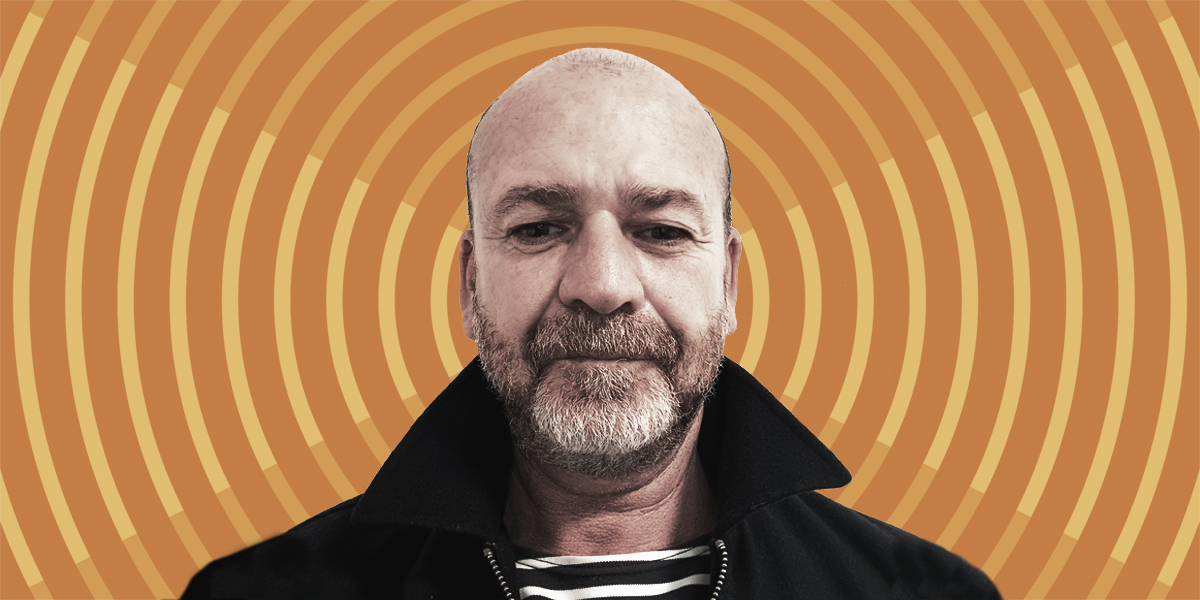
Sami Ben Gharbia is a Tunisian human rights campaigner, blogger, writer and freedom of expression advocate. He founded Global Voices Advocacy, and is the co-founder and current publisher of the collective media organization Nawaat, which won the EFF Award in 2011

Jillian York: So first, what is your personal definition, or how do you conceptualize freedom of expression?

Sami Ben Gharbia: So for me, freedom of expression, it is mainly as a human. Like, I love the definition of Arab philosophers to human beings, we call it “speaking animal”. So that's the definition in logic, like the science of logic, meditated on by the Greeks, and that defines a human being as a speaking animal, which means later on. Descartes, the French philosopher, describes it like the Ergo: I think, so I am. So the act of speaking is an act of thinking, and it's what makes us human. So this is my definition that I love about freedom of expression, because it's the condition, the bottom line of our human being. 

JY: I love that. Is that something that you learned about growing up?

SBG: You mean, like, reading it or living?

JY: Yeah, how did you come to this knowledge?

SBG: I read a little bit of logics, like science of logic, and this is the definition that the Arabs give to define what is a human being; to differentiate us from, from plants or animals, or, I don't know, rocks, et cetera. So the humans are speaking, animals, 

JY: Oh, that's beautiful. 

SBG: And by speaking, it's in the Arabic definition of the word speaking, it's thinking. It's equal to thinking. 

JY: At what point, growing up, did you realize…what was the turning point for you growing up in Tunisia and realizing that protecting freedom of expression was important?

SBG: Oh, I think, I was born in 1967 and I grew up under an authoritarian regime of the “father” of this Tunisian nation, Bourghiba, the first president of Tunisia, who got us independence from France. And during the 80s, it was very hard to find even books that speak about philosophy, ideology, nationalism, Islamism, Marxism, etc. So to us, almost everything was forbidden. So you need to hide the books that you smuggle from France or from libraries from other cities, et cetera. You always hide what you are reading because you do not want to expose your identity, like you are someone who is politically engaged or an activist. So, from that point, I realized how important freedom of expression is, because if you are not allowed even to read or to buy or to exchange books that are deemed to be controversial or are so politically unacceptable under an authoritarian regime, that's where the fight for freedom of expression should be at the forefront of of any other fights. That's the fight that we need to engage in in order to secure other rights and freedoms.

JY: You speak a number of languages, at what point did you start reading and exploring other languages than the one that you grew up speaking?

SBG: Oh, I think, well, we learn Arabic, French and English in school, and like, primary school, secondary school, so these are our languages that we take from school and from our readings, etc, and interaction with other people in Tunisia. But my first experience living in a country that speaks another language that I didn't know was in Iran. So I spent, in total, one and a half years there in Iran, where I started to learn a fourth language that I really intended to use. It's not a Latin language. It is a special language, although they use almost the same letters and alphabet with some difference in pronunciation and writing, but but it was easy for an Arab speaking native Tunisian to learn Farsi due to the familiarity with the alphabets and familiarity with the pronunciation of most of the alphabet itself. So, that's the first case where I was confronted with a foreign language. It was Iran. And then during my exile in the Netherlands, I was confronted by another family of languages, which is Dutch from the family of Germanic languages, and that's the fifth language that I learned in the Netherlands. 

JY: Wow. And how do you feel that language relates to expression? For you?

SBG: I mean…language, it's another word. It's another universe. Because language carries culture, carries knowledge, carries history, customs. So it's a universe that is living. And once you learn to speak a new language, actually, you embrace another culture. You are more open in the way of understanding and accepting differences between other cultures, and I think that's how it makes your openness much more elastic. Like you accept other cultures more, other identities, and then you are not afraid anymore. You're not scared anymore from other identities, let's say, because I think the problem of civilization and crisis or conflict starts from ignorance—like we don't know the others, we don't know the language, we don't know the customs, the culture, the heritage, the history. That's why we are scared of other people. So the language is the first, let's say, window to other identity and acceptance of other people

JY: And how many languages do you speak now?

SBG: Oh, well, I don't know. Five for sure, but since I moved to exile a second time now, to Spain, I started learning Spanish, and I've been traveling a lot in Italy, started learning some some Italian, but it is confusing, because both are Latin languages, and they share a lot of words, and so it is confusing, but it is funny. I'm not that young to learn quickly, but I'm 58 years old, so it's not easy for someone my age to learn a new language quickly, especially when you are confused about languages from the same family as Latin.

JY: Oh, that's beautiful, though. I love that. All right, now I want to dig into the history of [2011 EFF Award winner] Nawaat. How did it start?

SBG: So Nawaat started as a forum, like in the early 2000s, even before the phenomena of blogs. Blogs started later on, maybe 2003-4, when they became the main tools for expression. Before that, we had forums where people debate ideas, anything. So it started as a forum, multiple forums hosted on the same domain name, which is Nawaat.org and little by little, we adopted new technology. We moved it. We migrated the database from from the forum to CMS, built a new website, and then we started building the website or the blog as a collective blog where people can express themselves freely, and in a political context where, similar to many other countries, a lot of people express themselves through online platforms because they are not allowed to express themselves freely through television or radio or newspaper or magazines in in their own country. 

So it started mainly as an exiled media. It wasn't journalistically oriented or rooted in journalism. It was more of a platform to give voices to the diaspora, mainly the exiled Tunisian diaspora living in exile in France and in England and elsewhere. So we published Human Rights Reports, released news about the situation in Tunisia. We supported the opposition in Tunisia. We produced videos to counter the propaganda machine of the former President Ben Ali, etc. So that's how it started and evolved little by little through the changing in the tech industry, from forums to blogs and then to CMS, and then later on to to adopt social media accounts and pages. So this is how it started and why we created it that like that was not my decision. It was a friend of mine, we were living in exile, and then we said, “why not start a new platform to support the opposition and this movement in Tunisia?” And that's how we did it at first, it was fun, like it was something like it was a hobby. It wasn't our work. I was working somewhere else, and he was working something else. It was our, let's say hobby or pastime. And little by little, it became our, our only job, actually.

JY: And then, okay, so let's come to 2011. I want to hear now your perspective 14 years later. What role do you really feel that the internet played in Tunisia in 2011?

SBG: Well, it was a hybrid tool for liberation, etc. We know the context of the internet freedom policy from the US we know, like the evolution of Western interference within the digital sphere to topple governments that are deemed not friendly, etc. So Tunisia was like, a friend of the West, very friendly with France and the United States and Europe. They loved the dictatorship in Tunisia, in a way, because it secured the border. It secured the country from, by then, the Islamist movement, et cetera. So the internet did play a role as a platform to spread information and to highlight the human rights abuses that are taking place in Tunisia and to counter the narrative that is being manipulated then by the government agency, state agency, public broadcast channel, television news agency, etc. 

And I think we managed it like the big impact of the internet and the blogs by then and platforms like now. We adopted English. It was the first time that the Tunisian opposition used English in its discourse, with the objective to bridge the gap between the traditional support for opposition and human rights in Tunisia that was mainly was coming from French NGOs and human rights organization towards international support, and international support that is not only coming from the traditional, usual suspects of Human Rights Watch, Amnesty International, Freedom House, et cetera. Now we wanted to broaden the spectrum of the support and to reach researchers, to reach activists, to reach people who are writing about freedom elsewhere. So we managed to break the traditional chain of support between human rights movements or organizations and human rights activists in Tunisia, and we managed to broaden that and to reach other people, other audiences that were not really touching what was going on in Tunisia, and I think that's how the Internet helped in the field of international support to the struggle in Tunisia and within Tunisia. 

The impact was, I think, important to raise awareness about human rights abuses in the country, so people who are not really politically knowledgeable about the situation due to the censorship and due to the problem of access to information which was lacking in Tunisia, the internet helped spread the knowledge about the situation and help speed the process of the unrest, actually. So I think these are the two most important impacts within the country, to broaden the spectrum of the people who are reached and targeted by the discourse of political engagement and activism, and the second is to speed the process of consciousness and then the action in the street. So this is how I think the internet helped. That's great, but it wasn't the main tool. I mean, the main tool was really people on the ground and maybe people who didn't have access to the internet at all.

JY: That makes sense. So what about the other work that you were doing around that time with the Arabloggers meetings and Global Voices and the Arab Techies network. Tell us about that.

SBG: Okay, so my position was the founding director of Global Voices Advocacy, I was hired to found this, this arm of advocacy within Global Voices. And that gave me the opportunity to understand other spheres, linguistic spheres, cultural spheres. So it was beyond Tunisia, beyond the Arab world and the region. I was in touch with activists from all over the world. I mean by activists, I mean digital activists, bloggers that are living in Latin America or in Asia or in Eastern Europe, et cetera, because one of the projects that I worked on was Threatened Voices, which was a map of all people who were targeted because of their online activities. That gave me the opportunity to get in touch with a lot of activists.

And then we organized the first advocacy meeting. It was in Budapest, and we managed to invite like 40 or 50 activists from all over the world, from China, Hong Kong, Latin America, the Arab world, Eastern Europe, and Africa. And that broadened my understanding of the freedom of expression movement and how technology is being used to foster human rights online, and then the development of blog aggregators in the world, and mainly in the Arab world, like, each country had its own blog aggregator. That helped me understand those worlds, as did Global Voices. Because Global Voices was bridging the gap between what is being written elsewhere, through the translation effort of Global Voices to the English speaking world and vice versa, and the role played by Global Voices and Global Voices Advocacy made the space and the distance between all those blogospheres feel very diminished. We were very close to the blogosphere movement in Egypt or in Morocco or in Syria and elsewhere. 

And that's how, Alaa Abd El Fattah and Manal Bahey El-Din Hassan and myself, we started thinking about how to establish the Arab Techies collective, because the needs that we identified—there was a gap. There was a lack of communication between pure techies, people who are writing code, building software, translating tools and even online language into Arabic, and the people who are using those tools. The bloggers, freedom of expression advocates, et cetera. And because there are some needs that were not really met in terms of technology, we thought that bringing these two words together, techies and activists would help us build new tools, translate new tools, make tools available to the broader internet activists. And that's how the Arab Techies collective was born in Cairo, and then through organizing the Arabloggers meetings two times in Beirut, and then the third in Tunisia, after the revolution. 

It was a momentum for us, because it, I think it was the first time in Beirut that we brought bloggers from all Arab countries, like it was like a dream that was really unimaginable but at a certain point, but we made that happen. And then what they call the Arab revolution happened, and we lost contact with each other, because everybody was really busy with his or her own country's affairs. So Ali was really fully engaged in Egypt myself, I came back to Tunisia and was fully engaged in Tunisia, so we lost contact, because all of us were having a lot of trouble in their own country. A lot of those bloggers, like who attended the Arab bloggers meetings, few of them were arrested, few of them were killed, like Bassel was in prison, people were in exile, so we lost that connection and those conferences that brought us together, but then we've seen SMEX like filling that gap and taking over the work that started by the Arab techies and the Arab bloggers conference.

JY: We did have the fourth one in 2014 in Amman. But it was not the same. Okay, moving forward, EFF recently published this blog post reflecting on what had just happened to Nawaat, when you and I were in Beirut together a few weeks ago. Can you tell me what happened?

SBG: What happened is that they froze the work of Nawaat. Legally, although the move wasn't legal, because for us, we were respecting the law in Tunisia. But they stopped the activity of Nawaat for one month. And this is according to an article from the NGO legal framework, that the government can stop the work of an NGO if the NGO doesn't respect certain legal conditions; for them Nawaat didn't provide enough documentation that was requested by the government, which is a total lie, because we always submit all documentation on time to the government. So they stopped us from doing our job, which is what we call in Tunisia, an associated media. 

It's not a company, it's not a business. It's not a startup. It is an NGO that is managing the website and the media, and now it has other activities, like we have the online website, the main website, but we also have a festival, which is a three day festival in our headquarters. We have offline debates. We bring actors, civil society, activists, politicians, to discuss important issues in Tunisia. We have a quality print magazine that is being distributed and sold in Tunisia. We have an innovation media incubation program where we support people to build projects through journalism and technology. So we have a set of offline projects that stopped for a month, and we also stopped publishing anything on the website and all our social media accounts. And now what? It's not the only one. They also froze the work of other NGOs, like the Tunisian Association of Democratic Women, which is really giving support to women in Tunisia. Also the Tunisian Forum for Social and Economic Rights, which is a very important NGO giving support to grassroots movements in Tunisia. And they stopped Aswat Nissa, another NGO that is giving support to women in Tunisia. So they targeted impactful NGOs. 

So now what? It's not an exception, and we are very grateful to the wave of support that we got from Tunisian fellow citizens, and also friendly NGOs like EFF and others who wrote about the case. So this is the context in which we are living, and we are afraid that they will go for an outright ban of the network in the future. This is the worst case scenario that we are preparing ourselves for, and we might face this fate of seeing it close its doors and stop all offline activities that are taking place in Tunisia. Of course, the website will remain. We need to find a way to keep on producing, although it will really be risky for our on-the-ground journalists and video reporters and newsroom team, but we need to find a solution to keep the website alive. As an exiled media it's a very probable scenario and approach in the future, so we might go back to our exile media model, and we will keep on fighting.

JY: Yes, of course. I'm going to ask the final question. We always ask who someone’s free speech hero is, but I’m going to frame it differently for you, because you're somebody who influenced a lot of the way that I think about these topics. And so who's someone that has inspired you or influenced your work?

SBG: Although I started before the launch of WikiLeaks, for me Julian Assange was the concretization of the radical transparency movement that we saw. And for me, he is one of the heroes that really shaped a decade of transparency journalism and impacted not only the journalism industry itself, like even the established and mainstream media, such as the New York Times, Washington Post, Der Spiegel, et cetera. Wikileaks partnered with big media, but not only with big media, also with small, independent newsrooms in the Global South. So for me, Julian Assange is an icon that we shouldn't forget. And he is an inspiration in the way he uses technology to to fight against big tech and state and spy agencies and war crimes.
  •  

Speaking Freely: Laura Vidal

Interviewer: Jillian York

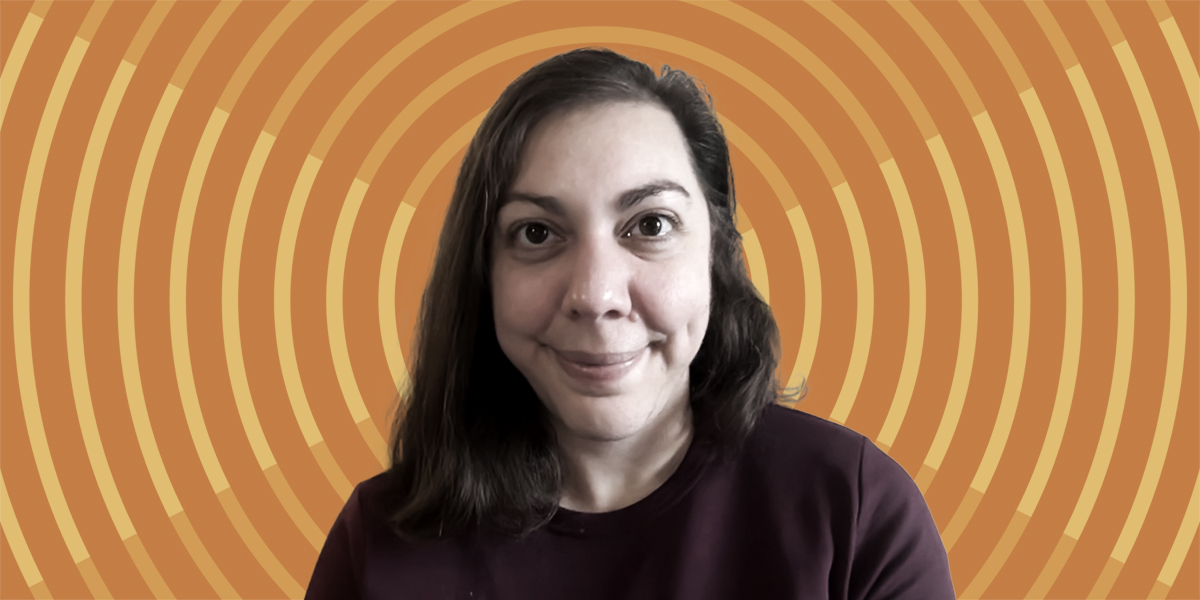
Laura Vidal is a Venezuelan researcher and writer focused on digital rights, community resilience, and the informal ways people learn and resist under authoritarian pressure. She holds a Doctorate in Education Sciences and intercultural communication, and her work explores how narratives, digital platforms, and transnational communities shape strategies of care, resistance, and belonging, particularly in Latin America and within the Venezuelan diaspora. She has investigated online censorship, disinformation, and digital literacy and is currently observing how regional and diasporic actors build third spaces online to defend civic space across borders. Her writing has appeared in Global Voices, IFEX, EFF, APC and other platforms that amplify underrepresented voices in tech and human rights.

Jillian York: Hi Laura, first tell me who you are. 

Laura Vidal: I am an independent researcher interested in digital security and how people learn about digital security. I'm also a consultant and a person of communications for IFEX and Digital Action. 

JY: Awesome. And what does free speech mean to you? 

LV: It means a responsibility. Free speech is a space that we all hold. It is not about saying what you want when you want, but understanding that it is a right that you have and others have. And that also means keeping the space as safe as possible and as free as possible for everybody to express themselves as much as possible safely. 

JY: We've known each other for nearly 20 years at this point. And like me, you have this varied background. You're a writer, you've shifted toward digital rights, you pursued a PhD. Tell me more about the path that led you to this work and why you do it. 

LV: Okay, so as you know well, we both started getting into these issues with Global Voices. I started at Global Voices as a translator and then as an author, then as an editor, and then as a community organizer. Actually, community organizer before editor, but anyways, because I started caring a lot about the representation of Latin America in general and Venezuela in particular. When I started with Global Voices, I saw that the political crisis and the narratives around the crisis were really prevalent. And it would bother me that there would be a portrait that is so simplistic. And at that time, we were monitoring the blogosphere, and the blogosphere was a reflection of this very interesting place where so many things happened. 

And so from there, I started my studies and I pursued a PhD in education sciences because I was very interested in observing how communities like Global Voices could be this field in which there was potential for intercultural exchange and learning about other cultures. At the end, of course, things were a lot more complicated than that. There are power imbalances and backgrounds that were a lot more complex, and there was this potential, but not in the way I thought it would be. Once my time in Global Voices was up and then I started pursuing research, I was very, very interested in moving from academia to research among communities and digital rights organizations and other non profits. I started doing consultancies with The Engine Room, with Tactical Tech, Internews, Mozilla and with other organizations in different projects. I've been able to work on issues that have to do with freedom of expression, with digital security and how communities are formed around digital security. And my big, big interest is how is it that we can think about security and digital rights as something that is ours, that is not something that belongs only to the super techies or the people that are super experts and that know very well this, because this is a world that can be a bit intimidating for some. It was definitely intimidating for me. So I really wanted to study and to follow up on the ways that this becomes more accessible and it becomes part of, becomes a good element to digital literacy for everyone. 

JY: That really resonates with me. I hadn't heard you articulate it that way before, but I remember when you were starting this path. I think we had that meeting in Berlin. Do you remember? 

LV: Yeah. In like 2017. Many meetings in Berlin, and we were talking about so many things. 

JY: Yeah, and I just, I remember like, because we've seen each other plenty of times over the past few years, but not as much as we used to….It's interesting, right, though, because we've both been in this space for so long. And we've seen it change, we've seen it grow. You know, I don't want to talk about Global Voices too much, but that was our entry point, right?

LV: It was. 

JY: And so that community—what did it mean for you coming from Venezuela? For me, coming from the US, we’ve both come from our home countries and moved to other countries…we have similar but different life paths. I guess I just see myself in you a little bit.

LV: That’s flattering to me. 

JY: I admire you so much. I've known you for 17 years.

LV: It's definitely mutual. 

JY: Thank you. But a lot of that comes from privilege, I recognize that.

LV: But it's good that you do, but it's also good that you use privilege for good things. 

JY: That's the thing: If you have privilege, you have to use it. And that's what I was raised with. My mother works for a non-profit organization. And so the idea of giving back has always been part of me. 

LV: I get it. And I also think that we are all part of a bigger chain. And it's very easy to get distracted by that. I definitely get distracted by those values, like the idea of being validated by a community. Coming from academia, that's definitely the case, that you really need to shine to be able to think that you're doing some work. And then also coming into the maturity of thinking, we're part of a chain. We're doing something bigger. Sometimes we are kind of going all places and we're making mistakes as a whole, but we're all part of a bigger system. And if you're part of the chain, if you have certain privileges and you can push forward the rest of the chain, that's what it is for. 

JY: Tell me about an experience that shaped your views on free expression, like a personal experience. 

LV: I'm thinking of the experience of writing about Venezuela while being abroad. That has been a very complicated, complex experience because I left Venezuela in 2008. 

JY: That's the year we met. 

LV: Exactly. I was in Budapest [for the Global Voices Summit] in 2008. And then I left Venezuela a few months later. So this experience about freedom of expression…when I left, it wasn't yet the time of the big exodus. This exodus translates today into a huge Venezuelan community all around the world that had to leave, not because they wanted to, but because they had basically no choice. It was very complicated to talk about the crisis because immediately you will get hit back. I will never forget that even in that summit that we keep discussing, the Budapest Summit of Global Voices, whenever I would talk about Venezuela, people would shut me down—people that were not Venezuelans. It was the big beginning of what we call the “Venezuelansplaining”. Because it was this political movement that was very much towards the left, that it was very much non-aligned…

JY: You had that in common with Syria. 

LV: Yeah. And so at the same time, they [the Venezuelan government] were so good at selling themselves as this progressive, non-aligned, global majority movement, feminist, you see…to me, it was shocking to see a lot of feminist groups aligning with the government, that it was a government led by a big, strong man, with a lot of discourse and very little policy change behind it. However, it was the ones that for the first time were talking about these issues from the side of the state. So from the outside, it really looked like this big government that was for the people and all the narratives of the 1960s, of the American interventions in the South that were definitely a reality, but in the case of Venezuela in the 2010s and now it is a lot more complex. And so whenever I would talk about the situation in Venezuela, it was very easy to shut me down. At first, I literally had somebody telling me, somebody who's not from Venezuela, telling me “You don't know what you're talking about. I cannot hear what you say about Venezuela because you're a privileged person.”

And I could totally take the idea of privilege, yes, but I did grow up in that country. He didn’t know it, and I did, and he definitely didn’t know anything about me. It was very easy to be shut down and very easy to self-censor because after that experience, plus writing about it or having opinions about it and constantly being told “you're not there, you cannot speak,” I just started not talking about it. And I think my way of responding to that was being able to facilitate conversations about that. 

And so I was very happy to become the editor of the Americas of Global Voices back then, because if I couldn't write about it because of these reasons—which I guess I understand—I will push others to talk about it. And not only about Venezuela, but Latin America, there are so many narratives that are very reductive, really simplistic about the region that I really wanted to really push back against. So that's why I see freedom of expression as this really complex thing, this really, really complicated thing. And I guess that's why I also see it not only as a right too, but also as a responsibility. Because the space that we have today is so messy and polluted with so many things that you can claim freedom of expression just to say anything, and your goal is not to express yourself, but to harm other people, vulnerable people in particular. 

JY: What do you think is the ideal online environment for free expression? What are the boundaries or guardrails that should be put in place? What guides you? 

LV: I'm not even sure that something guides me completely. I guess that I'm guided by the organizations that observe and defend the space, because they're constantly monitoring, they're constantly explaining, they're talking to people, they have an ear on the ground. It is impossible to think of a space that can be structured and have certain codes. We are a really complicated species. We had these platforms that we started seeing as this hope for people to connect, and then they ended up being used to harm. 

I guess that's also why the conversations about regulations are always so complicated, because whenever we push for legislation or for different kinds of regulations, those regulations then take a life of their own and everybody's able to weaponize them or manipulate them. So yes, there are definitely guidelines and regulations, but I think it's a pendular movement. You know, it's recognizing that the space in which people communicate is always going to be chaotic because everybody will want to have their say. But at the same time, it's important to keep observing and having guidelines. I will go with you, having UN guidelines that translate from organizations that observe the space. I hate to answer saying that I have no guidelines, but at the same time, I guess it's also the idea of the acceptance that it's a chaotic space. And for it to be healthy, we need to accept that it's going to be. It cannot be very structured. It cannot function if it's too structured because there will not be free expression. 

JY: I get that. So ultimately then, where do you stand on regulation? 

LV: I think it's necessary; at some point we need rules to go by and we need some rules of the game. But it cannot be blindly, and we cannot think that regulations are going to stay the same over time. Regulations need to be discussed. They need to evolve. They need to be studied. Once they're in place, you observe how they're used and then how they can be adjusted. It's like they need to be as alive as the spaces of expression are. 

JY: Yes. What countries do you think or entities do you think are doing the best job of this right now? I feel that the EU is maybe trying its hardest, but it's not necessarily enough. 

LV: And I think it's also a little bit dangerous to think of whatever the European Union does as an example. There have been so many cases of copy-paste legislation that has nothing to do with the context. When we talk about privacy, for example, the way that Europe, the way that France and Germany understand privacy, it's not the way that Colombia, for example, understands privacy. It's very different. Culturally, it's different. You can see that people understand legislation, thinking about privacy very differently. And so this kind of way, which I think is like, I will even dare to say is a bit colonial, you know? Like, we set the example, we put the rules and you should follow suit. And why? I like the effort of the European Union as an entity. The fact that so many countries that have been at war for so long managed to create a community, I'm impressed. The jury's still out on how that's working, but I'm still impressed. 

JY: Do you think that because—maybe because of Global Voices or our experience of moving countries, or our friendships—having a global worldview and seeing all of these different regulations and different failures and different successes makes it more complex for us than, say, somebody who's working only on policy in the EU or in the US or in the UK? Do you think it's harder for us then to reconcile these ideas, because we see this broader picture?

LV: That's a really good point. I'm not sure. I do believe very strongly in the idea that we should be in contact. As with everything that has to do with freedom of expression, initiatives, and the fight for spaces and to protect journalists and to regulate platforms, we should be looking at each other's notes. Absolutely. Is there a way to look at it globally? I don't know. I don't think so. I think that I was very much a believer of the idea of a global world where we're all in contact and the whole thing of the global village. 

But then when you start exchanging and when you see how things play out—whenever we think about “globalities”—there's always one overpowering the rest. And that's a really difficult balance to get. Nothing will ever be [truly] global. It will not. We're still communicating in English, we're still thinking about regulations, following certain values. I'm not saying that's good or bad. We do need to create connections. I wouldn't have been able to make friendships and beautiful, beautiful relations that taught me a lot about freedom of expression and digital security had I not spoken this language, because I don't speak Arabic, and these Egyptian friends [that I learned from early on] don't speak Spanish. So those connections are important. They're very important. But the idea of a globality where everybody is the same…I see that as very difficult. And I think it goes back to this idea that we could have perfect regulation or perfect structures—like, if we had these perfect structures, everything would be fine. And I think that we're learning very painfully that is just not possible. 

Everything that we will come up with, every space that we will open, will be occupied by many other people's powers and interests. So I guess that the first step could be to recognize that there's this uneasy relation of things that cannot be global, that cannot be completely horizontal, that doesn't obey rules, it doesn't obey structures…to see what it is that we're going to do. Because so far, I believe that there's been so many efforts towards equalizing spaces. I have been thinking about this a lot. We tend to think so much about solutions and ways in which we all connect and everything. And at the end, it ends up emptying those words of their meaning, because we're reproducing imbalances, we reproduce power relations. So, I don't know how to go back to the question, because I don't think that there's an ideal space. If there was an ideal space, I don't think that we'd be human, you know? I think that part of what will make it realistic is that it moves along. So I guess the ideal place is, it will be one that is relatively safe for most, and especially that it will have special attention to protect vulnerable groups. 

If I could dream of a space with regulations and structures that will help, I think that my priority would be structures that at least favor the safety of the most vulnerable, and then the others will find their ground. I hope this makes sense. 

JY: No, it does. It does. I mean, it might not make sense to someone who is purely working on policy, but it makes sense to me because I feel the same way. 

LV: Yeah, I think a policy person will already be like looking away, you know, like really hoping to get away from me as soon as possible because this woman is just rambling. But they have this really tough job. They need to put straight lines where there are only curves. 

JY: Going back for a moment to something you mentioned, learning from people elsewhere in the world. That Global Voices meeting changed my life.

LV: It changed my life too. I was 26.

JY: I was 26 too! I’d been living in Morocco until just recently, and I remember meeting all of these people from other parts of the region, and beginning to understand through meeting people how different Morocco was from Syria, or Egypt. How the region wasn’t a monolith.

LV: And that’s so important. These are the things I feel that we might know intellectually, but when you actually “taste” them, there are no words you can express when you realize the complexity of people that you didn’t think of as complex as you. That was the year I met Mohamed El Gohary. I will never forget that as critical as I was of the government of Venezuela back then, never in a million years would I have imagined that they would be like they are now. I used to work in a ministry, which means that I was very much in contact with people that were really big believers of [Chavismo’s] project, and I would listen to them being really passionate and see how people changed their lives because they had employment and many other things they lacked before: representation in government among them. All of those projects ended up being really short-term solutions, but they changed the perspective of a lot of people and a lot of people that believed so wholeheartedly in it. I remember that most of the Latin America team, we were very shaken by the presentations coming from Advox, seeing the blogs and the bloggers were in prison. I remember Gohary asking me “have you had any platforms blocked, or shutdowns, or have any newspapers been closed?” I said no, and he said “that’s coming.”

JY: I remember this. I feel like Tunisia and Egypt really served as examples to other countries of what states could do with the internet. And I think that people without a global view don’t recognize that as clearly.

LV: That's very true. And I think we still lack this global view. And in my opinion, we lack a global view that doesn't go through the United States or Europe. Most of the conveners and the people that put us in contact have been linked or rooted in Western powers. And connections were made, which is good. I would have never understood these issues of censorship had it not been for these Egyptian friends that were at Global Voices. That's very important. And ever since, I am convinced that you can grow through people from backgrounds that are very different from yours, because you align on one particular thing. And so I've always been really interested in South, quote unquote, “South-South” relationships, the vision Latin America has of Africa. And I really dislike saying Africa as if it was one thing. 

But the vision that we need to have is...I love, there's a writer that I love, Ryszard Kapuściński, and he wrote a book about Africa. He's a Polish journalist and he wrote about the movements of independence because he was the only journalist that the newspaper had for internationals. He would go to every place around, and it was the 60s. So there were like independence movements all around. And at the end, he wrote this big summary of his experiences in “Africa.” And the first page says, other than for the geographic name that we put to it, Africa doesn't exist. This is a whole universe. This is a whole world. And so the vision, this reductionist vision that a lot of us in Latin America have come through these, you know, glasses that come from the West. So to me, when I see cases in which you have groups from Venezuela, collaborating with groups in Senegal because the shutdowns that happen in both countries rhyme, I am passionately interested in these connections, because these are connections of people that don't think are similar, but they're going through similar, very similar things, and they realize how similar they are in the process. That was my feeling with [other friends from Egypt] and Gohary. The conversations that we had, the exchanges that we had, let's say at the center of our table, our excuse was this idea of freedom on the internet and how digital security will work. But that was the way that we could dialogue. And to me, it was one proof of how you grow through the experiences of people that you mistakenly think are not like you. 

JY: Yes. Yeah, no, exactly, And that was really, that was my experience too, because in the U.S. at the time, obviously there were no restrictions on the internet, but I moved to Morocco and immediately on my first day there, I had a LiveJournal. I think I've written about this many times. I had LiveJournal, which was my blogging platform at the time, and I went to log in and the site was blocked. And LiveJournal was blocked because there had been a lot of blogs about the Western Sahara, which was a taboo topic at the time, still is in many ways. And so I had to, I had to make a decision. Do I figure out a circumvention tool? I had an American friend who was emailing me about how to get around this, or maybe we had a phone call. And so I ended up, I ended up becoming a public blogger because of censorship. 

LV: That's so interesting because it is the reaction. Somebody says, I like, I didn't want to talk, but now that you don't want me to, now I will. 

JY:  Yeah, now I will. And I never crossed the red lines while I was living there because I didn't want to get in trouble. And I wrote about things carefully. But that experience connected me to people. That's how I found Global Voices. 

I want to ask you another question. When we met in Portugal in September, we discussed the idea that what’s happening in the U.S. has made it easier for people there to understand repression in other countries…that some Americans are now more able to see creeping authoritarianism or fascism elsewhere because they’re experiencing it themselves. What are your thoughts on that?

LV: So what pops in my mind is this, because I always find this fantasy very interesting that things cannot happen in certain countries, even if they've already happened. There are a lot of ideas of, we were talking about having the European Union as an example. And yes, the United States were very much into, you know, this idea of freedom of the press, freedom of expression. But there was also this idea, this narrative that these kinds of things will never happen in a place like the United States, which I think is a very dangerous idea, because it gets you to not pay attention. And there are so many ways in which expression can be limited, manipulated, weaponized, and it was a long time coming, that there were a lot of pushes to censor books. When you start seeing that, you push for libraries to take certain books out, you really start seeing like the winds blowing in that direction. And so now that it has become probably more evident, with the case of the Jimmy Kimmel show and the ways that certain media have been using their time to really misinform, you really start seeing parallels with other parts of the continent. I think it's very important, this idea that we look at each other. I will always defend the idea that we need to be constantly in dialogue and not necessarily look for examples.

Let’s say from Mexico downward, this idea of “look at this thing that people are doing in the States”—I don’t think that has ever served us, and it won’t serve us now. It is very important that we remain in dialogue. Because one thing that I found beautiful and fascinating that is happening among Venezuelan journalists is that you will see media that would  be competing with one in other circumstances are  now working together. They wouldn't survive otherwise. And also countries in the region that wouldn't look at each other before, they are working together as well. So you have Venezuelan journalists working with Nicaraguan journalists and also human rights defenders really looking at each other's cases because authoritarian regimes look at each other. We were talking about Egypt as an example before. And we keep seeing this but we're not paying enough attention. When we see events, for example, how they are regional, and that is really important. We need to talk amongst ourselves. We understand the realities of our regions, but it is so important that there's always somebody invited, somebody looking at other regions, how is it playing out, what are people doing. Latin America is a really great place where people should be looking at when thinking about counter-power and looking for examples of different ways of resistance. And unfortunately, also where things can go. How are technologies being used to censor? 

In the case of Venezuela, you had newspapers being progressively harassed. Then they wouldn't find paper. Then they had to close down. So they pushed them online where they're blocking them and harassing them. So it is a slow movement. It's very important to understand that this can happen anywhere. Everyone is at risk of having an authoritarian regime. This idea, these regressive ideas about rights, they are happening globally and they're getting a lot of traction. So the fact that we need to be in contact is crucial. It is crucial to really go beyond the narratives that we have of other countries and other cultures and to think that is particular to that place because of this and that. I think if there's a moment in which we can understand all of us as a whole group, as a region, like from the whole of the Americas, it is now. 

JY: That's such a good point. I agree. And I think it's important both to look at it on that semi-local scale and then also scale it globally, but understand like the Americas in particular, yeah, have so much in common. 

LV: No. I really believe that if there was something that I will be pushing forward, it's this idea that, first of all, these borders that are imagined, they're artificial, we created it to protect things that we have accumulated. And we, like the whole of the continent, have this history of people that came to occupy other people's lands. That's their origin story. All of the continent. Yeah. So maybe trying to understand that in terms of resistance and in terms of communities, we should be aware of that and really think about communities of counter power, resistance and fight for human rights should be, I guess they should have its own borders, you know, like not American groups or Nicaraguan groups or Colombian groups, like really create some sort of I guess, way to understand that these national borders are, they're not serving us. We really need to collaborate in ways that go really beyond that. Fully understanding the backgrounds and the differences and everything, but really connecting in things in ways that make sense. I don't think that one human rights defense community can go against its own state. They are outnumbered. The power imbalance is too big. But these groups in combination, looking at each other and learning from each other, being in contact, collaborating, it makes, well, you know, it's just simple math. It will make for more of us working together. 

JY: Absolutely. At EFF, we have a team that works on issues in Latin America, and some are based in Latin America. And it’s been interesting, because I came to EFF from having worked in a Middle East perspective, and my colleague Katitza Rodriguez, who started just a year or two before me came from a Latin American perspective, and apart from our EU work, those remain the two regional strongholds of EFF’s international work. And we’ve bridged that. I remember a couple of years ago having calls between Colombians and Palestinians because they were experiencing the same censorship issues online.

LV: That’s what I dream of.

JY: That's the sort of bridging work that you and I kind of came up in. And I think that like that experience for me, and similarly for Katitza, and then bringing that to EFF. And so we had these ties. And I think of everything you’ve said, one of the things that struck me the most is that this is a generational thing. We’re all Gen X, or early Millennials, or whatever you want to call it. I know it differs globally, but we all grew up under similar circumstances in terms of the information age, and I think that shaped our worldview in a way that—if we’re open to it—our generation thinks uniquely from the ones before and after us, because we lived a little bit in both worlds. I think it’s a really unique experience.

LV: I feel really excited to hear you say this because at times I feel that I'm thinking about this and it looks like it sounds like very weird ideas, but we are definitely part of this generation that lived the transition to online worlds and we are living in these—I love to call them digital third spaces. We're constantly negotiating our identities. We are creating new ones. We're creating homes that are “in the air.” Because yes, you are in Berlin now and I'm in France and other friends are in Venezuela, others are in Colombia and so on. But we are in this kind of commonplace, in this space where we meet that is neither nor. And it is a place that has let me understand borders very differently and understand identity very differently. And I think that is the door that we have to go through to understand how community and collaboration cross regionally and beyond borders. It's not only necessary, it's more realistic. 

JY: Absolutely, I agree. Let me ask you the last question: Who's your free expression hero? Or somebody who's inspired you. Somebody who really changed your world. 

LV: I am so proud of the Venezuelan community. So proud. They're all people that are inspiring, intelligent, dynamic. And if I had to pick one with a lot of pain, I would say Valentina Aguana. She works with Connexion Segura y Libre. She's like twenty-something. I love to see this person in her twenties. And very often, especially now that you see younger generations going to places that we don't understand. I love that she's a young person in this space, and I love how well she understands a lot of these things. I love very much how she integrates this idea of having the right to do things. That was very hard for me when I was growing up. It was very hard when I was her age to understand I had the right to do things, that I had the right to express myself. Not only does she understand that her work is devoted to ensuring that other people have the right as well, and they have the space to do that safely. 

JY: I love that. Thank you so much Laura.

  •  

Speaking Freely: Benjamin Ismail

Interviewer: Jillian York

Benjamin Ismail is the Campaign and Advocacy Director for GreatFire, where he leads efforts to expose the censorship apparatus of authoritarian regimes worldwide. He also runs/oversees the App Censorship Project, including the AppleCensorship.com and GoogleCensorship.org platforms, which track mobile app censorship globally. From 2011 to 2017, Benjamin headed the Asia-Pacific desk at Reporters Without Borders (RSF).

Jillian York: Hi Benjamin, it's great to chat with you. We got to meet at the Global Gathering recently and we did a short video there and it was wonderful to get to know you a little bit. I'm going to start by asking you my first basic question: What does free speech or free expression mean to you?

Benjamin Ismail: Well, it starts with a very, very big question. What I have in mind is a cliche answer, but it's what I genuinely believe. I think about all freedoms. So when you say free expression, free speech, or freedom of information or Article 19, all of those concepts are linked together, I immediately think of all human rights at once. Because what I have seen during my current or past work is how that freedom is really the cornerstone of all freedom. If you don’t have that, you can’t have any other freedom. If you don’t have freedom of expression, if you don't have journalism, you don't have pluralism of opinions—you have self-censorship.

You have realities, violations, that exist but are not talked about, and are not exposed, not revealed, not tackled, and nothing is really improved without that first freedom. I also think about Myanmar because I remember going there in 2012, when the country had just opened after the democratic revolution. We got the chance to meet with many officials, ministers, and we got to tell them that they should start with that because their speech was “don’t worry, don’t raise freedom of speech, freedom of the press will come in due time.”

And we were saying “no, that’s not how it works!” It doesn’t come in due time when other things are being worked on. It starts with that so you can work on other things. And so I remember very well those meetings and how actually, unfortunately, the key issues that re-emerged afterwards in the country were precisely due to the fact that they failed to truly implement free speech protections when the country started opening.

JY: What was your path to this work?

BI: This is a multi-faceted answer. So, I was studying Chinese language and civilization at the National Institute of Oriental Languages and Civilizations in Paris along with political science and international law. When I started that line of study, I considered maybe becoming a diplomat…that program led to preparing for the exams required to enter the diplomatic corps in France.

But I also heard negative feedback on the Ministry of Foreign Affairs and, notably, first-hand testimonies from friends and fellow students who had done internships there. I already knew that I had a little bit of an issue with authority. My experience as an assistant at Reporters Without Borders challenged the preconceptions I had about NGOs and civil society organizations in general. I was a bit lucky to come at a time when the organization was really trying to find its new direction, its new inspiration. So it a brief phase where the organization itself was hungry for new ideas.

Being young and not very experienced, I was invited to share my inputs, my views—among many others of course. I saw that you can influence an organization’s direction, actions, and strategy, and see the materialization of those strategic choices. Such as launching a campaign, setting priorities, and deciding how to tackle issues like freedom of information, and the protection of journalists in various contexts.

That really motivated me and I realized that I would have much less to say if I had joined an institution such as the Ministry of Foreign Affairs. Instead, I was part of a human-sized group, about thirty-plus employees working together in one big open space in Paris.

After that experience I set my mind on joining the civil society sector, focusing on freedom of the press. on journalistic issues, you get to touch on many different issues in many different regions, and I really like that. So even though it’s kind of monothematic, it's a single topic that's encompassing everything at the same time.

I was dealing with safety issues for Pakistani journalists threatened by the Taliban. At the same time I followed journalists pressured by corporations such as TEPCO and the government in Japan for covering nuclear issues. I got to touch on many topics through the work of the people we were defending and helping. That’s what really locked me onto this specific human right.

 I already had my interest when I was studying in political and civil rights, but after that first experience, at the end of 2010, I went to China and got called by Reporters Without Borders. They told me that the head of the Asia desk was leaving and invited me to apply for the position. At that time, I was in Shanghai, working to settle down there. The alternative was accepting a job that would take me back to Paris but likely close the door on any return to China. Once you start giving interviews to outlets like the BBC and CNN, well… you know how that goes—RSF was not viewed favorably in many countries. Eventually, I decided it was a huge opportunity, so I accepted the job and went back to Paris, and from then on I was fully committed to that issue.

 JY: For our readers, tell us what the timeline of this was.

 BI: I finished my studies in 2009. I did my internship with Reporters Without Borders that year and continued to work pro bono for the organization on the Chinese website in 2010. Then I went to China, and in January 2011, I was contacted by Reporters without Borders about the departure of the former head of the Asia Pacific Desk.

I did my first and last fact-finding mission in China, and went to Beijing. I met the artist Ai Weiwei in Beijing just a few weeks before he was arrested, around March 2011, and finally flew back to Paris and started heading the Asia desk. I left the organization in 2017. 

JY: Such an amazing story. I’d love to hear more about the work that you do now.

 BI: The story of the work I do now actually starts in 2011. That was my first year heading the Asia Pacific Desk. That same year, a group of anonymous activists based in China started a group called GreatFire. They launched their project with a website where you can type any URL you want and that website will test the connection from mainland China to that URL and tell you know if it’s accessible or blocked. They also kept the test records so that you can look at the history of the blocking of a specific website, which is great. That was GreatFire’s first project for monitoring web censorship in mainland China.

We started exchanging information, working on the issue of censorship in China. They continued to develop more projects which I tried to highlight as well. I also helped them to secure some funding. At the very beginning, they were working on these things as a side job. And progressively they managed to get some funding, which was very difficult because of the anonymity.

One of the things I remember is that I helped them get some funding from the EU through a mechanism called “Small Grants”, where every grant would be around €20- 30,000. The EU, you know, is a bureaucratic entity and they were demanding some paperwork and documents. But I was telling them that they wouldn’t be able to get the real names of the people working at GreatFire, but that they should not be concerned about that because, what they wanted was to finance that tool. So if we were to show them that the people they were going to send the money to were actually the people controlling that website, then it would be fine. And so we featured a little EU logo just for one day, I think on the footer of the website so they could check that. And that’s how we convinced the EU to support GreatFire for that work. Also, there's this tactic called “Collateral Freedom” that GreatFire uses very well.

The idea is that you host sensitive content on HTTPS servers that belong to companies which also operate inside China and are accessible there. Because it’s HTTPS, the connection is encrypted, so the authorities can’t just block a specific page—they can’t see exactly which page is being accessed. To block it, they’d have to block the entire service. Now, they can do that, but it comes at a higher political and economic cost, because it means disrupting access to other things hosted on that same service—like banks or major businesses. That’s why it’s called “collateral freedom”: you’re basically forcing the authorities to risk broader collateral damage if they want to censor your content.

When I was working for RSF, I proposed that we replicate that tactic on the 12th of March—that's the World Day against Cyber Censorship. We had the habit of publishing what we called the “enemies of the Internet” report, where we would highlight and update the situation on the countries which were carrying out the harshest repression online; countries like Iran, Turkmenistan, North Korea, and of course, China. I suggested in a team meeting: “what if we highlighted the good guys? Maybe we could highlight 10 exiled media and use collateral freedom to uncensor those. And so we did: some Iranian media, Egyptian media, Chinese media, Turkmen media were uncensored using mirrors hosted on https servers owned by big, and thus harder to block, companies...and that’s how we started to do collateral freedom and it continued to be an annual thing.

I also helped in my personal capacity, including after I left Reporters Without Borders. After I left RSF, I joined another NGO focusing on China, which I knew also from my time at RSF. I worked with that group for a year and a half; GreatFire contacted me to work on a website specifically. So here we are, at the beginning of 2020, they had just started this website called Applecensorship.com that allowed users to test availability of any app in any of Apple’s 175 App Stores worldwide They needed a better website—one that allowed advocacy content—for that tool.

The idea was to make a website useful for academics doing research, journalists investigating app store censorship and control and human rights NGOs, civil society organizations interested in the availability of any tools. Apple’s censorship in China started quickly after the company entered the Chinese market, in 2010.

In 2013, one of the projects by GreatFire which had been turned into an iOS app was removed by Apple 48 hours after its release on the App Store, at the demand of the Chinese authorities. That project was Free Weibo, which is a website which features censored posts from Weibo, the Chinese equivalent of Twitter—we crawl social media and detect censored posts and republish them on the site. In 2017 it was reported that Apple had removed all VPNs from the Chinese app store.

So between that episode in 2013, and the growing censorship of Apple in China (and in other places too) led to the creation of AppleCensorship in 2019. GreatFire asked me to work on that website. The transformation into an advocacy platform was successful. I then started working full time on that project, which has since evolved into the App Censorship Project, which includes another website, googlecensorship.org (offering features similar to Applecensorship.com but for the 224 Play Stores worldwide). In the meantime, I became the head of campaigns and advocacy, because of my background at RSF.  

 JY: I want to ask you, looking beyond China, what are some other places in the world that you're concerned about at the moment, whether on a professional basis, but also maybe just as a person. What are you seeing right now in terms of global trends around free expression that worry you?

BI: I think, like everyone else, that what we're seeing in Western democracies—in the US and even in Europe—is concerning. But I'm still more concerned about authoritarian regimes than about our democracies. Maybe it's a case of not learning my lesson or of naive optimism, but I'm still more concerned about China and Russia than I am about what I see in France, the UK, or the US.

There has been some recent reporting about China developing very advanced censorship and surveillance technologies and exporting them to other countries like Myanmar and Pakistan. What we’re seeing in Russia—I’m not an expert on that region, but we heard experts saying back in 2022 that Russia was trying to increase its censorship and control, but that it couldn’t become like China because China had exerted control over its internet from the very beginning: They removed Facebook back in 2009, then Google was pushed away by the authorities (and the market). And the Chinese authorities successfully filled the gaps left by the absence of those foreign Western companies.

Some researchers working on Russia were saying that it wasn’t really possible for Russia to do what China had done because it was unprepared and that China had engineered it for more than a decade. What we are seeing now is that Russia is close to being able to close its Internet, to close the country, to replace services by its own controlled ones. It’s not identical, but it’s also kind of replicating what China has been doing. And that’s a very sad observation to make.

 Beyond the digital, the issue of how far Putin is willing to go in escalating concerns. As a human being and an inhabitant of the European continent, I’m concerned by the ability of a country like Russia to isolate itself while waging a war. Russia is engaged in a real war and at the same time is able to completely digitally close down the country. Between that and the example of China exporting censorship, I’m not far from thinking that in ten or twenty years we’ll have a completely splintered internet.

JY: Do you feel like having a global perspective like this has changed or reshaped your views in any way?

BI: Yes, in the sense that when you start working with international organizations, and you start hearing about the world and how human rights are universal values, and you get to meet people and go to different countries, you really get to experience how universal those freedoms and aspirations are. When I worked RSF and lobbied governments to pass a good law or abolish a repressive one, or when I worked on a case of a jailed journalist or blogger, I got to talk to authorities and to hear weird justifications from certain governments (not mentioning any names but Myanmar and Vietnam) like “those populations are different from the French” and I would receive pushback that the ideas of freedoms I was describing were not applicable to their societies. It’s a bit destabilizing when you hear that for the first time. But as you gain experience, you can clearly explain why human rights are universal and why different populations shouldn’t be ruled differently when it comes to human rights.

Everyone wants to be free. This notion of “universality” is comforting because when you’re working for something universal, the argument is there. The freedoms you defend can’t be challenged in principle, because everyone wants them. If governments and authorities really listened to their people, they would hear them calling for those rights and freedoms.

Or that’s what I used to think. Now we hear this growing rhetoric that we (people from the West) are exporting democracy, that it’s a western value, and not a universal one. This discourse, notably developed by Xi Jinping in China, “Western democracy” as a new concept— is a complete fallacy. Democracy was invented in the West, but democracy is universal. Unfortunately, I now believe that, in the future, we will have to justify and argue much more strongly for the universality of concepts like democracy, human rights and fundamental freedoms. 

JY: Thank you so much for this insight. And now for our final question: Do you have a free speech hero?

BI: No.

JY: No? No heroes? An inspiration maybe.

BI: On the contrary, I’ve been disappointed so much by certain figures that were presented as human rights heroes…Like Aung San Suu Kyi during the Rohingya crisis, on which I worked when I was at RSF.

Myanmar officially recognizes 135 ethnic groups, but somehow this one additional ethnic minority (the Rohingya) is impossible for them to accept. It’s appalling. It’s weird to say, but some heroes are not really good people either. Being a hero is doing a heroic action, but people who do heroic actions can also do very bad things before or after, at a different level. They can be terrible persons, husbands or friends and be a “human rights” hero at the same time.

Some people really inspired me but they’re not public figures. They are freedom fighters, but they are not “heroes”. They remain in the shadows. I know their struggles; I see their determination, their conviction, and how their personal lives align with their role as freedom fighters. These are the people who truly inspire me.

  •  

EFF Stands With Tunisian Media Collective Nawaat

When the independent Tunisian online media collective Nawaat announced that the government had suspended its activities for one month, the news landed like a punch in the gut for anyone who remembers what the Arab uprisings promised: dignity, democracy, and a free press.

But Tunisia’s October 31 suspension of Nawaat—delivered quietly, without formal notice, and justified under Decree-Law 2011-88—is not just a bureaucratic decision. It’s a warning shot aimed at the very idea of independent civic life.

The silencing of a revolutionary media outlet

Nawaat’s statement, published last week, recounts how the group discovered the suspension: not through any official communication, but by finding the order slipped under its office door. The move came despite Nawaat’s documented compliance with all the legal requirements under Decree 88, the 2011 law that once symbolized post-revolutionary openness for associations.

Instead, the Decree, once seen as a safeguard for civic freedom, is now being weaponized as a tool of control. Nawaat’s team describes the action as part of a broader campaign of harassment: tax audits, financial investigations, and administrative interrogations that together amount to an attempt to “stifle all media resistance to the dictatorship.”

For those who have followed Tunisia’s post-2019 trajectory, the move feels chillingly familiar. Since President Kais Saied consolidated power in 2021, civil society organizations, journalists, and independent voices have faced escalating repression. Amnesty International has documented arrests of reporters, the use of counter-terrorism laws against critics, and the closure of NGOs. And now, the government has found in Decree 88 a convenient veneer of legality to achieve what old regimes did by force.

Adopted in the hopeful aftermath of the revolution, Decree-Law 2011-88 was designed to protect the right to association. It allowed citizens to form organizations without prior approval and receive funding freely—a radical departure from the Ben Ali era’s suffocating controls.

But laws are only as democratic as the institutions that enforce them. Over the years, Tunisian authorities have chipped away at these protections. Administrative notifications, once procedural, have become tools for sanction. Financial transparency requirements have turned into pretexts for selective punishment.

When a government can suspend an association that has complied with every rule, the rule of law itself becomes a performance.

Bureaucratic authoritarianism

What’s happening in Tunisia is not an isolated episode. Across the region, governments have refined the art of silencing dissent without firing a shot. But whether through Egypt’s NGO Law, Morocco’s press code, or Algeria’s foreign-funding restrictions, the outcome is the same: fewer independent outlets, and fewer critical voices.

These are the tools of bureaucratic authoritarianism…the punishment is quiet, plausible, and difficult to contest. A one-month suspension might sound minor, but for a small newsroom like Nawaat—which operates with limited funding and constant political pressure—it can mean disrupted investigations, delayed publications, and lost trust from readers and sources alike.

A decade of resistance

To understand why Nawaat matters, remember where it began. Founded in 2004 under Zine El Abidine Ben Ali’s dictatorship, Nawaat became a rare space for citizen journalism and digital dissent. During the 2011 uprising, its reporting and documentation helped the world witness Tunisia’s revolution.

Over the past two decades, Nawaat has earned international recognition, including an EFF Pioneer Award in 2011, for its commitment to free expression and technological empowerment. It’s not just a media outlet; it’s a living archive of Tunisia’s struggle for dignity and rights.

That legacy is precisely what makes it threatening to the current regime. Nawaat represents a continuity of civic resistance that authoritarianism cannot easily erase.

The cost of silence

Administrative suspensions like this one are designed to send a message: You can be shut down at any time. They impose psychological costs that are harder to quantify than arrests or raids. Journalists start to self-censor. Donors hesitate to renew grants. The public, fatigued by uncertainty, tunes out.

But the real tragedy lies in what this means for Tunisians’ right to know. Nawaat’s reporting on corruption, surveillance, and state violence fills the gaps left by state-aligned media. Silencing it deprives citizens of access to truth and accountability.

As Nawaat’s statement puts it:

“This arbitrary decision aims to silence free voices and stifle all media resistance to the dictatorship.”

The government’s ability to pause a media outlet, even temporarily, sets a precedent that could be replicated across Tunisia’s civic sphere. If Nawaat can be silenced today, so can any association tomorrow.

So what can be done? Nawaat has pledged to challenge the suspension in court, but litigation alone won’t fix a system where independence is eroding from within. What’s needed is sustained, visible, and international solidarity.

Tunisia’s government may succeed in pausing Nawaat’s operations for a month. But it cannot erase the two decades of documentation, dissent, and hope the outlet represents. Nor can it silence the networks of journalists, technologists, and readers who know what is at stake.

EFF has long argued that the right to free expression is inseparable from the right to digital freedom. Nawaat’s suspension shows how easily administrative and legal tools can become weapons against both. When states combine surveillance, regulatory control, and economic pressure, they don’t need to block websites or jail reporters outright—they simply tighten the screws until free expression becomes impossible.

That’s why what happens in Tunisia matters far beyond its borders. It’s a test of whether the ideals of 2011 still mean anything in 2025.

And Nawaat, for its part, has made its position clear:

“We will continue to defend our independence and our principles. We will not be silenced.”

  •  

Companies Must Provide Accurate and Transparent Information to Users When Posts are Removed

This is the third installment in a blog series documenting EFF's findings from the Stop Censoring Abortion campaign. You can read additional posts here. 

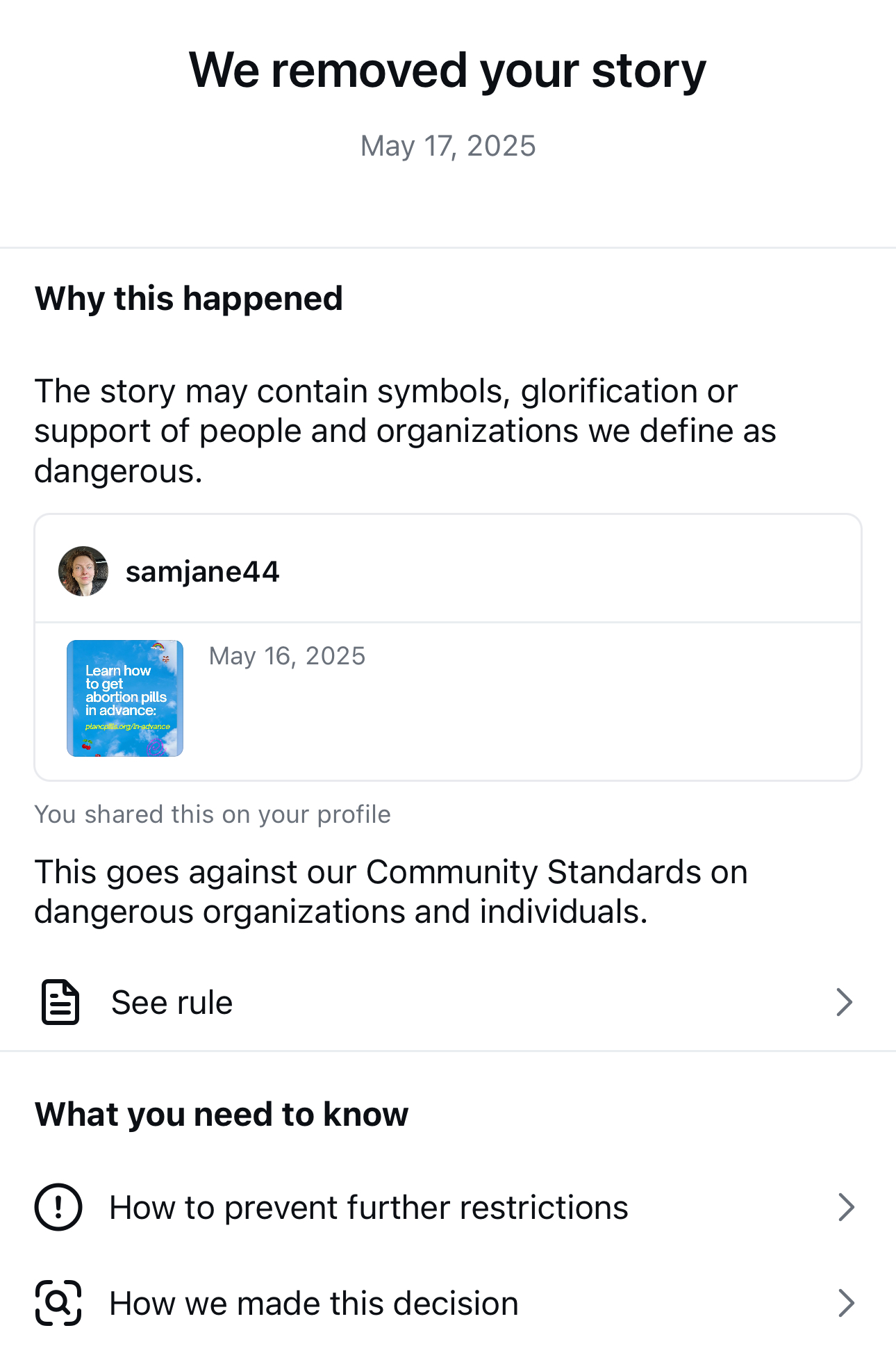
Imagine sharing information about reproductive health care on social media and receiving a message that your content has been removed for violating a policy intended to curb online extremism. That’s exactly what happened to one person using Instagram who shared her story with our Stop Censoring Abortion project.

Meta’s rules for “Dangerous Organizations and Individuals” (DOI) were supposed to be narrow: a way to prevent the platform from being used by terrorist groups, organized crime, and those engaged in violent or criminal activity. But over the years, we’ve seen these rules applied in far broader—and more troubling—ways, with little transparency and significant impact on marginalized voices.

EFF has long warned that the DOI policy is opaque, inconsistently enforced, and prone to overreach. The policy has been critiqued by others for its opacity and propensity to disproportionately censor marginalized groups.

a screenshot showing the user's post being flagged under Meta's DOI policy

Samantha Shoemaker's post about Plan C was flagged under Meta's policy on dangerous organizations and individuals

Meta has since added examples and clarifications in its Transparency Center to this and other policies, but their implementation still leaves users in the dark about what’s allowed and what isn’t.

The case we received illustrates just how harmful this lack of clarity can be. Samantha Shoemaker, an individual sharing information about abortion care, shared straightforward, facts about accessing abortion pills. Her posts included:

  • A video linking to Plan C’s website, which lists organizations that provide abortion pills in different states.

  • A reshared image from Plan C’s own Instagram account encouraging people to learn about advance provision of abortion pills.

  • A short clip of women talking about their experiences taking abortion pills.

Information Provided to Users Must Be Accurate

Instead of allowing her to facilitate informed discussion, Instagram flagged some of her posts under its “Prescription Drugs” policy, while others were removed under the DOI policy—the same set of rules meant to stop violent extremism from being shared.

We recognize that moderation systems—both human and automated—will make mistakes. But when Meta equates medically accurate, harm-reducing information about abortion with “dangerous organizations,” it underscores a deeper problem: the blunt tools of content moderation disproportionately silence speech that is lawful, important, and often life-saving.

At a time when access to abortion information is already under political attack in the United States and around the world, platforms must be especially careful not to compound the harm. This incident shows how overly broad rules and opaque enforcement can erase valuable speech and disempower users who most need access to knowledge.

And when content does violate the rules, it’s important that users are provided with accurate information as to why. An individual sharing information about health care will undoubtedly be confused or upset by being told that they have violated a policy meant to curb violent extremism. Moderating content responsibly means offering the greatest transparency and clarity to users as possible. As outlined in the Santa Clara Principles on Transparency and Accountability in Content Moderation, users should be able to readily understand:

  • What types of content are prohibited by the company and will be removed, with detailed guidance and examples of permissible and impermissible content;
  • What types of content the company will take action against other than removal, such as algorithmic downranking, with detailed guidance and examples on each type of content and action; and
  • The circumstances under which the company will suspend a user’s account, whether permanently or temporarily.

What You Can Do if Your Content is Removed

If you find your content removed under Meta’s policies, you do have options:

  • Appeal the decision: Every takedown notice should give you the option to appeal within the app. Appeals are sometimes reviewed by a human moderator rather than an automated system.
  • Request Oversight Board review: In certain cases, you can escalate to Meta’s independent Oversight Board, which has the power to overturn takedowns and set policy precedents.
  • Document your case: Save screenshots of takedown notices, appeals, and your original post. This documentation is essential if you want to report the issue to advocacy groups or in future proceedings.
  • Share your story: Projects like Stop Censoring Abortion collect cases of unjust takedowns to build pressure for change. Speaking out, whether to EFF and other advocacy groups or to the media, helps illustrate how policies harm real people.

Abortion is health care. Sharing information about it is not dangerous—it’s necessary. Meta should allow users to share vital information about reproductive care. The company must also ensure that users are provided with clear information about how their policies are being applied and how to appeal seemingly wrongful decisions.

This is the third post in our blog series documenting the findings from our Stop Censoring Abortion campaign. Read more in the series: https://www.eff.org/pages/stop-censoring-abortion   

  •  

Just Banning Minors From Social Media Is Not Protecting Them

By publishing its guidelines under Article 28 of the Digital Services Act, the European Commission has taken a major step towards social media bans that will undermine privacy, expression, and participation rights for young people that are already enshrined in international human rights law. 

EFF recently submitted feedback to the Commission’s consultation on the guidelines, emphasizing a critical point: Online safety for young people must include privacy and security for them and must not come at the expense of freedom of expression and equitable access to digital spaces.

Article 28 requires online platforms to take appropriate and proportionate measures to ensure a high level of safety, privacy and security of minors on their services. But the article also prohibits targeting minors with personalized ads, a measure that would seem to require that platforms know that a user is a minor. The DSA acknowledges that there is an inherent tension between ensuring a minor’s privacy and requiring platforms to know the age of every user. The DSA does not resolve this tension. Rather, it states that service providers should not be incentivized to collect the age of their users, and Article 28(3) makes a point of not requiring service providers to collect and process additional data to assess whether a user is underage. 

Thus, the question of age checks is a key to understanding the obligations of online platforms to safeguard minors online. Our submission explained the serious concerns that age checks pose to the rights and security of minors. All methods for conducting age checks come with serious drawbacks. Approaches to verify a user’s age generally involve some form of government-issued ID document, which millions of people in Europe—including migrants, members of marginalized groups and unhoused people, exchange students, refugees and tourists—may not have access to.

Other age assurance methods, like biometric age estimation, age estimation based on email addresses or user activity, involve the processing of vast amounts of personal, sensitive data – usually in the hands of third parties. Beyond being potentially exposed to discrimination and erroneous estimations, users are asked to trust platforms’ intransparent supply chains and hope for the best. Age assurance methods always impact the rights of children and teenagers: Their rights to privacy and data protection, free expression, information and participation.

The Commission's guidelines contain a wealth of measures elucidating the Commission's understanding of "age appropriate design" of online services. We have argued that some of them, including default settings to protect users’ privacy, effective content moderation and ensuring that recommender systems’ don’t rely on the collection of behavioral data, are practices that would benefit all users

But while the initial Commission draft document considered age checks as only a tool to determine users’ ages to be able to tailor their online experiences according to their age, the final guidelines go far beyond that. Crucially, the European Commission now seems to consider “measures restricting access based on age to be an effective means to ensure a high level of privacy, safety and security for minors on online platforms” (page 14). 

This is a surprising turn, as many in Brussels have considered social media bans like the one Australia passed (and still doesn’t know how to implement) disproportionate. Responding to mounting pressure from Member States like France, Denmark, and Greece to ban young people under a certain age from social media platforms, the guidelines contain an opening clause for national rules on age limits for certain services. According to the guidelines, the Commission considers such access restrictions  appropriate and proportionate where “union or national law, (...) prescribes a minimum age to access certain products or services (...), including specifically defined categories of online social media services”. This opens the door for different national laws introducing different age limits for services like social media platforms. 

It’s concerning that the Commission generally considers the use of age verification proportionate in any situation where a provider of an online platform identifies risks to minors’ privacy, safety, or security and those risks “cannot be mitigated by other less intrusive measures as effectively as by access restrictions supported by age verification” (page 17). This view risks establishing a broad legal mandate for age verification measures.

It is clear that such bans will do little in the way of making the internet a safer space for young people. By banning a particularly vulnerable group of users from accessing platforms, the providers themselves are let off the hook: If it is enough for platforms like Instagram and TikTok to implement (comparatively cheap) age restriction tools, there are no incentives anymore to actually make their products and features safer for young people. Banning a certain user group changes nothing about problematic privacy practices, insufficient content moderation or business models based on the exploitation of people’s attention and data. And assuming that teenagers will always find ways to circumvent age restrictions, the ones that do will be left without any protections or age-appropriate experiences.

  •