❌

Reading view

Anti-Zionism: A Jewish History by Benjamin Moser review – the deep roots of a contemporary movement

A biographer’s affecting account of prominent critics of Zionism, from Hannah Arendt to Nan Goldin

“Everyone in America – at least as far as I knew – was a Zionist,” recalls Benjamin Moser, “especially but not only if you were Jewish.” A Pulitzer-winning biographer of Susan Sontag, he remembers being brought up short in his 20s, when a friend described Israel as “a bunch of foreigners who had no business in the Middle East” and Zionism as a “terrible mistake”. Moser, who recently turned 50, admits: “I was not even aware that Zionism was controversial.” The shift in perspective culminated in a visit to the occupied territories in 2016, during which he found “the reality of the occupation of Palestine … deranging”.

His new book includes 12 portraits of Jewish figures who have opposed Zionism, a movement formed in the late 19th century to advocate for the creation of a homeland for Jewish people in Palestine. It is contentious to oppose Zionism today, but Moser wants contemporary Jewish activists to “feel less alone” by showing that debates about Zionism were once mainstream in Jewish communal life. While around 90% of American Jews now support Israel’s right to exist as a Jewish state (although fewer identify as Zionists), fewer than 1% belonged to the largest American Zionist organisation in 1914. The first character study is of Rabbi Aaron Samuel Tamares, who thought that Judaism offered a vision of a world beyond the devastating nationalism of the first world war. The book closes with a moving account of the photographer Nan Goldin, who spoke out, at considerable cost, as the assault on Gaza began in 2023 following the October 7th attacks.

Continue reading...

© Photograph: Fred Stein Archive/Getty Images

© Photograph: Fred Stein Archive/Getty Images

© Photograph: Fred Stein Archive/Getty Images


  •  

‘There’s a lot of racism, a lot of hatred’: Far right gains predicted as Israel heads to the polls

Whether or not Netanyahu can hold on to power, Israelis are expected to vote in a more rightwing Knesset

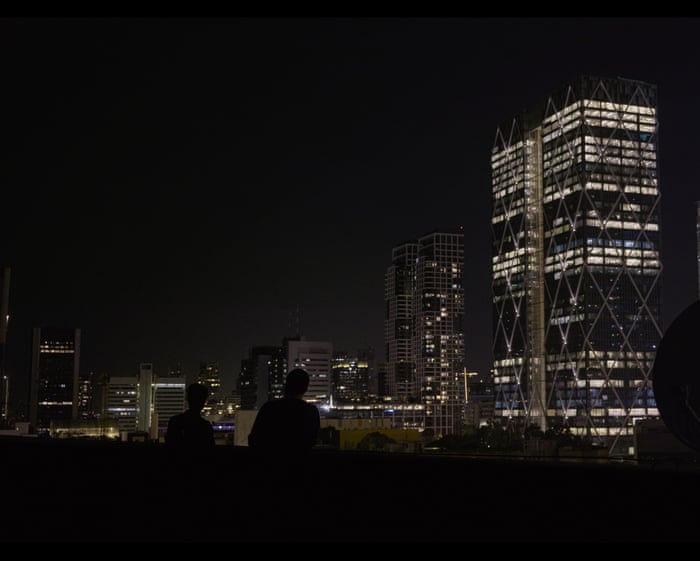
Four decades ago, when the extremist rabbi Meir Kahane won a single seat in Israel’s Knesset, other legislators passed a law to prevent him running again, left the chamber when he rose to speak and worked together to block discussion of his ethnonationalist proposals.

These ranged from mass expulsions of Palestinians to apartheid provisions such as segregated beaches and the criminalisation of sex between Jews and gentiles.

Continue reading...

© Photograph: Ilia Yefimovich/AFP/Getty Images
© Photograph: Ilia Yefimovich/AFP/Getty Images
© Photograph: Ilia Yefimovich/AFP/Getty Images
  •  

Jonathan Glazer was ‘shocked into silence’ by NAZA documentary

Film’s executive producer talks about first time he watched film detailing Israel’s mass killing of civilians in Gaza

The director Jonathan Glazer said he was “shocked into silence” the first time he watched NAZA, an award-winning documentary about Israel’s systems of mass killing in the war on Gaza.

Glazer appeared on a panel at NAZA’s UK premiere in London on Thursday night alongside key figures behind the documentary, including its Israeli co-directors, Yuval Abraham and Rachel Szor.

Continue reading...

© Photograph: David Levene/The Guardian

© Photograph: David Levene/The Guardian

© Photograph: David Levene/The Guardian

  •  

‘Tough to watch, impossible to ignore’: reviewers on NAZA documentary

Film interviewing military insiders about mass killing of civilians in Gaza wins widespread praise around the world

Critics around the world have hailed the award-winning documentary NAZA as a “brilliant and harrowing” film that is “impossible to ignore”.

NAZA, which is produced by the Guardian and details Israel’s mass killing of civilians in Gaza, was released in UK cinemas this week and will be shown in more than 50 countries. As well as its global cinema releases, NAZA will be available free on the Guardian’s website from late November.

Continue reading...

© Photograph: NAZA/The Guardian

© Photograph: NAZA/The Guardian

© Photograph: NAZA/The Guardian

  •  

NAZA: the film Israel does not want you to see - video

Oscar-winning filmmakers Yuval Abraham and Rachel Szor discuss their new documentary, NAZA, which exposes the AI systems that the Israeli military uses to rain down strikes on Gaza, causing the mass killing of civilians. Based on the testimony of 24 military insiders, the documentary caused uproar in Israel, with the government threatening to strip the filmmakers of their citizenship. The Guardian's Annie Kelly talks to the directors about how the film was made, and the price they paid for speaking out

Continue reading...

© Photograph: The Guardian

© Photograph: The Guardian

© Photograph: The Guardian

  •  

Palestine book by Alana Hadid and Jenan Matari pulled from Random House before release

Authors withdraw book planned for young readers after disputes with editors over characterizations of 7 October

A book on Palestine for young readers was pulled at Penguin Random House just before its scheduled release, following editorial disputes between the publisher and the book’s Palestinian American authors over their account of Palestinian history.

In November 2024, Random House Children’s Books, a division of Penguin Random House, signed the book deal with Alana Hadid, a philanthropist, activist and older sister of models Bella and Gigi, and Jenan Matari, an author and communications strategist. The book was promoted for release in September this year.

Continue reading...

© Photograph: Getty

© Photograph: Getty

© Photograph: Getty

  •  

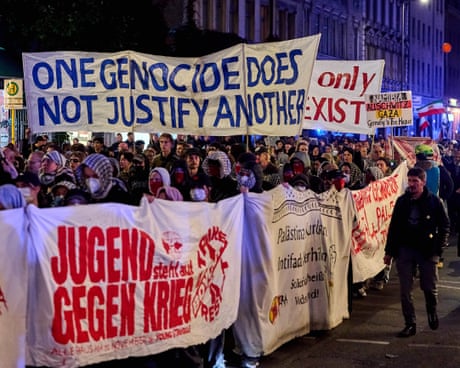
Thousands gather in London to express support for Palestinians after three years of ‘genocide’

Twenty arrested in first march since Ed Miliband declared UK’s position was that Israel’s occupation of West Bank was unlawful

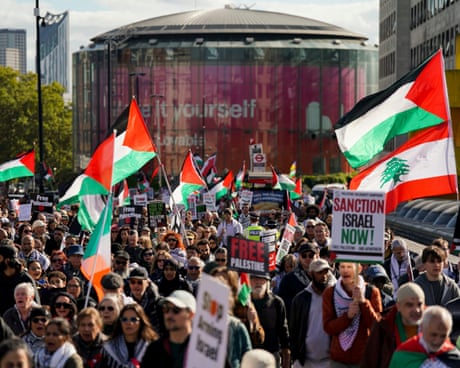
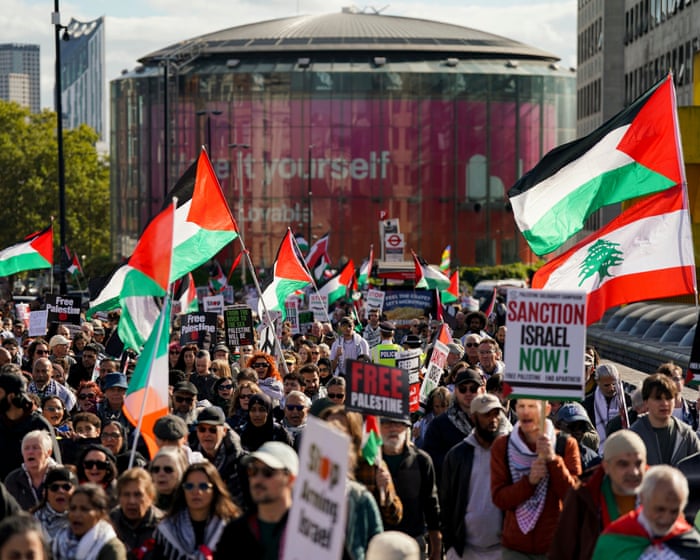
Thousands of people have gathered in central London to express their support for Palestinians after three years of “genocide” carried out against them by Israel.

The demonstrators, many wearing keffiyehs and holding Palestine flags, gathered on the Embankment at midday on Saturday. Some carried placards reading “End the genocide” and “Free Palestine” as they marched towards parliament. A bride and groom appeared to be among those in attendance and a two-minute silence was held to reflect on the lives lost in Gaza.

Continue reading...

© Photograph: Alberto Pezzali/AP

© Photograph: Alberto Pezzali/AP

© Photograph: Alberto Pezzali/AP

  •  

In three years, Israel's war on Gaza hasn't just changed the Middle East, it's changed the world | Steve Bloomfield

A whirlpool of violence has engulfed everywhere from Lebanon to Yemen. Meanwhile, the west has destroyed any political authority it once had

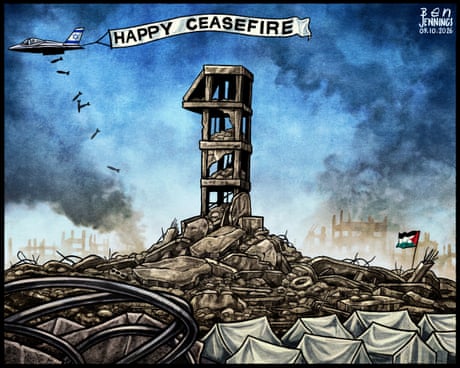
There was a world before 7 October, 2023, and now there is a world after. For Gaza, for Israel, for the wider Middle East, and for everyone else too. Not all hinge points in history are obvious at the time. Three years on from the day it began, and precisely one year since a supposed ceasefire was agreed, this one is now impossible to ignore.

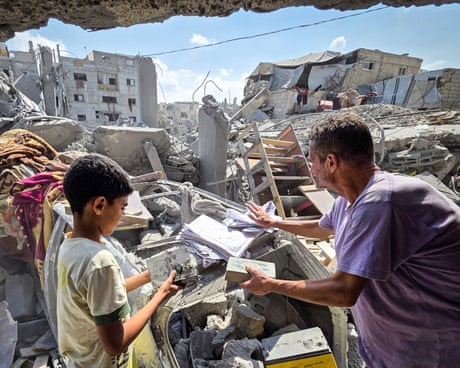
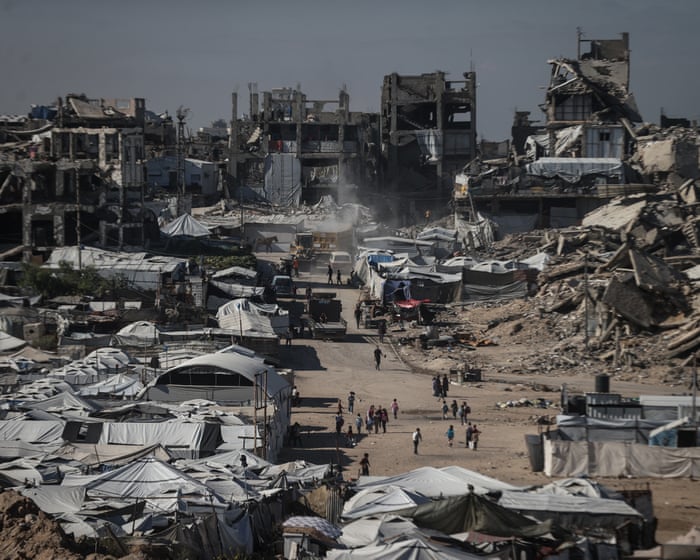
The before-and-after pictures tell part of the story. An update to Google Maps, released last week, underscores just what three years of relentless Israeli military onslaught has done to Gaza. Satellite images show how entire towns have been reduced to rubble. Mosques and hospitals, visible three years ago, have now disappeared. Meanwhile the once-empty shoreline is now crammed with tents. This is what it looks like when an attempt has been made to destroy a people.

Steve Bloomfield is the former international editor of the Observer

Continue reading...

© Photograph: Tariq Mohammad/APAImages/Shutterstock

© Photograph: Tariq Mohammad/APAImages/Shutterstock

© Photograph: Tariq Mohammad/APAImages/Shutterstock

  •  

‘Self-imposed irrelevance’: why the EU is failing to act on growing public criticism of Israel

While Israel’s actions against Palestinians intensify public anger, the bloc remains paralysed along familiar fault lines

When the British government announced sweeping sanctions on trade with illegal Israeli settlements and condemned “ethnic cleansing” in the West Bank by state-backed “settler terrorists”, some EU diplomats hoped this dramatic shift in UK government policy towards Israel would have a galvanising effect on the rest of Europe. So far, it has not.

Although France and Canada joined the UK in pledging to ban goods from illegal settlements and impose sanctions on “those who facilitate them or profit from them”, there has not yet been a wider ripple effect.

Continue reading...

© Photograph: snapshot-photography/F Boillot/Shutterstock

© Photograph: snapshot-photography/F Boillot/Shutterstock

© Photograph: snapshot-photography/F Boillot/Shutterstock

  •  

Israel promotes film that mimics NAZA documentary

Embassies post links to hastily produced online film echoing style of real Guardian documentary about mass killings of Gaza civilians

The Israeli government is promoting an online film project that mimics the style of NAZA, the award-winning documentary that details Israel’s mass killings of civilians in Gaza, in an attempt to counter the real film’s findings.

The real documentary, directed by the Oscar-winning film-makers Yuval Abraham and Rachel Szor, and produced by the Guardian, is in cinemas and will be shown in more than 50 countries.

Continue reading...

© Photograph: NAZA/The Guardian

© Photograph: NAZA/The Guardian

© Photograph: NAZA/The Guardian

  •  

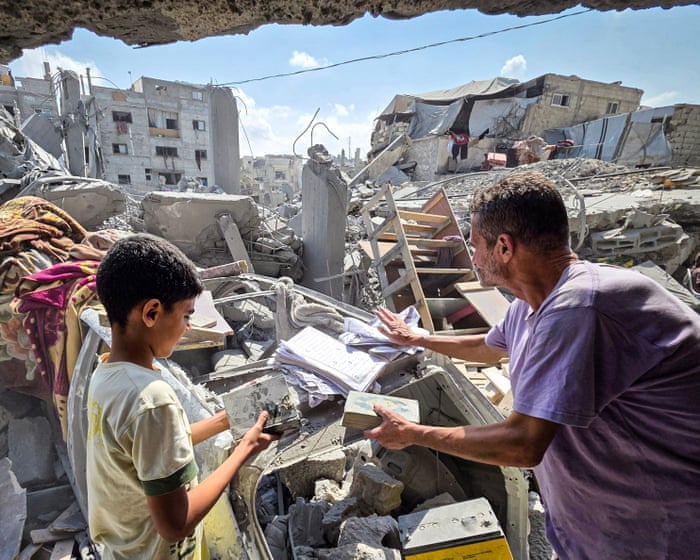
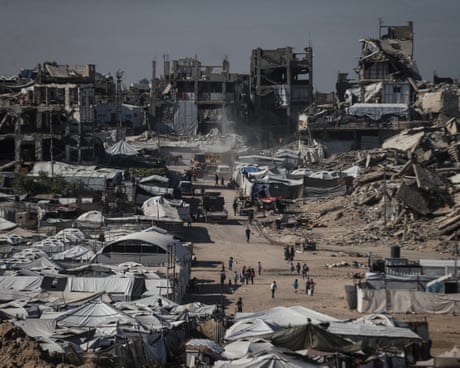
‘Neither war nor peace’: Palestinians in Gaza on existing amid disease, despair and ruins

People tell of lives changed beyond recognition after the 7 October attacks by Hamas three years ago and the subsequent Israeli offensive


Ahmed Ishtaiwi has six chairs. They are cheap and plastic and battered, but they are among the 43-year-old driver and mechanic’s most valuable possessions.

Continue reading...

© Photograph: Ali Jadallah/Anadolu/Getty Images
© Photograph: Ali Jadallah/Anadolu/Getty Images
© Photograph: Ali Jadallah/Anadolu/Getty Images
  •  

The Guardian view on the Green party and Palestine: rejecting two states is no shortcut to peace | Editorial

Zack Polanski must defend Palestinian freedom while reassuring Jewish members and showing that his party can handle disagreements

Last year, the UN general assembly endorsed the New York Declaration supporting two states in the Holy Land by 142 votes to 10. Those voting against included the US and Israel. The wider international diplomatic consensus rests on a 2002 UN security council resolution, which explicitly affirmed a two-state vision for Israel and Palestine. Saudi Arabia’s then crown prince said peace required “two equal parties” and could not survive “oppression and humiliation”. His words remain as relevant now as then.

The Green party has now rejected that two-state framework in favour of a one-state solution. The Guardian strongly disagrees with this move. Peace needs to acknowledge reality: the latest polls in Gaza and the West Bank suggest that a majority support a two-state formula based on the 1967 borders compared with just 10% who back a single democratic state with equal rights. The European Greens also disagree with the new direction of their English and Welsh sister party. The EU-wide representatives argue that the policy is incompatible with previously agreed positions. Europe’s Greens – which include the centrist German party – condemn “the genocide against Palestinians” and call for sanctions against Israel’s government.

Do you have an opinion on the issues raised in this article? If you would like to submit a response of up to 300 words by email to be considered for publication in our letters section, please click here.

Continue reading...

© Photograph: Andy Rain/EPA

© Photograph: Andy Rain/EPA

© Photograph: Andy Rain/EPA

  •  
❌