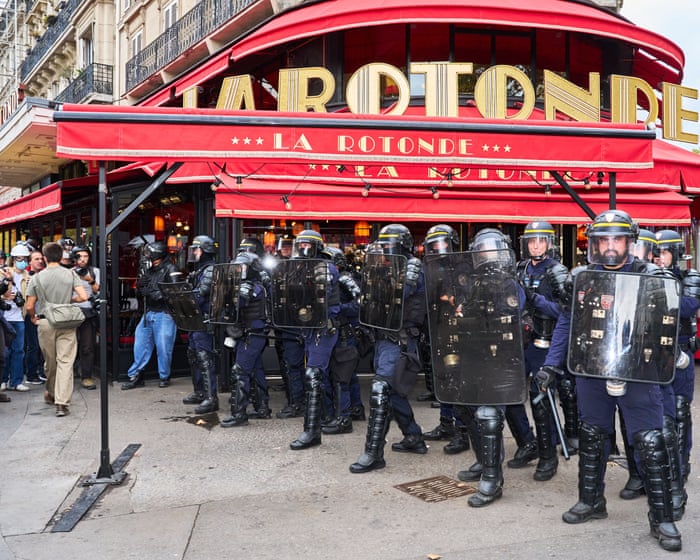
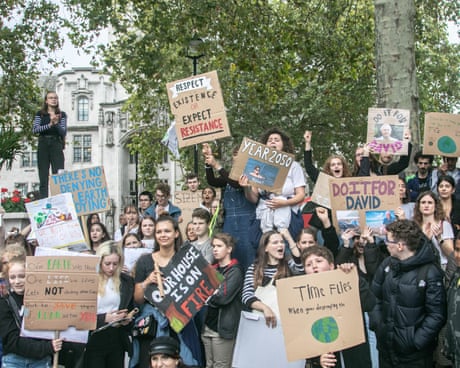
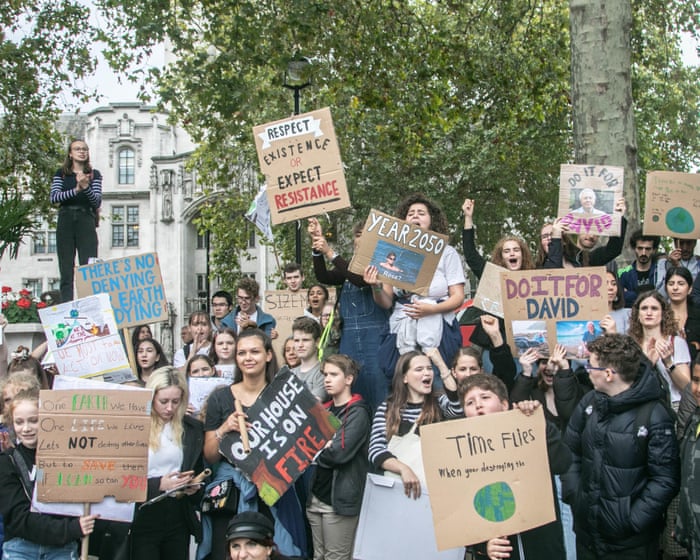
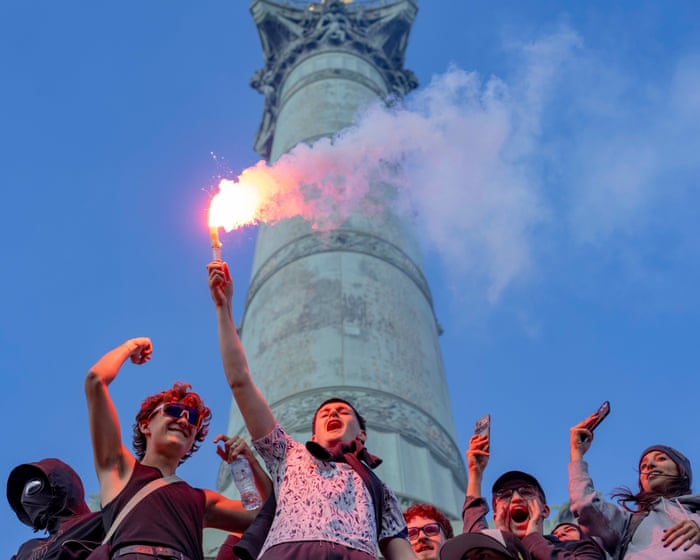
To protest against shameful conditions in schools is entirely legitimate. The government’s response is not
As a secondary school pupil in 1994, I took part in protests against a reform that would have allowed French employers to pay young people below the minimum wage. Our campaign was successful, but if we had had to face the terrifying police response unleashed on student protesters in France over recent weeks, I would have stayed at home.
A 14-year-old boy, Eden, suffered a fractured jaw and had teeth knocked out after a police teargas grenade struck him in the face. Sixteen-year-old Maël lost the sight in one eye allegedly after being struck by a shot from an LBD, a form of rubber-bullet launcher. Evan, 15, had his hand blown off in an explosion involving a police stun grenade. And in Dunkirk, a police SUV is alleged to have driven repeatedly at groups of secondary school pupils, as an officer could be heard saying: “Come closer, we’ll smash their fucking faces in.” Accounts from children left terrified by brutal treatment in police custody describe traumatic experiences with severe psychological and physical consequences.
Rokhaya Diallo is a French journalist, film-maker, activist and Guardian Europe columnist
Do you have an opinion on the issues raised in this article? If you would like to submit a response of up to 300 words by email to be considered for publication in our letters section, please click here.
Pete Crockett says the history of British education is not simply one of children dutifully accepting adult instruction, while Simon Dawson saysKitty Sayersmisses the mark when describing English attitudes. Plus a letter from Kevin Donnelly
At Marlborough college, troops were once summoned to dislodge rebellious pupils occupying an island in the school grounds. In the late 1700s, Winchester college experienced several rebellions.
Dozens of people detained after government building and two banks set on fire as tens of thousands march over education costs and corruption
Tens of thousands of students have taken to the streets of Tirana, the Albanian capital, setting alight a government building and two banks and hurling stones at police during a protest over rising education costs and corruption.
Police responded with water cannon and teargas to disperse protesters who started a fire at the ministry of education building, overturned bins and smashed the fronts of local businesses. A branch of Raiffeisen Bank near the education ministry also caught fire.
I grew up in France, where all children are taught about the revolutionary roots of their nation and what the state owes its citizens. The lessons leave their mark
Young British people have plenty to be angry about. Crushing student debt, private-school privilege, a housing market they can’t enter. Yet unlike their French counterparts, they have little tradition of turning that frustration into collective action. I grew up in France as a Briton, and for years I have watched my French friends do something my British ones never seem to: take to the streets.
“To arms, citizens! Form your battalions! Let’s march, let’s march!” It shouldn’t be too surprising, given the rousing lyrics of La Marseillaise, that France’s revolutionary spirit is not a relic of the past.
Fixing the broken education system will be just the start. The biggest challenge for an aloof political class is to finally pay attention to an abandoned generation
When adolescents protest that the government is failing to uphold their right to an education, and the government’s response is to send in riot police, the government has lost the plot. People outside France may have spent the past week watching the student protests in Paris and other cities, and thought, “Well, France has a long tradition of insurrection” or, “That’s just the French being French.”
But the situation that has provoked the high-school walkouts and teenage anger is most likely not one they would immediately associate with the France of their imaginations. In place of its lost plot, the French government has a collection of anecdotes and statistics that it should be ashamed of: 27th place in the most recent OECD education rankings, schools with ceilings collapsing and rats in classrooms and, in a school in Bagnolet, no drinkable water; an increase in the average number of students per class from 27 in 2010 to over 30 today; half of primary and high schools missing teachers at the start of the school year – many of them with no substitutes or replacements.
Alexander Hurst writes for Guardian Europe from Paris. His memoir Generation Desperation is out now
More than half of US students surveyed said the problem damaged their ability to do academic work, study finds
Procrastination is the biggest problem that can harm students’ academic performance at university, according to a study of more than 65,000 young people who placed it above issues such as ADHD, anxiety or financial worries.
The study found that nearly half of the students surveyed named procrastination as the thing damaging their ability to do academic work, more than twice the number who named depression, while the same proportion said procrastination caused them significant distress above any other problems including family pressures or bullying.
Young people use AI for everything. From schoolwork to interview prep, relationship advice to shopping decisions, the technology has become part of how young people live. For the most digitally fluent generation ever, AI is a competitive edge, a creative partner, and an always-on assistant.
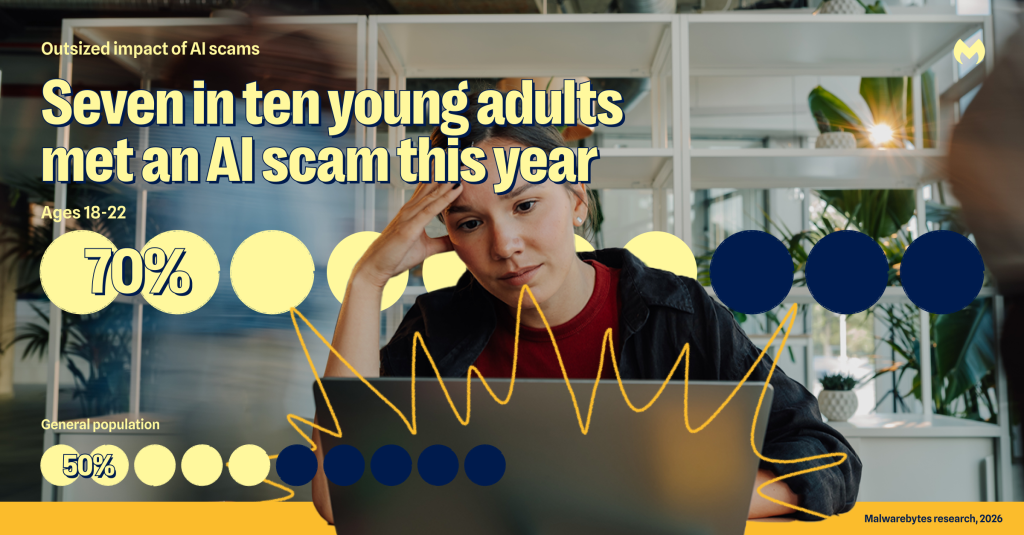
But the same technology making young people’s lives easier is also making the internet harder to navigate. AI is making scams more convincing, identities easier to manipulate, and online content harder to trust. Seven in ten (70%) 18-to-22-year-olds have experienced an AI-related scam in the last year, compared to half of the general population. And nearly every young person worries AI will be used against them.
This isn’t happening because young people are reckless. It’s happening because the online platforms they rely on for everyday life now double as entry points for AI threats: social feeds where manipulated content and real content sit side by side, online marketplaces filled with fake storefronts and reviews, messaging channels where threats can be personalized, and AI tools that can make false information feel like the truth.
That creates a new kind of safety burden. Young people are being asked to use AI, judge its output, protect their identities, and avoid increasingly personalized scams all at once. The result is a digital life that feels more powerful, but also more vulnerable to abuse.
The internet is getting harder for young people to trust
The internet young people grew up with isn’t the same one they’re facing today. AI has changed the landscape, making it harder for even these digital natives to know what information is credible and safe. Half of 18-to-22-year-olds strongly agree that it’s becoming harder to tell what content is genuinely human or real.
Young people have had a front row seat to how AI can bend the truth. Nearly half have seen AI provide information they knew or later found out was wrong or misleading (44% versus 30% of the general population). Nearly one in four (23%) have suffered negative consequences because of AI advice, compared with 16% of the general population, and 18% say they have suffered emotionally from AI advice, compared with 12% of the general population. For a generation using AI in every corner of their lives, bad information can have lasting effects on their credibility, reputation, and relationships.
Many young people have changed how they engage online as a result:
47% of young people say AI has changed how much they trust reviews or content, compared with 37% of the general population
35% say AI has changed how they shop online, compared with 26%
32% say AI has changed how they present themselves professionally, compared with 20%
19% say AI has changed how they date or communicate romantically, compared with 10%
As one young person said about online dating:
“Dating isn’t an option for me online anymore. You just never know what is or isn’t AI, and I don’t want to spend a lot of time on someone fake.”
AI is making it easier for scams to reach young people
The harder it becomes to tell what is real, the easier it becomes for scams to work. For young people, AI is fueling a wave of scams that are more personal and invasive than ever before.
Nearly one in four young people have been a victim of an extortion scam of some kind (24% versus 17% of the general population).
Nearly one in five have been a victim of a deepfake or virtual kidnapping scam (19% versus 8%).
Nearly one in ten have been a victim of sextortion (8% versus 7%).
More than one in ten have been a victim of an impersonation scam (14% versus 10%).
More than one in ten have been a victim of a romance scam (12% versus 10%).
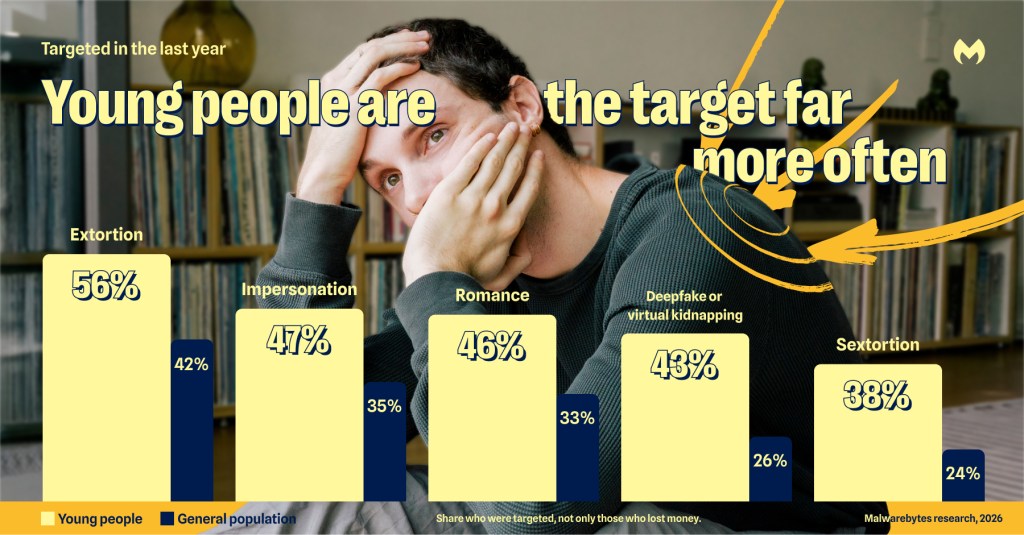
What’s striking isn’t just how many young people have been victimized—it’s how many have been targeted:
More than half have been the target of an extortion scam (56% versus 42% of the general population).
47% have encountered an impersonation scam (versus 35%)
46% have encountered a romance scam (versus 33%).
More than four in ten have been targeted by a deepfake or virtual kidnapping scam (43% versus 26%).
Nearly four in ten have encountered sextortion (38% versus 24%).
These scams may look different on the surface, but they all work the same way: they exploit fear, trust, shame, and intimacy. The more often young people encounter them, the more chances scammers have to find exactly which emotional triggers work.
This exposure isn’t random. Young people are on social platforms at rates up to three times those of the general population: 89% use Instagram (versus 55% of the general population), 78% use TikTok (versus 38%), 68% use Snapchat (versus 26%), and 49% use Pinterest (versus 25%). Scammers can use these platforms to get everything they need to make their threats more convincing: public photos, friend networks, school affiliations, relationship clues, and everyday posts containing personal information. With AI, scammers can use that content to create explicit images, clone voices, impersonate profiles, and create threats personalized with details that are hard to ignore.
One young person shared their experience:
“I had someone make fake nudes of me using AI on my photos from my social media and threaten to post them on Facebook after I realized that they had scammed me. I decided to be more careful with my personal information.”
Young people fear AI will steal what money cannot replace: identity, reputation, and sense of self
AI-fueled scams aren’t just scams in the traditional sense. They are forms of identity abuse. This is different from traditional identity theft. For young people, the risk isn’t only that someone steals a password or money. It’s that scammers can use AI to make them appear to say, do, or share something they never did, with consequences that can follow them in their personal and professional lives.
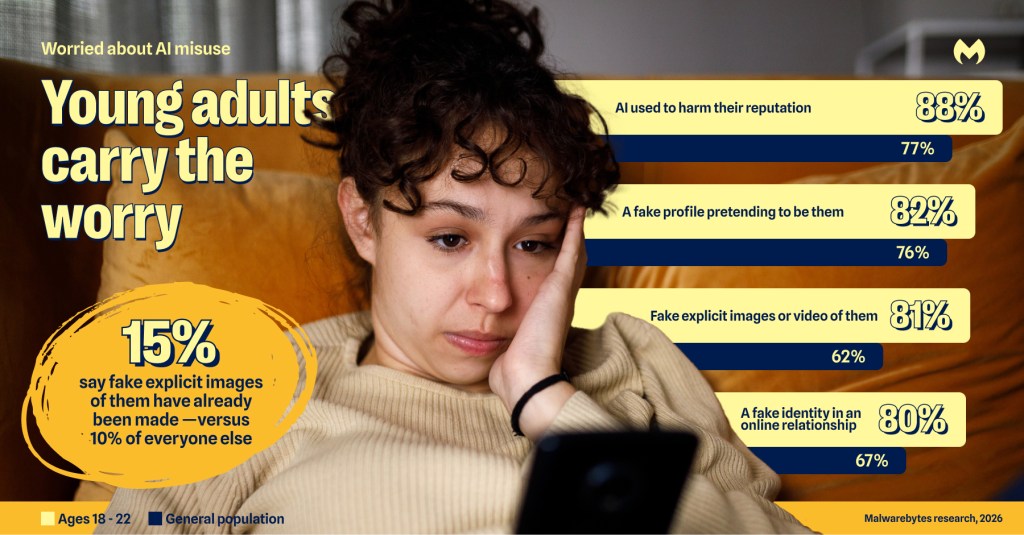
That’s why young people are so concerned about AI being used against them. The fears that hit hardest:
88% worry about AI being used to harm their professional or personal reputation versus 77% of the general population
82% worry about someone creating a fake profile pretending to be them versus 76%
81% worry about someone creating fake nude or sexually explicit photos or videos of them versus 62%; 15% say it’s happened to them already (versus 10%)
80% worry about being deceived by someone using AI to fake their identity in an online relationship versus 67%
These threats are especially powerful at a life stage where young people are still building their personal and professional reputations. A fake profile, manipulated image, or AI-generated explicit video can affect how everyone from classmates and professors to potential employers and romantic partners see them for years to come.
Young people are pulling back online, but protection is still too manual
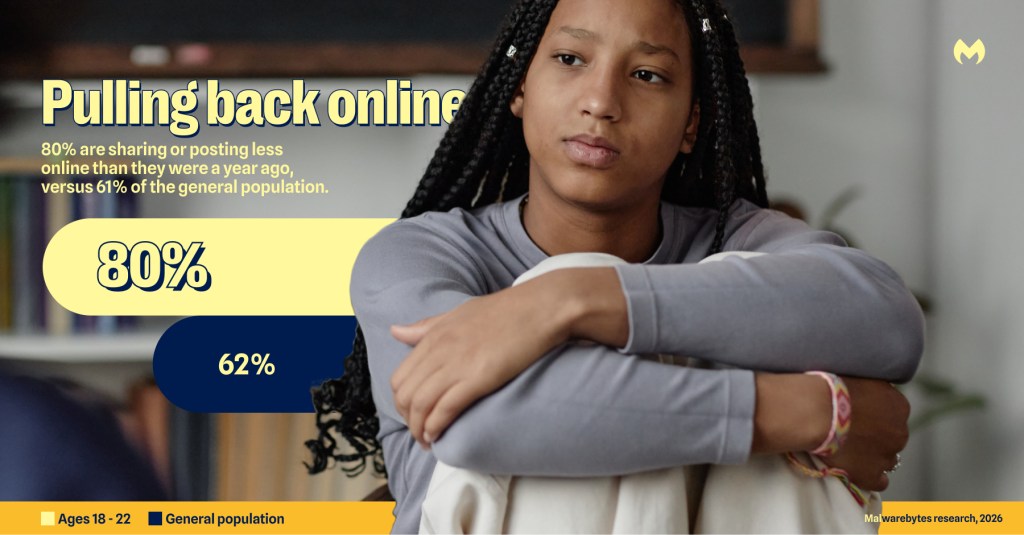
Many young people are responding by retreating. 80% are sharing or posting less online than they were a year ago, versus 61% of the general population. Compared to the general population, more 18–22-year-olds have also taken AI-related protective measures like tightening privacy settings, removing unknown followers, using reverse image search to verify content, requesting data removal, and watermarking their own photos and videos.
Those actions matter, but they also show how much responsibility has been pushed onto individuals. Staying safer online now means constantly reviewing settings, checking sources, questioning content, and so much more. That’s a lot to ask of anyone, and the fatigue is showing: 42% of young people say they receive so many warnings they have stopped paying attention, compared with 36% of the general population. It’s hard to sustain vigilance when new risks are always emerging.
At the same time, completely opting out isn’t realistic. Young people remain deeply embedded in digital life, and they’re still some of AI’s most enthusiastic adopters: 74% say AI has had a positive impact on their lives, compared with 57% of the general population. They aren’t rejecting AI or the internet, but they are carrying more of the safety burden than they should have to.
What young people can do to help decrease their risk right now
Know the scams targeting you. Extortion, sextortion, deepfakes, and romance scams disproportionately target young people. If someone contacts you with threats of any kind, do not pay. Report it to the platform and to authorities.
Button up your social media. Everything you post publicly is available to anyone, including scammers. Tighten privacy settings on the platforms you use most and review your followers regularly.
Don’t trust product images alone. Before buying from an unfamiliar retailer, use reverse image search on product photos and look for independent reviews off the retailer’s own site.
Create a family code word. Make sure you agree on this word in person, not online. If you receive a panicked call from someone you know asking for money or information, verify they are who they say they are with the code word.
Don’t reuse passwords. If one password gets stolen in a data breach, it will likely get tried on all other accounts you might have. Use a different password for every account to keep your accounts locked down.
Turn on two-factor authentication on all your important accounts. Only 30% of young people have done this. It is one of the highest-impact protections available and takes under five minutes to set up.
Protect your devices. Use security software on all your devices, and keep all your software up to date to make sure you’re patched against all known security holes.
Malwarebytes Student Protection Program
If you’re a student or work at a university, Malwarebytes Student Protection Program provides two years of free Premium Security for three devices for all US college or university students, staff and faculty.
This includes Malwarebytes device protection for laptops, tablets, and mobile phones with built-in scam protection. It protects against creepy trackers and ads, and blocks malware, ransomware, and cybercriminals themselves.
The research in this article is based on a March 2026 survey about AI, identity, and the collapse of digital trust and was conducted among 1,500 respondents in the United States, United Kingdom, Germany, Austria, and Switzerland. This article focuses on student-aged adults, defined as respondents ages 18 to 22, compared with the general population.
Additional context comes from Malwarebytes’ 2025 research Tap, Swipe, Scam: How Everyday Mobile Habits Carry Real Risk, which looked at mobile scams and scam-related behaviors across the same markets. Both research studies were prepared by an independent research consultant and distributed via Forsta.

 Login