❌

Reading view

Merging SpaceX and Tesla would be a "good idea," Musk says

Elon Musk said Tuesday that he would like to see the consolidation of his business empire by formally merging his two largest companies, SpaceX and Tesla.

"Do I think it would be a good idea? Yes," Musk said of a potential merger. He was speaking during a question-and-answer period as part of SpaceX's third-quarter earnings call. Musk said, ultimately, it not his decision. "But at the end of the day the shareholders have to be supportive of this."

Musk's talk of a merger comes after a busy year in which SpaceX already acquired Musk's artificial intelligence firm, xAI, in February. In June, SpaceX went public with the largest initial public offering on record.

Read full article

Comments

© SpaceX

  •  

Cops raid office of RFK Jr. allies planning “unethical” vaccine trial on babies

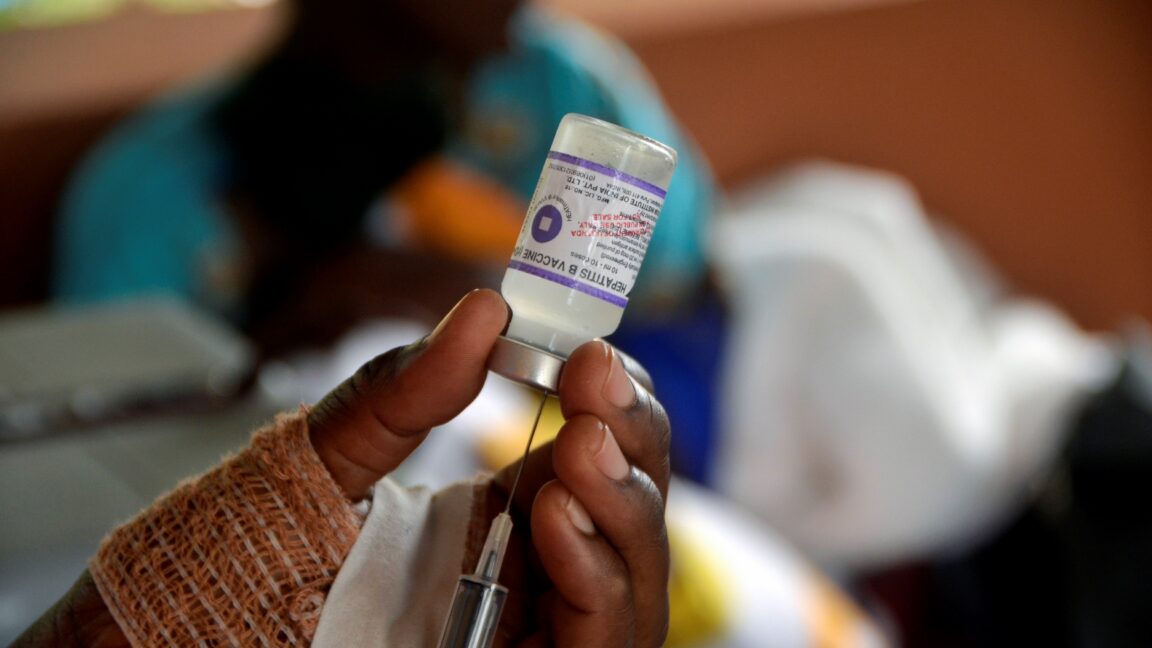
Police in Guinea-Bissau raided the offices of Danish researchers on Monday, seizing doses of hepatitis B vaccine intended for a vaccine trial for newborns. International health experts have called the trial "unethical," but anti-vaccine Health Secretary Robert F. Kennedy Jr. has attempted to fund it with US taxpayer dollars.

Under Kennedy, the US Centers for Disease Control and Prevention announced in December that it had awarded the Danish researchers—led by married couple Peter Aaby and Christine Stabell Benn of Bandim Health Project—an unsolicited $1.6 million grant to run the trial. Aaby and Stabell Benn are controversial vaccine researchers who claim vaccines cause overlooked harms. They have been repeatedly praised by Kennedy, but are currently under investigation for alleged scientific misconduct by Danish authorities.

Plans for the trial were halted in January as widespread condemnation erupted over the trial's design, which would potentially expose thousands of newborns in the country to hepatitis B, risking a lifelong infection that can lead to liver cirrhosis, cancer, and premature death. Outrage flared again after a Rolling Stone story earlier this month claimed the CDC set aside another $1.6 million in funding in late September and planned to move forward with the trial.

Read full article

Comments

© Getty | Nicholas Kajoba

  •  

Microsoft reportedly projects $1,200 to $1,800 price for 2028 Project Helix

We haven't heard many details about Microsoft's upcoming "Project Helix" gaming hardware since the company announced it in March as a device that will "play your Xbox and PC games." In a new wide-ranging profile of Xbox CEO Asha Sharma, though, Fortune alludes to a dual release strategy for upcoming Microsoft gaming hardware, with "a next-generation handheld device" planned by the end of next year and a 2028 holiday season console release that could cost between $1,200 and $1,800.

That future console price range is based on what has "internally been projected" at the company, according to Fortune. But the price for consumers could come down if "Microsoft decides to subsidize the cost," the outlet says, as many console makers have done in the past.

While a $1,200 starting price would be historically high for the game console market, even accounting for inflation, it also reflects a new normal: The slowdown in Moore's Law and AI-driven component shortages mean cutting-edge gaming hardware just isn't as cheap as it used to be. This year, the Steam Machine broke the $1,000 starting price, while the 2-year-old technology in the PlayStation 5 Pro is now going for $900, and the 6-year-old Xbox Series X now starts at $750.

Read full article

Comments

  •  

OpenBSD 8.0 released

Hot on the heels of Wine being ported to OpenBSD, we now have the release of OpenBSD 8.0. It adds hibernate support for arm64, switches the sparc64 toolchain to LLVM, and updates the DRM graphics drivers to Linux 6.18.53, which also adds support for Intel Arc A-Series (DG2/Alchemist) graphics cards. There’s a whole bunch of improvements, fixes, and changes for RISC-V and ARM in general, of course, as well as to the various Wi-Fi drivers. On top of that, it also comes with new versions of OpenSSH and LibreSSL, as well as a massive list of other improvements and fixes.

If you’ve never installed OpenBSD before, be sure to read this detailed guide to know what to do once everything’s installed, while listening to the official release song, of course.

  •  

JustWatch, which tackles streaming fragmentation, launches own streaming service

Since launching in 2015, JustWatch has helped people navigate the growing number of streaming services by providing a guide on where to find movies they want to stream. Now JustWatch has its own streaming service and wants people to subscribe.

Launched today, JustWatch TV offers some movies available for free with ads that aren’t free on any other streaming service, including Green Room (2015), Locke (2013), and Sing Sing (2023). Other free movies include Fiddlin’ (2018), Friday the 13th (1980), and Hotel Mumbai (2018). I could play movies available for free on JustWatch TV without creating an account.

JustWatch TV also has movies you can rent.

Read full article

Comments

© JustWatch

  •  

Meta drops the word "train" from its commercial TOS after AI backlash

Hoping to quell criticism, Meta has dropped the word “train” from its “streamlined” commercial terms of service that kick in on October 30.

Last week, Meta faced backlash after legal experts warned that the tech giant’s sweeping new commercial terms of service seemed to give Meta permission to endlessly scrape websites linked on business pages. Talking to Nieman Lab, experts suggested that Meta could possibly use the policy to avoid millions in licensing fees from news organizations by requiring all business users to share a wealth of AI training data simply for running a business page.

A Meta spokesperson confirmed that Meta did not alert users to the changed language following backlash. This potentially only adds to confusion ahead of the policy rollout. In response to backlash, Meta's spokesperson provided a statement to Ars, acknowledging Nieman Lab's initial report but not its follow-up report reiterating experts' concerns:

Read full article

Comments

© filo | DigitalVision Vectors

  •  

Gemini's Personal Intelligence is coming to cars

Google kicked off 2026 with the addition of Personal Intelligence to Gemini, allowing its AI to pull in more of your data to formulate answers. It started as a paid feature but eventually came to all Gemini users. However, this feature wasn't available in the car until now. Google is rolling out Personal Intelligence to Android Auto and Google Built-in, and it is still, thankfully, an optional feature.

As Google points out, a generative AI's outputs are better "when it knows the world and knows you," which is correct in an uncomfortable sort of way. The more context you can provide to a model, the better the output will be at the end of the token shuffle. Since Google has so much of your data already, it sees Personal Intelligence as a differentiator versus other AI systems. You don't have to provide the AI context because it already has it from apps like Gmail and Calendar.

Personal Intelligence is beginning its rollout in Android Auto today, and it will come to vehicles with Google built-in in the next few months. As an aside, "Google built-in" is questionable branding, but it refers to cars that run Google software in the infotainment system rather than projecting an interface from your phone. Very few vehicles have Google built-in, but Google often releases new car features on them first. This time, it's the other way around.

Read full article

Comments

© Google

  •  

OpenBSD 8.0 arrives with security record still intact

OpenBSD 8.0 is here, marking the project's 61st release and continuing its schedule of semiannual releases dating back to 1996. What started more than 30 years ago as a fork of NetBSD has grown into one of the most security-conscious operating systems in active development. In a post to the project's announcements mailing list, OpenBSD founder Theo de Raadt highlights a host of improvements included with the latest version and writes that the project remains "proud of OpenBSD's record of more than thirty years with only two remote holes in the default install."

The latest OpenBSD version brings new features and improvements across the board. These changes, particularly the new Intel Arc support and expanded virtual address space, should improve compatibility with modern graphics cards and allow the system to map more than 4GB of VRAM. Some of the major updates noted in the release newsletter are as follows:

  • Added support for Intel Arc A-Series (DG2/Alchemist) graphics cards.
  • 512GB kernel virtual address space on AMD64, up from 4GB, allowing VRAM mapping above 4GB.
  • Added hibernation support for ARM64 systems.
  • A new RPKI-to-router daemon: rtrd(8).
  • RISC-V improvements including kernel support for the 'V' vector extension and support for Advanced Interrupt Architecture.
  • Wireless network driver additions and improvements, including 802.11n and 40 MHz channels for the qwx(4) wireless driver.
  • Added support for up to 64 virtual CPUs per guest virtual machine.
  • Security and internal improvements for LibreSSL 4.4.0 and OpenSSH 10.6.
  • Improvements to the vmm/vmd virtualization stack.

The new OpenBSD also retires support for Loongson architecture after the port stopped working with the Clang 22 compiler. If you're interested in reading over all the changes that come with the new OpenBSD 8.0, you can take a look at the release announcement.

Read full article

Comments

© OpenBSD

  •  

The Internet goes on high alert after discovery of 8 compromised TLS certs

Security personnel around the world are on high alert Tuesday following the discovery of eight TLS certificates with private keys so weak they could allow anyone to mint trusted browser and app credentials for any site on the Internet.

As of late morning Tuesday, browser makers and some major apps and programming languages had blocked all eight of the intermediate certificates. There are no reports of certificate transparency logs, which track the issuance of all browser-trusted certificates, showing the compromised keys being used maliciously. The threat remains far from over, however, because it will be hard and time-consuming to update other key parts of the Internet, such as Linux distributions and embedded and Internet of Things devices.

One word: bonkers

The eight intermediate certificates belong to India-based certificate authority eMudhra Limited. An informal advisory published to emudhra.we-have-a-problem.com over on Tuesday posted the message “We have a problem here - Wayne.” The words were digitally signed using the private key of one of the eMudhra certificates. With proof that the reporting party had control of the key, defenders scrambled because the same key could be used to sign unauthorized certificates that would be trusted by millions of servers worldwide.

Read full article

Comments

© Getty Images

  •  

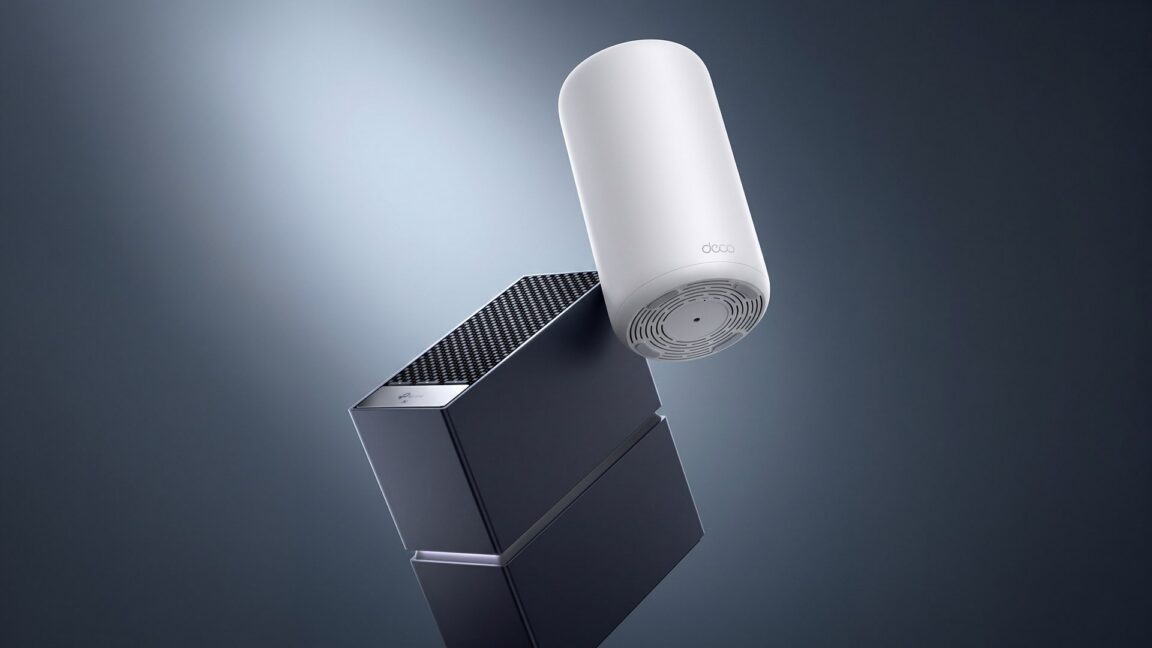
TP-Link tries to appease Trump admin with pledge to assemble routers in US

TP-Link yesterday announced plans to assemble Wi-Fi routers in the US, as the company attempts to get the Trump administration's approval to sell its newest routers to American consumers.

The timing is uncertain, as TP-Link's press release said it expects US-based assembly to begin "as early as" 2027. TP-Link's application to sell new routers in the US could be rejected by the Trump administration or remain pending long enough to push the US-based assembly to 2028.

"Pending US regulatory approval, TP-Link expects domestic assembly of its groundbreaking Wi-Fi 8 home networking product line to begin as early as next year," the company said. TP-Link said it signed a Letter of Intent with US company Keytronic, which agreed "to become a primary domestic manufacturing partner for TP-Link, supporting assembly of the company’s advanced networking portfolio in Corinth, Mississippi."

Read full article

Comments

© TP-Link

  •  

Does anyone actually want to win the medium-lift race in the United States?

It has been 13 years since the debut of a new medium-lift rocket in the United States, the Antares vehicle developed by Orbital Sciences Corporation.

The initial 100-series variant of the Antares rocket was kind of a hot mess. The rocket used old Soviet engines built during the era when Apollo astronauts were landing on the Moon. Decades later, in the 1990s, Aerojet acquired the engines and refurbished them for a rocket that would launch in the 2010s. Predictably, on the fifth launch of an Antares rocket in 2014, it exploded.

The Antares vehicle is the last of a dying breed of medium-lift rockets—defined as having a lift capacity of 2 to 20 metric tons—in the United States. Nearly a decade and a half later there is a new generation of medium-lift vehicles coming online, and they are starkly different from Antares, which had not just Russian engines but a core stage manufactured in Ukraine.

Read full article

Comments

© Stoke Space

  •  

Ukraine’s drone rescue of wounded soldier puts much touted idea into practice

Ukraine’s unprecedented drone rescue of a wounded soldier from the battlefield has shown once again how battlefield necessity can spur innovation. The operation was revealed just days after separate Ukrainian drones designed for casualty evacuation were deployed for frontline testing—taking a step beyond the US military’s decades of experimentation with similar concepts.

The drone evacuation of the injured soldier took place at an undisclosed time and place on the frontline where the presence of Russian drones and landmines made it impractical to send in a wheeled ground robot, according to The Kyiv Independent. On October 19, Ukraine’s Army shared a video of the drone evacuation, showing the wounded soldier securing himself in a harness suspended beneath a heavy hexacopter drone with six rotors before being flown to safety.

“This is a historic event, the next stage of evacuating the wounded, which we will all come to,” said Napalm, a programmer of the 92nd separate assault brigade's unmanned ground systems company, who went by his callsign per Ukrainian military practice, in a statement. “Now the serious systematic work begins, so that such missions are carried out constantly.”

Read full article

Comments

© 92nd Separate Assault Brigade of the Ukrainian Ground Forces

  •  

Quantum error correction goes well beyond breakeven

Running complicated algorithms on quantum computing hardware is going to require the use of logical qubits, where collections of hardware qubits are linked together in ways that allow errors to be detected and corrected. In general, the more hardware qubits you dedicate to each logical qubit, the better the chances are of identifying errors. But, given that the hardware qubits are prone to errors, adding more of them also increases the probability that errors will occur. If the hardware error rate is too high, then growing the logical qubit will only make matters worse.

Fortunately, several companies have demonstrated hardware where the error rate is not too high. Several demonstrations show logical qubits are beyond the breakeven point, where adding more qubits improves performance. The problem is that the improvement isn't very dramatic. To lower error rates to levels we'll need to run complex algorithms, we'd have to add a completely impractical number of qubits to each logical qubit.

On Monday, Quantinuum announced that its current generation of hardware is capable of scaling well beyond the breakeven point. Each step up in the size of logical qubits improved some measures of their performance by a factor of over 10.

Read full article

Comments

© Quantinuum

  •  

Meta tries to scapegoat staff who downloaded torrents to spare execs

In copyright lawsuits over AI training, Meta has spent weeks blaming staff for downloading torrents. The company has now been ordered to name executives who authorized decisions to pirate books from shadow libraries like Anna’s Archive and LibGen, TorrentFreak reported.

In a discovery order impacting a class action raised by book authors—including Richard Kadrey and Sarah Silverman—as well as a lawsuit from publisher Entrepreneur Media, Magistrate Judge Thomas Hixon largely agreed that Meta must clearly identify key decision-makers. Following testimony from Meta staff who downloaded torrents, the order could expose a wider range of supervisors, managers, and executives whom staffers said greenlit the piracy.

Meta had been hoping to avoid detailing the chain of command, particularly for leadership involved in early AI training. According to a Meta court filing, its initial efforts to compile massive AI datasets were managed through an “informal approach" where supposedly nobody with authority made any decisions. Instead, Meta insisted that a “decision” was “made only in the sense” that some staffers “technically” downloaded torrents.

Read full article

Comments

© JOAO LUIZ BULCAO / Contributor | AFP

  •  

'Vorssaint' Replaced at Least 10 Utility Apps on My Mac

Plenty of Mac apps do one job, and do it quite well. For example, KeyboardCleanTool lets you disable your Mac's keyboard temporarily while you get dust, food particles, and gunk off the keyboard. I love these apps, but if you keep installing utilities, things start to feel crowded; it can be a real problem even trying to remember that you have an app installed for a specific task. This is where Vorssaint comes in: It's the Swiss Army knife of Mac apps, packing over 75 utilities into a single, free resource.

The best thing is that you can choose which of these utilities you wish to enable—if you need only five of Vorssaint's features, you can disable the rest. This prevents the app from becoming a resource hog, which is particularly valuable for those of us with older, base-model MacBooks. Even though Vorssaint has replaced multiple Mac apps on my MacBook, however, it's not always better than the apps it replaces. If you use Vorssaint to set a custom volume level for each Mac app, for example, it doesn't mean Vorssaint can do everything SoundSource does.

Vorssaint is very much a jack of all trades, master of none, and that's perfectly fine for most people. If that sounds like the kind of tool you need, then Vorssaint could be great for you. Here are 10 Vorssaint features that I've used to replace apps on my MacBook:

Use Super key to replace Caps Lock modifier apps

Unless you're addicted to appearing like you're yelling all the time, you probably don't need the Caps Lock key at all. You can always hold Shift whenever you want to capitalize something, and in my opinion, Caps Lock should be repurposed for something better. Apps such as Raycast allow you to convert Caps Lock into a "hyper key," which means that when you press that button, your computer registers it as a combination of other modifier keys. On my MacBook, pressing Caps Lock equals holding Command-Control-Shift-Alt together, and I've used it to create keyboard shortcuts that don't conflict with those in macOS or third-party apps.

To enable this feature in Vorssaint, open the app, and go to Settings > Features. Go to the "Mouse and keyboard" section, and enable Super key. Vorssaint allows you to map modifier keys to Caps Lock. It also lets you continue using the button for capitalization, switching input sources, or as an alternative way to press the Esc key (useful for keyboards that don't have this button). It works by triggering the "Super key" only when you hold Caps Lock, and toggling the other feature you chose when you press the button once.

Try Vorssaint's built-in clipboard manager

Clipboard history in Vorssaint
Credit: Pranay Parab

Your Mac's Spotlight has a basic clipboard manager, but Vorssaint adds a few more features. The app lets you clean tracking data from URLs, and even adds a "Cut and Paste" feature to your Mac's Finder. The latter is great for people switching from Windows—Finder's cut/paste feature isn't as seamless as the one on Microsoft's platform.

Once you enable these features in Vorssaint, you can cut any file in Finder by pressing Command-X, and paste it elsewhere with Command-V. The URL cleaner is customizable, and it allows you to define parameters to remove. It also allows you to create filters for specific websites, which reduces the chances of breaking URLs when you try this feature. By default, Vorssaint will automatically clean a link the moment you copy one, but you can also manually clean links in the app if you wish to.

The app's clipboard manager has all the basic features you'll need, and it lets you exclude some apps too. This lets you keep Vorssaint from storing clipboard items from sensitive apps. The shortcut to view clipboard history from Vorssaint is Command-Option-Alt-V.

Use Vorssaint's disk image installer to replace Rapidmg

I use Rapidmg, a popular app installer format on the Mac, to auto-mount and install DMG files. After the app is installed, Rapidmg also gets rid of the installer file. Vorssaint has this feature built-in, and you can enable it by going to Vorssaint settings > Features > Disk image installer. It's located under the "Clipboard and files" section.

Try its free volume mixer for per-app volume control

If you're looking for an app to set a custom volume level for each Mac app, then Vorssaint has a tool for the job. It's good enough to replace basic volume control apps like FineTune, but not nearly as powerful as SoundSource. Vorssaint lets you set a per-app volume level, quickly switch between output devices, and even set priority for audio devices. It doesn't support sending audio to multiple devices at once, tweaking latency levels, boosting volume above the maximum, or sending audio from certain apps only to specific output devices (e.g., Spotify always goes to headphones, VLC always sends audio to speakers, etc.). If you value power-user features, then SoundSource has to be your go-to. For most people, Vorssaint is good enough to get the job done. You can enable volume mixer in the app by going to Vorssaint settings > Features > Volume mixer. It's under the "Sound" section in the app.

Use "Keep awake" to replace Amphetamine

There are many good reasons to stop your Mac from going to sleep, such as connecting your MacBook to an external display and using the laptop with its lid closed. Apps such as Amphetamine allow you to keep your Mac from going into sleep mode, and Vorssaint has this feature built-in as well. You can use it by enabling the "Keep awake" feature in the app, which lets you disable sleep mode on your Mac for a custom time interval that ranges from 15 minutes to indefinitely.

Replace notch apps with Vorssaint's built-in Dynamic Island

Vorssaint's Dynamic Island in action.
Credit: Pranay Parab

If you're missing your iPhone's Dynamic Island on your MacBook, you could install one of several useful notch apps on your Mac. These apps show a now playing widget, brightness or volume levels, calendars, or even have a temporary shelf to help you drag and drop files on your Mac. Vorssaint ships with a notch app, too: Dynamic Island. Once you enable it, Vorssaint's Dynamic Island can show notifications, calendar events, timers, song lyrics, playback queue, etc. Note that this feature is labeled "Experimental" in the app, which means that it's not as stable as most other features. I've also been using it to activate other Vorssaint features such as Keep awake and volume mixer, since Dynamic Island shows toggles to control them.

Monitor system stats with Vorssaint's CPU, GPU, and memory monitors

iStat Menus is one of my favorite Mac apps—it allows me to monitor my MacBook's current load and operating temperatures. Vorssaint also ships with the ability to monitor CPU load, GPU load, RAM usage, network usage, battery temperature, etc. It's not as elegant as iStat Menus, but it'll do the job for those who need a basic system stat monitor. In my tests, though, I observed that Vorssaint incorrectly reports CPU temperature. Two other apps (iStat Menus and TG Pro) reported my Mac's CPU temperature at around 104°F (40°C), but Vorssaint kept showing a number closer to 145°F (63°C). All other temperature readings were nearly identical in the three apps, which indicates that Vorssaint probably has a bug to fix.

Try its modifiers to enhance your Mac's Dock

Vorssaint's feature list.
Credit: Pranay Parab

Vorssaint can also be a substitute for apps that enhance your Mac's Dock. It allows you to enable features like previewing open windows by hovering over an app's icon in the Dock, quitting apps from the Dock preview, clicking the dock icon to minimize, hide, or cycle between apps' windows, etc. One useful feature allows you to click the green button to maximize any app's window, as opposed to switching to full-screen mode. I don't use it, but I can recommend it to people who switch from Windows and ask me about the maximize button.

Vorssaint's mouse modifiers replace Mac "mouse fix" apps

macOS doesn't always allow your mouse to work the way you want it to. Third-party "mouse fix" apps add nice features such as smooth scrolling, customizable actions for side buttons, and so on. Vorssaint includes support for smooth scrolling, and a few other features. It lets you map extra mouse buttons to custom keyboard shortcuts, and even has a feature to prevent accidental double-clicks. The latter is good for people who have a mouse with double-click problems. You can enable these features under the "Mouse and keyboard" section in Vorssaint.

Use Cleaning Mode to temporarily disable the keyboard while you clean it

Apps like KeyboardCleanTool allow you to temporarily disable your Mac's keyboard for you to give it a good clean, or to allow your cat to sit on the keyboard without disturbing your workflow. Vorssaint supports this, too—you can enable this feature by toggling "Cleaning Mode" under the Tools section in the app. Once you lock the keyboard, you can either click the "Unlock" button or press Esc five times to start typing again.

  •  

Polestar tries to quantify what it’s like to drive a performance car

The human desire to go fast is old, dating back at least as far as the first time some adventurous Yamnaya saw a horse on the Pontic-Caspian steppe and thought, “I bet if I jumped on that thing’s back, it would be faster than walking.”

A thousand years later, someone else invented the wheel—and the chariot—and humanity was ready to roll. Now, about five millennia since that first horseback ride, equestrianism is mostly a leisure activity, and we drive cars, propelled by motors with more power than an entire herd of beasts could muster.

Acceleration, top speed, and lap times are the usual ways we quantify that performance, and performance electric vehicles are currently in an arms race to see which one can hit 60 mph in the least amount of time. But measuring a car’s performance is easy—all you need is a stopwatch and a track. How about measuring the effect of car performance on the driver? That’s a question Polestar is trying to answer with researchers at the University of Oxford.

Read full article

Comments

© Polestar

  •  

The Guardian view on Alberta’s referendum: Canada holds together – against Donald Trump | Editorial

Voters’ emphatic rejection of separation strengthens Mark Carney’s energy strategy in the face of a US trade war and threats

Canadians are proving to be a voice of sanity. In roundly rejecting the idea of separating from Canada, voters in the oil- and gas-rich province of Alberta sensibly backed the nation-building strategy of the prime minister, Mark Carney. He has put Alberta at the centre of his plan to make Canada an energy superpower that is “much less dependent on the United States”.

Donald Trump’s trade war and threats last week to make Canada the 51st US state were a fillip for Mr Carney in Alberta, a landlocked western province where Liberal prime ministers have historically been unpopular. The stakes were high: a successful separatist campaign would have handed Mr Trump leverage over Canada’s resource belt. The result instead lets Mr Carney cast Alberta’s mineral wealth as a national asset, rather than allow separatists to define it as a regional grievance.

Do you have an opinion on the issues raised in this article? If you would like to submit a response of up to 300 words by email to be considered for publication in our letters section, please click here.

Continue reading...

© Photograph: Timon Johnson/The Canadian Press/AP

© Photograph: Timon Johnson/The Canadian Press/AP

© Photograph: Timon Johnson/The Canadian Press/AP

  •  

Google may add your number to all your accounts: How to stop it

As Android Central reports, users have received unexpected emails telling them their phone number has been verified for secondary Google accounts.

Like me and many others, you may have one Google account for everyday use, another for work, and a third for things you would rather keep separate. But if you’re using an Android phone, those accounts may have something in common that you didn’t intend or even know about: your phone number.

Google’s own documentation confirms that phone number verification is on by default and adds your number to all Google accounts signed in on the device. This applies to both existing accounts and any you add later.

Google says phone number verification helps support features such as signing in, account recovery, Rich Communications Services (RCS) messaging, and finding or securing a lost device.

But it also means that a number you intended to use with your main account can become associated with a secondary account simply because both are signed in on the same Android device.

If you deliberately left your phone number off a secondary account, this links it to your real identity without you knowingly making that connection. Your number doesn’t automatically become public, but Google gains another way to connect accounts you wanted to keep separate.

This reminded me of an article I wrote about unexpected Google account connections: “Google Play sign-ins can be abused to track another person’s movements.” Signing in to Google Play on one phone allowed me to see its movements in Google Maps Timeline.

“After some digging I learned that my Google account was added to my wife’s phone’s accounts when I logged in on the Play Store, but was not removed when I logged out after noticing the tracking issue.”

While that particular issue should be solved by Google’s move toward device-based Timeline storage, unwanted phone number associations need to be removed manually.

How to remove your number from separate accounts

Phone manufacturers arrange their settings differently, so there may be some differences in menu names and locations. We tried to make sure everyone can follow these instructions, but there might be makes and models where you get stuck. Feel free to ask in the comments and maybe others with the same phone can help you.

Step 1: Turn off automatic phone number verification

This needs to be done on the Android phone itself:

  • Open the phone’s Settings app.
  • Tap Google. On some phones, this may be called Google services or Google services and preferences.
  • Open All services.
  • Under Privacy & security, tap Phone number verification.
  • Turn off Verify phone numbers automatically, or the equivalent verification switch shown on your phone.

Turning this off does not remove numbers already added to your accounts.

Step 2: Check which accounts already have your number

This step can be done in a browser, so should be the same for everyone.

  • Open a browser and type myaccount.google.com into the address bar.
  • Check the account picture or initial in the top-right corner. Make sure you are looking at the account you want to inspect.
  • Select Personal info.
  • Find Contact info, then select Phone. Depending on the layout, you may see Phone directly.
  • Select any number listed to review its details and how it is used.

To remove the number from that account, select the delete icon and follow the on-screen instructions. Repeat for each account you want to check.

Step 3: Check for other uses of the number

There’s a wrinkle. Google says changing a number in your Google Account only affects some services. Other services, such as 2-Step Verification, may use the number separately and may not all appear on the Phone page.

On each account you are cleaning up:

  • Check the number’s Usage section on the Phone page to see which services are listed.
  • Visit Security or Security & sign-in and review your recovery phone and 2-Step Verification settings.
  • If you use another Google service that has its own phone number settings, check those settings too.

If your goal is to remove the number entirely from a particular account, don’t assume deleting it from Personal info has removed every separate use. Check those security settings as well, but make sure to keep a working alternative sign-in and recovery method before removing the number.

Android Central reports that some users say automatic verification switches itself back on after they disable it. Those are user reports, not confirmation that this happens on every phone. But if you’re concerned, check the setting again later.


Scammers know more about you than you think. 

Malwarebytes Mobile Security protects you from phishing, scam texts, malicious sites, and more. With real-time AI-powered Scam Guard built right in. 

.wp-block-kadence-advancedbtn.kb-btns97520_6de029-2f{gap:var(--global-kb-gap-xs, 0.5rem );justify-content:flex-start;align-items:center;}.kt-btns97520_6de029-2f .kt-button{font-weight:normal;font-style:normal;}.kt-btns97520_6de029-2f .kt-btn-wrap-0{margin-right:5px;}.wp-block-kadence-advancedbtn.kt-btns97520_6de029-2f .kt-btn-wrap-0 .kt-button{color:#555555;border-color:#555555;}.wp-block-kadence-advancedbtn.kt-btns97520_6de029-2f .kt-btn-wrap-0 .kt-button:hover, .wp-block-kadence-advancedbtn.kt-btns97520_6de029-2f .kt-btn-wrap-0 .kt-button:focus{color:#ffffff;border-color:#444444;}.wp-block-kadence-advancedbtn.kt-btns97520_6de029-2f .kt-btn-wrap-0 .kt-button::before{display:none;}.wp-block-kadence-advancedbtn.kt-btns97520_6de029-2f .kt-btn-wrap-0 .kt-button:hover, .wp-block-kadence-advancedbtn.kt-btns97520_6de029-2f .kt-btn-wrap-0 .kt-button:focus{background:#444444;}
ul.menu .wp-block-kadence-advancedbtn .kb-btn97520_074a67-a8.kb-button{width:initial;}.wp-block-kadence-advancedbtn .kb-btn97520_074a67-a8.kb-button{color:var(--color-neutral-10);background:var(--color-brand-blue-60);border-top-left-radius:40px;border-top-right-radius:40px;border-bottom-right-radius:40px;border-bottom-left-radius:40px;padding:var(--kb-btn-padding);margin:var(--kb-btn-margin);box-shadow:1px 1px 2px 0px rgba(0, 0, 0, 0.2);}.wp-block-kadence-advancedbtn .kb-btn97520_074a67-a8.kb-button:hover, .wp-block-kadence-advancedbtn .kb-btn97520_074a67-a8.kb-button:focus{box-shadow:0px 4px 0px 0px var(--color-brand-blue-90);}Try it now
  •  

Meta Muse exposes users' personal and business secrets when they share conversations

Muse, the new general-purpose AI agent from Meta, can expose sensitive information when users share conversations through web links, researchers reported Monday. In response to questions from Ars about the behavior, Meta said it's suspending the sharing feature while the company reviews it and considers making changes.

Like many online services, Muse has allowed users to share searches, conversations, images, and similar content with other people. Such share features usually involve clicking an option to create a unique URL that anyone can use to load a page hosting the content. To keep potentially sensitive information from being accessible to unintended people, the URLs typically contain a long sequence of text that can’t be easily guessed.

A single query is all that's required

Muse, which Meta CEO Mark Zuckerberg said last month was “built from the ground up for privacy and security,” seems to take the same precautions. But a central design decision for constructing URLs has made the links easy to discover. As a result, researchers from security firm Claroc said they were able to enumerate 6,800 links Muse users created for sharing conversations with others. After opening a few hundred of them, the researchers found information that was clearly not intended to be publicly available, including:

Read full article

Comments

© Getty Images

  •  

Visiting Slate’s first showroom as its $25,000 electric truck nears production

As I sat in the cab of the pickup truck and manually rolled down the windows, I closed my eyes and, for the briefest moment, flashed back to opening the windows on a cold, winter day in my dad’s 1975 Ford Ranger to let more cigarette smoke escape. I opened my eyes and looked through the windshield at a wall in the Slate Customer Experience Center studded with bright color chips.

Last week, in a former Tesla store staffed by some former Tesla employees, Slate opened its first showroom. Located in the Fulton Market District just northwest of the Chicago Loop, the Slate Experience Center is a place for would-be buyers to poke around a prototype, check out customization options, buy some Slate merch, and even preorder a new Slate Truck with a $300 deposit.

Designed for the American obsession with pickup trucks, the Slate Truck is a bare-bones electric pickup truck retailing for $24,950. It sports plastic panels, a minimalist interior design sensibility, actual window winders, and a projected range of 205 miles. Ars went for a ride in a Slate Truck over the summer, but we haven't had a chance to shop for one. So I stopped by the Slate Experience Center so I could, er, experience the Slate.

Read full article

Comments

© Eric Bangeman/Ars Technica

  •  

Japan launches mission to bring home a piece of the Martian moon Phobos

Japan launched a $578 million mission Monday on a five-year expedition to land on the largest moon of Mars and retrieve samples for return to Earth, a daring international project that could yield new insights into the formation of the Solar System.

The robotic Martian Moons eXploration mission, known as MMX, lifted off at 3:41 pm EDT Monday (4:41 am Japan Standard Time Tuesday) from Tanegashima Space Center in southern Japan.

The MMX spacecraft rode into orbit atop a 207-foot-tall (63-meter) H3 rocket, Japan's flagship launch vehicle. The rocket assigned to MMX debuted a new souped-up configuration with four strap-on solid rocket boosters, full-throttle main engines, and an extended payload shroud to accommodate the demands of Japan's heaviest and most ambitious interplanetary mission to date.

Read full article

Comments

© ESA/DLR/FU Berlin/Andrea Luck

  •  

Myanmar’s ousted leader Aung San Suu Kyi seen in rare photos after receiving gift from King Charles

Critics said images of detained former leader were a stunt by the military to end country’s diplomatic isolation

Myanmar has delivered presents from Britain’s ​King Charles to Aung San Suu Kyi, releasing rare photos of the imprisoned former leader in what critics said was a stunt by the country’s military to end diplomatic isolation.

A presidential spokesperson said on social media that home ministry officials handed over two gardening books on soil, “along with one sealed envelope and a sealed diplomatic pouch”, from King Charles, who is known to have an interest in planting and the environment.

Continue reading...

© Photograph: Myanmar President Spokesperson Office/AP

© Photograph: Myanmar President Spokesperson Office/AP

© Photograph: Myanmar President Spokesperson Office/AP

  •  

Pennsylvania issues alert on congenital measles—something US hasn't seen for decades

Pennsylvania's health department issued a health alert Monday as cases of measles in pregnancy and, in turn, cases of congenital measles have continued to increase. Before the current outbreak—which continues to rage across the state—congenital measles cases hadn't been seen in decades, the department noted in its advisory.

The alert included detailed clinical guidance for managing measles exposures and cases during pregnancy as well as cases in newborns. Many doctors have never seen such cases in their careers given the decades of successful use of the measles, mumps, and rubella (MMR) vaccine. But now, with vaccination rates slipping nationwide, the highly infectious virus is better able to get footholds in communities and spread rapidly through under-vaccinated pockets, as is happening in Pennsylvania.

As of October 19, Pennsylvania had reported 1,286 measles cases this year across 42 counties. Of those, 247 have been hospitalized, and six people have reportedly died (though the latest reported death is still pending an investigation by the state health department before it is added to the state tally).

Read full article

Comments

© South_agency

  •  

Require Police to Get a Warrant to Search ALPR Data

This post was co-written by Andi Cao, an EFF legal intern.

Automated license plate readers (ALPRs) are mass surveillance. They photograph every passing car and log where and when it was captured, building a searchable record of where nearly everyone drives. Cities should not buy them, and cities that already have them should shut them down.

Where these systems still operate, courts and state legislatures must reduce their harms by (among other things) requiring police to get a warrant before searching stored ALPR data. A warrant requirement would not make mass surveillance acceptable, but it would require police to justify a search to a judge before accessing records of people’s movements. Without this independent judicial check on police power, officers have been searching this data for improper reasons (many exposed by EFF) that violate our fundamental rights.

A warrant requires a judge to find probable cause and specificity—many warrantless police searches of ALPR data lack both. Officers have searched this data to profile Romani people, monitor protesters, investigate an abortion, find immigrants for deportation, track a man who complained about a deputy, stalk romantic partners, and even for no stated reason beyond “LMAO.” A warrant requirement would force law enforcement to justify these searches before accessing sensitive location records, not leave the people they target to discover and challenge the abuse after the harm is done.

What a Warrant Requires

Warrants are a check on police power. Before officers can search a person or their property, the Fourth Amendment requires them to convince a neutral judge, under oath, that probable cause exists, meaning a fair probability the search will turn up evidence of a crime. The warrant must also describe with particularity what will be searched, so police cannot go on a fishing expedition. Critically, the officer who wants to search is not the person who decides whether the search is justified.

That is why warrants are required for so many kinds of police surveillance. For example, police generally need a warrant to wiretap phone calls, to search the contents of a cell phone, and to obtain historical cell phone location records.

Stored ALPR data reveals sensitive information about the private details of our lives: where we go, when, and with whom. That’s why we believe police searches of stored ALPR data should also require a warrant. Earlier this month, a federal judge in Oklahoma agreed.

What Goes Wrong Without a Warrant: San Jose, California

San Jose demonstrates the harmful consequences of letting law enforcement search stored ALPR data without a warrant. EFF and the ACLU of Northern California represent SIREN and CAIR-California in a lawsuit challenging this practice.

The first problem is the sheer number of times that SJPD officers search stored ALPR data: 261,711 times between June 5, 2024, and June 17, 2025, about 692 searches a day. That scale is the result of having no warrant requirement, which would greatly reduce this kind of casual police surveillance.

Inevitably, officers abuse this unchecked power. In September, San Jose’s police chief disclosed an example from five months earlier: the department had fired an officer who used its ALPR system to track a woman who had accused his cousin of domestic violence, and then shared her location information with his cousin. The abusive search of stored ALPR data came to light only after the woman told police that her alleged assailant had implied he was tracking her.  A warrant requirement would have prevented this.

Of course, similar problems appear nationwide. For each example below, consider how things could have turned out differently if the officer had to put the reason for the search in a sworn warrant application and handed it to a judge.

Racial profiling of Romani people

More than 80 law enforcement agencies searched the Flock network using terms that unfairly stereotype Romani people, often without mentioning any crime. For example, the Grand Prairie (Texas) Police Department searched for “g*psy” six times using a Flock feature that identifies vehicles traveling together, in effect targeting a whole community without naming a crime.

No judge should sign that warrant. Ethnicity is not evidence of a crime, and a search aimed at an entire ethnic group is the opposite of particular: it targets people for who they are, not evidence that they committed a crime.

Surveillance of protesters

EFF found that more than 50 agencies ran hundreds of protest-related searches of ALPR data in 2025. For example, the Tempe (Arizona) Police Department ran three searches tied to the No Kings protest across 425 networks, with no identified crime.

This lacks probable cause and targets activity that is protected by the First Amendment.

Investigating an abortion

In 2025, a Texas sheriff’s office searched more than 83,000 Flock cameras, including cameras in Washington and Illinois, where abortion is legal, listing the reason as “had an abortion, search for female.” Records later obtained by EFF show deputies had opened a “death investigation” after the woman’s partner, who was later charged in connection with assaulting her, reported her self-managed abortion.

In a state where abortion is legal, a judge would not grant a warrant for a search like this.

Finding immigrants for deportation

San Francisco police let out-of-state agencies search the city’s ALPR data (which itself violates California law), and at least 19 of those searches were marked as related to ICE (though San Francisco is a sanctuary city). This problem is widespread. One investigation found more than 4,000 cases in which police departments around the country searched stored ALPR data on behalf of federal law enforcement, including for immigration investigations. Some agencies even connect their ALPR systems to an “Immigration Violator” hotlist populated by ICE, which includes plates tied to administrative warrants issued by ICE agents without any judge involved.

Here too, a judge in a state where police may not help enforce immigration law would not issue a warrant for these searches.

Retaliation against a critic

In May 2025, Navy veteran Napoleon Jones lawfully recorded a police traffic stop of another person in Sussex, Wisconsin. Jones alleges that a Waukesha County deputy retaliated by stopping and arresting him. He was released five hours later without citations or charges, and the deputy’s supervisor concluded the stop was illegal. Jones filed a complaint against the deputy the next day.

In the weeks that followed, officers reportedly ran more than 100 Flock searches against Jones, including some run by the deputy he had complained about. Deputies testified that a lieutenant ordered the searches in connection with Jones’s complaint.

No judge should authorize tracking a man for criticizing the police.

Stalking romantic partners

The Institute for Justice (IJ) has documented dozens of cases in which officers allegedly used ALPRs to track current, potential, and former romantic partners. For example, a Lufkin, Texas, officer was indicted on 100 felony counts after allegedly searching for his ex-girlfriend and people she knew more than 10,000 times. Likewise, a Milwaukee officer allegedly tracked a woman he was dating and her ex nearly 180 times over two months. IJ found that most of these cases surfaced only after victims reported the officer.

We hope that no officer would write “tracking the location of my ex-girlfriend” on a warrant application, and even if they did so, a judge would not authorize such a search.

Searches for “LMAO”

Sometimes officers do not even provide a real reason to search stored ALPR data. EFF found officers logging search reasons such as “LOL,” “LMAO,” “idk,” and random keyboard mashing. These entries are supposed to document why a search complies with an agency’s own use policies. A Goshen (Indiana) Police Department officer searched 6,474 networks, representing data from 82,413 cameras, with “idk” as the reason.

An officer who asked a judge for a warrant to track someone for “LMAO” would be laughed out of the courtroom.

The Solution

The best way to eliminate these abusive searches is to end ALPR mass surveillance. Where these systems remain, however, courts and state legislatures must require police to get a warrant before searching stored ALPR data. Warrants are the time-tested way to put an independent judicial check on police use of a dangerous surveillance technology. Officers must establish probable cause and specifically describe the proposed search before accessing the data, while existing exceptions for genuine emergencies still apply.

These protections must also cover real-time tracking. An ALPR “hotlist” is a list of license plates that trigger an alert when a camera spots a matching plate. Officers can stalk potential romantic partners by putting them on a hotlist, as a Florida deputy allegedly did with a woman he met on the set of a TV show. Thus, state legislators should require officers to get a warrant before putting a person on an ALPR hotlist (as well as a warrant to search stored ALPR data).

  •  

Apple adds mystery folder to your PATH and everyone is apparently just okay with that

Apparently, macOS 27 comes with a small mystery people are trying to figure out.

Recently, while troubleshooting a PATH issue, I noticed an entry for /pkg/env/global/bin. At first, I worried that something had gone horribly wrong. Turns out, this is part of macOS 27.0… though no one is sure what it’s for yet.

[…]

In a post about how macOS’s boot volume structure has been updated, Howard Oakley explains that the pkg directory was added to the Data volume in macOS 26.4, but not added to the root of the Signed System Volume until 27.0. He also notes that this is sort of a big deal.

The weird thing is, as far as I can tell, no one seems to know what this new directory is for! It’s odd that Apple would update their filesystem structure, add it to everyone’s PATH, and there not be some explicable reason.

↫ Gavin Anderegg

I guess we’ll find out eventually, but this does highlight something that I find extremely unsettling about this. With proprietary software like macOS, you literally are at the mercy of whatever Apple decides to do to “your” operating system. You install an update, and aside from all the documented changes, there’s going to be changes you simply have no idea what they’re for, or why they’re there. Don’t get me wrong, there’s obviously not something nefarious going on in this particular case, but it still feels wild to me that people just willingly accept this.

In the open source world, stuff like this simply does not happen. You’re not going to install a bunch of Fedora updates one day and find a mysterious, undocumented folder in your PATH. Such a change will be documented, but even in the unlikely event it’s not, you can just go through the commit history and find out exactly why the new folder is there, and what its intended purpose is or is going to be.

Considering the state of the world and the people corporations like Apple really answer to, I would not be comfortable with letting them dictate even something as simple as my PATH.

  •  

I Tried Strava's New Strength Coach Feature, and I'm Optimistic

Strava has built its reputation on runs, rides, and swims. Strength training, however, has always felt like an afterthought in the app. Strava is trying to close that gap with its new guided strength workouts, and I spent some time with the beginner session to see whether it delivers.

Strava’s new strength coach feature

The update brings guided workouts directly in the app. Instead of just logging that you lifted, you're walked through each exercise with animations, and you track sets and reps live as you go. Tap into any exercise, and you'll find form guidance, tips, and the specific muscles it targets.

When you finish, everything (every exercise, set, and rep) is saved automatically to your activity through the Workout Log. Your muscle map then updates to show where the effort went, which is a neat way to see at a glance whether you've been neglecting certain areas.

The feature is rolling out to subscribers over the next few weeks, and free users get access to a sample workout, so you can try it before deciding whether it's worth paying for.

My experience with Strava's strength workouts

I started with the beginner workout, and I want to be clear about who it's for: true beginners. There's no equipment required, so you don't need dumbbells, bands, or a gym membership. If you've been lifting for years, this isn't going to challenge you—but that's clearly not the point. For this first workout, it's designed to lower the barrier to entry.

Strava's strength workouts.
Credit: Meredith Dietz

The interface is clean and easy to use. I especially liked the graphics, which make it simple to follow along without having to pause and decipher what a movement is supposed to look like. Everything worked smoothly throughout, with no glitches, lag, or lost progress.

I have only two real notes:

  1. Exercise instructions sometimes cut off. A few of the written descriptions were truncated with no way to see the full text, so I couldn't always read the full guidance on form.

  2. Switching sides isn't always clear. For movements that work one side at a time, it wasn't obvious when I was supposed to switch. A simple cue or prompt would go a long way, especially for beginners who are already juggling a lot of new information.

Exercise instructions sometimes cut off.
Exercise instructions sometimes cut off. Credit: Meredith Dietz

What's coming next to Strava's strength workout feature

Strava says more workout series will arrive before the end of the year, which should give the feature more range beyond that first beginner session. The company is also planning additional ways to log strength work:

  • Screenshot uploads: Snap a screenshot of text-based sets and reps from a training plan or notes app and import it instantly.

  • Build-your-own workouts: Create custom sessions instead of relying only on Strava's.

  • More partner integrations: So strength data can flow in automatically from wherever you already train.

These additions are what could turn this from a nice beginner tool into something I'd actually use. The real test will be whether Strava delivers the variety, progression, and range that lifters need to stick with it over time. For now, if you're new to strength work or curious, the free sample workout is an easy way to try it out. I'll be watching to see where Strava takes it from here.

  •  

Russian spacecraft maneuvers in "extreme proximity" to satellite used by Ukraine

A Russian military satellite maneuvered in "extreme proximity" of a commercial Earth-imaging satellite in recent days in the first known example an unsanctioned rendezvous in low-Earth orbit, according to orbital intelligence company LeoLabs.

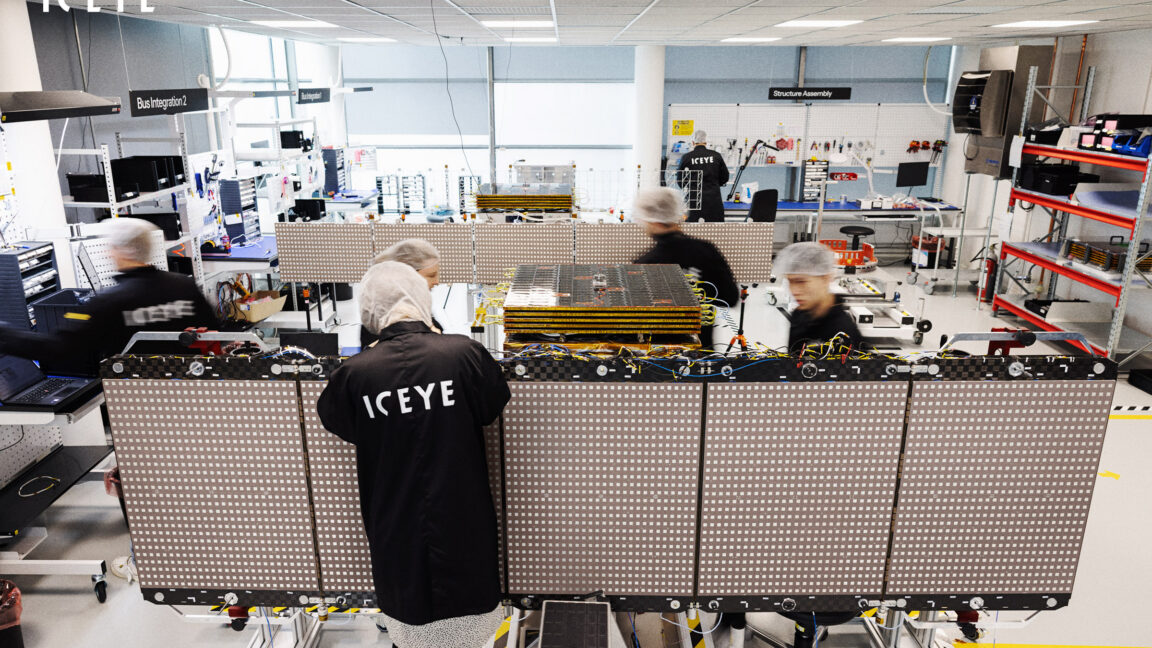
The Russian spacecraft, Kosmos 2612, "conducted a deliberate series of maneuvers toward ICEYE-X36, a US-operated commercial imaging satellite," LeoLabs said. "Kosmos 2612 closed from hundreds of kilometers away to extreme proximity to ICEYE-X36. It then maneuvered around ICEYE-X36, remained nearby for an extended period, and then began moving away."

US military officials and independent analysts have tracked Kosmos 2612 since its April launch on a Soyuz rocket from a spaceport in northern Russia. Within weeks, it became apparent that at least four of the six satellites from that launch were stalking ICEYE-X36 after they adjusted orbits to line up with the orbit of the ICEYE spacecraft.

Read full article

Comments

© ICEYE

  •  

Accused OpenAI spy had folder called “Saudi Gov Docs,” FBI says

On Monday, a court granted the US government's request to deny release of a former OpenAI engineer accused of bugging a top-secret conference room to steal the frontier lab’s secrets.

In a court filing Sunday, US attorney Craig Missakian argued that Abdulrahman Alfozan must continue to be detained while the US makes its case that Alfozan brazenly spied on OpenAI, either for his own personal business gain or to benefit the Kingdom of Saudi Arabia.

Evidence showed that Alfozan had been chatting with a member of the KSA royal family on WhatsApp, while pursuing opportunities to permanently move back to Saudi Arabia during the country's biggest AI push yet, the government argued. Shortly before his arrest, the FBI found he accessed a folder called "Saudi Gov Docs" on his iPhone, where he also allegedly stored photos of a second bug he planted in the offices.

Read full article

Comments

© BRENDAN SMIALOWSKI / Contributor | AFP

  •  

Batteries help reduce emissions, but how do we reduce their emissions?

The first order of business for the energy transition is electrifying applications like vehicles and heating and making sure that the electricity that powers them is made using renewables. But once the dominant slices of the emissions pie have shrunk, other categories with less potential to reduce emissions become important.

A new study led by Haiwei Zhou at the University of Melbourne focused on the emissions associated with making lithium-ion batteries, which many parts of the energy transition rely on. Those emissions aren’t zero, so as we use more and more batteries, that number will grow. Right now, the researchers estimate that these emissions only account for 0.18 percent of annual greenhouse gas releases, but they could increase by a factor of 10 or more by 2050.

Avoiding production

There are a number of ways to reduce the emissions required to make a battery. Some elements used in various lithium-ion battery chemistries are more energy-intensive to mine and refine than others. The battery manufacturing process involves many steps that could be made more energy-efficient. And then there’s recycling, which can put battery materials back into the loop while requiring much less energy than mining.

Read full article

Comments

© Oleg Nikishin

  •  

PSA: Patch your Plex media server before someone hacks it

Recently fixed vulnerabilities in the Plex Media Server are under active exploitation in attacks that, when successful, install malware, including cryptominers and residential proxy apps, a researcher said.

Plex fixed four vulnerabilities at the start of last month. Three weeks later, published CVE designations revealed five vulnerabilities, with one of them carrying a severity rating of 8.6 out of 10. A researcher last week revealed an exploit that chained four of them together to achieve remote code execution of the device running a vulnerable Plex version. The researcher named the chain "Plex2Shell."

Complex exploit chain

The new details allowed a separate researcher to create a honeypot that could track attempts in the wild to exploit the vulnerability chain. Within a day, the researcher began seeing active scanning of the simulated Plex server and eventually successful attempts to infect devices. So far, successful attacks are installing two payloads. One is a cryptominer, which uses the device to mine cryptocurrency and deposit it into a wallet controlled by the attacker. The other payload is residential proxy software, which allows people to anonymize their Internet activity (much of it illegal) by connecting to the infected box and then using it to send the user’s traffic to a final destination.

Read full article

Comments

© Plex

  •  

Startup taps underwater volcano as energy source in "proof point" test

The world’s first demonstration of a subsea geothermal power plant has taken place near an active underwater volcano almost a mile below the ocean surface. It generated less than 10 seconds of net-positive electricity but showed the technical feasibility of tapping another form of renewable energy underwater.

The three-week test deployment of the 3-ton prototype power plant took place at the Axial Seamount in the northeast Pacific Ocean in September. Endurance Energy, the Seattle-based startup behind the effort, aims to eventually commercialize subsea geothermal power for Pacific island nations and other customers looking for alternatives to importing expensive fossil fuels.

“The deep ocean gives us unlimited cold seawater for cooling, and its weight keeps the system and the well pressurized, so our plants can be compact,” said Andrew Redd, founder and CEO of Endurance Energy, in an email to Ars.

Read full article

Comments

© Endurance Energy

  •  

The lost oceans of Venus, many crashes, a new space telescope

Chinese food in orbit, hard-working robots, and lightning strikes a rising rocket. As the Earth's northern hemisphere moves through autumn, let's check in on humanity's exploration of space.

Sun An international team found gorgeous images of the photosphere and "small-scale magnetized Kelvin–Helmholtz instabilities in the solar photosphere." (previously). Mercury The European Space Agency (ESA) and Japan Aerospace Exploration Agency (JAXA) BepiColombo mission arrived at Mercury. However, that planet closest to the Sun seems to be shrinking faster than previously understood. Venus A new study argues that Venus may have been covered with oceans a long time ago. A moon may once have orbited ancient Venus but spiraled in to its destruction. On Earth's surface In Canada an amateur astronomer identified an impact crater; "[a]fter consultations with the Innu Council of Ekuanitshit, the research team is calling the crater Uhackatik." Wildfires in Spain threatened a NASA observatory. In Chile an observatory started its "Legacy Survey of Space and Time," a decade-long project to "create the most comprehensive, cinematic record of the universe in history." Japan's experimental RV-X rocket lifted off, moved horizontally, then safely landed nearby in a test. RocketLab announced it was offering a portable spaceport, the Global Hypersonic & Orbital Spaceport Technology, or GHOST. Indian company Skyroot hopes to produce one launch vehicle per month. NASA's Office of Inspector General called for upgrades to launch facilities as Artemis missions and private rocketry increase pressure on the system. NASA stated that it won't fly humans on the Boeing Starliner until 2028. The Trump administration issued a national space transportation policy. Demand for space launches might soon exceed rocket capacity. From Earth's surface to orbit German's Isar Aerospace successfully launched a Spectrum rocket from Norway into Earth orbit, the first such mission from a Western European site. Lighting struck a Long March rocket as it ascended, but the craft went on to a successful orbital deployment. Another Long March suffered an anomaly and exploded (archive link). A Taiwanese rocket launch failed (archive). NASA's Nancy Grace Roman Space Telescope successfully launched, deployed solar panes and heatshield, and is on its way to an L2 point position with plenty of fuel. (previously). A Falcon rocket accomplished two achievements in August: 100 SpaceX missions that year to date, and the 37th mission for booster B1067. Starship's 13th mission reached orbit, deployed Starlink satellites, and returned to Earth. A camera captured the first 15 seconds of Starship's engines firing from close up; cameras on some of those Starlinks looked back at their launch vehicle (another copy). A Google satellite reached orbit, carrying a group of Tensor Processing Units (TPUs) running Gemma AI in a test of orbital data center capacity. In Earth orbit The Tiangong space station now serves more than 200 different meals. Russia's Rassvet satellites are apparently struggling to reach needed altitude. Polish company Orbital Matter is testing out materials 3d printed by its Replicator 2. Kyoto University researchers are using Starlink data to study Earth's thermosphere. NASA and Katalyst conceded defeat in an effort to rescue the failing Neil Gehrels Swift Observatory. Swift is still doing its best to track gamma-ray bursts. (previously) A United States Space Force exercise saw one satellite successfully launch, target, and intercept another. Space Force also declared it had placed "space control weapons" in orbit. back down to Earth A NASA astronaut in orbit observed cities changing their lighting technologies. The number of alerts for space debris falling to Earth has increased. The United States Federal Communications Commission granted Reflect Orbital permission to orbit its Eärendil-1 satellite, designed to reflect solar light onto the Earth's night side. Reflect then bought space on a Skyroot launch. SpaceX is struggling to make Starship's heat shield reusable. A petition warned that expanding satellite numbers with orbital data centers would cause Earthly damage, including pollution and ozone layer depletion. More than 40 million years ago it seems that an asteroid struck what is now known as the North Sea. Earth's Moon In 2024 an asteroid struck the moon, "the largest contemporary impact crater found in the Solar System and, according to current models, a once-in-132-year event.' A Falcon 9 rocket stage crashed into the moon (photo). A lunar hole, Marius Hill Pit, may become a habitat for human visitors. NASA's Cooperative Autonomous Distributed Robotic Exploration mission (CADRE) will rove the lunar surface to some degree of autonomy. NASA is also considering sending Promise, an engineering model for Perseverance, to the moon. The China Manned Space Agency (CMSA) delayed launching its Chang'e 7 (嫦娥七号) lunar mission until 2027. Mars Perseverance set a new record for offworld driving, having notched up 28.10 miles in over 14 years (seen from HiRISE). The rover also took photos of Phobos crossing in front of Earth. Not to be outdone Curiosity came across "honeycomb-like textures called polygonal fractures." Speaking of Martian moons, Japan's Martian Moons eXploration (MMX) mission is due to launch today (previously). Pioneer Labs announced they made their first microbe for a Mars mission. Planetary geological and former NASA program administrator Adriana C. Ocampo Uría called for an international approach to human settlement of Mars; NASA Administrator Jared Isaacman rejected that. To the asteroids Tianwen-2 (天问二号) reached asteroid 469219 Kamoʻoalewa and is scheduled to attempt a sample return. Astronomers were able to image 44 Nysa clearly enough to find it was unusually triple-lobed and had its own tiny moon. China's National Space Administration (CNSA) is considering a two-ship mission to strike and observe a near Earth asteroid. Jupiter The Juno probe marked ten years orbiting and working around Jupiter. Saturn Astronomers working with Hubble imagery discovered a new ten-sided atmospheric shape on Saturn's southern pole. Neptune The large moon Triton may have wrecked preexisting Neptunian moons when it first arrived, leaving tiny moons as orbital wreckage behind. (previously) In the Kuiper belt NASA's New Horizons safely awoke from hibernation mode as it traveled nearly 6 billion miles from Earth. It may become the third human craft to exit the solar system. However, funding cuts threaten two instruments.
  •  

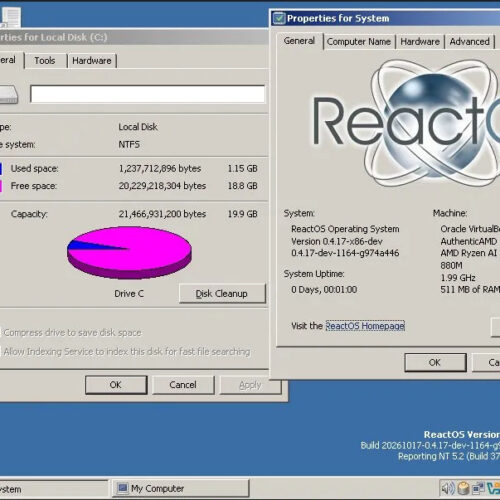
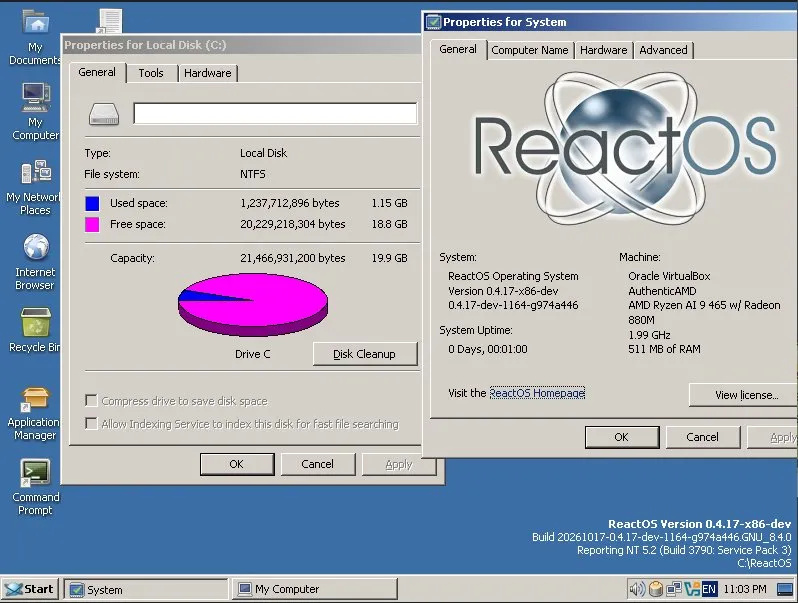
ReactOS reaches major milestone with NTFS install support

Open source Windows alternative ReactOS has reached a major milestone: The operating system can now be installed directly onto an NTFS drive partition. As reported by Phoronix, the move to NTFS clears a long-standing hurdle for the project and brings it one step closer to finally reaching beta.

Prior to this latest announcement, ReactOS required users to keep a FAT32 partition for installations. A proprietary Microsoft-developed filesystem, NTFS can trace its roots back through the Windows NT family lineage starting in 1993 with Windows NT 3.1. The variant introduced with Windows XP in 2001 remains the standard used by most Windows systems today. With ReactOS's stated goal of reaching binary compatibility with Windows Server 2003, being confined to FAT32 partitions was a practical barrier to clear on the way to reproducing the Windows environment.

However, users looking to hop off the Windows train shouldn't be grabbing their bags just yet. ReactOS wrote that the new driver still "lacks caching (which causes inferior performance), journaling and security support." So while the new driver is here, even the most intrepid of OS tinkerers should tread carefully. The ReactOS team warned in its announcement on X that there are still "potentially undiscovered bugs."

Read full article

Comments

© ReactOS

  •  

AI game clones are making indie developers afraid to show their work

Since its earliest days, the video game industry has been built on developers creating clones of competing games, with varying levels of originality and varying levels of enforcement from game platforms. Now, though, AI coding tools are making that cloning process so efficient that many developers are getting extremely cautious about sharing their early work too widely.

Developer Alliance Arts highlighted this trend over the weekend, delaying the launch of a planned public demo for its demon-themed Russian Roulette drinking game Drunken Goddess Reflux, which had been set to go live with today's launch of Steam Next Fest.

In a post on social media Friday evening, the Alliance Arts team wrote that, in addition to concerns about managing streaming restrictions, "we're concerned that the demo's content could be used to quickly imitate or replicate the game's presentation and gameplay with AI or other tools and that such works could be released before our launch."

Read full article

Comments

  •  

Announcing Privacy Badger for Safari on macOS

Exciting news for Safari users: Privacy Badger is now available on Safari for macOS! You’ll need Safari version 26.5 or higher to use it.

Whether you want to protect yourself from data brokers or just don’t want Big Tech profiting off your browsing data, Privacy Badger is here to help. More than 4 million people already use EFF’s free tracker-blocking extension to take a stand against online surveillance. Safari users can now join them and EFF in the fight for a better web.  

Install Privacy Badger

Support the Fight Against Online Tracking

Safari support has been one of Privacy Badger’s most requested features for years. Thanks to recent improvements in Safari's extension support, we’ve finally made it happen for Safari version 26.5 and higher. Privacy Badger is now available on all major desktop browsers. And before you ask, yes, we will look into supporting Safari for iOS once we've ironed out any issues on macOS.

Why Install Privacy Badger on Safari? 

Most websites contain invisible tracking code that lets companies collect, share, and profit from your personal data. Some of those companies are data brokers that sell your information to anyone willing to pay. Creepy ads are just the tip of the iceberg when it comes to the harms of online tracking: Once your information enters the data broker ecosystem, it’s nearly impossible to know who buys it or what they’re doing with it. Privacy Badger blocks online trackers to prevent your browsing data from being used against you.  

Privacy Badger goes beyond Safari’s built-in privacy features to provide additional protection against online tracking. In its default browsing mode, Safari limits the information that trackers can access but still allows them to load. Privacy Badger blocks trackers from loading in the first place, preventing them from tracking you using techniques that bypass Safari’s protections. 

Privacy Badger works well by itself, and will continue to enhance your privacy when installed along side an ad blocker or with Safari’s Advanced settings to block trackers in all windows. Since Privacy Badger automatically learns to block trackers, Privacy Badger will block trackers that other tools don’t know about or choose not to block. 

For example, Privacy Badger blocks tracking from widgets like embedded tweets, comments sections, and video players. These widgets can share your data even if you never click on them. Privacy Badger prevents these trackers from loading and replaces them with click-to-activate placeholders. 

Beyond tracker blocking, Privacy Badger automatically sends the Global Privacy Control (GPC) signal to tell websites not to sell or share your personal information. The GPC signal is already legally binding in a growing number of states, including California, Colorado, New Jersey, and Connecticut.  

All these features (and more) work together to help keep your browsing activity private on Safari. 

Try It Out and Spread the Word 

If you use Safari on macOS, give Privacy Badger a try. You’ll install Privacy Badger through the App Store on your macOS device. Installing extensions is a little more complicated on Safari than other browsers, so follow Apple’s directions here if you’re having trouble.  

This is our first release of Privacy Badger for Safari, and we will keep improving it based on your feedback. If you run into any problems, let us know by emailing extension-devs@eff.org, or by opening an issue on GitHub. And if blocking harmful trackers causes issues on a website you visit, you can disable Privacy Badger for that specific site while keeping it enabled and protecting you everywhere else. You can also let us know about broken sites by using the “Report broken site” button found next to the “Disable for this site” button in Privacy Badger’s popup window. 

When you use Privacy Badger, you join EFF and millions of other users in the fight for a better web. Help spread the word by telling your friends and family who use Safari that they can use Privacy Badger too!  

Install Privacy Badger 

Support the Fight Against Online Tracking 

  •  

EFF Launches Privacy Badger for Safari on macOS

Free Tracker Blocker Used by Millions Will Protect Even More Users' Privacy

SAN FRANCISCO—Privacy Badger, the award-winning tracker blocker made by the member-supported digital rights nonprofit Electronic Frontier Foundation (EFF), is now available for Safari on macOS.  

Safari users can download the free browser extension today and join the more than 4 million people using Privacy Badger to take a stand against data brokers and online surveillance. Users will need Safari version 26.5 or higher to use it.

Ranked as one of the best ad tracker blockers by The Wirecutter, Consumer Reports, PC Mag and more, Privacy Badger is different from other blocking extensions. Created by EFF to stop companies from spying on you online, Privacy Badger automatically learns to block hidden trackers on the web, along with additional privacy-protecting features. 

"Most websites contain invisible tracking code that lets companies collect, share, and profit from your personal data," said Lena Cohen, Staff Technologist at EFF. "Creepy ads are just the tip of the iceberg when it comes to the harms of online tracking: Once your information enters the data broker ecosystem, it’s nearly impossible to know who buys it or what they’re doing with it. Safari support has long been one of Privacy Badger’s most requested features and EFF is excited to be able to make this important tool available to Safari users to fight back for a better web." 

On Safari, Privacy Badger goes beyond the browser’s built-in privacy features to provide additional protection against online tracking. In its default browsing mode, Safari limits the information that trackers can access, but it still allows them to load. Privacy Badger blocks online trackers from loading in the first place, preventing them from tracking you using techniques that bypass Safari’s protections. 

With today's launch, Privacy Badger is now available on all major desktop browsers. 

As the leading nonprofit defending online civil liberties, EFF is committed to fighting mass surveillance in the courts, through activism, and by making free, privacy-protecting tools like Privacy Badger. Now, even more people can join the movement against online tracking, by installing Privacy Badger themselves, telling their friends and family who use Safari about it, or by supporting Privacy Badger today. 

For more on Privacy Badger for Safari on macOS: https://www.eff.org/deeplinks/2026/10/announcing-privacy-badger-safari-macos

For more on the dangers of online tracking: https://www.eff.org/deeplinks/2025/03/online-tracking-out-control-privacy-badger-can-help-you-fight-back 

For more on how Privacy Badger works: https://privacybadger.org/ 

Contact: press@eff.org

  •  

Feds Suspect Ransom Negotiator Ran ShinyHunters Extortion Site

U.S. federal investigators pursuing the ShinyHunters hacking group that recently stole highly sensitive data from the FBI have identified executives at two different ransomware negotiation firms who maintained unusually close relations with the extortion group, KrebsOnSecurity has learned. Sources close to the investigation say one of the executives in the United States even helped ShinyHunters operate a website that pressured victims into paying a ransom.

Hackers aligned with ShinyHunters have claimed credit for dozens of major data breaches since 2019, when the group was primarily operated by cybercriminals living in France. As those original members were arrested or jailed one by one, control over the ShinyHunters brand eventually passed to “Rey,” identified last year as a teenage hacker from Amman, Jordan. According to the FBI, ShinyHunters has extorted more than $70 million from victims so far this year.

In late September, ShinyHunters hacked the FBI recruitment website fbijobs.gov and taunted the agency by threatening to publish the stolen files, which reportedly included medical and psychological records, Social Security numbers and home addresses, and information about each employee’s unit and specialization.

The FBI jobs site hack has prompted the agency to move with uncommon speed to arrest, detain and question people who had any communications with Rey or other ShinyHunters suspects. Reuters reported on October 3 that Rey had been detained by Jordanian authorities and was cooperating with the FBI.

Rey was able to assume control over the hacking group because one of its alleged senior members had just been nabbed. On the evening of September 15, 2026, authorities in the Netherlands arrested convicted hacker and ShinyHunters suspect Pepijn van der Stap. Dutch police reportedly used flash-bang grenades in an effort to stun and apprehend Van der Stap as he was logged in to various online accounts.

According to a source close to the investigation, the authorities arrested Van der Stap while he was using his Signal instant messaging account, which allowed them to read recent communications with frequent contacts — including ransomware negotiators based in Canada and the United States.

Multiple sources with knowledge of the matter told KrebsOnSecurity that Van der Stap’s messages were the key to unraveling a murder-for-hire plot that emerged immediately following his arrest. The Dutch news outlet RTL reported last month the two murders were allegedly to be committed abroad, and that there are indications Van der Stap gave the order for the attacks (there is no indication those orders were ever carried out).

On October 9, KrebsOnSecurity broke the news that the FBI arrested a 54-year-old Canadian cybersecurity executive named Edward Dubrovsky in connection with the ShinyHunters investigation. Dubrovsky, who recently published a book on handling cyber extortion that recommended always engaging with the hackers, was charged with threatening to disclose stolen or hacked data and interfering with interstate commerce through extortion, according to court records. Politico reports prosecutors have asked that Dubrovsky remain in custody pending trial, and that records related to his case remain under seal.

A source close to the investigation told KrebsOnSecurity that Van der Stap’s Signal messages showed he had frequent conversations with Mr. Dubrovsky and with at least one executive at a large U.S.-based consulting firm, and that these executives often knew the details about new ShinyHunters victims before the victims themselves had even learned of the breach.

That source shared another potentially explosive finding by federal investigators: the Dutch hacker’s chats showed Mr. Dubrovsky knew ShinyHunters had stolen highly sensitive data from FBI servers, and that he never informed the bureau of the data breach prior to ShinyHunters threatening on Twitter/X to publish the agency’s deeply personal personnel files.

SHINYWIRE

KrebsOnSecurity has learned from two sources close to the ShinyHunters probe that FBI investigators believe at least one executive at a U.S.-based consulting firm played an active role in operating the now-defunct ShinyHunters victim extortion website “shinywire[.]com.” KrebsOnSecurity is not naming the U.S. company or the suspected executive(s) for now because they have not yet been charged with a crime, but it is a prestigious firm with more than 1,000 associates.

A section of the homepage for the now-defunct Shinywire website.

The Shinywire website was active from approximately May 3, 2026 until October 16 and had entries for nearly 100 organizations hacked by ShinyHunters. Each entry urged victims to engage with the cybercrime group and discuss terms for payment. The pages also included samples of stolen files and promised those files would be published online if the victim ignored their demands.

The following screenshot shows a cached portion of the Shinywire extortion page for Intuitive Surgical, an American medical technology company that was breached in March 2026 after an employee fell for a targeted phishing email.

The Shinywire website, as indexed by urlscan.io. This listing is an extortion demand targeting Intuitive Surgical, an American medical technology company breached in March 2026 by a targeted phishing email attack that compromised an employee’s credentials.

Victim organizations that refused to engage or negotiate after seven days would find all of their stolen data published on the ShinyHunters victim shaming blog (a website that is only reachable via the anonymity network Tor).

In a story published October 15, The Globe and Mail wrote that a few months before Edward Dubrovsky was arrested by the FBI, the Canadian cybersecurity executive alleged in court documents he had become collateral damage in a campaign by a former business partner to “destroy” another industry executive.

The story noted that Dubrovsky filed the lawsuit in Ontario this year against Daniel Tobok, the former chief executive of Cypfer, a cybersecurity firm founded in Toronto with offices in the U.S., Britain, the Netherlands, the United Arab Emirates, and Mexico. The two first became business partners in 2017 and later developed Cypfer together, where Mr. Dubrovsky was a managing partner and chief operating officer. But by 2024, the two had a falling out, with Dubrovsky accusing Tobok of gradually excluding him from business matters and making “increasingly capricious business decisions.”

Mr. Tobok reportedly denied the allegations and filed a counterclaim, accusing Mr. Dubrovsky of accessing confidential information and unfairly competing with Cypfer through work at another firm called CyberSteward Inc. He also said Mr. Dubrovsky has misrepresented himself as a Cypfer founder, and is not a shareholder.

GHOSTBYTE

According to interviews with several former colleagues of Mr. Tobok, as far back as eight years ago he was known to ransomware purveyors by a particular nickname: Ghostbyte. In 2018, a Canadian company was hacked by Dharma, a prolific Russian-language ransomware affiliate program that first surfaced in 2016. The victim company told the Dharma ransomware representative they were leaning toward paying because some of the files were unrecoverable after being locked, but that they needed a better guarantee that Dharma would keep their word if paid.

A redacted copy of the Dharma rep’s reply is pictured below, and it shows the ransomware group urged the victim to contact a person at a Canadian IT firm that helps companies seeking such guarantees. The Dharma rep recommended the victim contact the email address ghostbyte@tutanota.com.

“If you want guarantees, you can write to the IT company,” the Dharma reply advised. “Take the phone and negotiate with them. This IT company often solves such problems in Canada. You can contact them and sign a contract for services. You’ll still have to pay.”

An email reply from the Dharma ransomware group to a victim, recommending they contact an email address that is connected to Mr. Tobok.

It’s unclear if Mr. Tobok ever used that Ghostbyte address offered by the Dharma representative, and he has not responded to multiple requests for comment. However, the breach tracking service Constella Intelligence finds an email address Mr. Tobok has frequently used — dtobok@me.com — is associated with two online accounts where the chosen username was “ghostbyte,” including a Snapchat account.

Incidentally, Constella also finds the Dharma rep’s email address luckygoodlucky@tuta.io is associated with a cryptocurrency address that processed 38 transactions totaling 43 bitcoin, ~$3.5 million at today’s value (the most recent transaction for this wallet is dated February 2019).

In a statement shared on October 14, Cypfer said the company’s business does not include making or facilitating ransomware payments, and that Cypfer learned of Dubrovsky’s arrest when the news first broke in the media.

“We had no prior knowledge of Mr. Dubrovsky’s arrest,” a spokesperson told KrebsOnSecurity via email. “CYPFER has not received any outreach from law enforcement and, to our knowledge, is not the target of any law enforcement investigation.”

The statement said CyberSteward and Cypfer are separate companies with no officers, directors or employees in common, and that Cypfer was recently acquired by the Apros Group, a holding company led by Jason Hogg, a former FBI special agent and former CEO of Aon Cyber Solutions Group. In 2020, Aon aquired Cytelligence, a security consulting firm where Mr. Tobok was founder and CEO and Mr. Dubrovsky was a managing partner.

CONFLICTING INTERESTS

It is not illegal in the United States to pay hackers for an encryption key to unlock servers infected with ransomware, or in exchange for a promise to delete any stolen files and refrain from publishing them online. While victim organizations can land in legal hot water if they pay a ransom to a group that is sanctioned by the U.S. Treasury Department, ShinyHunters is not among the ransomware groups currently sanctioned by the United States or by any other government.

Experts say ransomware victims are typically directed by their insurance provider to work with a specific incident response firm. But not all cyber forensics and breach response companies will agree to facilitate payments to ransomware groups on behalf of their clients. As a result, once victim firms make a decision to pay, the firms that eschew rewarding extortionists are invariably replaced by companies that have no such qualms.

In December 2024, ShinyHunters began extorting the education technology company PowerSchool, stealing private information on 62 million students and 9.5 million teachers in the U.S. and Canada. PowerSchool reportedly paid a $2.85 million ransom demand, and a “frequently asked questions” statement (PDF) about the breach says PowerSchool was assisted in that effort by CyberSteward (ShinyHunters affiliate Matthew Lane, 20, of Sterling, Mass., was sentenced in November 2025 to four years in prison for his admitted role in the PowerSchool hack).

But that ransom payment did not stop future extortion attempts using the same stolen data. By May 2025, individual school districts were reportedly receiving separate ransom demands using samples of the same stolen files. While nobody has alleged ShinyHunters was behind the second wave of extortion against PowerSchool users, the incident drives home the reality that there is no technical way to verify the threat actors have deleted the stolen data as promised, or prevent others from abusing the same records.

A number of leading cyber incident response firms, including Coveware and Unit 221B, have consistently warned victims against paying ShinyHunters, noting that “destroyed” victim data is often kept, resold or used to extort the company’s clients directly later on.

The FBI echoed those sentiments in an alert on May 15, 2026 advising victims against paying the ShinyHunters group. Meanwhile, ShinyHunters members have been harassing and threatening employees at Coveware and Unit 221B for offering this advice.

The following screenshots show just how annoyed the ShinyHunters leaders were with Coveware’s relentless advice against paying the group. The first image is from a conversation on May 6, 2026 that took place between the group’s main account on Telegram and a co-conspirator. In that chat, snippets of which were shared with KrebsOnSecurity by a trusted source, ShinyHunters complained that Coveware was harming the group’s payment rates.

The operator of the ShinyHunters account on Telegram speaking privately with a co-conspirator and complaining that Coveware was harming their business.

“Go on my website, majority of those companies would’ve paid if it weren’t for Coveware giving them misinformation,” the ShinyHunters account wrote. “Someone (100% Coveware) is going out of their way to make sure i am not paid.”

In another conversation on April 11, 2026, the ShinyHunters Telegram account privately said they were trying to “eliminate the problem,” which they said was Coveware. Coveware declined to comment for this story.

“I’m sure the company will pay but in this specific case I am aware of Coveware and their involvement, and I’ve probably been not getting a lot of other negotiations mostly likely because Coveware keeps getting involved,” the ShinyHunters account bemoaned.

The operator of the ShinyHunters account on Telegram telling a co-conspirator they were “trying to eliminate the problem,” which they identified as Coveware advising victims not to pay the cybercrime group.

Mark Camillo is chief executive at CyberAcuView, an industry group founded in 2021 by a consortium of major cyber insurance carriers. Camillo said some firms charge a flat retainer fee, while those that specialize in helping companies negotiate a ransom payment tend to charge a percentage of the total ransom amount paid.

That latter dynamic, he said, is an inherent conflict of interest, as the negotiator has every incentive to make things more favorable to the attackers because they are financially incentivized to negotiate and pay out, and to not negotiate down on the price.

“It has come to the industry’s attention that many of the ransomware payers charge a percentage of the final payment which may or may not be disclosed,” Camillo said. “This makes no sense if they are also the negotiator. There needs to be more transparency in the process as no one in the ecosystem should be profiting purely on the size of the ransomware transaction or payment itself.”

Camillo said the firms doing this work would argue the fees are needed because there may be unexpectedly higher costs to secure larger quantities of cryptocurrency or more risk carrying the float, and because cryptocurrency exchanges may charge higher fees for high risk transactions.

“There definitely needs to be more visibility around the transaction and clarity on the increasing value of the crypto and the exchange’s percent in the transaction to get to the bottom of this and remove any misaligned incentives,” he said.

In recent months, the U.S. Department of Justice has prosecuted a number of ransomware negotiators alleged to have conspired with cybercriminals to defraud their clients. On October 7, the DOJ charged MonsterCloud CEO Zohar Pinhasi, 50, with wire fraud and conspiracy for allegedly charging customers to remediate ransomware attacks without paying the hackers. According to charging documents, Pinhasi secretly went behind his customers’ backs and paid hackers anyway, paying ransomware groups $8 million while charging customers $19 million.

In July, Angelo Martino, a 41-year-old ransomware negotiator from Land O’Lakes, Florida, was sentenced to 70 months in prison for conspiring with the Blackcat/ALPHV ransomware group to extort multiple victims. According to the DOJ, Martino was paid by BlackCat attackers to provide confidential information about the negotiating position and strategy of his employer’s clients and enable the ransomware actors to maximize the ransoms paid by the victims.

  •  

Florida DMV hacked after police dept insecurely stored login info

The Florida Department of Highway Safety and Motor Vehicles (FLHSMV) has begun notifying victims impacted by a recent data breach of driver’s license and motor vehicle data, but not everyone whose information was stolen will receive an alert.

In a notice posted Friday, FLHSMV confirmed that it took “immediate steps” after discovering that “a malicious actor accessed certain department records on September 4, 2026, using compromised credentials.” There’s “no evidence” that data has yet been misused, the department said, but law enforcement “determined the information potentially affected includes driver license and motor vehicle data, to include document images, and other personal information.”


FLHSMV is sending out letters to everyone affected, offering victims one year of credit monitoring from Sontiq, Inc. However, the state acknowledged that it may not have current contact information for many former Florida residents whose data was still being stored. Those potential victims can confirm if their data was stolen by emailing FLHSMV at customerinquiry@flhsmv.gov, officials said.

Read full article

Comments

© ablokhin | iStock Editorial / Getty Images Plus

  •  

Disney found a way to buy Character.AI without buying its lawsuits

This week, Character.AI declared bankruptcy. While some saw the fall of a chatbot platform as a harbinger for the industry, court filings indicate that the decision was actually a key part of a deal that has let Disney hire most of Character.AI’s staff—including its now former CEO Karandeep Anand—potentially acquire most of Character.AI’s technology, and avoid the beleaguered startup’s many legal liabilities and obligations.

In the past few years, Character.AI has faced multiple private lawsuits over the safety of its chatbots, as well as investigations from regulators around the world. In a declaration filed as part of the bankruptcy, Character.AI’s newly appointed CEO explained that the goal of the bankruptcy was to reach a “consensual resolution” with personal injury claimants and a group of states investigating the company, while maximizing the value of the company’s assets for shareholders.

The Disney deal seems to be structured so that whatever is left of Character.AI will retain responsibility for those legal battles, some of which are still ongoing.

Read full article

Comments

© Getty Images | NurPhoto

  •  

A Chinese rocket deorbited over Minnesota and left this in a farmer's cornfield

About a month ago, a Chinese rocket took off from a remote spaceport in the Gobi Desert, released 10 satellites into orbit, then reignited its engine and put itself on a trajectory to rain down debris over the American Midwest.

The rocket's flight on September 15 lasted between 75 and 80 minutes, and it came down without completing a full orbit of the Earth. Social media posts at the time showed streaks of fiery debris falling from the sky, heading north over Kansas toward Minnesota. The overnight spectacle was also visible on the western horizon from Wisconsin.

The exact time, location, and direction of the debris allowed experts to connect it to the launch of a Zhuque-2E rocket, a medium-lift vehicle built by a Chinese company called LandSpace. The rocket had launched from Dongfeng, a commercial launch zone co-located with the military-run Jiuquan Satellite Launch Center in northwestern China, less than two hours before.

Read full article

Comments

© Stevens County Sheriff's Office

  •  

Review: Lanterns is a truly unique twist on the superhero genre

The trailers for HBO's DC Universe series Lanterns teased a show that eschewed the usual superhero hijinks in favor of a gritty realism more in the vein of True Detective or Slow Horses. Personally, I liked the change. My verdict: Ignore the review bombing; it's wonderful. The season wrapped with an emotionally charged, almost elegiac finale that fully delivered on that initial promise. I've found the rebooted DC Universe films released thus far to be enjoyable but rather forgettable, even when the positives outweigh the negatives. But Lanterns is a shining beacon of what is possible when someone is allowed to get really creative within the genre.

(Spoilers below, but no major reveals.)

There are two primary storylines. The first takes place in 2016 with a mass shooting at a local football game in Rushville, Nebraska. Current Green Lantern Hal Jordan (Kyle Chandler) and his new trainee, John Stewart (Aaron Pierre), get involved in the investigation, to the annoyance of Sheriff Kerry Kane (Kelly Macdonald), who initially doesn't think the case has any extraterrestrial connection. She is soon proved wrong when the suspect (an alien) self-detonates. Hal's power ring controls the damage, but the mystery remains.

Read full article

Comments

© YouTube/HBO Max

  •  

DIY VR: How to build your own headset, and why you probably won't want to

Virtual reality is in a bit of a weird place right now. After a lot of unfulfilled promise in the 1990s, it came back strong with the 2016 release of the Oculus Rift. For a while, it looked like VR, AR, XR, the metaverse, or whatever you wanted to call it, was going to be huge. Mark Zuckerberg was certainly convinced, and even Apple got in on the hype with its Vision Pro.

But by then momentum for alternate realities of every acronym was already in steady decline, and it only dwindled from there. The rate of development of new headsets has slowed, with many companies (including Apple) scaling back or shelving their efforts. While new releases like the Steam Frame and Pimax Dream Air are still happening, many of the most interesting developments in the space these days are on the enthusiast front.

That's right, DIY VR is a thing, and with a couple hundred dollars in components, plus many hours of your time, you too can enter the immersive world of virtual reality while also experiencing the highs and lows of soldering, firmware flashing, and 3D printing. I rode that rollercoaster myself and learned why this is still a decidedly niche movement.

Read full article

Comments

© Tim Stevens

  •  

Stratospheric airship flew from US to Japan to test sky cell tower concept

Nearly 100 years after the dirigible Graf Zeppelin made the first nonstop airship journey across the Pacific Ocean, another airship has successfully completed a round-trip flight from New Mexico to Japan and back. But the significance of this modern feat was less about the journey's length and more about its purpose: demonstrating how a lighter-than-air platform can act as a cell phone tower in the sky.

The trans-Pacific flight that took place over a month between August and September 2026 was the most notable milestone yet for Sceye, a US aerospace company based near Albuquerque, New Mexico. Sceye has developed an uncrewed platform filled with helium for buoyancy and equipped with an electric-powered propeller for active propulsion, allowing it to resist most strong winds and keep hovering over the same location for long periods. The platform also uses top-mounted solar panels and onboard batteries to stay powered for stratospheric operations around the clock.

“We can stay over an area of operation, and we do that in the stratosphere right around 60,000 feet, so we're twice as high as air traffic and we're above the jet stream, and yet 30 times closer than low-Earth orbit satellites,” Mikkel Frandsen, founder and CEO of Sceye, told Ars. “We can fly through day and night until the sun comes up the next morning and recharges the batteries, at which point we're still at the same altitude and still over the same area of operation.”

Read full article

Comments

© Sceye

  •  
❌