❌

Reading view

Another unremarkable win shows Arsenal’s strength is in depth rather than creativity | Jonathan Wilson

Champions so risk-averse Forest were lured into thinking they had a chance, until bench was used to see them off

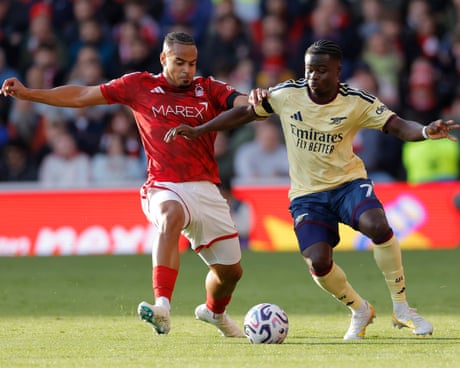
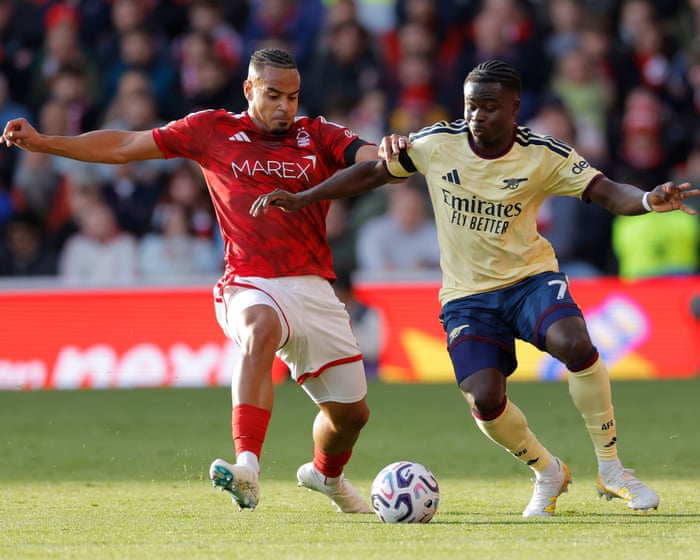
Pass. Pass. Pass. Pass. Sideways. Square. Backwards. Pass. Pass. Recycle. Pass. It wasn’t much of a spectacle. But in the end, for the second week running, thanks in no small part of their bench, Arsenal won. Fireworks in the autumn are for Bonfire Night; titles require relentless accumulation. Since the international break, Arsenal have won three games out of three despite not being in the lead at half-time in any of them.

Hammered at Brighton and having endured a drab first hour at home to Leeds last week, there has been a rare sense, for the first time really since Manchester City dropped points at Everton at the beginning of May, of Arsenal not being quite at their best, needing to reassert their quality. This was not a performance that would terrify any opponent, but it did highlight Arsenal’s consistency and it did demonstrate just how deep their squad now runs.

Continue reading...

© Photograph: Tom Jenkins/The Guardian
© Photograph: Tom Jenkins/The Guardian
© Photograph: Tom Jenkins/The Guardian

  •  

Europe is a blast – but more a curse than a blessing if you are not a Premier League super-club I Jonathan Wilson

The four Premier League clubs playing in the lesser continental competitions face each other on Sunday – but three are struggling domestically

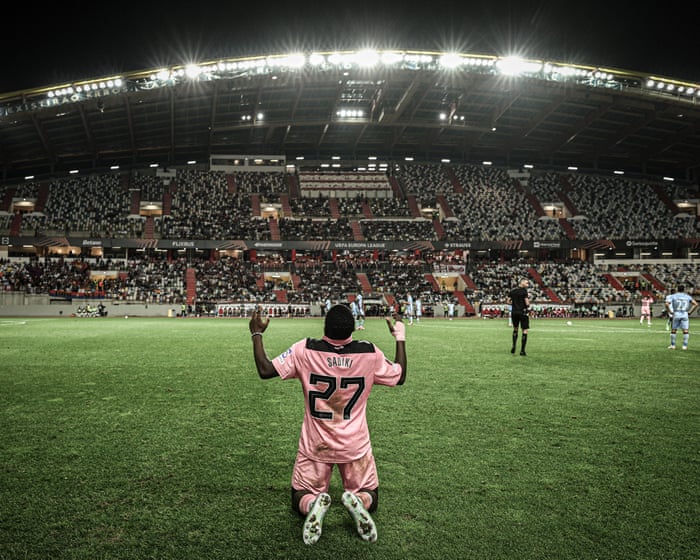
The sun shone. The temperature was in the high 20s. There was a mood of great conviviality. If you were struggling with the official allocation, it turned out you could just email the president of Torreense and he’d sort you out. Were these “Nuno-tickets” real? It turned out they were. Not only that, but you could sit anywhere you wanted in a stadium too big for the game and, if you happened to have gravitated to the comfortable hospitality seating at the back of the lower tier, the beer was inexplicably free.

Locals in Leiria seemed bewildered but could hardly have been more accommodating. A beer pump had been installed outside a patisserie on the Praça Francisco Rodrigues Lobo, whose owner soon found fans happy to help stack empty barrels if that facilitated the free flow of Sagres. “There was a meeting at the town hall to explain these are not hooligans,” said the owner of a radical leftist flammkuchen restaurant between the square and the cathedral. “They told us the club comes from the labour movement and I found that very interesting.” And how had she found the fans? “Noisy, but with a quirky sense of humour.”

Continue reading...

© Photograph: Octávio Passos/UEFA/Getty Images

© Photograph: Octávio Passos/UEFA/Getty Images

© Photograph: Octávio Passos/UEFA/Getty Images

  •  

Winning is not enough for Manchester City to move on from this crisis | Jonathan Wilson

It’s not just that the club’s recent charges themselves are unprecedented – it’s the language used to describe them too

The language of football is a fine and highly nuanced dialect. The majority of people involved in the game speak it with a high degree of sophistication. Minor deviations from the familiar, almost imperceptible to outsiders, can set off alarm bells: what’s really going on there? Why isn’t he happy? What’s she hinting at? But it’s an argot developed to talk about football, and when applied to other subjects, it can sound extremely jarring.

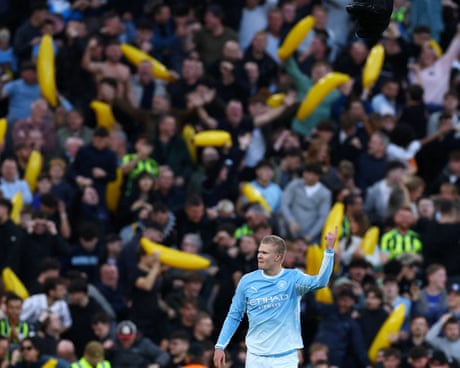
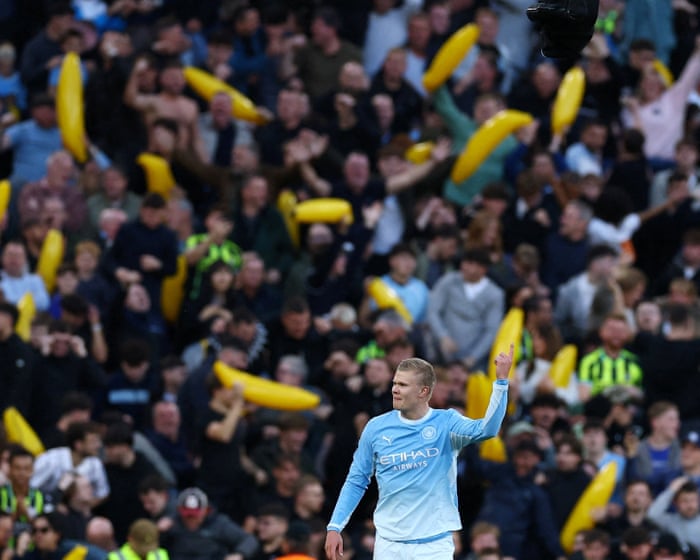
Erling Haaland is one of the brighter, more engaging players. There’s an appealing quirkiness to him that suggests he has a higher-than-usual level of self-awareness. He doesn’t mind stepping outside the norms, being a bit different. But consider his assessment of Manchester City’s 3-0 win at Liverpool on Sunday.

Continue reading...

© Composite: Guardian Design, Getty Images

© Composite: Guardian Design, Getty Images

© Composite: Guardian Design, Getty Images

  •  

Premier League returns in shadow of Manchester City’s judgment day | Jonathan Wilson

Football felt secondary on the first weekend of action since club were found guilty of breaking financial rules

The Cimbri are heading menacingly south, but in Rome life goes on. The asteroid is definitely coming this way, but people go to work, eat, drink, plan as usual. The White Walkers are approaching the Wall, but the squabbles between the great houses go on. Everyone in the Premier League knows the crisis is approaching, thinks – hopes, fears? – it may be apocalyptic, but until it arrives, what can you do but carry on?

After any break, there’s always an awkward moment while everybody resets. What was the cliffhanger we left the soap opera on? What new plotline had just been seeded? This is one of the reasons international weeks are so disruptive. It’s not just that the Premier League story slows for a while, it’s that we are reminded that these entities are not eternal but alliances of convenience between paid employees who have a life outside the soap opera.

Continue reading...

© Photograph: Phil Noble/Reuters

© Photograph: Phil Noble/Reuters

© Photograph: Phil Noble/Reuters

  •  

Why we’re stuck with a Premier League in the clutches of the global mega-rich | Jonathan Wilson

There’s little prospect of the model changing in a country that welcomes wealthy international owners with open arms

Football, the world’s most popular sport, played by laws drawn up in London in 1863. The Premier League is the UK’s greatest soft power export. Premier League clubs are owned by a deputy prime minister of Abu Dhabi, the public investment fund of Saudi Arabia, a billionaire based in Monaco for tax reasons and a disappointing assortment of investors and private equity funds. And what, really, could be more British than that? Football truly is the national game.

What the Manchester City case has exposed is just how difficult it is to regulate some of the richest and most powerful bodies in the world. While the wait for the verdict was frustrating, it’s perhaps unavoidable given the possibility of legal objection at every turn when a leaked email from City’s in-house lawyer during Uefa’s action against the club had threatened to “spend 30 million on the 50 best lawyers in the world to sue them for the next 10 years”. You didn’t get that with Albert Alexander Sr or Peter Swales.

Continue reading...

© Photograph: Ed Sykes/Action Images/Reuters

© Photograph: Ed Sykes/Action Images/Reuters

© Photograph: Ed Sykes/Action Images/Reuters

  •  
❌