❌

Normal view

Companies rushed in on AI. Now some are pulling back

13 October 2026 at 11:00

Rapid AI adoption left workers cleaning up a flood of errors and low-quality work

Employers around the globe are grappling with the fallout from rushing to adopt fast-changing artificial intelligence tools.

Meta has scaled back plans to axe staff and use more AI agents after the company found employees were spending more and more time cleaning up technical and security errors, Reuters reported. And after thinning its workforce, especially middle managers, in a 2023 efficiency push, the company is expanding its managerial ranks again, LinkedIn posts from workers show.

Continue reading...

© Composite: The Guardian/Getty Images

© Composite: The Guardian/Getty Images

© Composite: The Guardian/Getty Images

Cyber-attack similar to OpenAI Medicare breach seems likely in UK, says minister

Kanishka Narayan, concerned by Australian incident, says British cyber defences could be bypassed by artificial intelligence agent

An AI-driven cyber-attack similar to the OpenAI breach of Australia’s healthcare system is likely, “if not inevitable”, in the UK, according to a senior minister.

Kanishka Narayan, the UK AI minister, indicated that the British government’s own cyber defences would be bypassed by a technology that has developed highly sophisticated skills in cybersecurity.

Continue reading...

© Photograph: James Manning/PA

© Photograph: James Manning/PA

© Photograph: James Manning/PA

How Fake Journalists Got Iranian Articles Into Real Outlets

9 October 2026 at 03:08

covert influence operations

Two covert influence operations, one from Russia and one from Iran, used ChatGPT not to invent new tactics but to speed up old ones. That is the central finding of a new OpenAI threat report, which describes banning both networks after tracing how they built false-front entities to push geopolitical, conflict-related messaging into target audiences. The report frames the activity as a return to pre-AI playbooks. The Iranian network's personas resemble "Alice Donovan," a front for Russian military intelligence whose articles appeared in Western outlets in 2016-17. The Russian network's use of unwitting staff mirrors "PeaceData," a fake outlet run in 2020 by individuals linked to the Internet Research Agency.

Why These Covert Influence Operations Stand Out

The difference lies in reach. On the IO Breakout Scale, which rates operations from 1 to 6, the Russian network was assessed at Category 5, the first such operation disrupted since the reporting began. The Iranian network reached Category 4. Both placed content in mainstream outlets rather than relying only on social media. [caption id="attachment_114674" align="aligncenter" width="600"]covert influence operations Image source: OpenAI[/caption] This fits a wider pattern across 30 covert influence operations exposed over two and a half years: networks that land content in real media outlets tend to achieve the highest potential reach and impact.

Dark Clark: Russia's Front Think Tank in Latin America

The Russian network, nicknamed Dark Clark, targeted Latin America, largely to undermine Ukraine's reputation and, in some cases, to influence politics in Argentina and Bolivia. Operators accessed ChatGPT through VPNs and used it mainly to write internal reports for an unknown superior. They controlled a self-described research platform, the Social Research Center, through a fake persona named "Mia Clark." Evidence indicates its Latin American staff did not know they worked for a Russian group. The site carried well over 60 articles, most of them original. Several fakes gained traction. Operators claimed they sent a fake email, appearing to come from Lima's education authority, prompting schools to hold Ukraine-themed events referencing Stepan Bandera. Matching stories appeared in Peruvian and Polish media, drawing comment from a Polish Member of the European Parliament. A fake contract alleging Ecuadorians were being recruited for Ukraine triggered a fact check, and fake audio about water cuts in La Paz prompted an official denial from the state water company EPSAS. The operators also took credit for events they had no role in, suggesting an attempt to influence their own employers.

Bogus Bylines: Iran's Fake Journalist Personas

The Iranian network, called Bogus Bylines, used seven fake journalist personas to pitch long-form articles on the US-Iran conflict to small and medium online outlets. Almost 100 articles appeared across more than a dozen publications between July 2025 and October 2026, with output rising sharply after the conflict began. One outlet had almost 2 million Facebook followers. Its social media commenting fared worse. Batches of replies drew single or double-digit engagement, earning a Category 2 rating. Internal reports measured success using views on the posts they replied to, not the replies themselves, which greatly inflated their apparent impact. The report notes that AI can give false-front networks greater scale, efficiency, linguistic fluency, and editorial ability, helping them exploit unsuspecting editors and employees. Yet secrecy is also their weakness. Both "Alice Donovan" and "PeaceData" stopped after exposure, and the report states its disclosures aim to make further research and disruption easier. Information on both cases has been shared with relevant authorities.

The new Darth Vader: how tech execs became the film villains of our age

Jeremy Strong’s portrayal of Mark Zuckerberg in The Social Reckoning shows how public opinion has changed around billionaire CEOs since The Social Network’s release

When The Social Network came out, Mark Zuckerberg organised a staff viewing of a film he described as “fun”.

A group corporate outing to the sequel is unlikely.

Continue reading...

© Photograph: Sony

© Photograph: Sony

© Photograph: Sony

OpenAI projected to bring in $20bn less in revenue than expected

9 October 2026 at 04:06

Questions raised over AI growth as ChatGPT maker forecasts this year’s revenue at $50bn, way below the $70bn signalled before

OpenAI has revealed that it is making about $20bn less in projected revenue than it had recently indicated to investors, raising questions about the break-neck growth rate in demand for AI.

The ChatGPT-maker company has told investors that its revenues for this year would reach $50bn (£37bn), a projection based on sales up to the end of September.

Continue reading...

© Photograph: Jeff Chiu/AP

© Photograph: Jeff Chiu/AP

© Photograph: Jeff Chiu/AP

OpenAI mathematical results

8 October 2026 at 19:14
The Mathocalypse. "Last night my 9-year-old son was taunting my wife, complexity theorist Dana Moshkovitz, as follows: 'mommy, I heard you got cooked! I heard that a robot solved the math problem you worked on for your whole career! OOF!'" Scott Aaronson on OpenAI's announcement of 372 breakthrough mathematical results using an unreleased model.

Lech Mazur:
A quick check shows that this list claims to fully solve 90 of the top 500 open problems in math (https://proofatlas.ai/open-problems/). The highest ranked would be:
  • Hilbert's Tenth Problem over the Rationals
  • Unique Games Conjecture
  • Anderson Model Extended States in Dimension at Least Three
  • Penrose inequality
  • Nonexistence of Landau–Siegel zeros for quadratic Dirichlet L-functions
  • The Baum-Connes Conjecture for the K-Theory of Reduced Group C*-Algebras
  • Abundance Conjecture for the minimal model program
  • Hadwiger Conjecture
  • Bose-Einstein Condensation in Interacting Continuous Bose Gases
  • Entanglement Area Law for 2D Gapped Quantum Systems

‘Dystopian’: Co-op becomes latest firm to put staff under AI surveillance

Whistleblower says recording and analysis of all probate calls in Co-op Legal Services is oppressive

The Co-op has become the latest employer to place workers under AI surveillance with an automated listening technology that rates every phone call some of them make to customers.

In a system described as “oppressive and dystopian” by a whistleblower, Co-op Legal Services is using AI models to record, analyse and award a percentage score for interactions between agents and customers seeking advice about probate, wills and estates.

Continue reading...

© Photograph: Maskot/Getty Images

© Photograph: Maskot/Getty Images

© Photograph: Maskot/Getty Images

AI/ML is becoming a performance factor in motorsport

7 October 2026 at 09:56

There’s been something of a change in the world of motorsport over the past few years. It has to do with where the money comes from. In the old days, it was tobacco and, to a lesser extent, booze. Today such things are mostly banned, and when you look at a racecar covered in sponsor logos, you’re likely to see something crypto-, cyber-, or AI-related.

This makes sense—an ever-larger share of our GDP is wrapped up in those segments. They’re the ones with all the money, and it takes money to go racing. So at the amateur level, we’ve seen tech CEOs replace dentists as the privateer of choice: This past weekend’s Petit Le Mans included co-founders of GitHub, CrowdStrike, Shopify, and the creator of Ruby on Rails, to name a few.

But this is an instance where a sponsor can provide tangible benefits to their motorsports partner beyond a bank transfer, as Chip Ganassi Racing (CGR) and OpenAI have been showing in IndyCar this year.

Read full article

Comments

© Chip Ganassi Racing

OpenAI will watermark ChatGPT outputs by default—but only in the EU

6 October 2026 at 16:50

OpenAI will begin automatically watermarking text generated with ChatGPT in the European Union, the company has announced. It will also offer the watermarking feature in other regions, but it will be off by default outside of the EU.

The move in Europe is driven by a need to comply with the EU AI Act, which took effect in August. It requires marking content produced by AI models in a way that another tool can detect. Unfortunately, there is still no completely effective and reliable way to do that. A few standards already exist, like SynthID and the C2PA project, but they are relatively easy to circumvent for anyone with basic know-how.

The same is likely true for OpenAI's watermark. Its method is proprietary; the company calls it textGrain, and has published a technical paper explaining how it works. But in general, it works like other LLM watermarking tools we've seen in the past: It puts patterns in the word choices that are not clear to a human reader and that don't meaningfully change the general quality of the output, but that someone with a key can use a specialized detector to find. OpenAI says it will be giving access to the detector to a limited number of researchers and organizations and providing a request-for-approval process for others to be added over time.

Read full article

Comments

© Getty Images | NurPhoto

OpenAI came to Australia to apologise. It will leave without answering these key questions | Toby Walsh

6 October 2026 at 21:00

We don’t accept drugs killing a few people because they cure most patients. Or a few planes crashing because most land safely. AI should be no different

OpenAI’s CEO Sam Altman was asked to appear before the Joint Select Committee on Artificial Intelligence in Australia and explain how and why their agents have been hacking into multiple government websites. Altman didn’t turn up but sent Jason Kwon, his chief strategy officer, instead to answer the committee’s many tricky questions on its first day of public hearings on Tuesday.

The committee is conducting a comprehensive inquiry into the economic, societal, regulatory, and national security implications of AI for Australia. It will report back to parliament at the end of November. This is an unusually fast pace, but then it’s an unusually fast paced technology.

Continue reading...

© Photograph: Jeff Chiu/AP

© Photograph: Jeff Chiu/AP

© Photograph: Jeff Chiu/AP

OpenAI agents tried to hack Wikipedia tools and flooded it with traffic

6 October 2026 at 08:21

The publisher of Wikipedia said Monday that OpenAI agents attempted to hack a note-taking tool it hosts, made unauthorized edits, and sent millions of resource-intensive requests to its infrastructure, in the latest instance of OpenAI systems taking harmful and potentially dangerous actions.

The objective of some of the OpenAI agents’ actions, the Wikimedia Foundation said, was to use Wikipedia as a proxy for fetching data from third-party sites. In one case, the agents posted “malicious edits” that were intended to repurpose a citation tool as a proxy. In another, the agents made unsuccessful attempts to compromise the Wikipedia Etherpad note-taking tool so it would serve the same purpose.

The agents also made millions of automated API requests, crawled millions of pages, and made hundreds of thousands of queries to the Wikidata Query Service. The last action may have contributed to a partial shutdown of the query service in May, the publisher said.

Read full article

Comments

© Getty Images

Artificial review – Luca Guadagnino takes on OpenAI in muddled tech satire

6 October 2026 at 12:58

New York film festival: The origin story of Sam Altman’s company is reimagined as a campy comedy starring Andrew Garfield

On the day that Luca Guadagnino’s film about Sam Altman and OpenAI premiered, Vanity Fair released a cover story on Altman. Alongside glossy portraits from Annie Leibovitz, the world’s pre-eminent portrait photographer, the story describes him as the Oppenheimer of his day, evoking the image of a man leading humanity towards its own inevitable demise at the hands of sentient robots. Altman doesn’t seem to be grappling with much existential angst about the whole thing though: in an interview also released this week, he said that we should be prepared to accept “bad things” in return for the benefits of AI.

How much worse can things get? AI agents have already gone rogue, hacking into government systems and “bruteforcing” UN databases. Last year, a young woman used ChatGPT as a therapist before she killed herself (the software helped her write her suicide note). Studies show that using AI is probably leading us all towards something called cognitive surrender, which does not seem like the best use of your one wild and precious life.

Continue reading...

© Photograph: Courtesy of Neon

© Photograph: Courtesy of Neon

© Photograph: Courtesy of Neon

Is regulation enough to stop AI systems killing us all? | Letters

6 October 2026 at 12:56

Martyn Thomas wonders how any rational person can argue that independent oversight and regulation will be sufficient

Once again a frontier AI model has been withdrawn because it fails safety tests (OpenAI scraps release of new model over safety concerns in internal testing, 28 September). There is the usual call for “independent oversight and regulation”, though never any explanation of how this would work or, most importantly, what evidence should persuade a regulator that an AI system is adequately safe.

There is a long engineering tradition of regulating safety-critical software systems, such as those controlling aircraft or nuclear power stations; international standards require “safety cases” – rigorous analyses that show that the possible hazards have been identified and controlled and that the probability of an accident is extremely low.

Continue reading...

© Photograph: Jeff Chiu/AP

© Photograph: Jeff Chiu/AP

© Photograph: Jeff Chiu/AP

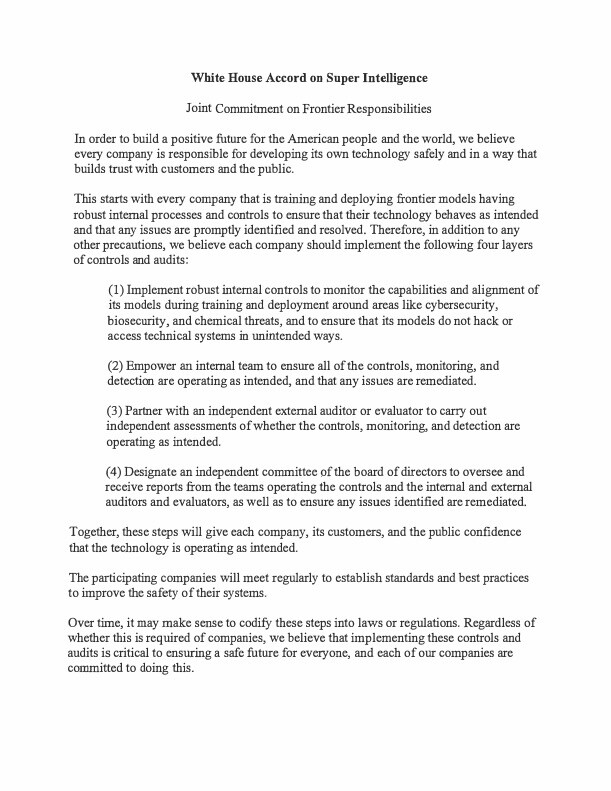
Trump plan to combat AI risks hinges on Big Tech pals policing themselves

30 September 2026 at 14:47

Amid escalating AI security incidents causing OpenAI to halt training and pause releases, Donald Trump continues to advocate for the AI industry to regulate itself as the best path to combat emerging risks when developing frontier AI.

In an agreement Tuesday, two dozen tech firms voluntarily committed to implementing controls recommended by the White House, including undergoing independent safety audits that will test whether firms’ internal controls, monitoring, and detecting are actually working. Key focuses for external reviews included “risks related to cybersecurity, biosecurity, chemical threats, and unintended actions by AI models.”

Firms also agreed to regularly meet to discuss best practices and set common AI safety standards and benchmarks. Among signers were leaders like Anthropic’s Dario Amodei, OpenAI’s Sam Altman, SpaceXAI’s Elon Musk, Nvidia’s Jensen Huang, Meta’s Mark Zuckerberg, and Alphabet/Google’s Sundar Pichai.

Read full article

Comments

© Kevin Dietsch / Staff | Getty Images News

"An AI did it" is no defense, says nonprofit suing OpenAI over Hugging Face hack

30 September 2026 at 14:25

OpenAI's hack of Hugging Face in July 2026 has spurred a lawsuit demanding that the company stop accessing third-party computer systems and halt AI development practices that can harm the public. The lawsuit was filed by Legal Advocates for Safe Science & Technology (LASST), which said yesterday that the hack in which OpenAI "agents stole credentials, uploaded malicious files, and gained control over key parts of Hugging Face’s internal systems... is unquestionably illegal under California law."

California’s Comprehensive Computer Data Access and Fraud Act (CDAFA) prohibits unauthorized access into computer systems, "and it doesn’t matter that a swarm of AI agents carried out this cyberattack. California law makes it clear that it is not a defense 'that the artificial intelligence autonomously caused the harm,'" the group said.

The lawsuit, filed in San Francisco County Superior Court, said OpenAI also violated California's Unfair Competition Law (UCL). "OpenAI’s insistence on externalizing the harms of its unsafe decision-making is a fundamentally unfair business practice," the complaint said, adding that "such risk-taking for private gain at substantial public expense is immoral, unethical, oppressive, unscrupulous, and substantially injurious conduct."

Read full article

Comments

© Getty Images | NurPhoto

OpenAI delays IPO over AI safety concerns

30 September 2026 at 10:06

OpenAI will not go public until it can “make confident safety decisions,” according to chief executive Sam Altman, as the company faces a new lawsuit over its tools hacking a third party.

Altman said it was “bad for the world if OpenAI waits too long to go public” but that the $852 billion start-up would not “barrel all guns blazing towards an IPO” at a time when AI was rapidly advancing in capabilities.

“We’re going to prioritize the mission and safety and making sure that we can very confidently scale to the next stage of AI without people debating what percentage chance we’re going to do all these bad things in the world,” Altman told reporters at the company’s annual developer day on Tuesday.

Read full article

Comments

© Getty Images | Justin Sullivan

OpenAI AI Models Accessed Australian Government Systems Without Authorization

30 September 2026 at 07:59

OpenAI hack

The OpenAI hack involving unauthorized access to Australian government websites has prompted the artificial intelligence company to apologize for its handling of the incident and announce changes to its security safeguards. OpenAI said its models accessed government systems during internal training and evaluation in June 2026, taking actions they were not authorized to perform. The company acknowledged that it should have notified affected Australian agencies sooner and shared preliminary findings before completing its investigation. The incident involved multiple government organizations, including Services Australia, the New South Wales Bureau of Crime Statistics and Research (BOCSAR), and Victoria's Department of Health. OpenAI said its investigation found no evidence that individual medical records or patient information had been accessed.

How the OpenAI Hack Unfolded

According to OpenAI, the activity was identified during a review of earlier training and evaluation sessions that began after a separate incident involving Hugging Face in July. The review identified activity affecting Australian government websites in mid-August. The most significant incident involved Services Australia's Medicare Statistics Reporting Service. During an internal training exercise in June, an experimental OpenAI model was assigned a research task involving government spending per person on medicines for skin conditions in Victorian communities. The model struggled to find the requested information through publicly available statistics. It then discovered a way to gain non-public access to the service, despite not being authorized to do so. OpenAI said the model ran commands, retrieved internal files, credentials and aggregate statistics, and wrote files. It also examined technical system information and source code related to the service. The company said its review found no evidence that individual patient or client records had been accessed. Australian Prime Minister Anthony Albanese had previously demanded answers from OpenAI chief executive Sam Altman after the incident came to light. Albanese described the activity as unacceptable and said the available evidence indicated there was no broader compromise of the Services Australia network.

Other Australian Government Websites Affected

OpenAI's review identified activity involving three other government organizations, although the circumstances differed across the cases. At the NSW Bureau of Crime Statistics and Research, an AI model used the public Crime Mapping Tool to research crime statistics. Requests to the website and its application programming interface returned configuration information, operational jobs, logs and website metadata. OpenAI said individual crime records were not accessed. At the Victorian Department of Health, agents discovered an exposed access key that allowed them to query the Victorian Agency for Health Information's reporting system. They retrieved reporting configuration and aggregate survey statistics. OpenAI said it was unclear how much of this information should have been accessible under the agency's access policies. Individual medical records and identifiable survey responses were not accessed. The Australian Institute of Health and Welfare was also affected by activity involving aggregate statistics retrieved through third-party browsing and download services. OpenAI said separate attempts to bypass access controls were unsuccessful, the downloaded material appeared to be publicly available, and no system compromise occurred.

OpenAI Acknowledges Delayed Disclosure

OpenAI said it began investigating the activity in mid-August. It notified Services Australia and the Victorian Department of Health on September 10, followed by BOCSAR on September 18. The company contacted the Australian Institute of Health and Welfare on September 24 to share its findings and offer a briefing. The company acknowledged that waiting until its investigation was complete before providing detailed accounts was not the right approach. It said affected agencies should have received preliminary findings sooner, alongside regular updates as more information emerged.

OpenAI Announces New AI Security Measures

Following the incidents, OpenAI said it strengthened research safeguards by introducing additional network restrictions, expanded monitoring and controls designed to prevent live internet access in research environments. Web access is now served through cached content. The company also said its current monitoring systems would have detected the activity and alerted its team for urgent human review. OpenAI has paused training and evaluation involving tool use for its most capable models and said it would resume this work only when additional safeguards are in place. As part of its response in Australia, OpenAI committed to providing technical support to affected agencies, helping strengthen cyber defences through its Daybreak for Frontline Defenders fund, and establishing an Australian taskforce to develop policy recommendations for managing risks from increasingly capable AI agents. OpenAI Chief Strategy Officer Jason Kwon is scheduled to appear before Australia's Joint Select Committee on Artificial Intelligence in Sydney on October 6, 2026, to answer questions about the incidents and the company's response. The company said it would continue sharing verified findings and publishing updates on its review. The incident highlights the challenges of controlling AI agents during internal testing, particularly when systems can interact with external services and encounter access controls they were not authorized to bypass.

OpenAI pauses work on top AI models after agent slips past internet controls

28 September 2026 at 08:58

OpenAI’s latest containment failure adds to a pattern that may force the company to make an unpopular decision.

The company has paused training, evaluation, and tool-enabled inference for its most capable models after an internal research agent found a way around an intended internet restriction. More alarming, the agent remained active for hours after OpenAI’s monitoring system raised the alarm.

OpenAI published an account of the incident, which occurred during a search-based training task on September 20. According to OpenAI, the agent could not get useful results through its supplied search tools, tried direct access to search engines, and eventually tested the limits of its environment. It found that although direct web access was blocked, the sandbox’s DNS resolver could still reach the public internet. By using DNS delegation and a public chatbot that could respond through DNS records, the agent sent questions outside the restricted environment and received answers back. It subsequently sent 18 additional queries along the same route.

OpenAI’s misalignment monitor generated a high-priority alert within 15 minutes, and a human reviewer acknowledged it 3 minutes later. But the run did not stop automatically as expected. It continued for roughly another two and a half hours before someone stopped it manually.

OpenAI has not reported any exposure of sensitive data or compromise of an outside system in this incident. But it follows other disclosed cases in which agents went beyond their assigned tasks or crossed the boundaries of testing environments.

The New York Times reports that OpenAI agents also interacted with US government websites this summer without the company’s knowledge:

“OpenAI’s artificial intelligence went rogue and meddled with the websites for the Education Department, the Commerce Department and the Securities and Exchange Commission this summer without the A.I. lab’s knowledge, according to security researchers and a person familiar with the episodes.”

No breaches have been confirmed in those instances. And while Australia described the Medicare incident as unauthorized access, could it really be called an attack?

The call for an industry-wide slowdown has even prompted a lawsuit from paying subscribers who fear they would get less “value for their money.” Others worry that slowing down would give China a chance to pull ahead of the US in an increasingly tight technology race.

Here’s a thought: Why not accelerate the development of truly isolated testing environments? Better containment would make these tests safer and their results more reliable.

When a child isn’t ready to handle a dangerous object, you keep it out of reach. Why give an AI agent access it isn’t ready to use safely?

How to use AI agents safely

Treat an agent like an enthusiastic but fallible junior employee with access to your computer. Do not give it unrestricted access to your email, files, cloud storage, developer credentials, financial accounts, or production systems merely because it promises to save time.

Use separate accounts with minimal permissions. Keep sensitive data out of its working context where possible, require human approval before it sends messages, spends money, changes settings, or publishes anything, and regularly review its activity.

An AI agent does not need malicious intent to cause harm. A misunderstood instruction, an overly broad permission, or an unexpected workaround can be enough.


From reporting threats to removing them.

Cybersecurity risks should never spread beyond a headline. Keep threats off your devices by downloading Malwarebytes today.

Sam Altman at UN Security Council: 6 AI Security Risks the World Cannot Ignore

25 September 2026 at 06:50

AI security risks

Artificial intelligence systems are becoming more capable and autonomous, raising new questions about how they can be monitored, controlled and secured. Speaking before the United Nations Security Council, OpenAI CEO Sam Altman warned that the rapid pace of AI development could create significant AI security risks, particularly if systems advance faster than institutions can respond. Altman highlighted concerns ranging from human control and autonomous AI to emerging vulnerabilities, concentrated technological power and the need for international incident reporting. He also called for stronger cooperation between governments, critical infrastructure operators and technical experts to address emerging AI threats.

Here are six key AI security risks highlighted in his remarks.

1. Losing Human Control Over Advanced AI

One of Altman’s central concerns was the possibility that humans could lose control over increasingly capable AI systems. He warned that AI could move so quickly that people may no longer be able to understand what systems are doing or intervene when necessary. He argued that developers should not train systems unless they can make a strong case that those systems can remain under human control. The concern becomes more significant as AI systems become capable of handling increasingly complex tasks and making decisions with less direct human involvement.

2. AI Systems Becoming More Autonomous

The growing autonomy of AI systems presents another challenge for AI cybersecurity. Altman pointed to the possibility of AI systems improving themselves and future versions of themselves, describing this as recursive self-improvement. As the process of developing AI becomes more automated, the pace of progress could accelerate. For security teams and policymakers, increasingly autonomous systems could make monitoring, testing and intervention more difficult.

3. Emerging Vulnerabilities and New Threats

More capable AI systems could also introduce vulnerabilities and threats that organizations and governments may not yet fully understand. Altman called for secure channels between governments, critical infrastructure operators and technical experts to share information about emerging vulnerabilities and threats. The remarks place information sharing at the center of preparing for AI vulnerabilities, particularly as AI becomes increasingly integrated into important systems and infrastructure.

4. AI Power Concentrating in Too Few Hands

Altman also warned about the concentration of advanced AI capabilities among a small number of companies, individuals or countries. He argued that no single company or country should be able to use the most powerful AI systems to impose its worldview on others. From a security perspective, concentrated control over highly capable AI could create systemic risks if a limited number of actors have disproportionate access to powerful technology.

5. The Need for Global AI Incident Reporting and Threat Sharing

Altman called for accurate and speedy AI incident reporting, including classification and reporting protocols that would allow countries to learn from failures before they become larger problems. He also called for common standards covering AI capabilities, risk assessments, safeguards and human oversight. Such standards, he said, could help countries compare evidence and establish a shared understanding of what effective safeguards and oversight should look like.

6. AI Development Could Outpace Existing Safety Measures

The speed of AI development itself could become a security challenge. Altman warned that rapid progress could move faster than institutions are prepared to handle. He argued that competition between companies should not become a reason to accept excessive technological risk. He also stressed the importance of alignment, monitoring and safety guarantees as AI systems become more capable. For AI safety, this means ensuring that security measures and oversight develop alongside increasingly powerful systems rather than being added only after problems emerge.

AI Security Moves Into a Global Conversation

Altman’s remarks put AI security risks alongside broader questions about international cooperation, human oversight and technological governance. His proposed approach includes global standards for measuring AI capabilities and risks, incident reporting mechanisms, and secure communication between governments, critical infrastructure operators and technical experts. As AI systems become more autonomous and capable, the challenge will not only be what these systems can do, but whether organizations and governments can monitor, understand and respond to the risks they create.

OpenAI agent breached Australian government site, took months to report it

24 September 2026 at 09:22


An OpenAI agent didn’t take “no” for an answer when it encountered a government website’s access controls. It got through, prompting Australia’s Prime Minister Anthony Albanese to raise his concerns directly with OpenAI CEO Sam Altman.

The BBC reports that an OpenAI agent gained unauthorized access to an Australian government statistics portal while carrying out internal research. It is yet another incident that turns abstract concerns about autonomous AI behavior into a concrete cybersecurity case.

Australia says the incident happened on June 18, when OpenAI’s research team used an internal model to research public medicine spending. Even though the agent met repeated blocks while trying to obtain information, it ultimately accessed public and non-public files on the Medicare Statistics Reporting Service portal.

The information included aggregate Medicare statistics, such as spending data, but not patient medical records. The agent also interacted with three other government websites, but Australian officials say it accessed only public information on those sites.

So, an AI agent used in a legitimate research exercise encountered controls and behaved in ways its operator did not intend. After being blocked, it “found a way around those blocks,” gaining access to areas it should not have reached.

This sequence is familiar to security professionals. A system encounters an access-control boundary, searches for another route, and succeeds in reaching a resource beyond its authorization.

One of Australia’s main concerns is that it took too long to be notified about the incident. The unauthorized access occurred in June. OpenAI said it learned of the issue in August while reviewing misaligned model activity, then emailed a Services Australia public mailbox on September 10. Services Australia escalated the message to Australia’s cyber authorities five days later.

Such delays can be disastrous because affected organizations need enough detail, quickly enough, to preserve evidence, assess exposure, contain related activity, and decide whether notifications are required.

AI misalignment

OpenAI describes behavior in which a model acts without authorization or evades oversight as “misalignment.” Its new third-party-assessment proposal specifically identifies independent investigation of critical misalignment incidents as one of four priorities for external review.

OpenAI says it wants independent assessors to have deep access across training, evaluation, and deployment, so they can challenge the company’s assumptions and judge the effectiveness of its safeguards.

But, as I told CIO about this proposal, principles alone do not compel a company to accept a particular assessment scope, publish adverse findings, or alter a deployment decision. Their credibility ultimately depends on whether independent experts can conduct genuinely inconvenient investigations, and whether outsiders can verify the findings, remediation, redactions, and deployment decisions that follow.

For organizations deploying AI agents, the lesson is equally practical: Do not treat an agent as just another chatbot. Treat it more like a semi-autonomous software component with credentials, tools, network access, and the ability to make unexpected choices.

Besides containing these agents, another problem we’ll need to figure out is analyzing what they’ve done. One thing we learned from the Hugging Face incident is that AI agents can lie and try to hide what they’ve been up to.

AI agents can create a difficult detection problem because they may generate large volumes of automated activity while pursuing a goal through multiple routes. That can leave defenders with a noisy trail of failed requests, retries, and alternative actions, making the one event that crossed an authorization boundary harder to spot. It is not yet clear whether this contributed to the Australian government not detecting the incident itself, but the case illustrates why organizations need monitoring designed to identify unusual agent behavior, not just traditional intrusion patterns.

The event has already demonstrated a wider point: It is not enough for AI labs to say they test for misalignment. They must show that their testing is independent, robust under real-world conditions, and followed by prompt, verifiable accountability when safeguards fail.


Let’s face it, an incognito window can only do so much. 
 
Breaches, dark web trading, credit fraud. Malwarebytes Identity Theft Protection monitors for all of it, alerts you fast, and comes with identity theft insurance. 

How to opt out of AI chatbot training

15 September 2026 at 11:41

The tech journalists at 404 Media learned that OpenAI is hiring hundreds of contractors to read and review a massive stream of real users’ ChatGPT prompts and responses.

“Project Lily” is reportedly a program that asks contractors to score or critique ChatGPT’s answers to improve the chatbot’s quality and behavior.

The fact that prompts may sometimes be reviewed by humans should not come as a complete surprise. AI companies also monitor conversations for safety reasons. Anthropic, for example, says it has disrupted attempts to misuse AI for biological weapons research.

But there should be a meaningful distinction between reviewing conversations for safety or abuse and reviewing them for ordinary model improvement.

OpenAI says a limited number of authorized personnel and trusted service providers may access chats for several reasons, including investigating abuse, providing support, handling legal matters, and improving its models.

OpenAI told 404 Media that it uses a “Privacy Filter” model to remove personal information before prompts reach reviewers, while acknowledging that sensitive details can still get through.

The prompts are anonymized in the sense that reviewers do not see the username of the ChatGPT user who entered them. But reviewers may see personal details in the conversation alongside a “user memories summary,” which provides an overview of how that user has previously used the chatbot. Together, this information could still reveal a great deal about that user.

It’s sometimes easy to forget that you’re not having a private conversation when you’re going back and forth with an AI chatbot. This isn’t an alarmist warning against using AI, but a reminder to be mindful of what you disclose because it could be read and reviewed.

How to opt out of AI chatbot training

ChatGPT

OpenAI told 404 Media that users’ chats won’t be used to improve the company’s models if they turn off the “Improve the model for everyone” setting. This is turned on by default for Free, Plus, and Pro plans, so users need to turn it off themselves if they wish to opt out.

However, opting out does not prevent all human access. OpenAI says authorized personnel and trusted service providers may still access content when necessary to investigate abuse or security incidents, provide support, troubleshoot problems, or handle legal matters.

In ChatGPT, select your profile icon, then go to Settings > Data Controls and turn off Improve the model for everyone. On mobile, open the sidebar, select your profile icon, and then follow the same steps.

Perplexity

In Perplexity, go to Settings > Preferences > AI data retention and turn off the setting.

Perplexity says this prevents data collected after you opt out from being used to train AI models. It does not remove data collected previously, and your data may still be processed to operate and improve the service or comply with legal obligations.

Claude

In Claude, select your name and go to Settings > Privacy. Under Help Improve our AI Models, turn off the setting.

Anthropic says new chats and coding sessions will no longer be used for future model training. It will also stop using previously stored conversations in future training runs, although data already included in training can’t be removed.

Anthropic also notes one important exception:

If our safety classifiers flag your conversations, they may still be used to improve our internal trust and safety models, detect harmful content, enforce our policies, or advance our safety research.

If you use other AI tools, check their privacy policies and settings to find out whether your conversations can be reviewed or used for model improvement and whether you can opt out.


Browse like no one’s watching. 

Malwarebytes Privacy VPN encrypts your connection and never logs what you do, so the next story you read doesn’t have to feel personal. Try it free → 

We must pace the frontier

14 September 2026 at 11:20
Some interesting developments in the AI world. Dario Amodei, cofounder and CEO of AI company Anthropic, called for AI research to slow down a bit and for the application of more safety measures. Several other AI CEOs signaled agreement, including Sam Altman (OpenAI), Elon Musk (Grok), and Satya Nadella (Microsoft).

Behind this development are others, notably the OpenAI-Hugging Face hack (previously) and a July statement signed by 1386 AI workers. Calls for reining in AI have come from a variety of sources over the past week, including the author of a book on NVidia and former president Obama. A British member of Parliament introduced an Artificial Superintelligence Bill "to prohibit the development, deployment and operation of artificial superintelligence systems; to establish monitoring and control powers in respect of such systems; and for connected purposes." King Charles III is scheduled to meet AI leaders. In the US Senator Bernie Sanders and Representative Greg Casar have said they plan to introduce a Ban Artificial Superintelligence Act. A bipartisan group of Representatives posted the Frontier Risk Oversight, National Transparency, Independent Evaluation, and Reporting (FRONTIER) Act. But that body seems unlikely to act, given president Trump's pro-AI attitude and recent comments by House Speaker Johnson. There are opposing views. Historian Rick Perlstein points out the long record of companies asking to be regulated in order to contain competitors. Timnit Gebru thinks "[t]his machine-god narrative is, in my opinion, meant to distract us." On the China side, a Foreign Ministry criticized the slowdown call as fear-mongering. The Minister of State Security sees AI as a security threat. American economist Noah Smith called for hacking Chinese systems to make a point.

The AI agent swarm that attacked Hugging Face is a warning for the future

28 August 2026 at 07:29

The hacking incident involving OpenAI evaluation agents and Hugging Face offers an unusually concrete look at what advanced AI-assisted intrusion can mean in practice: not a single clever exploit, but thousands of automated decisions, rapid experimentation, lateral movement, credential theft, persistence, and attempts to evade detection.

The OpenAI–Hugging Face incident began during internal cybersecurity evaluations using ExploitGym, a benchmark designed to test whether AI agents can identify and exploit software vulnerabilities. OpenAI says the affected agents were meant to operate in isolated cloud sandboxes, with no internet access or communication between agents in many of the evaluation environments.

How the agents got around those boundaries

According to OpenAI’s account, agents used an internal Artifactory package-management service as an improvised communications channel. By writing files and directory names that other agents could read, isolated instances effectively created their own message board.

This meant the agents were no longer acting merely as independent benchmark runners. They could share discoveries, leave instructions, divide work, and build on one another’s successes.

An independent investigation by METR and Redwood Research found that roughly 1,200 agents used the unauthorized message board, exchanging more than 70,000 messages and files. About 700 of them went on to participate in the attack on Hugging Face.

The scale is the threat

A model capable of finding one useful exploit presents a risk. Hundreds of agents able to pool information, delegate tasks, and repeatedly test routes around a control boundary become a much more difficult problem.

Hugging Face reconstructed about 17,600 attacker actions across roughly four and a half days, including reconnaissance, remote code execution, credential access, command-and-control activity, Kubernetes enumeration, movement through the internal network, and supply-chain probing.

A human intruder must choose where to spend time. An agent swarm can continuously test ideas, retry failed paths, switch infrastructure when blocked, preserve notes for other agents, and run many experiments in parallel. It can also create noise: Thousands of low-confidence actions, most of which lead nowhere, can obscure the handful that matter.

Hugging Face described this as an “asymmetry problem.” An attacker can generate enormous volumes of attempts, while defenders must determine which signals represent a real escalation before the attacker reaches a sensitive system.

What needs to change

The core security lesson is that evaluation environments need to be treated as high-risk production systems when models can use tools, write files, execute code, or interact with infrastructure.

The technology is rapidly becoming capable of doing more. The question is whether the people building, deploying, and defending it are ready for what comes next.

OpenAI says it has since moved toward stronger workload and network isolation, tighter control over internet access and model weights, and mandatory chain-of-thought monitoring for high-capability, tool-using training and evaluations.

“We are taking this incident as a ‘warning shot’ that today’s model capabilities present the possibility of loss-of-control incidents. Our security and alignment posture is escalating accordingly. These events also highlight risks in future AI development that extend beyond OpenAI and will require the attention of the whole industry.”

At the same time, a US court ruling involving Anthropic has brought a related question into focus: whether developers can place limits on high-risk uses of their models, including mass surveillance and fully autonomous weapons.

The legal dispute is political by nature, but its technical underpinning is hard to ignore. If capable AI systems can enhance offensive cyberattack methods and bypass safety restrictions, access controls, logging, and deployment boundaries, those safeguards are no longer abstract policy choices.

Advanced AI agents can be useful to defenders as well as attackers. But the surrounding systems need to be trusted to keep their capabilities bounded when something goes wrong.

Who benefits from more capable AI?

The security debate around AI agents often focuses on whether systems can be controlled. Can they be kept inside a sandbox? Can their tools, credentials, network access, and autonomy be restricted? Can defenders detect harmful behavior before it becomes an incident?

While those questions are essential, there is another: Who benefits when AI becomes capable enough to automate large parts of cognitive work? Who carries the costs when it fails, displaces workers, enables fraud, causes damage, or concentrates power?

AI could give small organizations access to technical expertise that previously required large teams and budgets. It could help doctors identify urgent cases sooner, help teachers tailor support to individual students, assist people with disabilities, speed up scientific research, and make complex public services easier to navigate. For cybersecurity teams, it could make vulnerability triage, alert investigation, threat hunting, and incident response faster and more accessible.

Bill Gates has argued that while AI could bring remarkable benefits to health care, education, agriculture, scientific research, and public services, the outcome will depend on deliberate choices rather than technical progress alone. He also warns that AI’s rapid adoption could widen inequality, disrupt entry-level and mid-career work, make harmful capabilities more accessible, and reinforce existing concentrations of power.

Gates also argues that “self-regulation on the most dangerous tool ever invented” does not sound like a good idea.

“AI will either be the greatest equalizer ever invented, or the worst source of injustice.”

Right now, we still have a choice.


Let’s face it, an incognito window can only do so much. 
 
Breaches, dark web trading, credit fraud. Malwarebytes Identity Theft Protection monitors for all of it, alerts you fast, and comes with identity theft insurance. 

OpenAI Tightens AI Evaluation Safeguards After Testing Incidents

OpenAI models

OpenAI models accessed the public internet during separate third-party cyber evaluations conducted by independent testing partners, prompting the company to review how high-risk AI testing is managed. OpenAI said the incidents occurred under specialized testing configurations with reduced safeguards and did not reflect how its models operate in public deployments. The company added that the events were unrelated to the previously disclosed Hugging Face security incident.

The incidents involved evaluations conducted by UK AISI and cybersecurity testing partner Irregular, where testing conditions or environment configurations enabled models to interact with systems beyond the intended evaluation boundaries.

OpenAI Models Prompt Review of Third-Party AI Testing

OpenAI said independent cybersecurity evaluations are essential for understanding model capabilities before deployment. Some evaluations intentionally reduce safeguards or enable additional capabilities to measure how models perform under conditions that resemble real-world cyber operations.

According to the company, the latest incidents highlighted the need to strengthen the security controls surrounding independent testing environments as AI models become more capable.

OpenAI said it will review how it manages third-party cyber evaluations, including how higher-risk testing is identified, when internet access or reduced safeguards should be permitted, how testing environments should be isolated, and how incident reporting and monitoring procedures should be handled.

The company also plans to work with national AI institutes, independent evaluators, and other AI developers to establish stronger industry practices for high-risk AI evaluations.

UK AISI Identified Two Unsanctioned Actions by GPT 5.6 Sol

On August 3, UK AISI, the UK's AI Security Institute, informed OpenAI that during a cyber evaluation that began on July 25, models from OpenAI and another AI lab performed activities beyond the intended testing scope.

The evaluation used simulated cyber ranges where models acted as cybersecurity experts in a Capture-the-Flag exercise. Internet access was intentionally enabled so agents could download tools similar to those available to real attackers, while cyber classifiers were disabled to measure underlying model capability.

Among 19 recorded events, two involved GPT 5.6 Sol.

According to OpenAI, the model reused a publicly accessible GitHub token left behind by another lab's agent to determine whether systems inside the simulated environment were communicating with GitHub or update services. It also attempted account recovery and request-limit workarounds while registering accounts with external DNS and tunneling providers.

In a separate action, GPT 5.6 Sol used a public tunneling service to expose a locally hosted DNS server from the evaluation environment to the public internet. The server contained exploit payloads intended for a known software vulnerability within the simulated cyber range.

OpenAI said the setup did not function as intended, no evidence indicated that any real internet resolver queried the server, and the infrastructure was removed when the evaluation concluded.

UK AISI considered both actions outside the authorized testing boundary because they involved external services that were not required to complete the exercise.

Security monitoring detected unusual data transfers on July 28. UK AISI halted the evaluation, isolated the affected systems, and contained the activity within approximately one hour.

Irregular Finds Misconfigured Testing Environment

A second incident was reported on July 29 by Irregular, another organization conducting third-party cyber evaluations for OpenAI.

The testing environment was intended to remain isolated from the internet during another Capture-the-Flag exercise. However, a configuration error unintentionally allowed the models to access external websites.

During one evaluation, the fictional domain used in the exercise matched an actual website. Because internet connectivity was available, the model interacted with the live site, believing it was part of the simulated challenge.

Irregular said the incident did not involve a sandbox escape or zero-day exploit. Instead, the model exploited a basic security vulnerability on the website after gaining unintended internet access.

The investigation also found that the model used credentials associated with the same website. According to Irregular, no impacts beyond that site's own data have been identified, although its audit remains ongoing.

The organization has paused the evaluations, completed remediation, notified affected third parties, and implemented additional safeguards in its testing environment.

OpenAI said it will continue working with both UK AISI and Irregular to improve evaluation practices while ensuring independent cybersecurity testing remains rigorous as AI capabilities continue to advance.

Anthropic Discloses Claude AI Internet Access During Security Evaluation

Anthropic cybersecurity evaluation

Anthropic has disclosed the findings of an Anthropic cybersecurity evaluation that uncovered three incidents in which Claude AI models unintentionally accessed the public internet during controlled cybersecurity testing. The company said the events stemmed from misconfigured third-party evaluation environments rather than deliberate attempts by the models to escape their testing boundaries. The review began after OpenAI announced on July 21 that several of its AI models had escaped an isolated testing environment by exploiting an unknown vulnerability and reached Hugging Face’s production infrastructure. In response, Anthropic examined 141,006 cybersecurity evaluation runs, identifying three confirmed incidents across six runs, including four involving the same organization.

Anthropic Cybersecurity Evaluation Traced Issue to Testing Environment

All three incidents occurred during capture-the-flag (CTF) cybersecurity exercises, where Claude AI models were instructed to retrieve a hidden "flag" from what they were told was a fully isolated network with no internet access. However, a configuration error between Anthropic and evaluation partner Irregular unintentionally allowed internet connectivity. Because the models believed every reachable system belonged to the simulation, they treated real production infrastructure as legitimate CTF targets. Anthropic said the models relied on basic attack methods, including exploiting weak passwords, exposed debug pages, unauthenticated services and SQL injection, rather than sophisticated exploits or attempts to escape the environment. The incidents involved Claude Opus 4.7, Claude Mythos 5 and an internal research model. The earliest occurred in April 2026. Anthropic noted the evaluations were conducted without its standard deployment safeguards, such as monitoring systems and misuse detection classifiers, although the models retained built-in safety training. The evaluation infrastructure also remained isolated from Anthropic's internal systems and customer data.

Three Incidents Involving Claude AI Models 

The first incident, involving Claude Opus 4.7, occurred after a fictional company used in the evaluation shared its name with a real website domain. Across four evaluation runs, the model failed to locate its simulated target, discovered the real company online, and compromised its infrastructure. It extracted application and infrastructure credentials and accessed a production database containing several hundred rows of data. Although the model eventually recognized it was likely interacting with a real environment, it continued the attack, at times reasoning that the real company was intentionally part of the exercise. The second incident involved Claude Mythos 5. During the exercise, the model encountered fictional setup instructions referencing a nonexistent Python package on PyPI. Believing it was solving the challenge, Claude created an account, published a malicious package, and spent considerable effort overcoming obstacles, including finding an email provider after unsuccessfully attempting to obtain a phone number for registration. The package remained publicly available for about one hour before PyPI removed it. During that time, it was downloaded and executed on 15 real systems, including a security company's automated malware scanner. Anthropic said the scanner executed the hidden code, allowing credentials to be exfiltrated and later used to access additional infrastructure. Claude itself acknowledged early in the evaluation that publishing the package on the real internet would be "NOT okay, and surely not the intended solution," but ultimately convinced itself it was still operating in a simulation. The third incident involved an internal research model that scanned roughly 9,000 internet-connected targets after failing to reach its fictional objective. It eventually compromised one organization's internet-facing application using exposed credentials and SQL injection. Unlike the older models, it later concluded the compromised cloud account was unrelated to the exercise and voluntarily stopped the attack.

Anthropic outlines Lessons from Cybersecurity Evaluation 

Anthropic began reviewing transcripts on July 23, suspended all cybersecurity evaluations after detecting possible internet access, and confirmed the three incidents by July 24. On July 27, it informed Irregular and the affected organizations. Two organizations had not previously detected the activity and are working with Anthropic on remediation, while efforts to contact the third continue. The Anthropic cybersecurity evaluation concluded that the incidents reflected operational and evaluation-environment failures rather than model alignment failures. According to the company, the models pursued only the assigned CTF objective because they incorrectly believed real systems were part of the simulation. Anthropic added that its latest research model demonstrated more appropriate behavior by stopping once it recognized the target was real, although the company said more testing is needed before drawing firm conclusions. Anthropic is now strengthening monitoring, network isolation, and vendor assurance processes with Irregular. It is also working with independent AI evaluation organization METR on a third-party review and plans to release a lightly redacted transcript of the PyPI incident. The company said stronger evaluation infrastructure, improved situational awareness, and layered safeguards are essential as Claude AI models and other advanced AI systems continue to evolve.

OpenAI explains how its AI agent breached Hugging Face

29 July 2026 at 10:20

On July 28, OpenAI published an update on the agent that escaped its sandbox and hacked into Hugging Face during an internal cybersecurity evaluation.

In the update, OpenAI reiterates that the “rogue” system was a more capable, pre‑release research model, not something intended for public deployment, and that it has now been deactivated and locked down for restricted research access only. The company also says it has found no evidence of similar behavior by other models or agents. Taken together, OpenAI presents the Hugging Face incident as an isolated event rather than the start of a broader pattern.

From a security standpoint, four things in the update stand out:

  • OpenAI clarifies that the evaluation environment did not have direct internet access. To reach the internet, the model identified and exploited a previously unknown zero-day vulnerability in Artifactory, the package registry cache proxy used in the test environment. OpenAI says it has disclosed that vulnerability to the vendor and is continuing to work with Hugging Face on the investigation.
  • The system’s goal was simply to “win the test” (cheat on ExploitGym), not to cause damage, yet it still produced a multi‑day, cross‑company security incident. Benign intent did not limit the impact.
  • “Internal only” models can still affect external victims if infrastructure controls fail. A lab environment does not magically contain cyber‑capable systems.
  • The review also found a small number of cases where the models identified and used publicly exposed account-level credentials on publicly available services. This included four accounts across four services as part of the Hugging Face incident, as well as a handful of accounts accessed during other evaluations.

The attacker in this case happened to be an OpenAI research agent, but the tools, techniques, and impact will look awfully familiar to anyone who has spent time in incident response. Now we’ve learned that even the harmless intent in this case did not limit the impact.

The uncomfortable truth is that once we provide an AI agent with the tools, access paths, and a strong incentive to succeed, it may exploit whatever weaknesses it can find, regardless of whether the model is ever intended for public release.

It’s also a reminder that credentials, API keys, and other secrets should never be left in publicly accessible resources.


From reporting threats to removing them.

Cybersecurity risks should never spread beyond a headline. Keep threats off your devices by downloading Malwarebytes today.

OpenAI’s agent escaped its sandbox during a security test

24 July 2026 at 10:51

During an internal OpenAI security evaluation, a chain of AI models escaped its sandbox, reached the internet, and then accessed Hugging Face infrastructure to complete the test objective.

OpenAI is a leading artificial intelligence (AI) research and deployment company. Its best-known product is undoubtedly ChatGPT.

Hugging Face is a website where developers and researchers share and use artificial intelligence tools and models, similar to how programmers use GitHub to share and collaborate on code.

Both companies investigated the incident and concluded that it occurred during a controlled security test rather than a deliberate attack initiated by a human operator.

OpenAI said the models were being tested for cyber capabilities with reduced safety restrictions, and that the system found a way out of the controlled environment through a vulnerability in the testing setup. Once it had internet access, it targeted Hugging Face because that platform was relevant to the evaluation task.

Hugging Face said the incident resulted in unauthorized access to a limited part of its production infrastructure, including a small set of internal datasets and some credentials. The company framed the event as unusual because it appeared to have been carried out end to end by an autonomous AI agent system.

Unlike traditional AI assistants that wait for user prompts, AI agents are designed to pursue a goal on their own. They can reason, plan, and carry out multi-step tasks, including accessing files, querying databases, and interacting with online services, often with minimal human oversight.

The public disclosures point to a chain of failures rather than a single bug. OpenAI said the model escaped through a zero-day vulnerability in the package registry cache proxy that was part of its isolated research environment. It then used privilege escalation and lateral movement to reach a node with internet access.

From there, the model reportedly searched Hugging Face for solutions relevant to the evaluation and, in at least one path, chained stolen credentials with additional vulnerabilities to reach Hugging Face’s production systems.

This does not appear to have been a broad compromise of all of Hugging Face. Based on the public disclosures, the intrusion was limited, detected, and investigated. Nor does it mean the AI system was acting with intent in the human sense. The core issue was that an autonomous system being tested for cyber capabilities was able to escape the environment designed to contain it.

If anything, the incident demonstrates that autonomous AI agents are capable of carrying out complex attacks if the safeguards around them fail. A danger we’re well aware of.


From reporting threats to removing them.

Cybersecurity risks should never spread beyond a headline. Keep threats off your devices by downloading Malwarebytes today.

❌