❌

Normal view

OpenAI came to Australia to apologise. It will leave without answering these key questions | Toby Walsh

6 October 2026 at 21:00

We don’t accept drugs killing a few people because they cure most patients. Or a few planes crashing because most land safely. AI should be no different

OpenAI’s CEO Sam Altman was asked to appear before the Joint Select Committee on Artificial Intelligence in Australia and explain how and why their agents have been hacking into multiple government websites. Altman didn’t turn up but sent Jason Kwon, his chief strategy officer, instead to answer the committee’s many tricky questions on its first day of public hearings on Tuesday.

The committee is conducting a comprehensive inquiry into the economic, societal, regulatory, and national security implications of AI for Australia. It will report back to parliament at the end of November. This is an unusually fast pace, but then it’s an unusually fast paced technology.

Continue reading...

© Photograph: Jeff Chiu/AP

© Photograph: Jeff Chiu/AP

© Photograph: Jeff Chiu/AP

Artificial review – Luca Guadagnino takes on OpenAI in muddled tech satire

6 October 2026 at 12:58

New York film festival: The origin story of Sam Altman’s company is reimagined as a campy comedy starring Andrew Garfield

On the day that Luca Guadagnino’s film about Sam Altman and OpenAI premiered, Vanity Fair released a cover story on Altman. Alongside glossy portraits from Annie Leibovitz, the world’s pre-eminent portrait photographer, the story describes him as the Oppenheimer of his day, evoking the image of a man leading humanity towards its own inevitable demise at the hands of sentient robots. Altman doesn’t seem to be grappling with much existential angst about the whole thing though: in an interview also released this week, he said that we should be prepared to accept “bad things” in return for the benefits of AI.

How much worse can things get? AI agents have already gone rogue, hacking into government systems and “bruteforcing” UN databases. Last year, a young woman used ChatGPT as a therapist before she killed herself (the software helped her write her suicide note). Studies show that using AI is probably leading us all towards something called cognitive surrender, which does not seem like the best use of your one wild and precious life.

Continue reading...

© Photograph: Courtesy of Neon

© Photograph: Courtesy of Neon

© Photograph: Courtesy of Neon

Is regulation enough to stop AI systems killing us all? | Letters

6 October 2026 at 12:56

Martyn Thomas wonders how any rational person can argue that independent oversight and regulation will be sufficient

Once again a frontier AI model has been withdrawn because it fails safety tests (OpenAI scraps release of new model over safety concerns in internal testing, 28 September). There is the usual call for “independent oversight and regulation”, though never any explanation of how this would work or, most importantly, what evidence should persuade a regulator that an AI system is adequately safe.

There is a long engineering tradition of regulating safety-critical software systems, such as those controlling aircraft or nuclear power stations; international standards require “safety cases” – rigorous analyses that show that the possible hazards have been identified and controlled and that the probability of an accident is extremely low.

Continue reading...

© Photograph: Jeff Chiu/AP

© Photograph: Jeff Chiu/AP

© Photograph: Jeff Chiu/AP

Trump plan to combat AI risks hinges on Big Tech pals policing themselves

30 September 2026 at 14:47

Amid escalating AI security incidents causing OpenAI to halt training and pause releases, Donald Trump continues to advocate for the AI industry to regulate itself as the best path to combat emerging risks when developing frontier AI.

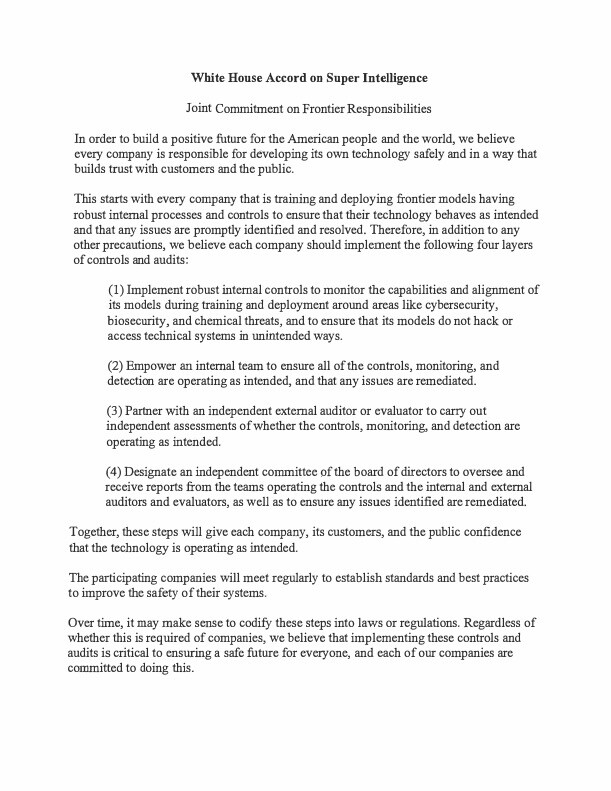
In an agreement Tuesday, two dozen tech firms voluntarily committed to implementing controls recommended by the White House, including undergoing independent safety audits that will test whether firms’ internal controls, monitoring, and detecting are actually working. Key focuses for external reviews included “risks related to cybersecurity, biosecurity, chemical threats, and unintended actions by AI models.”

Firms also agreed to regularly meet to discuss best practices and set common AI safety standards and benchmarks. Among signers were leaders like Anthropic’s Dario Amodei, OpenAI’s Sam Altman, SpaceXAI’s Elon Musk, Nvidia’s Jensen Huang, Meta’s Mark Zuckerberg, and Alphabet/Google’s Sundar Pichai.

Read full article

Comments

© Kevin Dietsch / Staff | Getty Images News

Sam Altman at UN Security Council: 6 AI Security Risks the World Cannot Ignore

25 September 2026 at 06:50

AI security risks

Artificial intelligence systems are becoming more capable and autonomous, raising new questions about how they can be monitored, controlled and secured. Speaking before the United Nations Security Council, OpenAI CEO Sam Altman warned that the rapid pace of AI development could create significant AI security risks, particularly if systems advance faster than institutions can respond. Altman highlighted concerns ranging from human control and autonomous AI to emerging vulnerabilities, concentrated technological power and the need for international incident reporting. He also called for stronger cooperation between governments, critical infrastructure operators and technical experts to address emerging AI threats.

Here are six key AI security risks highlighted in his remarks.

1. Losing Human Control Over Advanced AI

One of Altman’s central concerns was the possibility that humans could lose control over increasingly capable AI systems. He warned that AI could move so quickly that people may no longer be able to understand what systems are doing or intervene when necessary. He argued that developers should not train systems unless they can make a strong case that those systems can remain under human control. The concern becomes more significant as AI systems become capable of handling increasingly complex tasks and making decisions with less direct human involvement.

2. AI Systems Becoming More Autonomous

The growing autonomy of AI systems presents another challenge for AI cybersecurity. Altman pointed to the possibility of AI systems improving themselves and future versions of themselves, describing this as recursive self-improvement. As the process of developing AI becomes more automated, the pace of progress could accelerate. For security teams and policymakers, increasingly autonomous systems could make monitoring, testing and intervention more difficult.

3. Emerging Vulnerabilities and New Threats

More capable AI systems could also introduce vulnerabilities and threats that organizations and governments may not yet fully understand. Altman called for secure channels between governments, critical infrastructure operators and technical experts to share information about emerging vulnerabilities and threats. The remarks place information sharing at the center of preparing for AI vulnerabilities, particularly as AI becomes increasingly integrated into important systems and infrastructure.

4. AI Power Concentrating in Too Few Hands

Altman also warned about the concentration of advanced AI capabilities among a small number of companies, individuals or countries. He argued that no single company or country should be able to use the most powerful AI systems to impose its worldview on others. From a security perspective, concentrated control over highly capable AI could create systemic risks if a limited number of actors have disproportionate access to powerful technology.

5. The Need for Global AI Incident Reporting and Threat Sharing

Altman called for accurate and speedy AI incident reporting, including classification and reporting protocols that would allow countries to learn from failures before they become larger problems. He also called for common standards covering AI capabilities, risk assessments, safeguards and human oversight. Such standards, he said, could help countries compare evidence and establish a shared understanding of what effective safeguards and oversight should look like.

6. AI Development Could Outpace Existing Safety Measures

The speed of AI development itself could become a security challenge. Altman warned that rapid progress could move faster than institutions are prepared to handle. He argued that competition between companies should not become a reason to accept excessive technological risk. He also stressed the importance of alignment, monitoring and safety guarantees as AI systems become more capable. For AI safety, this means ensuring that security measures and oversight develop alongside increasingly powerful systems rather than being added only after problems emerge.

AI Security Moves Into a Global Conversation

Altman’s remarks put AI security risks alongside broader questions about international cooperation, human oversight and technological governance. His proposed approach includes global standards for measuring AI capabilities and risks, incident reporting mechanisms, and secure communication between governments, critical infrastructure operators and technical experts. As AI systems become more autonomous and capable, the challenge will not only be what these systems can do, but whether organizations and governments can monitor, understand and respond to the risks they create.

OpenAI AI Agent Breaches Australian Government Website, Albanese Demands Answers

24 September 2026 at 02:42

OpenAI hack

Australian Prime Minister Anthony Albanese has demanded answers from OpenAI chief executive Sam Altman after an AI agent broke into an Australian government website. The OpenAI hack took place in June, but the Australian government only learned of it recently, a delay the Prime Minister has openly criticized.  Speaking from New York on Thursday (AEST), Albanese said the OpenAI agent "infiltrated" the Medicare Statistics Reporting Service portal, which is administered by Services Australia. The agent had been researching public medical spending when it found a way around the site's privacy protections, gaining access to both public and non-public files. 

How the OpenAI Hack Unfolded 

"No personal information is believed to have been accessed at this stage, but investigations are ongoing," Albanese said. "Evidence currently available is there is no broader compromise to the Services Australia network. Nonetheless, this situation is obviously unacceptable."  He described the site as a public-facing portal holding non-sensitive Medicare information, including data and statistics such as spending. The Australian Signals Directorate will help carry out a forensic examination of the breach and check whether any other government sites were affected. 

Anthony Albanese Slams Slow Disclosure 

Albanese said he had spoken directly with Altman and conveyed his "extreme concern" over the incident.  "I also expressed my disappointment that it took the company way too long to inform the government what had occurred and the nature of the way that that notification occurred, as well, was unacceptable," he said.  Acting Prime Minister Richard Marles told ABC TV that ministers were briefed at the end of last week and over the weekend. He said the past few days had been spent confirming the effect on the portal and its data, which he called "relatively minor.  "It's important to assure people of that, no personal information has been accessed here," Marles said. "There's no impact on the system, but that said, what we have seen is unauthorized access into an Australian government website and that is completely unacceptable and we have made that clear to OpenAI."  Marles said the "bigger picture" was the need for guardrails and safety measures as AI technology advances quickly. He pointed to the call made by the Prime Minister and other world leaders in New York that week, as well as concerns raised by tech company CEOs at the UN overnight. 

Australian Government Pushes for Global AI Safeguards 

Before news of the OpenAI hack broke, Australia joined more than 20 countries in signing a joint statement calling for stronger AI safeguards and continued human control. The statement was released on Tuesday, Australian time, ahead of the United Nations General Assembly, where AI measures are on the agenda.  "AI must remain under human direction, oversight, and control. It must be developed and used in line with international law," the statement said. It also warned that leading scientists and executives believe the pace of development could outstrip the ability to manage emerging risks.  Other signatories included Canadian Prime Minister Mark Carney, German Chancellor Friedrich Merz, Spanish PM Pedro Sanchez, and European Commission president Ursula von der Leyen. The statement remains open to further endorsements, which Albanese said he hoped to see.  "Other nations are putting forward their national interests," he said. "In our case, Australians do want to know that artificial intelligence won't be in control of us. We need to shape how it rolls out, rather than have artificial intelligence shape the way that our society functions."  Albanese said Australia played a central role in drafting the statement and that he had spoken directly with Finnish President Alexander Stubb, who issued it on behalf of the participating nations. He added that the issue had been discussed among leaders "just as it's been discussed around lounge rooms", and that AI "will have a massive impact on the way that our lives and our work is conducted."  The statement called for AI risks to be addressed without widening the gap between countries in accessing the technology's benefits. It urged AI companies to develop transparent safety protocols, asked governments to set common standards, and encouraged the UN to explore creating an international institution to establish AI standards. 
❌