Normal view

Received before yesterday

Ford’s Car of the Future, Hatched in a Skunk Works Near Los Angeles

11 December 2025 at 14:25
Desperate to catch up with Chinese automakers, Ford is redesigning its fleet with a Silicon Valley-style team. Is it too late?

© Emily Elconin for The New York Times

Doug Field, Ford Motor Company’s chief of electric vehicles, digital and design.

Trump’s Nvidia Chip Deal Reverses Decades of Technology Restrictions

9 December 2025 at 20:21
President Trump’s decision to allow Nvidia to sell its chips to China has raised questions about whether he is prioritizing short-term economic gain over long-term American security interests.

© Pete Marovich for The New York Times

President Trump with Jensen Huang, the chief executive of Nvidia, at the White House in April.

Trump Eases Limits on Nvidia Exports to China at ‘Critical Moment’

9 December 2025 at 12:08
President Trump said Nvidia can export some chips. But years of U.S. restrictions have propelled China to make everything it needs for advanced A.I.

© John G Mabanglo/EPA, via Shutterstock

Nvidia has argued that blocking access to its chips has only spurred Chinese companies to improve faster.

Drones to Diplomas: How Russia’s Largest Private University is Linked to a $25M Essay Mill

6 December 2025 at 09:45

A sprawling academic cheating network turbocharged by Google Ads that has generated nearly $25 million in revenue has curious ties to a Kremlin-connected oligarch whose Russian university builds drones for Russia’s war against Ukraine.

The Nerdify homepage.

The link between essay mills and Russian attack drones might seem improbable, but understanding it begins with a simple question: How does a human-intensive academic cheating service stay relevant in an era when students can simply ask AI to write their term papers? The answer – recasting the business as an AI company – is just the latest chapter in a story of many rebrands that link the operation to Russia’s largest private university.

Search in Google for any terms related to academic cheating services — e.g., “help with exam online” or “term paper online” — and you’re likely to encounter websites with the words “nerd” or “geek” in them, such as thenerdify[.]com and geekly-hub[.]com. With a simple request sent via text message, you can hire their tutors to help with any assignment.

These nerdy and geeky-branded websites frequently cite their “honor code,” which emphasizes they do not condone academic cheating, will not write your term papers for you, and will only offer support and advice for customers. But according to This Isn’t Fine, a Substack blog about contract cheating and essay mills, the Nerdify brand of websites will happily ignore that mantra.

“We tested the quick SMS for a price quote,” wrote This Isn’t Fine author Joseph Thibault. “The honor code references and platitudes apparently stop at the website. Within three minutes, we confirmed that a full three-page, plagiarism- and AI-free MLA formatted Argumentative essay could be ours for the low price of $141.”

A screenshot from Joseph Thibault’s Substack post shows him purchasing a 3-page paper with the Nerdify service.

Google prohibits ads that “enable dishonest behavior.” Yet, a sprawling global essay and homework cheating network run under the Nerdy brands has quietly bought its way to the top of Google searches – booking revenues of almost $25 million through a maze of companies in Cyprus, Malta and Hong Kong, while pitching “tutoring” that delivers finished work that students can turn in.

When one Nerdy-related Google Ads account got shut down, the group behind the company would form a new entity with a front-person (typically a young Ukrainian woman), start a new ads account along with a new website and domain name (usually with “nerdy” in the brand), and resume running Google ads for the same set of keywords.

UK companies belonging to the group that have been shut down by Google Ads since Jan 2025 include:

Proglobal Solutions LTD (advertised nerdifyit[.]com);
AW Tech Limited (advertised thenerdify[.]com);
Geekly Solutions Ltd (advertised geekly-hub[.]com).

Currently active Google Ads accounts for the Nerdify brands include:

-OK Marketing LTD (advertising geekly-hub[.]net⁩), formed in the name of Olha Karpenko, a young Ukrainian woman;
Two Sigma Solutions LTD (advertising litero[.]ai), formed in the name of Olekszij (Alexey) Pokatilo.

Google’s Ads Transparency page for current Nerdify advertiser OK Marketing LTD.

Mr. Pokatilo has been in the essay-writing business since at least 2009, operating a paper-mill enterprise called Livingston Research alongside Alexander Korsukov, who is listed as an owner. According to a lengthy account from a former employee, Livingston Research mainly farmed its writing tasks out to low-cost workers from Kenya, Philippines, Pakistan, Russia and Ukraine.

Pokatilo moved from Ukraine to the United Kingdom in Sept. 2015 and co-founded a company called Awesome Technologies, which pitched itself as a way for people to outsource tasks by sending a text message to the service’s assistants.

The other co-founder of Awesome Technologies is 36-year-old Filip Perkon, a Swedish man living in London who touts himself as a serial entrepreneur and investor. Years before starting Awesome together, Perkon and Pokatilo co-founded a student group called Russian Business Week while the two were classmates at the London School of Economics. According to the Bulgarian investigative journalist Christo Grozev, Perkon’s birth certificate was issued by the Soviet Embassy in Sweden.

Alexey Pokatilo (left) and Filip Perkon at a Facebook event for startups in San Francisco in mid-2015.

Around the time Perkon and Pokatilo launched Awesome Technologies, Perkon was building a social media propaganda tool called the Russian Diplomatic Online Club, which Perkon said would “turbo-charge” Russian messaging online. The club’s newsletter urged subscribers to install in their Twitter accounts a third-party app called Tweetsquad that would retweet Kremlin messaging on the social media platform.

Perkon was praised by the Russian Embassy in London for his efforts: During the contentious Brexit vote that ultimately led to the United Kingdom leaving the European Union, the Russian embassy in London used this spam tweeting tool to auto-retweet the Russian ambassador’s posts from supporters’ accounts.

Neither Mr. Perkon nor Mr. Pokatilo replied to requests for comment.

A review of corporations tied to Mr. Perkon as indexed by the business research service North Data finds he holds or held director positions in several U.K. subsidiaries of Synergy, Russia’s largest private education provider. Synergy has more than 35,000 students, and sells T-shirts with patriotic slogans such as “Crimea is Ours,” and “The Russian Empire — Reloaded.”

The president of Synergy is Vadim Lobov, a Kremlin insider whose headquarters on the outskirts of Moscow reportedly features a wall-sized portrait of Russian President Vladimir Putin in the pop-art style of Andy Warhol. For a number of years, Lobov and Perkon co-produced a cross-cultural event in the U.K. called Russian Film Week.

Synergy President Vadim Lobov and Filip Perkon, speaking at a press conference for Russian Film Week, a cross-cultural event in the U.K. co-produced by both men.

Mr. Lobov was one of 11 individuals reportedly hand-picked by the convicted Russian spy Marina Butina to attend the 2017 National Prayer Breakfast held in Washington D.C. just two weeks after President Trump’s first inauguration.

While Synergy University promotes itself as Russia’s largest private educational institution, hundreds of international students tell a different story. Online reviews from students paint a picture of unkept promises: Prospective students from Nigeria, Kenya, Ghana, and other nations paying thousands in advance fees for promised study visas to Russia, only to have their applications denied with no refunds offered.

“My experience with Synergy University has been nothing short of heartbreaking,” reads one such account. “When I first discovered the school, their representative was extremely responsive and eager to assist. He communicated frequently and made me believe I was in safe hands. However, after paying my hard-earned tuition fees, my visa was denied. It’s been over 9 months since that denial, and despite their promises, I have received no refund whatsoever. My messages are now ignored, and the same representative who once replied instantly no longer responds at all. Synergy University, how can an institution in Europe feel comfortable exploiting the hopes of Africans who trust you with their life savings? This is not just unethical — it’s predatory.”

This pattern repeats across reviews by multilingual students from Pakistan, Nepal, India, and various African nations — all describing the same scheme: Attractive online marketing, promises of easy visa approval, upfront payment requirements, and then silence after visa denials.

Reddit discussions in r/Moscow and r/AskARussian are filled with warnings. “It’s a scam, a diploma mill,” writes one user. “They literally sell exams. There was an investigation on Rossiya-1 television showing students paying to pass tests.”

The Nerdify website’s “About Us” page says the company was co-founded by Pokatilo and an American named Brian Mellor. The latter identity seems to have been fabricated, or at least there is no evidence that a person with this name ever worked at Nerdify.

Rather, it appears that the SMS assistance company co-founded by Messrs. Pokatilo and Perkon (Awesome Technologies) fizzled out shortly after its creation, and that Nerdify soon adopted the process of accepting assignment requests via text message and routing them to freelance writers.

A closer look at an early “About Us” page for Nerdify in The Wayback Machine suggests that Mr. Perkon was the real co-founder of the company: The photo at the top of the page shows four people wearing Nerdify T-shirts seated around a table on a rooftop deck in San Francisco, and the man facing the camera is Perkon.

Filip Perkon, top right, is pictured wearing a Nerdify T-shirt in an archived copy of the company’s About Us page. Image: archive.org.

Where are they now? Pokatilo is currently running a startup called Litero.Ai, which appears to be an AI-based essay writing service. In July 2025, Mr. Pokatilo received pre-seed funding of $800,000 for Litero from an investment program backed by the venture capital firms AltaIR Capital, Yellow Rocks, Smart Partnership Capital, and I2BF Global Ventures.

Meanwhile, Filip Perkon is busy setting up toy rubber duck stores in Miami and in at least three locations in the United Kingdom. These “Duck World” shops market themselves as “the world’s largest duck store.”

This past week, Mr. Lobov was in India with Putin’s entourage on a charm tour with India’s Prime Minister Narendra Modi. Although Synergy is billed as an educational institution, a review of the company’s sprawling corporate footprint (via DNS) shows it also is assisting the Russian government in its war against Ukraine.

Synergy University President Vadim Lobov (right) pictured this week in India next to Natalia Popova, a Russian TV presenter known for her close ties to Putin’s family, particularly Putin’s daughter, who works with Popova at the education and culture-focused Innopraktika Foundation.

The website bpla.synergy[.]bot, for instance, says the company is involved in developing combat drones to aid Russian forces and to evade international sanctions on the supply and re-export of high-tech products.

A screenshot from the website of synergy,bot shows the company is actively engaged in building armed drones for the war in Ukraine.

KrebsOnSecurity would like to thank the anonymous researcher NatInfoSec for their assistance in this investigation.

Update, Dec. 8, 10:06 a.m. ET: Mr. Pokatilo responded to requests for comment after the publication of this story. Pokatilo said he has no relation to Synergy nor to Mr. Lobov, and that his work with Mr. Perkon ended with the dissolution of Awesome Technologies.

“I have had no involvement in any of his projects and business activities mentioned in the article and he has no involvement in Litero.ai,” Pokatilo said of Perkon.

Mr. Pokatilo said his new company Litero “does not provide contract cheating services and is built specifically to improve transparency and academic integrity in the age of universal use of AI by students.”

“I am Ukrainian,” he said in an email. “My close friends, colleagues, and some family members continue to live in Ukraine under the ongoing invasion. Any suggestion that I or my company may be connected in any way to Russia’s war efforts is deeply offensive on a personal level and harmful to the reputation of Litero.ai, a company where many team members are Ukrainian.”

Hard Fork’s 50 Most Iconic Technologies of 2025

“You can’t tell the story of 2025 without these icons.”

© Photo Illustration by The New York Times; Photo: Photo Illustration by Joe Raedle/Getty Images

Is Your Android TV Streaming Box Part of a Botnet?

24 November 2025 at 13:44

On the surface, the Superbox media streaming devices for sale at retailers like BestBuy and Walmart may seem like a steal: They offer unlimited access to more than 2,200 pay-per-view and streaming services like Netflix, ESPN and Hulu, all for a one-time fee of around $400. But security experts warn these TV boxes require intrusive software that forces the user’s network to relay Internet traffic for others, traffic that is often tied to cybercrime activity such as advertising fraud and account takeovers.

Superbox media streaming boxes for sale on Walmart.com.

Superbox bills itself as an affordable way for households to stream all of the television and movie content they could possibly want, without the hassle of monthly subscription fees — for a one-time payment of nearly $400.

“Tired of confusing cable bills and hidden fees?,” Superbox’s website asks in a recent blog post titled, “Cheap Cable TV for Low Income: Watch TV, No Monthly Bills.”

“Real cheap cable TV for low income solutions does exist,” the blog continues. “This guide breaks down the best alternatives to stop overpaying, from free over-the-air options to one-time purchase devices that eliminate monthly bills.”

Superbox claims that watching a stream of movies, TV shows, and sporting events won’t violate U.S. copyright law.

“SuperBox is just like any other Android TV box on the market, we can not control what software customers will use,” the company’s website maintains. “And you won’t encounter a law issue unless uploading, downloading, or broadcasting content to a large group.”

A blog post from the Superbox website.

There is nothing illegal about the sale or use of the Superbox itself, which can be used strictly as a way to stream content at providers where users already have a paid subscription. But that is not why people are shelling out $400 for these machines. The only way to watch those 2,200+ channels for free with a Superbox is to install several apps made for the device that enable them to stream this content.

Superbox’s homepage includes a prominent message stating the company does “not sell access to or preinstall any apps that bypass paywalls or provide access to unauthorized content.” The company explains that they merely provide the hardware, while customers choose which apps to install.

“We only sell the hardware device,” the notice states. “Customers must use official apps and licensed services; unauthorized use may violate copyright law.”

Superbox is technically correct here, except for maybe the part about how customers must use official apps and licensed services: Before the Superbox can stream those thousands of channels, users must configure the device to update itself, and the first step involves ripping out Google’s official Play store and replacing it with something called the “App Store” or “Blue TV Store.”

Superbox does this because the device does not use the official Google-certified Android TV system, and its apps will not load otherwise. Only after the Google Play store has been supplanted by this unofficial App Store do the various movie and video streaming apps that are built specifically for the Superbox appear available for download (again, outside of Google’s app ecosystem).

Experts say while these Android streaming boxes generally do what they advertise — enabling buyers to stream video content that would normally require a paid subscription — the apps that enable the streaming also ensnare the user’s Internet connection in a distributed residential proxy network that uses the devices to relay traffic from others.

Ashley is a senior solutions engineer at Censys, a cyber intelligence company that indexes Internet-connected devices, services and hosts. Ashley requested that only her first name be used in this story.

In a recent video interview, Ashley showed off several Superbox models that Censys was studying in the malware lab — including one purchased off the shelf at BestBuy.

“I’m sure a lot of people are thinking, ‘Hey, how bad could it be if it’s for sale at the big box stores?'” she said. “But the more I looked, things got weirder and weirder.”

Ashley said she found the Superbox devices immediately contacted a server at the Chinese instant messaging service Tencent QQ, as well as a residential proxy service called Grass IO.

GET GRASSED

Also known as getgrass[.]io, Grass says it is “a decentralized network that allows users to earn rewards by sharing their unused Internet bandwidth with AI labs and other companies.”

“Buyers seek unused internet bandwidth to access a more diverse range of IP addresses, which enables them to see certain websites from a retail perspective,” the Grass website explains. “By utilizing your unused internet bandwidth, they can conduct market research, or perform tasks like web scraping to train AI.” 

Reached via Twitter/X, Grass founder Andrej Radonjic told KrebsOnSecurity he’d never heard of a Superbox, and that Grass has no affiliation with the device maker.

“It looks like these boxes are distributing an unethical proxy network which people are using to try to take advantage of Grass,” Radonjic said. “The point of grass is to be an opt-in network. You download the grass app to monetize your unused bandwidth. There are tons of sketchy SDKs out there that hijack people’s bandwidth to help webscraping companies.”

Radonjic said Grass has implemented “a robust system to identify network abusers,” and that if it discovers anyone trying to misuse or circumvent its terms of service, the company takes steps to stop it and prevent those users from earning points or rewards.

Superbox’s parent company, Super Media Technology Company Ltd., lists its street address as a UPS store in Fountain Valley, Calif. The company did not respond to multiple inquiries.

According to this teardown by behindmlm.com, a blog that covers multi-level marketing (MLM) schemes, Grass’s compensation plan is built around “grass points,” which are earned through the use of the Grass app and through app usage by recruited affiliates. Affiliates can earn 5,000 grass points for clocking 100 hours usage of Grass’s app, but they must progress through ten affiliate tiers or ranks before they can redeem their grass points (presumably for some type of cryptocurrency). The 10th or “Titan” tier requires affiliates to accumulate a whopping 50 million grass points, or recruit at least 221 more affiliates.

Radonjic said Grass’s system has changed in recent months, and confirmed the company has a referral program where users can earn Grass Uptime Points by contributing their own bandwidth and/or by inviting other users to participate.

“Users are not required to participate in the referral program to earn Grass Uptime Points or to receive Grass Tokens,” Radonjic said. “Grass is in the process of phasing out the referral program and has introduced an updated Grass Points model.”

A review of the Terms and Conditions page for getgrass[.]io at the Wayback Machine shows Grass’s parent company has changed names at least five times in the course of its two-year existence. Searching the Wayback Machine on getgrass[.]io shows that in June 2023 Grass was owned by a company called Wynd Network. By March 2024, the owner was listed as Lower Tribeca Corp. in the Bahamas. By August 2024, Grass was controlled by a Half Space Labs Limited, and in November 2024 the company was owned by Grass OpCo (BVI) Ltd. Currently, the Grass website says its parent is just Grass OpCo Ltd (no BVI in the name).

Radonjic acknowledged that Grass has undergone “a handful of corporate clean-ups over the last couple of years,” but described them as administrative changes that had no operational impact. “These reflect normal early-stage restructuring as the project moved from initial development…into the current structure under the Grass Foundation,” he said.

UNBOXING

Censys’s Ashley said the phone home to China’s Tencent QQ instant messaging service was the first red flag with the Superbox devices she examined. She also discovered the streaming boxes included powerful network analysis and remote access tools, such as Tcpdump and Netcat.

“This thing DNS hijacked my router, did ARP poisoning to the point where things fall off the network so they can assume that IP, and attempted to bypass controls,” she said. “I have root on all of them now, and they actually have a folder called ‘secondstage.’ These devices also have Netcat and Tcpdump on them, and yet they are supposed to be streaming devices.”

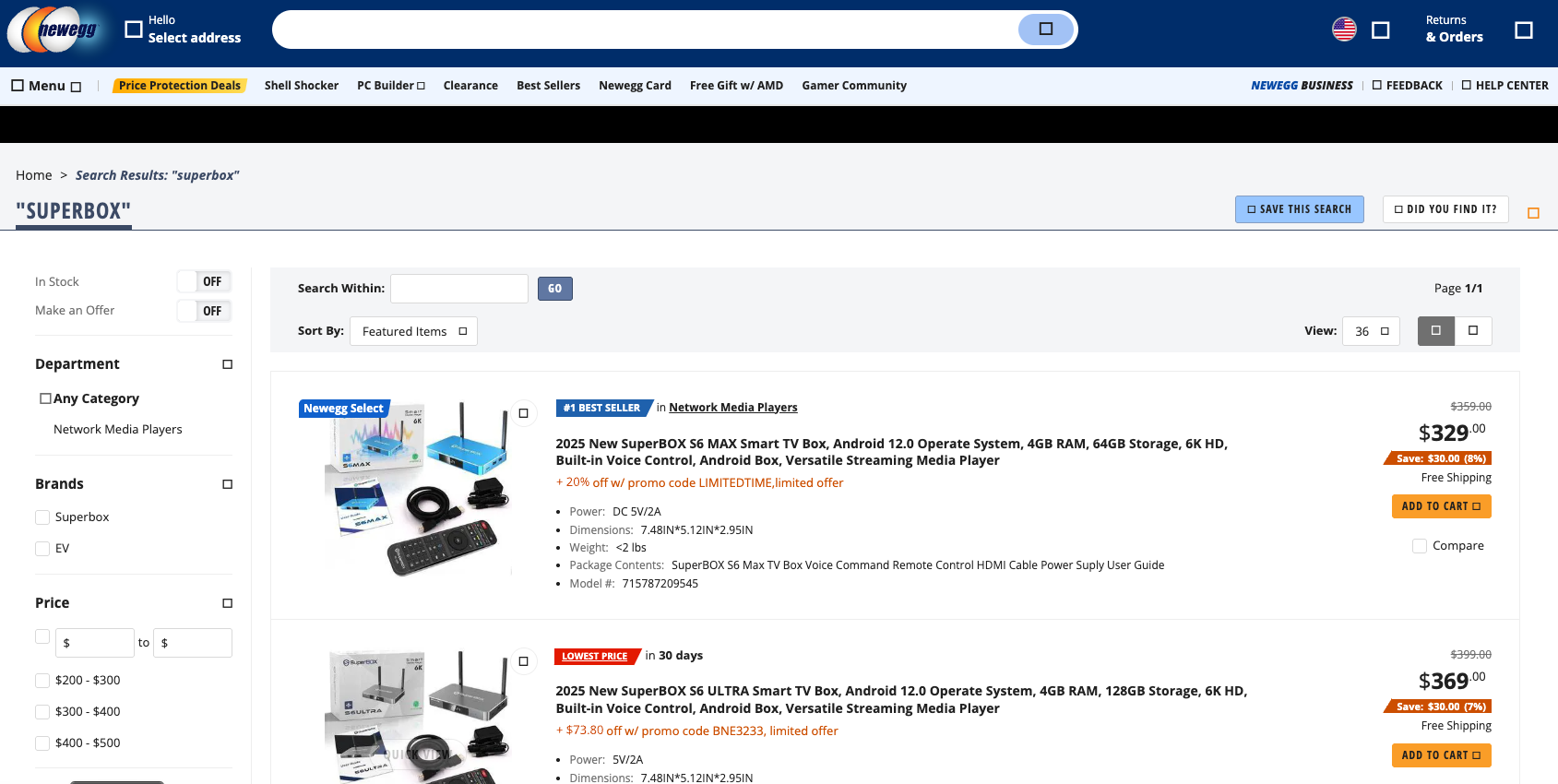
A quick online search shows various Superbox models and many similar Android streaming devices for sale at a wide range of top retail destinations, including Amazon, BestBuy, Newegg, and Walmart. Newegg.com, for example, currently lists more than three dozen Superbox models. In all cases, the products are sold by third-party merchants on these platforms, but in many instances the fulfillment comes from the e-commerce platform itself.

“Newegg is pretty bad now with these devices,” Ashley said. “Ebay is the funniest, because they have Superbox in Spanish — the SuperCaja — which is very popular.”

Superbox devices for sale via Newegg.com.

Ashley said Amazon recently cracked down on Android streaming devices branded as Superbox, but that those listings can still be found under the more generic title “modem and router combo” (which may be slightly closer to the truth about the device’s behavior).

Superbox doesn’t advertise its products in the conventional sense. Rather, it seems to rely on lesser-known influencers on places like Youtube and TikTok to promote the devices. Meanwhile, Ashley said, Superbox pays those influencers 50 percent of the value of each device they sell.

“It’s weird to me because influencer marketing usually caps compensation at 15 percent, and it means they don’t care about the money,” she said. “This is about building their network.”

A TikTok influencer casually mentions and promotes Superbox while chatting with her followers over a glass of wine.

BADBOX

As plentiful as the Superbox is on e-commerce sites, it is just one brand in an ocean of no-name Android-based TV boxes available to consumers. While these devices generally do provide buyers with “free” streaming content, they also tend to include factory-installed malware or require the installation of third-party apps that engage the user’s Internet address in advertising fraud.

In July 2025, Google filed a “John Doe” lawsuit (PDF) against 25 unidentified defendants dubbed the “BadBox 2.0 Enterprise,” which Google described as a botnet of over ten million Android streaming devices that engaged in advertising fraud. Google said the BADBOX 2.0 botnet, in addition to compromising multiple types of devices prior to purchase, can also infect devices by requiring the download of malicious apps from unofficial marketplaces.

Some of the unofficial Android devices flagged by Google as part of the Badbox 2.0 botnet are still widely for sale at major e-commerce vendors. Image: Google.

Several of the Android streaming devices flagged in Google’s lawsuit are still for sale on top U.S. retail sites. For example, searching for the “X88Pro 10” and the “T95” Android streaming boxes finds both continue to be peddled by Amazon sellers.

Google’s lawsuit came on the heels of a June 2025 advisory from the Federal Bureau of Investigation (FBI), which warned that cyber criminals were gaining unauthorized access to home networks by either configuring the products with malicious software prior to the user’s purchase, or infecting the device as it downloads required applications that contain backdoors, usually during the set-up process.

“Once these compromised IoT devices are connected to home networks, the infected devices are susceptible to becoming part of the BADBOX 2.0 botnet and residential proxy services known to be used for malicious activity,” the FBI said.

The FBI said BADBOX 2.0 was discovered after the original BADBOX campaign was disrupted in 2024. The original BADBOX was identified in 2023, and primarily consisted of Android operating system devices that were compromised with backdoor malware prior to purchase.

Riley Kilmer is founder of Spur, a company that tracks residential proxy networks. Kilmer said Badbox 2.0 was used as a distribution platform for IPidea, a China-based entity that is now the world’s largest residential proxy network.

Kilmer and others say IPidea is merely a rebrand of 911S5 Proxy, a China-based proxy provider sanctioned last year by the U.S. Department of the Treasury for operating a botnet that helped criminals steal billions of dollars from financial institutions, credit card issuers, and federal lending programs (the U.S. Department of Justice also arrested the alleged owner of 911S5).

How are most IPidea customers using the proxy service? According to the proxy detection service Synthient, six of the top ten destinations for IPidea proxies involved traffic that has been linked to either ad fraud or credential stuffing (account takeover attempts).

Kilmer said companies like Grass are probably being truthful when they say that some of their customers are companies performing web scraping to train artificial intelligence efforts, because a great deal of content scraping which ultimately benefits AI companies is now leveraging these proxy networks to further obfuscate their aggressive data-slurping activity. By routing this unwelcome traffic through residential IP addresses, Kilmer said, content scraping firms can make it far trickier to filter out.

“Web crawling and scraping has always been a thing, but AI made it like a commodity, data that had to be collected,” Kilmer told KrebsOnSecurity. “Everybody wanted to monetize their own data pots, and how they monetize that is different across the board.”

SOME FRIENDLY ADVICE

Products like Superbox are drawing increased interest from consumers as more popular network television shows and sportscasts migrate to subscription streaming services, and as people begin to realize they’re spending as much or more on streaming services than they previously paid for cable or satellite TV.

These streaming devices from no-name technology vendors are another example of the maxim, “If something is free, you are the product,” meaning the company is making money by selling access to and/or information about its users and their data.

Superbox owners might counter, “Free? I paid $400 for that device!” But remember: Just because you paid a lot for something doesn’t mean you are done paying for it, or that somehow you are the only one who might be worse off from the transaction.

It may be that many Superbox customers don’t care if someone uses their Internet connection to tunnel traffic for ad fraud and account takeovers; for them, it beats paying for multiple streaming services each month. My guess, however, is that quite a few people who buy (or are gifted) these products have little understanding of the bargain they’re making when they plug them into an Internet router.

Superbox performs some serious linguistic gymnastics to claim its products don’t violate copyright laws, and that its customers alone are responsible for understanding and observing any local laws on the matter. However, buyer beware: If you’re a resident of the United States, you should know that using these devices for unauthorized streaming violates the Digital Millennium Copyright Act (DMCA), and can incur legal action, fines, and potential warnings and/or suspension of service by your Internet service provider.

According to the FBI, there are several signs to look for that may indicate a streaming device you own is malicious, including:

-The presence of suspicious marketplaces where apps are downloaded.
-Requiring Google Play Protect settings to be disabled.
-Generic TV streaming devices advertised as unlocked or capable of accessing free content.
-IoT devices advertised from unrecognizable brands.
-Android devices that are not Play Protect certified.
-Unexplained or suspicious Internet traffic.

This explainer from the Electronic Frontier Foundation delves a bit deeper into each of the potential symptoms listed above.

Europe’s Chip Dreams Confront Business Realities

19 November 2025 at 11:39
European chipmakers need TSMC’s help to grow their own semiconductor supply chain, but the chip giant’s Taiwanese suppliers find Europe a tough place to do business.

© Milan Bures for The New York Times

TSMC is teaming up with European chipmakers to build a factory near Dresden, Germany, as Europe’s need to make its own chips has grown more pressing.

Canada Fines Cybercrime Friendly Cryptomus $176M

22 October 2025 at 13:21

Financial regulators in Canada this week levied $176 million in fines against Cryptomus, a digital payments platform that supports dozens of Russian cryptocurrency exchanges and websites hawking cybercrime services. The penalties for violating Canada’s anti money-laundering laws come ten months after KrebsOnSecurity noted that Cryptomus’s Vancouver street address was home to dozens of foreign currency dealers, money transfer businesses, and cryptocurrency exchanges — none of which were physically located there.

On October 16, the Financial Transactions and Reports Analysis Center of Canada (FINTRAC) imposed a $176,960,190 penalty on Xeltox Enterprises Ltd., more commonly known as the cryptocurrency payments platform Cryptomus.

FINTRAC found that Cryptomus failed to submit suspicious transaction reports in cases where there were reasonable grounds to suspect that they were related to the laundering of proceeds connected to trafficking in child sexual abuse material, fraud, ransomware payments and sanctions evasion.

“Given that numerous violations in this case were connected to trafficking in child sexual abuse material, fraud, ransomware payments and sanctions evasion, FINTRAC was compelled to take this unprecedented enforcement action,” said Sarah Paquet, director and CEO at the regulatory agency.

In December 2024, KrebsOnSecurity covered research by blockchain analyst and investigator Richard Sanders, who’d spent several months signing up for various cybercrime services, and then tracking where their customer funds go from there. The 122 services targeted in Sanders’s research all used Cryptomus, and included some of the more prominent businesses advertising on the cybercrime forums, such as:

-abuse-friendly or “bulletproof” hosting providers like anonvm[.]wtf, and PQHosting;
-sites selling aged email, financial, or social media accounts, such as verif[.]work and kopeechka[.]store;
-anonymity or “proxy” providers like crazyrdp[.]com and rdp[.]monster;
-anonymous SMS services, including anonsim[.]net and smsboss[.]pro.

Flymoney, one of dozens of cryptocurrency exchanges apparently nested at Cryptomus. The image from this website has been machine translated from Russian.

Sanders found at least 56 cryptocurrency exchanges were using Cryptomus to process transactions, including financial entities with names like casher[.]su, grumbot[.]com, flymoney[.]biz, obama[.]ru and swop[.]is.

“These platforms were built for Russian speakers, and they each advertised the ability to anonymously swap one form of cryptocurrency for another,” the December 2024 story noted. “They also allowed the exchange of cryptocurrency for cash in accounts at some of Russia’s largest banks — nearly all of which are currently sanctioned by the United States and other western nations.”

Reached for comment on FINTRAC’s action, Sanders told KrebsOnSecurity he was surprised it took them so long.

“I have no idea why they don’t just sanction them or prosecute them,” Sanders said. “I’m not let down with the fine amount but it’s also just going to be the cost of doing business to them.”

The $173 million fine is a significant sum for FINTRAC, which imposed 23 such penalties last year totaling less than $26 million. But Sanders says FINTRAC still has much work to do in pursuing other shadowy money service businesses (MSBs) that are registered in Canada but are likely money laundering fronts for entities based in Russia and Iran.

In an investigation published in July 2024, CTV National News and the Investigative Journalism Foundation (IJF) documented dozens of cases across Canada where multiple MSBs are incorporated at the same address, often without the knowledge or consent of the location’s actual occupant.

Their inquiry found that the street address for Cryptomus parent Xeltox Enterprises was listed as the home of at least 76 foreign currency dealers, eight MSBs, and six cryptocurrency exchanges. At that address is a three-story building that used to be a bank and now houses a massage therapy clinic and a co-working space. But the news outlets found none of the MSBs or currency dealers were paying for services at that co-working space.

The reporters also found another collection of 97 MSBs clustered at an address for a commercial office suite in Ontario, even though there was no evidence any of these companies had ever arranged for any business services at that address.

Lula Hitches a Ride to the COP30 Climate Talks in an E.V.

7 November 2025 at 15:13
The climate-friendly fleet assembled to shuttle delegations to the gathering in Brazil sent a clear signal: China is making inroads in Latin America.

© Joa Souza/Reuters

A factory in Camaçari, Brazil, assembling electric vehicles for BYD, a Chinese manufacturer.

Saudi Arabia’s New Power Play Is Exporting A.I. to the World

28 October 2025 at 10:20
The kingdom is pouring money into data centers and working with U.S. and Chinese tech giants, landing its A.I. ambitions in the middle of a geopolitical tussle for tech power.

© Photo Illustration by Mark Harris; source photographs by Spencer Lowell for The New York Times, Tamir Kalifa for The New York Times, Katarina Premfors for The New York Times, Doug Mills/The New York Times, Hamad I Mohammed/Reuters, iStock

G.M. Previews Talking Cars, Cheaper Batteries and Other New Tech

22 October 2025 at 14:18
Drivers will be able to converse with an artificial intelligence assistant while cars largely drive themselves in certain situations, the company said.

© Brett Carlsen for The New York Times

Battery assembly at a General Motors plant in Spring Hill, Tenn. G.M. announced that it had developed a new lower-cost battery.

A Mystery C.E.O. and Billions in Sales: Is China Buying Banned Nvidia Chips?

An executive of a Singaporean firm called Megaspeed socialized with Nvidia’s Jensen Huang. Now the company is being scrutinized by U.S. officials for its ties to China.

© Amrita Chandradas for The New York Times

Construction workers at Sedenak Tech Park, where U.S. workers found Megaspeed’s orders of Nvidia products still in boxes.

Bulletproof Host Stark Industries Evades EU Sanctions

11 September 2025 at 13:40

In May 2025, the European Union levied financial sanctions on the owners of Stark Industries Solutions Ltd., a bulletproof hosting provider that materialized two weeks before Russia invaded Ukraine and quickly became a top source of Kremlin-linked cyberattacks and disinformation campaigns. But new findings show those sanctions have done little to stop Stark from simply rebranding and transferring their assets to other corporate entities controlled by its original hosting providers.

Image: Shutterstock.

Materializing just two weeks before Russia invaded Ukraine in 2022, Stark Industries Solutions became a frequent source of massive DDoS attacks, Russian-language proxy and VPN services, malware tied to Russia-backed hacking groups, and fake news. ISPs like Stark are called “bulletproof” providers when they cultivate a reputation for ignoring any abuse complaints or police inquiries about activity on their networks.

In May 2025, the European Union sanctioned one of Stark’s two main conduits to the larger Internet — Moldova-based PQ Hosting — as well as the company’s Moldovan owners Yuri and Ivan Neculiti. The EU Commission said the Neculiti brothers and PQ Hosting were linked to Russia’s hybrid warfare efforts.

But a new report from Recorded Future finds that just prior to the sanctions being announced, Stark rebranded to the[.]hosting, under control of the Dutch entity WorkTitans BV (AS209847) on June 24, 2025. The Neculiti brothers reportedly got a heads up roughly 12 days before the sanctions were announced, when Moldovan and EU media reported on the forthcoming inclusion of the Neculiti brothers in the sanctions package.

In response, the Neculiti brothers moved much of Stark’s considerable address space and other resources over to a new company in Moldova called PQ Hosting Plus S.R.L., an entity reportedly connected to the Neculiti brothers thanks to the re-use of a phone number from the original PQ Hosting.

“Although the majority of associated infrastructure remains attributable to Stark Industries, these changes likely reflect an attempt to obfuscate ownership and sustain hosting services under new legal and network entities,” Recorded Future observed.

Neither the Recorded Future report nor the May 2025 sanctions from the EU mentioned a second critical pillar of Stark’s network that KrebsOnSecurity identified in a May 2024 profile on the notorious bulletproof hoster: The Netherlands-based hosting provider MIRhosting.

MIRhosting is operated by 38-year old Andrey Nesterenko, whose personal website says he is an accomplished concert pianist who began performing publicly at a young age. DomainTools says mirhosting[.]com is registered to Mr. Nesterenko and to Innovation IT Solutions Corp, which lists addresses in London and in Nesterenko’s stated hometown of Nizhny Novgorod, Russia.

Image credit: correctiv.org.

According to the book Inside Cyber Warfare by Jeffrey Carr, Innovation IT Solutions Corp. was responsible for hosting StopGeorgia[.]ru, a hacktivist website for organizing cyberattacks against Georgia that appeared at the same time Russian forces invaded the former Soviet nation in 2008. That conflict was thought to be the first war ever fought in which a notable cyberattack and an actual military engagement happened simultaneously.

Mr. Nesterenko did not respond to requests for comment. In May 2024, Mr. Nesterenko said he couldn’t verify whether StopGeorgia was ever a customer because they didn’t keep records going back that far. But he maintained that Stark Industries Solutions was merely one client of many, and claimed MIRhosting had not received any actionable complaints about abuse on Stark.

However, it appears that MIRhosting is once again the new home of Stark Industries, and that MIRhosting employees are managing both the[.]hosting and WorkTitans — the primary beneficiaries of Stark’s assets.

A copy of the incorporation documents for WorkTitans BV obtained from the Dutch Chamber of Commerce shows WorkTitans also does business under the names Misfits Media and and WT Hosting (considering Stark’s historical connection to Russian disinformation websites, “Misfits Media” is a bit on the nose).

An incorporation document for WorkTitans B.V. from the Netherlands Chamber of Commerce.

The incorporation document says the company was formed in 2019 by a y.zinad@worktitans.nl. That email address corresponds to a LinkedIn account for a Youssef Zinad, who says their personal websites are worktitans[.]nl and custom-solution[.]nl. The profile also links to a website (etripleasims dot nl) that LinkedIn currently blocks as malicious. All of these websites are or were hosted at MIRhosting.

Although Mr. Zinad’s LinkedIn profile does not mention any employment at MIRhosting, virtually all of his LinkedIn posts over the past year have been reposts of advertisements for MIRhosting’s services.

Mr. Zinad’s LinkedIn profile is full of posts for MIRhosting’s services.

A Google search for Youssef Zinad reveals multiple startup-tracking websites that list him as the founder of the[.]hosting, which censys.io finds is hosted by PQ Hosting Plus S.R.L.

The Dutch Chamber of Commerce document says WorkTitans’ sole shareholder is a company in Almere, Netherlands called Fezzy B.V. Who runs Fezzy? The phone number listed in a Google search for Fezzy B.V. — 31651079755 — also was used to register a Facebook profile for a Youssef Zinad from the same town, according to the breach tracking service Constella Intelligence.

In a series of email exchanges leading up to KrebsOnSecurity’s May 2024 deep dive on Stark, Mr. Nesterenko included Mr. Zinad in the message thread (youssef@mirhosting.com), referring to him as part of the company’s legal team. The Dutch website stagemarkt[.]nl lists Youssef Zinad as an official contact for MIRhosting’s offices in Almere. Mr. Zinad did not respond to requests for comment.

Given the above, it is difficult to argue with the Recorded Future report on Stark’s rebranding, which concluded that “the EU’s sanctioning of Stark Industries was largely ineffective, as affiliated infrastructure remained operational and services were rapidly re-established under new branding, with no significant or lasting disruption.”

U.S. Sanctions Cloud Provider ‘Funnull’ as Top Source of ‘Pig Butchering’ Scams

29 May 2025 at 21:55

Image: Shutterstock, ArtHead.

The U.S. government today imposed economic sanctions on Funnull Technology Inc., a Philippines-based company that provides computer infrastructure for hundreds of thousands of websites involved in virtual currency investment scams known as “pig butchering.” In January 2025, KrebsOnSecurity detailed how Funnull was being used as a content delivery network that catered to cybercriminals seeking to route their traffic through U.S.-based cloud providers.

“Americans lose billions of dollars annually to these cyber scams, with revenues generated from these crimes rising to record levels in 2024,” reads a statement from the U.S. Department of the Treasury, which sanctioned Funnull and its 40-year-old Chinese administrator Liu Lizhi. “Funnull has directly facilitated several of these schemes, resulting in over $200 million in U.S. victim-reported losses.”

The Treasury Department said Funnull’s operations are linked to the majority of virtual currency investment scam websites reported to the FBI. The agency said Funnull directly facilitated pig butchering and other schemes that resulted in more than $200 million in financial losses by Americans.

Pig butchering is a rampant form of fraud wherein people are lured by flirtatious strangers online into investing in fraudulent cryptocurrency trading platforms. Victims are coached to invest more and more money into what appears to be an extremely profitable trading platform, only to find their money is gone when they wish to cash out.

The scammers often insist that investors pay additional “taxes” on their crypto “earnings” before they can see their invested funds again (spoiler: they never do), and a shocking number of people have lost six figures or more through these pig butchering scams.

KrebsOnSecurity’s January story on Funnull was based on research from the security firm Silent Push, which discovered in October 2024 that a vast number of domains hosted via Funnull were promoting gambling sites that bore the logo of the Suncity Group, a Chinese entity named in a 2024 UN report (PDF) for laundering millions of dollars for the North Korean state-sponsored hacking group Lazarus.

Silent Push found Funnull was a criminal content delivery network (CDN) that carried a great deal of traffic tied to scam websites, funneling the traffic through a dizzying chain of auto-generated domain names and U.S.-based cloud providers before redirecting to malicious or phishous websites. The FBI has released a technical writeup (PDF) of the infrastructure used to manage the malicious Funnull domains between October 2023 and April 2025.

A graphic from the FBI explaining how Funnull generated a slew of new domains on a regular basis and mapped them to Internet addresses on U.S. cloud providers.

Silent Push revisited Funnull’s infrastructure in January 2025 and found Funnull was still using many of the same Amazon and Microsoft cloud Internet addresses identified as malicious in its October report. Both Amazon and Microsoft pledged to rid their networks of Funnull’s presence following that story, but according to Silent Push’s Zach Edwards only one of those companies has followed through.

Edwards said Silent Push no longer sees Microsoft Internet addresses showing up in Funnull’s infrastructure, while Amazon continues to struggle with removing Funnull servers, including one that appears to have first materialized in 2023.

“Amazon is doing a terrible job — every day since they made those claims to you and us in our public blog they have had IPs still mapped to Funnull, including some that have stayed mapped for inexplicable periods of time,” Edwards said.

Amazon said its Amazon Web Services (AWS) hosting platform actively counters abuse attempts.

“We have stopped hundreds of attempts this year related to this group and we are looking into the information you shared earlier today,” reads a statement shared by Amazon. “If anyone suspects that AWS resources are being used for abusive activity, they can report it to AWS Trust & Safety using the report abuse form here.”

U.S. based cloud providers remain an attractive home base for cybercriminal organizations because many organizations will not be overly aggressive in blocking traffic from U.S.-based cloud networks, as doing so can result in blocking access to many legitimate web destinations that are also on that same shared network segment or host.

What’s more, funneling their bad traffic so that it appears to be coming out of U.S. cloud Internet providers allows cybercriminals to connect to websites from web addresses that are geographically close(r) to their targets and victims (to sidestep location-based security controls by your bank, for example).

Funnull is not the only cybercriminal infrastructure-as-a-service provider that was sanctioned this month: On May 20, 2025, the European Union imposed sanctions on Stark Industries Solutions, an ISP that materialized at the start of Russia’s invasion of Ukraine and has been used as a global proxy network that conceals the true source of cyberattacks and disinformation campaigns against enemies of Russia.

In May 2024, KrebsOnSecurity published a deep dive on Stark Industries Solutions that found much of the malicious traffic traversing Stark’s network (e.g. vulnerability scanning and password brute force attacks) was being bounced through U.S.-based cloud providers. My reporting showed how deeply Stark had penetrated U.S. ISPs, and that its co-founder for many years sold “bulletproof” hosting services that told Russian cybercrime forum customers they would proudly ignore any abuse complaints or police inquiries.

The homepage of Stark Industries Solutions.

That story examined the history of Stark’s co-founders, Moldovan brothers Ivan and Yuri Neculiti, who each denied past involvement in cybercrime or any current involvement in assisting Russian disinformation efforts or cyberattacks. Nevertheless, the EU sanctioned both brothers as well.

The EU said Stark and the Neculti brothers “enabled various Russian state-sponsored and state-affiliated actors to conduct destabilising activities including coordinated information manipulation and interference and cyber-attacks against the Union and third countries by providing services intended to hide these activities from European law enforcement and security agencies.”

When Getting Phished Puts You in Mortal Danger

27 March 2025 at 12:39

Many successful phishing attacks result in a financial loss or malware infection. But falling for some phishing scams, like those currently targeting Russians searching online for organizations that are fighting the Kremlin war machine, can cost you your freedom or your life.

The real website of the Ukrainian paramilitary group “Freedom of Russia” legion. The text has been machine-translated from Russian.

Researchers at the security firm Silent Push mapped a network of several dozen phishing domains that spoof the recruitment websites of Ukrainian paramilitary groups, as well as Ukrainian government intelligence sites.

The website legiohliberty[.]army features a carbon copy of the homepage for the Freedom of Russia Legion (a.k.a. “Free Russia Legion”), a three-year-old Ukraine-based paramilitary unit made up of Russian citizens who oppose Vladimir Putin and his invasion of Ukraine.

The phony version of that website copies the legitimate site — legionliberty[.]army — providing an interactive Google Form where interested applicants can share their contact and personal details. The form asks visitors to provide their name, gender, age, email address and/or Telegram handle, country, citizenship, experience in the armed forces; political views; motivations for joining; and any bad habits.

“Participation in such anti-war actions is considered illegal in the Russian Federation, and participating citizens are regularly charged and arrested,” Silent Push wrote in a report released today. “All observed campaigns had similar traits and shared a common objective: collecting personal information from site-visiting victims. Our team believes it is likely that this campaign is the work of either Russian Intelligence Services or a threat actor with similarly aligned motives.”

Silent Push’s Zach Edwards said the fake Legion Liberty site shared multiple connections with rusvolcorps[.]net. That domain mimics the recruitment page for a Ukrainian far-right paramilitary group called the Russian Volunteer Corps (rusvolcorps[.]com), and uses a similar Google Forms page to collect information from would-be members.

Other domains Silent Push connected to the phishing scheme include: ciagov[.]icu, which mirrors the content on the official website of the U.S. Central Intelligence Agency; and hochuzhitlife[.]com, which spoofs the Ministry of Defense of Ukraine & General Directorate of Intelligence (whose actual domain is hochuzhit[.]com).

According to Edwards, there are no signs that these phishing sites are being advertised via email. Rather, it appears those responsible are promoting them by manipulating the search engine results shown when someone searches for one of these anti-Putin organizations.

In August 2024, security researcher Artem Tamoian posted on Twitter/X about how he received startlingly different results when he searched for “Freedom of Russia legion” in Russia’s largest domestic search engine Yandex versus Google.com. The top result returned by Google was the legion’s actual website, while the first result on Yandex was a phishing page targeting the group.

“I think at least some of them are surely promoted via search,” Tamoian said of the phishing domains. “My first thread on that accuses Yandex, but apart from Yandex those websites are consistently ranked above legitimate in DuckDuckGo and Bing. Initially, I didn’t realize the scale of it. They keep appearing to this day.”

Tamoian, a native Russian who left the country in 2019, is the founder of the cyber investigation platform malfors.com. He recently discovered two other sites impersonating the Ukrainian paramilitary groups — legionliberty[.]world and rusvolcorps[.]ru — and reported both to Cloudflare. When Cloudflare responded by blocking the sites with a phishing warning, the real Internet address of these sites was exposed as belonging to a known “bulletproof hosting” network called Stark Industries Solutions Ltd.

Stark Industries Solutions appeared two weeks before Russia invaded Ukraine in February 2022, materializing out of nowhere with hundreds of thousands of Internet addresses in its stable — many of them originally assigned to Russian government organizations. In May 2024, KrebsOnSecurity published a deep dive on Stark, which has repeatedly been used to host infrastructure for distributed denial-of-service (DDoS) attacks, phishing, malware and disinformation campaigns from Russian intelligence agencies and pro-Kremlin hacker groups.

In March 2023, Russia’s Supreme Court designated the Freedom of Russia legion as a terrorist organization, meaning that Russians caught communicating with the group could face between 10 and 20 years in prison.

Tamoian said those searching online for information about these paramilitary groups have become easy prey for Russian security services.

“I started looking into those phishing websites, because I kept stumbling upon news that someone gets arrested for trying to join [the] Ukrainian Army or for trying to help them,” Tamoian told KrebsOnSecurity. “I have also seen reports [of] FSB contacting people impersonating Ukrainian officers, as well as using fake Telegram bots, so I thought fake websites might be an option as well.”

Search results showing news articles about people in Russia being sentenced to lengthy prison terms for attempting to aid Ukrainian paramilitary groups.

Tamoian said reports surface regularly in Russia about people being arrested for trying carry out an action requested by a “Ukrainian recruiter,” with the courts unfailingly imposing harsh sentences regardless of the defendant’s age.

“This keeps happening regularly, but usually there are no details about how exactly the person gets caught,” he said. “All cases related to state treason [and] terrorism are classified, so there are barely any details.”

Tamoian said while he has no direct evidence linking any of the reported arrests and convictions to these phishing sites, he is certain the sites are part of a larger campaign by the Russian government.

“Considering that they keep them alive and keep spawning more, I assume it might be an efficient thing,” he said. “They are on top of DuckDuckGo and Yandex, so it unfortunately works.”

Further reading: Silent Push report, Russian Intelligence Targeting its Citizens and Informants.

❌