Normal view

Received today — 14 February 2026

‘The bear feels comfortable and uncomfortable. It’s a bittersweet moment’: Iñigo Jerez Quintana’s best phone picture

14 February 2026 at 06:00

Capturing things that mix the strange with the beautiful helped the Spanish graphic designer recover from a blue period

Iñigo Jerez Quintana uses the French term objet trouvé to describe this abandoned bear. Quintana, a Spanish graphic designer, was walking from his studio to a work meeting in Poblenou, a district of Barcelona, when he spotted it.

“I take photos based on visual impulses; anything that catches my eye,” he says. “The colour match of the bear’s fur and wall paint anchors a childish stereotype in a place where it doesn’t really belong.”

Continue reading...

© Photograph: Iñigo Jerez

© Photograph: Iñigo Jerez

© Photograph: Iñigo Jerez

‘Regrets? Number one: smoking. Number two: taking it up the wrong hole’: Tracey Emin on reputation, radical honesty – and Reform

14 February 2026 at 01:00

She scandalised the art world in the 1990s with her unmade bed, partied hard in the 2000s – then a brush with death turned the artist’s life upside down. Now she’s as frank as ever

There is a long buildup before I get to see Tracey Emin – her two cats, Teacup and Pancake, preceding her like a pair of slinky sentries as she walks into the white-painted basement kitchen of her huge Georgian house in Margate. The lengthy overture is because – though I’ve been invited for noon – Emin is a magnificently late riser. Her average working day, her studio manager Harry tells me, runs from about 6pm to 3am. And so, while the artist is gradually sorting herself out, Harry takes me on a tour through her home town in the January drizzle, the sea a sulky grey blur beyond the sands.

At last, Harry is ringing the doorbell, and Emin’s lovely housekeeper, Sam, is sitting me down in the kitchen, then finally here she is, dressed in loose dark trousers and top, with those faithful cats. Emin is recognisably the same as she’s ever been – the artist who scandalised and entranced the nation in the 1990s with her tent embroidered with the names of everyone she’d ever slept with; with her unmade bed and its rumpled sheets and detritus. She still has that sardonic lip, those arched brows, those flashing eyes. But these days she is surprisingly calm, slow moving, her greying hair swept back into a loose bun. This is the Emin who has worked hard, survived a great deal and, somewhat unpredictably, ended up a national treasure.

Continue reading...

© Photograph: © Juergen Teller

© Photograph: © Juergen Teller

© Photograph: © Juergen Teller

From Wuthering Heights to Mario Tennis Fever: your complete entertainment guide to the week ahead

14 February 2026 at 01:00

Emerald Fennell’s film brings the raunch to Brontë’s romance, while Nintendo’s beloved plumber stars in a colourful, family-friendly sports game

Wuthering Heights
Out now
Out on the wily, windy moors, writer-director Emerald Fennell has constructed a new interpretation of the Emily Brontë classic. Margot Robbie is Cathy while Jacob Elordi takes on Heathcliff, and as you might expect from the film-maker behind Saltburn, the passionate pair are set to leave no height unwuthered.

Continue reading...

© Composite: LANDMARK MEDIA / Alamy Stock Photo

© Composite: LANDMARK MEDIA / Alamy Stock Photo

© Composite: LANDMARK MEDIA / Alamy Stock Photo

Received yesterday — 13 February 2026

Spooky shores, folkloric visions and Ireland’s mysterious landscapes reveal a secret – the week in art

13 February 2026 at 09:17

Georges Seurat takes an eerie trip to the seaside, Yinka Shonibare puts empire in its place and Sean Scully reveals his source – all in your weekly dispatch

Seurat and the Sea
If you thought French 19th-century paintings of the seaside were all happy impressionism, you will be disconcerted, then absorbed by Seurat’s eerie modernist shores. Read the review.
Courtauld Gallery, London, until 17 May

Continue reading...

© Photograph: Indianapolis Museum of Art at Newfields

© Photograph: Indianapolis Museum of Art at Newfields

© Photograph: Indianapolis Museum of Art at Newfields

A great artist on paper: why Lucian Freud’s magical drawings are the key to his major works

13 February 2026 at 06:00

The artist often swapped painting for etching as a way to rediscover his craft. Now a new exhibition shows these flashes of inspiration in all their intimate glory

At home one evening in 1951, Lucian Freud did three drawings of fellow artist Francis Bacon. The biographer William Feaver recounts the anecdote as Freud told it to him: Bacon had stood up, undone the buttons on his trousers, rolled up his sleeves and wiggled his hips a little, saying: “I think you ought to do this, because I think that’s rather important.”

By Freud’s own admission, the older painter was provocative in more ways than just this pose: “I got very impatient with the way I was working. It was limited and a limited vehicle for me,” Freud told Feaver. He felt his drawing stopped him from freeing himself, he said, “and I think my admiration for Francis came into this. I realised that by working in the way I did I couldn’t really evolve. The change wasn’t perhaps more than one of focus, but it did make it possible for me to approach the whole thing in another way.”

Continue reading...

© Photograph: © The Lucian Freud Archive. All Rights Reserved 2025 / Bridgeman Images

© Photograph: © The Lucian Freud Archive. All Rights Reserved 2025 / Bridgeman Images

© Photograph: © The Lucian Freud Archive. All Rights Reserved 2025 / Bridgeman Images

Euan Uglow review – No wonder Cherie Blair didn’t model for long, these pictures are exhausting just to look at

13 February 2026 at 05:42

MK Gallery, Milton Keynes
His work was so painstaking and slow to produce that the models – including a certain trainee barrister – often didn’t make it to the end of a portrait. It makes for paintings that seem drained of life

Euan Uglow, they say, is an artist’s artist, and therein lies the problem. If you were approaching his painstaking canvases out of curiosity – how to construct the figure, capture precise perspective, proportions – I can see how their visible workings (complex little dashes and crosses and plumb lines and geometric grids) would prove revelatory. But lots of us come to art to be inspired, transported, to feel. And for all their technical prowess, Uglow’s 70-odd regimented paintings at MK Gallery leave me cold.

First, some context, which we get immediately upon entering – in a slightly maddening move, the five-room retrospective of the artist opens with a room of seven paintings, of which only two are by him. After studying at the Camberwell School of Arts and Crafts in London from 1948 to 1950, he moved to the Slade. He was influenced by Paul Cézanne and Alberto Giacometti, as well as three tutors, all of whom are represented here.

Continue reading...

© Photograph: © The estate of Euan Uglow. All rights reserved 2025, Bridgeman Images

© Photograph: © The estate of Euan Uglow. All rights reserved 2025, Bridgeman Images

© Photograph: © The estate of Euan Uglow. All rights reserved 2025, Bridgeman Images

Received before yesterday

‘Not for ogling’: forget Titian, Botticelli and the male fantasists – only women can paint great female nudes

12 February 2026 at 09:27

From Yoko Ono to Frida Kahlo, from Louise Bourgeois to Artemisia Gentileschi, women have long been capturing the unvarnished truth about their own bodies – and that’s why my novel Female, Nude weaves them into the plot

‘If you want to paint, put your clothes back on!” That was how Carolee Schneemann summarised the critical response to her 1975 performance piece Interior Scroll, which she had performed nude standing on a gallery table. After making a series of life model poses, she removed a scroll from her vagina and began to read her manifesto. In doing so, Schneemann asked an important question: “What does it mean for a female artist to be both the artist and the life model?” Or as she put it: “Both image and image-maker?”

The female nude, as depicted and objectified by the male artist, has dominated western art for centuries. Despite decades of feminist efforts, that interaction between the great male genius and his female model – sometimes muse – remains a subject of perennial fascination. To enter a gallery, or to open a university textbook, is to be confronted with a parade of idealised naked females by male artists from Rubens, Titian and Botticelli to Picasso and De Kooning.

Continue reading...

© Photograph: Alamy

© Photograph: Alamy

© Photograph: Alamy

The god of small things: Seurat and the sea – review

11 February 2026 at 19:01

Courtauld Gallery, London
This quietly tremendous exhibition gathers more than half of the pointillist painter’s works, all depicting the Channel coast and sea, full of blizzards of light and a quivering sense of import

Georges Seurat died young. His two most famous paintings, both extremely large and innovative in their composition and technique, were completed while he was still in his mid-20s. As it was, Seurat painted approximately 45 paintings before his death, probably from diphtheria, in March 1891 when he was 31. More than half these works depict the Channel coast and sea and were completed on his summer trips between 1885 and 1890. Seurat and the Sea at the Courtauld is the first exhibition to be devoted entirely to these images. Twenty-three paintings and smaller oil studies, and three drawings hang in two rooms. It is a quietly tremendous exhibition.

Even if one takes on board the artist’s claims to science, objectivity and his adherence to theories about colour and perception which distance him from impressionism, Seurat’s paintings are peculiar and strange. Sometimes his line is very odd and stiff, yet his drawings themselves – tonal studies worked in conté crayon on textured, laid paper, are among the most marvellous I can think of. It is clear Seurat knew what he was doing; who knows what he might have gone on to achieve?

Continue reading...

© Photograph: National Gallery of Art, Washington DC

© Photograph: National Gallery of Art, Washington DC

© Photograph: National Gallery of Art, Washington DC

Byte magazine artist Robert Tinney, who illustrated the birth of PCs, dies at 78

11 February 2026 at 16:51

On February 1, Robert Tinney, the illustrator whose airbrushed cover paintings defined the look and feel of pioneering computer magazine Byte for over a decade, died at age 78 in Baker, Louisiana, according to a memorial posted on his official website.

As the primary cover artist for Byte from 1975 to the late 1980s, Tinney became one of the first illustrators to give the abstract world of personal computing a coherent visual language, translating topics like artificial intelligence, networking, and programming into vivid, surrealist-influenced paintings that a generation of computer enthusiasts grew up with.

Tinney went on to paint more than 80 covers for Byte, working almost entirely in airbrushed Designers Gouache, a medium he chose for its opaque, intense colors and smooth finish. He said the process of creating each cover typically took about a week of painting once a design was approved, following phone conversations with editors about each issue's theme. He cited René Magritte and M.C. Escher as two of his favorite artists, and fans often noticed their influence in his work.

Read full article

Comments

© Robert Tinney / Byte Magazine

Online shoppers at risk as Magecart skimming hits major payment networks

14 January 2026 at 07:03

Researchers have been tracking a Magecart campaign that targets several major payment providers, including American Express, Diners Club, Discover, and Mastercard.

Magecart is an umbrella term for criminal groups that specialize in stealing payment data from online checkout pages using malicious JavaScript, a technique known as web skimming.

In the early days, Magecart started as a loose coalition of threat actors targeting Magento‑based web stores. Today, the name is used more broadly to describe web-skimming operations against many e‑commerce platforms. In these attacks, criminals inject JavaScript into legitimate checkout pages to capture card data and personal details as shoppers enter them.

The campaign described by the researchers has been active since early 2022. They found a vast network of domains related to a long-running credit card skimming operation with a wide reach.

“This campaign utilizes scripts targeting at least six major payment network providers: American Express, Diners Club, Discover (a subsidiary of Capital One), JCB Co., Ltd., Mastercard, and UnionPay. Enterprise organizations that are clients of these payment providers are the most likely to be impacted.”

Attackers typically plant web skimmers on e-commerce sites by exploiting vulnerabilities in supply chains, third-party scripts, or the sites themselves. This is why web shop owners need to stay vigilant by keeping systems up to date and monitoring their content management system (CMS).

Web skimmers usually hook into the checkout flow using JavaScript. They are designed to read form fields containing card numbers, expiry dates, card verification codes (CVC), and billing or shipping details, then send that data to the attackers.

To avoid detection, the JavaScript is heavily obfuscated to and may even trigger a self‑destruct routine to remove the skimmer from the page. This can cause investigations performed through an admin session to appear unsuspicious.

Besides other methods to stay hidden, the campaign uses bulletproof hosting for a stable environment. Bulletproof hosting refers to web hosting services designed to shield cybercriminals by deliberately ignoring abuse complaints, takedown requests, and law enforcement actions.

How to stay safe

Magecart campaigns affect three groups: customers, merchants, and payment providers. Because web skimmers operate inside the browser, they can bypass many traditional server‑side fraud controls.

While shoppers cannot fix compromised checkout pages themselves, they can reduce their exposure and improve their chances of spotting fraud early.

A few things you can protect against the risk of web skimmers:

  • Use virtual or single‑use cards for online purchases so any skimmed card number has a limited lifetime and spending scope.
  • Where possible, turn on transaction alerts (SMS, email, or app push) for card activity and review statements regularly to spot unsolicited charges quickly.
  • Use strong, unique passwords on bank and card portals so attackers cannot easily pivot from stolen card data to full account takeover.
  • Use a web protection solution to avoid connecting to malicious domains.

Pro tip: Malwarebytes Browser Guard is free and blocks known malicious sites and scripts.


We don’t just report on threats—we remove them

Cybersecurity risks should never spread beyond a headline. Keep threats off your devices by downloading Malwarebytes today.

Why iPhone users should update and restart their devices now

13 January 2026 at 07:55

If you were still questioning whether iOS 26+ is for you, now is the time to make that call.

Why?

On December 12, 2025, Apple patched two WebKit zero‑day vulnerabilities linked to mercenary spyware and is now effectively pushing iPhone 11 and newer users toward iOS 26+, because that’s where the fixes and new memory protections live. These vulnerabilities were primarily used in highly targeted attacks, but such campaigns are likely to expand over time.

WebKit powers the Safari browser and many other iOS applications, so it’s a big attack surface to leave exposed and isn’t limited to “risky” behavior. These vulnerabilities allowed an attacker to execute arbitrary code on a device after exploitation via malicious web content.

Apple has confirmed that attackers are already exploiting these vulnerabilities in the wild, making installation of the update a high‑priority security task for every user. Campaigns that start with diplomats, journalists, or executives often lead to tooling and exploits leaking or being repurposed, so “I’m not a target” is not a viable safety strategy.

Due to public resistance to new features like Liquid Glass, many iPhone users have not yet upgraded to iOS 26.2. Reports suggest adoption of iOS 26 has been unusually slow. As of January 2026, only about 4.6% of active iPhones are on iOS 26.2, and roughly 16% are on any version of iOS 26, leaving the vast majority on older releases such as iOS 18.

However, Apple only ships these fixes and newer protections, such as Memory Integrity Enforcement, on iOS 26+ for supported devices. Users on older, unsupported devices won’t be able to access these protections at all.

Another important factor in the upgrade cycle is restarting the device. What many people don’t realize is that when you restart your device, any memory-resident malware is flushed—unless it has somehow gained persistence, in which case it will return. High-end spyware tools tend to avoid leaving traces needed for persistence and often rely on users not restarting their devices.

Upgrading requires a restart, which makes this a win-win: you get the latest protections, and any memory-resident malware is flushed at the same time.

For iOS and iPadOS users, you can check if you’re using the latest software version, go to Settings > General > Software Update. It’s also worth turning on Automatic Updates if you haven’t already. You can do that on the same screen.

How to stay safe

The most important fix—however painful you may find it—is to upgrade to iOS 26.2. Not doing means missing an accumulating list of security fixes, leaving your device vulnerable to more and more newly found vulnerabilities.

 But here are some other useful tips:

  • Make it a habit to restart your device on a regular basis. The NSA recommends doing this weekly.
  • Do not open unsolicited links and attachments without verifying with the trusted sender.
  • Remember, Apple threat notifications will never ask users to click links, open files, install apps or ask for account passwords or verification code.
  • For Apple Mail users specifically, these vulnerabilities create risk when viewing HTML-formatted emails containing malicious web content.
  • Malwarebytes for iOS can help keep your device secure, with Trusted Advisor alerting you when important updates are available.
  • If you are a high-value target, or you want the extra level of security, consider using Apple’s Lockdown Mode.

We don’t just report on phone security—we provide it

Cybersecurity risks should never spread beyond a headline. Keep threats off your mobile devices by downloading Malwarebytes for iOS, and Malwarebytes for Android today.

New Dietary Guidelines Abandon Longstanding Advice on Alcohol

8 January 2026 at 07:05
Now the government’s recommendation is to “limit” drinking, without specifying safe amounts for men and women. The guidelines no longer warn of risks like cancer.

© Jason Henry for The New York Times

New guidelines issued on Wednesday say that people should consume less alcohol “for better overall health” and “limit alcohol beverages,” but they don’t recommend clear limits.

90 Minutes to Give Baby Luna a New Heart

1 January 2026 at 10:39
After eight years of training, Dr. Maureen McKiernan made her debut as the lead surgeon on an infant heart transplant — an operation on the edge of what’s possible.

© Victor J. Blue for The New York Times

Before Luna’s heart transplant, Dr. Goldstone advised Dr. McKiernan to “plan the surgery out — every detail down to the suture,” she recalled.

Is Your Android TV Streaming Box Part of a Botnet?

24 November 2025 at 13:44

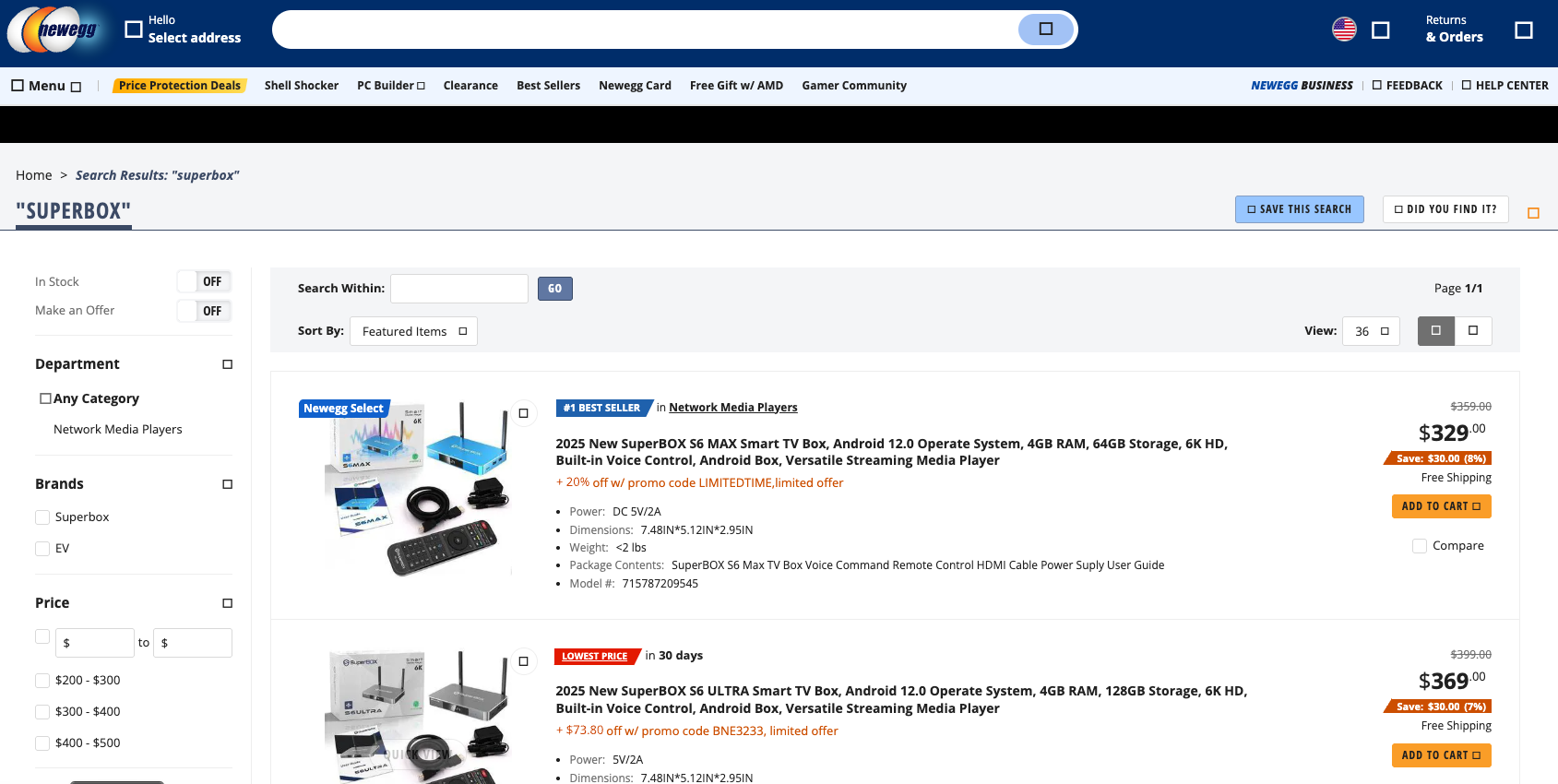
On the surface, the Superbox media streaming devices for sale at retailers like BestBuy and Walmart may seem like a steal: They offer unlimited access to more than 2,200 pay-per-view and streaming services like Netflix, ESPN and Hulu, all for a one-time fee of around $400. But security experts warn these TV boxes require intrusive software that forces the user’s network to relay Internet traffic for others, traffic that is often tied to cybercrime activity such as advertising fraud and account takeovers.

Superbox media streaming boxes for sale on Walmart.com.

Superbox bills itself as an affordable way for households to stream all of the television and movie content they could possibly want, without the hassle of monthly subscription fees — for a one-time payment of nearly $400.

“Tired of confusing cable bills and hidden fees?,” Superbox’s website asks in a recent blog post titled, “Cheap Cable TV for Low Income: Watch TV, No Monthly Bills.”

“Real cheap cable TV for low income solutions does exist,” the blog continues. “This guide breaks down the best alternatives to stop overpaying, from free over-the-air options to one-time purchase devices that eliminate monthly bills.”

Superbox claims that watching a stream of movies, TV shows, and sporting events won’t violate U.S. copyright law.

“SuperBox is just like any other Android TV box on the market, we can not control what software customers will use,” the company’s website maintains. “And you won’t encounter a law issue unless uploading, downloading, or broadcasting content to a large group.”

A blog post from the Superbox website.

There is nothing illegal about the sale or use of the Superbox itself, which can be used strictly as a way to stream content at providers where users already have a paid subscription. But that is not why people are shelling out $400 for these machines. The only way to watch those 2,200+ channels for free with a Superbox is to install several apps made for the device that enable them to stream this content.

Superbox’s homepage includes a prominent message stating the company does “not sell access to or preinstall any apps that bypass paywalls or provide access to unauthorized content.” The company explains that they merely provide the hardware, while customers choose which apps to install.

“We only sell the hardware device,” the notice states. “Customers must use official apps and licensed services; unauthorized use may violate copyright law.”

Superbox is technically correct here, except for maybe the part about how customers must use official apps and licensed services: Before the Superbox can stream those thousands of channels, users must configure the device to update itself, and the first step involves ripping out Google’s official Play store and replacing it with something called the “App Store” or “Blue TV Store.”

Superbox does this because the device does not use the official Google-certified Android TV system, and its apps will not load otherwise. Only after the Google Play store has been supplanted by this unofficial App Store do the various movie and video streaming apps that are built specifically for the Superbox appear available for download (again, outside of Google’s app ecosystem).

Experts say while these Android streaming boxes generally do what they advertise — enabling buyers to stream video content that would normally require a paid subscription — the apps that enable the streaming also ensnare the user’s Internet connection in a distributed residential proxy network that uses the devices to relay traffic from others.

Ashley is a senior solutions engineer at Censys, a cyber intelligence company that indexes Internet-connected devices, services and hosts. Ashley requested that only her first name be used in this story.

In a recent video interview, Ashley showed off several Superbox models that Censys was studying in the malware lab — including one purchased off the shelf at BestBuy.

“I’m sure a lot of people are thinking, ‘Hey, how bad could it be if it’s for sale at the big box stores?'” she said. “But the more I looked, things got weirder and weirder.”

Ashley said she found the Superbox devices immediately contacted a server at the Chinese instant messaging service Tencent QQ, as well as a residential proxy service called Grass IO.

GET GRASSED

Also known as getgrass[.]io, Grass says it is “a decentralized network that allows users to earn rewards by sharing their unused Internet bandwidth with AI labs and other companies.”

“Buyers seek unused internet bandwidth to access a more diverse range of IP addresses, which enables them to see certain websites from a retail perspective,” the Grass website explains. “By utilizing your unused internet bandwidth, they can conduct market research, or perform tasks like web scraping to train AI.” 

Reached via Twitter/X, Grass founder Andrej Radonjic told KrebsOnSecurity he’d never heard of a Superbox, and that Grass has no affiliation with the device maker.

“It looks like these boxes are distributing an unethical proxy network which people are using to try to take advantage of Grass,” Radonjic said. “The point of grass is to be an opt-in network. You download the grass app to monetize your unused bandwidth. There are tons of sketchy SDKs out there that hijack people’s bandwidth to help webscraping companies.”

Radonjic said Grass has implemented “a robust system to identify network abusers,” and that if it discovers anyone trying to misuse or circumvent its terms of service, the company takes steps to stop it and prevent those users from earning points or rewards.

Superbox’s parent company, Super Media Technology Company Ltd., lists its street address as a UPS store in Fountain Valley, Calif. The company did not respond to multiple inquiries.

According to this teardown by behindmlm.com, a blog that covers multi-level marketing (MLM) schemes, Grass’s compensation plan is built around “grass points,” which are earned through the use of the Grass app and through app usage by recruited affiliates. Affiliates can earn 5,000 grass points for clocking 100 hours usage of Grass’s app, but they must progress through ten affiliate tiers or ranks before they can redeem their grass points (presumably for some type of cryptocurrency). The 10th or “Titan” tier requires affiliates to accumulate a whopping 50 million grass points, or recruit at least 221 more affiliates.

Radonjic said Grass’s system has changed in recent months, and confirmed the company has a referral program where users can earn Grass Uptime Points by contributing their own bandwidth and/or by inviting other users to participate.

“Users are not required to participate in the referral program to earn Grass Uptime Points or to receive Grass Tokens,” Radonjic said. “Grass is in the process of phasing out the referral program and has introduced an updated Grass Points model.”

A review of the Terms and Conditions page for getgrass[.]io at the Wayback Machine shows Grass’s parent company has changed names at least five times in the course of its two-year existence. Searching the Wayback Machine on getgrass[.]io shows that in June 2023 Grass was owned by a company called Wynd Network. By March 2024, the owner was listed as Lower Tribeca Corp. in the Bahamas. By August 2024, Grass was controlled by a Half Space Labs Limited, and in November 2024 the company was owned by Grass OpCo (BVI) Ltd. Currently, the Grass website says its parent is just Grass OpCo Ltd (no BVI in the name).

Radonjic acknowledged that Grass has undergone “a handful of corporate clean-ups over the last couple of years,” but described them as administrative changes that had no operational impact. “These reflect normal early-stage restructuring as the project moved from initial development…into the current structure under the Grass Foundation,” he said.

UNBOXING

Censys’s Ashley said the phone home to China’s Tencent QQ instant messaging service was the first red flag with the Superbox devices she examined. She also discovered the streaming boxes included powerful network analysis and remote access tools, such as Tcpdump and Netcat.

“This thing DNS hijacked my router, did ARP poisoning to the point where things fall off the network so they can assume that IP, and attempted to bypass controls,” she said. “I have root on all of them now, and they actually have a folder called ‘secondstage.’ These devices also have Netcat and Tcpdump on them, and yet they are supposed to be streaming devices.”

A quick online search shows various Superbox models and many similar Android streaming devices for sale at a wide range of top retail destinations, including Amazon, BestBuy, Newegg, and Walmart. Newegg.com, for example, currently lists more than three dozen Superbox models. In all cases, the products are sold by third-party merchants on these platforms, but in many instances the fulfillment comes from the e-commerce platform itself.

“Newegg is pretty bad now with these devices,” Ashley said. “Ebay is the funniest, because they have Superbox in Spanish — the SuperCaja — which is very popular.”

Superbox devices for sale via Newegg.com.

Ashley said Amazon recently cracked down on Android streaming devices branded as Superbox, but that those listings can still be found under the more generic title “modem and router combo” (which may be slightly closer to the truth about the device’s behavior).

Superbox doesn’t advertise its products in the conventional sense. Rather, it seems to rely on lesser-known influencers on places like Youtube and TikTok to promote the devices. Meanwhile, Ashley said, Superbox pays those influencers 50 percent of the value of each device they sell.

“It’s weird to me because influencer marketing usually caps compensation at 15 percent, and it means they don’t care about the money,” she said. “This is about building their network.”

A TikTok influencer casually mentions and promotes Superbox while chatting with her followers over a glass of wine.

BADBOX

As plentiful as the Superbox is on e-commerce sites, it is just one brand in an ocean of no-name Android-based TV boxes available to consumers. While these devices generally do provide buyers with “free” streaming content, they also tend to include factory-installed malware or require the installation of third-party apps that engage the user’s Internet address in advertising fraud.

In July 2025, Google filed a “John Doe” lawsuit (PDF) against 25 unidentified defendants dubbed the “BadBox 2.0 Enterprise,” which Google described as a botnet of over ten million Android streaming devices that engaged in advertising fraud. Google said the BADBOX 2.0 botnet, in addition to compromising multiple types of devices prior to purchase, can also infect devices by requiring the download of malicious apps from unofficial marketplaces.

Some of the unofficial Android devices flagged by Google as part of the Badbox 2.0 botnet are still widely for sale at major e-commerce vendors. Image: Google.

Several of the Android streaming devices flagged in Google’s lawsuit are still for sale on top U.S. retail sites. For example, searching for the “X88Pro 10” and the “T95” Android streaming boxes finds both continue to be peddled by Amazon sellers.

Google’s lawsuit came on the heels of a June 2025 advisory from the Federal Bureau of Investigation (FBI), which warned that cyber criminals were gaining unauthorized access to home networks by either configuring the products with malicious software prior to the user’s purchase, or infecting the device as it downloads required applications that contain backdoors, usually during the set-up process.

“Once these compromised IoT devices are connected to home networks, the infected devices are susceptible to becoming part of the BADBOX 2.0 botnet and residential proxy services known to be used for malicious activity,” the FBI said.

The FBI said BADBOX 2.0 was discovered after the original BADBOX campaign was disrupted in 2024. The original BADBOX was identified in 2023, and primarily consisted of Android operating system devices that were compromised with backdoor malware prior to purchase.

Riley Kilmer is founder of Spur, a company that tracks residential proxy networks. Kilmer said Badbox 2.0 was used as a distribution platform for IPidea, a China-based entity that is now the world’s largest residential proxy network.

Kilmer and others say IPidea is merely a rebrand of 911S5 Proxy, a China-based proxy provider sanctioned last year by the U.S. Department of the Treasury for operating a botnet that helped criminals steal billions of dollars from financial institutions, credit card issuers, and federal lending programs (the U.S. Department of Justice also arrested the alleged owner of 911S5).

How are most IPidea customers using the proxy service? According to the proxy detection service Synthient, six of the top ten destinations for IPidea proxies involved traffic that has been linked to either ad fraud or credential stuffing (account takeover attempts).

Kilmer said companies like Grass are probably being truthful when they say that some of their customers are companies performing web scraping to train artificial intelligence efforts, because a great deal of content scraping which ultimately benefits AI companies is now leveraging these proxy networks to further obfuscate their aggressive data-slurping activity. By routing this unwelcome traffic through residential IP addresses, Kilmer said, content scraping firms can make it far trickier to filter out.

“Web crawling and scraping has always been a thing, but AI made it like a commodity, data that had to be collected,” Kilmer told KrebsOnSecurity. “Everybody wanted to monetize their own data pots, and how they monetize that is different across the board.”

SOME FRIENDLY ADVICE

Products like Superbox are drawing increased interest from consumers as more popular network television shows and sportscasts migrate to subscription streaming services, and as people begin to realize they’re spending as much or more on streaming services than they previously paid for cable or satellite TV.

These streaming devices from no-name technology vendors are another example of the maxim, “If something is free, you are the product,” meaning the company is making money by selling access to and/or information about its users and their data.

Superbox owners might counter, “Free? I paid $400 for that device!” But remember: Just because you paid a lot for something doesn’t mean you are done paying for it, or that somehow you are the only one who might be worse off from the transaction.

It may be that many Superbox customers don’t care if someone uses their Internet connection to tunnel traffic for ad fraud and account takeovers; for them, it beats paying for multiple streaming services each month. My guess, however, is that quite a few people who buy (or are gifted) these products have little understanding of the bargain they’re making when they plug them into an Internet router.

Superbox performs some serious linguistic gymnastics to claim its products don’t violate copyright laws, and that its customers alone are responsible for understanding and observing any local laws on the matter. However, buyer beware: If you’re a resident of the United States, you should know that using these devices for unauthorized streaming violates the Digital Millennium Copyright Act (DMCA), and can incur legal action, fines, and potential warnings and/or suspension of service by your Internet service provider.

According to the FBI, there are several signs to look for that may indicate a streaming device you own is malicious, including:

-The presence of suspicious marketplaces where apps are downloaded.
-Requiring Google Play Protect settings to be disabled.
-Generic TV streaming devices advertised as unlocked or capable of accessing free content.
-IoT devices advertised from unrecognizable brands.
-Android devices that are not Play Protect certified.
-Unexplained or suspicious Internet traffic.

This explainer from the Electronic Frontier Foundation delves a bit deeper into each of the potential symptoms listed above.

Home Depot Halloween phish gives users a fright, not a freebie

22 October 2025 at 08:02

We received a timely phishing email pretending to come from Home Depot. It claimed we’d won a Gorilla Carts dump cart (that’s a sort of four-wheeled wheelbarrow for anyone unfamiliar)—and said it was just one click away.

It wasn’t.

Prepare to be amazed: your treat is just a click away! No catch, no cost. Win in minutes!

The whole image in the email was clickable, and it hid plenty of surprises underneath.

Sender:

The sender email’s domain (yula[.]org) is related neither to Home Depot nor the recipient.

sender is not Home Depot

The yula[.]org domain belongs to a Los Angeles high school. The email address or server may be compromised. We have notified them of the incident.

Hidden characters:

Below the main image, we found a block filled with unnecessary Unicode whitespace and control characters (like =E2=80=8C, =C3=82), likely trying to obfuscate its actual content and evade spam filters. The use of zero-width and control Unicode characters is designed to break up strings to confound automated phishing or spam filters, while being invisible to human readers.

Reusing legitimate content:

Below the image we found an order confirmation that appears to be a legitimate transactional message for trading-card storage boxes.

old but legitimate order confirmation

The message seems to be lifted from a chain (there’s a reply asking “When is the expected date of arrival?”), and includes an embedded, very old order confirmation (from 2017) from sales@bcwsupplies[.]com—a real vendor for card supplies.

So, the phisher is reusing benign, historic content (likely harvested from somewhere) to lend legitimacy to the email and to help it sneak past email filters. Many spam and phishing filters (both gateway and client-side) give higher trust scores to emails that look like they’re part of an existing, valid conversation thread or an ongoing business relationship. This is because genuine reply chains are rarely spam or phishing.

Tracking pixel:

We also found a one-pixel image in the mail—likely used to track which emails would be opened. They are almost invisible to the human eye and serve no purpose except to confirm the email was opened and viewed, alerting the attacker that their message landed in a real inbox.

The address of that image was in the subdomain JYEUPPYOXOJNLZRWMXQPCSZWQUFK.soundestlink[.]com. The domain soundestlink[.]com  is used by the Omnisend/Soundest email marketing infrastructure for tracking email link clicks, opens, and managing things like “unsubscribe” links. In other words, when someone uses Omnisend to send a campaign, embedded links and tracking pixels in the email often go through this domain so that activity can be logged (clicks, opens, etc.).

Following the trail

That’s a lot of background, so let’s get to the main attraction: the clickable image.

The link leads to https://www.streetsofgold[.]co.uk/wp-content/uploads/2025/05/bluestarguide.html and contains a unique identifier. In many phishing campaigns, each recipient gets a unique tracking token in the URL, so attackers know exactly whose link was clicked and when. This helps them track engagement, validate their target list, and potentially personalize follow-ups or sell ‘confirmed-open’ addresses.

The streetsofgold[.]co.uk WordPress instance hasn’t been updated since 2023 and is highly likely compromised. The HTML file on that site redirects visitors to bluestarguide[.]com, which immediately forwards to  outsourcedserver[.]com, adding more tracking parameters. It took a bit of tinkering and a VPN (set to Los Angeles) to follow the chain of redirects, but I finally ended up at the landing page.

fake Home Depot website

Of course, urgency was applied so visitors don’t take the time to think things through. The site said the offer was only valid for a few more minutes. The “one-click” promise quickly turned into a survey—answering basic questions about my age and gender, I was finally allowed to “order” my free Gorilla Cart.

Gorilla Cart decription priced at $0.00

The fake reward

But no surprise here, now they wanted shipping details.

How to claim

Wait… what? A small processing fee?!

Now it's $11,97

This is as far as I got. After filling out the details, I kept getting this error.

Something went wrong with the request, Please try again.

“Something went wrong with the request, Please try again.”

The backend showed that the submitted data was handled locally at /prize/ajax.php?method=new_prospect on prizewheelhub[.]com with no apparent forwarding address. Likely, after “collecting” the personal info, the backend:

  • stores it for later use in phishing or identity theft,
  • possibly emails it to a criminal/“affiliate” scammer, and/or
  • asks for credit card or payment details in a follow-up.

We’re guessing all of the above.

Tips to stay safe

This campaign demonstrates that phishing is often an adaptive, multi-stage process, combining technical and psychological tricks. The best defense is a mix of technical protection and human vigilance.

The best way to stay safe is to be aware of these scams, and look out for red flags:

  • Don’t click on links in unsolicited emails.
  • Always check the sender’s address against the legitimate one you would expect.
  • Double-check the website’s address before entering any information.
  • Use an up-to-date real-time anti-malware solution with a web protection component.
  • Don’t fill out personal details on unfamiliar websites.
  • And certainly don’t fill out payment details unless you are sure of where you are and what you’re paying for.

IOCs

During this campaign we found and blocked these domains:

www.streetsofgold[.]co.uk (compromised WordPress website)

bluestarguide[.]com (redirector)

outsourcedserver[.]com (fingerprint and redirect) 

sweepscraze[.]online

prizewheelhub[.]com

techstp[.]com

Other domains we found associated with bluestarguide[.]com

substantialweb[.]com

quelingwaters[.]com

myredirectservices[.]com

prizetide[.]online

Caught in the privileges of their youths and the tragicomedies of their lives

11 July 2025 at 03:01
Savage's essay has attracted both derision and amens in newspapers and journals, on social media and Substacks, over drinks and in group chats. "I think the nerve I hit is fairly obvious," Savage said in an interview, adding, "being able to put numbers behind it was cathartic to some people and triggering to others." Humming underneath the disputation is a less tangible but more significant question. Let us say the perspective of the straight white man is being dampened in the world of literary fiction. Should we care? from The Death and Life of the Straight White Man's Novel [NY Times; ungated]

What happens when you choose to do something simple and do it well

7 July 2025 at 18:06
What happens when you choose to do something simple and do it well What kind of paper would you use to fold flowers? As folders, we know that finding the right paper for the model we want to fold (and vice versa) is important for achieving the right form and appearance. Personally, I've used a lot of different materials for my work, including everything from printer paper and aluminum foil to cellophane, fabric and more. When folding origami flowers, why not use flower petals? from The Art of Hanakami [The Fold]
❌