Normal view

Received before yesterday

Planned satellite constellations may swamp future orbiting telescopes

3 December 2025 at 11:26

On Wednesday, three NASA astronomers released an analysis showing that several planned orbital telescopes would see their images criss-crossed by planned satellite constellations, such as a fully expanded Starlink and its competitors. While the impact of these constellations on ground-based has been widely considered, orbital hardware was thought to be relatively immune from their interference. But the planned expansion of constellations, coupled with some of the features of upcoming missions, will mean that at least one proposed observatory will see an average of nearly 100 satellite tracks in every exposure.

Making matters worse, some of the planned measures meant to minimize the impact on ground-based telescopes will make things worse for those in orbit.

Constellations vs. astronomy

Satellite constellations are a relatively new threat to astronomy; prior to the drop in launch costs driven by SpaceX’s reusable rockets, the largest constellations in orbit consisted of a few dozen satellites. But the rapid growth of the Starlink system caused problems for ground-based astronomy that are not easy to solve.

Read full article

Comments

© NASA

DDoS Botnet Aisuru Blankets US ISPs in Record DDoS

10 October 2025 at 12:10

The world’s largest and most disruptive botnet is now drawing a majority of its firepower from compromised Internet-of-Things (IoT) devices hosted on U.S. Internet providers like AT&T, Comcast and Verizon, new evidence suggests. Experts say the heavy concentration of infected devices at U.S. providers is complicating efforts to limit collateral damage from the botnet’s attacks, which shattered previous records this week with a brief traffic flood that clocked in at nearly 30 trillion bits of data per second.

Since its debut more than a year ago, the Aisuru botnet has steadily outcompeted virtually all other IoT-based botnets in the wild, with recent attacks siphoning Internet bandwidth from an estimated 300,000 compromised hosts worldwide.

The hacked systems that get subsumed into the botnet are mostly consumer-grade routers, security cameras, digital video recorders and other devices operating with insecure and outdated firmware, and/or factory-default settings. Aisuru’s owners are continuously scanning the Internet for these vulnerable devices and enslaving them for use in distributed denial-of-service (DDoS) attacks that can overwhelm targeted servers with crippling amounts of junk traffic.

As Aisuru’s size has mushroomed, so has its punch. In May 2025, KrebsOnSecurity was hit with a near-record 6.35 terabits per second (Tbps) attack from Aisuru, which was then the largest assault that Google’s DDoS protection service Project Shield had ever mitigated. Days later, Aisuru shattered that record with a data blast in excess of 11 Tbps.

By late September, Aisuru was publicly flexing DDoS capabilities topping 22 Tbps. Then on October 6, its operators heaved a whopping 29.6 terabits of junk data packets each second at a targeted host. Hardly anyone noticed because it appears to have been a brief test or demonstration of Aisuru’s capabilities: The traffic flood lasted less only a few seconds and was pointed at an Internet server that was specifically designed to measure large-scale DDoS attacks.

A measurement of an Oct. 6 DDoS believed to have been launched through multiple botnets operated by the owners of the Aisuru botnet. Image: DDoS Analyzer Community on Telegram.

Aisuru’s overlords aren’t just showing off. Their botnet is being blamed for a series of increasingly massive and disruptive attacks. Although recent assaults from Aisuru have targeted mostly ISPs that serve online gaming communities like Minecraft, those digital sieges often result in widespread collateral Internet disruption.

For the past several weeks, ISPs hosting some of the Internet’s top gaming destinations have been hit with a relentless volley of gargantuan attacks that experts say are well beyond the DDoS mitigation capabilities of most organizations connected to the Internet today.

Steven Ferguson is principal security engineer at Global Secure Layer (GSL), an ISP in Brisbane, Australia. GSL hosts TCPShield, which offers free or low-cost DDoS protection to more than 50,000 Minecraft servers worldwide. Ferguson told KrebsOnSecurity that on October 8, TCPShield was walloped with a blitz from Aisuru that flooded its network with more than 15 terabits of junk data per second.

Ferguson said that after the attack subsided, TCPShield was told by its upstream provider OVH that they were no longer welcome as a customer.

“This was causing serious congestion on their Miami external ports for several weeks, shown publicly via their weather map,” he said, explaining that TCPShield is now solely protected by GSL.

Traces from the recent spate of crippling Aisuru attacks on gaming servers can be still seen at the website blockgametracker.gg, which indexes the uptime and downtime of the top Minecraft hosts. In the following example from a series of data deluges on the evening of September 28, we can see an Aisuru botnet campaign briefly knocked TCPShield offline.

An Aisuru botnet attack on TCPShield (AS64199) on Sept. 28  can be seen in the giant downward spike in the middle of this uptime graphic. Image: grafana.blockgametracker.gg.

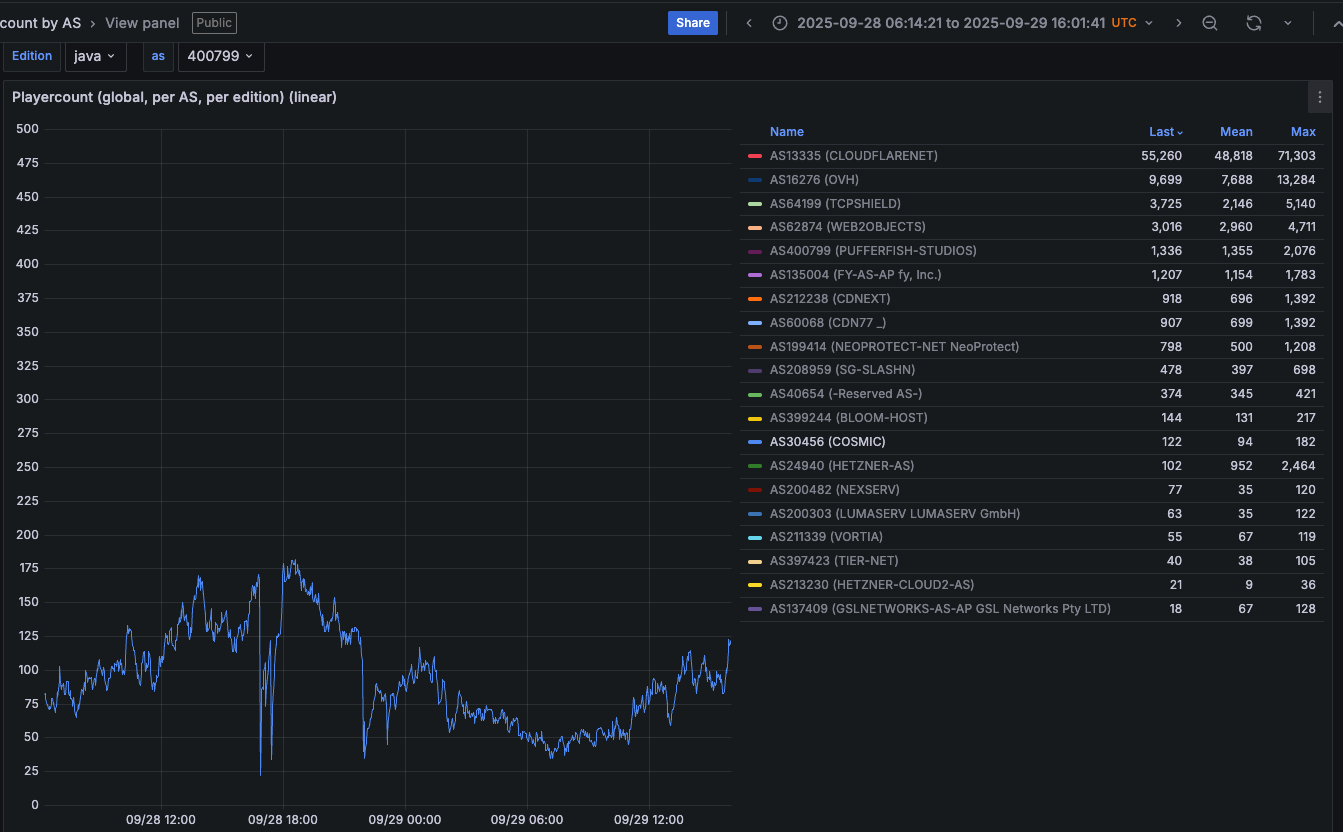
Paging through the same uptime graphs for other network operators listed shows almost all of them suffered brief but repeated outages around the same time. Here is the same uptime tracking for Minecraft servers on the network provider Cosmic (AS30456), and it shows multiple large dips that correspond to game server outages caused by Aisuru.

Multiple DDoS attacks from Aisuru can be seen against the Minecraft host Cosmic on Sept. 28. The sharp downward spikes correspond to brief but enormous attacks from Aisuru. Image: grafana.blockgametracker.gg.

BOTNETS R US

Ferguson said he’s been tracking Aisuru for about three months, and recently he noticed the botnet’s composition shifted heavily toward infected systems at ISPs in the United States. Ferguson shared logs from an attack on October 8 that indexed traffic by the total volume sent through each network provider, and the logs showed that 11 of the top 20 traffic sources were U.S. based ISPs.

AT&T customers were by far the biggest U.S. contributors to that attack, followed by botted systems on Charter Communications, Comcast, T-Mobile and Verizon, Ferguson found. He said the volume of data packets per second coming from infected IoT hosts on these ISPs is often so high that it has started to affect the quality of service that ISPs are able to provide to adjacent (non-botted) customers.

“The impact extends beyond victim networks,” Ferguson said. “For instance we have seen 500 gigabits of traffic via Comcast’s network alone. This amount of egress leaving their network, especially being so US-East concentrated, will result in congestion towards other services or content trying to be reached while an attack is ongoing.”

Roland Dobbins is principal engineer at Netscout. Dobbins said Ferguson is spot on, noting that while most ISPs have effective mitigations in place to handle large incoming DDoS attacks, many are far less prepared to manage the inevitable service degradation caused by large numbers of their customers suddenly using some or all available bandwidth to attack others.

“The outbound and cross-bound DDoS attacks can be just as disruptive as the inbound stuff,” Dobbin said. “We’re now in a situation where ISPs are routinely seeing terabit-per-second plus outbound attacks from their networks that can cause operational problems.”

“The crying need for effective and universal outbound DDoS attack suppression is something that is really being highlighted by these recent attacks,” Dobbins continued. “A lot of network operators are learning that lesson now, and there’s going to be a period ahead where there’s some scrambling and potential disruption going on.”

KrebsOnSecurity sought comment from the ISPs named in Ferguson’s report. Charter Communications pointed to a recent blog post on protecting its network, stating that Charter actively monitors for both inbound and outbound attacks, and that it takes proactive action wherever possible.

“In addition to our own extensive network security, we also aim to reduce the risk of customer connected devices contributing to attacks through our Advanced WiFi solution that includes Security Shield, and we make Security Suite available to our Internet customers,” Charter wrote in an emailed response to questions. “With the ever-growing number of devices connecting to networks, we encourage customers to purchase trusted devices with secure development and manufacturing practices, use anti-virus and security tools on their connected devices, and regularly download security patches.”

A spokesperson for Comcast responded, “Currently our network is not experiencing impacts and we are able to handle the traffic.”

9 YEARS OF MIRAI

Aisuru is built on the bones of malicious code that was leaked in 2016 by the original creators of the Mirai IoT botnet. Like Aisuru, Mirai quickly outcompeted all other DDoS botnets in its heyday, and obliterated previous DDoS attack records with a 620 gigabit-per-second siege that sidelined this website for nearly four days in 2016.

The Mirai botmasters likewise used their crime machine to attack mostly Minecraft servers, but with the goal of forcing Minecraft server owners to purchase a DDoS protection service that they controlled. In addition, they rented out slices of the Mirai botnet to paying customers, some of whom used it to mask the sources of other types of cybercrime, such as click fraud.

A depiction of the outages caused by the Mirai botnet attacks against the internet infrastructure firm Dyn on October 21, 2016. Source: Downdetector.com.

Dobbins said Aisuru’s owners also appear to be renting out their botnet as a distributed proxy network that cybercriminal customers anywhere in the world can use to anonymize their malicious traffic and make it appear to be coming from regular residential users in the U.S.

“The people who operate this botnet are also selling (it as) residential proxies,” he said. “And that’s being used to reflect application layer attacks through the proxies on the bots as well.”

The Aisuru botnet harkens back to its predecessor Mirai in another intriguing way. One of its owners is using the Telegram handle “9gigsofram,” which corresponds to the nickname used by the co-owner of a Minecraft server protection service called Proxypipe that was heavily targeted in 2016 by the original Mirai botmasters.

Robert Coelho co-ran Proxypipe back then along with his business partner Erik “9gigsofram” Buckingham, and has spent the past nine years fine-tuning various DDoS mitigation companies that cater to Minecraft server operators and other gaming enthusiasts. Coelho said he has no idea why one of Aisuru’s botmasters chose Buckingham’s nickname, but added that it might say something about how long this person has been involved in the DDoS-for-hire industry.

“The Aisuru attacks on the gaming networks these past seven day have been absolutely huge, and you can see tons of providers going down multiple times a day,” Coelho said.

Coelho said the 15 Tbps attack this week against TCPShield was likely only a portion of the total attack volume hurled by Aisuru at the time, because much of it would have been shoved through networks that simply couldn’t process that volume of traffic all at once. Such outsized attacks, he said, are becoming increasingly difficult and expensive to mitigate.

“It’s definitely at the point now where you need to be spending at least a million dollars a month just to have the network capacity to be able to deal with these attacks,” he said.

RAPID SPREAD

Aisuru has long been rumored to use multiple zero-day vulnerabilities in IoT devices to aid its rapid growth over the past year. XLab, the Chinese security company that was the first to profile Aisuru’s rise in 2024, warned last month that one of the Aisuru botmasters had compromised the firmware distribution website for Totolink, a maker of low-cost routers and other networking gear.

“Multiple sources indicate the group allegedly compromised a router firmware update server in April and distributed malicious scripts to expand the botnet,” XLab wrote on September 15. “The node count is currently reported to be around 300,000.”

A malicious script implanted into a Totolink update server in April 2025. Image: XLab.

Aisuru’s operators received an unexpected boost to their crime machine in August when the U.S. Department Justice charged the alleged proprietor of Rapper Bot, a DDoS-for-hire botnet that competed directly with Aisuru for control over the global pool of vulnerable IoT systems.

Once Rapper Bot was dismantled, Aisuru’s curators moved quickly to commandeer vulnerable IoT devices that were suddenly set adrift by the government’s takedown, Dobbins said.

“Folks were arrested and Rapper Bot control servers were seized and that’s great, but unfortunately the botnet’s attack assets were then pieced out by the remaining botnets,” he said. “The problem is, even if those infected IoT devices are rebooted and cleaned up, they will still get re-compromised by something else generally within minutes of being plugged back in.”

A screenshot shared by XLabs showing the Aisuru botmasters recently celebrating a record-breaking 7.7 Tbps DDoS. The user at the top has adopted the name “Ethan J. Foltz” in a mocking tribute to the alleged Rapper Bot operator who was arrested and charged in August 2025.

BOTMASTERS AT LARGE

XLab’s September blog post cited multiple unnamed sources saying Aisuru is operated by three cybercriminals: “Snow,” who’s responsible for botnet development; “Tom,” tasked with finding new vulnerabilities; and “Forky,” responsible for botnet sales.

KrebsOnSecurity interviewed Forky in our May 2025 story about the record 6.3 Tbps attack from Aisuru. That story identified Forky as a 21-year-old man from Sao Paulo, Brazil who has been extremely active in the DDoS-for-hire scene since at least 2022. The FBI has seized Forky’s DDoS-for-hire domains several times over the years.

Like the original Mirai botmasters, Forky also operates a DDoS mitigation service called Botshield. Forky declined to discuss the makeup of his ISP’s clientele, or to clarify whether Botshield was more of a hosting provider or a DDoS mitigation firm. However, Forky has posted on Telegram about Botshield successfully mitigating large DDoS attacks launched against other DDoS-for-hire services.

In our previous interview, Forky acknowledged being involved in the development and marketing of Aisuru, but denied participating in attacks launched by the botnet.

Reached for comment earlier this month, Forky continued to maintain his innocence, claiming that he also is still trying to figure out who the current Aisuru botnet operators are in real life (Forky said the same thing in our May interview).

But after a week of promising juicy details, Forky came up empty-handed once again. Suspecting that Forky was merely being coy, I asked him how someone so connected to the DDoS-for-hire world could still be mystified on this point, and suggested that his inability or unwillingness to blame anyone else for Aisuru would not exactly help his case.

At this, Forky verbally bristled at being pressed for more details, and abruptly terminated our interview.

“I’m not here to be threatened with ignorance because you are stressed,” Forky replied. “They’re blaming me for those new attacks. Pretty much the whole world (is) due to your blog.”

TP-Link warns of botnet infecting routers and targeting Microsoft 365 accounts

4 September 2025 at 06:50

TP-Link has issued a warning about a botnet exploiting two vulnerabilities to infect small office/home (SOHO) routers, which are then weaponized to attack Microsoft 365 accounts. 

The vulnerabilities affect the Archer C7 and TL-WR841N/ND routers, though other models may also be at risk. Despite the fact that these routers have reached end-of-life (EOL), TP-Link has nonetheless released firmware updates to address the flaws.

If you have a router issued by your internet service provider (ISP) this also deserves checking. Several ISPs have used the TP-Link Archer C7 and TL-WR841N/ND routers, sometimes rebranding them for distribution to customers, especially in Europe and North America. For example, Dutch ISP Ziggo is known to have rebranded the TP-Link Archer C7 as the “Wifibooster Ziggo C7”, supplying it to customers with Ziggo-specific firmware.

The two vulnerabilities, tracked as CVE-2023-50224 and CVE-2025-9377, are chained to add a router to a botnet. CVE-2025-50224 is a vulnerability that allows an attacker to steal passwords from the router and CVE-2025-9377 is a known Parental Control command injection RCE exploit, allowing the attacker to run their code on the router.

The botnet, called Quad7 (aka 7777) uses the infected routers to perform password-spraying attacks against Microsoft 365 accounts. Password spraying literally means trying common passwords across many accounts or using many common passwords against the same account.

Last year, Microsoft warned about the same botnet but the specific vulnerabilities were unknown at the time. Detection remains difficult for defenders, as the botnet uses thousands of IP addresses from home users and small businesses. TP-Link urges owners of these router models to install the updated firmware or switch to a fully supported router. The company is also investigating reports that other models might be vulnerable. Meanwhile, the US Cybersecurity and Infrastructure Security Agency (CISA) has also issued advisories for these two flaws.

Recommendations for owners of TP-Link routers

It is rare that a manufacturer would issue a firmware update for a EOL product, which emphasizes the importance of deploying that update. Being a part of a botnet is not just a danger to others, it can considerably slow down your home device(s).

  • Check if your router is an Archer C7 or TL-WR841N/ND, or another older TP-Link model. If so, update your firmware immediately with the version provided by TP-Link.
  • If firmware updates are no longer provided or your router is out of support, strongly consider upgrading to a supported model.
  • Change your router’s admin password to a strong, unique value, meaning you should avoid reusing passwords from other accounts.
  • Disable remote management features unless absolutely necessary and always check that parental control pages are only accessible by authenticated users.

Recommendations for Microsoft 365 users

Since the botnet is used at this moment in time to take over Microsoft 365 accounts, there are a few things you can do to make this a lot harder.

Staying ahead of threats like botnets means keeping devices patched, using strong authentication practices, and remaining alert for updates on device security. Don’t wait until your router—or your Microsoft 365 account—becomes part of someone else’s attack toolkit.


We don’t just report on threats – we help safeguard your entire digital identity

Cybersecurity risks should never spread beyond a headline. Protect your—and your family’s—personal information by using identity protection.

DOGE to Fired CISA Staff: Email Us Your Personal Data

19 March 2025 at 21:26

A message posted on Monday to the homepage of the U.S. Cybersecurity & Infrastructure Security Agency (CISA) is the latest exhibit in the Trump administration’s continued disregard for basic cybersecurity protections. The message instructed recently-fired CISA employees to get in touch so they can be rehired and then immediately placed on leave, asking employees to send their Social Security number or date of birth in a password-protected email attachment — presumably with the password needed to view the file included in the body of the email.

The homepage of cisa.gov as it appeared on Monday and Tuesday afternoon.

On March 13, a Maryland district court judge ordered the Trump administration to reinstate more than 130 probationary CISA employees who were fired last month. On Monday, the administration announced that those dismissed employees would be reinstated but placed on paid administrative leave. They are among nearly 25,000 fired federal workers who are in the process of being rehired.

A notice covering the CISA homepage said the administration is making every effort to contact those who were unlawfully fired in mid-February.

“Please provide a password protected attachment that provides your full name, your dates of employment (including date of termination), and one other identifying factor such as date of birth or social security number,” the message reads. “Please, to the extent that it is available, attach any termination notice.”

The message didn’t specify how affected CISA employees should share the password for any attached files, so the implicit expectation is that employees should just include the plaintext password in their message.

Email is about as secure as a postcard sent through the mail, because anyone who manages to intercept the missive anywhere along its path of delivery can likely read it. In security terms, that’s the equivalent of encrypting sensitive data while also attaching the secret key needed to view the information.

What’s more, a great many antivirus and security scanners have trouble inspecting password-protected files, meaning the administration’s instructions are likely to increase the risk that malware submitted by cybercriminals could be accepted and opened by U.S. government employees.

The message in the screenshot above was removed from the CISA homepage Tuesday evening and replaced with a much shorter notice directing former CISA employees to contact a specific email address. But a slightly different version of the same message originally posted to CISA’s website still exists at the website for the U.S. Citizenship and Immigration Services, which likewise instructs those fired employees who wish to be rehired and put on leave to send a password-protected email attachment with sensitive personal data.

A message from the White House to fired federal employees at the U.S. Citizenship and Immigration Services instructs recipients to email personal information in a password-protected attachment.

This is hardly the first example of the administration discarding Security 101 practices in the name of expediency. Last month, the Central Intelligence Agency (CIA) sent an unencrypted email to the White House with the first names and first letter of the last names of recently hired CIA officers who might be easy to fire.

As cybersecurity journalist Shane Harris noted in The Atlantic, even those fragments of information could be useful to foreign spies.

“Over the weekend, a former senior CIA official showed me the steps by which a foreign adversary who knew only his first name and last initial could have managed to identify him from the single line of the congressional record where his full name was published more than 20 years ago, when he became a member of the Foreign Service,” Harris wrote. “The former official was undercover at the time as a State Department employee. If a foreign government had known even part of his name from a list of confirmed CIA officers, his cover would have been blown.”

The White House has also fired at least 100 intelligence staffers from the National Security Agency (NSA), reportedly for using an internal NSA chat tool to discuss their personal lives and politics. Testifying before the House Select Committee on the Communist Party earlier this month, the NSA’s former top cybersecurity official said the Trump administration’s attempts to mass fire probationary federal employees will be “devastating” to U.S. cybersecurity operations.

Rob Joyce, who spent 34 years at the NSA, told Congress how important those employees are in sustaining an aggressive stance against China in cyberspace.

“At my former agency, remarkable technical talent was recruited into developmental programs that provided intensive unique training and hands-on experience to cultivate vital skills,” Joyce told the panel. “Eliminating probationary employees will destroy a pipeline of top talent responsible for hunting and eradicating [Chinese] threats.”

Both the message to fired CISA workers and DOGE’s ongoing efforts to bypass vetted government networks for a faster Wi-Fi signal are emblematic of this administration’s overall approach to even basic security measures: To go around them, or just pretend they don’t exist for a good reason.

On Monday, The New York Times reported that U.S. Secret Service agents at the White House were briefly on alert last month when a trusted captain of Elon Musk’s “Department of Government Efficiency” (DOGE) visited the roof of the Eisenhower building inside the White House compound — to see about setting up a dish to receive satellite Internet access directly from Musk’s Starlink service.

The White House press secretary told The Times that Starlink had “donated” the service and that the gift had been vetted by the lawyer overseeing ethics issues in the White House Counsel’s Office. The White House claims the service is necessary because its wireless network is too slow.

Jake Williams, vice president for research and development at the cybersecurity consulting firm Hunter Strategy, told The Times “it’s super rare” to install Starlink or another internet provider as a replacement for existing government infrastructure that has been vetted and secured.

“I can’t think of a time that I have heard of that,” Williams said. “It introduces another attack point,” Williams said. “But why introduce that risk?”

Meanwhile, NBC News reported on March 7 that Starlink is expanding its footprint across the federal government.

“Multiple federal agencies are exploring the idea of adopting SpaceX’s Starlink for internet access — and at least one agency, the General Services Administration (GSA), has done so at the request of Musk’s staff, according to someone who worked at the GSA last month and is familiar with its network operations — despite a vow by Musk and Trump to slash the overall federal budget,” NBC wrote.

The longtime Musk employee who encountered the Secret Service on the roof in the White House complex was Christopher Stanley, the 33-year-old senior director for security engineering at X and principal security engineer at SpaceX.

On Monday, Bloomberg broke the news that Stanley had been tapped for a seat on the board of directors at the mortgage giant Fannie Mae. Stanley was added to the board alongside newly confirmed Federal Housing Finance Agency director Bill Pulte, the grandson of the late housing businessman and founder of PulteGroup — William J. Pulte.

In a nod to his new board role atop an agency that helps drive the nation’s $12 trillion mortgage market, Stanley retweeted a Bloomberg story about the hire with a smiley emoji and the comment “Tech Support.”

But earlier today, Bloomberg reported that Stanley had abruptly resigned from the Fannie board, and that details about the reason for his quick departure weren’t immediately clear. As first reported here last month, Stanley had a brush with celebrity on Twitter in 2015 when he leaked the user database for the DDoS-for-hire service LizardStresser, and soon faced threats of physical violence against his family.

My 2015 story on that leak did not name Stanley, but he exposed himself as the source by posting a video about it on his Youtube channel. A review of domain names registered by Stanley shows he went by the nickname “enKrypt,” and was the former owner of a pirated software and hacking forum called error33[.]net, as well as theC0re, a video game cheating community.

Stanley is one of more than 50 DOGE workers, mostly young men and women who have worked with one or more of Musk’s companies. The Trump administration remains dogged by questions about how many — if any — of the DOGE workers were put through the gauntlet of a thorough security background investigation before being given access to such sensitive government databases.

That’s largely because in one of his first executive actions after being sworn in for a second term on Jan. 20, President Trump declared that the security clearance process was simply too onerous and time-consuming, and that anyone so designated by the White House counsel would have full top secret/sensitive compartmented information (TS/SCI) clearances for up to six months. Translation: We accepted the risk, so TAH-DAH! No risk!

Presumably, this is the same counsel who saw no ethical concerns with Musk “donating” Starlink to the White House, or with President Trump summoning the media to film him hawking Cybertrucks and Teslas (a.k.a. “Teslers”) on the White House lawn last week.

Mr. Musk’s unelected role as head of an ad hoc executive entity that is gleefully firing federal workers and feeding federal agencies into “the wood chipper” has seen his Tesla stock price plunge in recent weeks, while firebombings and other vandalism attacks on property carrying the Tesla logo are cropping up across the U.S. and overseas and driving down Tesla sales.

President Trump and his attorney general Pam Bondi have dubiously asserted that those responsible for attacks on Tesla dealerships are committing “domestic terrorism,” and that vandals will be prosecuted accordingly. But it’s not clear this administration would recognize a real domestic security threat if it was ensconced squarely behind the Resolute Desk.

Or at the pinnacle of the Federal Bureau of Investigation (FBI). The Washington Post reported last month that Trump’s new FBI director Kash Patel was paid $25,000 last year by a film company owned by a dual U.S. Russian citizen that has made programs promoting “deep state” conspiracy theories pushed by the Kremlin.

“The resulting six-part documentary appeared on Tucker Carlson’s online network, itself a reliable conduit for Kremlin propaganda,” The Post reported. “In the film, Patel made his now infamous pledge to shut down the FBI’s headquarters in Washington and ‘open it up as a museum to the deep state.'”

When the head of the FBI is promising to turn his own agency headquarters into a mocking public exhibit on the U.S. National Mall, it may seem silly to fuss over the White House’s clumsy and insulting instructions to former employees they unlawfully fired.

Indeed, one consistent feedback I’ve heard from a subset of readers here is something to this effect: “I used to like reading your stuff more when you weren’t writing about politics all the time.”

My response to that is: “Yeah, me too.” It’s not that I’m suddenly interested in writing about political matters; it’s that various actions by this administration keep intruding on my areas of coverage.

A less charitable interpretation of that reader comment is that anyone still giving such feedback is either dangerously uninformed, being disingenuous, or just doesn’t want to keep being reminded that they’re on the side of the villains, despite all the evidence showing it.

Article II of the U.S. Constitution unambiguously states that the president shall take care that the laws be faithfully executed. But almost from Day One of his second term, Mr. Trump has been acting in violation of his sworn duty as president by choosing not to enforce laws passed by Congress (TikTok ban, anyone?), by freezing funds already allocated by Congress, and most recently by flouting a federal court order while simultaneously calling for the impeachment of the judge who issued it. Sworn to uphold, protect and defend The Constitution, President Trump appears to be creating new constitutional challenges with almost each passing day.

When Mr. Trump was voted out of office in November 2020, he turned to baseless claims of widespread “election fraud” to explain his loss — with deadly and long-lasting consequences. This time around, the rallying cry of DOGE and White House is “government fraud,” which gives the administration a certain amount of cover for its actions among a base of voters that has long sought to shrink the size and cost of government.

In reality, “government fraud” has become a term of derision and public scorn applied to anything or anyone the current administration doesn’t like. If DOGE and the White House were truly interested in trimming government waste, fraud and abuse, they could scarcely do better than consult the inspectors general fighting it at various federal agencies.

After all, the inspectors general likely know exactly where a great deal of the federal government’s fiscal skeletons are buried. Instead, Mr. Trump fired at least 17 inspectors general, leaving the government without critical oversight of agency activities. That action is unlikely to stem government fraud; if anything, it will only encourage such activity.

As Techdirt founder Mike Masnick noted in a recent column “Why Techdirt is Now a Democracy Blog (Whether We Like it or Not),” when the very institutions that made American innovation possible are being systematically dismantled, it’s not a “political” story anymore: It’s a story about whether the environment that enabled all the other stories we cover will continue to exist.

“This is why tech journalism’s perspective is so crucial right now,” Masnick wrote. “We’ve spent decades documenting how technology and entrepreneurship can either strengthen or undermine democratic institutions. We understand the dangers of concentrated power in the digital age. And we’ve watched in real-time as tech leaders who once championed innovation and openness now actively work to consolidate control and dismantle the very systems that enabled their success.”

“But right now, the story that matters most is how the dismantling of American institutions threatens everything else we cover,” Masnick continued. “When the fundamental structures that enable innovation, protect civil liberties, and foster open dialogue are under attack, every other tech policy story becomes secondary.”

❌