Normal view

Received before yesterday

The Cloudflare Outage May Be a Security Roadmap

19 November 2025 at 09:07

An intermittent outage at Cloudflare on Tuesday briefly knocked many of the Internet’s top destinations offline. Some affected Cloudflare customers were able to pivot away from the platform temporarily so that visitors could still access their websites. But security experts say doing so may have also triggered an impromptu network penetration test for organizations that have come to rely on Cloudflare to block many types of abusive and malicious traffic.

At around 6:30 EST/11:30 UTC on Nov. 18, Cloudflare’s status page acknowledged the company was experiencing “an internal service degradation.” After several hours of Cloudflare services coming back up and failing again, many websites behind Cloudflare found they could not migrate away from using the company’s services because the Cloudflare portal was unreachable and/or because they also were getting their domain name system (DNS) services from Cloudflare.

However, some customers did manage to pivot their domains away from Cloudflare during the outage. And many of those organizations probably need to take a closer look at their web application firewall (WAF) logs during that time, said Aaron Turner, a faculty member at IANS Research.

Turner said Cloudflare’s WAF does a good job filtering out malicious traffic that matches any one of the top ten types of application-layer attacks, including credential stuffing, cross-site scripting, SQL injection, bot attacks and API abuse. But he said this outage might be a good opportunity for Cloudflare customers to better understand how their own app and website defenses may be failing without Cloudflare’s help.

“Your developers could have been lazy in the past for SQL injection because Cloudflare stopped that stuff at the edge,” Turner said. “Maybe you didn’t have the best security QA [quality assurance] for certain things because Cloudflare was the control layer to compensate for that.”

Turner said one company he’s working with saw a huge increase in log volume and they are still trying to figure out what was “legit malicious” versus just noise.

“It looks like there was about an eight hour window when several high-profile sites decided to bypass Cloudflare for the sake of availability,” Turner said. “Many companies have essentially relied on Cloudflare for the OWASP Top Ten [web application vulnerabilities] and a whole range of bot blocking. How much badness could have happened in that window? Any organization that made that decision needs to look closely at any exposed infrastructure to see if they have someone persisting after they’ve switched back to Cloudflare protections.”

Turner said some cybercrime groups likely noticed when an online merchant they normally stalk stopped using Cloudflare’s services during the outage.

“Let’s say you were an attacker, trying to grind your way into a target, but you felt that Cloudflare was in the way in the past,” he said. “Then you see through DNS changes that the target has eliminated Cloudflare from their web stack due to the outage. You’re now going to launch a whole bunch of new attacks because the protective layer is no longer in place.”

Nicole Scott, senior product marketing manager at the McLean, Va. based Replica Cyber, called yesterday’s outage “a free tabletop exercise, whether you meant to run one or not.”

“That few-hour window was a live stress test of how your organization routes around its own control plane and shadow IT blossoms under the sunlamp of time pressure,” Scott said in a post on LinkedIn. “Yes, look at the traffic that hit you while protections were weakened. But also look hard at the behavior inside your org.”

Scott said organizations seeking security insights from the Cloudflare outage should ask themselves:

1. What was turned off or bypassed (WAF, bot protections, geo blocks), and for how long?
2. What emergency DNS or routing changes were made, and who approved them?
3. Did people shift work to personal devices, home Wi-Fi, or unsanctioned Software-as-a-Service providers to get around the outage?
4. Did anyone stand up new services, tunnels, or vendor accounts “just for now”?
5. Is there a plan to unwind those changes, or are they now permanent workarounds?
6. For the next incident, what’s the intentional fallback plan, instead of decentralized improvisation?

In a postmortem published Tuesday evening, Cloudflare said the disruption was not caused, directly or indirectly, by a cyberattack or malicious activity of any kind.

“Instead, it was triggered by a change to one of our database systems’ permissions which caused the database to output multiple entries into a ‘feature file’ used by our Bot Management system,” Cloudflare CEO Matthew Prince wrote. “That feature file, in turn, doubled in size. The larger-than-expected feature file was then propagated to all the machines that make up our network.”

Cloudflare estimates that roughly 20 percent of websites use its services, and with much of the modern web relying heavily on a handful of other cloud providers including AWS and Azure, even a brief outage at one of these platforms can create a single point of failure for many organizations.

Martin Greenfield, CEO at the IT consultancy Quod Orbis, said Tuesday’s outage was another reminder that many organizations may be putting too many of their eggs in one basket.

“There are several practical and overdue fixes,” Greenfield advised. “Split your estate. Spread WAF and DDoS protection across multiple zones. Use multi-vendor DNS. Segment applications so a single provider outage doesn’t cascade. And continuously monitor controls to detect single-vendor dependency.”

Google Sues to Disrupt Chinese SMS Phishing Triad

13 November 2025 at 09:47

Google is suing more than two dozen unnamed individuals allegedly involved in peddling a popular China-based mobile phishing service that helps scammers impersonate hundreds of trusted brands, blast out text message lures, and convert phished payment card data into mobile wallets from Apple and Google.

In a lawsuit filed in the Southern District of New York on November 12, Google sued to unmask and disrupt 25 “John Doe” defendants allegedly linked to the sale of Lighthouse, a sophisticated phishing kit that makes it simple for even novices to steal payment card data from mobile users. Google said Lighthouse has harmed more than a million victims across 120 countries.

A component of the Chinese phishing kit Lighthouse made to target customers of The Toll Roads, which refers to several state routes through Orange County, Calif.

Lighthouse is one of several prolific phishing-as-a-service operations known as the “Smishing Triad,” and collectively they are responsible for sending millions of text messages that spoof the U.S. Postal Service to supposedly collect some outstanding delivery fee, or that pretend to be a local toll road operator warning of a delinquent toll fee. More recently, Lighthouse has been used to spoof e-commerce websites, financial institutions and brokerage firms.

Regardless of the text message lure or brand used, the basic scam remains the same: After the visitor enters their payment information, the phishing site will automatically attempt to enroll the card as a mobile wallet from Apple or Google. The phishing site then tells the visitor that their bank is going to verify the transaction by sending a one-time code that needs to be entered into the payment page before the transaction can be completed.

If the recipient provides that one-time code, the scammers can link the victim’s card data to a mobile wallet on a device that they control. Researchers say the fraudsters usually load several stolen wallets onto each mobile device, and wait 7-10 days after that enrollment before selling the phones or using them for fraud.

Google called the scale of the Lighthouse phishing attacks “staggering.” A May 2025 report from Silent Push found the domains used by the Smishing Triad are rotated frequently, with approximately 25,000 phishing domains active during any 8-day period.

Google’s lawsuit alleges the purveyors of Lighthouse violated the company’s trademarks by including Google’s logos on countless phishing websites. The complaint says Lighthouse offers over 600 templates for phishing websites of more than 400 entities, and that Google’s logos were featured on at least a quarter of those templates.

Google is also pursuing Lighthouse under the Racketeer Influenced and Corrupt Organizations (RICO) Act, saying the Lighthouse phishing enterprise encompasses several connected threat actor groups that work together to design and implement complex criminal schemes targeting the general public.

According to Google, those threat actor teams include a “developer group” that supplies the phishing software and templates; a “data broker group” that provides a list of targets; a “spammer group” that provides the tools to send fraudulent text messages in volume; a “theft group,” in charge of monetizing the phished information; and an “administrative group,” which runs their Telegram support channels and discussion groups designed to facilitate collaboration and recruit new members.

“While different members of the Enterprise may play different roles in the Schemes, they all collaborate to execute phishing attacks that rely on the Lighthouse software,” Google’s complaint alleges. “None of the Enterprise’s Schemes can generate revenue without collaboration and cooperation among the members of the Enterprise. All of the threat actor groups are connected to one another through historical and current business ties, including through their use of Lighthouse and the online community supporting its use, which exists on both YouTube and Telegram channels.”

Silent Push’s May report observed that the Smishing Triad boasts it has “300+ front desk staff worldwide” involved in Lighthouse, staff that is mainly used to support various aspects of the group’s fraud and cash-out schemes.

An image shared by an SMS phishing group shows a panel of mobile phones responsible for mass-sending phishing messages. These panels require a live operator because the one-time codes being shared by phishing victims must be used quickly as they generally expire within a few minutes.

Google alleges that in addition to blasting out text messages spoofing known brands, Lighthouse makes it easy for customers to mass-create fake e-commerce websites that are advertised using Google Ads accounts (and paid for with stolen credit cards). These phony merchants collect payment card information at checkout, and then prompt the customer to expect and share a one-time code sent from their financial institution.

Once again, that one-time code is being sent by the bank because the fake e-commerce site has just attempted to enroll the victim’s payment card data in a mobile wallet. By the time a victim understands they will likely never receive the item they just purchased from the fake e-commerce shop, the scammers have already run through hundreds of dollars in fraudulent charges, often at high-end electronics stores or jewelers.

Ford Merrill works in security research at SecAlliance, a CSIS Security Group company, and he’s been tracking Chinese SMS phishing groups for several years. Merrill said many Lighthouse customers are now using the phishing kit to erect fake e-commerce websites that are advertised on Google and Meta platforms.

“You find this shop by searching for a particular product online or whatever, and you think you’re getting a good deal,” Merrill said. “But of course you never receive the product, and they will phish that one-time code at checkout.”

Merrill said some of the phishing templates include payment buttons for services like PayPal, and that victims who choose to pay through PayPal can also see their PayPal accounts hijacked.

A fake e-commerce site from the Smishing Triad spoofing PayPal on a mobile device.

“The main advantage of the fake e-commerce site is that it doesn’t require them to send out message lures,” Merrill said, noting that the fake vendor sites have more staying power than traditional phishing sites because it takes far longer for them to be flagged for fraud.

Merrill said Google’s legal action may temporarily disrupt the Lighthouse operators, and could make it easier for U.S. federal authorities to bring criminal charges against the group. But he said the Chinese mobile phishing market is so lucrative right now that it’s difficult to imagine a popular phishing service voluntarily turning out the lights.

Merrill said Google’s lawsuit also can help lay the groundwork for future disruptive actions against Lighthouse and other phishing-as-a-service entities that are operating almost entirely on Chinese networks. According to Silent Push, a majority of the phishing sites created with these kits are sitting at two Chinese hosting companies: Tencent (AS132203) and Alibaba (AS45102).

“Once Google has a default judgment against the Lighthouse guys in court, theoretically they could use that to go to Alibaba and Tencent and say, ‘These guys have been found guilty, here are their domains and IP addresses, we want you to shut these down or we’ll include you in the case.'”

If Google can bring that kind of legal pressure consistently over time, Merrill said, they might succeed in increasing costs for the phishers and more frequently disrupting their operations.

“If you take all of these Chinese phishing kit developers, I have to believe it’s tens of thousands of Chinese-speaking people involved,” he said. “The Lighthouse guys will probably burn down their Telegram channels and disappear for a while. They might call it something else or redevelop their service entirely. But I don’t believe for a minute they’re going to close up shop and leave forever.”

Drilling Down on Uncle Sam’s Proposed TP-Link Ban

9 November 2025 at 13:14

The U.S. government is reportedly preparing to ban the sale of wireless routers and other networking gear from TP-Link Systems, a tech company that currently enjoys an estimated 50% market share among home users and small businesses. Experts say while the proposed ban may have more to do with TP-Link’s ties to China than any specific technical threats, much of the rest of the industry serving this market also sources hardware from China and ships products that are insecure fresh out of the box.

A TP-Link WiFi 6 AX1800 Smart WiFi Router (Archer AX20).

The Washington Post recently reported that more than a half-dozen federal departments and agencies were backing a proposed ban on future sales of TP-Link devices in the United States. The story said U.S. Department of Commerce officials concluded TP-Link Systems products pose a risk because the U.S.-based company’s products handle sensitive American data and because the officials believe it remains subject to jurisdiction or influence by the Chinese government.

TP-Link Systems denies that, saying that it fully split from the Chinese TP-Link Technologies over the past three years, and that its critics have vastly overstated the company’s market share (TP-Link puts it at around 30 percent). TP-Link says it has headquarters in California, with a branch in Singapore, and that it manufactures in Vietnam. The company says it researches, designs, develops and manufactures everything except its chipsets in-house.

TP-Link Systems told The Post it has sole ownership of some engineering, design and manufacturing capabilities in China that were once part of China-based TP-Link Technologies, and that it operates them without Chinese government supervision.

“TP-Link vigorously disputes any allegation that its products present national security risks to the United States,” Ricca Silverio, a spokeswoman for TP-Link Systems, said in a statement. “TP-Link is a U.S. company committed to supplying high-quality and secure products to the U.S. market and beyond.”

Cost is a big reason TP-Link devices are so prevalent in the consumer and small business market: As this February 2025 story from Wired observed regarding the proposed ban, TP-Link has long had a reputation for flooding the market with devices that are considerably cheaper than comparable models from other vendors. That price point (and consistently excellent performance ratings) has made TP-Link a favorite among Internet service providers (ISPs) that provide routers to their customers.

In August 2024, the chairman and the ranking member of the House Select Committee on the Strategic Competition Between the United States and the Chinese Communist Party called for an investigation into TP-Link devices, which they said were found on U.S. military bases and for sale at exchanges that sell them to members of the military and their families.

“TP-Link’s unusual degree of vulnerabilities and required compliance with PRC law are in and of themselves disconcerting,” the House lawmakers warned in a letter (PDF) to the director of the Commerce Department. “When combined with the PRC government’s common use of SOHO [small office/home office] routers like TP-Link to perpetrate extensive cyberattacks in the United States, it becomes significantly alarming.”

The letter cited a May 2023 blog post by Check Point Research about a Chinese state-sponsored hacking group dubbed “Camaro Dragon” that used a malicious firmware implant for some TP-Link routers to carry out a sequence of targeted cyberattacks against European foreign affairs entities. Check Point said while it only found the malicious firmware on TP-Link devices, “the firmware-agnostic nature of the implanted components indicates that a wide range of devices and vendors may be at risk.”

In a report published in October 2024, Microsoft said it was tracking a network of compromised TP-Link small office and home office routers that has been abused by multiple distinct Chinese state-sponsored hacking groups since 2021. Microsoft found the hacker groups were leveraging the compromised TP-Link systems to conduct “password spraying” attacks against Microsoft accounts. Password spraying involves rapidly attempting to access a large number of accounts (usernames/email addresses) with a relatively small number of commonly used passwords.

TP-Link rightly points out that most of its competitors likewise source components from China. The company also correctly notes that advanced persistent threat (APT) groups from China and other nations have leveraged vulnerabilities in products from their competitors, such as Cisco and Netgear.

But that may be cold comfort for TP-Link customers who are now wondering if it’s smart to continue using these products, or whether it makes sense to buy more costly networking gear that might only be marginally less vulnerable to compromise.

Almost without exception, the hardware and software that ships with most consumer-grade routers includes a number of default settings that need to be changed before the devices can be safely connected to the Internet. For example, bring a new router online without changing the default username and password and chances are it will only take a few minutes before it is probed and possibly compromised by some type of Internet-of-Things botnet. Also, it is incredibly common for the firmware in a brand new router to be dangerously out of date by the time it is purchased and unboxed.

Until quite recently, the idea that router manufacturers should make it easier for their customers to use these products safely was something of an anathema to this industry. Consumers were largely left to figure that out on their own, with predictably disastrous results.

But over the past few years, many manufacturers of popular consumer routers have begun forcing users to perform basic hygiene — such as changing the default password and updating the internal firmware — before the devices can be used as a router. For example, most brands of “mesh” wireless routers — like Amazon’s Eero, Netgear’s Orbi series, or Asus’s ZenWifi — require online registration that automates these critical steps going forward (or at least through their stated support lifecycle).

For better or worse, less expensive, traditional consumer routers like those from Belkin and Linksys also now automate this setup by heavily steering customers toward installing a mobile app to complete the installation (this often comes as a shock to people more accustomed to manually configuring a router). Still, these products tend to put the onus on users to check for and install available updates periodically. Also, they’re often powered by underwhelming or else bloated firmware, and a dearth of configurable options.

Of course, not everyone wants to fiddle with mobile apps or is comfortable with registering their router so that it can be managed or monitored remotely in the cloud. For those hands-on folks — and for power users seeking more advanced router features like VPNs, ad blockers and network monitoring — the best advice is to check if your router’s stock firmware can be replaced with open-source alternatives, such as OpenWrt or DD-WRT.

These open-source firmware options are compatible with a wide range of devices, and they generally offer more features and configurability. Open-source firmware can even help extend the life of routers years after the vendor stops supporting the underlying hardware, but it still requires users to manually check for and install any available updates.

Happily, TP-Link users spooked by the proposed ban may have an alternative to outright junking these devices, as many TP-Link routers also support open-source firmware options like OpenWRT. While this approach may not eliminate any potential hardware-specific security flaws, it could serve as an effective hedge against more common vendor-specific vulnerabilities, such as undocumented user accounts, hard-coded credentials, and weaknesses that allow attackers to bypass authentication.

Regardless of the brand, if your router is more than four or five years old it may be worth upgrading for performance reasons alone — particularly if your home or office is primarily accessing the Internet through WiFi.

NB: The Post’s story notes that a substantial portion of TP-Link routers and those of its competitors are purchased or leased through ISPs. In these cases, the devices are typically managed and updated remotely by your ISP, and equipped with custom profiles responsible for authenticating your device to the ISP’s network. If this describes your setup, please do not attempt to modify or replace these devices without first consulting with your Internet provider.

Aisuru Botnet Shifts from DDoS to Residential Proxies

28 October 2025 at 20:51

Aisuru, the botnet responsible for a series of record-smashing distributed denial-of-service (DDoS) attacks this year, recently was overhauled to support a more low-key, lucrative and sustainable business: Renting hundreds of thousands of infected Internet of Things (IoT) devices to proxy services that help cybercriminals anonymize their traffic. Experts say a glut of proxies from Aisuru and other sources is fueling large-scale data harvesting efforts tied to various artificial intelligence (AI) projects, helping content scrapers evade detection by routing their traffic through residential connections that appear to be regular Internet users.

Image credit: vxdb

First identified in August 2024, Aisuru has spread to at least 700,000 IoT systems, such as poorly secured Internet routers and security cameras. Aisuru’s overlords have used their massive botnet to clobber targets with headline-grabbing DDoS attacks, flooding targeted hosts with blasts of junk requests from all infected systems simultaneously.

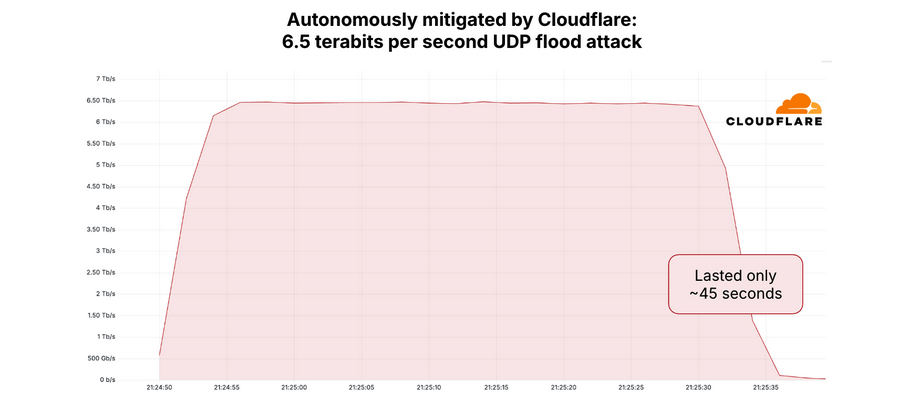
In June, Aisuru hit KrebsOnSecurity.com with a DDoS clocking at 6.3 terabits per second — the biggest attack that Google had ever mitigated at the time. In the weeks and months that followed, Aisuru’s operators demonstrated DDoS capabilities of nearly 30 terabits of data per second — well beyond the attack mitigation capabilities of most Internet destinations.

These digital sieges have been particularly disruptive this year for U.S.-based Internet service providers (ISPs), in part because Aisuru recently succeeded in taking over a large number of IoT devices in the United States. And when Aisuru launches attacks, the volume of outgoing traffic from infected systems on these ISPs is often so high that it can disrupt or degrade Internet service for adjacent (non-botted) customers of the ISPs.

“Multiple broadband access network operators have experienced significant operational impact due to outbound DDoS attacks in excess of 1.5Tb/sec launched from Aisuru botnet nodes residing on end-customer premises,” wrote Roland Dobbins, principal engineer at Netscout, in a recent executive summary on Aisuru. “Outbound/crossbound attack traffic exceeding 1Tb/sec from compromised customer premise equipment (CPE) devices has caused significant disruption to wireline and wireless broadband access networks. High-throughput attacks have caused chassis-based router line card failures.”

The incessant attacks from Aisuru have caught the attention of federal authorities in the United States and Europe (many of Aisuru’s victims are customers of ISPs and hosting providers based in Europe). Quite recently, some of the world’s largest ISPs have started informally sharing block lists identifying the rapidly shifting locations of the servers that the attackers use to control the activities of the botnet.

Experts say the Aisuru botmasters recently updated their malware so that compromised devices can more easily be rented to so-called “residential proxy” providers. These proxy services allow paying customers to route their Internet communications through someone else’s device, providing anonymity and the ability to appear as a regular Internet user in almost any major city worldwide.

From a website’s perspective, the IP traffic of a residential proxy network user appears to originate from the rented residential IP address, not from the proxy service customer. Proxy services can be used in a legitimate manner for several business purposes — such as price comparisons or sales intelligence. But they are massively abused for hiding cybercrime activity (think advertising fraud, credential stuffing) because they can make it difficult to trace malicious traffic to its original source.

And as we’ll see in a moment, this entire shadowy industry appears to be shifting its focus toward enabling aggressive content scraping activity that continuously feeds raw data into large language models (LLMs) built to support various AI projects.

‘INSANE’ GROWTH

Riley Kilmer is co-founder of spur.us, a service that tracks proxy networks. Kilmer said all of the top proxy services have grown substantially over the past six months.

“I just checked, and in the last 90 days we’ve seen 250 million unique residential proxy IPs,” Kilmer said. “That is insane. That is so high of a number, it’s unheard of. These proxies are absolutely everywhere now.”

Today, Spur says it is tracking an unprecedented spike in available proxies across all providers, including;

LUMINATI_PROXY    11,856,421
NETNUT_PROXY    10,982,458
ABCPROXY_PROXY    9,294,419
OXYLABS_PROXY     6,754,790
IPIDEA_PROXY     3,209,313
EARNFM_PROXY    2,659,913
NODEMAVEN_PROXY    2,627,851
INFATICA_PROXY    2,335,194
IPROYAL_PROXY    2,032,027
YILU_PROXY    1,549,155

Reached for comment about the apparent rapid growth in their proxy network, Oxylabs (#4 on Spur’s list) said while their proxy pool did grow recently, it did so at nowhere near the rate cited by Spur.

“We don’t systematically track other providers’ figures, and we’re not aware of any instances of 10× or 100× growth, especially when it comes to a few bigger companies that are legitimate businesses,” the company said in a written statement.

Bright Data was formerly known as Luminati Networks, the name that is currently at the top of Spur’s list of the biggest residential proxy networks. Bright Data likewise told KrebsOnSecurity that Spur’s current estimates of its proxy network are dramatically overstated and inaccurate.

“We did not actively initiate nor do we see any 10x or 100x expansion of our network, which leads me to believe that someone might be presenting these IPs as Bright Data’s in some way,” said Rony Shalit, Bright Data’s chief compliance and ethics officer. “In many cases in the past, due to us being the leading data collection proxy provider, IPs were falsely tagged as being part of our network, or while being used by other proxy providers for malicious activity.”

“Our network is only sourced from verified IP providers and a robust opt-in only residential peers, which we work hard and in complete transparency to obtain,” Shalit continued. “Every DC, ISP or SDK partner is reviewed and approved, and every residential peer must actively opt in to be part of our network.”

HK NETWORK

Even Spur acknowledges that Luminati and Oxylabs are unlike most other proxy services on their top proxy providers list, in that these providers actually adhere to “know-your-customer” policies, such as requiring video calls with all customers, and strictly blocking customers from reselling access.

Benjamin Brundage is founder of Synthient, a startup that helps companies detect proxy networks. Brundage said if there is increasing confusion around which proxy networks are the most worrisome, it’s because nearly all of these lesser-known proxy services have evolved into highly incestuous bandwidth resellers. What’s more, he said, some proxy providers do not appreciate being tracked and have been known to take aggressive steps to confuse systems that scan the Internet for residential proxy nodes.

Brundage said most proxy services today have created their own software development kit or SDK that other app developers can bundle with their code to earn revenue. These SDKs quietly modify the user’s device so that some portion of their bandwidth can be used to forward traffic from proxy service customers.

“Proxy providers have pools of constantly churning IP addresses,” he said. “These IP addresses are sourced through various means, such as bandwidth-sharing apps, botnets, Android SDKs, and more. These providers will often either directly approach resellers or offer a reseller program that allows users to resell bandwidth through their platform.”

Many SDK providers say they require full consent before allowing their software to be installed on end-user devices. Still, those opt-in agreements and consent checkboxes may be little more than a formality for cybercriminals like the Aisuru botmasters, who can earn a commission each time one of their infected devices is forced to install some SDK that enables one or more of these proxy services.

Depending on its structure, a single provider may operate hundreds of different proxy pools at a time — all maintained through other means, Brundage said.

“Often, you’ll see resellers maintaining their own proxy pool in addition to an upstream provider,” he said. “It allows them to market a proxy pool to high-value clients and offer an unlimited bandwidth plan for cheap reduce their own costs.”

Some proxy providers appear to be directly in league with botmasters. Brundage identified one proxy seller that was aggressively advertising cheap and plentiful bandwidth to content scraping companies. After scanning that provider’s pool of available proxies, Brundage said he found a one-to-one match with IP addresses he’d previously mapped to the Aisuru botnet.

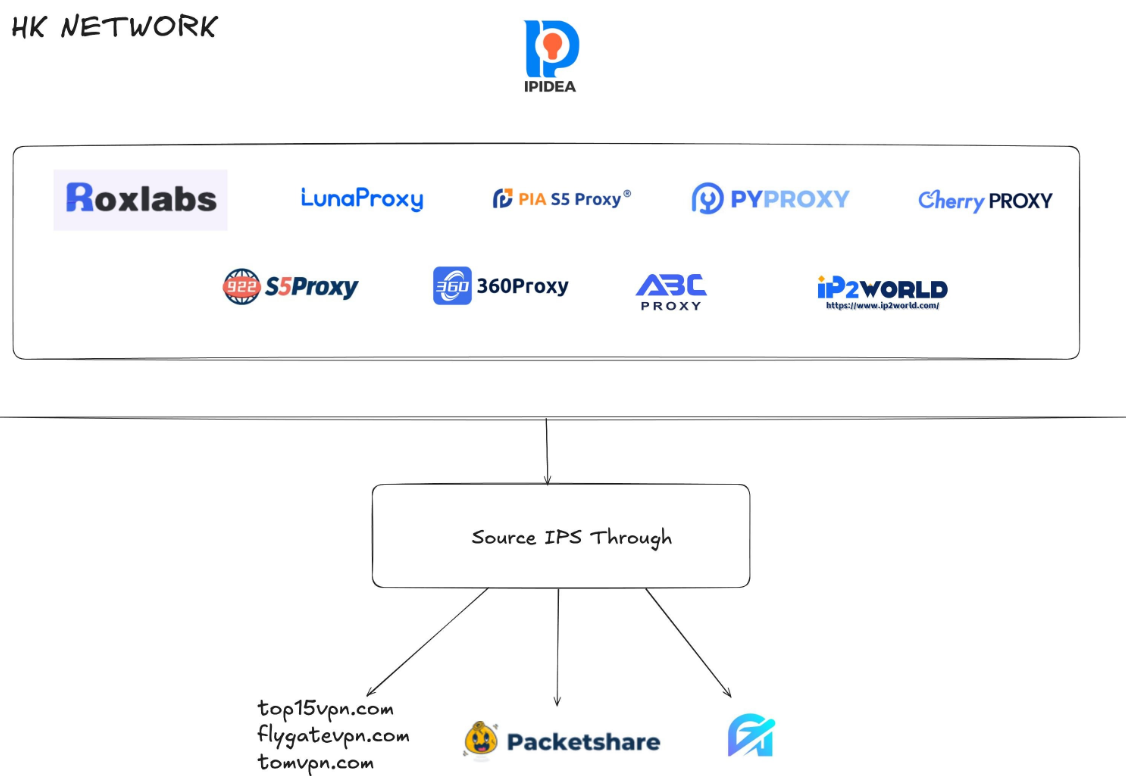
Brundage says that by almost any measurement, the world’s largest residential proxy service is IPidea, a China-based proxy network. IPidea is #5 on Spur’s Top 10, and Brundage said its brands include ABCProxy (#3), Roxlabs, LunaProxy, PIA S5 Proxy, PyProxy, 922Proxy, 360Proxy, IP2World, and Cherry Proxy. Spur’s Kilmer said they also track Yilu Proxy (#10) as IPidea.

Brundage said all of these providers operate under a corporate umbrella known on the cybercrime forums as “HK Network.”

“The way it works is there’s this whole reseller ecosystem, where IPidea will be incredibly aggressive and approach all these proxy providers with the offer, ‘Hey, if you guys buy bandwidth from us, we’ll give you these amazing reseller prices,'” Brundage explained. “But they’re also very aggressive in recruiting resellers for their apps.”

A graphic depicting the relationship between proxy providers that Synthient found are white labeling IPidea proxies. Image: Synthient.com.

Those apps include a range of low-cost and “free” virtual private networking (VPN) services that indeed allow users to enjoy a free VPN, but which also turn the user’s device into a traffic relay that can be rented to cybercriminals, or else parceled out to countless other proxy networks.

“They have all this bandwidth to offload,” Brundage said of IPidea and its sister networks. “And they can do it through their own platforms, or they go get resellers to do it for them by advertising on sketchy hacker forums to reach more people.”

One of IPidea’s core brands is 922S5Proxy, which is a not-so-subtle nod to the 911S5Proxy service that was hugely popular between 2015 and 2022. In July 2022, KrebsOnSecurity published a deep dive into 911S5Proxy’s origins and apparent owners in China. Less than a week later, 911S5Proxy announced it was closing down after the company’s servers were massively hacked.

That 2022 story named Yunhe Wang from Beijing as the apparent owner and/or manager of the 911S5 proxy service. In May 2024, the U.S. Department of Justice arrested Mr Wang, alleging that his network was used to steal billions of dollars from financial institutions, credit card issuers, and federal lending programs. At the same time, the U.S. Treasury Department announced sanctions against Wang and two other Chinese nationals for operating 911S5Proxy.

The website for 922Proxy.

DATA SCRAPING FOR AI

In recent months, multiple experts who track botnet and proxy activity have shared that a great deal of content scraping which ultimately benefits AI companies is now leveraging these proxy networks to further obfuscate their aggressive data-slurping activity. That’s because by routing it through residential IP addresses, content scraping firms can make their traffic far trickier to filter out.

“It’s really difficult to block, because there’s a risk of blocking real people,” Spur’s Kilmer said of the LLM scraping activity that is fed through individual residential IP addresses, which are often shared by multiple customers at once.

Kilmer says the AI industry has brought a veneer of legitimacy to residential proxy business, which has heretofore mostly been associated with sketchy affiliate money making programs, automated abuse, and unwanted Internet traffic.

“Web crawling and scraping has always been a thing, but AI made it like a commodity, data that had to be collected,” Kilmer said. “Everybody wanted to monetize their own data pots, and how they monetize that is different across the board.”

Kilmer said many LLM-related scrapers rely on residential proxies in cases where the content provider has restricted access to their platform in some way, such as forcing interaction through an app, or keeping all content behind a login page with multi-factor authentication.

“Where the cost of data is out of reach — there is some exclusivity or reason they can’t access the data — they’ll turn to residential proxies so they look like a real person accessing that data,” Kilmer said of the content scraping efforts.

Aggressive AI crawlers increasingly are overloading community-maintained infrastructure, causing what amounts to persistent DDoS attacks on vital public resources. A report earlier this year from LibreNews found some open-source projects now see as much as 97 percent of their traffic originating from AI company bots, dramatically increasing bandwidth costs, service instability, and burdening already stretched-thin maintainers.

Cloudflare is now experimenting with tools that will allow content creators to charge a fee to AI crawlers to scrape their websites. The company’s “pay-per-crawl” feature is currently in a private beta, and it lets publishers set their own prices that bots must pay before scraping content.

On October 22, the social media and news network Reddit sued Oxylabs (PDF) and several other proxy providers, alleging that their systems enabled the mass-scraping of Reddit user content even though Reddit had taken steps to block such activity.

“Recognizing that Reddit denies scrapers like them access to its site, Defendants scrape the data from Google’s search results instead,” the lawsuit alleges. “They do so by masking their identities, hiding their locations, and disguising their web scrapers as regular people (among other techniques) to circumvent or bypass the security restrictions meant to stop them.”

Denas Grybauskas, chief governance and strategy officer at Oxylabs, said the company was shocked and disappointed by the lawsuit.

“Reddit has made no attempt to speak with us directly or communicate any potential concerns,” Grybauskas said in a written statement. “Oxylabs has always been and will continue to be a pioneer and an industry leader in public data collection, and it will not hesitate to defend itself against these allegations. Oxylabs’ position is that no company should claim ownership of public data that does not belong to them. It is possible that it is just an attempt to sell the same public data at an inflated price.”

As big and powerful as Aisuru may be, it is hardly the only botnet that is contributing to the overall broad availability of residential proxies. For example, on June 5 the FBI’s Internet Crime Complaint Center warned that an IoT malware threat dubbed BADBOX 2.0 had compromised millions of smart-TV boxes, digital projectors, vehicle infotainment units, picture frames, and other IoT devices.

In July, Google filed a lawsuit in New York federal court against the Badbox botnet’s alleged perpetrators. Google said the Badbox 2.0 botnet “compromised more than 10 million uncertified devices running Android’s open-source software, which lacks Google’s security protections. Cybercriminals infected these devices with pre-installed malware and exploited them to conduct large-scale ad fraud and other digital crimes.”

A FAMILIAR DOMAIN NAME

Brundage said the Aisuru botmasters have their own SDK, and for some reason part of its code tells many newly-infected systems to query the domain name fuckbriankrebs[.]com. This may be little more than an elaborate “screw you” to this site’s author: One of the botnet’s alleged partners goes by the handle “Forky,” and was identified in June by KrebsOnSecurity as a young man from Sao Paulo, Brazil.

Brundage noted that only systems infected with Aisuru’s Android SDK will be forced to resolve the domain. Initially, there was some discussion about whether the domain might have some utility as a “kill switch” capable of disrupting the botnet’s operations, although Brundage and others interviewed for this story say that is unlikely.

A tiny sample of the traffic after a DNS server was enabled on the newly registered domain fuckbriankrebs dot com. Each unique IP address requested its own unique subdomain. Image: Seralys.

For one thing, they said, if the domain was somehow critical to the operation of the botnet, why was it still unregistered and actively for-sale? Why indeed, we asked. Happily, the domain name was deftly snatched up last week by Philippe Caturegli, “chief hacking officer” for the security intelligence company Seralys.

Caturegli enabled a passive DNS server on that domain and within a few hours received more than 700,000 requests for unique subdomains on fuckbriankrebs[.]com.

But even with that visibility into Aisuru, it is difficult to use this domain check-in feature to measure its true size, Brundage said. After all, he said, the systems that are phoning home to the domain are only a small portion of the overall botnet.

“The bots are hardcoded to just spam lookups on the subdomains,” he said. “So anytime an infection occurs or it runs in the background, it will do one of those DNS queries.”

Caturegli briefly configured all subdomains on fuckbriankrebs dot com to display this ASCII art image to visiting systems today.

The domain fuckbriankrebs[.]com has a storied history. On its initial launch in 2009, it was used to spread malicious software by the Cutwail spam botnet. In 2011, the domain was involved in a notable DDoS against this website from a botnet powered by Russkill (a.k.a. “Dirt Jumper”).

Domaintools.com finds that in 2015, fuckbriankrebs[.]com was registered to an email address attributed to David “Abdilo” Crees, a 27-year-old Australian man sentenced in May 2025 to time served for cybercrime convictions related to the Lizard Squad hacking group.

Update, Nov. 1, 2025, 10:25 a.m. ET: An earlier version of this story erroneously cited Spur’s proxy numbers from earlier this year; Spur said those numbers conflated residential proxies — which are rotating and attached to real end-user devices — with “ISP proxies” located at AT&T. ISP proxies, Spur said, involve tricking an ISP into routing a large number of IP addresses that are resold as far more static datacenter proxies.

Email Bombs Exploit Lax Authentication in Zendesk

17 October 2025 at 07:26

Cybercriminals are abusing a widespread lack of authentication in the customer service platform Zendesk to flood targeted email inboxes with menacing messages that come from hundreds of Zendesk corporate customers simultaneously.

Zendesk is an automated help desk service designed to make it simple for people to contact companies for customer support issues. Earlier this week, KrebsOnSecurity started receiving thousands of ticket creation notification messages through Zendesk in rapid succession, each bearing the name of different Zendesk customers, such as CapCom, CompTIA, Discord, GMAC, NordVPN, The Washington Post, and Tinder.

The abusive missives sent via Zendesk’s platform can include any subject line chosen by the abusers. In my case, the messages variously warned about a supposed law enforcement investigation involving KrebsOnSecurity.com, or else contained personal insults.

Moreover, the automated messages that are sent out from this type of abuse all come from customer domain names — not from Zendesk. In the example below, replying to any of the junk customer support responses from The Washington Post’s Zendesk installation shows the reply-to address is help@washpost.com.

One of dozens of messages sent to me this week by The Washington Post.

Notified about the mass abuse of their platform, Zendesk said the emails were ticket creation notifications from customer accounts that configured their Zendesk instance to allow anyone to submit support requests — including anonymous users.

“These types of support tickets can be part of a customer’s workflow, where a prior verification is not required to allow them to engage and make use of the Support capabilities,” said Carolyn Camoens, communications director at Zendesk. “Although we recommend our customers to permit only verified users to submit tickets, some Zendesk customers prefer to use an anonymous environment to allow for tickets to be created due to various business reasons.”

Camoens said requests that can be submitted in an anonymous manner can also make use of an email address of the submitter’s choice.

“However, this method can also be used for spam requests to be created on behalf of third party email addresses,” Camoens said. “If an account has enabled the auto-responder trigger based on ticket creation, then this allows for the ticket notification email to be sent from our customer’s accounts to these third parties. The notification will also include the Subject added by the creator of these tickets.”

Zendesk claims it uses rate limits to prevent a high volume of requests from being created at once, but those limits did not stop Zendesk customers from flooding my inbox with thousands of messages in just a few hours.

“We recognize that our systems were leveraged against you in a distributed, many-against-one manner,” Camoens said. “We are actively investigating additional preventive measures. We are also advising customers experiencing this type of activity to follow our general security best practices and configure an authenticated ticket creation workflow.”

In all of the cases above, the messaging abuse would not have been possible if Zendesk customers validated support request email addresses prior to sending responses. Failing to do so may make it easier for Zendesk clients to handle customer support requests, but it also allows ne’er-do-wells to sully the sender’s brand in service of disruptive and malicious email floods.

DDoS Botnet Aisuru Blankets US ISPs in Record DDoS

10 October 2025 at 12:10

The world’s largest and most disruptive botnet is now drawing a majority of its firepower from compromised Internet-of-Things (IoT) devices hosted on U.S. Internet providers like AT&T, Comcast and Verizon, new evidence suggests. Experts say the heavy concentration of infected devices at U.S. providers is complicating efforts to limit collateral damage from the botnet’s attacks, which shattered previous records this week with a brief traffic flood that clocked in at nearly 30 trillion bits of data per second.

Since its debut more than a year ago, the Aisuru botnet has steadily outcompeted virtually all other IoT-based botnets in the wild, with recent attacks siphoning Internet bandwidth from an estimated 300,000 compromised hosts worldwide.

The hacked systems that get subsumed into the botnet are mostly consumer-grade routers, security cameras, digital video recorders and other devices operating with insecure and outdated firmware, and/or factory-default settings. Aisuru’s owners are continuously scanning the Internet for these vulnerable devices and enslaving them for use in distributed denial-of-service (DDoS) attacks that can overwhelm targeted servers with crippling amounts of junk traffic.

As Aisuru’s size has mushroomed, so has its punch. In May 2025, KrebsOnSecurity was hit with a near-record 6.35 terabits per second (Tbps) attack from Aisuru, which was then the largest assault that Google’s DDoS protection service Project Shield had ever mitigated. Days later, Aisuru shattered that record with a data blast in excess of 11 Tbps.

By late September, Aisuru was publicly flexing DDoS capabilities topping 22 Tbps. Then on October 6, its operators heaved a whopping 29.6 terabits of junk data packets each second at a targeted host. Hardly anyone noticed because it appears to have been a brief test or demonstration of Aisuru’s capabilities: The traffic flood lasted less only a few seconds and was pointed at an Internet server that was specifically designed to measure large-scale DDoS attacks.

A measurement of an Oct. 6 DDoS believed to have been launched through multiple botnets operated by the owners of the Aisuru botnet. Image: DDoS Analyzer Community on Telegram.

Aisuru’s overlords aren’t just showing off. Their botnet is being blamed for a series of increasingly massive and disruptive attacks. Although recent assaults from Aisuru have targeted mostly ISPs that serve online gaming communities like Minecraft, those digital sieges often result in widespread collateral Internet disruption.

For the past several weeks, ISPs hosting some of the Internet’s top gaming destinations have been hit with a relentless volley of gargantuan attacks that experts say are well beyond the DDoS mitigation capabilities of most organizations connected to the Internet today.

Steven Ferguson is principal security engineer at Global Secure Layer (GSL), an ISP in Brisbane, Australia. GSL hosts TCPShield, which offers free or low-cost DDoS protection to more than 50,000 Minecraft servers worldwide. Ferguson told KrebsOnSecurity that on October 8, TCPShield was walloped with a blitz from Aisuru that flooded its network with more than 15 terabits of junk data per second.

Ferguson said that after the attack subsided, TCPShield was told by its upstream provider OVH that they were no longer welcome as a customer.

“This was causing serious congestion on their Miami external ports for several weeks, shown publicly via their weather map,” he said, explaining that TCPShield is now solely protected by GSL.

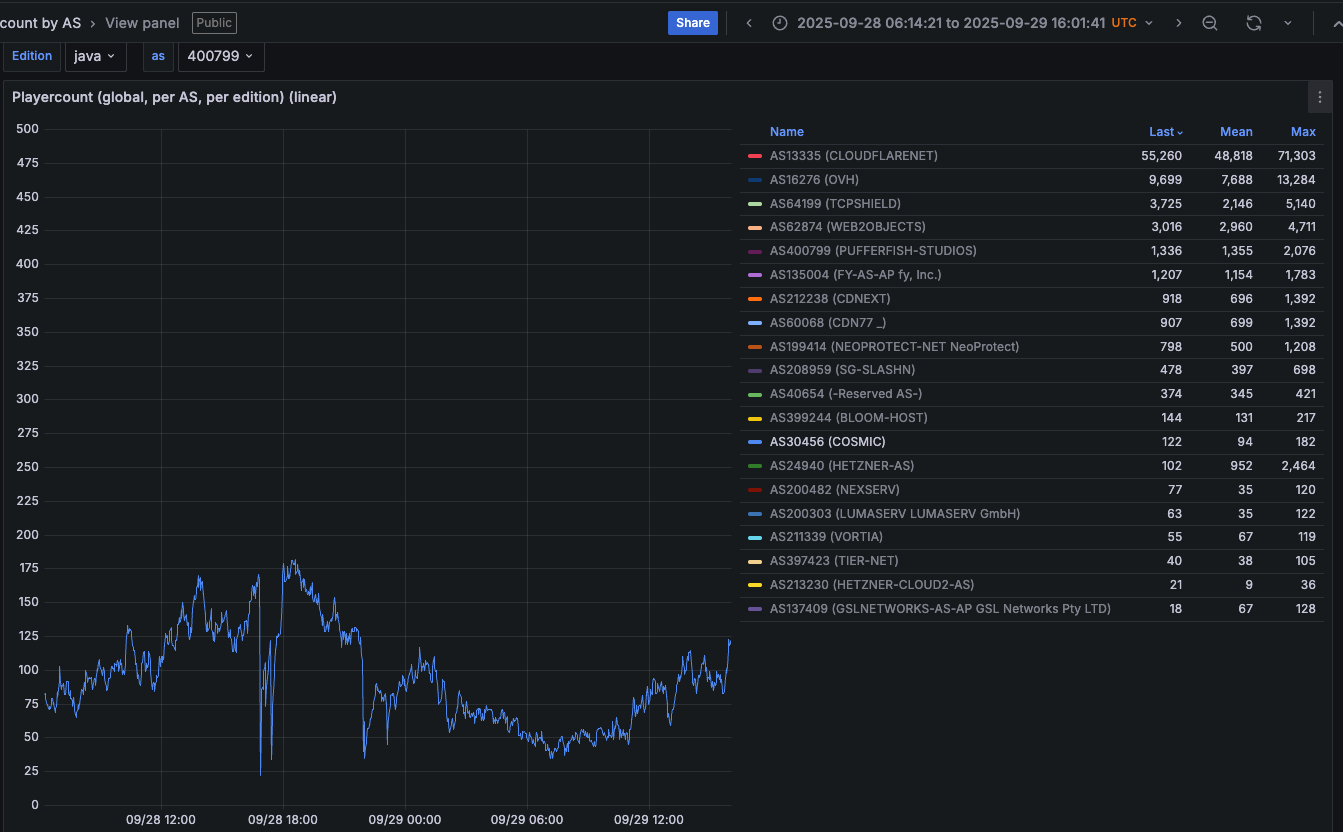
Traces from the recent spate of crippling Aisuru attacks on gaming servers can be still seen at the website blockgametracker.gg, which indexes the uptime and downtime of the top Minecraft hosts. In the following example from a series of data deluges on the evening of September 28, we can see an Aisuru botnet campaign briefly knocked TCPShield offline.

An Aisuru botnet attack on TCPShield (AS64199) on Sept. 28  can be seen in the giant downward spike in the middle of this uptime graphic. Image: grafana.blockgametracker.gg.

Paging through the same uptime graphs for other network operators listed shows almost all of them suffered brief but repeated outages around the same time. Here is the same uptime tracking for Minecraft servers on the network provider Cosmic (AS30456), and it shows multiple large dips that correspond to game server outages caused by Aisuru.

Multiple DDoS attacks from Aisuru can be seen against the Minecraft host Cosmic on Sept. 28. The sharp downward spikes correspond to brief but enormous attacks from Aisuru. Image: grafana.blockgametracker.gg.

BOTNETS R US

Ferguson said he’s been tracking Aisuru for about three months, and recently he noticed the botnet’s composition shifted heavily toward infected systems at ISPs in the United States. Ferguson shared logs from an attack on October 8 that indexed traffic by the total volume sent through each network provider, and the logs showed that 11 of the top 20 traffic sources were U.S. based ISPs.

AT&T customers were by far the biggest U.S. contributors to that attack, followed by botted systems on Charter Communications, Comcast, T-Mobile and Verizon, Ferguson found. He said the volume of data packets per second coming from infected IoT hosts on these ISPs is often so high that it has started to affect the quality of service that ISPs are able to provide to adjacent (non-botted) customers.

“The impact extends beyond victim networks,” Ferguson said. “For instance we have seen 500 gigabits of traffic via Comcast’s network alone. This amount of egress leaving their network, especially being so US-East concentrated, will result in congestion towards other services or content trying to be reached while an attack is ongoing.”

Roland Dobbins is principal engineer at Netscout. Dobbins said Ferguson is spot on, noting that while most ISPs have effective mitigations in place to handle large incoming DDoS attacks, many are far less prepared to manage the inevitable service degradation caused by large numbers of their customers suddenly using some or all available bandwidth to attack others.

“The outbound and cross-bound DDoS attacks can be just as disruptive as the inbound stuff,” Dobbin said. “We’re now in a situation where ISPs are routinely seeing terabit-per-second plus outbound attacks from their networks that can cause operational problems.”

“The crying need for effective and universal outbound DDoS attack suppression is something that is really being highlighted by these recent attacks,” Dobbins continued. “A lot of network operators are learning that lesson now, and there’s going to be a period ahead where there’s some scrambling and potential disruption going on.”

KrebsOnSecurity sought comment from the ISPs named in Ferguson’s report. Charter Communications pointed to a recent blog post on protecting its network, stating that Charter actively monitors for both inbound and outbound attacks, and that it takes proactive action wherever possible.

“In addition to our own extensive network security, we also aim to reduce the risk of customer connected devices contributing to attacks through our Advanced WiFi solution that includes Security Shield, and we make Security Suite available to our Internet customers,” Charter wrote in an emailed response to questions. “With the ever-growing number of devices connecting to networks, we encourage customers to purchase trusted devices with secure development and manufacturing practices, use anti-virus and security tools on their connected devices, and regularly download security patches.”

A spokesperson for Comcast responded, “Currently our network is not experiencing impacts and we are able to handle the traffic.”

9 YEARS OF MIRAI

Aisuru is built on the bones of malicious code that was leaked in 2016 by the original creators of the Mirai IoT botnet. Like Aisuru, Mirai quickly outcompeted all other DDoS botnets in its heyday, and obliterated previous DDoS attack records with a 620 gigabit-per-second siege that sidelined this website for nearly four days in 2016.

The Mirai botmasters likewise used their crime machine to attack mostly Minecraft servers, but with the goal of forcing Minecraft server owners to purchase a DDoS protection service that they controlled. In addition, they rented out slices of the Mirai botnet to paying customers, some of whom used it to mask the sources of other types of cybercrime, such as click fraud.

A depiction of the outages caused by the Mirai botnet attacks against the internet infrastructure firm Dyn on October 21, 2016. Source: Downdetector.com.

Dobbins said Aisuru’s owners also appear to be renting out their botnet as a distributed proxy network that cybercriminal customers anywhere in the world can use to anonymize their malicious traffic and make it appear to be coming from regular residential users in the U.S.

“The people who operate this botnet are also selling (it as) residential proxies,” he said. “And that’s being used to reflect application layer attacks through the proxies on the bots as well.”

The Aisuru botnet harkens back to its predecessor Mirai in another intriguing way. One of its owners is using the Telegram handle “9gigsofram,” which corresponds to the nickname used by the co-owner of a Minecraft server protection service called Proxypipe that was heavily targeted in 2016 by the original Mirai botmasters.

Robert Coelho co-ran Proxypipe back then along with his business partner Erik “9gigsofram” Buckingham, and has spent the past nine years fine-tuning various DDoS mitigation companies that cater to Minecraft server operators and other gaming enthusiasts. Coelho said he has no idea why one of Aisuru’s botmasters chose Buckingham’s nickname, but added that it might say something about how long this person has been involved in the DDoS-for-hire industry.

“The Aisuru attacks on the gaming networks these past seven day have been absolutely huge, and you can see tons of providers going down multiple times a day,” Coelho said.

Coelho said the 15 Tbps attack this week against TCPShield was likely only a portion of the total attack volume hurled by Aisuru at the time, because much of it would have been shoved through networks that simply couldn’t process that volume of traffic all at once. Such outsized attacks, he said, are becoming increasingly difficult and expensive to mitigate.

“It’s definitely at the point now where you need to be spending at least a million dollars a month just to have the network capacity to be able to deal with these attacks,” he said.

RAPID SPREAD

Aisuru has long been rumored to use multiple zero-day vulnerabilities in IoT devices to aid its rapid growth over the past year. XLab, the Chinese security company that was the first to profile Aisuru’s rise in 2024, warned last month that one of the Aisuru botmasters had compromised the firmware distribution website for Totolink, a maker of low-cost routers and other networking gear.

“Multiple sources indicate the group allegedly compromised a router firmware update server in April and distributed malicious scripts to expand the botnet,” XLab wrote on September 15. “The node count is currently reported to be around 300,000.”

A malicious script implanted into a Totolink update server in April 2025. Image: XLab.

Aisuru’s operators received an unexpected boost to their crime machine in August when the U.S. Department Justice charged the alleged proprietor of Rapper Bot, a DDoS-for-hire botnet that competed directly with Aisuru for control over the global pool of vulnerable IoT systems.

Once Rapper Bot was dismantled, Aisuru’s curators moved quickly to commandeer vulnerable IoT devices that were suddenly set adrift by the government’s takedown, Dobbins said.

“Folks were arrested and Rapper Bot control servers were seized and that’s great, but unfortunately the botnet’s attack assets were then pieced out by the remaining botnets,” he said. “The problem is, even if those infected IoT devices are rebooted and cleaned up, they will still get re-compromised by something else generally within minutes of being plugged back in.”

A screenshot shared by XLabs showing the Aisuru botmasters recently celebrating a record-breaking 7.7 Tbps DDoS. The user at the top has adopted the name “Ethan J. Foltz” in a mocking tribute to the alleged Rapper Bot operator who was arrested and charged in August 2025.

BOTMASTERS AT LARGE

XLab’s September blog post cited multiple unnamed sources saying Aisuru is operated by three cybercriminals: “Snow,” who’s responsible for botnet development; “Tom,” tasked with finding new vulnerabilities; and “Forky,” responsible for botnet sales.

KrebsOnSecurity interviewed Forky in our May 2025 story about the record 6.3 Tbps attack from Aisuru. That story identified Forky as a 21-year-old man from Sao Paulo, Brazil who has been extremely active in the DDoS-for-hire scene since at least 2022. The FBI has seized Forky’s DDoS-for-hire domains several times over the years.

Like the original Mirai botmasters, Forky also operates a DDoS mitigation service called Botshield. Forky declined to discuss the makeup of his ISP’s clientele, or to clarify whether Botshield was more of a hosting provider or a DDoS mitigation firm. However, Forky has posted on Telegram about Botshield successfully mitigating large DDoS attacks launched against other DDoS-for-hire services.

In our previous interview, Forky acknowledged being involved in the development and marketing of Aisuru, but denied participating in attacks launched by the botnet.

Reached for comment earlier this month, Forky continued to maintain his innocence, claiming that he also is still trying to figure out who the current Aisuru botnet operators are in real life (Forky said the same thing in our May interview).

But after a week of promising juicy details, Forky came up empty-handed once again. Suspecting that Forky was merely being coy, I asked him how someone so connected to the DDoS-for-hire world could still be mystified on this point, and suggested that his inability or unwillingness to blame anyone else for Aisuru would not exactly help his case.

At this, Forky verbally bristled at being pressed for more details, and abruptly terminated our interview.

“I’m not here to be threatened with ignorance because you are stressed,” Forky replied. “They’re blaming me for those new attacks. Pretty much the whole world (is) due to your blog.”

ShinyHunters Wage Broad Corporate Extortion Spree

7 October 2025 at 18:45

A cybercriminal group that used voice phishing attacks to siphon more than a billion records from Salesforce customers earlier this year has launched a website that threatens to publish data stolen from dozens of Fortune 500 firms if they refuse to pay a ransom. The group also claimed responsibility for a recent breach involving Discord user data, and for stealing terabytes of sensitive files from thousands of customers of the enterprise software maker Red Hat.

The new extortion website tied to ShinyHunters (UNC6040), which threatens to publish stolen data unless Salesforce or individual victim companies agree to pay a ransom.

In May 2025, a prolific and amorphous English-speaking cybercrime group known as ShinyHunters launched a social engineering campaign that used voice phishing to trick targets into connecting a malicious app to their organization’s Salesforce portal.

The first real details about the incident came in early June, when the Google Threat Intelligence Group (GTIG) warned that ShinyHunters — tracked by Google as UNC6040 — was extorting victims over their stolen Salesforce data, and that the group was poised to launch a data leak site to publicly shame victim companies into paying a ransom to keep their records private. A month later, Google acknowledged that one of its own corporate Salesforce instances was impacted in the voice phishing campaign.

Last week, a new victim shaming blog dubbed “Scattered LAPSUS$ Hunters” began publishing the names of companies that had customer Salesforce data stolen as a result of the May voice phishing campaign.

“Contact us to negotiate this ransom or all your customers data will be leaked,” the website stated in a message to Salesforce. “If we come to a resolution all individual extortions against your customers will be withdrawn from. Nobody else will have to pay us, if you pay, Salesforce, Inc.”

Below that message were more than three dozen entries for companies that allegedly had Salesforce data stolen, including Toyota, FedEx, Disney/Hulu, and UPS. The entries for each company specified the volume of stolen data available, as well as the date that the information was retrieved (the stated breach dates range between May and September 2025).

Image: Mandiant.

On October 5, the Scattered LAPSUS$ Hunters victim shaming and extortion blog announced that the group was responsible for a breach in September involving a GitLab server used by Red Hat that contained more than 28,000 Git code repositories, including more than 5,000 Customer Engagement Reports (CERs).

“Alot of folders have their client’s secrets such as artifactory access tokens, git tokens, azure, docker (redhat docker, azure containers, dockerhub), their client’s infrastructure details in the CERs like the audits that were done for them, and a whole LOT more, etc.,” the hackers claimed.

Their claims came several days after a previously unknown hacker group calling itself the Crimson Collective took credit for the Red Hat intrusion on Telegram.

Red Hat disclosed on October 2 that attackers had compromised a company GitLab server, and said it was in the process of notifying affected customers.

“The compromised GitLab instance housed consulting engagement data, which may include, for example, Red Hat’s project specifications, example code snippets, internal communications about consulting services, and limited forms of business contact information,” Red Hat wrote.

Separately, Discord has started emailing users affected by another breach claimed by ShinyHunters. Discord said an incident on September 20 at a “third-party customer service provider” impacted a “limited number of users” who communicated with Discord customer support or Trust & Safety teams. The information included Discord usernames, emails, IP address, the last four digits of any stored payment cards, and government ID images submitted during age verification appeals.

The Scattered Lapsus$ Hunters claim they will publish data stolen from Salesforce and its customers if ransom demands aren’t paid by October 10. The group also claims it will soon begin extorting hundreds more organizations that lost data in August after a cybercrime group stole vast amounts of authentication tokens from Salesloft, whose AI chatbot is used by many corporate websites to convert customer interaction into Salesforce leads.

In a communication sent to customers today, Salesforce emphasized that the theft of any third-party Salesloft data allegedly stolen by ShinyHunters did not originate from a vulnerability within the core Salesforce platform. The company also stressed that it has no plans to meet any extortion demands.

“Salesforce will not engage, negotiate with, or pay any extortion demand,” the message to customers read. “Our focus is, and remains, on defending our environment, conducting thorough forensic analysis, supporting our customers, and working with law enforcement and regulatory authorities.”

The GTIG tracked the group behind the Salesloft data thefts as UNC6395, and says the group has been observed harvesting the data for authentication tokens tied to a range of cloud services like Snowflake and Amazon’s AWS.

Google catalogs Scattered Lapsus$ Hunters by so many UNC names (throw in UNC6240 for good measure) because it is thought to be an amalgamation of three hacking groups — Scattered Spider, Lapsus$ and ShinyHunters. The members of these groups hail from many of the same chat channels on the Com, a mostly English-language cybercriminal community that operates across an ocean of Telegram and Discord servers.

The Scattered Lapsus$ Hunters darknet blog is currently offline. The outage appears to have coincided with the disappearance of the group’s new clearnet blog — breachforums[.]hn — which vanished after shifting its Domain Name Service (DNS) servers from DDoS-Guard to Cloudflare.

But before it died, the websites disclosed that hackers were exploiting a critical zero-day vulnerability in Oracle’s E-Business Suite software. Oracle has since confirmed that a security flaw tracked as CVE-2025-61882 allows attackers to perform unauthenticated remote code execution, and is urging customers to apply an emergency update to address the weakness.

Mandiant’s Charles Carmakal shared on LinkedIn that CVE-2025-61882 was initially exploited in August 2025 by the Clop ransomware gang to steal data from Oracle E-Business Suite servers. Bleeping Computer writes that news of the Oracle zero-day first surfaced on the Scattered Lapsus$ Hunters blog, which published a pair of scripts that were used to exploit vulnerable Oracle E-Business Suite instances.

On Monday evening, KrebsOnSecurity received a malware-laced message from a reader that threatened physical violence unless their unstated demands were met. The missive, titled “Shiny hunters,” contained the hashtag $LAPSU$$SCATEREDHUNTER, and urged me to visit a page on limewire[.]com to view their demands.

A screenshot of the phishing message linking to a malicious trojan disguised as a Windows screensaver file.

KrebsOnSecurity did not visit this link, but instead forwarded it to Mandiant, which confirmed that similar menacing missives were sent to employees at Mandiant and other security firms around the same time.

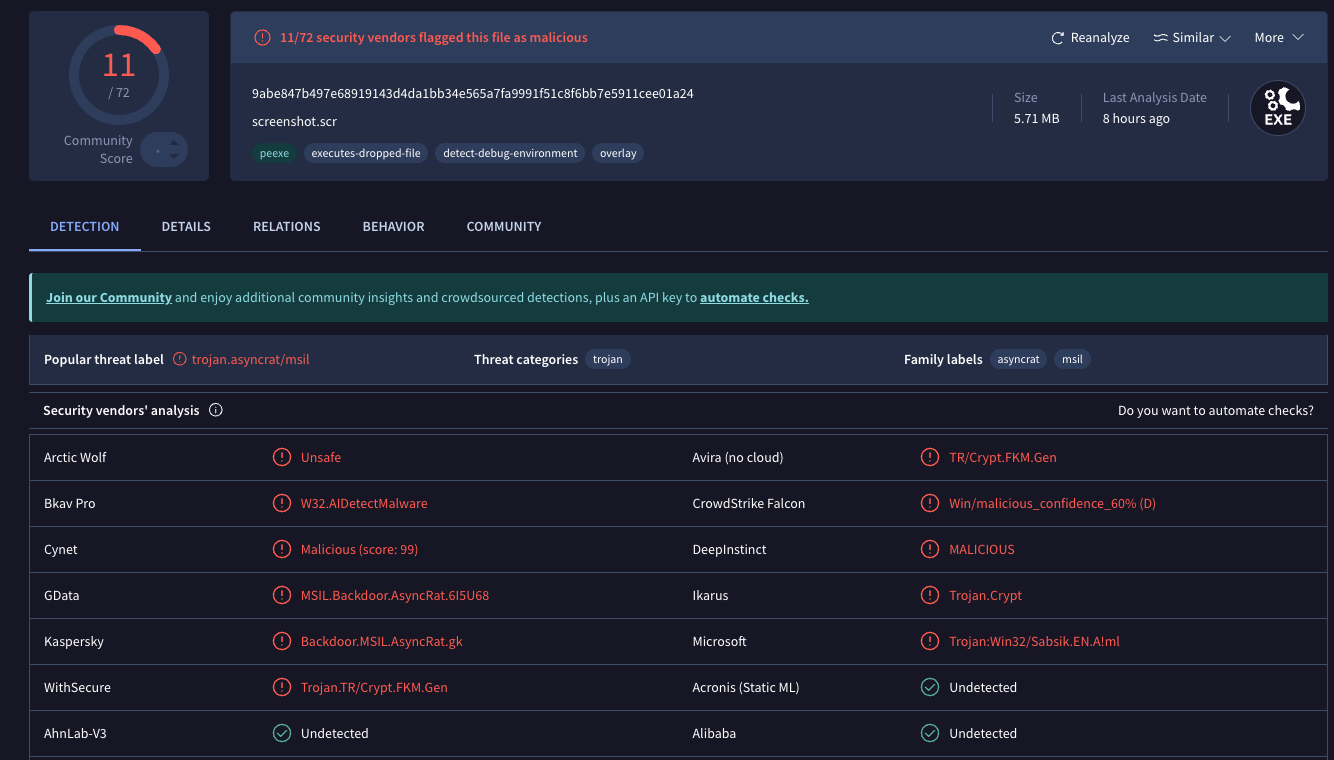
The link in the message fetches a malicious trojan disguised as a Windows screensaver file (Virustotal’s analysis on this malware is here). Simply viewing the booby-trapped screensaver on a Windows PC is enough to cause the bundled trojan to launch in the background.

Mandiant’s Austin Larsen said the trojan is a commercially available backdoor known as ASYNCRAT, a .NET-based backdoor that communicates using a custom binary protocol over TCP, and can execute shell commands and download plugins to extend its features.

A scan of the malicious screensaver file at Virustotal.com shows it is detected as bad by nearly a dozen security and antivirus tools.

“Downloaded plugins may be executed directly in memory or stored in the registry,” Larsen wrote in an analysis shared via email. “Capabilities added via plugins include screenshot capture, file transfer, keylogging, video capture, and cryptocurrency mining. ASYNCRAT also supports a plugin that targets credentials stored by Firefox and Chromium-based web browsers.”

Malware-laced targeted emails are not out of character for certain members of the Scattered Lapsus$ Hunters, who have previously harassed and threatened security researchers and even law enforcement officials who are investigating and warning about the extent of their attacks.

With so many big data breaches and ransom attacks now coming from cybercrime groups operating on the Com, law enforcement agencies on both sides of the pond are under increasing pressure to apprehend the criminal hackers involved. In late September, prosecutors in the U.K. charged two alleged Scattered Spider members aged 18 and 19 with extorting at least $115 million in ransom payments from companies victimized by data theft.

U.S. prosecutors heaped their own charges on the 19 year-old in that duo — U.K. resident Thalha Jubair — who is alleged to have been involved in data ransom attacks against Marks & Spencer and Harrods, the British food retailer Co-op Group, and the 2023 intrusions at MGM Resorts and Caesars Entertainment. Jubair also was allegedly a key member of LAPSUS$, a cybercrime group that broke into dozens of technology companies beginning in late 2021.

A Mastodon post by Kevin Beaumont, lamenting the prevalence of major companies paying millions to extortionist teen hackers, refers derisively to Thalha Jubair as a part of an APT threat known as “Advanced Persistent Teenagers.”

In August, convicted Scattered Spider member and 20-year-old Florida man Noah Michael Urban was sentenced to 10 years in federal prison and ordered to pay roughly $13 million in restitution to victims.

In April 2025, a 23-year-old Scottish man thought to be an early Scattered Spider member was extradited from Spain to the U.S., where he is facing charges of wire fraud, conspiracy and identity theft. U.S. prosecutors allege Tyler Robert Buchanan and co-conspirators hacked into dozens of companies in the United States and abroad, and that he personally controlled more than $26 million stolen from victims.

Update, Oct. 8, 8:59 a.m. ET: A previous version of this story incorrectly referred to the malware sent by the reader as a Windows screenshot file. Rather, it is a Windows screensaver file.

Self-Replicating Worm Hits 180+ Software Packages

16 September 2025 at 10:08

At least 187 code packages made available through the JavaScript repository NPM have been infected with a self-replicating worm that steals credentials from developers and publishes those secrets on GitHub, experts warn. The malware, which briefly infected multiple code packages from the security vendor CrowdStrike, steals and publishes even more credentials every time an infected package is installed.

Image: https://en.wikipedia.org/wiki/Sandworm_(Dune)

The novel malware strain is being dubbed Shai-Hulud — after the name for the giant sandworms in Frank Herbert’s Dune novel series — because it publishes any stolen credentials in a new public GitHub repository that includes the name “Shai-Hulud.”

“When a developer installs a compromised package, the malware will look for a npm token in the environment,” said Charlie Eriksen, a researcher for the Belgian security firm Aikido. “If it finds it, it will modify the 20 most popular packages that the npm token has access to, copying itself into the package, and publishing a new version.”

At the center of this developing maelstrom are code libraries available on NPM (short for “Node Package Manager”), which acts as a central hub for JavaScript development and provides the latest updates to widely-used JavaScript components.

The Shai-Hulud worm emerged just days after unknown attackers launched a broad phishing campaign that spoofed NPM and asked developers to “update” their multi-factor authentication login options. That attack led to malware being inserted into at least two-dozen NPM code packages, but the outbreak was quickly contained and was narrowly focused on siphoning cryptocurrency payments.

Image: aikido.dev

In late August, another compromise of an NPM developer resulted in malware being added to “nx,” an open-source code development toolkit with as many as six million weekly downloads. In the nx compromise, the attackers introduced code that scoured the user’s device for authentication tokens from programmer destinations like GitHub and NPM, as well as SSH and API keys. But instead of sending those stolen credentials to a central server controlled by the attackers, the malicious nx code created a new public repository in the victim’s GitHub account, and published the stolen data there for all the world to see and download.

Last month’s attack on nx did not self-propagate like a worm, but this Shai-Hulud malware does and bundles reconnaissance tools to assist in its spread. Namely, it uses the open-source tool TruffleHog to search for exposed credentials and access tokens on the developer’s machine. It then attempts to create new GitHub actions and publish any stolen secrets.

“Once the first person got compromised, there was no stopping it,” Aikido’s Eriksen told KrebsOnSecurity. He said the first NPM package compromised by this worm appears to have been altered on Sept. 14, around 17:58 UTC.

The security-focused code development platform socket.dev reports the Shai-Halud attack briefly compromised at least 25 NPM code packages managed by CrowdStrike. Socket.dev said the affected packages were quickly removed by the NPM registry.

In a written statement shared with KrebsOnSecurity, CrowdStrike said that after detecting several malicious packages in the public NPM registry, the company swiftly removed them and rotated its keys in public registries.

“These packages are not used in the Falcon sensor, the platform is not impacted and customers remain protected,” the statement reads, referring to the company’s widely-used endpoint threat detection service. “We are working with NPM and conducting a thorough investigation.”

A writeup on the attack from StepSecurity found that for cloud-specific operations, the malware enumerates AWS, Azure and Google Cloud Platform secrets. It also found the entire attack design assumes the victim is working in a Linux or macOS environment, and that it deliberately skips Windows systems.

StepSecurity said Shai-Hulud spreads by using stolen NPM authentication tokens, adding its code to the top 20 packages in the victim’s account.

“This creates a cascading effect where an infected package leads to compromised maintainer credentials, which in turn infects all other packages maintained by that user,” StepSecurity’s Ashish Kurmi wrote.

Eriksen said Shai-Hulud is still propagating, although its spread seems to have waned in recent hours.

“I still see package versions popping up once in a while, but no new packages have been compromised in the last ~6 hours,” Eriksen said. “But that could change now as the east coast starts working. I would think of this attack as a ‘living’ thing almost, like a virus. Because it can lay dormant for a while, and if just one person is suddenly infected by accident, they could restart the spread. Especially if there’s a super-spreader attack.”

For now, it appears that the web address the attackers were using to exfiltrate collected data was disabled due to rate limits, Eriksen said.

Nicholas Weaver is a researcher with the International Computer Science Institute, a nonprofit in Berkeley, Calif. Weaver called the Shai-Hulud worm “a supply chain attack that conducts a supply chain attack.” Weaver said NPM (and all other similar package repositories) need to immediately switch to a publication model that requires explicit human consent for every publication request using a phish-proof 2FA method.

“Anything less means attacks like this are going to continue and become far more common, but switching to a 2FA method would effectively throttle these attacks before they can spread,” Weaver said. “Allowing purely automated processes to update the published packages is now a proven recipe for disaster.”

Microsoft Patch Tuesday, September 2025 Edition

9 September 2025 at 17:21

Microsoft Corp. today issued security updates to fix more than 80 vulnerabilities in its Windows operating systems and software. There are no known “zero-day” or actively exploited vulnerabilities in this month’s bundle from Redmond, which nevertheless includes patches for 13 flaws that earned Microsoft’s most-dire “critical” label. Meanwhile, both Apple and Google recently released updates to fix zero-day bugs in their devices.

Microsoft assigns security flaws a “critical” rating when malware or miscreants can exploit them to gain remote access to a Windows system with little or no help from users. Among the more concerning critical bugs quashed this month is CVE-2025-54918. The problem here resides with Windows NTLM, or NT LAN Manager, a suite of code for managing authentication in a Windows network environment.

Redmond rates this flaw as “Exploitation More Likely,” and although it is listed as a privilege escalation vulnerability, Kev Breen at Immersive says this one is actually exploitable over the network or the Internet.

“From Microsoft’s limited description, it appears that if an attacker is able to send specially crafted packets over the network to the target device, they would have the ability to gain SYSTEM-level privileges on the target machine,” Breen said. “The patch notes for this vulnerability state that ‘Improper authentication in Windows NTLM allows an authorized attacker to elevate privileges over a network,’ suggesting an attacker may already need to have access to the NTLM hash or the user’s credentials.”

Breen said another patch — CVE-2025-55234, a 8.8 CVSS-scored flaw affecting the Windows SMB client for sharing files across a network — also is listed as privilege escalation bug but is likewise remotely exploitable. This vulnerability was publicly disclosed prior to this month.

“Microsoft says that an attacker with network access would be able to perform a replay attack against a target host, which could result in the attacker gaining additional privileges, which could lead to code execution,” Breen noted.

CVE-2025-54916 is an “important” vulnerability in Windows NTFS — the default filesystem for all modern versions of Windows — that can lead to remote code execution. Microsoft likewise thinks we are more than likely to see exploitation of this bug soon: The last time Microsoft patched an NTFS bug was in March 2025 and it was already being exploited in the wild as a zero-day.

“While the title of the CVE says ‘Remote Code Execution,’ this exploit is not remotely exploitable over the network, but instead needs an attacker to either have the ability to run code on the host or to convince a user to run a file that would trigger the exploit,” Breen said. “This is commonly seen in social engineering attacks, where they send the user a file to open as an attachment or a link to a file to download and run.”

Critical and remote code execution bugs tend to steal all the limelight, but Tenable Senior Staff Research Engineer Satnam Narang notes that nearly half of all vulnerabilities fixed by Microsoft this month are privilege escalation flaws that require an attacker to have gained access to a target system first before attempting to elevate privileges.

“For the third time this year, Microsoft patched more elevation of privilege vulnerabilities than remote code execution flaws,” Narang observed.

On Sept. 3, Google fixed two flaws that were detected as exploited in zero-day attacks, including CVE-2025-38352, an elevation of privilege in the Android kernel, and CVE-2025-48543, also an elevation of privilege problem in the Android Runtime component.

Also, Apple recently patched its seventh zero-day (CVE-2025-43300) of this year. It was part of an exploit chain used along with a vulnerability in the WhatsApp (CVE-2025-55177) instant messenger to hack Apple devices. Amnesty International reports that the two zero-days have been used in “an advanced spyware campaign” over the past 90 days. The issue is fixed in iOS 18.6.2, iPadOS 18.6.2, iPadOS 17.7.10, macOS Sequoia 15.6.1, macOS Sonoma 14.7.8, and macOS Ventura 13.7.8.

The SANS Internet Storm Center has a clickable breakdown of each individual fix from Microsoft, indexed by severity and CVSS score. Enterprise Windows admins involved in testing patches before rolling them out should keep an eye on askwoody.com, which often has the skinny on wonky updates.

AskWoody also reminds us that we’re now just two months out from Microsoft discontinuing free security updates for Windows 10 computers. For those interested in safely extending the lifespan and usefulness of these older machines, check out last month’s Patch Tuesday coverage for a few pointers.

As ever, please don’t neglect to back up your data (if not your entire system) at regular intervals, and feel free to sound off in the comments if you experience problems installing any of these fixes.

18 Popular Code Packages Hacked, Rigged to Steal Crypto

8 September 2025 at 18:53

At least 18 popular JavaScript code packages that are collectively downloaded more than two billion times each week were briefly compromised with malicious software today, after a developer involved in maintaining the projects was phished. The attack appears to have been quickly contained and was narrowly focused on stealing cryptocurrency. But experts warn that a similar attack with a slightly more nefarious payload could lead to a disruptive malware outbreak that is far more difficult to detect and restrain.

This phishing email lured a developer into logging in at a fake NPM website and supplying a one-time token for two-factor authentication. The phishers then used that developer’s NPM account to add malicious code to at least 18 popular JavaScript code packages.

Aikido is a security firm in Belgium that monitors new code updates to major open-source code repositories, scanning any code updates for suspicious and malicious code. In a blog post published today, Aikido said its systems found malicious code had been added to at least 18 widely-used code libraries available on NPM (short for) “Node Package Manager,” which acts as a central hub for JavaScript development and the latest updates to widely-used JavaScript components.

JavaScript is a powerful web-based scripting language used by countless websites to build a more interactive experience with users, such as entering data into a form. But there’s no need for each website developer to build a program from scratch for entering data into a form when they can just reuse already existing packages of code at NPM that are specifically designed for that purpose.

Unfortunately, if cybercriminals manage to phish NPM credentials from developers, they can introduce malicious code that allows attackers to fundamentally control what people see in their web browser when they visit a website that uses one of the affected code libraries.

According to Aikido, the attackers injected a piece of code that silently intercepts cryptocurrency activity in the browser, “manipulates wallet interactions, and rewrites payment destinations so that funds and approvals are redirected to attacker-controlled accounts without any obvious signs to the user.”

“This malware is essentially a browser-based interceptor that hijacks both network traffic and application APIs,” Aikido researcher Charlie Eriksen wrote. “What makes it dangerous is that it operates at multiple layers: Altering content shown on websites, tampering with API calls, and manipulating what users’ apps believe they are signing. Even if the interface looks correct, the underlying transaction can be redirected in the background.”

Aikido said it used the social network Bsky to notify the affected developer, Josh Junon, who quickly replied that he was aware of having just been phished. The phishing email that Junon fell for was part of a larger campaign that spoofed NPM and told recipients they were required to update their two-factor authentication (2FA) credentials. The phishing site mimicked NPM’s login page, and intercepted Junon’s credentials and 2FA token. Once logged in, the phishers then changed the email address on file for Junon’s NPM account, temporarily locking him out.

Aikido notified the maintainer on Bluesky, who replied at 15:15 UTC that he was aware of being compromised, and starting to clean up the compromised packages.

Junon also issued a mea culpa on HackerNews, telling the community’s coder-heavy readership, “Hi, yep I got pwned.”

“It looks and feels a bit like a targeted attack,” Junon wrote. “Sorry everyone, very embarrassing.”

Philippe Caturegli, “chief hacking officer” at the security consultancy Seralys, observed that the attackers appear to have registered their spoofed website — npmjs[.]help — just two days before sending the phishing email. The spoofed website used services from dnsexit[.]com, a “dynamic DNS” company that also offers “100% free” domain names that can instantly be pointed at any IP address controlled by the user.

Junon’s mea cupla on Hackernews today listed the affected packages.

Caturegli said it’s remarkable that the attackers in this case were not more ambitious or malicious with their code modifications.

“The crazy part is they compromised billions of websites and apps just to target a couple of cryptocurrency things,” he said. “This was a supply chain attack, and it could easily have been something much worse than crypto harvesting.”

Aikido’s Eriksen agreed, saying countless websites dodged a bullet because this incident was handled in a matter of hours. As an example of how these supply-chain attacks can escalate quickly, Eriksen pointed to another compromise of an NPM developer in late August that added malware to “nx,” an open-source code development toolkit with as many as six million weekly downloads.

In the nx compromise, the attackers introduced code that scoured the user’s device for authentication tokens from programmer destinations like GitHub and NPM, as well as SSH and API keys. But instead of sending those stolen credentials to a central server controlled by the attackers, the malicious code created a new public repository in the victim’s GitHub account, and published the stolen data there for all the world to see and download.

Eriksen said coding platforms like GitHub and NPM should be doing more to ensure that any new code commits for broadly-used packages require a higher level of attestation that confirms the code in question was in fact submitted by the person who owns the account, and not just by that person’s account.

“More popular packages should require attestation that it came through trusted provenance and not just randomly from some location on the Internet,” Eriksen said. “Where does the package get uploaded from, by GitHub in response to a new pull request into the main branch, or somewhere else? In this case, they didn’t compromise the target’s GitHub account. They didn’t touch that. They just uploaded a modified version that didn’t come where it’s expected to come from.”

Eriksen said code repository compromises can be devastating for developers, many of whom end up abandoning their projects entirely after such an incident.

“It’s unfortunate because one thing we’ve seen is people have their projects get compromised and they say, ‘You know what, I don’t have the energy for this and I’m just going to deprecate the whole package,'” Eriksen said.

Kevin Beaumont, a frequently quoted security expert who writes about security incidents at the blog doublepulsar.com, has been following this story closely today in frequent updates to his account on Mastodon. Beaumont said the incident is a reminder that much of the planet still depends on code that is ultimately maintained by an exceedingly small number of people who are mostly overburdened and under-resourced.

“For about the past 15 years every business has been developing apps by pulling in 178 interconnected libraries written by 24 people in a shed in Skegness,” Beaumont wrote on Mastodon. “For about the past 2 years orgs have been buying AI vibe coding tools, where some exec screams ‘make online shop’ into a computer and 389 libraries are added and an app is farted out. The output = if you want to own the world’s companies, just phish one guy in Skegness.”

Image: https://infosec.exchange/@GossiTheDog@cyberplace.social.

Aikido recently launched a product that aims to help development teams ensure that every code library used is checked for malware before it can be used or installed. Nicholas Weaver, a researcher with the International Computer Science Institute, a nonprofit in Berkeley, Calif., said Aikido’s new offering exists because many organizations are still one successful phishing attack away from a supply-chain nightmare.

Weaver said these types of supply-chain compromises will continue as long as people responsible for maintaining widely-used code continue to rely on phishable forms of 2FA.

“NPM should only support phish-proof authentication,” Weaver said, referring to physical security keys that are phish-proof — meaning that even if phishers manage to steal your username and password, they still can’t log in to your account without also possessing that physical key.

“All critical infrastructure needs to use phish-proof 2FA, and given the dependencies in modern software, archives such as NPM are absolutely critical infrastructure,” Weaver said. “That NPM does not require that all contributor accounts use security keys or similar 2FA methods should be considered negligence.”

The Ongoing Fallout from a Breach at AI Chatbot Maker Salesloft

1 September 2025 at 17:55

The recent mass-theft of authentication tokens from Salesloft, whose AI chatbot is used by a broad swath of corporate America to convert customer interaction into Salesforce leads, has left many companies racing to invalidate the stolen credentials before hackers can exploit them. Now Google warns the breach goes far beyond access to Salesforce data, noting the hackers responsible also stole valid authentication tokens for hundreds of online services that customers can integrate with Salesloft, including Slack, Google Workspace, Amazon S3, Microsoft Azure, and OpenAI.

Salesloft says its products are trusted by 5,000+ customers. Some of the bigger names are visible on the company’s homepage.

Salesloft disclosed on August 20 that, “Today, we detected a security issue in the Drift application,” referring to the technology that powers an AI chatbot used by so many corporate websites. The alert urged customers to re-authenticate the connection between the Drift and Salesforce apps to invalidate their existing authentication tokens, but it said nothing then to indicate those tokens had already been stolen.

On August 26, the Google Threat Intelligence Group (GTIG) warned that unidentified hackers tracked as UNC6395 used the access tokens stolen from Salesloft to siphon large amounts of data from numerous corporate Salesforce instances. Google said the data theft began as early as Aug. 8, 2025 and lasted through at least Aug. 18, 2025, and that the incident did not involve any vulnerability in the Salesforce platform.

Google said the attackers have been sifting through the massive data haul for credential materials such as AWS keys, VPN credentials, and credentials to the cloud storage provider Snowflake.

“If successful, the right credentials could allow them to further compromise victim and client environments, as well as pivot to the victim’s clients or partner environments,” the GTIG report stated.

The GTIG updated its advisory on August 28 to acknowledge the attackers used the stolen tokens to access email from “a very small number of Google Workspace accounts” that were specially configured to integrate with Salesloft. More importantly, it warned organizations to immediately invalidate all tokens stored in or connected to their Salesloft integrations — regardless of the third-party service in question.

“Given GTIG’s observations of data exfiltration associated with the campaign, organizations using Salesloft Drift to integrate with third-party platforms (including but not limited to Salesforce) should consider their data compromised and are urged to take immediate remediation steps,” Google advised.

On August 28, Salesforce blocked Drift from integrating with its platform, and with its productivity platforms Slack and Pardot.

The Salesloft incident comes on the heels of a broad social engineering campaign that used voice phishing to trick targets into connecting a malicious app to their organization’s Salesforce portal. That campaign led to data breaches and extortion attacks affecting a number of companies including Adidas, Allianz Life and Qantas.

On August 5, Google disclosed that one of its corporate Salesforce instances was compromised by the attackers, which the GTIG has dubbed UNC6040 (“UNC” stands for “uncategorized threat group”). Google said the extortionists consistently claimed to be the threat group ShinyHunters, and that the group appeared to be preparing to escalate its extortion attacks by launching a data leak site.

ShinyHunters is an amorphous threat group known for using social engineering to break into cloud platforms and third-party IT providers, and for posting dozens of stolen databases to cybercrime communities like the now-defunct Breachforums.

The ShinyHunters brand dates back to 2020, and the group has been credited with or taken responsibility for dozens of data leaks that exposed hundreds of millions of breached records. The group’s member roster is thought to be somewhat fluid, drawing mainly from active denizens of the Com, a mostly English-language cybercrime community scattered across an ocean of Telegram and Discord servers.

Recorded Future’s Alan Liska told Bleeping Computer that the overlap in the “tools, techniques and procedures” used by ShinyHunters and the Scattered Spider extortion group likely indicate some crossover between the two groups.

To muddy the waters even further, on August 28 a Telegram channel that now has nearly 40,000 subscribers was launched under the intentionally confusing banner “Scattered LAPSUS$ Hunters 4.0,” wherein participants have repeatedly claimed responsibility for the Salesloft hack without actually sharing any details to prove their claims.

The Telegram group has been trying to attract media attention by threatening security researchers at Google and other firms. It also is using the channel’s sudden popularity to promote a new cybercrime forum called “Breachstars,” which they claim will soon host data stolen from victim companies who refuse to negotiate a ransom payment.

The “Scattered Lapsus$ Hunters 4.0” channel on Telegram now has roughly 40,000 subscribers.

But Austin Larsen, a principal threat analyst at Google’s threat intelligence group, said there is no compelling evidence to attribute the Salesloft activity to ShinyHunters or to other known groups at this time.

“Their understanding of the incident seems to come from public reporting alone,” Larsen told KrebsOnSecurity, referring to the most active participants in the Scattered LAPSUS$ Hunters 4.0 Telegram channel.

Joshua Wright, a senior technical director at Counter Hack, is credited with coining the term “authorization sprawl” to describe one key reason that social engineering attacks from groups like Scattered Spider and ShinyHunters so often succeed: They abuse legitimate user access tokens to move seamlessly between on-premises and cloud systems.

Wright said this type of attack chain often goes undetected because the attacker sticks to the resources and access already allocated to the user.

“Instead of the conventional chain of initial access, privilege escalation and endpoint bypass, these threat actors are using centralized identity platforms that offer single sign-on (SSO) and integrated authentication and authorization schemes,” Wright wrote in a June 2025 column. “Rather than creating custom malware, attackers use the resources already available to them as authorized users.”

It remains unclear exactly how the attackers gained access to all Salesloft Drift authentication tokens. Salesloft announced on August 27 that it hired Mandiant, Google Cloud’s incident response division, to investigate the root cause(s).

“We are working with Salesloft Drift to investigate the root cause of what occurred and then it’ll be up to them to publish that,” Mandiant Consulting CTO Charles Carmakal told Cyberscoop. “There will be a lot more tomorrow, and the next day, and the next day.”

Affiliates Flock to ‘Soulless’ Scam Gambling Machine

28 August 2025 at 13:21

Last month, KrebsOnSecurity tracked the sudden emergence of hundreds of polished online gaming and wagering websites that lure people with free credits and eventually abscond with any cryptocurrency funds deposited by players. We’ve since learned that these scam gambling sites have proliferated thanks to a new Russian affiliate program called “Gambler Panel” that bills itself as a “soulless project that is made for profit.”

A machine-translated version of Gambler Panel’s affiliate website.

The scam begins with deceptive ads posted on social media that claim the wagering sites are working in partnership with popular athletes or social media personalities. The ads invariably state that by using a supplied “promo code,” interested players can claim a $2,500 credit on the advertised gaming website.

The gaming sites ask visitors to create a free account to claim their $2,500 credit, which they can use to play any number of extremely polished video games that ask users to bet on each action. However, when users try to cash out any “winnings” the gaming site will reject the request and prompt the user to make a “verification deposit” of cryptocurrency — typically around $100 — before any money can be distributed.

Those who deposit cryptocurrency funds are soon pressed into more wagering and making additional deposits. And — shocker alert — all players eventually lose everything they’ve invested in the platform.

The number of scam gambling or “scambling” sites has skyrocketed in the past month, and now we know why: The sites all pull their gaming content and detailed strategies for fleecing players straight from the playbook created by Gambler Panel, a Russian-language affiliate program that promises affiliates up to 70 percent of the profits.

Gambler Panel’s website gambler-panel[.]com links to a helpful wiki that explains the scam from cradle to grave, offering affiliates advice on how best to entice visitors, keep them gambling, and extract maximum profits from each victim.

“We have a completely self-written from scratch FAKE CASINO engine that has no competitors,” Gambler Panel’s wiki enthuses. “Carefully thought-out casino design in every pixel, a lot of audits, surveys of real people and test traffic floods were conducted, which allowed us to create something that has no doubts about the legitimacy and trustworthiness even for an inveterate gambling addict with many years of experience.”

Gambler Panel explains that the one and only goal of affiliates is to drive traffic to these scambling sites by any and all means possible.

A machine-translated portion of Gambler Panel’s singular instruction for affiliates: Drive traffic to these scambling sites by any means available.

“Unlike white gambling affiliates, we accept absolutely any type of traffic, regardless of origin, the only limitation is the CIS countries,” the wiki continued, referring to a common prohibition against scamming people in Russia and former Soviet republics in the Commonwealth of Independent States.

The program’s website claims it has more than 20,000 affiliates, who earn a minimum of $10 for each verification deposit. Interested new affiliates must first get approval from the group’s Telegram channel, which currently has around 2,500 active users.

The Gambler Panel channel is replete with images of affiliate panels showing the daily revenue of top affiliates, scantily-clad young women promoting the Gambler logo, and fast cars that top affiliates claimed they bought with their earnings.

A machine-translated version of the wiki for the affiliate program Gambler Panel.

The apparent popularity of this scambling niche is a consequence of the program’s ease of use and detailed instructions for successfully reproducing virtually every facet of the scam. Indeed, much of the tutorial focuses on advice and ready-made templates to help even novice affiliates drive traffic via social media websites, particularly on Instagram and TikTok.

Gambler Panel also walks affiliates through a range of possible responses to questions from users who are trying to withdraw funds from the platform. This section, titled “Rules for working in Live chat,” urges scammers to respond quickly to user requests (1-7 minutes), and includes numerous strategies for keeping the conversation professional and the user on the platform as long as possible.

A machine-translated version of the Gambler Panel’s instructions on managing chat support conversations with users.

The connection between Gambler Panel and the explosion in the number of scambling websites was made by a 17-year-old developer who operates multiple Discord servers that have been flooded lately with misleading ads for these sites.

The researcher, who asked to be identified only by the nickname “Thereallo,” said Gambler Panel has built a scalable business product for other criminals.

“The wiki is kinda like a ‘how to scam 101’ for criminals written with the clarity you would expect from a legitimate company,” Thereallo said. “It’s clean, has step by step guides, and treats their scam platform like a real product. You could swap out the content, and it could be any documentation for startups.”

“They’ve minimized their own risk — spreading the links on Discord / Facebook / YT Shorts, etc. — and outsourced it to a hungry affiliate network, just like a franchise,” Thereallo wrote in response to questions.

“A centralized platform that can serve over 1,200 domains with a shared user base, IP tracking, and a custom API is not at all a trivial thing to build,” Thereallo said. “It’s a scalable system designed to be a resilient foundation for thousands of disposable scam sites.”

The security firm Silent Push has compiled a list of the latest domains associated with the Gambler Panel, available here (.csv).

Mobile Phishers Target Brokerage Accounts in ‘Ramp and Dump’ Cashout Scheme

15 August 2025 at 14:27

Cybercriminal groups peddling sophisticated phishing kits that convert stolen card data into mobile wallets have recently shifted their focus to targeting customers of brokerage services, new research shows. Undeterred by security controls at these trading platforms that block users from wiring funds directly out of accounts, the phishers have pivoted to using multiple compromised brokerage accounts in unison to manipulate the prices of foreign stocks.

Image: Shutterstock, WhataWin.

This so-called ‘ramp and dump‘ scheme borrows its name from age-old “pump and dump” scams, wherein fraudsters purchase a large number of shares in some penny stock, and then promote the company in a frenzied social media blitz to build up interest from other investors. The fraudsters dump their shares after the price of the penny stock increases to some degree, which usually then causes a sharp drop in the value of the shares for legitimate investors.

With ramp and dump, the scammers do not need to rely on ginning up interest in the targeted stock on social media. Rather, they will preposition themselves in the stock that they wish to inflate, using compromised accounts to purchase large volumes of it and then dumping the shares after the stock price reaches a certain value. In February 2025, the FBI said it was seeking information from victims of this scheme.

“In this variation, the price manipulation is primarily the result of controlled trading activity conducted by the bad actors behind the scam,” reads an advisory from the Financial Industry Regulatory Authority (FINRA), a private, non-profit organization that regulates member brokerage firms. “Ultimately, the outcome for unsuspecting investors is the same—a catastrophic collapse in share price that leaves investors with unrecoverable losses.”

Ford Merrill is a security researcher at SecAlliance, a CSIS Security Group company. Merrill said he has tracked recent ramp-and-dump activity to a bustling Chinese-language community that is quite openly selling advanced mobile phishing kits on Telegram.

“They will often coordinate with other actors and will wait until a certain time to buy a particular Chinese IPO [initial public offering] stock or penny stock,” said Merrill, who has been chronicling the rapid maturation and growth of the China-based phishing community over the past three years.

“They’ll use all these victim brokerage accounts, and if needed they’ll liquidate the account’s current positions, and will preposition themselves in that instrument in some account they control, and then sell everything when the price goes up,” he said. “The victim will be left with worthless shares of that equity in their account, and the brokerage may not be happy either.”

Merrill said the early days of these phishing groups — between 2022 and 2024 — were typified by phishing kits that used text messages to spoof the U.S. Postal Service or some local toll road operator, warning about a delinquent shipping or toll fee that needed paying. Recipients who clicked the link and provided their payment information at a fake USPS or toll operator site were then asked to verify the transaction by sharing a one-time code sent via text message.

In reality, the victim’s bank is sending that code to the mobile number on file for their customer because the fraudsters have just attempted to enroll that victim’s card details into a mobile wallet. If the visitor supplies that one-time code, their payment card is then added to a new mobile wallet on an Apple or Google device that is physically controlled by the phishers.

The phishing gangs typically load multiple stolen cards to digital wallets on a single Apple or Android device, and then sell those phones in bulk to scammers who use them for fraudulent e-commerce and tap-to-pay transactions.

An image from the Telegram channel for a popular Chinese mobile phishing kit vendor shows 10 mobile phones for sale, each loaded with 4-6 digital wallets from different financial institutions.

This China-based phishing collective exposed a major weakness common to many U.S.-based financial institutions that already require multi-factor authentication: The reliance on a single, phishable one-time token for provisioning mobile wallets. Happily, Merrill said many financial institutions that were caught flat-footed on this scam two years ago have since strengthened authentication requirements for onboarding new mobile wallets (such as requiring the card to be enrolled via the bank’s mobile app).

But just as squeezing one part of a balloon merely forces the air trapped inside to bulge into another area, fraudsters don’t go away when you make their current enterprise less profitable: They just shift their focus to a less-guarded area. And lately, that gaze has settled squarely on customers of the major brokerage platforms, Merrill said.

THE OUTSIDER

Merrill pointed to several Telegram channels operated by some of the more accomplished phishing kit sellers, which are full of videos demonstrating how every feature in their kits can be tailored to the attacker’s target. The video snippet below comes from the Telegram channel of “Outsider,” a popular Mandarin-speaking phishing kit vendor whose latest offering includes a number of ready-made templates for using text messages to phish brokerage account credentials and one-time codes.

According to Merrill, Outsider is a woman who previously went by the handle “Chenlun.” KrebsOnSecurity profiled Chenlun’s phishing empire in an October 2023 story about a China-based group that was phishing mobile customers of more than a dozen postal services around the globe. In that case, the phishing sites were using a Telegram bot that sent stolen credentials to the “@chenlun” Telegram account.

Chenlun’s phishing lures are sent via Apple’s iMessage and Google’s RCS service and spoof one of the major brokerage platforms, warning that the account has been suspended for suspicious activity and that recipients should log in and verify some information. The missives include a link to a phishing page that collects the customer’s username and password, and then asks the user to enter a one-time code that will arrive via SMS.

The new phish kit videos on Outsider’s Telegram channel only feature templates for Schwab customers, but Merrill said the kit can easily be adapted to target other brokerage platforms. One reason the fraudsters are picking on brokerage firms, he said, has to do with the way they handle multi-factor authentication.

Schwab clients are presented with two options for second factor authentication when they open an account. Users who select the option to only prompt for a code on untrusted devices can choose to receive it via text message, an automated inbound phone call, or an outbound call to Schwab. With the “always at login” option selected, users can choose to receive the code through the Schwab app, a text message, or a Symantec VIP mobile app.

In response to questions, Schwab said it regularly updates clients on emerging fraud trends, including this specific type, which the company addressed in communications sent to clients earlier this year.

The 2FA text message from Schwab warns recipients against giving away their one-time code.

“That message focused on trading-related fraud, highlighting both account intrusions and scams conducted through social media or messaging apps that deceive individuals into executing trades themselves,” Schwab said in a written statement. “We are aware and tracking this trend across several channels, as well as others like it, which attempt to exploit SMS-based verification with stolen credentials. We actively monitor for suspicious patterns and take steps to disrupt them. This activity is part of a broader, industry-wide threat, and we take a multi-layered approach to address and mitigate it.”

Other popular brokerage platforms allow similar methods for multi-factor authentication. Fidelity requires a username and password on initial login, and offers the ability to receive a one-time token via SMS, an automated phone call, or by approving a push notification sent through the Fidelity mobile app. However, all three of these methods for sending one-time tokens are phishable; even with the brokerage firm’s app, the phishers could prompt the user to approve a login request that they initiated in the app with the phished credentials.

Vanguard offers customers a range of multi-factor authentication choices, including the option to require a physical security key in addition to one’s credentials on each login. A security key implements a robust form of multi-factor authentication known as Universal 2nd Factor (U2F), which allows the user to complete the login process simply by connecting an enrolled USB or Bluetooth device and pressing a button. The key works without the need for any special software drivers, and the nice thing about it is your second factor cannot be phished.

THE PERFECT CRIME?

Merrill said that in many ways the ramp-and-dump scheme is the perfect crime because it leaves precious few connections between the victim brokerage accounts and the fraudsters.

“It’s really genius because it decouples so many things,” he said. “They can buy shares [in the stock to be pumped] in their personal account on the Chinese exchanges, and the price happens to go up. The Chinese or Hong Kong brokerages aren’t going to see anything funky.”

Merrill said it’s unclear exactly how those perpetrating these ramp-and-dump schemes coordinate their activities, such as whether the accounts are phished well in advance or shortly before being used to inflate the stock price of Chinese companies. The latter possibility would fit nicely with the existing human infrastructure these criminal groups already have in place.

For example, KrebsOnSecurity recently wrote about research from Merrill and other researchers showing the phishers behind these slick mobile phishing kits employed people to sit for hours at a time in front of large banks of mobile phones being used to send the text message lures. These technicians were needed to respond in real time to victims who were supplying the one-time code sent from their financial institution.

The ashtray says: You’ve been phishing all night.

“You can get access to a victim’s brokerage with a one-time passcode, but then you sort of have to use it right away if you can’t set new security settings so you can come back to that account later,” Merrill said.

The rapid pace of innovations produced by these China-based phishing vendors is due in part to their use of artificial intelligence and large language models to help develop the mobile phishing kits, he added.

“These guys are vibe coding stuff together and using LLMs to translate things or help put the user interface together,” Merrill said. “It’s only a matter of time before they start to integrate the LLMs into their development cycle to make it more rapid. The technologies they are building definitely have helped lower the barrier of entry for everyone.”

Microsoft Patch Tuesday, August 2025 Edition

12 August 2025 at 18:14

Microsoft today released updates to fix more than 100 security flaws in its Windows operating systems and other software. At least 13 of the bugs received Microsoft’s most-dire “critical” rating, meaning they could be abused by malware or malcontents to gain remote access to a Windows system with little or no help from users.

August’s patch batch from Redmond includes an update for CVE-2025-53786, a vulnerability that allows an attacker to pivot from a compromised Microsoft Exchange Server directly into an organization’s cloud environment, potentially gaining control over Exchange Online and other connected Microsoft Office 365 services. Microsoft first warned about this bug on Aug. 6, saying it affects Exchange Server 2016 and Exchange Server 2019, as well as its flagship Exchange Server Subscription Edition.

Ben McCarthy, lead cyber security engineer at Immersive, said a rough search reveals approximately 29,000 Exchange servers publicly facing on the internet that are vulnerable to this issue, with many of them likely to have even older vulnerabilities.

McCarthy said the fix for CVE-2025-53786 requires more than just installing a patch, such as following Microsoft’s manual instructions for creating a dedicated service to oversee and lock down the hybrid connection.

“In effect, this vulnerability turns a significant on-premise Exchange breach into a full-blown, difficult-to-detect cloud compromise with effectively living off the land techniques which are always harder to detect for defensive teams,” McCarthy said.

CVE-2025-53779 is a weakness in the Windows Kerberos authentication system that allows an unauthenticated attacker to gain domain administrator privileges. Microsoft credits the discovery of the flaw to Akamai researcher Yuval Gordon, who dubbed it “BadSuccessor” in a May 2025 blog post. The attack exploits a weakness in “delegated Managed Service Account” or dMSA — a feature that was introduced in Windows Server 2025.

Some of the critical flaws addressed this month with the highest severity (between 9.0 and 9.9 CVSS scores) include a remote code execution bug in the Windows GDI+ component that handles graphics rendering (CVE-2025-53766) and CVE-2025-50165, another graphics rendering weakness. Another critical patch involves CVE-2025-53733, a vulnerability in Microsoft Word that can be exploited without user interaction and triggered through the Preview Pane.

One final critical bug tackled this month deserves attention: CVE-2025-53778, a bug in Windows NTLM, a core function of how Windows systems handle network authentication. According to Microsoft, the flaw could allow an attacker with low-level network access and basic user privileges to exploit NTLM and elevate to SYSTEM-level access — the highest level of privilege in Windows. Microsoft rates the exploitation of this bug as “more likely,” although there is no evidence the vulnerability is being exploited at the moment.

Feel free to holler in the comments if you experience problems installing any of these updates. As ever, the SANS Internet Storm Center has its useful breakdown of the Microsoft patches indexed by severity and CVSS score, and AskWoody.com is keeping an eye out for Windows patches that may cause problems for enterprises and end users.

GOOD MIGRATIONS

Windows 10 users out there likely have noticed by now that Microsoft really wants you to upgrade to Windows 11. The reason is that after the Patch Tuesday on October 14, 2025, Microsoft will stop shipping free security updates for Windows 10 computers. The trouble is, many PCs running Windows 10 do not meet the hardware specifications required to install Windows 11 (or they do, but just barely).

If the experience with Windows XP is any indicator, many of these older computers will wind up in landfills or else will be left running in an unpatched state. But if your Windows 10 PC doesn’t have the hardware chops to run Windows 11 and you’d still like to get some use out of it safely, consider installing a newbie-friendly version of Linux, like Linux Mint.

Like most modern Linux versions, Mint will run on anything with a 64-bit CPU that has at least 2GB of memory, although 4GB is recommended. In other words, it will run on almost any computer produced in the last decade.

There are many versions of Linux available, but Linux Mint is likely to be the most intuitive interface for regular Windows users, and it is largely configurable without any fuss at the text-only command-line prompt. Mint and other flavors of Linux come with LibreOffice, which is an open source suite of tools that includes applications similar to Microsoft Office, and it can open, edit and save documents as Microsoft Office files.

If you’d prefer to give Linux a test drive before installing it on a Windows PC, you can always just download it to a removable USB drive. From there, reboot the computer (with the removable drive plugged in) and select the option at startup to run the operating system from the external USB drive. If you don’t see an option for that after restarting, try restarting again and hitting the F8 button, which should open a list of bootable drives. Here’s a fairly thorough tutorial that walks through exactly how to do all this.

And if this is your first time trying out Linux, relax and have fun: The nice thing about a “live” version of Linux (as it’s called when the operating system is run from a removable drive such as a CD or a USB stick) is that none of your changes persist after a reboot. Even if you somehow manage to break something, a restart will return the system back to its original state.

Who Got Arrested in the Raid on the XSS Crime Forum?

6 August 2025 at 08:12

On July 22, 2025, the European police agency Europol said a long-running investigation led by the French Police resulted in the arrest of a 38-year-old administrator of XSS, a Russian-language cybercrime forum with more than 50,000 members. The action has triggered an ongoing frenzy of speculation and panic among XSS denizens about the identity of the unnamed suspect, but the consensus is that he is a pivotal figure in the crime forum scene who goes by the hacker handle “Toha.” Here’s a deep dive on what’s knowable about Toha, and a short stab at who got nabbed.

An unnamed 38-year-old man was arrested in Kiev last month on suspicion of administering the cybercrime forum XSS. Image: ssu.gov.ua.

Europol did not name the accused, but published partially obscured photos of him from the raid on his residence in Kiev. The police agency said the suspect acted as a trusted third party — arbitrating disputes between criminals — and guaranteeing the security of transactions on XSS. A statement from Ukraine’s SBU security service said XSS counted among its members many cybercriminals from various ransomware groups, including REvil, LockBit, Conti, and Qiliin.

Since the Europol announcement, the XSS forum resurfaced at a new address on the deep web (reachable only via the anonymity network Tor). But from reviewing the recent posts, there appears to be little consensus among longtime members about the identity of the now-detained XSS administrator.

The most frequent comment regarding the arrest was a message of solidarity and support for Toha, the handle chosen by the longtime administrator of XSS and several other major Russian forums. Toha’s accounts on other forums have been silent since the raid.

Europol said the suspect has enjoyed a nearly 20-year career in cybercrime, which roughly lines up with Toha’s history. In 2005, Toha was a founding member of the Russian-speaking forum Hack-All. That is, until it got massively hacked a few months after its debut. In 2006, Toha rebranded the forum to exploit[.]in, which would go on to draw tens of thousands of members, including an eventual Who’s-Who of wanted cybercriminals.

Toha announced in 2018 that he was selling the Exploit forum, prompting rampant speculation on the forums that the buyer was secretly a Russian or Ukrainian government entity or front person. However, those suspicions were unsupported by evidence, and Toha vehemently denied the forum had been given over to authorities.

One of the oldest Russian-language cybercrime forums was DaMaGeLaB, which operated from 2004 to 2017, when its administrator “Ar3s” was arrested. In 2018, a partial backup of the DaMaGeLaB forum was reincarnated as xss[.]is, with Toha as its stated administrator.

CROSS-SITE GRIFTING

Clues about Toha’s early presence on the Internet — from ~2004 to 2010 — are available in the archives of Intel 471, a cyber intelligence firm that tracks forum activity. Intel 471 shows Toha used the same email address across multiple forum accounts, including at Exploit, Antichat, Carder[.]su and inattack[.]ru.

DomainTools.com finds Toha’s email address — toschka2003@yandex.ru — was used to register at least a dozen domain names — most of them from the mid- to late 2000s. Apart from exploit[.]in and a domain called ixyq[.]com, the other domains registered to that email address end in .ua, the top-level domain for Ukraine (e.g. deleted.org[.]ua, lj.com[.]ua, and blogspot.org[.]ua).

A 2008 snapshot of a domain registered to toschka2003@yandex.ru and to Anton Medvedovsky in Kiev. Note the message at the bottom left, “Protected by Exploit,in.” Image: archive.org.

Nearly all of the domains registered to toschka2003@yandex.ru contain the name Anton Medvedovskiy in the registration records, except for the aforementioned ixyq[.]com, which is registered to the name Yuriy Avdeev in Moscow.

This Avdeev surname came up in a lengthy conversation with Lockbitsupp, the leader of the rapacious and destructive ransomware affiliate group Lockbit. The conversation took place in February 2024, when Lockbitsupp asked for help identifying Toha’s real-life identity.

In early 2024, the leader of the Lockbit ransomware group — Lockbitsupp — asked for help investigating the identity of the XSS administrator Toha, which he claimed was a Russian man named Anton Avdeev.

Lockbitsupp didn’t share why he wanted Toha’s details, but he maintained that Toha’s real name was Anton Avdeev. I declined to help Lockbitsupp in whatever revenge he was planning on Toha, but his question made me curious to look deeper.

It appears Lockbitsupp’s query was based on a now-deleted Twitter post from 2022, when a user by the name “3xp0rt” asserted that Toha was a Russian man named Anton Viktorovich Avdeev, born October 27, 1983.

Searching the web for Toha’s email address toschka2003@yandex.ru reveals a 2010 sales thread on the forum bmwclub.ru where a user named Honeypo was selling a 2007 BMW X5. The ad listed the contact person as Anton Avdeev and gave the contact phone number 9588693.

A search on the phone number 9588693 in the breach tracking service Constella Intelligence finds plenty of official Russian government records with this number, date of birth and the name Anton Viktorovich Avdeev. For example, hacked Russian government records show this person has a Russian tax ID and SIN (Social Security number), and that they were flagged for traffic violations on several occasions by Moscow police; in 2004, 2006, 2009, and 2014.

Astute readers may have noticed by now that the ages of Mr. Avdeev (41) and the XSS admin arrested this month (38) are a bit off. This would seem to suggest that the person arrested is someone other than Mr. Avdeev, who did not respond to requests for comment.

A FLY ON THE WALL

For further insight on this question, KrebsOnSecurity sought comments from Sergeii Vovnenko, a former cybercriminal from Ukraine who now works at the security startup paranoidlab.com. I reached out to Vovnenko because for several years beginning around 2010 he was the owner and operator of thesecure[.]biz, an encrypted “Jabber” instant messaging server that Europol said was operated by the suspect arrested in Kiev. Thesecure[.]biz grew quite popular among many of the top Russian-speaking cybercriminals because it scrupulously kept few records of its users’ activity, and its administrator was always a trusted member of the community.

The reason I know this historic tidbit is that in 2013, Vovnenko — using the hacker nicknames “Fly,” and “Flycracker” — hatched a plan to have a gram of heroin purchased off of the Silk Road darknet market and shipped to our home in Northern Virginia. The scheme was to spoof a call from one of our neighbors to the local police, saying this guy Krebs down the street was a druggie who was having narcotics delivered to his home.

I happened to be lurking on Flycracker’s private cybercrime forum when his heroin-framing plan was carried out, and called the police myself before the smack eventually arrived in the U.S. Mail. Vovnenko was later arrested for unrelated cybercrime activities, extradited to the United States, convicted, and deported after a 16-month stay in the U.S. prison system [on several occasions, he has expressed heartfelt apologies for the incident, and we have since buried the hatchet].

Vovnenko said he purchased a device for cloning credit cards from Toha in 2009, and that Toha shipped the item from Russia. Vovnenko explained that he (Flycracker) was the owner and operator of thesecure[.]biz from 2010 until his arrest in 2014.

Vovnenko believes thesecure[.]biz was stolen while he was in jail, either by Toha and/or an XSS administrator who went by the nicknames N0klos and Sonic.

“When I was in jail, [the] admin of xss.is stole that domain, or probably N0klos bought XSS from Toha or vice versa,” Vovnenko said of the Jabber domain. “Nobody from [the forums] spoke with me after my jailtime, so I can only guess what really happened.”

N0klos was the owner and administrator of an early Russian-language cybercrime forum known as Darklife[.]ws. However, N0kl0s also appears to be a lifelong Russian resident, and in any case seems to have vanished from Russian cybercrime forums several years ago.

Asked whether he believes Toha was the XSS administrator who was arrested this month in Ukraine, Vovnenko maintained that Toha is Russian, and that “the French cops took the wrong guy.”

WHO IS TOHA?

So who did the Ukrainian police arrest in response to the investigation by the French authorities? It seems plausible that the BMW ad invoking Toha’s email address and the name and phone number of a Russian citizen was simply misdirection on Toha’s part — intended to confuse and throw off investigators. Perhaps this even explains the Avdeev surname surfacing in the registration records from one of Toha’s domains.

But sometimes the simplest answer is the correct one. “Toha” is a common Slavic nickname for someone with the first name “Anton,” and that matches the name in the registration records for more than a dozen domains tied to Toha’s toschka2003@yandex.ru email address: Anton Medvedovskiy.

Constella Intelligence finds there is an Anton Gannadievich Medvedovskiy living in Kiev who will be 38 years old in December. This individual owns the email address itsmail@i.ua, as well an an Airbnb account featuring a profile photo of a man with roughly the same hairline as the suspect in the blurred photos released by the Ukrainian police. Mr. Medvedovskiy did not respond to a request for comment.

My take on the takedown is that the Ukrainian authorities likely arrested Medvedovskiy. Toha shared on DaMaGeLab in 2005 that he had recently finished the 11th grade and was studying at a university — a time when Mevedovskiy would have been around 18 years old. On Dec. 11, 2006, fellow Exploit members wished Toha a happy birthday. Records exposed in a 2022 hack at the Ukrainian public services portal diia.gov.ua show that Mr. Medvedovskiy’s birthday is Dec. 11, 1987.

The law enforcement action and resulting confusion about the identity of the detained has thrown the Russian cybercrime forum scene into disarray in recent weeks, with lengthy and heated arguments about XSS’s future spooling out across the forums.

XSS relaunched on a new Tor address shortly after the authorities plastered their seizure notice on the forum’s  homepage, but all of the trusted moderators from the old forum were dismissed without explanation. Existing members saw their forum account balances drop to zero, and were asked to plunk down a deposit to register at the new forum. The new XSS “admin” said they were in contact with the previous owners and that the changes were to help rebuild security and trust within the community.

However, the new admin’s assurances appear to have done little to assuage the worst fears of the forum’s erstwhile members, most of whom seem to be keeping their distance from the relaunched site for now.

Indeed, if there is one common understanding amid all of these discussions about the seizure of XSS, it is that Ukrainian and French authorities now have several years worth of private messages between XSS forum users, as well as contact rosters and other user data linked to the seized Jabber server.

“The myth of the ‘trusted person’ is shattered,” the user “GordonBellford” cautioned on Aug. 3 in an Exploit forum thread about the XSS admin arrest. “The forum is run by strangers. They got everything. Two years of Jabber server logs. Full backup and forum database.”

GordonBellford continued:

And the scariest thing is: this data array is not just an archive. It is material for analysis that has ALREADY BEEN DONE . With the help of modern tools, they see everything:

Graphs of your contacts and activity.
Relationships between nicknames, emails, password hashes and Jabber ID.
Timestamps, IP addresses and digital fingerprints.
Your unique writing style, phraseology, punctuation, consistency of grammatical errors, and even typical typos that will link your accounts on different platforms.

They are not looking for a needle in a haystack. They simply sifted the haystack through the AI sieve and got ready-made dossiers.

Microsoft Fix Targets Attacks on SharePoint Zero-Day

21 July 2025 at 10:45

On Sunday, July 20, Microsoft Corp. issued an emergency security update for a vulnerability in SharePoint Server that is actively being exploited to compromise vulnerable organizations. The patch comes amid reports that malicious hackers have used the SharePoint flaw to breach U.S. federal and state agencies, universities, and energy companies.

Image: Shutterstock, by Ascannio.

In an advisory about the SharePoint security hole, a.k.a. CVE-2025-53770, Microsoft said it is aware of active attacks targeting on-premises SharePoint Server customers and exploiting vulnerabilities that were only partially addressed by the July 8, 2025 security update.

The Cybersecurity & Infrastructure Security Agency (CISA) concurred, saying CVE-2025-53770 is a variant on a flaw Microsoft patched earlier this month (CVE-2025-49706). Microsoft notes the weakness applies only to SharePoint Servers that organizations use in-house, and that SharePoint Online and Microsoft 365 are not affected.

The Washington Post reported on Sunday that the U.S. government and partners in Canada and Australia are investigating the hack of SharePoint servers, which provide a platform for sharing and managing documents. The Post reports at least two U.S. federal agencies have seen their servers breached via the SharePoint vulnerability.

According to CISA, attackers exploiting the newly-discovered flaw are retrofitting compromised servers with a backdoor dubbed “ToolShell” that provides unauthenticated, remote access to systems. CISA said ToolShell enables attackers to fully access SharePoint content — including file systems and internal configurations — and execute code over the network.

Researchers at Eye Security said they first spotted large-scale exploitation of the SharePoint flaw on July 18, 2025, and soon found dozens of separate servers compromised by the bug and infected with ToolShell. In a blog post, the researchers said the attacks sought to steal SharePoint server ASP.NET machine keys.

“These keys can be used to facilitate further attacks, even at a later date,” Eye Security warned. “It is critical that affected servers rotate SharePoint server ASP.NET machine keys and restart IIS on all SharePoint servers. Patching alone is not enough. We strongly advise defenders not to wait for a vendor fix before taking action. This threat is already operational and spreading rapidly.”

Microsoft’s advisory says the company has issued updates for SharePoint Server Subscription Edition and SharePoint Server 2019, but that it is still working on updates for supported versions of SharePoint 2019 and SharePoint 2016.

CISA advises vulnerable organizations to enable the anti-malware scan interface (AMSI) in SharePoint, to deploy Microsoft Defender AV on all SharePoint servers, and to disconnect affected products from the public-facing Internet until an official patch is available.

The security firm Rapid7 notes that Microsoft has described CVE-2025-53770 as related to a previous vulnerability — CVE-2025-49704, patched earlier this month — and that CVE-2025-49704 was part of an exploit chain demonstrated at the Pwn2Own hacking competition in May 2025. That exploit chain invoked a second SharePoint weakness — CVE-2025-49706 — which Microsoft unsuccessfully tried to fix in this month’s Patch Tuesday.

Microsoft also has issued a patch for a related SharePoint vulnerability — CVE-2025-53771; Microsoft says there are no signs of active attacks on CVE-2025-53771, and that the patch is to provide more robust protections than the update for CVE-2025-49706.

This is a rapidly developing story. Any updates will be noted with timestamps.

DOGE Denizen Marko Elez Leaked API Key for xAI

14 July 2025 at 21:23

Marko Elez, a 25-year-old employee at Elon Musk’s Department of Government Efficiency (DOGE), has been granted access to sensitive databases at the U.S. Social Security Administration, the Treasury and Justice departments, and the Department of Homeland Security. So it should fill all Americans with a deep sense of confidence to learn that Mr. Elez over the weekend inadvertently published a private key that allowed anyone to interact directly with more than four dozen large language models (LLMs) developed by Musk’s artificial intelligence company xAI.

Image: Shutterstock, @sdx15.

On July 13, Mr. Elez committed a code script to GitHub called “agent.py” that included a private application programming interface (API) key for xAI. The inclusion of the private key was first flagged by GitGuardian, a company that specializes in detecting and remediating exposed secrets in public and proprietary environments. GitGuardian’s systems constantly scan GitHub and other code repositories for exposed API keys, and fire off automated alerts to affected users.

Philippe Caturegli, “chief hacking officer” at the security consultancy Seralys, said the exposed API key allowed access to at least 52 different LLMs used by xAI. The most recent LLM in the list was called “grok-4-0709” and was created on July 9, 2025.

Grok, the generative AI chatbot developed by xAI and integrated into Twitter/X, relies on these and other LLMs (a query to Grok before publication shows Grok currently uses Grok-3, which was launched in Feburary 2025). Earlier today, xAI announced that the Department of Defense will begin using Grok as part of a contract worth up to $200 million. The contract award came less than a week after Grok began spewing antisemitic rants and invoking Adolf Hitler.

Mr. Elez did not respond to a request for comment. The code repository containing the private xAI key was removed shortly after Caturegli notified Elez via email. However, Caturegli said the exposed API key still works and has not yet been revoked.

“If a developer can’t keep an API key private, it raises questions about how they’re handling far more sensitive government information behind closed doors,” Caturegli told KrebsOnSecurity.

Prior to joining DOGE, Marko Elez worked for a number of Musk’s companies. His DOGE career began at the Department of the Treasury, and a legal battle over DOGE’s access to Treasury databases showed Elez was sending unencrypted personal information in violation of the agency’s policies.

While still at Treasury, Elez resigned after The Wall Street Journal linked him to social media posts that advocated racism and eugenics. When Vice President J.D. Vance lobbied for Elez to be rehired, President Trump agreed and Musk reinstated him.

Since his re-hiring as a DOGE employee, Elez has been granted access to databases at one federal agency after another. TechCrunch reported in February 2025 that he was working at the Social Security Administration. In March, Business Insider found Elez was part of a DOGE detachment assigned to the Department of Labor.

Marko Elez, in a photo from a social media profile.

In April, The New York Times reported that Elez held positions at the U.S. Customs and Border Protection and the Immigration and Customs Enforcement (ICE) bureaus, as well as the Department of Homeland Security. The Washington Post later reported that Elez, while serving as a DOGE advisor at the Department of Justice, had gained access to the Executive Office for Immigration Review’s Courts and Appeals System (EACS).

Elez is not the first DOGE worker to publish internal API keys for xAI: In May, KrebsOnSecurity detailed how another DOGE employee leaked a private xAI key on GitHub for two months, exposing LLMs that were custom made for working with internal data from Musk’s companies, including SpaceX, Tesla and Twitter/X.

Caturegli said it’s difficult to trust someone with access to confidential government systems when they can’t even manage the basics of operational security.

“One leak is a mistake,” he said. “But when the same type of sensitive key gets exposed again and again, it’s not just bad luck, it’s a sign of deeper negligence and a broken security culture.”

Senator Chides FBI for Weak Advice on Mobile Security

30 June 2025 at 13:33

Agents with the Federal Bureau of Investigation (FBI) briefed Capitol Hill staff recently on hardening the security of their mobile devices, after a contacts list stolen from the personal phone of the White House Chief of Staff Susie Wiles was reportedly used to fuel a series of text messages and phone calls impersonating her to U.S. lawmakers. But in a letter this week to the FBI, one of the Senate’s most tech-savvy lawmakers says the feds aren’t doing enough to recommend more appropriate security protections that are already built into most consumer mobile devices.

A screenshot of the first page from Sen. Wyden’s letter to FBI Director Kash Patel.

On May 29, The Wall Street Journal reported that federal authorities were investigating a clandestine effort to impersonate Ms. Wiles via text messages and in phone calls that may have used AI to spoof her voice. According to The Journal, Wiles told associates her cellphone contacts were hacked, giving the impersonator access to the private phone numbers of some of the country’s most influential people.

The execution of this phishing and impersonation campaign — whatever its goals may have been — suggested the attackers were financially motivated, and not particularly sophisticated.

“It became clear to some of the lawmakers that the requests were suspicious when the impersonator began asking questions about Trump that Wiles should have known the answers to—and in one case, when the impersonator asked for a cash transfer, some of the people said,” the Journal wrote. “In many cases, the impersonator’s grammar was broken and the messages were more formal than the way Wiles typically communicates, people who have received the messages said. The calls and text messages also didn’t come from Wiles’s phone number.”

Sophisticated or not, the impersonation campaign was soon punctuated by the murder of Minnesota House of Representatives Speaker Emerita Melissa Hortman and her husband, and the shooting of Minnesota State Senator John Hoffman and his wife. So when FBI agents offered in mid-June to brief U.S. Senate staff on mobile threats, more than 140 staffers took them up on that invitation (a remarkably high number considering that no food was offered at the event).

But according to Sen. Ron Wyden (D-Ore.), the advice the FBI provided to Senate staffers was largely limited to remedial tips, such as not clicking on suspicious links or attachments, not using public wifi networks, turning off bluetooth, keeping phone software up to date, and rebooting regularly.

“This is insufficient to protect Senate employees and other high-value targets against foreign spies using advanced cyber tools,” Wyden wrote in a letter sent today to FBI Director Kash Patel. “Well-funded foreign intelligence agencies do not have to rely on phishing messages and malicious attachments to infect unsuspecting victims with spyware. Cyber mercenary companies sell their government customers advanced ‘zero-click’ capabilities to deliver spyware that do not require any action by the victim.”

Wyden stressed that to help counter sophisticated attacks, the FBI should be encouraging lawmakers and their staff to enable anti-spyware defenses that are built into Apple’s iOS and Google’s Android phone software.

These include Apple’s Lockdown Mode, which is designed for users who are worried they may be subject to targeted attacks. Lockdown Mode restricts non-essential iOS features to reduce the device’s overall attack surface. Google Android devices carry a similar feature called Advanced Protection Mode.

Wyden also urged the FBI to update its training to recommend a number of other steps that people can take to make their mobile devices less trackable, including the use of ad blockers to guard against malicious advertisements, disabling ad tracking IDs in mobile devices, and opting out of commercial data brokers (the suspect charged in the Minnesota shootings reportedly used multiple people-search services to find the home addresses of his targets).

The senator’s letter notes that while the FBI has recommended all of the above precautions in various advisories issued over the years, the advice the agency is giving now to the nation’s leaders needs to be more comprehensive, actionable and urgent.

“In spite of the seriousness of the threat, the FBI has yet to provide effective defensive guidance,” Wyden said.

Nicholas Weaver is a researcher with the International Computer Science Institute, a nonprofit in Berkeley, Calif. Weaver said Lockdown Mode or Advanced Protection will mitigate many vulnerabilities, and should be the default setting for all members of Congress and their staff.

“Lawmakers are at exceptional risk and need to be exceptionally protected,” Weaver said. “Their computers should be locked down and well administered, etc. And the same applies to staffers.”

Weaver noted that Apple’s Lockdown Mode has a track record of blocking zero-day attacks on iOS applications; in September 2023, Citizen Lab documented how Lockdown Mode foiled a zero-click flaw capable of installing spyware on iOS devices without any interaction from the victim.

Earlier this month, Citizen Lab researchers documented a zero-click attack used to infect the iOS devices of two journalists with Paragon’s Graphite spyware. The vulnerability could be exploited merely by sending the target a booby-trapped media file delivered via iMessage. Apple also recently updated its advisory for the zero-click flaw (CVE-2025-43200), noting that it was mitigated as of iOS 18.3.1, which was released in February 2025.

Apple has not commented on whether CVE-2025-43200 could be exploited on devices with Lockdown Mode turned on. But HelpNetSecurity observed that at the same time Apple addressed CVE-2025-43200 back in February, the company fixed another vulnerability flagged by Citizen Lab researcher Bill Marczak: CVE-2025-24200, which Apple said was used in an extremely sophisticated physical attack against specific targeted individuals that allowed attackers to disable USB Restricted Mode on a locked device.

In other words, the flaw could apparently be exploited only if the attacker had physical access to the targeted vulnerable device. And as the old infosec industry adage goes, if an adversary has physical access to your device, it’s most likely not your device anymore.

I can’t speak to Google’s Advanced Protection Mode personally, because I don’t use Google or Android devices. But I have had Apple’s Lockdown Mode enabled on all of my Apple devices since it was first made available in September 2022. I can only think of a single occasion when one of my apps failed to work properly with Lockdown Mode turned on, and in that case I was able to add a temporary exception for that app in Lockdown Mode’s settings.

My main gripe with Lockdown Mode was captured in a March 2025 column by TechCrunch’s Lorenzo Francheschi-Bicchierai, who wrote about its penchant for periodically sending mystifying notifications that someone has been blocked from contacting you, even though nothing then prevents you from contacting that person directly. This has happened to me at least twice, and in both cases the person in question was already an approved contact, and said they had not attempted to reach out.

Although it would be nice if Apple’s Lockdown Mode sent fewer, less alarming and more informative alerts, the occasional baffling warning message is hardly enough to make me turn it off.

KrebsOnSecurity Hit With Near-Record 6.3 Tbps DDoS

20 May 2025 at 17:30

KrebsOnSecurity last week was hit by a near record distributed denial-of-service (DDoS) attack that clocked in at more than 6.3 terabits of data per second (a terabit is one trillion bits of data). The brief attack appears to have been a test run for a massive new Internet of Things (IoT) botnet capable of launching crippling digital assaults that few web destinations can withstand. Read on for more about the botnet, the attack, and the apparent creator of this global menace.

For reference, the 6.3 Tbps attack last week was ten times the size of the assault launched against this site in 2016 by the Mirai IoT botnet, which held KrebsOnSecurity offline for nearly four days. The 2016 assault was so large that Akamai – which was providing pro-bono DDoS protection for KrebsOnSecurity at the time — asked me to leave their service because the attack was causing problems for their paying customers.

Since the Mirai attack, KrebsOnSecurity.com has been behind the protection of Project Shield, a free DDoS defense service that Google provides to websites offering news, human rights, and election-related content. Google Security Engineer Damian Menscher told KrebsOnSecurity the May 12 attack was the largest Google has ever handled. In terms of sheer size, it is second only to a very similar attack that Cloudflare mitigated and wrote about in April.

After comparing notes with Cloudflare, Menscher said the botnet that launched both attacks bears the fingerprints of Aisuru, a digital siege machine that first surfaced less than a year ago. Menscher said the attack on KrebsOnSecurity lasted less than a minute, hurling large UDP data packets at random ports at a rate of approximately 585 million data packets per second.

“It was the type of attack normally designed to overwhelm network links,” Menscher said, referring to the throughput connections between and among various Internet service providers (ISPs). “For most companies, this size of attack would kill them.”

A graph depicting the 6.5 Tbps attack mitigated by Cloudflare in April 2025. Image: Cloudflare.

The Aisuru botnet comprises a globally-dispersed collection of hacked IoT devices, including routers, digital video recorders and other systems that are commandeered via default passwords or software vulnerabilities. As documented by researchers at QiAnXin XLab, the botnet was first identified in an August 2024 attack on a large gaming platform.

Aisuru reportedly went quiet after that exposure, only to reappear in November with even more firepower and software exploits. In a January 2025 report, XLab found the new and improved Aisuru (a.k.a. “Airashi“) had incorporated a previously unknown zero-day vulnerability in Cambium Networks cnPilot routers.

NOT FORKING AROUND

The people behind the Aisuru botnet have been peddling access to their DDoS machine in public Telegram chat channels that are closely monitored by multiple security firms. In August 2024, the botnet was rented out in subscription tiers ranging from $150 per day to $600 per week, offering attacks of up to two terabits per second.

“You may not attack any measurement walls, healthcare facilities, schools or government sites,” read a notice posted on Telegram by the Aisuru botnet owners in August 2024.

Interested parties were told to contact the Telegram handle “@yfork” to purchase a subscription. The account @yfork previously used the nickname “Forky,” an identity that has been posting to public DDoS-focused Telegram channels since 2021.

According to the FBI, Forky’s DDoS-for-hire domains have been seized in multiple law enforcement operations over the years. Last year, Forky said on Telegram he was selling the domain stresser[.]best, which saw its servers seized by the FBI in 2022 as part of an ongoing international law enforcement effort aimed at diminishing the supply of and demand for DDoS-for-hire services.

“The operator of this service, who calls himself ‘Forky,’ operates a Telegram channel to advertise features and communicate with current and prospective DDoS customers,” reads an FBI seizure warrant (PDF) issued for stresser[.]best. The FBI warrant stated that on the same day the seizures were announced, Forky posted a link to a story on this blog that detailed the domain seizure operation, adding the comment, “We are buying our new domains right now.”

A screenshot from the FBI’s seizure warrant for Forky’s DDoS-for-hire domains shows Forky announcing the resurrection of their service at new domains.

Approximately ten hours later, Forky posted again, including a screenshot of the stresser[.]best user dashboard, instructing customers to use their saved passwords for the old website on the new one.

A review of Forky’s posts to public Telegram channels — as indexed by the cyber intelligence firms Unit 221B and Flashpoint — reveals a 21-year-old individual who claims to reside in Brazil [full disclosure: Flashpoint is currently an advertiser on this blog].

Since late 2022, Forky’s posts have frequently promoted a DDoS mitigation company and ISP that he operates called botshield[.]io. The Botshield website is connected to a business entity registered in the United Kingdom called Botshield LTD, which lists a 21-year-old woman from Sao Paulo, Brazil as the director. Internet routing records indicate Botshield (AS213613) currently controls several hundred Internet addresses that were allocated to the company earlier this year.

Domaintools.com reports that botshield[.]io was registered in July 2022 to a Kaike Southier Leite in Sao Paulo. A LinkedIn profile by the same name says this individual is a network specialist from Brazil who works in “the planning and implementation of robust network infrastructures, with a focus on security, DDoS mitigation, colocation and cloud server services.”

MEET FORKY

Image: Jaclyn Vernace / Shutterstock.com.

In his posts to public Telegram chat channels, Forky has hardly attempted to conceal his whereabouts or identity. In countless chat conversations indexed by Unit 221B, Forky could be seen talking about everyday life in Brazil, often remarking on the extremely low or high prices in Brazil for a range of goods, from computer and networking gear to narcotics and food.

Reached via Telegram, Forky claimed he was “not involved in this type of illegal actions for years now,” and that the project had been taken over by other unspecified developers. Forky initially told KrebsOnSecurity he had been out of the botnet scene for years, only to concede this wasn’t true when presented with public posts on Telegram from late last year that clearly showed otherwise.

Forky denied being involved in the attack on KrebsOnSecurity, but acknowledged that he helped to develop and market the Aisuru botnet. Forky claims he is now merely a staff member for the Aisuru botnet team, and that he stopped running the botnet roughly two months ago after starting a family. Forky also said the woman named as director of Botshield is related to him.

Forky offered equivocal, evasive responses to a number of questions about the Aisuru botnet and his business endeavors. But on one point he was crystal clear:

“I have zero fear about you, the FBI, or Interpol,” Forky said, asserting that he is now almost entirely focused on their hosting business — Botshield.

Forky declined to discuss the makeup of his ISP’s clientele, or to clarify whether Botshield was more of a hosting provider or a DDoS mitigation firm. However, Forky has posted on Telegram about Botshield successfully mitigating large DDoS attacks launched against other DDoS-for-hire services.

DomainTools finds the same Sao Paulo street address in the registration records for botshield[.]io was used to register several other domains, including cant-mitigate[.]us. The email address in the WHOIS records for that domain is forkcontato@gmail.com, which DomainTools says was used to register the domain for the now-defunct DDoS-for-hire service stresser[.]us, one of the domains seized in the FBI’s 2023 crackdown.

On May 8, 2023, the U.S. Department of Justice announced the seizure of stresser[.]us, along with a dozen other domains offering DDoS services. The DOJ said ten of the 13 domains were reincarnations of services that were seized during a prior sweep in December, which targeted 48 top stresser services (also known as “booters”).

Forky claimed he could find out who attacked my site with Aisuru. But when pressed a day later on the question, Forky said he’d come up empty-handed.

“I tried to ask around, all the big guys are not retarded enough to attack you,” Forky explained in an interview on Telegram. “I didn’t have anything to do with it. But you are welcome to write the story and try to put the blame on me.”

THE GHOST OF MIRAI

The 6.3 Tbps attack last week caused no visible disruption to this site, in part because it was so brief — lasting approximately 45 seconds. DDoS attacks of such magnitude and brevity typically are produced when botnet operators wish to test or demonstrate their firepower for the benefit of potential buyers. Indeed, Google’s Menscher said it is likely that both the May 12 attack and the slightly larger 6.5 Tbps attack against Cloudflare last month were simply tests of the same botnet’s capabilities.

In many ways, the threat posed by the Aisuru/Airashi botnet is reminiscent of Mirai, an innovative IoT malware strain that emerged in the summer of 2016 and successfully out-competed virtually all other IoT malware strains in existence at the time.

As first revealed by KrebsOnSecurity in January 2017, the Mirai authors were two U.S. men who co-ran a DDoS mitigation service — even as they were selling far more lucrative DDoS-for-hire services using the most powerful botnet on the planet.

Less than a week after the Mirai botnet was used in a days-long DDoS against KrebsOnSecurity, the Mirai authors published the source code to their botnet so that they would not be the only ones in possession of it in the event of their arrest by federal investigators.

Ironically, the leaking of the Mirai source is precisely what led to the eventual unmasking and arrest of the Mirai authors, who went on to serve probation sentences that required them to consult with FBI investigators on DDoS investigations. But that leak also rapidly led to the creation of dozens of Mirai botnet clones, many of which were harnessed to fuel their own powerful DDoS-for-hire services.

Menscher told KrebsOnSecurity that as counterintuitive as it may sound, the Internet as a whole would probably be better off if the source code for Aisuru became public knowledge. After all, he said, the people behind Aisuru are in constant competition with other IoT botnet operators who are all striving to commandeer a finite number of vulnerable IoT devices globally.

Such a development would almost certainly cause a proliferation of Aisuru botnet clones, he said, but at least then the overall firepower from each individual botnet would be greatly diminished — or at least within range of the mitigation capabilities of most DDoS protection providers.

Barring a source code leak, Menscher said, it would be nice if someone published the full list of software exploits being used by the Aisuru operators to grow their botnet so quickly.

“Part of the reason Mirai was so dangerous was that it effectively took out competing botnets,” he said. “This attack somehow managed to compromise all these boxes that nobody else knows about. Ideally, we’d want to see that fragmented out, so that no [individual botnet operator] controls too much.”

Patch Tuesday, May 2025 Edition

14 May 2025 at 07:57

Microsoft on Tuesday released software updates to fix at least 70 vulnerabilities in Windows and related products, including five zero-day flaws that are already seeing active exploitation. Adding to the sense of urgency with this month’s patch batch from Redmond are fixes for two other weaknesses that now have public proof-of-concept exploits available.

Microsoft and several security firms have disclosed that attackers are exploiting a pair of bugs in the Windows Common Log File System (CLFS) driver that allow attackers to elevate their privileges on a vulnerable device. The Windows CLFS is a critical Windows component responsible for logging services, and is widely used by Windows system services and third-party applications for logging. Tracked as CVE-2025-32701 & CVE-2025-32706, these flaws are present in all supported versions of Windows 10 and 11, as well as their server versions.

Kev Breen, senior director of threat research at Immersive Labs, said privilege escalation bugs assume an attacker already has initial access to a compromised host, typically through a phishing attack or by using stolen credentials. But if that access already exists, Breen said, attackers can gain access to the much more powerful Windows SYSTEM account, which can disable security tooling or even gain domain administration level permissions using credential harvesting tools.

“The patch notes don’t provide technical details on how this is being exploited, and no Indicators of Compromise (IOCs) are shared, meaning the only mitigation security teams have is to apply these patches immediately,” he said. “The average time from public disclosure to exploitation at scale is less than five days, with threat actors, ransomware groups, and affiliates quick to leverage these vulnerabilities.”

Two other zero-days patched by Microsoft today also were elevation of privilege flaws: CVE-2025-32709, which concerns afd.sys, the Windows Ancillary Function Driver that enables Windows applications to connect to the Internet; and CVE-2025-30400, a weakness in the Desktop Window Manager (DWM) library for Windows. As Adam Barnett at Rapid7 notes, tomorrow marks the one-year anniversary of CVE-2024-30051, a previous zero-day elevation of privilege vulnerability in this same DWM component.

The fifth zero-day patched today is CVE-2025-30397, a flaw in the Microsoft Scripting Engine, a key component used by Internet Explorer and Internet Explorer mode in Microsoft Edge.

Chris Goettl at Ivanti points out that the Windows 11 and Server 2025 updates include some new AI features that carry a lot of baggage and weigh in at around 4 gigabytes. Said baggage includes new artificial intelligence (AI) capabilities, including the controversial Recall feature, which constantly takes screenshots of what users are doing on Windows CoPilot-enabled computers.

Microsoft went back to the drawing board on Recall after a fountain of negative feedback from security experts, who warned it would present an attractive target and a potential gold mine for attackers. Microsoft appears to have made some efforts to prevent Recall from scooping up sensitive financial information, but privacy and security concerns still linger. Former Microsoftie Kevin Beaumont has a good teardown on Microsoft’s updates to Recall.

In any case, windowslatest.com reports that Windows 11 version 24H2 shows up ready for downloads, even if you don’t want it.

“It will now show up for ‘download and install’ automatically if you go to Settings > Windows Update and click Check for updates, but only when your device does not have a compatibility hold,” the publication reported. “Even if you don’t check for updates, Windows 11 24H2 will automatically download at some point.”

Apple users likely have their own patching to do. On May 12 Apple released security updates to fix at least 30 vulnerabilities in iOS and iPadOS (the updated version is 18.5). TechCrunch writes that iOS 18.5 also expands emergency satellite capabilities to iPhone 13 owners for the first time (previously it was only available on iPhone 14 or later).

Apple also released updates for macOS Sequoia, macOS Sonoma, macOS Ventura, WatchOS, tvOS and visionOS. Apple said there is no indication of active exploitation for any of the vulnerabilities fixed this month.

As always, please back up your device and/or important data before attempting any updates. And please feel free to sound off in the comments if you run into any problems applying any of these fixes.

xAI Dev Leaks API Key for Private SpaceX, Tesla LLMs

1 May 2025 at 20:52

An employee at Elon Musk’s artificial intelligence company xAI leaked a private key on GitHub that for the past two months could have allowed anyone to query private xAI large language models (LLMs) which appear to have been custom made for working with internal data from Musk’s companies, including SpaceX, Tesla and Twitter/X, KrebsOnSecurity has learned.

Image: Shutterstock, @sdx15.

Philippe Caturegli, “chief hacking officer” at the security consultancy Seralys, was the first to publicize the leak of credentials for an x.ai application programming interface (API) exposed in the GitHub code repository of a technical staff member at xAI.

Caturegli’s post on LinkedIn caught the attention of researchers at GitGuardian, a company that specializes in detecting and remediating exposed secrets in public and proprietary environments. GitGuardian’s systems constantly scan GitHub and other code repositories for exposed API keys, and fire off automated alerts to affected users.

GitGuardian’s Eric Fourrier told KrebsOnSecurity the exposed API key had access to several unreleased models of Grok, the AI chatbot developed by xAI. In total, GitGuardian found the key had access to at least 60 fine-tuned and private LLMs.

“The credentials can be used to access the X.ai API with the identity of the user,” GitGuardian wrote in an email explaining their findings to xAI. “The associated account not only has access to public Grok models (grok-2-1212, etc) but also to what appears to be unreleased (grok-2.5V), development (research-grok-2p5v-1018), and private models (tweet-rejector, grok-spacex-2024-11-04).”

Fourrier found GitGuardian had alerted the xAI employee about the exposed API key nearly two months ago — on March 2. But as of April 30, when GitGuardian directly alerted xAI’s security team to the exposure, the key was still valid and usable. xAI told GitGuardian to report the matter through its bug bounty program at HackerOne, but just a few hours later the repository containing the API key was removed from GitHub.

“It looks like some of these internal LLMs were fine-tuned on SpaceX data, and some were fine-tuned with Tesla data,” Fourrier said. “I definitely don’t think a Grok model that’s fine-tuned on SpaceX data is intended to be exposed publicly.”

xAI did not respond to a request for comment. Nor did the 28-year-old xAI technical staff member whose key was exposed.

Carole Winqwist, chief marketing officer at GitGuardian, said giving potentially hostile users free access to private LLMs is a recipe for disaster.

“If you’re an attacker and you have direct access to the model and the back end interface for things like Grok, it’s definitely something you can use for further attacking,” she said. “An attacker could it use for prompt injection, to tweak the (LLM) model to serve their purposes, or try to implant code into the supply chain.”

The inadvertent exposure of internal LLMs for xAI comes as Musk’s so-called Department of Government Efficiency (DOGE) has been feeding sensitive government records into artificial intelligence tools. In February, The Washington Post reported DOGE officials were feeding data from across the Education Department into AI tools to probe the agency’s programs and spending.

The Post said DOGE plans to replicate this process across many departments and agencies, accessing the back-end software at different parts of the government and then using AI technology to extract and sift through information about spending on employees and programs.

“Feeding sensitive data into AI software puts it into the possession of a system’s operator, increasing the chances it will be leaked or swept up in cyberattacks,” Post reporters wrote.

Wired reported in March that DOGE has deployed a proprietary chatbot called GSAi to 1,500 federal workers at the General Services Administration, part of an effort to automate tasks previously done by humans as DOGE continues its purge of the federal workforce.

A Reuters report last month said Trump administration officials told some U.S. government employees that DOGE is using AI to surveil at least one federal agency’s communications for hostility to President Trump and his agenda. Reuters wrote that the DOGE team has heavily deployed Musk’s Grok AI chatbot as part of their work slashing the federal government, although Reuters said it could not establish exactly how Grok was being used.

Caturegli said while there is no indication that federal government or user data could be accessed through the exposed x.ai API key, these private models are likely trained on proprietary data and may unintentionally expose details related to internal development efforts at xAI, Twitter, or SpaceX.

“The fact that this key was publicly exposed for two months and granted access to internal models is concerning,” Caturegli said. “This kind of long-lived credential exposure highlights weak key management and insufficient internal monitoring, raising questions about safeguards around developer access and broader operational security.”

DOGE Worker’s Code Supports NLRB Whistleblower

23 April 2025 at 16:45

A whistleblower at the National Labor Relations Board (NLRB) alleged last week that denizens of Elon Musk’s Department of Government Efficiency (DOGE) siphoned gigabytes of data from the agency’s sensitive case files in early March. The whistleblower said accounts created for DOGE at the NLRB downloaded three code repositories from GitHub. Further investigation into one of those code bundles shows it is remarkably similar to a program published in January 2025 by Marko Elez, a 25-year-old DOGE employee who has worked at a number of Musk’s companies.

A screenshot shared by NLRB whistleblower Daniel Berulis shows three downloads from GitHub.

According to a whistleblower complaint filed last week by Daniel J. Berulis, a 38-year-old security architect at the NLRB, officials from DOGE met with NLRB leaders on March 3 and demanded the creation of several all-powerful “tenant admin” accounts that were to be exempted from network logging activity that would otherwise keep a detailed record of all actions taken by those accounts.

Berulis said the new DOGE accounts had unrestricted permission to read, copy, and alter information contained in NLRB databases. The new accounts also could restrict log visibility, delay retention, route logs elsewhere, or even remove them entirely — top-tier user privileges that neither Berulis nor his boss possessed.

Berulis said he discovered one of the DOGE accounts had downloaded three external code libraries from GitHub that neither NLRB nor its contractors ever used. A “readme” file in one of the code bundles explained it was created to rotate connections through a large pool of cloud Internet addresses that serve “as a proxy to generate pseudo-infinite IPs for web scraping and brute forcing.” Brute force attacks involve automated login attempts that try many credential combinations in rapid sequence.

A search on that description in Google brings up a code repository at GitHub for a user with the account name “Ge0rg3” who published a program roughly four years ago called “requests-ip-rotator,” described as a library that will allow the user “to bypass IP-based rate-limits for sites and services.”

The README file from the GitHub user Ge0rg3’s page for requests-ip-rotator includes the exact wording of a program the whistleblower said was downloaded by one of the DOGE users. Marko Elez created an offshoot of this program in January 2025.

“A Python library to utilize AWS API Gateway’s large IP pool as a proxy to generate pseudo-infinite IPs for web scraping and brute forcing,” the description reads.

Ge0rg3’s code is “open source,” in that anyone can copy it and reuse it non-commercially. As it happens, there is a newer version of this project that was derived or “forked” from Ge0rg3’s code — called “async-ip-rotator” — and it was committed to GitHub in January 2025 by DOGE captain Marko Elez.

The whistleblower stated that one of the GitHub files downloaded by the DOGE employees who transferred sensitive files from an NLRB case database was an archive whose README file read: “Python library to utilize AWS API Gateway’s large IP pool as a proxy to generate pseudo-infinite IPs for web scraping and brute forcing.” Elez’s code pictured here was forked in January 2025 from a code library that shares the same description.

A key DOGE staff member who gained access to the Treasury Department’s central payments system, Elez has worked for a number of Musk companies, including X, SpaceX, and xAI. Elez was among the first DOGE employees to face public scrutiny, after The Wall Street Journal linked him to social media posts that advocated racism and eugenics.

Elez resigned after that brief scandal, but was rehired after President Donald Trump and Vice President JD Vance expressed support for him. Politico reports Elez is now a Labor Department aide detailed to multiple agencies, including the Department of Health and Human Services.

“During Elez’s initial stint at Treasury, he violated the agency’s information security policies by sending a spreadsheet containing names and payments information to officials at the General Services Administration,” Politico wrote, citing court filings.

KrebsOnSecurity sought comment from both the NLRB and DOGE, and will update this story if either responds.

The NLRB has been effectively hobbled since President Trump fired three board members, leaving the agency without the quorum it needs to function. Both Amazon and Musk’s SpaceX have been suing the NLRB over complaints the agency filed in disputes about workers’ rights and union organizing, arguing that the NLRB’s very existence is unconstitutional. On March 5, a U.S. appeals court unanimously rejected Musk’s claim that the NLRB’s structure somehow violates the Constitution.

Berulis’s complaint alleges the DOGE accounts at NLRB downloaded more than 10 gigabytes of data from the agency’s case files, a database that includes reams of sensitive records including information about employees who want to form unions and proprietary business documents. Berulis said he went public after higher-ups at the agency told him not to report the matter to the US-CERT, as they’d previously agreed.

Berulis told KrebsOnSecurity he worried the unauthorized data transfer by DOGE could unfairly advantage defendants in a number of ongoing labor disputes before the agency.

“If any company got the case data that would be an unfair advantage,” Berulis said. “They could identify and fire employees and union organizers without saying why.”

Marko Elez, in a photo from a social media profile.

Berulis said the other two GitHub archives that DOGE employees downloaded to NLRB systems included Integuru, a software framework designed to reverse engineer application programming interfaces (APIs) that websites use to fetch data; and a “headless” browser called Browserless, which is made for automating web-based tasks that require a pool of browsers, such as web scraping and automated testing.

On February 6, someone posted a lengthy and detailed critique of Elez’s code on the GitHub “issues” page for async-ip-rotator, calling it “insecure, unscalable and a fundamental engineering failure.”

“If this were a side project, it would just be bad code,” the reviewer wrote. “But if this is representative of how you build production systems, then there are much larger concerns. This implementation is fundamentally broken, and if anything similar to this is deployed in an environment handling sensitive data, it should be audited immediately.”

Further reading: Berulis’s complaint (PDF).

Update 7:06 p.m. ET: Elez’s code repo was deleted after this story was published. An archived version of it is here.

Whistleblower: DOGE Siphoned NLRB Case Data

21 April 2025 at 21:48

A security architect with the National Labor Relations Board (NLRB) alleges that employees from Elon Musk‘s Department of Government Efficiency (DOGE) transferred gigabytes of sensitive data from agency case files in early March, using short-lived accounts configured to leave few traces of network activity. The NLRB whistleblower said the unusual large data outflows coincided with multiple blocked login attempts from an Internet address in Russia that tried to use valid credentials for a newly-created DOGE user account.

The cover letter from Berulis’s whistleblower statement, sent to the leaders of the Senate Select Committee on Intelligence.

The allegations came in an April 14 letter to the Senate Select Committee on Intelligence, signed by Daniel J. Berulis, a 38-year-old security architect at the NLRB.

NPR, which was the first to report on Berulis’s whistleblower complaint, says NLRB is a small, independent federal agency that investigates and adjudicates complaints about unfair labor practices, and stores “reams of potentially sensitive data, from confidential information about employees who want to form unions to proprietary business information.”

The complaint documents a one-month period beginning March 3, during which DOGE officials reportedly demanded the creation of all-powerful “tenant admin” accounts in NLRB systems that were to be exempted from network logging activity that would otherwise keep a detailed record of all actions taken by those accounts.

Berulis said the new DOGE accounts had unrestricted permission to read, copy, and alter information contained in NLRB databases. The new accounts also could restrict log visibility, delay retention, route logs elsewhere, or even remove them entirely — top-tier user privileges that neither Berulis nor his boss possessed.

Berulis writes that on March 3, a black SUV accompanied by a police escort arrived at his building — the NLRB headquarters in Southeast Washington, D.C. The DOGE staffers did not speak with Berulis or anyone else in NLRB’s IT staff, but instead met with the agency leadership.

“Our acting chief information officer told us not to adhere to standard operating procedure with the DOGE account creation, and there was to be no logs or records made of the accounts created for DOGE employees, who required the highest level of access,” Berulis wrote of their instructions after that meeting.

“We have built in roles that auditors can use and have used extensively in the past but would not give the ability to make changes or access subsystems without approval,” he continued. “The suggestion that they use these accounts was not open to discussion.”

Berulis found that on March 3 one of the DOGE accounts created an opaque, virtual environment known as a “container,” which can be used to build and run programs or scripts without revealing its activities to the rest of the world. Berulis said the container caught his attention because he polled his colleagues and found none of them had ever used containers within the NLRB network.

Berulis said he also noticed that early the next morning — between approximately 3 a.m. and 4 a.m. EST on Tuesday, March 4  — there was a large increase in outgoing traffic from the agency. He said it took several days of investigating with his colleagues to determine that one of the new accounts had transferred approximately 10 gigabytes worth of data from the NLRB’s NxGen case management system.

Berulis said neither he nor his co-workers had the necessary network access rights to review which files were touched or transferred — or even where they went. But his complaint notes the NxGen database contains sensitive information on unions, ongoing legal cases, and corporate secrets.

“I also don’t know if the data was only 10gb in total or whether or not they were consolidated and compressed prior,” Berulis told the senators. “This opens up the possibility that even more data was exfiltrated. Regardless, that kind of spike is extremely unusual because data almost never directly leaves NLRB’s databases.”

Berulis said he and his colleagues grew even more alarmed when they noticed nearly two dozen login attempts from a Russian Internet address (83.149.30,186) that presented valid login credentials for a DOGE employee account — one that had been created just minutes earlier. Berulis said those attempts were all blocked thanks to rules in place that prohibit logins from non-U.S. locations.

“Whoever was attempting to log in was using one of the newly created accounts that were used in the other DOGE related activities and it appeared they had the correct username and password due to the authentication flow only stopping them due to our no-out-of-country logins policy activating,” Berulis wrote. “There were more than 20 such attempts, and what is particularly concerning is that many of these login attempts occurred within 15 minutes of the accounts being created by DOGE engineers.”

According to Berulis, the naming structure of one Microsoft user account connected to the suspicious activity suggested it had been created and later deleted for DOGE use in the NLRB’s cloud systems: “DogeSA_2d5c3e0446f9@nlrb.microsoft.com.” He also found other new Microsoft cloud administrator accounts with nonstandard usernames, including “Whitesox, Chicago M.” and “Dancehall, Jamaica R.”

A screenshot shared by Berulis showing the suspicious user accounts.

On March 5, Berulis documented that a large section of logs for recently created network resources were missing, and a network watcher in Microsoft Azure was set to the “off” state, meaning it was no longer collecting and recording data like it should have.

Berulis said he discovered someone had downloaded three external code libraries from GitHub that neither NLRB nor its contractors ever use. A “readme” file in one of the code bundles explained it was created to rotate connections through a large pool of cloud Internet addresses that serve “as a proxy to generate pseudo-infinite IPs for web scraping and brute forcing.” Brute force attacks involve automated login attempts that try many credential combinations in rapid sequence.

The complaint alleges that by March 17 it became clear the NLRB no longer had the resources or network access needed to fully investigate the odd activity from the DOGE accounts, and that on March 24, the agency’s associate chief information officer had agreed the matter should be reported to US-CERT. Operated by the Department of Homeland Security’s Cybersecurity and Infrastructure Security Agency (CISA), US-CERT provides on-site cyber incident response capabilities to federal and state agencies.

But Berulis said that between April 3 and 4, he and the associate CIO were informed that “instructions had come down to drop the US-CERT reporting and investigation and we were directed not to move forward or create an official report.” Berulis said it was at this point he decided to go public with his findings.

An email from Daniel Berulis to his colleagues dated March 28, referencing the unexplained traffic spike earlier in the month and the unauthorized changing of security controls for user accounts.

Tim Bearese, the NLRB’s acting press secretary, told NPR that DOGE neither requested nor received access to its systems, and that “the agency conducted an investigation after Berulis raised his concerns but ‘determined that no breach of agency systems occurred.'” The NLRB did not respond to questions from KrebsOnSecurity.

Nevertheless, Berulis has shared a number of supporting screenshots showing agency email discussions about the unexplained account activity attributed to the DOGE accounts, as well as NLRB security alerts from Microsoft about network anomalies observed during the timeframes described.

As CNN reported last month, the NLRB has been effectively hobbled since President Trump fired three board members, leaving the agency without the quorum it needs to function.

“Despite its limitations, the agency had become a thorn in the side of some of the richest and most powerful people in the nation — notably Elon Musk, Trump’s key supporter both financially and arguably politically,” CNN wrote.

Both Amazon and Musk’s SpaceX have been suing the NLRB over complaints the agency filed in disputes about workers’ rights and union organizing, arguing that the NLRB’s very existence is unconstitutional. On March 5, a U.S. appeals court unanimously rejected Musk’s claim that the NLRB’s structure somehow violates the Constitution.

Berulis shared screenshots with KrebsOnSecurity showing that on the day the NPR published its story about his claims (April 14), the deputy CIO at NLRB sent an email stating that administrative control had been removed from all employee accounts. Meaning, suddenly none of the IT employees at the agency could do their jobs properly anymore, Berulis said.

An email from the NLRB’s associate chief information officer Eric Marks, notifying employees they will lose security administrator privileges.

Berulis shared a screenshot of an agency-wide email dated April 16 from NLRB director Lasharn Hamilton saying DOGE officials had requested a meeting, and reiterating claims that the agency had no prior “official” contact with any DOGE personnel. The message informed NLRB employees that two DOGE representatives would be detailed to the agency part-time for several months.

An email from the NLRB Director Lasharn Hamilton on April 16, stating that the agency previously had no contact with DOGE personnel.

Berulis told KrebsOnSecurity he was in the process of filing a support ticket with Microsoft to request more information about the DOGE accounts when his network administrator access was restricted. Now, he’s hoping lawmakers will ask Microsoft to provide more information about what really happened with the accounts.

“That would give us way more insight,” he said. “Microsoft has to be able to see the picture better than we can. That’s my goal, anyway.”

Berulis’s attorney told lawmakers that on April 7, while his client and legal team were preparing the whistleblower complaint, someone physically taped a threatening note to Mr. Berulis’s home door with photographs — taken via drone — of him walking in his neighborhood.

“The threatening note made clear reference to this very disclosure he was preparing for you, as the proper oversight authority,” reads a preface by Berulis’s attorney Andrew P. Bakaj. “While we do not know specifically who did this, we can only speculate that it involved someone with the ability to access NLRB systems.”

Berulis said the response from friends, colleagues and even the public has been largely supportive, and that he doesn’t regret his decision to come forward.

“I didn’t expect the letter on my door or the pushback from [agency] leaders,” he said. “If I had to do it over, would I do it again? Yes, because it wasn’t really even a choice the first time.”

For now, Mr. Berulis is taking some paid family leave from the NLRB. Which is just as well, he said, considering he was stripped of the tools needed to do his job at the agency.

“They came in and took full administrative control and locked everyone out, and said limited permission will be assigned on a need basis going forward” Berulis said of the DOGE employees. “We can’t really do anything, so we’re literally getting paid to count ceiling tiles.”

Further reading: Berulis’s complaint (PDF).

Funding Expires for Key Cyber Vulnerability Database

15 April 2025 at 23:59

A critical resource that cybersecurity professionals worldwide rely on to identify, mitigate and fix security vulnerabilities in software and hardware is in danger of breaking down. The federally funded, non-profit research and development organization MITRE warned today that its contract to maintain the Common Vulnerabilities and Exposures (CVE) program — which is traditionally funded each year by the Department of Homeland Security — expires on April 16.

A letter from MITRE vice president Yosry Barsoum, warning that the funding for the CVE program will expire on April 16, 2025.

Tens of thousands of security flaws in software are found and reported every year, and these vulnerabilities are eventually assigned their own unique CVE tracking number (e.g. CVE-2024-43573, which is a Microsoft Windows bug that Redmond patched last year).

There are hundreds of organizations — known as CVE Numbering Authorities (CNAs) — that are authorized by MITRE to bestow these CVE numbers on newly reported flaws. Many of these CNAs are country and government-specific, or tied to individual software vendors or vulnerability disclosure platforms (a.k.a. bug bounty programs).

Put simply, MITRE is a critical, widely-used resource for centralizing and standardizing information on software vulnerabilities. That means the pipeline of information it supplies is plugged into an array of cybersecurity tools and services that help organizations identify and patch security holes — ideally before malware or malcontents can wriggle through them.

“What the CVE lists really provide is a standardized way to describe the severity of that defect, and a centralized repository listing which versions of which products are defective and need to be updated,” said Matt Tait, chief operating officer of Corellium, a cybersecurity firm that sells phone-virtualization software for finding security flaws.

In a letter sent today to the CVE board, MITRE Vice President Yosry Barsoum warned that on April 16, 2025, “the current contracting pathway for MITRE to develop, operate and modernize CVE and several other related programs will expire.”

“If a break in service were to occur, we anticipate multiple impacts to CVE, including deterioration of national vulnerability databases and advisories, tool vendors, incident response operations, and all manner of critical infrastructure,” Barsoum wrote.

MITRE told KrebsOnSecurity the CVE website listing vulnerabilities will remain up after the funding expires, but that new CVEs won’t be added after April 16.

A representation of how a vulnerability becomes a CVE, and how that information is consumed. Image: James Berthoty, Latio Tech, via LinkedIn.

DHS officials did not immediately respond to a request for comment. The program is funded through DHS’s Cybersecurity & Infrastructure Security Agency (CISA), which is currently facing deep budget and staffing cuts by the Trump administration. The CVE contract available at USAspending.gov says the project was awarded approximately $40 million last year.

Former CISA Director Jen Easterly said the CVE program is a bit like the Dewey Decimal System, but for cybersecurity.

“It’s the global catalog that helps everyone—security teams, software vendors, researchers, governments—organize and talk about vulnerabilities using the same reference system,” Easterly said in a post on LinkedIn. “Without it, everyone is using a different catalog or no catalog at all, no one knows if they’re talking about the same problem, defenders waste precious time figuring out what’s wrong, and worst of all, threat actors take advantage of the confusion.”

John Hammond, principal security researcher at the managed security firm Huntress, told Reuters he swore out loud when he heard the news that CVE’s funding was in jeopardy, and that losing the CVE program would be like losing “the language and lingo we used to address problems in cybersecurity.”

“I really can’t help but think this is just going to hurt,” said Hammond, who posted a Youtube video to vent about the situation and alert others.

Several people close to the matter told KrebsOnSecurity this is not the first time the CVE program’s budget has been left in funding limbo until the last minute. Barsoum’s letter, which was apparently leaked, sounded a hopeful note, saying the government is making “considerable efforts to continue MITRE’s role in support of the program.”

Tait said that without the CVE program, risk managers inside companies would need to continuously monitor many other places for information about new vulnerabilities that may jeopardize the security of their IT networks. Meaning, it may become more common that software updates get mis-prioritized, with companies having hackable software deployed for longer than they otherwise would, he said.

“Hopefully they will resolve this, but otherwise the list will rapidly fall out of date and stop being useful,” he said.

Update, April 16, 11:00 a.m. ET: The CVE board today announced the creation of non-profit entity called The CVE Foundation that will continue the program’s work under a new, unspecified funding mechanism and organizational structure.

“Since its inception, the CVE Program has operated as a U.S. government-funded initiative, with oversight and management provided under contract,” the press release reads. “While this structure has supported the program’s growth, it has also raised longstanding concerns among members of the CVE Board about the sustainability and neutrality of a globally relied-upon resource being tied to a single government sponsor.”

The organization’s website, thecvefoundation.org, is less than a day old and currently hosts no content other than the press release heralding its creation. The announcement said the foundation would release more information about its structure and transition planning in the coming days.

Update, April 16, 4:26 p.m. ET: MITRE issued a statement today saying it “identified incremental funding to keep the programs operational. We appreciate the overwhelming support for these programs that have been expressed by the global cyber community, industry and government over the last 24 hours. The government continues to make considerable efforts to support MITRE’s role in the program and MITRE remains committed to CVE and CWE as global resources.”

Trump Revenge Tour Targets Cyber Leaders, Elections

14 April 2025 at 23:27

President Trump last week revoked security clearances for Chris Krebs, the former director of the Cybersecurity and Infrastructure Security Agency (CISA) who was fired by Trump after declaring the 2020 election the most secure in U.S. history. The White House memo, which also suspended clearances for other security professionals at Krebs’s employer SentinelOne, comes as CISA is facing huge funding and staffing cuts.

Chris Krebs. Image: Getty Images.

The extraordinary April 9 memo directs the attorney general to investigate Chris Krebs (no relation), calling him “a significant bad-faith actor who weaponized and abused his government authority.”

The memo said the inquiry will include “a comprehensive evaluation of all of CISA’s activities over the last 6 years and will identify any instances where Krebs’ or CISA’s conduct appears to be contrary to the administration’s commitment to free speech and ending federal censorship, including whether Krebs’ conduct was contrary to suitability standards for federal employees or involved the unauthorized dissemination of classified information.”

CISA was created in 2018 during Trump’s first term, with Krebs installed as its first director. In 2020, CISA launched Rumor Control, a website that sought to rebut disinformation swirling around the 2020 election.

That effort ran directly counter to Trump’s claims that he lost the election because it was somehow hacked and stolen. The Trump campaign and its supporters filed at least 62 lawsuits contesting the election, vote counting, and vote certification in nine states, and nearly all of those cases were dismissed or dropped for lack of evidence or standing.

When the Justice Department began prosecuting people who violently attacked the U.S. Capitol on January 6, 2021, President Trump and Republican leaders shifted the narrative, claiming that Trump lost the election because the previous administration had censored conservative voices on social media.

Incredibly, the president’s memo seeking to ostracize Krebs stands reality on its head, accusing Krebs of promoting the censorship of election information, “including known risks associated with certain voting practices.” Trump also alleged that Krebs “falsely and baselessly denied that the 2020 election was rigged and stolen, including by inappropriately and categorically dismissing widespread election malfeasance and serious vulnerabilities with voting machines” [emphasis added].

Krebs did not respond to a request for comment. SentinelOne issued a statement saying it would cooperate in any review of security clearances held by its personnel, which is currently fewer than 10 employees.

Krebs’s former agency is now facing steep budget and staff reductions. The Record reports that CISA is looking to remove some 1,300 people by cutting about half its full-time staff and another 40% of its contractors.

“The agency’s National Risk Management Center, which serves as a hub analyzing risks to cyber and critical infrastructure, is expected to see significant cuts, said two sources familiar with the plans,” The Record’s Suzanne Smalley wrote. “Some of the office’s systematic risk responsibilities will potentially be moved to the agency’s Cybersecurity Division, according to one of the sources.”

CNN reports the Trump administration is also advancing plans to strip civil service protections from 80% of the remaining CISA employees, potentially allowing them to be fired for political reasons.

The Electronic Frontier Foundation (EFF) urged professionals in the cybersecurity community to defend Krebs and SentinelOne, noting that other security companies and professionals could be the next victims of Trump’s efforts to politicize cybersecurity.

“The White House must not be given free reign to turn cybersecurity professionals into political scapegoats,” the EFF wrote. “It is critical that the cybersecurity community now join together to denounce this chilling attack on free speech and rally behind Krebs and SentinelOne rather than cowering because they fear they will be next.”

However, Reuters said it found little sign of industry support for Krebs or SentinelOne, and that many security professionals are concerned about potentially being targeted if they speak out.

“Reuters contacted 33 of the largest U.S. cybersecurity companies, including tech companies and professional services firms with large cybersecurity practices, and three industry groups, for comment on Trump’s action against SentinelOne,” wrote Raphael Satter and A.J. Vicens. “Only one offered comment on Trump’s action. The rest declined, did not respond or did not answer questions.”

CYBERCOM-PLICATIONS

On April 3, President Trump fired Gen. Timothy Haugh, the head of the National Security Agency (NSA) and the U.S. Cyber Command, as well as Haugh’s deputy, Wendy Noble. The president did so immediately after meeting in the Oval Office with far-right conspiracy theorist Laura Loomer, who reportedly urged their dismissal. Speaking to reporters on Air Force One after news of the firings broke, Trump questioned Haugh’s loyalty.

Gen. Timothy Haugh. Image: C-SPAN.

Virginia Senator Mark Warner, the top Democrat on the Senate Intelligence Committee, called it inexplicable that the administration would remove the senior leaders of NSA-CYBERCOM without cause or warning, and risk disrupting critical ongoing intelligence operations.

“It is astonishing, too, that President Trump would fire the nonpartisan, experienced leader of the National Security Agency while still failing to hold any member of his team accountable for leaking classified information on a commercial messaging app – even as he apparently takes staffing direction on national security from a discredited conspiracy theorist in the Oval Office,” Warner said in a statement.

On Feb. 28, The Record’s Martin Matishak cited three sources saying Defense Secretary Pete Hegseth ordered U.S. Cyber Command to stand down from all planning against Russia, including offensive digital actions. The following day, The Guardian reported that analysts at CISA were verbally informed that they were not to follow or report on Russian threats, even though this had previously been a main focus for the agency.

A follow-up story from The Washington Post cited officials saying Cyber Command had received an order to halt active operations against Russia, but that the pause was intended to last only as long as negotiations with Russia continue.

The Department of Defense responded on Twitter/X that Hegseth had “neither canceled nor delayed any cyber operations directed against malicious Russian targets and there has been no stand-down order whatsoever from that priority.”

But on March 19, Reuters reported several U.S. national security agencies have halted work on a coordinated effort to counter Russian sabotage, disinformation and cyberattacks.

“Regular meetings between the National Security Council and European national security officials have gone unscheduled, and the NSC has also stopped formally coordinating efforts across U.S. agencies, including with the FBI, the Department of Homeland Security and the State Department,” Reuters reported, citing current and former officials.

TARIFFS VS TYPHOONS

President’s Trump’s institution of 125% tariffs on goods from China has seen Beijing strike back with 84 percent tariffs on U.S. imports. Now, some security experts are warning that the trade war could spill over into a cyber conflict, given China’s successful efforts to burrow into America’s critical infrastructure networks.

Over the past year, a number of Chinese government-backed digital intrusions have come into focus, including a sprawling espionage campaign involving the compromise of at least nine U.S. telecommunications providers. Dubbed “Salt Typhoon” by Microsoft, these telecom intrusions were pervasive enough that CISA and the FBI in December 2024 warned Americans against communicating sensitive information over phone networks, urging people instead to use encrypted messaging apps (like Signal).

The other broad ranging China-backed campaign is known as “Volt Typhoon,” which CISA described as “state-sponsored cyber actors seeking to pre-position themselves on IT networks for disruptive or destructive cyberattacks against U.S. critical infrastructure in the event of a major crisis or conflict with the United States.”

Responsibility for determining the root causes of the Salt Typhoon security debacle fell to the Cyber Safety Review Board (CSRB), a nonpartisan government entity established in February 2022 with a mandate to investigate the security failures behind major cybersecurity events. But on his first full day back in the White House, President Trump dismissed all 15 CSRB advisory committee members — likely because those advisers included Chris Krebs.

Last week, Sen. Ron Wyden (D-Ore.) placed a hold on Trump’s nominee to lead CISA, saying the hold would continue unless the agency published a report on the telecom industry hacks, as promised.

“CISA’s multi-year cover up of the phone companies’ negligent cybersecurity has real consequences,” Wyden said in a statement. “Congress and the American people have a right to read this report.”

The Wall Street Journal reported last week Chinese officials acknowledged in a secret December meeting that Beijing was behind the widespread telecom industry compromises.

“The Chinese official’s remarks at the December meeting were indirect and somewhat ambiguous, but most of the American delegation in the room interpreted it as a tacit admission and a warning to the U.S. about Taiwan,” The Journal’s Dustin Volz wrote, citing a former U.S. official familiar with the meeting.

Meanwhile, China continues to take advantage of the mass firings of federal workers. On April 9, the National Counterintelligence and Security Center warned (PDF) that Chinese intelligence entities are pursuing an online effort to recruit recently laid-off U.S. employees.

“Foreign intelligence entities, particularly those in China, are targeting current and former U.S. government (USG) employees for recruitment by posing as consulting firms, corporate headhunters, think tanks, and other entities on social and professional networking sites,” the alert warns. “Their deceptive online job offers, and other virtual approaches, have become more sophisticated in targeting unwitting individuals with USG backgrounds seeking new employment.”

Image: Dni.gov

ELECTION THREATS

As Reuters notes, the FBI last month ended an effort to counter interference in U.S. elections by foreign adversaries including Russia, and put on leave staff working on the issue at the Department of Homeland Security.

Meanwhile, the U.S. Senate is now considering a House-passed bill dubbed the “Safeguard American Voter Eligibility (SAVE) Act,” which would order states to obtain proof of citizenship, such as a passport or a birth certificate, in person from those seeking to register to vote.

Critics say the SAVE Act could disenfranchise millions of voters and discourage eligible voters from registering to vote. What’s more, documented cases of voter fraud are few and far between, as is voting by non-citizens. Even the conservative Heritage Foundation acknowledges as much: An interactive “election fraud map” published by Heritage lists just 1,576 convictions or findings of voter fraud between 1982 and the present day.

Nevertheless, the GOP-led House passed the SAVE Act with the help of four Democrats. Its passage in the Senate will require support from at least seven Democrats, Newsweek writes.

In February, CISA cut roughly 130 employees, including its election security advisors. The agency also was forced to freeze all election security activities pending an internal review. The review was reportedly completed in March, but the Trump administration has said the findings would not be made public, and there is no indication of whether any cybersecurity support has been restored.

Many state leaders have voiced anxiety over the administration’s cuts to CISA programs that provide assistance and threat intelligence to election security efforts. Iowa Secretary of State Paul Pate last week told the PBS show Iowa Press he would not want to see those programs dissolve.

“If those (systems) were to go away, it would be pretty serious,” Pate said. “We do count on a lot those cyber protections.”

Pennsylvania’s Secretary of the Commonwealth Al Schmidt recently warned the CISA election security cuts would make elections less secure, and said no state on its own can replace federal election cybersecurity resources.

The Pennsylvania Capital-Star reports that several local election offices received bomb threats around the time polls closed on Nov. 5, and that in the week before the election a fake video showing mail-in ballots cast for Trump and Sen. Dave McCormick (R-Pa.) being destroyed and thrown away was linked to a Russian disinformation campaign.

“CISA was able to quickly identify not only that it was fraudulent, but also the source of it, so that we could share with our counties and we could share with the public so confidence in the election wasn’t undermined,” Schmidt said.

According to CNN, the administration’s actions have deeply alarmed state officials, who warn the next round of national elections will be seriously imperiled by the cuts. A bipartisan association representing 46 secretaries of state, and several individual top state election officials, have pressed the White House about how critical functions of protecting election security will perform going forward. However, CNN reports they have yet to receive clear answers.

Nevada and 18 other states are suing Trump over an executive order he issued on March 25 that asserts the executive branch has broad authority over state election procedures.

“None of the president’s powers allow him to change the rules of elections,” Nevada Secretary of State Cisco Aguilar wrote in an April 11 op-ed. “That is an intentional feature of our Constitution, which the Framers built in to ensure election integrity. Despite that, Trump is seeking to upend the voter registration process; impose arbitrary deadlines on vote counting; allow an unelected and unaccountable billionaire to invade state voter rolls; and withhold congressionally approved funding for election security.”

The order instructs the U.S. Election Assistance Commission to abruptly amend the voluntary federal guidelines for voting machines without going through the processes mandated by federal law. And it calls for allowing the administrator of the so-called Department of Government Efficiency (DOGE), along with DHS, to review state voter registration lists and other records to identify non-citizens.

The Atlantic’s Paul Rosenzweig notes that the chief executive of the country — whose unilateral authority the Founding Fathers most feared — has literally no role in the federal election system.

“Trump’s executive order on elections ignores that design entirely,” Rosenzweig wrote. “He is asserting an executive-branch role in governing the mechanics of a federal election that has never before been claimed by a president. The legal theory undergirding this assertion — that the president’s authority to enforce federal law enables him to control state election activity — is as capacious as it is frightening.”

China-based SMS Phishing Triad Pivots to Banks

10 April 2025 at 11:31

China-based purveyors of SMS phishing kits are enjoying remarkable success converting phished payment card data into mobile wallets from Apple and Google. Until recently, the so-called “Smishing Triad” mainly impersonated toll road operators and shipping companies. But experts say these groups are now directly targeting customers of international financial institutions, while dramatically expanding their cybercrime infrastructure and support staff.

An image of an iPhone device farm shared on Telegram by one of the Smishing Triad members. Image: Prodaft.

If you own a mobile device, the chances are excellent that at some point in the past two years you’ve received at least one instant message that warns of a delinquent toll road fee, or a wayward package from the U.S. Postal Service (USPS). Those who click the promoted link are brought to a website that spoofs the USPS or a local toll road operator and asks for payment card information.

The site will then complain that the visitor’s bank needs to “verify” the transaction by sending a one-time code via SMS. In reality, the bank is sending that code to the mobile number on file for their customer because the fraudsters have just attempted to enroll that victim’s card details into a mobile wallet.

If the visitor supplies that one-time code, their payment card is then added to a new mobile wallet on an Apple or Google device that is physically controlled by the phishers. The phishing gangs typically load multiple stolen cards to digital wallets on a single Apple or Android device, and then sell those phones in bulk to scammers who use them for fraudulent e-commerce and tap-to-pay transactions.

A screenshot of the administrative panel for a smishing kit. On the left is the (test) data entered at the phishing site. On the right we can see the phishing kit has superimposed the supplied card number onto an image of a payment card. When the phishing kit scans that created card image into Apple or Google Pay, it triggers the victim’s bank to send a one-time code. Image: Ford Merrill.

The moniker “Smishing Triad” comes from Resecurity, which was among the first to report in August 2023 on the emergence of three distinct mobile phishing groups based in China that appeared to share some infrastructure and innovative phishing techniques. But it is a bit of a misnomer because the phishing lures blasted out by these groups are not SMS or text messages in the conventional sense.

Rather, they are sent via iMessage to Apple device users, and via RCS on Google Android devices. Thus, the missives bypass the mobile phone networks entirely and enjoy near 100 percent delivery rate (at least until Apple and Google suspend the spammy accounts).

In a report published on March 24, the Swiss threat intelligence firm Prodaft detailed the rapid pace of innovation coming from the Smishing Triad, which it characterizes as a loosely federated group of Chinese phishing-as-a-service operators with names like Darcula, Lighthouse, and the Xinxin Group.

Prodaft said they’re seeing a significant shift in the underground economy, particularly among Chinese-speaking threat actors who have historically operated in the shadows compared to their Russian-speaking counterparts.

“Chinese-speaking actors are introducing innovative and cost-effective systems, enabling them to target larger user bases with sophisticated services,” Prodaft wrote. “Their approach marks a new era in underground business practices, emphasizing scalability and efficiency in cybercriminal operations.”

A new report from researchers at the security firm SilentPush finds the Smishing Triad members have expanded into selling mobile phishing kits targeting customers of global financial institutions like CitiGroup, MasterCard, PayPal, Stripe, and Visa, as well as banks in Canada, Latin America, Australia and the broader Asia-Pacific region.

Phishing lures from the Smishing Triad spoofing PayPal. Image: SilentPush.

SilentPush found the Smishing Triad now spoofs recognizable brands in a variety of industry verticals across at least 121 countries and a vast number of industries, including the postal, logistics, telecommunications, transportation, finance, retail and public sectors.

According to SilentPush, the domains used by the Smishing Triad are rotated frequently, with approximately 25,000 phishing domains active during any 8-day period and a majority of them sitting at two Chinese hosting companies: Tencent (AS132203) and Alibaba (AS45102).

“With nearly two-thirds of all countries in the world targeted by [the] Smishing Triad, it’s safe to say they are essentially targeting every country with modern infrastructure outside of Iran, North Korea, and Russia,” SilentPush wrote. “Our team has observed some potential targeting in Russia (such as domains that mentioned their country codes), but nothing definitive enough to indicate Russia is a persistent target. Interestingly, even though these are Chinese threat actors, we have seen instances of targeting aimed at Macau and Hong Kong, both special administrative regions of China.”

SilentPush’s Zach Edwards said his team found a vulnerability that exposed data from one of the Smishing Triad’s phishing pages, which revealed the number of visits each site received each day across thousands of phishing domains that were active at the time. Based on that data, SilentPush estimates those phishing pages received well more than a million visits within a 20-day time span.

The report notes the Smishing Triad boasts it has “300+ front desk staff worldwide” involved in one of their more popular phishing kits — Lighthouse — staff that is mainly used to support various aspects of the group’s fraud and cash-out schemes.

The Smishing Triad members maintain their own Chinese-language sales channels on Telegram, which frequently offer videos and photos of their staff hard at work. Some of those images include massive walls of phones used to send phishing messages, with human operators seated directly in front of them ready to receive any time-sensitive one-time codes.

As noted in February’s story How Phished Data Turns Into Apple and Google Wallets, one of those cash-out schemes involves an Android app called Z-NFC, which can relay a valid NFC transaction from one of these compromised digital wallets to anywhere in the world. For a $500 month subscription, the customer can wave their phone at any payment terminal that accepts Apple or Google pay, and the app will relay an NFC transaction over the Internet from a stolen wallet on a phone in China.

Chinese nationals were recently busted trying to use these NFC apps to buy high-end electronics in Singapore. And in the United States, authorities in California and Tennessee arrested Chinese nationals accused of using NFC apps to fraudulently purchase gift cards from retailers.

The Prodaft researchers said they were able to find a previously undocumented backend management panel for Lucid, a smishing-as-a-service operation tied to the XinXin Group. The panel included victim figures that suggest the smishing campaigns maintain an average success rate of approximately five percent, with some domains receiving over 500 visits per week.

“In one observed instance, a single phishing website captured 30 credit card records from 550 victim interactions over a 7-day period,” Prodaft wrote.

Prodaft’s report details how the Smishing Triad has achieved such success in sending their spam messages. For example, one phishing vendor appears to send out messages using dozens of Android device emulators running in parallel on a single machine.

Phishers using multiple virtualized Android devices to orchestrate and distribute RCS-based scam campaigns. Image: Prodaft.

According to Prodaft, the threat actors first acquire phone numbers through various means including data breaches, open-source intelligence, or purchased lists from underground markets. They then exploit technical gaps in sender ID validation within both messaging platforms.

“For iMessage, this involves creating temporary Apple IDs with impersonated display names, while RCS exploitation leverages carrier implementation inconsistencies in sender verification,” Prodaft wrote. “Message delivery occurs through automated platforms using VoIP numbers or compromised credentials, often deployed in precisely timed multi-wave campaigns to maximize effectiveness.

In addition, the phishing links embedded in these messages use time-limited single-use URLs that expire or redirect based on device fingerprinting to evade security analysis, they found.

“The economics strongly favor the attackers, as neither RCS nor iMessage messages incur per-message costs like traditional SMS, enabling high-volume campaigns at minimal operational expense,” Prodaft continued. “The overlap in templates, target pools, and tactics among these platforms underscores a unified threat landscape, with Chinese-speaking actors driving innovation in the underground economy. Their ability to scale operations globally and evasion techniques pose significant challenges to cybersecurity defenses.”

Ford Merrill works in security research at SecAlliance, a CSIS Security Group company. Merrill said he’s observed at least one video of a Windows binary that wraps a Chrome executable and can be used to load in target phone numbers and blast messages via RCS, iMessage, Amazon, Instagram, Facebook, and WhatsApp.

“The evidence we’ve observed suggests the ability for a single device to send approximately 100 messages per second,” Merrill said. “We also believe that there is capability to source country specific SIM cards in volume that allow them to register different online accounts that require validation with specific country codes, and even make those SIM cards available to the physical devices long-term so that services that rely on checks of the validity of the phone number or SIM card presence on a mobile network are thwarted.”

Experts say this fast-growing wave of card fraud persists because far too many financial institutions still default to sending one-time codes via SMS for validating card enrollment in mobile wallets from Apple or Google. KrebsOnSecurity interviewed multiple security executives at non-U.S. financial institutions who spoke on condition of anonymity because they were not authorized to speak to the press. Those banks have since done away with SMS-based one-time codes and are now requiring customers to log in to the bank’s mobile app before they can link their card to a digital wallet.

Patch Tuesday, April 2025 Edition

8 April 2025 at 23:09

Microsoft today released updates to plug at least 121 security holes in its Windows operating systems and software, including one vulnerability that is already being exploited in the wild. Eleven of those flaws earned Microsoft’s most-dire “critical” rating, meaning malware or malcontents could exploit them with little to no interaction from Windows users.

The zero-day flaw already seeing exploitation is CVE-2025-29824, a local elevation of privilege bug in the Windows Common Log File System (CLFS) driver.  Microsoft rates it as “important,” but as Chris Goettl from Ivanti points out, risk-based prioritization warrants treating it as critical.

This CLFS component of Windows is no stranger to Patch Tuesday: According to Tenable’s Satnam Narang, since 2022 Microsoft has patched 32 CLFS vulnerabilities — averaging 10 per year — with six of them exploited in the wild. The last CLFS zero-day was patched in December 2024.

Narang notes that while flaws allowing attackers to install arbitrary code are consistently top overall Patch Tuesday features, the data is reversed for zero-day exploitation.

“For the past two years, elevation of privilege flaws have led the pack and, so far in 2025, account for over half of all zero-days exploited,” Narang wrote.

Rapid7’s Adam Barnett warns that any Windows defenders responsible for an LDAP server — which means almost any organization with a non-trivial Microsoft footprint — should add patching for the critical flaw CVE-2025-26663 to their to-do list.

“With no privileges required, no need for user interaction, and code execution presumably in the context of the LDAP server itself, successful exploitation would be an attractive shortcut to any attacker,” Barnett said. “Anyone wondering if today is a re-run of December 2024 Patch Tuesday can take some small solace in the fact that the worst of the trio of LDAP critical RCEs published at the end of last year was likely easier to exploit than today’s example, since today’s CVE-2025-26663 requires that an attacker win a race condition. Despite that, Microsoft still expects that exploitation is more likely.”

Among the critical updates Microsoft patched this month are remote code execution flaws in Windows Remote Desktop services (RDP), including CVE-2025-26671, CVE-2025-27480 and CVE-2025-27482; only the latter two are rated “critical,” and Microsoft marked both of them as “Exploitation More Likely.”

Perhaps the most widespread vulnerabilities fixed this month were in web browsers. Google Chrome updated to fix 13 flaws this week, and Mozilla Firefox fixed eight bugs, with possibly more updates coming later this week for Microsoft Edge.

As it tends to do on Patch Tuesdays, Adobe has released 12 updates resolving 54 security holes across a range of products, including ColdFusion, Adobe Commerce, Experience Manager Forms, After Effects, Media Encoder, BridgePremiere Pro, Photoshop, Animate, AEM Screens, and FrameMaker.

Apple users may need to patch as well. On March 31, Apple released a huge security update (more than three gigabytes in size) to fix issues in a range of their products, including at least one zero-day flaw.

And in case you missed it, on March 31, 2025 Apple released a rather large batch of security updates for a wide range of their products, from macOS to the iOS operating systems on iPhones and iPads.

Earlier today, Microsoft included a note saying Windows 10 security updates weren’t available but would be released as soon as possible. It appears from browsing askwoody.com that this snafu has since been rectified. Either way, if you run into complications applying any of these updates please leave a note about it in the comments below, because the chances are good that someone else had the same problem.

As ever, please consider backing up your data and or devices prior to updating, which makes it far less complicated to undo a software update gone awry. For more granular details on today’s Patch Tuesday, check out the SANS Internet Storm Center’s roundup. Microsoft’s update guide for April 2025 is here.

For more details on Patch Tuesday, check out the write-ups from Action1 and Automox.

Cyber Forensic Expert in 2,000+ Cases Faces FBI Probe

4 April 2025 at 12:37

A Minnesota cybersecurity and computer forensics expert whose testimony has featured in thousands of courtroom trials over the past 30 years is facing questions about his credentials and an inquiry from the Federal Bureau of Investigation (FBI). Legal experts say the inquiry could be grounds to reopen a number of adjudicated cases in which the expert’s testimony may have been pivotal.

One might conclude from reading Mr. Lanterman’s LinkedIn profile that has a degree from Harvard University.

Mark Lanterman is a former investigator for the U.S. Secret Service Electronics Crimes Task Force who founded the Minneapolis consulting firm Computer Forensic Services (CFS). The CFS website says Lanterman’s 30-year career has seen him testify as an expert in more than 2,000 cases, with experience in cases involving sexual harassment and workplace claims, theft of intellectual property and trade secrets, white-collar crime, and class action lawsuits.

Or at least it did until last month, when Lanterman’s profile and work history were quietly removed from the CFS website. The removal came after Hennepin County Attorney’s Office said it was notifying parties to ten pending cases that they were unable to verify Lanterman’s educational and employment background. The county attorney also said the FBI is now investigating the allegations.

Those allegations were raised by Sean Harrington, an attorney and forensics examiner based in Prescott, Wisconsin. Harrington alleged that Lanterman lied under oath in court on multiple occasions when he testified that he has a Bachelor of Science and a Master’s degree in computer science from the now-defunct Upsala College, and that he completed his postgraduate work in cybersecurity at Harvard University.

Harrington’s claims gained steam thanks to digging by the law firm Perkins Coie LLP, which is defending a case wherein a client’s laptop was forensically reviewed by Lanterman. On March 14, Perkins Coie attorneys asked the judge (PDF) to strike Lanterman’s testimony because neither he nor they could substantiate claims about his educational background.

Upsala College, located in East Orange, N.J., operated for 102 years until it closed in 1995 after a period of declining enrollment and financial difficulties. Perkins Coie told the court that they’d visited Felician University, which holds the transcripts for Upsala College during the years Lanterman claimed to have earned undergraduate and graduate degrees. The law firm said Felician had no record of transcripts for Lanterman (PDF), and that his name was absent from all of the Upsala College student yearbooks and commencement programs during that period.

Reached for comment, Lanterman acknowledged he had no way to prove he attended Upsala College, and that his “postgraduate work” at Harvard was in fact an eight-week online cybersecurity class called HarvardX, which cautions that its certificates should not be considered equivalent to a Harvard degree or a certificate earned through traditional, in-person programs at Harvard University.

Lanterman has testified that his first job after college was serving as a police officer in Springfield Township, Pennsylvania, although the Perkins Coie attorneys noted that this role was omitted from his resume. The attorneys said when they tried to verify Lanterman’s work history, “the police department responded with a story that would be almost impossible to believe if it was not corroborated by Lanterman’s own email communications.”

As recounted in the March 14 filing, Lanterman was deposed on Feb. 11, and the following day he emailed the Springfield Township Police Department to see if he could have a peek at his old personnel file. On Feb. 14, Lanterman visited the Springfield Township PD and asked to borrow his employment record. He told the officer he spoke with on the phone that he’d recently been instructed to “get his affairs in order” after being diagnosed with a grave heart condition, and that he wanted his old file to show his family about his early career.

According to Perkins Coie, Lanterman left the Springfield Township PD with his personnel file, and has not returned it as promised.

“It is shocking that an expert from Minnesota would travel to suburban Philadelphia and abscond with his decades-old personnel file to obscure his background,” the law firm wrote. “That appears to be the worst and most egregious form of spoliation, and the deception alone is reason enough to exclude Lanterman and consider sanctions.”

Harrington initially contacted KrebsOnSecurity about his concerns in late 2023, fuming after sitting through a conference speech in which Lanterman shared documents from a ransomware victim and told attendees it was because they’d refused to hire his company to perform a forensic investigation on a recent breach.

“He claims he was involved in the Martha Stewart investigation, the Bernie Madoff trial, Paul McCartney’s divorce, the Tom Petters investigation, the Denny Hecker investigation, and many others,” Harrington said. “He claims to have been invited to speak to the Supreme Court, claims to train the ‘entire federal judiciary’ on cybersecurity annually, and is a faculty member of the United States Judicial Conference and the Judicial College — positions which he obtained, in part, on a house of fraudulent cards.”

In an interview this week, Harrington said court documents reveal that at least two of Lanterman’s previous clients complained CFS had held their data for ransom over billing disputes. In a declaration (PDF) dated August 2022, the co-founder of the law firm MoreLaw Minneapolis LLC said she hired Lanterman in 2014 to examine several electronic devices after learning that one of their paralegals had a criminal fraud history.

But the law firm said when it pushed back on a consulting bill that was far higher than expected, Lanterman told them CFS would “escalate” its collection efforts if they didn’t pay, including “a claim and lien against the data which will result in a public auction of your data.”

“All of us were flabbergasted by Mr. Lanterman’s email,” wrote MoreLaw co-founder Kimberly Hanlon. “I had never heard of any legitimate forensic company threatening to ‘auction’ off an attorney’s data, particularly knowing that the data is comprised of confidential client data, much of which is sensitive in nature.”

In 2009, a Wisconsin-based manufacturing company that had hired Lanterman for computer forensics balked at paying an $86,000 invoice from CFS, calling it “excessive and unsubstantiated.” The company told a Hennepin County court that on April 15, 2009, CFS conducted an auction of its trade secret information in violation of their confidentiality agreement.

“CFS noticed and conducted a Public Sale of electronic information that was entrusted to them pursuant to the terms of the engagement agreement,” the company wrote. “CFS submitted the highest bid at the Public Sale in the amount of $10,000.”

Lanterman briefly responded to a list of questions about his background (and recent heart diagnosis) on March 24, saying he would send detailed replies the following day. Those replies never materialized. Instead, Lanterman forwarded a recent memo he wrote to the court that attacked Harrington and said his accuser was only trying to take out a competitor. He has not responded to further requests for comment.

“When I attended Upsala, I was a commuter student who lived with my grandparents in Morristown, New Jersey approximately 30 minutes away from Upsala College,” Lanterman explained to the judge (PDF) overseeing a separate ongoing case (PDF) in which he has testified. “With limited resources, I did not participate in campus social events, nor did I attend graduation ceremonies. In 2023, I confirmed with Felician University — which maintains Upsala College’s records — that they could not locate my transcripts or diploma, a situation that they indicated was possibly due to unresolved money-related issues.”

Lanterman was ordered to appear in court on April 3 in the case defended by Perkins Coie, but he did not show up. Instead, he sent a message to the judge withdrawing from the case.

“I am 60 years old,” Lanterman told the judge. “I created my business from nothing. I am done dealing with the likes of individuals like Sean Harrington. And quite frankly, I have been planning at turning over my business to my children for years. That time has arrived.”

Lanterman’s letter leaves the impression that it was his decision to retire. But according to an affidavit (PDF) filed in a Florida case on March 28, Mark Lanterman’s son Sean said he’d made the difficult decision to ask his dad to step down given all the negative media attention.

Mark Rasch, a former federal cybercrime prosecutor who now serves as counsel to the New York cybersecurity intelligence firm Unit 221B, said that if an expert witness is discredited, any defendants who lost cases that were strongly influenced by that expert’s conclusions at trial could have grounds for appeal.

Rasch said law firms who propose an expert witness have a duty in good faith to vet that expert’s qualifications, knowing that those credentials will be subject to cross-examination.

“Federal rules of civil procedure and evidence both require experts to list every case they have testified in as an expert for the past few years,” Rasch said. “Part of that due diligence is pulling up the results of those cases and seeing what the nature of their testimony has been.”

Perhaps the most well-publicized case involving significant forensic findings from Lanterman was the 2018 conviction of Stephen Allwine, who was found guilty of killing his wife two years earlier after attempts at hiring a hitman on the dark net fell through. Allwine is serving a sentence of life in prison, and continues to maintain that he was framed, casting doubt on computer forensic evidence found on 64 electronic devices taken from his home.

On March 24, Allwine petitioned a Minnesota court (PDF) to revisit his case, citing the accusations against Lanterman and his role as a key witness for the prosecution.

How Each Pillar of the 1st Amendment is Under Attack

30 March 2025 at 21:22

“Congress shall make no law respecting an establishment of religion, or prohibiting the free exercise thereof; or abridging the freedom of speech, or of the press; or the right of the people peaceably to assemble, and to petition the Government for a redress of grievances.” -U.S. Constitution, First Amendment.

Image: Shutterstock, zimmytws.

In an address to Congress this month, President Trump claimed he had “brought free speech back to America.” But barely two months into his second term, the president has waged an unprecedented attack on the First Amendment rights of journalists, students, universities, government workers, lawyers and judges.

This story explores a slew of recent actions by the Trump administration that threaten to undermine all five pillars of the First Amendment to the U.S. Constitution, which guarantees freedoms concerning speech, religion, the media, the right to assembly, and the right to petition the government and seek redress for wrongs.

THE RIGHT TO PETITION

The right to petition allows citizens to communicate with the government, whether to complain, request action, or share viewpoints — without fear of reprisal. But that right is being assaulted by this administration on multiple levels. For starters, many GOP lawmakers are now heeding their leadership’s advice to stay away from local town hall meetings and avoid the wrath of constituents affected by the administration’s many federal budget and workforce cuts.

Another example: President Trump recently fired most of the people involved in processing Freedom of Information Act (FOIA) requests for government agencies. FOIA is an indispensable tool used by journalists and the public to request government records, and to hold leaders accountable.

The biggest story by far this week was the bombshell from The Atlantic editor Jeffrey Goldberg, who recounted how he was inadvertently added to a Signal group chat with National Security Advisor Michael Waltz and 16 other Trump administration officials discussing plans for an upcoming attack on Yemen.

One overlooked aspect of Goldberg’s incredible account is that by planning and coordinating the attack on Signal — which features messages that can auto-delete after a short time — administration officials were evidently seeking a way to avoid creating a lasting (and potentially FOIA-able) record of their deliberations.

“Intentional or not, use of Signal in this context was an act of erasure—because without Jeffrey Goldberg being accidentally added to the list, the general public would never have any record of these communications or any way to know they even occurred,” Tony Bradley wrote this week at Forbes.

Petitioning the government, particularly when it ignores your requests, often requires challenging federal agencies in court. But that becomes far more difficult if the most competent law firms start to shy away from cases that may involve crossing the president and his administration.

On March 22, the president issued a memorandum that directs heads of the Justice and Homeland Security Departments to “seek sanctions against attorneys and law firms who engage in frivolous, unreasonable and vexatious litigation against the United States,” or in matters that come before federal agencies.

The POTUS recently issued several executive orders railing against specific law firms with attorneys who worked legal cases against him. On Friday, the president announced that the law firm of Skadden, Arps, Slate, Meager & Flom had agreed to provide $100 million in pro bono work on issues that he supports.

Trump issued another order naming the firm Paul, Weiss, Rifkind, Wharton & Garrison, which ultimately agreed to pledge $40 million in pro bono legal services to the president’s causes.

Other Trump executive orders targeted law firms Jenner & Block and WilmerHale, both of which have attorneys that worked with special counsel Robert Mueller on the investigation into Russian interference in the 2016 election. But this week, two federal judges in separate rulings froze parts of those orders.

“There is no doubt this retaliatory action chills speech and legal advocacy, and that is qualified as a constitutional harm,” wrote Judge Richard Leon, who ruled against the executive order targeting WilmerHale.

President Trump recently took the extraordinary step of calling for the impeachment of federal judges who rule against the administration. Trump called U.S. District Judge James Boasberg a “Radical Left Lunatic” and urged he be removed from office for blocking deportation of Venezuelan alleged gang members under a rarely invoked wartime legal authority.

In a rare public rebuke to a sitting president, U.S. Supreme Court Justice John Roberts issued a statement on March 18 pointing out that “For more than two centuries, it has been established that impeachment is not an appropriate response to disagreement concerning a judicial decision.”

The U.S. Constitution provides that judges can be removed from office only through impeachment by the House of Representatives and conviction by the Senate. The Constitution also states that judges’ salaries cannot be reduced while they are in office.

Undeterred, House Speaker Mike Johnson this week suggested the administration could still use the power of its purse to keep courts in line, and even floated the idea of wholesale eliminating federal courts.

“We do have authority over the federal courts as you know,” Johnson said. “We can eliminate an entire district court. We have power of funding over the courts, and all these other things. But desperate times call for desperate measures, and Congress is going to act, so stay tuned for that.”

FREEDOM OF ASSEMBLY

President Trump has taken a number of actions to discourage lawful demonstrations at universities and colleges across the country, threatening to cut federal funding for any college that supports protests he deems “illegal.”

A Trump executive order in January outlined a broad federal crackdown on what he called “the explosion of antisemitism” on U.S. college campuses. This administration has asserted that foreign students who are lawfully in the United States on visas do not enjoy the same free speech or due process rights as citizens.

Reuters reports that the acting civil rights director at the Department of Education on March 10 sent letters to 60 educational institutions warning they could lose federal funding if they don’t do more to combat anti-semitism. On March 20, Trump issued an order calling for the closure of the Education Department.

Meanwhile, U.S. Immigration and Customs Enforcement (ICE) agents have been detaining and trying to deport pro-Palestinian students who are legally in the United States. The administration is targeting students and academics who spoke out against Israel’s attacks on Gaza, or who were active in campus protests against U.S. support for the attacks. Secretary of State Marco Rubio told reporters Thursday that at least 300 foreign students have seen their visas revoked under President Trump, a far higher number than was previously known.

In his first term, Trump threatened to use the national guard or the U.S. military to deal with protesters, and in campaigning for re-election he promised to revisit the idea.

“I think the bigger problem is the enemy from within,” Trump told Fox News in October 2024. “We have some very bad people. We have some sick people, radical left lunatics. And I think they’re the big — and it should be very easily handled by, if necessary, by National Guard, or if really necessary, by the military, because they can’t let that happen.”

This term, Trump acted swiftly to remove the top judicial advocates in the armed forces who would almost certainly push back on any request by the president to use U.S. soldiers in an effort to quell public protests, or to arrest and detain immigrants. In late February, the president and Defense Secretary Pete Hegseth fired the top legal officers for the military services — those responsible for ensuring the Uniform Code of Military Justice is followed by commanders.

Military.com warns that the purge “sets an alarming precedent for a crucial job in the military, as President Donald Trump has mused about using the military in unorthodox and potentially illegal ways.” Hegseth told reporters the removals were necessary because he didn’t want them to pose any “roadblocks to orders that are given by a commander in chief.”

FREEDOM OF THE PRESS

President Trump has sued a number of U.S. news outlets, including 60 Minutes, CNN, The Washington Post, The New York Times and other smaller media organizations for unflattering coverage.

In a $10 billion lawsuit against 60 Minutes and its parent Paramount, Trump claims they selectively edited an interview with former Vice President Kamala Harris prior to the 2024 election. The TV news show last month published transcripts of the interview at the heart of the dispute, but Paramount is reportedly considering a settlement to avoid potentially damaging its chances of winning the administration’s approval for a pending multibillion-dollar merger.

The president sued The Des Moines Register and its parent company, Gannett, for publishing a poll showing Trump trailing Harris in the 2024 presidential election in Iowa (a state that went for Trump). The POTUS also is suing the Pulitzer Prize board over 2018 awards given to The New York Times and The Washington Post for their coverage of purported Russian interference in the 2016 election.

Whether or not any of the president’s lawsuits against news organizations have merit or succeed is almost beside the point. The strategy behind suing the media is to make reporters and newsrooms think twice about criticizing or challenging the president and his administration. The president also knows some media outlets will find it more expedient to settle.

Trump also sued ABC News and George Stephanopoulos for stating that the president had been found liable for “rape” in a civil case [Trump was found liable of sexually abusing and defaming E. Jean Carroll]. ABC parent Disney settled that claim by agreeing to donate $15 million to the Trump Presidential Library.

Following the attack on the U.S. Capitol on Jan. 6, 2021, Facebook blocked President Trump’s account. Trump sued Meta, and after the president’s victory in 2024 Meta settled and agreed to pay Trump $25 million: $22 million would go to his presidential library, and the rest to legal fees. Meta CEO Mark Zuckerberg also announced Facebook and Instagram would get rid of fact-checkers and rely instead on reader-submitted “community notes” to debunk disinformation on the social media platform.

Brendan Carr, the president’s pick to run the Federal Communications Commission (FCC), has pledged to “dismantle the censorship cartel and restore free speech rights for everyday Americans.” But on January 22, 2025, the FCC reopened complaints against ABC, CBS and NBC over their coverage of the 2024 election. The previous FCC chair had dismissed the complaints as attacks on the First Amendment and an attempt to weaponize the agency for political purposes.

According to Reuters, the complaints call for an investigation into how ABC News moderated the pre-election TV debate between Trump and Biden, and appearances of then-Vice President Harris on 60 Minutes and on NBC’s “Saturday Night Live.”

Since then, the FCC has opened investigations into NPR and PBS, alleging that they are breaking sponsorship rules. The Center for Democracy & Technology (CDT), a think tank based in Washington, D.C., noted that the FCC is also investigating KCBS in San Francisco for reporting on the location of federal immigration authorities.

“Even if these investigations are ultimately closed without action, the mere fact of opening them – and the implicit threat to the news stations’ license to operate – can have the effect of deterring the press from news coverage that the Administration dislikes,” the CDT’s Kate Ruane observed.

Trump has repeatedly threatened to “open up” libel laws, with the goal of making it easier to sue media organizations for unfavorable coverage. But this week, the U.S. Supreme Court declined to hear a challenge brought by Trump donor and Las Vegas casino magnate Steve Wynn to overturn the landmark 1964 decision in New York Times v. Sullivan, which insulates the press from libel suits over good-faith criticism of public figures.

The president also has insisted on picking which reporters and news outlets should be allowed to cover White House events and participate in the press pool that trails the president. He barred the Associated Press from the White House and Air Force One over their refusal to call the Gulf of Mexico by another name.

And the Defense Department has ordered a number of top media outlets to vacate their spots at the Pentagon, including CNN, The Hill, The Washington Post, The New York Times, NBC News, Politico and National Public Radio.

“Incoming media outlets include the New York Post, Breitbart, the Washington Examiner, the Free Press, the Daily Caller, Newsmax, the Huffington Post and One America News Network, most of whom are seen as conservative or favoring Republican President Donald Trump,” Reuters reported.

FREEDOM OF SPEECH

Shortly after Trump took office again in January 2025, the administration began circulating lists of hundreds of words that government staff and agencies shall not use in their reports and communications.

The Brookings Institution notes that in moving to comply with this anti-speech directive, federal agencies have purged countless taxpayer-funded data sets from a swathe of government websites, including data on crime, sexual orientation, gender, education, climate, and global development.

The New York Times reports that in the past two months, hundreds of terabytes of digital resources analyzing data have been taken off government websites.

“While in many cases the underlying data still exists, the tools that make it possible for the public and researchers to use that data have been removed,” The Times wrote.

On Jan. 27, Trump issued a memo (PDF) that paused all federally funded programs pending a review of those programs for alignment with the administration’s priorities. Among those was ensuring that no funding goes toward advancing “Marxist equity, transgenderism, and green new deal social engineering policies.”

According to the CDT, this order is a blatant attempt to force government grantees to cease engaging in speech that the current administration dislikes, including speech about the benefits of diversity, climate change, and LGBTQ issues.

“The First Amendment does not permit the government to discriminate against grantees because it does not like some of the viewpoints they espouse,” the CDT’s Ruane wrote. “Indeed, those groups that are challenging the constitutionality of the order argued as much in their complaint, and have won an injunction blocking its implementation.”

On January 20, the same day Trump issued an executive order on free speech, the president also issued an executive order titled “Reevaluating and Realigning United States Foreign Aid,” which froze funding for programs run by the U.S. Agency for International Development (USAID). Among those were programs designed to empower civil society and human rights groups, journalists and others responding to digital repression and Internet shutdowns.

According to the Electronic Frontier Foundation (EFF), this includes many freedom technologies that use cryptography, fight censorship, protect freedom of speech, privacy and anonymity for millions of people around the world.

“While the State Department has issued some limited waivers, so far those waivers do not seem to cover the open source internet freedom technologies,” the EFF wrote about the USAID disruptions. “As a result, many of these projects have to stop or severely curtail their work, lay off talented workers, and stop or slow further development.”

On March 14, the president signed another executive order that effectively gutted the U.S. Agency for Global Media (USAGM), which oversees or funds media outlets including Radio Free Europe/Radio Liberty and Voice of America (VOA). The USAGM also oversees Radio Free Asia, which supporters say has been one of the most reliable tools used by the government to combat Chinese propaganda.

But this week, U.S. District Court Judge Royce Lamberth, a Reagan appointee, temporarily blocked USAGM’s closure by the administration.

“RFE/RL has, for decades, operated as one of the organizations that Congress has statutorily designated to carry out this policy,” Lamberth wrote in a 10-page opinion. “The leadership of USAGM cannot, with one sentence of reasoning offering virtually no explanation, force RFE/RL to shut down — even if the President has told them to do so.”

FREEDOM OF RELIGION

The Trump administration rescinded a decades-old policy that instructed officers not to take immigration enforcement actions in or near “sensitive” or “protected” places, such as churches, schools, and hospitals.

That directive was immediately challenged in a case brought by a group of Quakers, Baptists and Sikhs, who argued the policy reversal was keeping people from attending services for fear of being arrested on civil immigration violations. On Feb. 24, a federal judge agreed and blocked ICE agents from entering churches or targeting migrants nearby.

The president’s executive order allegedly addressing antisemitism came with a fact sheet that described college campuses as “infested” with “terrorists” and “jihadists.” Multiple faith groups expressed alarm over the order, saying it attempts to weaponize antisemitism and promote “dehumanizing anti-immigrant policies.

The president also announced the creation of a “Task Force to Eradicate Anti-Christian Bias,” to be led by Attorney General Pam Bondi. Never mind that Christianity is easily the largest faith in America and that Christians are well-represented in Congress.

The Rev. Paul Brandeis Raushenbush, a Baptist minister and head of the progressive Interfaith Alliance, issued a statement accusing Trump of hypocrisy in claiming to champion religion by creating the task force.

“From allowing immigration raids in churches, to targeting faith-based charities, to suppressing religious diversity, the Trump Administration’s aggressive government overreach is infringing on religious freedom in a way we haven’t seen for generations,” Raushenbush said.

A statement from Americans United for Separation of Church and State said the task force could lead to religious persecution of those with other faiths.

“Rather than protecting religious beliefs, this task force will misuse religious freedom to justify bigotry, discrimination, and the subversion of our civil rights laws,” said Rachel Laser, the group’s president and CEO.

Where is President Trump going with all these blatant attacks on the First Amendment? The president has made no secret of his affection for autocratic leaders and “strongmen” around the world, and he is particularly enamored with Hungary’s far-right Prime Minister Viktor Orbán, who has visited Trump’s Mar-a-Lago resort twice in the past year.

A March 15 essay in The Atlantic by Hungarian investigative journalist András Pethő recounts how Orbán rose to power by consolidating control over the courts, and by building his own media universe while simultaneously placing a stranglehold on the independent press.

“As I watch from afar what’s happening to the free press in the United States during the first weeks of Trump’s second presidency — the verbal bullying, the legal harassment, the buckling by media owners in the face of threats — it all looks very familiar,” Pethő wrote. “The MAGA authorities have learned Orbán’s lessons well.”

Arrests in Tap-to-Pay Scheme Powered by Phishing

21 March 2025 at 15:12

Authorities in at least two U.S. states last week independently announced arrests of Chinese nationals accused of perpetrating a novel form of tap-to-pay fraud using mobile devices. Details released by authorities so far indicate the mobile wallets being used by the scammers were created through online phishing scams, and that the accused were relying on a custom Android app to relay tap-to-pay transactions from mobile devices located in China.

Image: WLVT-8.

Authorities in Knoxville, Tennessee last week said they arrested 11 Chinese nationals accused of buying tens of thousands of dollars worth of gift cards at local retailers with mobile wallets created through online phishing scams. The Knox County Sheriff’s office said the arrests are considered the first in the nation for a new type of tap-to-pay fraud.

Responding to questions about what makes this scheme so remarkable, Knox County said that while it appears the fraudsters are simply buying gift cards, in fact they are using multiple transactions to purchase various gift cards and are plying their scam from state to state.

“These offenders have been traveling nationwide, using stolen credit card information to purchase gift cards and launder funds,” Knox County Chief Deputy Bernie Lyon wrote. “During Monday’s operation, we recovered gift cards valued at over $23,000, all bought with unsuspecting victims’ information.”

Asked for specifics about the mobile devices seized from the suspects, Lyon said “tap-to-pay fraud involves a group utilizing Android phones to conduct Apple Pay transactions utilizing stolen or compromised credit/debit card information,” [emphasis added].

Lyon declined to offer additional specifics about the mechanics of the scam, citing an ongoing investigation.

Ford Merrill works in security research at SecAlliance, a CSIS Security Group company. Merrill said there aren’t many valid use cases for Android phones to transmit Apple Pay transactions. That is, he said, unless they are running a custom Android app that KrebsOnSecurity wrote about last month as part of a deep dive into the operations of China-based phishing cartels that are breathing new life into the payment card fraud industry (a.k.a. “carding”).

How are these China-based phishing groups obtaining stolen payment card data and then loading it onto Google and Apple phones? It all starts with phishing.

If you own a mobile phone, the chances are excellent that at some point in the past two years it has received at least one phishing message that spoofs the U.S. Postal Service to supposedly collect some outstanding delivery fee, or an SMS that pretends to be a local toll road operator warning of a delinquent toll fee.

These messages are being sent through sophisticated phishing kits sold by several cybercriminals based in mainland China. And they are not traditional SMS phishing or “smishing” messages, as they bypass the mobile networks entirely. Rather, the missives are sent through the Apple iMessage service and through RCS, the functionally equivalent technology on Google phones.

People who enter their payment card data at one of these sites will be told their financial institution needs to verify the small transaction by sending a one-time passcode to the customer’s mobile device. In reality, that code will be sent by the victim’s financial institution in response to a request by the fraudsters to link the phished card data to a mobile wallet.

If the victim then provides that one-time code, the phishers will link the card data to a new mobile wallet from Apple or Google, loading the wallet onto a mobile phone that the scammers control. These phones are then loaded with multiple stolen wallets (often between 5-10 per device) and sold in bulk to scammers on Telegram.

An image from the Telegram channel for a popular Chinese smishing kit vendor shows 10 mobile phones for sale, each loaded with 5-7 digital wallets from different financial institutions.

Merrill found that at least one of the Chinese phishing groups sells an Android app called “Z-NFC” that can relay a valid NFC transaction to anywhere in the world. The user simply waves their phone at a local payment terminal that accepts Apple or Google pay, and the app relays an NFC transaction over the Internet from a phone in China.

“I would be shocked if this wasn’t the NFC relay app,” Merrill said, concerning the arrested suspects in Tennessee.

Merrill said the Z-NFC software can work from anywhere in the world, and that one phishing gang offers the software for $500 a month.

“It can relay both NFC enabled tap-to-pay as well as any digital wallet,” Merrill said. “They even have 24-hour support.”

On March 16, the ABC affiliate in Sacramento (ABC10), Calif. aired a segment about two Chinese nationals who were arrested after using an app to run stolen credit cards at a local Target store. The news story quoted investigators saying the men were trying to buy gift cards using a mobile app that cycled through more than 80 stolen payment cards.

ABC10 reported that while most of those transactions were declined, the suspects still made off with $1,400 worth of gift cards. After their arrests, both men reportedly admitted that they were being paid $250 a day to conduct the fraudulent transactions.

Merrill said it’s not unusual for fraud groups to advertise this kind of work on social media networks, including TikTok.

A CBS News story on the Sacramento arrests said one of the suspects tried to use 42 separate bank cards, but that 32 were declined. Even so, the man still was reportedly able to spend $855 in the transactions.

Likewise, the suspect’s alleged accomplice tried 48 transactions on separate cards, finding success 11 times and spending $633, CBS reported.

“It’s interesting that so many of the cards were declined,” Merrill said. “One reason this might be is that banks are getting better at detecting this type of fraud. The other could be that the cards were already used and so they were already flagged for fraud even before these guys had a chance to use them. So there could be some element of just sending these guys out to stores to see if it works, and if not they’re on their own.”

Merrill’s investigation into the Telegram sales channels for these China-based phishing gangs shows their phishing sites are actively manned by fraudsters who sit in front of giant racks of Apple and Google phones that are used to send the spam and respond to replies in real time.

In other words, the phishing websites are powered by real human operators as long as new messages are being sent. Merrill said the criminals appear to send only a few dozen messages at a time, likely because completing the scam takes manual work by the human operators in China. After all, most one-time codes used for mobile wallet provisioning are generally only good for a few minutes before they expire.

For more on how these China-based mobile phishing groups operate, check out How Phished Data Turns Into Apple and Google Wallets.

The ashtray says: You’ve been phishing all night.

DOGE to Fired CISA Staff: Email Us Your Personal Data

19 March 2025 at 21:26

A message posted on Monday to the homepage of the U.S. Cybersecurity & Infrastructure Security Agency (CISA) is the latest exhibit in the Trump administration’s continued disregard for basic cybersecurity protections. The message instructed recently-fired CISA employees to get in touch so they can be rehired and then immediately placed on leave, asking employees to send their Social Security number or date of birth in a password-protected email attachment — presumably with the password needed to view the file included in the body of the email.

The homepage of cisa.gov as it appeared on Monday and Tuesday afternoon.

On March 13, a Maryland district court judge ordered the Trump administration to reinstate more than 130 probationary CISA employees who were fired last month. On Monday, the administration announced that those dismissed employees would be reinstated but placed on paid administrative leave. They are among nearly 25,000 fired federal workers who are in the process of being rehired.

A notice covering the CISA homepage said the administration is making every effort to contact those who were unlawfully fired in mid-February.

“Please provide a password protected attachment that provides your full name, your dates of employment (including date of termination), and one other identifying factor such as date of birth or social security number,” the message reads. “Please, to the extent that it is available, attach any termination notice.”

The message didn’t specify how affected CISA employees should share the password for any attached files, so the implicit expectation is that employees should just include the plaintext password in their message.

Email is about as secure as a postcard sent through the mail, because anyone who manages to intercept the missive anywhere along its path of delivery can likely read it. In security terms, that’s the equivalent of encrypting sensitive data while also attaching the secret key needed to view the information.

What’s more, a great many antivirus and security scanners have trouble inspecting password-protected files, meaning the administration’s instructions are likely to increase the risk that malware submitted by cybercriminals could be accepted and opened by U.S. government employees.

The message in the screenshot above was removed from the CISA homepage Tuesday evening and replaced with a much shorter notice directing former CISA employees to contact a specific email address. But a slightly different version of the same message originally posted to CISA’s website still exists at the website for the U.S. Citizenship and Immigration Services, which likewise instructs those fired employees who wish to be rehired and put on leave to send a password-protected email attachment with sensitive personal data.

A message from the White House to fired federal employees at the U.S. Citizenship and Immigration Services instructs recipients to email personal information in a password-protected attachment.

This is hardly the first example of the administration discarding Security 101 practices in the name of expediency. Last month, the Central Intelligence Agency (CIA) sent an unencrypted email to the White House with the first names and first letter of the last names of recently hired CIA officers who might be easy to fire.

As cybersecurity journalist Shane Harris noted in The Atlantic, even those fragments of information could be useful to foreign spies.

“Over the weekend, a former senior CIA official showed me the steps by which a foreign adversary who knew only his first name and last initial could have managed to identify him from the single line of the congressional record where his full name was published more than 20 years ago, when he became a member of the Foreign Service,” Harris wrote. “The former official was undercover at the time as a State Department employee. If a foreign government had known even part of his name from a list of confirmed CIA officers, his cover would have been blown.”

The White House has also fired at least 100 intelligence staffers from the National Security Agency (NSA), reportedly for using an internal NSA chat tool to discuss their personal lives and politics. Testifying before the House Select Committee on the Communist Party earlier this month, the NSA’s former top cybersecurity official said the Trump administration’s attempts to mass fire probationary federal employees will be “devastating” to U.S. cybersecurity operations.

Rob Joyce, who spent 34 years at the NSA, told Congress how important those employees are in sustaining an aggressive stance against China in cyberspace.

“At my former agency, remarkable technical talent was recruited into developmental programs that provided intensive unique training and hands-on experience to cultivate vital skills,” Joyce told the panel. “Eliminating probationary employees will destroy a pipeline of top talent responsible for hunting and eradicating [Chinese] threats.”

Both the message to fired CISA workers and DOGE’s ongoing efforts to bypass vetted government networks for a faster Wi-Fi signal are emblematic of this administration’s overall approach to even basic security measures: To go around them, or just pretend they don’t exist for a good reason.

On Monday, The New York Times reported that U.S. Secret Service agents at the White House were briefly on alert last month when a trusted captain of Elon Musk’s “Department of Government Efficiency” (DOGE) visited the roof of the Eisenhower building inside the White House compound — to see about setting up a dish to receive satellite Internet access directly from Musk’s Starlink service.

The White House press secretary told The Times that Starlink had “donated” the service and that the gift had been vetted by the lawyer overseeing ethics issues in the White House Counsel’s Office. The White House claims the service is necessary because its wireless network is too slow.

Jake Williams, vice president for research and development at the cybersecurity consulting firm Hunter Strategy, told The Times “it’s super rare” to install Starlink or another internet provider as a replacement for existing government infrastructure that has been vetted and secured.

“I can’t think of a time that I have heard of that,” Williams said. “It introduces another attack point,” Williams said. “But why introduce that risk?”

Meanwhile, NBC News reported on March 7 that Starlink is expanding its footprint across the federal government.

“Multiple federal agencies are exploring the idea of adopting SpaceX’s Starlink for internet access — and at least one agency, the General Services Administration (GSA), has done so at the request of Musk’s staff, according to someone who worked at the GSA last month and is familiar with its network operations — despite a vow by Musk and Trump to slash the overall federal budget,” NBC wrote.

The longtime Musk employee who encountered the Secret Service on the roof in the White House complex was Christopher Stanley, the 33-year-old senior director for security engineering at X and principal security engineer at SpaceX.

On Monday, Bloomberg broke the news that Stanley had been tapped for a seat on the board of directors at the mortgage giant Fannie Mae. Stanley was added to the board alongside newly confirmed Federal Housing Finance Agency director Bill Pulte, the grandson of the late housing businessman and founder of PulteGroup — William J. Pulte.

In a nod to his new board role atop an agency that helps drive the nation’s $12 trillion mortgage market, Stanley retweeted a Bloomberg story about the hire with a smiley emoji and the comment “Tech Support.”

But earlier today, Bloomberg reported that Stanley had abruptly resigned from the Fannie board, and that details about the reason for his quick departure weren’t immediately clear. As first reported here last month, Stanley had a brush with celebrity on Twitter in 2015 when he leaked the user database for the DDoS-for-hire service LizardStresser, and soon faced threats of physical violence against his family.

My 2015 story on that leak did not name Stanley, but he exposed himself as the source by posting a video about it on his Youtube channel. A review of domain names registered by Stanley shows he went by the nickname “enKrypt,” and was the former owner of a pirated software and hacking forum called error33[.]net, as well as theC0re, a video game cheating community.

Stanley is one of more than 50 DOGE workers, mostly young men and women who have worked with one or more of Musk’s companies. The Trump administration remains dogged by questions about how many — if any — of the DOGE workers were put through the gauntlet of a thorough security background investigation before being given access to such sensitive government databases.

That’s largely because in one of his first executive actions after being sworn in for a second term on Jan. 20, President Trump declared that the security clearance process was simply too onerous and time-consuming, and that anyone so designated by the White House counsel would have full top secret/sensitive compartmented information (TS/SCI) clearances for up to six months. Translation: We accepted the risk, so TAH-DAH! No risk!

Presumably, this is the same counsel who saw no ethical concerns with Musk “donating” Starlink to the White House, or with President Trump summoning the media to film him hawking Cybertrucks and Teslas (a.k.a. “Teslers”) on the White House lawn last week.

Mr. Musk’s unelected role as head of an ad hoc executive entity that is gleefully firing federal workers and feeding federal agencies into “the wood chipper” has seen his Tesla stock price plunge in recent weeks, while firebombings and other vandalism attacks on property carrying the Tesla logo are cropping up across the U.S. and overseas and driving down Tesla sales.

President Trump and his attorney general Pam Bondi have dubiously asserted that those responsible for attacks on Tesla dealerships are committing “domestic terrorism,” and that vandals will be prosecuted accordingly. But it’s not clear this administration would recognize a real domestic security threat if it was ensconced squarely behind the Resolute Desk.

Or at the pinnacle of the Federal Bureau of Investigation (FBI). The Washington Post reported last month that Trump’s new FBI director Kash Patel was paid $25,000 last year by a film company owned by a dual U.S. Russian citizen that has made programs promoting “deep state” conspiracy theories pushed by the Kremlin.

“The resulting six-part documentary appeared on Tucker Carlson’s online network, itself a reliable conduit for Kremlin propaganda,” The Post reported. “In the film, Patel made his now infamous pledge to shut down the FBI’s headquarters in Washington and ‘open it up as a museum to the deep state.'”

When the head of the FBI is promising to turn his own agency headquarters into a mocking public exhibit on the U.S. National Mall, it may seem silly to fuss over the White House’s clumsy and insulting instructions to former employees they unlawfully fired.

Indeed, one consistent feedback I’ve heard from a subset of readers here is something to this effect: “I used to like reading your stuff more when you weren’t writing about politics all the time.”

My response to that is: “Yeah, me too.” It’s not that I’m suddenly interested in writing about political matters; it’s that various actions by this administration keep intruding on my areas of coverage.

A less charitable interpretation of that reader comment is that anyone still giving such feedback is either dangerously uninformed, being disingenuous, or just doesn’t want to keep being reminded that they’re on the side of the villains, despite all the evidence showing it.

Article II of the U.S. Constitution unambiguously states that the president shall take care that the laws be faithfully executed. But almost from Day One of his second term, Mr. Trump has been acting in violation of his sworn duty as president by choosing not to enforce laws passed by Congress (TikTok ban, anyone?), by freezing funds already allocated by Congress, and most recently by flouting a federal court order while simultaneously calling for the impeachment of the judge who issued it. Sworn to uphold, protect and defend The Constitution, President Trump appears to be creating new constitutional challenges with almost each passing day.

When Mr. Trump was voted out of office in November 2020, he turned to baseless claims of widespread “election fraud” to explain his loss — with deadly and long-lasting consequences. This time around, the rallying cry of DOGE and White House is “government fraud,” which gives the administration a certain amount of cover for its actions among a base of voters that has long sought to shrink the size and cost of government.

In reality, “government fraud” has become a term of derision and public scorn applied to anything or anyone the current administration doesn’t like. If DOGE and the White House were truly interested in trimming government waste, fraud and abuse, they could scarcely do better than consult the inspectors general fighting it at various federal agencies.

After all, the inspectors general likely know exactly where a great deal of the federal government’s fiscal skeletons are buried. Instead, Mr. Trump fired at least 17 inspectors general, leaving the government without critical oversight of agency activities. That action is unlikely to stem government fraud; if anything, it will only encourage such activity.

As Techdirt founder Mike Masnick noted in a recent column “Why Techdirt is Now a Democracy Blog (Whether We Like it or Not),” when the very institutions that made American innovation possible are being systematically dismantled, it’s not a “political” story anymore: It’s a story about whether the environment that enabled all the other stories we cover will continue to exist.

“This is why tech journalism’s perspective is so crucial right now,” Masnick wrote. “We’ve spent decades documenting how technology and entrepreneurship can either strengthen or undermine democratic institutions. We understand the dangers of concentrated power in the digital age. And we’ve watched in real-time as tech leaders who once championed innovation and openness now actively work to consolidate control and dismantle the very systems that enabled their success.”

“But right now, the story that matters most is how the dismantling of American institutions threatens everything else we cover,” Masnick continued. “When the fundamental structures that enable innovation, protect civil liberties, and foster open dialogue are under attack, every other tech policy story becomes secondary.”

❌