Normal view

Received before yesterday

After years of resisting it, SpaceX now plans to go public. Why?

10 December 2025 at 18:16

SpaceX is planning to raise tens of billions of dollars through an initial public offering next year, multiple outlets have reported, and Ars can confirm. This represents a major change in thinking from the world’s leading space company and its founder, Elon Musk.

The Wall Street Journal and The Information first reported about a possible IPO last Friday, and Bloomberg followed that up on Tuesday evening with a report suggesting the company would target a $1.5 trillion valuation. This would allow SpaceX to raise in excess of $30 billion.

This is an enormous amount of funding. The largest IPO in history occurred in 2019, when the state-owned Saudi Arabian oil company began public trading as Aramco and raised $29 billion. In terms of revenue, Aramco is a top-five company in the world.

Read full article

Comments

© JIM WATSON/AFP via Getty Images

After key Russian launch site is damaged, NASA accelerates Dragon supply missions

10 December 2025 at 13:13

With a key Russian launch pad out of service, NASA is accelerating the launch of two Cargo Dragon spaceships in order to ensure that astronauts on board the International Space Station have all the supplies they need next year.

According to the space agency’s internal schedule, the next Dragon supply mission, CRS-34, is moving forward one month from June 2026 to May. And the next Dragon supply mission after this, CRS-35, has been advanced three months from November to August.

A source indicated that the changing schedules are a “direct result” of a launch pad incident on Thanksgiving Day at the Russian spaceport in Baikonur, Kazakhstan.

Read full article

Comments

© NASA

William Hill owner Evoke considers sale or break-up after budget tax hikes – business live

10 December 2025 at 09:52

Rolling coverage of the latest economic and financial news, as Evoke decides to undertake a review of the Company’s strategic options

European stock markets are mostly in the red this morning, as defence company stocks fall.

Shares in German automotive and arms manufacturer Rheinmetall are down 3.3%, UK weapons maker BAE System has dropped by 1.27%, and Italian defence firm Leonardo has lost 2.2%.

Mainland European equity markets are heading lower in a day that will be dominated by monetary policy out of the Americas.

Notably, the defence sector has particularly suffered this morning, with the likes of BAE Systems, Rheinmetall, and Thales lose traction as the end of the Russia-Ukraine war comes into sight. Unfortunately for Europe, the peace agreement appears to be a deal Trump has formed with Russia behind the back of European leaders whom the President has labelled “weak”.

Continue reading...

© Photograph: Phil Noble/Reuters

© Photograph: Phil Noble/Reuters

© Photograph: Phil Noble/Reuters

Rocket Report: Blunder at Baikonur; do launchers really need rocket engines?

5 December 2025 at 07:00

Welcome to Edition 8.21 of the Rocket Report! We’re back after the Thanksgiving holiday with more launch news. Most of the big stories over the last couple of weeks came from abroad. Russian rockets and launch pads didn’t fare so well. China’s launch industry celebrated several key missions. SpaceX was busy, too, with seven launches over the last two weeks, six of them carrying more Starlink Internet satellites into orbit. We expect between 15 and 20 more orbital launch attempts worldwide before the end of the year.

As always, we welcome reader submissions. If you don’t want to miss an issue, please subscribe using the box below (the form will not appear on AMP-enabled versions of the site). Each report will include information on small-, medium-, and heavy-lift rockets, as well as a quick look ahead at the next three launches on the calendar.

Another Sarmat failure. A Russian intercontinental ballistic missile (ICBM) fired from an underground silo on the country’s southern steppe on November 28 on a scheduled test to deliver a dummy warhead to a remote impact zone nearly 4,000 miles away. The missile didn’t even make it 4,000 feet, Ars reports. Russia’s military has been silent on the accident, but the missile’s crash was seen and heard for miles around the Dombarovsky air base in Orenburg Oblast near the Russian-Kazakh border. A video posted by the Russian blog site MilitaryRussia.ru on Telegram and widely shared on other social media platforms showed the missile veering off course immediately after launch before cartwheeling upside down, losing power, and then crashing a short distance from the launch site.

Read full article

Comments

© Korea Aerospace Research Institute

Congress warned that NASA’s current plan for Artemis “cannot work”

4 December 2025 at 17:54

In recent months, it has begun dawning on US lawmakers that, absent significant intervention, China will land humans on the Moon before the United States can return there with the Artemis Program.

So far, legislators have yet to take meaningful action on this—a $10 billion infusion into NASA’s budget this summer essentially provided zero funding for efforts needed to land humans on the Moon this decade. But now a subcommittee of the House Committee on Space, Science, and Technology has begun reviewing the space agency’s policy, expressing concerns about Chinese competition in civil spaceflight.

During a hearing on Thursday in Washington, DC, the subcommittee members asked a panel of experts how NASA could maintain its global leadership in space over China in general, and more specifically, how to improve the Artemis Program to reach the Moon more quickly.

Read full article

Comments

© Liu Guoxing/VCG via Getty Images

Rivals object to SpaceX’s Starship plans in Florida—who’s interfering with whom?

24 November 2025 at 17:52

The commander of the military unit responsible for running the Cape Canaveral spaceport in Florida expects SpaceX to begin launching Starship rockets there next year.

Launch companies with facilities near SpaceX’s Starship pads are not pleased. SpaceX’s two chief rivals, Blue Origin and United Launch Alliance, complained last year that SpaceX’s proposal of launching as many as 120 Starships per year from Florida’s Space Coast could force them to routinely clear personnel from their launch pads for safety reasons.

This isn’t the first time Blue Origin and ULA have tried to throw up roadblocks in front of SpaceX. The companies sought to prevent NASA from leasing a disused launch pad to SpaceX in 2013, but they lost the fight.

Read full article

Comments

© SpaceX

Rocket Report: SpaceX’s next-gen booster fails; Pegasus will fly again

21 November 2025 at 08:31

Welcome to Edition 8.20 of the Rocket Report! For the second week in a row, Blue Origin dominated the headlines with news about its New Glenn rocket. After a stunning success November 13 with the launch and landing of the second New Glenn rocket, Jeff Bezos’ space company revealed a roadmap this week showing how engineers will supercharge the vehicle with more engines. Meanwhile, in South Texas, SpaceX took a step toward the first flight of the next-generation Starship rocket. There will be no Rocket Report next week due to the Thanksgiving holiday in the United States. We look forward to resuming delivery of all the news in space lift the first week of December.

As always, we welcome reader submissions. If you don’t want to miss an issue, please subscribe using the box below (the form will not appear on AMP-enabled versions of the site). Each report will include information on small-, medium-, and heavy-lift rockets, as well as a quick look ahead at the next three launches on the calendar.

Northrop’s Pegasus rocket wins a rare contract. A startup named Katalyst Space Technologies won a $30 million contract from NASA in August to build a robotic rescue mission for the agency’s Neil Gehrels Swift Observatory in low-Earth orbit. Swift, in space since 2004, is a unique instrument designed to study gamma-ray bursts, the most powerful explosions in the Universe. The spacecraft lacks a propulsion system and its orbit is subject to atmospheric drag, and NASA says it is “racing against the clock” to boost Swift’s orbit and extend its lifetime before it falls back to Earth. On Wednesday, Katalyst announced it selected Northrop Grumman’s air-launched Pegasus XL rocket to send the rescue craft into orbit next year.

Read full article

Comments

© Manuel Mazzanti/NurPhoto via Getty Images

Newest Starship booster is significantly damaged during testing early Friday

21 November 2025 at 07:12

During the pre-dawn hours in South Texas on Friday morning, SpaceX’s next-generation Starship first stage suffered some sort of major damage during pre-launch testing.

The company had only rolled the massive rocket out of the factory a day earlier, noting the beginning of its test campaign, it said on the social media site X: “The first operations will test the booster’s redesigned propellant systems and its structural strength.”

That testing commenced on Thursday night at the Massey’s Test Site a couple of miles down the road from the company’s main production site at Starbase Texas. However an independent video showed the rocket’s lower half undergo an explosive (or possibly implosive) event at 4:04 am CT (10:04 UTC) Friday.

Read full article

Comments

© SpaceX

xAI Dev Leaks API Key for Private SpaceX, Tesla LLMs

1 May 2025 at 20:52

An employee at Elon Musk’s artificial intelligence company xAI leaked a private key on GitHub that for the past two months could have allowed anyone to query private xAI large language models (LLMs) which appear to have been custom made for working with internal data from Musk’s companies, including SpaceX, Tesla and Twitter/X, KrebsOnSecurity has learned.

Image: Shutterstock, @sdx15.

Philippe Caturegli, “chief hacking officer” at the security consultancy Seralys, was the first to publicize the leak of credentials for an x.ai application programming interface (API) exposed in the GitHub code repository of a technical staff member at xAI.

Caturegli’s post on LinkedIn caught the attention of researchers at GitGuardian, a company that specializes in detecting and remediating exposed secrets in public and proprietary environments. GitGuardian’s systems constantly scan GitHub and other code repositories for exposed API keys, and fire off automated alerts to affected users.

GitGuardian’s Eric Fourrier told KrebsOnSecurity the exposed API key had access to several unreleased models of Grok, the AI chatbot developed by xAI. In total, GitGuardian found the key had access to at least 60 fine-tuned and private LLMs.

“The credentials can be used to access the X.ai API with the identity of the user,” GitGuardian wrote in an email explaining their findings to xAI. “The associated account not only has access to public Grok models (grok-2-1212, etc) but also to what appears to be unreleased (grok-2.5V), development (research-grok-2p5v-1018), and private models (tweet-rejector, grok-spacex-2024-11-04).”

Fourrier found GitGuardian had alerted the xAI employee about the exposed API key nearly two months ago — on March 2. But as of April 30, when GitGuardian directly alerted xAI’s security team to the exposure, the key was still valid and usable. xAI told GitGuardian to report the matter through its bug bounty program at HackerOne, but just a few hours later the repository containing the API key was removed from GitHub.

“It looks like some of these internal LLMs were fine-tuned on SpaceX data, and some were fine-tuned with Tesla data,” Fourrier said. “I definitely don’t think a Grok model that’s fine-tuned on SpaceX data is intended to be exposed publicly.”

xAI did not respond to a request for comment. Nor did the 28-year-old xAI technical staff member whose key was exposed.

Carole Winqwist, chief marketing officer at GitGuardian, said giving potentially hostile users free access to private LLMs is a recipe for disaster.

“If you’re an attacker and you have direct access to the model and the back end interface for things like Grok, it’s definitely something you can use for further attacking,” she said. “An attacker could it use for prompt injection, to tweak the (LLM) model to serve their purposes, or try to implant code into the supply chain.”

The inadvertent exposure of internal LLMs for xAI comes as Musk’s so-called Department of Government Efficiency (DOGE) has been feeding sensitive government records into artificial intelligence tools. In February, The Washington Post reported DOGE officials were feeding data from across the Education Department into AI tools to probe the agency’s programs and spending.

The Post said DOGE plans to replicate this process across many departments and agencies, accessing the back-end software at different parts of the government and then using AI technology to extract and sift through information about spending on employees and programs.

“Feeding sensitive data into AI software puts it into the possession of a system’s operator, increasing the chances it will be leaked or swept up in cyberattacks,” Post reporters wrote.

Wired reported in March that DOGE has deployed a proprietary chatbot called GSAi to 1,500 federal workers at the General Services Administration, part of an effort to automate tasks previously done by humans as DOGE continues its purge of the federal workforce.

A Reuters report last month said Trump administration officials told some U.S. government employees that DOGE is using AI to surveil at least one federal agency’s communications for hostility to President Trump and his agenda. Reuters wrote that the DOGE team has heavily deployed Musk’s Grok AI chatbot as part of their work slashing the federal government, although Reuters said it could not establish exactly how Grok was being used.

Caturegli said while there is no indication that federal government or user data could be accessed through the exposed x.ai API key, these private models are likely trained on proprietary data and may unintentionally expose details related to internal development efforts at xAI, Twitter, or SpaceX.

“The fact that this key was publicly exposed for two months and granted access to internal models is concerning,” Caturegli said. “This kind of long-lived credential exposure highlights weak key management and insufficient internal monitoring, raising questions about safeguards around developer access and broader operational security.”

Whistleblower: DOGE Siphoned NLRB Case Data

21 April 2025 at 21:48

A security architect with the National Labor Relations Board (NLRB) alleges that employees from Elon Musk‘s Department of Government Efficiency (DOGE) transferred gigabytes of sensitive data from agency case files in early March, using short-lived accounts configured to leave few traces of network activity. The NLRB whistleblower said the unusual large data outflows coincided with multiple blocked login attempts from an Internet address in Russia that tried to use valid credentials for a newly-created DOGE user account.

The cover letter from Berulis’s whistleblower statement, sent to the leaders of the Senate Select Committee on Intelligence.

The allegations came in an April 14 letter to the Senate Select Committee on Intelligence, signed by Daniel J. Berulis, a 38-year-old security architect at the NLRB.

NPR, which was the first to report on Berulis’s whistleblower complaint, says NLRB is a small, independent federal agency that investigates and adjudicates complaints about unfair labor practices, and stores “reams of potentially sensitive data, from confidential information about employees who want to form unions to proprietary business information.”

The complaint documents a one-month period beginning March 3, during which DOGE officials reportedly demanded the creation of all-powerful “tenant admin” accounts in NLRB systems that were to be exempted from network logging activity that would otherwise keep a detailed record of all actions taken by those accounts.

Berulis said the new DOGE accounts had unrestricted permission to read, copy, and alter information contained in NLRB databases. The new accounts also could restrict log visibility, delay retention, route logs elsewhere, or even remove them entirely — top-tier user privileges that neither Berulis nor his boss possessed.

Berulis writes that on March 3, a black SUV accompanied by a police escort arrived at his building — the NLRB headquarters in Southeast Washington, D.C. The DOGE staffers did not speak with Berulis or anyone else in NLRB’s IT staff, but instead met with the agency leadership.

“Our acting chief information officer told us not to adhere to standard operating procedure with the DOGE account creation, and there was to be no logs or records made of the accounts created for DOGE employees, who required the highest level of access,” Berulis wrote of their instructions after that meeting.

“We have built in roles that auditors can use and have used extensively in the past but would not give the ability to make changes or access subsystems without approval,” he continued. “The suggestion that they use these accounts was not open to discussion.”

Berulis found that on March 3 one of the DOGE accounts created an opaque, virtual environment known as a “container,” which can be used to build and run programs or scripts without revealing its activities to the rest of the world. Berulis said the container caught his attention because he polled his colleagues and found none of them had ever used containers within the NLRB network.

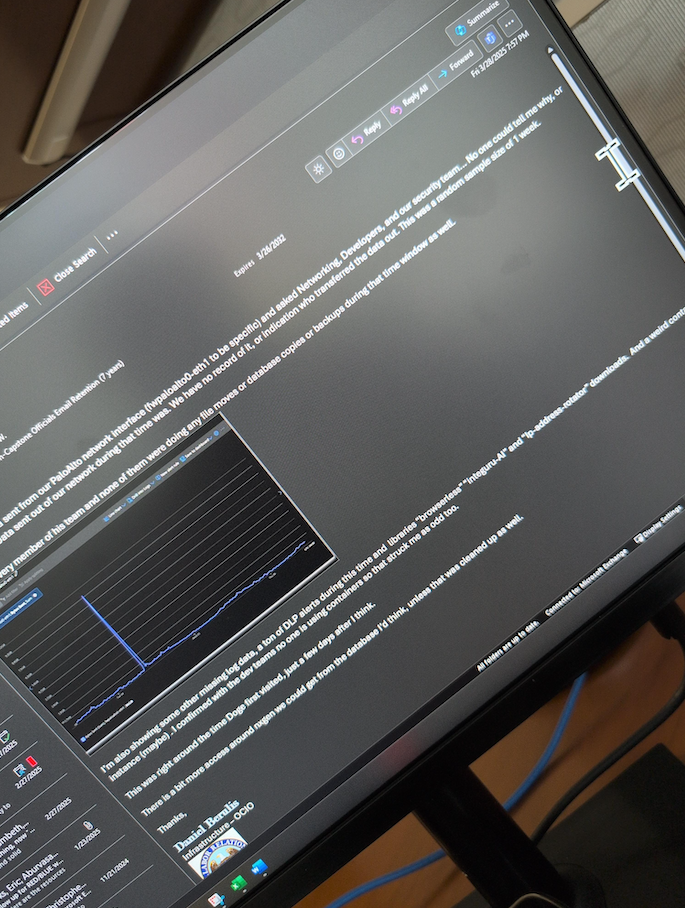
Berulis said he also noticed that early the next morning — between approximately 3 a.m. and 4 a.m. EST on Tuesday, March 4  — there was a large increase in outgoing traffic from the agency. He said it took several days of investigating with his colleagues to determine that one of the new accounts had transferred approximately 10 gigabytes worth of data from the NLRB’s NxGen case management system.

Berulis said neither he nor his co-workers had the necessary network access rights to review which files were touched or transferred — or even where they went. But his complaint notes the NxGen database contains sensitive information on unions, ongoing legal cases, and corporate secrets.

“I also don’t know if the data was only 10gb in total or whether or not they were consolidated and compressed prior,” Berulis told the senators. “This opens up the possibility that even more data was exfiltrated. Regardless, that kind of spike is extremely unusual because data almost never directly leaves NLRB’s databases.”

Berulis said he and his colleagues grew even more alarmed when they noticed nearly two dozen login attempts from a Russian Internet address (83.149.30,186) that presented valid login credentials for a DOGE employee account — one that had been created just minutes earlier. Berulis said those attempts were all blocked thanks to rules in place that prohibit logins from non-U.S. locations.

“Whoever was attempting to log in was using one of the newly created accounts that were used in the other DOGE related activities and it appeared they had the correct username and password due to the authentication flow only stopping them due to our no-out-of-country logins policy activating,” Berulis wrote. “There were more than 20 such attempts, and what is particularly concerning is that many of these login attempts occurred within 15 minutes of the accounts being created by DOGE engineers.”

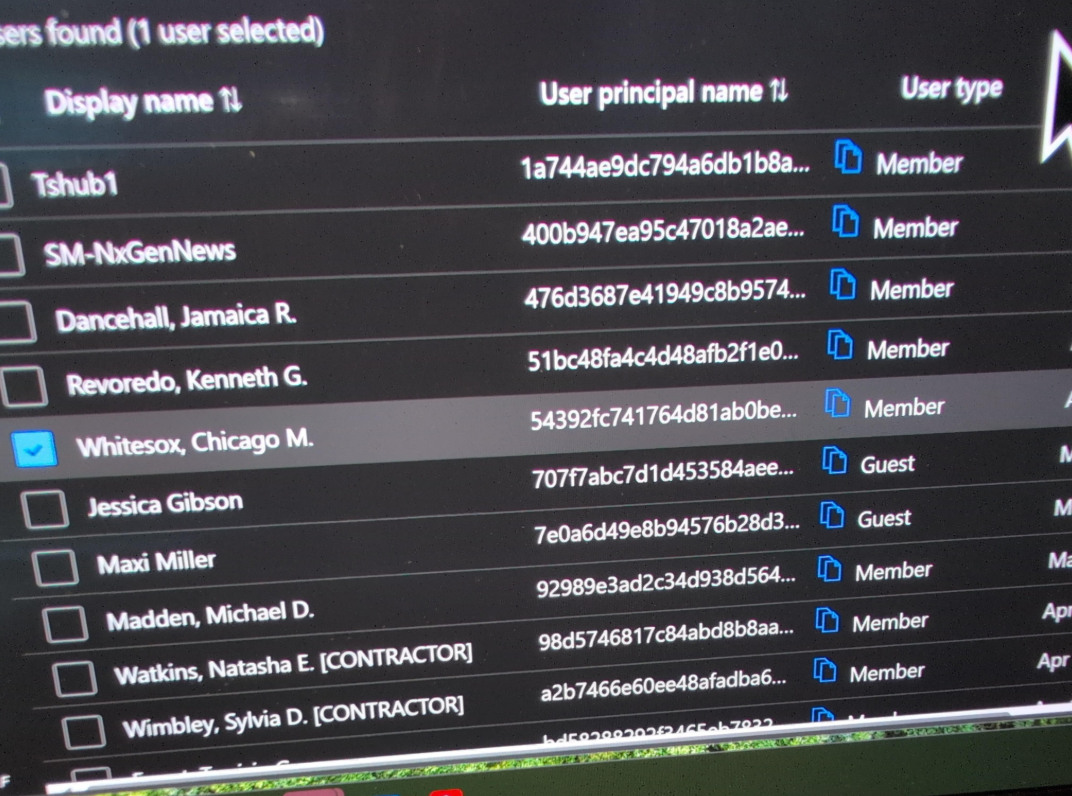
According to Berulis, the naming structure of one Microsoft user account connected to the suspicious activity suggested it had been created and later deleted for DOGE use in the NLRB’s cloud systems: “DogeSA_2d5c3e0446f9@nlrb.microsoft.com.” He also found other new Microsoft cloud administrator accounts with nonstandard usernames, including “Whitesox, Chicago M.” and “Dancehall, Jamaica R.”

A screenshot shared by Berulis showing the suspicious user accounts.

On March 5, Berulis documented that a large section of logs for recently created network resources were missing, and a network watcher in Microsoft Azure was set to the “off” state, meaning it was no longer collecting and recording data like it should have.

Berulis said he discovered someone had downloaded three external code libraries from GitHub that neither NLRB nor its contractors ever use. A “readme” file in one of the code bundles explained it was created to rotate connections through a large pool of cloud Internet addresses that serve “as a proxy to generate pseudo-infinite IPs for web scraping and brute forcing.” Brute force attacks involve automated login attempts that try many credential combinations in rapid sequence.

The complaint alleges that by March 17 it became clear the NLRB no longer had the resources or network access needed to fully investigate the odd activity from the DOGE accounts, and that on March 24, the agency’s associate chief information officer had agreed the matter should be reported to US-CERT. Operated by the Department of Homeland Security’s Cybersecurity and Infrastructure Security Agency (CISA), US-CERT provides on-site cyber incident response capabilities to federal and state agencies.

But Berulis said that between April 3 and 4, he and the associate CIO were informed that “instructions had come down to drop the US-CERT reporting and investigation and we were directed not to move forward or create an official report.” Berulis said it was at this point he decided to go public with his findings.

An email from Daniel Berulis to his colleagues dated March 28, referencing the unexplained traffic spike earlier in the month and the unauthorized changing of security controls for user accounts.

Tim Bearese, the NLRB’s acting press secretary, told NPR that DOGE neither requested nor received access to its systems, and that “the agency conducted an investigation after Berulis raised his concerns but ‘determined that no breach of agency systems occurred.'” The NLRB did not respond to questions from KrebsOnSecurity.

Nevertheless, Berulis has shared a number of supporting screenshots showing agency email discussions about the unexplained account activity attributed to the DOGE accounts, as well as NLRB security alerts from Microsoft about network anomalies observed during the timeframes described.

As CNN reported last month, the NLRB has been effectively hobbled since President Trump fired three board members, leaving the agency without the quorum it needs to function.

“Despite its limitations, the agency had become a thorn in the side of some of the richest and most powerful people in the nation — notably Elon Musk, Trump’s key supporter both financially and arguably politically,” CNN wrote.

Both Amazon and Musk’s SpaceX have been suing the NLRB over complaints the agency filed in disputes about workers’ rights and union organizing, arguing that the NLRB’s very existence is unconstitutional. On March 5, a U.S. appeals court unanimously rejected Musk’s claim that the NLRB’s structure somehow violates the Constitution.

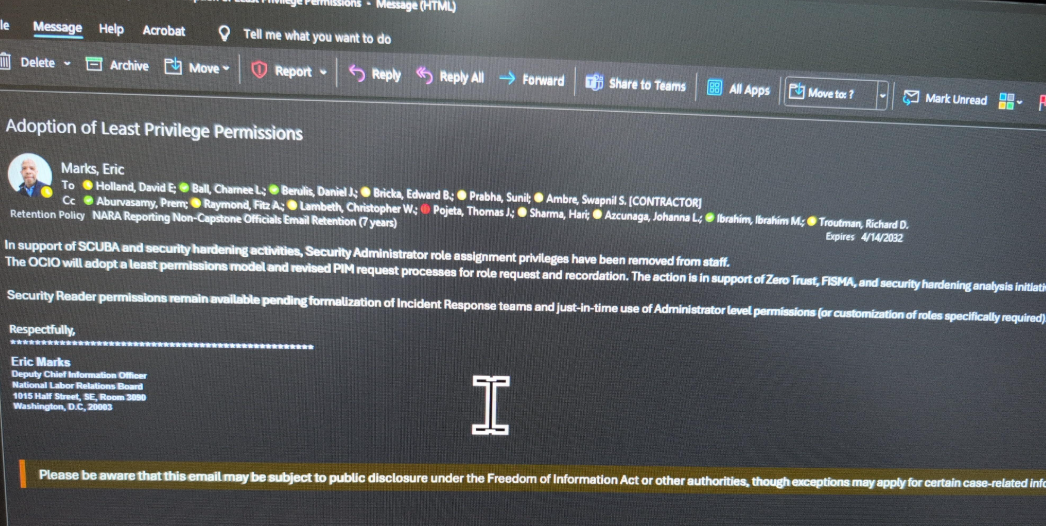
Berulis shared screenshots with KrebsOnSecurity showing that on the day the NPR published its story about his claims (April 14), the deputy CIO at NLRB sent an email stating that administrative control had been removed from all employee accounts. Meaning, suddenly none of the IT employees at the agency could do their jobs properly anymore, Berulis said.

An email from the NLRB’s associate chief information officer Eric Marks, notifying employees they will lose security administrator privileges.

Berulis shared a screenshot of an agency-wide email dated April 16 from NLRB director Lasharn Hamilton saying DOGE officials had requested a meeting, and reiterating claims that the agency had no prior “official” contact with any DOGE personnel. The message informed NLRB employees that two DOGE representatives would be detailed to the agency part-time for several months.

An email from the NLRB Director Lasharn Hamilton on April 16, stating that the agency previously had no contact with DOGE personnel.

Berulis told KrebsOnSecurity he was in the process of filing a support ticket with Microsoft to request more information about the DOGE accounts when his network administrator access was restricted. Now, he’s hoping lawmakers will ask Microsoft to provide more information about what really happened with the accounts.

“That would give us way more insight,” he said. “Microsoft has to be able to see the picture better than we can. That’s my goal, anyway.”

Berulis’s attorney told lawmakers that on April 7, while his client and legal team were preparing the whistleblower complaint, someone physically taped a threatening note to Mr. Berulis’s home door with photographs — taken via drone — of him walking in his neighborhood.

“The threatening note made clear reference to this very disclosure he was preparing for you, as the proper oversight authority,” reads a preface by Berulis’s attorney Andrew P. Bakaj. “While we do not know specifically who did this, we can only speculate that it involved someone with the ability to access NLRB systems.”

Berulis said the response from friends, colleagues and even the public has been largely supportive, and that he doesn’t regret his decision to come forward.

“I didn’t expect the letter on my door or the pushback from [agency] leaders,” he said. “If I had to do it over, would I do it again? Yes, because it wasn’t really even a choice the first time.”

For now, Mr. Berulis is taking some paid family leave from the NLRB. Which is just as well, he said, considering he was stripped of the tools needed to do his job at the agency.

“They came in and took full administrative control and locked everyone out, and said limited permission will be assigned on a need basis going forward” Berulis said of the DOGE employees. “We can’t really do anything, so we’re literally getting paid to count ceiling tiles.”

Further reading: Berulis’s complaint (PDF).

❌