
Normal view

Received before yesterday

SMS Phishers Pivot to Points, Taxes, Fake Retailers

4 December 2025 at 18:02

China-based phishing groups blamed for non-stop scam SMS messages about a supposed wayward package or unpaid toll fee are promoting a new offering, just in time for the holiday shopping season: Phishing kits for mass-creating fake but convincing e-commerce websites that convert customer payment card data into mobile wallets from Apple and Google. Experts say these same phishing groups also are now using SMS lures that promise unclaimed tax refunds and mobile rewards points.

Over the past week, thousands of domain names were registered for scam websites that purport to offer T-Mobile customers the opportunity to claim a large number of rewards points. The phishing domains are being promoted by scam messages sent via Apple’s iMessage service or the functionally equivalent RCS messaging service built into Google phones.

An instant message spoofing T-Mobile says the recipient is eligible to claim thousands of rewards points.

The website scanning service urlscan.io shows thousands of these phishing domains have been deployed in just the past few days alone. The phishing websites will only load if the recipient visits with a mobile device, and they ask for the visitor’s name, address, phone number and payment card data to claim the points.

A phishing website registered this week that spoofs T-Mobile.

If card data is submitted, the site will then prompt the user to share a one-time code sent via SMS by their financial institution. In reality, the bank is sending the code because the fraudsters have just attempted to enroll the victim’s phished card details in a mobile wallet from Apple or Google. If the victim also provides that one-time code, the phishers can then link the victim’s card to a mobile device that they physically control.

Pivoting off these T-Mobile phishing domains in urlscan.io reveals a similar scam targeting AT&T customers:

An SMS phishing or “smishing” website targeting AT&T users.

Ford Merrill works in security research at SecAlliance, a CSIS Security Group company. Merrill said multiple China-based cybercriminal groups that sell phishing-as-a-service platforms have been using the mobile points lure for some time, but the scam has only recently been pointed at consumers in the United States.

“These points redemption schemes have not been very popular in the U.S., but have been in other geographies like EU and Asia for a while now,” Merrill said.

A review of other domains flagged by urlscan.io as tied to this Chinese SMS phishing syndicate shows they are also spoofing U.S. state tax authorities, telling recipients they have an unclaimed tax refund. Again, the goal is to phish the user’s payment card information and one-time code.

A text message that spoofs the District of Columbia’s Office of Tax and Revenue.

CAVEAT EMPTOR

Many SMS phishing or “smishing” domains are quickly flagged by browser makers as malicious. But Merrill said one burgeoning area of growth for these phishing kits — fake e-commerce shops — can be far harder to spot because they do not call attention to themselves by spamming the entire world.

Merrill said the same Chinese phishing kits used to blast out package redelivery message scams are equipped with modules that make it simple to quickly deploy a fleet of fake but convincing e-commerce storefronts. Those phony stores are typically advertised on Google and Facebook, and consumers usually end up at them by searching online for deals on specific products.

A machine-translated screenshot of an ad from a China-based phishing group promoting their fake e-commerce shop templates.

With these fake e-commerce stores, the customer is supplying their payment card and personal information as part of the normal check-out process, which is then punctuated by a request for a one-time code sent by your financial institution. The fake shopping site claims the code is required by the user’s bank to verify the transaction, but it is sent to the user because the scammers immediately attempt to enroll the supplied card data in a mobile wallet.

According to Merrill, it is only during the check-out process that these fake shops will fetch the malicious code that gives them away as fraudulent, which tends to make it difficult to locate these stores simply by mass-scanning the web. Also, most customers who pay for products through these sites don’t realize they’ve been snookered until weeks later when the purchased item fails to arrive.

“The fake e-commerce sites are tough because a lot of them can fly under the radar,” Merrill said. “They can go months without being shut down, they’re hard to discover, and they generally don’t get flagged by safe browsing tools.”

Happily, reporting these SMS phishing lures and websites is one of the fastest ways to get them properly identified and shut down. Raymond Dijkxhoorn is the CEO and a founding member of SURBL, a widely-used blocklist that flags domains and IP addresses known to be used in unsolicited messages, phishing and malware distribution. SURBL has created a website called smishreport.com that asks users to forward a screenshot of any smishing message(s) received.

“If [a domain is] unlisted, we can find and add the new pattern and kill the rest” of the matching domains, Dijkxhoorn said. “Just make a screenshot and upload. The tool does the rest.”

The SMS phishing reporting site smishreport.com.

Merrill said the last few weeks of the calendar year typically see a big uptick in smishing — particularly package redelivery schemes that spoof the U.S. Postal Service or commercial shipping companies.

“Every holiday season there is an explosion in smishing activity,” he said. “Everyone is in a bigger hurry, frantically shopping online, paying less attention than they should, and they’re just in a better mindset to get phished.”

SHOP ONLINE LIKE A SECURITY PRO

As we can see, adopting a shopping strategy of simply buying from the online merchant with the lowest advertised prices can be a bit like playing Russian Roulette with your wallet. Even people who shop mainly at big-name online stores can get scammed if they’re not wary of too-good-to-be-true offers (think third-party sellers on these platforms).

If you don’t know much about the online merchant that has the item you wish to buy, take a few minutes to investigate its reputation. If you’re buying from an online store that is brand new, the risk that you will get scammed increases significantly. How do you know the lifespan of a site selling that must-have gadget at the lowest price? One easy way to get a quick idea is to run a basic WHOIS search on the site’s domain name. The more recent the site’s “created” date, the more likely it is a phantom store.

If you receive a message warning about a problem with an order or shipment, visit the e-commerce or shipping site directly, and avoid clicking on links or attachments — particularly missives that warn of some dire consequences unless you act quickly. Phishers and malware purveyors typically seize upon some kind of emergency to create a false alarm that often causes recipients to temporarily let their guard down.

But it’s not just outright scammers who can trip up your holiday shopping: Often times, items that are advertised at steeper discounts than other online stores make up for it by charging way more than normal for shipping and handling.

So be careful what you agree to: Check to make sure you know how long the item will take to be shipped, and that you understand the store’s return policies. Also, keep an eye out for hidden surcharges, and be wary of blithely clicking “ok” during the checkout process.

Most importantly, keep a close eye on your monthly statements. If I were a fraudster, I’d most definitely wait until the holidays to cram through a bunch of unauthorized charges on stolen cards, so that the bogus purchases would get buried amid a flurry of other legitimate transactions. That’s why it’s key to closely review your credit card bill and to quickly dispute any charges you didn’t authorize.
FCC boss Brendan Carr claims another victory over DEI as AT&T drops programs

3 December 2025 at 12:48

AT&T told the Federal Communications Commission that it has eliminated DEI (diversity, equity, and inclusion) policies and programs, complying with demands from Chairman Brendan Carr.

The FCC boss has refused to approve mergers and other large transactions involving companies that don’t agree to drop support for DEI. On Monday, AT&T filed a letter disowning its former DEI initiatives in the FCC docket for its $1 billion purchase of US Cellular spectrum licenses.

“We have closely followed the recent Executive Orders, Supreme Court rulings, and guidance issued by the US Equal Employment Opportunity Commission and have adjusted our employment and business practices to ensure that they comply with all applicable laws and related requirements, including ending DEI-related policies as described below, not just in name but in substance,” AT&T’s letter to Carr said.

Read full article

Comments

© Getty Images | Lluis Gene

Data-driven sport: How Oracle Red Bull Racing and AT&T move terabytes of F1 info

21 November 2025 at 15:19

LAS VEGAS—A Formula 1 car runs on soon-to-be-synthetic gasoline, but an F1 team runs on data. It’s always been an engineering-driven sport, and while you can make decisions based on a hunch, the kinds of people who become good engineers prefer something a little more convincing. And the volumes of data just continue to get bigger and bigger each season. A few years ago, we spoke to Red Bull Racing about how it stayed on top of the task, but a lot has changed in F1 since 2017, as we found out at this year’s Las Vegas Grand Prix.

It’s hugely popular now, for one thing, even in the United States: a 200 mph soap opera now with 24 episodes a season. Superficially, the cars look the same—exposed wheels, front and rear wings, the driver in between some side pods. And the hybrid powertrains that make the cars move are still the same format: 1.6 L turbocharged V6 engines that recover energy from the rear wheels under braking as well as the turbine as it gets spun by hot exhaust gases.

But the cars are actually fundamentally different, particularly the way they generate their aerodynamic grip mostly via ground effect generated by the specially sculpted underside of their floors rather than the front and rear wings. A bigger change lurks in everyone’s accounts. The days when teams were free to spend as much money as they could find are gone.

Read full article

Comments

© Jonathan Gitlin

DDoS Botnet Aisuru Blankets US ISPs in Record DDoS

10 October 2025 at 12:10

The world’s largest and most disruptive botnet is now drawing a majority of its firepower from compromised Internet-of-Things (IoT) devices hosted on U.S. Internet providers like AT&T, Comcast and Verizon, new evidence suggests. Experts say the heavy concentration of infected devices at U.S. providers is complicating efforts to limit collateral damage from the botnet’s attacks, which shattered previous records this week with a brief traffic flood that clocked in at nearly 30 trillion bits of data per second.

Since its debut more than a year ago, the Aisuru botnet has steadily outcompeted virtually all other IoT-based botnets in the wild, with recent attacks siphoning Internet bandwidth from an estimated 300,000 compromised hosts worldwide.

The hacked systems that get subsumed into the botnet are mostly consumer-grade routers, security cameras, digital video recorders and other devices operating with insecure and outdated firmware, and/or factory-default settings. Aisuru’s owners are continuously scanning the Internet for these vulnerable devices and enslaving them for use in distributed denial-of-service (DDoS) attacks that can overwhelm targeted servers with crippling amounts of junk traffic.

As Aisuru’s size has mushroomed, so has its punch. In May 2025, KrebsOnSecurity was hit with a near-record 6.35 terabits per second (Tbps) attack from Aisuru, which was then the largest assault that Google’s DDoS protection service Project Shield had ever mitigated. Days later, Aisuru shattered that record with a data blast in excess of 11 Tbps.

By late September, Aisuru was publicly flexing DDoS capabilities topping 22 Tbps. Then on October 6, its operators heaved a whopping 29.6 terabits of junk data packets each second at a targeted host. Hardly anyone noticed because it appears to have been a brief test or demonstration of Aisuru’s capabilities: The traffic flood lasted less only a few seconds and was pointed at an Internet server that was specifically designed to measure large-scale DDoS attacks.

A measurement of an Oct. 6 DDoS believed to have been launched through multiple botnets operated by the owners of the Aisuru botnet. Image: DDoS Analyzer Community on Telegram.

Aisuru’s overlords aren’t just showing off. Their botnet is being blamed for a series of increasingly massive and disruptive attacks. Although recent assaults from Aisuru have targeted mostly ISPs that serve online gaming communities like Minecraft, those digital sieges often result in widespread collateral Internet disruption.

For the past several weeks, ISPs hosting some of the Internet’s top gaming destinations have been hit with a relentless volley of gargantuan attacks that experts say are well beyond the DDoS mitigation capabilities of most organizations connected to the Internet today.

Steven Ferguson is principal security engineer at Global Secure Layer (GSL), an ISP in Brisbane, Australia. GSL hosts TCPShield, which offers free or low-cost DDoS protection to more than 50,000 Minecraft servers worldwide. Ferguson told KrebsOnSecurity that on October 8, TCPShield was walloped with a blitz from Aisuru that flooded its network with more than 15 terabits of junk data per second.

Ferguson said that after the attack subsided, TCPShield was told by its upstream provider OVH that they were no longer welcome as a customer.

“This was causing serious congestion on their Miami external ports for several weeks, shown publicly via their weather map,” he said, explaining that TCPShield is now solely protected by GSL.

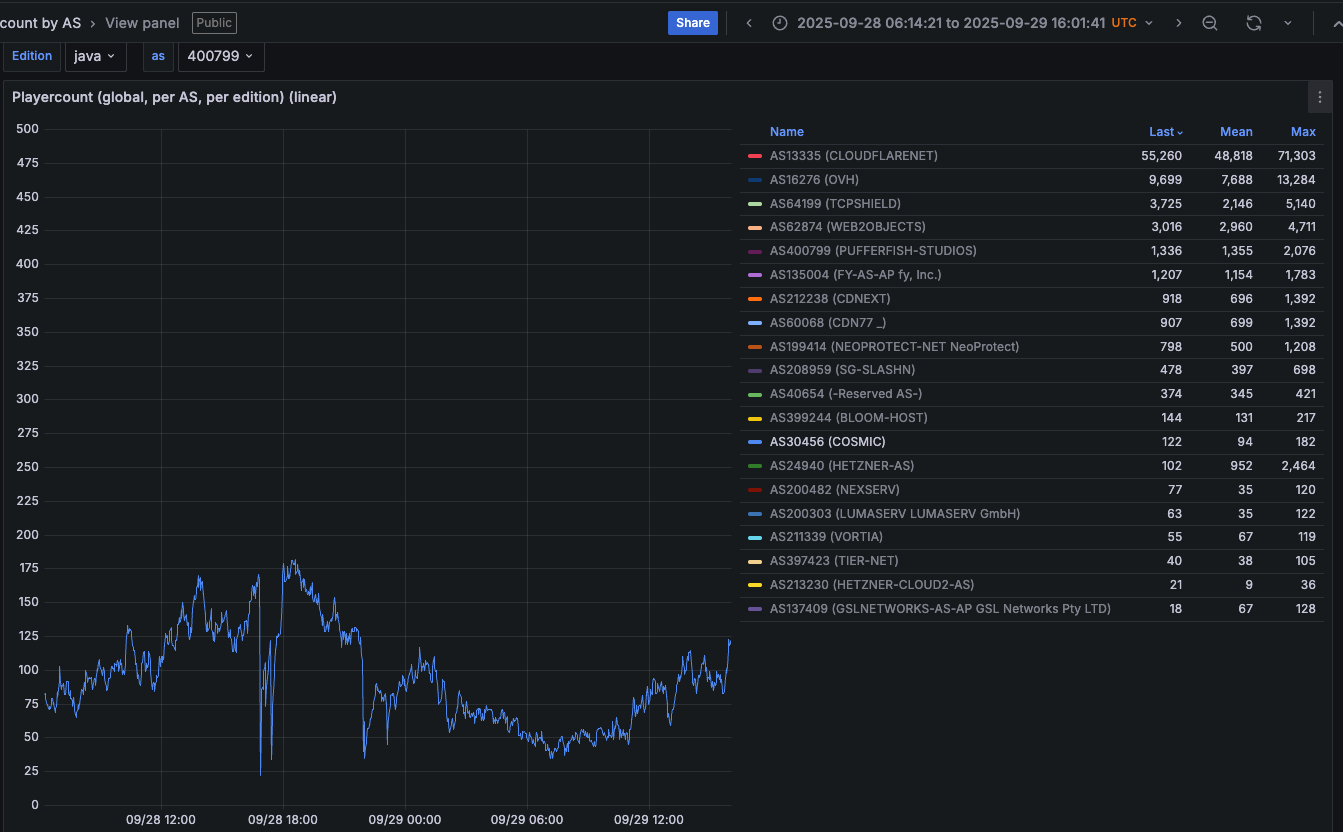
Traces from the recent spate of crippling Aisuru attacks on gaming servers can be still seen at the website blockgametracker.gg, which indexes the uptime and downtime of the top Minecraft hosts. In the following example from a series of data deluges on the evening of September 28, we can see an Aisuru botnet campaign briefly knocked TCPShield offline.

An Aisuru botnet attack on TCPShield (AS64199) on Sept. 28  can be seen in the giant downward spike in the middle of this uptime graphic. Image: grafana.blockgametracker.gg.

Paging through the same uptime graphs for other network operators listed shows almost all of them suffered brief but repeated outages around the same time. Here is the same uptime tracking for Minecraft servers on the network provider Cosmic (AS30456), and it shows multiple large dips that correspond to game server outages caused by Aisuru.

Multiple DDoS attacks from Aisuru can be seen against the Minecraft host Cosmic on Sept. 28. The sharp downward spikes correspond to brief but enormous attacks from Aisuru. Image: grafana.blockgametracker.gg.

BOTNETS R US

Ferguson said he’s been tracking Aisuru for about three months, and recently he noticed the botnet’s composition shifted heavily toward infected systems at ISPs in the United States. Ferguson shared logs from an attack on October 8 that indexed traffic by the total volume sent through each network provider, and the logs showed that 11 of the top 20 traffic sources were U.S. based ISPs.

AT&T customers were by far the biggest U.S. contributors to that attack, followed by botted systems on Charter Communications, Comcast, T-Mobile and Verizon, Ferguson found. He said the volume of data packets per second coming from infected IoT hosts on these ISPs is often so high that it has started to affect the quality of service that ISPs are able to provide to adjacent (non-botted) customers.

“The impact extends beyond victim networks,” Ferguson said. “For instance we have seen 500 gigabits of traffic via Comcast’s network alone. This amount of egress leaving their network, especially being so US-East concentrated, will result in congestion towards other services or content trying to be reached while an attack is ongoing.”

Roland Dobbins is principal engineer at Netscout. Dobbins said Ferguson is spot on, noting that while most ISPs have effective mitigations in place to handle large incoming DDoS attacks, many are far less prepared to manage the inevitable service degradation caused by large numbers of their customers suddenly using some or all available bandwidth to attack others.

“The outbound and cross-bound DDoS attacks can be just as disruptive as the inbound stuff,” Dobbin said. “We’re now in a situation where ISPs are routinely seeing terabit-per-second plus outbound attacks from their networks that can cause operational problems.”

“The crying need for effective and universal outbound DDoS attack suppression is something that is really being highlighted by these recent attacks,” Dobbins continued. “A lot of network operators are learning that lesson now, and there’s going to be a period ahead where there’s some scrambling and potential disruption going on.”

KrebsOnSecurity sought comment from the ISPs named in Ferguson’s report. Charter Communications pointed to a recent blog post on protecting its network, stating that Charter actively monitors for both inbound and outbound attacks, and that it takes proactive action wherever possible.

“In addition to our own extensive network security, we also aim to reduce the risk of customer connected devices contributing to attacks through our Advanced WiFi solution that includes Security Shield, and we make Security Suite available to our Internet customers,” Charter wrote in an emailed response to questions. “With the ever-growing number of devices connecting to networks, we encourage customers to purchase trusted devices with secure development and manufacturing practices, use anti-virus and security tools on their connected devices, and regularly download security patches.”

A spokesperson for Comcast responded, “Currently our network is not experiencing impacts and we are able to handle the traffic.”

9 YEARS OF MIRAI

Aisuru is built on the bones of malicious code that was leaked in 2016 by the original creators of the Mirai IoT botnet. Like Aisuru, Mirai quickly outcompeted all other DDoS botnets in its heyday, and obliterated previous DDoS attack records with a 620 gigabit-per-second siege that sidelined this website for nearly four days in 2016.

The Mirai botmasters likewise used their crime machine to attack mostly Minecraft servers, but with the goal of forcing Minecraft server owners to purchase a DDoS protection service that they controlled. In addition, they rented out slices of the Mirai botnet to paying customers, some of whom used it to mask the sources of other types of cybercrime, such as click fraud.

A depiction of the outages caused by the Mirai botnet attacks against the internet infrastructure firm Dyn on October 21, 2016. Source: Downdetector.com.

Dobbins said Aisuru’s owners also appear to be renting out their botnet as a distributed proxy network that cybercriminal customers anywhere in the world can use to anonymize their malicious traffic and make it appear to be coming from regular residential users in the U.S.

“The people who operate this botnet are also selling (it as) residential proxies,” he said. “And that’s being used to reflect application layer attacks through the proxies on the bots as well.”

The Aisuru botnet harkens back to its predecessor Mirai in another intriguing way. One of its owners is using the Telegram handle “9gigsofram,” which corresponds to the nickname used by the co-owner of a Minecraft server protection service called Proxypipe that was heavily targeted in 2016 by the original Mirai botmasters.

Robert Coelho co-ran Proxypipe back then along with his business partner Erik “9gigsofram” Buckingham, and has spent the past nine years fine-tuning various DDoS mitigation companies that cater to Minecraft server operators and other gaming enthusiasts. Coelho said he has no idea why one of Aisuru’s botmasters chose Buckingham’s nickname, but added that it might say something about how long this person has been involved in the DDoS-for-hire industry.

“The Aisuru attacks on the gaming networks these past seven day have been absolutely huge, and you can see tons of providers going down multiple times a day,” Coelho said.

Coelho said the 15 Tbps attack this week against TCPShield was likely only a portion of the total attack volume hurled by Aisuru at the time, because much of it would have been shoved through networks that simply couldn’t process that volume of traffic all at once. Such outsized attacks, he said, are becoming increasingly difficult and expensive to mitigate.

“It’s definitely at the point now where you need to be spending at least a million dollars a month just to have the network capacity to be able to deal with these attacks,” he said.

RAPID SPREAD

Aisuru has long been rumored to use multiple zero-day vulnerabilities in IoT devices to aid its rapid growth over the past year. XLab, the Chinese security company that was the first to profile Aisuru’s rise in 2024, warned last month that one of the Aisuru botmasters had compromised the firmware distribution website for Totolink, a maker of low-cost routers and other networking gear.

“Multiple sources indicate the group allegedly compromised a router firmware update server in April and distributed malicious scripts to expand the botnet,” XLab wrote on September 15. “The node count is currently reported to be around 300,000.”

A malicious script implanted into a Totolink update server in April 2025. Image: XLab.

Aisuru’s operators received an unexpected boost to their crime machine in August when the U.S. Department Justice charged the alleged proprietor of Rapper Bot, a DDoS-for-hire botnet that competed directly with Aisuru for control over the global pool of vulnerable IoT systems.

Once Rapper Bot was dismantled, Aisuru’s curators moved quickly to commandeer vulnerable IoT devices that were suddenly set adrift by the government’s takedown, Dobbins said.

“Folks were arrested and Rapper Bot control servers were seized and that’s great, but unfortunately the botnet’s attack assets were then pieced out by the remaining botnets,” he said. “The problem is, even if those infected IoT devices are rebooted and cleaned up, they will still get re-compromised by something else generally within minutes of being plugged back in.”

A screenshot shared by XLabs showing the Aisuru botmasters recently celebrating a record-breaking 7.7 Tbps DDoS. The user at the top has adopted the name “Ethan J. Foltz” in a mocking tribute to the alleged Rapper Bot operator who was arrested and charged in August 2025.

BOTMASTERS AT LARGE

XLab’s September blog post cited multiple unnamed sources saying Aisuru is operated by three cybercriminals: “Snow,” who’s responsible for botnet development; “Tom,” tasked with finding new vulnerabilities; and “Forky,” responsible for botnet sales.

KrebsOnSecurity interviewed Forky in our May 2025 story about the record 6.3 Tbps attack from Aisuru. That story identified Forky as a 21-year-old man from Sao Paulo, Brazil who has been extremely active in the DDoS-for-hire scene since at least 2022. The FBI has seized Forky’s DDoS-for-hire domains several times over the years.

Like the original Mirai botmasters, Forky also operates a DDoS mitigation service called Botshield. Forky declined to discuss the makeup of his ISP’s clientele, or to clarify whether Botshield was more of a hosting provider or a DDoS mitigation firm. However, Forky has posted on Telegram about Botshield successfully mitigating large DDoS attacks launched against other DDoS-for-hire services.

In our previous interview, Forky acknowledged being involved in the development and marketing of Aisuru, but denied participating in attacks launched by the botnet.

Reached for comment earlier this month, Forky continued to maintain his innocence, claiming that he also is still trying to figure out who the current Aisuru botnet operators are in real life (Forky said the same thing in our May interview).

But after a week of promising juicy details, Forky came up empty-handed once again. Suspecting that Forky was merely being coy, I asked him how someone so connected to the DDoS-for-hire world could still be mystified on this point, and suggested that his inability or unwillingness to blame anyone else for Aisuru would not exactly help his case.

At this, Forky verbally bristled at being pressed for more details, and abruptly terminated our interview.

“I’m not here to be threatened with ignorance because you are stressed,” Forky replied. “They’re blaming me for those new attacks. Pretty much the whole world (is) due to your blog.”

Proxy Services Feast on Ukraine’s IP Address Exodus

5 June 2025 at 18:44

Image: Mark Rademaker, via Shutterstock.

Ukraine has seen nearly one-fifth of its Internet space come under Russian control or sold to Internet address brokers since February 2022, a new study finds. The analysis indicates large chunks of Ukrainian Internet address space are now in the hands of shadowy proxy and anonymity services that are nested at some of America’s largest Internet service providers (ISPs).

The findings come in a report examining how the Russian invasion has affected Ukraine’s domestic supply of Internet Protocol Version 4 (IPv4) addresses. Researchers at Kentik, a company that measures the performance of Internet networks, found that while a majority of ISPs in Ukraine haven’t changed their infrastructure much since the war began in 2022, others have resorted to selling swathes of their valuable IPv4 address space just to keep the lights on.

For example, Ukraine’s incumbent ISP Ukrtelecom is now routing just 29 percent of the IPv4 address ranges that the company controlled at the start of the war, Kentik found. Although much of that former IP space remains dormant, Ukrtelecom told Kentik’s Doug Madory they were forced to sell many of their address blocks “to secure financial stability and continue delivering essential services.”

“Leasing out a portion of our IPv4 resources allowed us to mitigate some of the extraordinary challenges we have been facing since the full-scale invasion began,” Ukrtelecom told Madory.

Madory found much of the IPv4 space previously allocated to Ukrtelecom is now scattered to more than 100 providers globally, particularly at three large American ISPs — Amazon (AS16509), AT&T (AS7018), and Cogent (AS174).

Another Ukrainian Internet provider — LVS (AS43310) — in 2022 was routing approximately 6,000 IPv4 addresses across the nation. Kentik learned that by November 2022, much of that address space had been parceled out to over a dozen different locations, with the bulk of it being announced at AT&T.

IP addresses routed over time by Ukrainian provider LVS (AS43310) shows a large chunk of it being routed by AT&T (AS7018). Image: Kentik.

Ditto for the Ukrainian ISP TVCOM, which currently routes nearly 15,000 fewer IPv4 addresses than it did at the start of the war. Madory said most of those addresses have been scattered to 37 other networks outside of Eastern Europe, including Amazon, AT&T, and Microsoft.

The Ukrainian ISP Trinity (AS43554) went offline in early March 2022 during the bloody siege of Mariupol, but its address space eventually began showing up in more than 50 different networks worldwide. Madory found more than 1,000 of Trinity’s IPv4 addresses suddenly appeared on AT&T’s network.

Why are all these former Ukrainian IP addresses being routed by U.S.-based networks like AT&T? According to spur.us, a company that tracks VPN and proxy services, nearly all of the address ranges identified by Kentik now map to commercial proxy services that allow customers to anonymously route their Internet traffic through someone else’s computer.

From a website’s perspective, the traffic from a proxy network user appears to originate from the rented IP address, not from the proxy service customer. These services can be used for several business purposes, such as price comparisons, sales intelligence, web crawlers and content-scraping bots. However, proxy services also are massively abused for hiding cybercrime activity because they can make it difficult to trace malicious traffic to its original source.

IPv4 address ranges are always in high demand, which means they are also quite valuable. There are now multiple companies that will pay ISPs to lease out their unwanted or unused IPv4 address space. Madory said these IPv4 brokers will pay between $100-$500 per month to lease a block of 256 IPv4 addresses, and very often the entities most willing to pay those rental rates are proxy and VPN providers.

A cursory review of all Internet address blocks currently routed through AT&T — as seen in public records maintained by the Internet backbone provider Hurricane Electric — shows a preponderance of country flags other than the United States, including networks originating in Hungary, Lithuania, Moldova, Mauritius, Palestine, Seychelles, Slovenia, and Ukraine.

AT&T’s IPv4 address space seems to be routing a great deal of proxy traffic, including a large number of IP address ranges that were until recently routed by ISPs in Ukraine.

Asked about the apparent high incidence of proxy services routing foreign address blocks through AT&T, the telecommunications giant said it recently changed its policy about originating routes for network blocks that are not owned and managed by AT&T. That new policy, spelled out in a February 2025 update to AT&T’s terms of service, gives those customers until Sept. 1, 2025 to originate their own IP space from their own autonomous system number (ASN), a unique number assigned to each ISP (AT&T’s is AS7018).

“To ensure our customers receive the best quality of service, we changed our terms for dedicated internet in February 2025,” an AT&T spokesperson said in an emailed reply. “We no longer permit static routes with IP addresses that we have not provided. We have been in the process of identifying and notifying affected customers that they have 90 days to transition to Border Gateway Protocol routing using their own autonomous system number.”

Ironically, the co-mingling of Ukrainian IP address space with proxy providers has resulted in many of these addresses being used in cyberattacks against Ukraine and other enemies of Russia. Earlier this month, the European Union sanctioned Stark Industries Solutions Inc., an ISP that surfaced two weeks before the Russian invasion and quickly became the source of large-scale DDoS attacks and spear-phishing attempts by Russian state-sponsored hacking groups. A deep dive into Stark’s considerable address space showed some of it was sourced from Ukrainian ISPs, and most of it was connected to Russia-based proxy and anonymity services.

According to Spur, the proxy service IPRoyal is the current beneficiary of IP address blocks from several Ukrainian ISPs profiled in Kentik’s report. Customers can chose proxies by specifying the city and country they would to proxy their traffic through. Image: Trend Micro.

Spur’s Chief Technology Officer Riley Kilmer said AT&T’s policy change will likely force many proxy services to migrate to other U.S. providers that have less stringent policies.

“AT&T is the first one of the big ISPs that seems to be actually doing something about this,” Kilmer said. “We track several services that explicitly sell AT&T IP addresses, and it will be very interesting to see what happens to those services come September.”

Still, Kilmer said, there are several other large U.S. ISPs that continue to make it easy for proxy services to bring their own IP addresses and host them in ranges that give the appearance of residential customers. For example, Kentik’s report identified former Ukrainian IP ranges showing up as proxy services routed by Cogent Communications (AS174), a tier-one Internet backbone provider based in Washington, D.C.

Kilmer said Cogent has become an attractive home base for proxy services because it is relatively easy to get Cogent to route an address block.

“In fairness, they transit a lot of traffic,” Kilmer said of Cogent. “But there’s a reason a lot of this proxy stuff shows up as Cogent: Because it’s super easy to get something routed there.”

Cogent declined a request to comment on Kentik’s findings.

❌