Normal view

Received before yesterday

Amanda Seyfried says she will not apologise for calling Charlie Kirk ‘hateful’ after his shooting

11 December 2025 at 12:34

The Housemaid actor received backlash in September when she left a comment on Instagram after the rightwing activist was killed

The Housemaid star Amanda Seyfried has said she is “not fucking apologising” for describing Charlie Kirk as “hateful” after the latter was shot dead in September.

Seyfried was speaking to Who What Wear when she was asked about her social media activity, including the backlash around her Kirk comment. “I’m not fucking apologising for that. I mean, for fuck’s sake, I commented on one thing. I said something that was based on actual reality and actual footage and actual quotes. What I said was pretty damn factual, and I’m free to have an opinion, of course.”

Continue reading...

© Photograph: Dominik Bindl/Getty Images

© Photograph: Dominik Bindl/Getty Images

© Photograph: Dominik Bindl/Getty Images

You be the judge: should my wannabe influencer friend stop using me for content?

11 December 2025 at 03:00

Marielle says being recorded is part of being her friend, but Beth is fed up of being a muse. Who should reel it in?

Get a disagreement settled or become a YBTJ juror

Sometimes she films me while I’m eating. I’ll see myself on her Instagram – it’s like a jumpscare

I want Beth to see that the content we make together can get us a foot in the door

Continue reading...

© Illustration: Igor Bastidas/The Guardian

© Illustration: Igor Bastidas/The Guardian

© Illustration: Igor Bastidas/The Guardian

Australian Social Media Ban Takes Effect as Kids Scramble for Alternatives

9 December 2025 at 16:10

Australian Social Media Ban Takes Effect as Kids Scramble for Alternatives

Australia’s world-first social media ban for children under age 16 takes effect on December 10, leaving kids scrambling for alternatives and the Australian government with the daunting task of enforcing the ambitious ban. What is the Australian social media ban, who and what services does it cover, and what steps can affected children take? We’ll cover all that, plus the compliance and enforcement challenges facing both social media companies and the Australian government – and the move toward similar bans in other parts of the world.

Australian Social Media Ban Supported by Most – But Not All

In September 2024, Prime Minister Anthony Albanese announced that his government would introduce legislation to set a minimum age requirement for social media because of concerns about the effect of social media on the mental health of children. The amendment to the Online Safety Act 2021 passed in November 2024 with the overwhelming support of the Australian Parliament. The measure has met with overwhelming support – even as most parents say they don’t plan to fully enforce the ban with their children. The law already faces a legal challenge from The Digital Freedom Project, and the Australian Financial Review reported that Reddit may file a challenge too. Services affected by the ban – which proponents call a social media “delay” – include the following 10 services:
  • Facebook
  • Instagram
  • Kick
  • Reddit
  • Snapchat
  • Threads
  • TikTok
  • Twitch
  • X
  • YouTube
Those services must take steps by Wednesday to remove accounts held by users under 16 in Australia and prevent children from registering new accounts. Many services began to comply before the Dec. 10 implementation date, although X had not yet communicated its policy to the government as of Dec. 9, according to The Guardian. Companies that fail to comply with the ban face fines of up to AUD $49.5 million, while there are no penalties for parents or children who fail to comply.

Opposition From a Wide Range of Groups - And Efforts Elsewhere

Opposition to the law has come from a range of groups, including those concerned about the privacy issues resulting from age verification processes such as facial recognition and assessment technology or use of government IDs. Others have said the ban could force children toward darker, less regulated platforms, and one group noted that children often reach out for mental health help on social media. Amnesty International also opposed the ban. The international human rights group called the ban “an ineffective quick fix that’s out of step with the realities of a generation that lives both on and offline.” Amnesty said strong regulation and safeguards would be a better solution. “The most effective way to protect children and young people online is by protecting all social media users through better regulation, stronger data protection laws and better platform design,” Amnesty said. “Robust safeguards are needed to ensure social media platforms stop exposing users to harms through their relentless pursuit of user engagement and exploitation of people’s personal data. “Many young people will no doubt find ways to avoid the restrictions,” the group added. “A ban simply means they will continue to be exposed to the same harms but in secret, leaving them at even greater risk.” Even the prestigious medical journal The Lancet suggested that a ban may be too blunt an instrument and that 16-year-olds will still face the same harmful content and risks. Jasmine Fardouly of the University of Sydney School of Psychology noted in a Lancet commentary that “Further government regulations and support for parents and children are needed to help make social media safe for all users while preserving its benefits.” Still, despite the chorus of concerns, the idea of a social media ban for children is catching on in other places, including the EU and Malaysia.

Australian Children Seek Alternatives as Compliance Challenges Loom

The Australian social media ban leaves open a range of options for under-16 users, among them Yope, Lemon8, Pinterest, Discord, WhatsApp, Messenger, iMessage, Signal, and communities that have been sources of controversy such as Telegram and 4chan. Users have exchanged phone numbers with friends and other users, and many have downloaded their personal data from apps where they’ll be losing access, including photos, videos, posts, comments, interactions and platform profile data. Many have investigated VPNs as a possible way around the ban, but a VPN is unlikely to work with an existing account that has already been identified as an underage Australian account. In the meantime, social media services face the daunting task of trying to confirm the age of account holders, a process that even Albanese has acknowledged “won’t be 100 per cent perfect.” There have already been reports of visual age checks failing, and a government-funded report released in August admitted the process will be imperfect. The government has published substantial guidance for helping social media companies comply with the law, but it will no doubt take time to determine what “reasonable steps” to comply look like. In the meantime, social media companies will have to navigate compliance guidance like the following passage: “Providers may choose to offer the option to end-users to provide government-issued identification or use the services of an accredited provider. However, if a provider wants to employ an age assurance method that requires the collection of government-issued identification, then the provider must always offer a reasonable alternative that doesn’t require the collection of government-issued identification. A provider can never require an end-user to give government-issued identification as the sole method of age assurance and must always give end-users an alternative choice if one of the age assurance options is to use government-issued identification. A provider also cannot implement an age assurance system which requires end-users to use the services of an accredited provider without providing the end-user with other choices.”  

ChatGPT hyped up violent stalker who believed he was “God’s assassin,” DOJ says

4 December 2025 at 13:40

ChatGPT allegedly validated the worst impulses of a wannabe influencer accused of stalking more than 10 women at boutique gyms, where the chatbot supposedly claimed he’d meet the “wife type.”

In a press release on Tuesday, the Department of Justice confirmed that 31-year-old Brett Michael Dadig currently remains in custody after being charged with cyberstalking, interstate stalking, and making interstate threats. He now faces a maximum sentence of up to 70 years in prison that could be coupled with “a fine of up to $3.5 million,” the DOJ said.

The podcaster—who primarily posted about “his desire to find a wife and his interactions with women”—allegedly harassed and sometimes even doxxed his victims through his videos on platforms including Instagram, Spotify, and TikTok. Over time, his videos and podcasts documented his intense desire to start a family, which was frustrated by his “anger towards women,” whom he claimed were “all the same from fucking 18 to fucking 40 to fucking 90” and “trash.”

Read full article

Comments

© Yurii Karvatskyi | iStock / Getty Images Plus

Meta wins monopoly trial, convinces judge that social networking is dead

18 November 2025 at 16:47

After years of pushback from the Federal Trade Commission over Meta’s acquisitions of Instagram and WhatsApp, Meta has defeated the FTC’s monopoly claims.

In a Tuesday ruling, US District Judge James Boasberg said the FTC failed to show that Meta has a monopoly in a market dubbed “personal social networking.” In that narrowly defined market, the FTC unsuccessfully argued, Meta supposedly faces only two rivals, Snapchat and MeWe, which struggle to compete due to its alleged monopoly.

But the days of grouping apps into “separate markets of social networking and social media” are over, Boasberg wrote. He cited the Greek philosopher Heraclitus, who “posited that no man can ever step into the same river twice,” while telling the FTC they missed their chance to block Meta’s purchase.

Read full article

Comments

© Bloomberg / Contributor | Bloomberg

How to set up two factor authentication (2FA) on your Instagram account

27 October 2025 at 10:53

Two-factor authentication (2FA) isn’t foolproof, but it is one of the best ways to protect your accounts from hackers.

It adds a small extra step when logging in, but that extra effort pays off. Instagram’s 2FA requires an additional code whenever you try to log in from an unrecognized device or browser—stopping attackers even if they have your password.

Instagram offers multiple 2FA options: text message (SMS), an authentication app (recommended), or a security key.

Instagram 2FA options

Here’s how to enable 2FA on Instagram for Android, iPhone/iPad, and the web.

How to set up 2FA for Instagram on Android

  1. Open the Instagram app and log in.
  2. Tap your profile picture at the bottom right.
  3. Tap the menu icon (three horizontal lines) in the top right.
  4. Select Accounts Center at the bottom.
  5. Tap Password and security > Two-factor authentication.
  6. Choose your Instagram account.
  7. Select a verification method: Text message (SMS), Authentication app (recommended), or WhatsApp.
    • SMS: Enter your phone number if you haven’t already. Instagram will send you a six-digit code. Enter it to confirm.
    • Authentication app: Choose an app like Google Authenticator or Duo Mobile. Scan the QR code or copy the setup key, then enter the generated code on Instagram.
    • WhatsApp: Enable text message security first, then link your WhatsApp number.
  8. Follow the on-screen instructions to finish setup.

How to set up 2FA for Instagram on iPhone or iPad

  1. Open the Instagram app and log in.
  2. Tap your profile picture at the bottom right.
  3. Tap the menu icon > Settings > Security > Two-factor authentication.
  4. Tap Get Started.
  5. Choose Authentication app (recommended), Text message, or WhatsApp.
    • Authentication app: Copy the setup key or scan the QR code with your chosen app. Enter the generated code and tap Next.
    • Text message: Turn it on, then enter the six-digit SMS code Instagram sends you.
    • WhatsApp: Enable text message first, then add WhatsApp.
  6. Follow on-screen instructions to complete the setup.

How to set up 2FA for Instagram in a web browser

  1. Go to instagram.com and log in.
  2. Open Accounts Center > Password and security.
  3. Click Two-factor authentication, then choose your account.
    • Note: If your accounts are linked, you can enable 2FA for both Instagram and your overall Meta account here.Instagram accoounts center
  4. Choose your preferred 2FA method and follow the online prompts.

Enable it today

Even the strongest password isn’t enough on its own. 2FA means a thief must have access to your an additional factor to be able to log in to your account, whether that’s a code on a physical device or a security key. That makes it far harder for criminals to break in.

Turn on 2FA for all your important accounts, especially social media and messaging apps. It only takes a few minutes, but it could save you hours—or even days—of recovery later.It’s currently the best password advice we have.


We don’t just report on threats – we help safeguard your entire digital identity

Cybersecurity risks should never spread beyond a headline. Protect your—and your family’s—personal information by using identity protection.

Affiliates Flock to ‘Soulless’ Scam Gambling Machine

28 August 2025 at 13:21

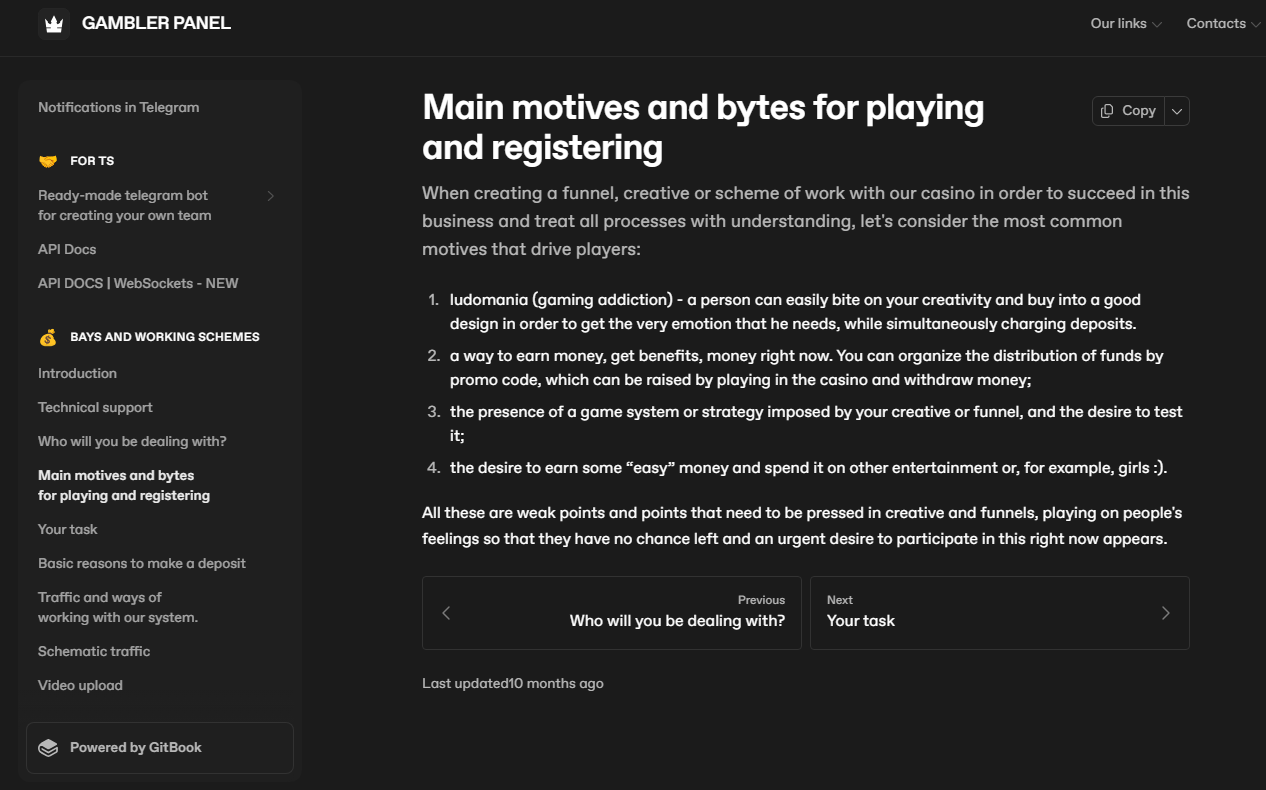
Last month, KrebsOnSecurity tracked the sudden emergence of hundreds of polished online gaming and wagering websites that lure people with free credits and eventually abscond with any cryptocurrency funds deposited by players. We’ve since learned that these scam gambling sites have proliferated thanks to a new Russian affiliate program called “Gambler Panel” that bills itself as a “soulless project that is made for profit.”

A machine-translated version of Gambler Panel’s affiliate website.

The scam begins with deceptive ads posted on social media that claim the wagering sites are working in partnership with popular athletes or social media personalities. The ads invariably state that by using a supplied “promo code,” interested players can claim a $2,500 credit on the advertised gaming website.

The gaming sites ask visitors to create a free account to claim their $2,500 credit, which they can use to play any number of extremely polished video games that ask users to bet on each action. However, when users try to cash out any “winnings” the gaming site will reject the request and prompt the user to make a “verification deposit” of cryptocurrency — typically around $100 — before any money can be distributed.

Those who deposit cryptocurrency funds are soon pressed into more wagering and making additional deposits. And — shocker alert — all players eventually lose everything they’ve invested in the platform.

The number of scam gambling or “scambling” sites has skyrocketed in the past month, and now we know why: The sites all pull their gaming content and detailed strategies for fleecing players straight from the playbook created by Gambler Panel, a Russian-language affiliate program that promises affiliates up to 70 percent of the profits.

Gambler Panel’s website gambler-panel[.]com links to a helpful wiki that explains the scam from cradle to grave, offering affiliates advice on how best to entice visitors, keep them gambling, and extract maximum profits from each victim.

“We have a completely self-written from scratch FAKE CASINO engine that has no competitors,” Gambler Panel’s wiki enthuses. “Carefully thought-out casino design in every pixel, a lot of audits, surveys of real people and test traffic floods were conducted, which allowed us to create something that has no doubts about the legitimacy and trustworthiness even for an inveterate gambling addict with many years of experience.”

Gambler Panel explains that the one and only goal of affiliates is to drive traffic to these scambling sites by any and all means possible.

A machine-translated portion of Gambler Panel’s singular instruction for affiliates: Drive traffic to these scambling sites by any means available.

“Unlike white gambling affiliates, we accept absolutely any type of traffic, regardless of origin, the only limitation is the CIS countries,” the wiki continued, referring to a common prohibition against scamming people in Russia and former Soviet republics in the Commonwealth of Independent States.

The program’s website claims it has more than 20,000 affiliates, who earn a minimum of $10 for each verification deposit. Interested new affiliates must first get approval from the group’s Telegram channel, which currently has around 2,500 active users.

The Gambler Panel channel is replete with images of affiliate panels showing the daily revenue of top affiliates, scantily-clad young women promoting the Gambler logo, and fast cars that top affiliates claimed they bought with their earnings.

A machine-translated version of the wiki for the affiliate program Gambler Panel.

The apparent popularity of this scambling niche is a consequence of the program’s ease of use and detailed instructions for successfully reproducing virtually every facet of the scam. Indeed, much of the tutorial focuses on advice and ready-made templates to help even novice affiliates drive traffic via social media websites, particularly on Instagram and TikTok.

Gambler Panel also walks affiliates through a range of possible responses to questions from users who are trying to withdraw funds from the platform. This section, titled “Rules for working in Live chat,” urges scammers to respond quickly to user requests (1-7 minutes), and includes numerous strategies for keeping the conversation professional and the user on the platform as long as possible.

A machine-translated version of the Gambler Panel’s instructions on managing chat support conversations with users.

The connection between Gambler Panel and the explosion in the number of scambling websites was made by a 17-year-old developer who operates multiple Discord servers that have been flooded lately with misleading ads for these sites.

The researcher, who asked to be identified only by the nickname “Thereallo,” said Gambler Panel has built a scalable business product for other criminals.

“The wiki is kinda like a ‘how to scam 101’ for criminals written with the clarity you would expect from a legitimate company,” Thereallo said. “It’s clean, has step by step guides, and treats their scam platform like a real product. You could swap out the content, and it could be any documentation for startups.”

“They’ve minimized their own risk — spreading the links on Discord / Facebook / YT Shorts, etc. — and outsourced it to a hungry affiliate network, just like a franchise,” Thereallo wrote in response to questions.

“A centralized platform that can serve over 1,200 domains with a shared user base, IP tracking, and a custom API is not at all a trivial thing to build,” Thereallo said. “It’s a scalable system designed to be a resilient foundation for thousands of disposable scam sites.”

The security firm Silent Push has compiled a list of the latest domains associated with the Gambler Panel, available here (.csv).

❌