❌

Normal view

Trump says Ukraine needs a new leader after diesel deal with Russia

10 October 2026 at 16:42

US president suggests Ukrainian president, Volodymyr Zelenskyy, has not done enough to end war

Donald Trump has said Ukraine needs “a new leader”, a day after making a deal with Vladimir Putin to buy large quantities of Russian diesel.

The US president suggested Volodymyr Zelenskyy has not done enough to end the war with Russia and blamed him for high diesel prices in the US.

Continue reading...

© Photograph: Reuters

© Photograph: Reuters

© Photograph: Reuters

The more Putin escalates his attacks on Europe, the more Europe should support Ukraine | Timothy Garton Ash

10 October 2026 at 07:00

Moscow’s imperialist strongman believes decadent European democracies can be cowed. Our job is to prove him wrong

Vladimir Putin is escalating both his full-scale war against Ukraine and his shadow war against the rest of Europe. His main purpose in the shadow one is to break European support for Ukraine so he can subjugate that country, something he regards as existential for Russia’s future and his own. While we in the rest of Europe must prepare as best we can to defend ourselves against every kind of hybrid attack, the central thrust of our response should be to redouble our support for Ukraine. Ukraine is his main target. It’s there, and only there, not in a contest of a thousand hybrid pinpricks, that Putin’s Russia can in a meaningful sense be defeated and deterred.

In a powerful new book, Warum Russland nicht aufhören wird (Why Russia Won’t Stop), the German historian Martin Schulze Wessel shows how Putin’s policy fits into a much older Russian tradition of territorial expansionism and striving for hegemony, combined with a religiously infused imperial ideology. He reminds us that in 2016 Putin said “Russia’s frontier ends nowhere” and in 2025, “wherever the boot of a Russian soldier steps, that is ours”. West Europeans, fondly imagining that we have consigned such brute territorial imperialism to the dustbin of history, tend to think there must be some other explanation (eg something we did “wrong”, like the eastward expansion of Nato). Finns, Estonians and Poles know better. Despite Russia’s weaknesses, the author concludes, it is “the most dangerous country in the world”. Some in Asia might question that large claim, but certainly Russia is the most dangerous country for Europe.

Continue reading...

© Photograph: AFP/Getty Images

© Photograph: AFP/Getty Images

© Photograph: AFP/Getty Images

Don’t rebuild the dam: Ukrainian experts urge Unesco to protect site uncovered by Russian sabotage

As archaeologists find treasure trove along new floodplain, conservationists say another Nova Kakhovka would be ecocide

On a warm September day, a group of underwater archaeologists and researchers were boiling water for tea on their campfire on the banks of the Dnipro River, tents pitched on the sandy shoreline. They were three weeks into an archaeological expedition of the waters around Khortytsia – a rocky island 12.5km long and 2.5km wide that lies just downstream of the city of Zaporizhzhia, in south-eastern Ukraine.

High above the island, a Shahed drone whined on its way. A Ukrainian interceptor, and small-arms fire from the ground, tried, unsuccessfully, to bring it down. The archaeologists ignored it. This is life as normal, 28 miles (45km) from the combat zone in Russia’s war on Ukraine.

Continue reading...

© Photograph: Julia Kochetova/The Guardian

© Photograph: Julia Kochetova/The Guardian

© Photograph: Julia Kochetova/The Guardian

Ukraine’s drones knock out AI data center belonging to "Russia’s Google"

9 October 2026 at 18:04

Ukrainian drone strikes have knocked out two of five data centers belonging to the Russian tech giant Yandex. The damage has left Yandex, known as “Russia’s Google” because it operates the country’s most popular search engine, struggling to maintain its AI chatbot and other online services.

The Ukrainian drones struck Yandex data centers in the Sasovo and Kaluga regions of Russia on October 8 and October 9, according to Reuters. Those actions came as a direct response to a Russian drone strike campaign targeting Ukraine’s data centers, which has disrupted mobile phone and Internet services for thousands of Ukrainians since late September.

“We continue to respond to Russia’s attacks on Ukraine, and we’re doing so with high precision,” said Ukrainian President Volodymyr Zelenskyy in a post on X. “Another data center was hit as well—our symmetrical response.”

Read full article

Comments

© Planet Labs PBC

Zelenskyy furious as Trump announces deal to buy Russian diesel

US president says agreement needed to lower American fuel prices, but move likely to create fresh crisis with Ukraine and Nato allies

Donald Trump was on a fresh collision course with the Ukrainian president, Volodymyr Zelenskyy, and European allies after a stunning agreement to buy Russian diesel, upending years of US and western pressure on the Kremlin to end its four-and-a-half year war against Ukraine.

Zelenskyy reacted furiously to Trump’s announcement of the deal with Vladimir Putin, calling it “absolutely terrible” and “not fair and not honest”.

Continue reading...

© Photograph: Kent Nishimura/AFP/Getty Images

© Photograph: Kent Nishimura/AFP/Getty Images

© Photograph: Kent Nishimura/AFP/Getty Images

Pro-Kremlin Russian military blogger Mikhail Zvinchuk arrested in Montenegro

9 October 2026 at 07:51

Founder of influential Rybar blog detained after warnings of attempts to destabilise Balkan country, officials say

A leading pro-Kremlin Russian military blogger with reported ties to Russia’s intelligence services has been arrested in Montenegro, after warnings of attempts to destabilise the Balkan country, officials have said.

Mikhail Zvinchuk, the founder of the influential Rybar war blog, was detained on Friday alongside his wife and three other Russians by police and security agents in the Adriatic resort town of Risan, on suspicion of spreading Russian influence, local media reported.

Continue reading...

© Photograph: Francesca Ebel/The Washington Post/Getty Images

© Photograph: Francesca Ebel/The Washington Post/Getty Images

© Photograph: Francesca Ebel/The Washington Post/Getty Images

‘It gave me a superpower – question everything’: ​as punk turns 50, bands from China to Greenland explain how it fires up their lives

9 October 2026 at 03:00

Whether on the frontline in Ukraine or skate parks in Soweto, the genre is still a vital outlet for disaffected people everywhere. Here, musicians explain how they rage against the machine

Andriy Zholob, vocalist/guitarist, Beton: When MTV arrived in Ukraine, I heard Nirvana, the Offspring, Bad Brains, Social Distortion and thrash metal, and realised that all this started from punk rock. Our drummer and I were in a ska-punk band first, but when our vocalist became pregnant we started Beton in 2017 and played lots of festivals.

Continue reading...

© Composite: Jess Clark for the Guardian: Getty Images/ Katrīna Līva Dalbiņa, Alejandra Núñez, Assante Chiweshe, Ruslan Bulgakov, Valeriia Nekhvodiuk, Yulia Sachul

© Composite: Jess Clark for the Guardian: Getty Images/ Katrīna Līva Dalbiņa, Alejandra Núñez, Assante Chiweshe, Ruslan Bulgakov, Valeriia Nekhvodiuk, Yulia Sachul

© Composite: Jess Clark for the Guardian: Getty Images/ Katrīna Līva Dalbiņa, Alejandra Núñez, Assante Chiweshe, Ruslan Bulgakov, Valeriia Nekhvodiuk, Yulia Sachul

Ukraine war briefing: Zelenskyy criticises US, calls for more Starlink access, amid deadly Russian assault

8 October 2026 at 19:42

Ukrainian president says expanded Starlink access will help nation target Russian ballistic-missile launchers. What we know on day 1,689

President Volodymyr Zelenskyy accused the US of being unwilling to help Ukraine after a Russian bomb attack on Thursday killed at least 35 people in the east, sending the two-day death ⁠toll from Russian strikes to more than 70. Hours ⁠after the strike on the ​embattled city of Kramatorsk tore through two buses, Zelenskyy criticised Washington’s effort to pursue economic ties with Russia while also seeking to mediate the more than four-year war.

Speaking to reporters in ‌Pryluky, the Ukrainian leader urged the US to accede ‌to his requests to expand Ukraine’s access to the Starlink satellite service to help it target Russian ballistic-missile launchers. “Open Starlink for Ukraine. You did open it when you ‌were responding to Iran ... I’ve said quite openly – give it to us, help us defend our skies and dominate there. And then Putin will sit down at the negotiating table,” he said.

UN rights chief Volker Turk said he was appalled by Thursday’s “horrifying strike”. “I am appalled by the wave of attacks killing civilians across Ukraine over the past four days, including today’s horrifying strike hitting two public buses,” he said in a statement. “The scale and manner of these attacks – killing and injuring people on buses, at their homes and work in different areas of the country – is reprehensible. In the last two days, 78 people were killed and ​215 wounded by strikes across Ukraine, Zelenskyy said.

Ukrainian negotiators will travel to the US on Friday and Saturday for talks, Zelenskyy said, urging US president Donald Trump to increase sanction pressure on Russia. Ukraine’s president told reporters that he expected Kyiv’s European partners to join the talks with the US. Zelenskyy said his chief of staff, Kyrylo Budanov, as well as Ukraine’s top officials: Rustem Umerov, Sergiy Kyslytsya and David Arakhamia will take part in the talks in Florida.

The US-led peace efforts to end the Ukraine war have largely stalled, with Washington focused on its conflict with Iran. But US officials said they were making a fresh effort in an enlarged format, following visits to Moscow and Kyiv last month by Witkoff, Trump’s business friend-turned-roving envoy, and the president’s son-in-law Kushner. US officials said the envoys would discuss “security guarantees for Ukraine, a postwar prosperity plan, and other aspects of the conflict”. Witkoff and Kushner “will discuss new ideas and proposals that American negotiators began developing with the Russians and Ukrainians during their recent visit to the region,” a source familiar with the talks said.

Nato said it would start its annual ‘nuclear deterrence’ exercises in Italy from Tuesday amid mounting concerns about Russia. The drills will run from 13-23 October and involve 17 nations. “The exercise is a long-planned, routine training activity that is part of Nato’s efforts to maintain readiness and test procedures that contribute to the alliance’s deterrence and defence,” said a Nato statement.

South Korea will ⁠recall its ambassador to Ukraine, the foreign minister said on Thursday, following a dispute over ⁠Zelenskyy’s announcement that two ⁠North ​Korean prisoners of war were being transferred to Seoul. The two sides have been locked in a dispute ⁠after Seoul accused Kyiv of breaching a confidentiality agreement over the transfer of the captured soldiers.

Continue reading...

© Photograph: Gleb Garanich/Reuters

© Photograph: Gleb Garanich/Reuters

© Photograph: Gleb Garanich/Reuters

Russian attack on bus kills at least 30 people near Ukraine frontline

8 October 2026 at 10:00

Zelenskyy says Kremlin deliberately targeted ‘ordinary public transport stop’ in Kramatorsk, with 18 wounded

A Russian missile strike on a bus in the eastern city of Kramatorsk has killed at least 30 people, officials have said, in one of the worst attacks by Moscow on Ukrainian civilians this year.

The regional prosecutor’s office in the Donetsk region said on Thursday the vehicle had been hit at 10am by an aerial bomb. “As of now, the death toll from this morning’s attack has risen to 30. Eighteen people were wounded,” it said, adding that all local public transport had been suspended.

Continue reading...

© Photograph: Ukrainian State Emergency Service/AFP/Getty Images

© Photograph: Ukrainian State Emergency Service/AFP/Getty Images

© Photograph: Ukrainian State Emergency Service/AFP/Getty Images

South Korea threatens legal action if fuel shipments to Russia found to have broken law

8 October 2026 at 00:45

Responding to a Guardian report that revealed thousands of tonnes of fuel was transported to Russia, Seoul said it was investigating the cases

South Korea will take legal action if it finds that shipments of fuel from its ports to Russia broke domestic law, the government has said, responding to a Guardian report on the trade.

The government, in a statement issued by the foreign and trade ministries and the customs service, said that it is “checking additional information concerning the loading cases reported by the Guardian” and “if the verification establishes that our laws and regulations have been violated, it plans to act in accordance with the law”.

Continue reading...

© Photograph: Bloomberg/Getty Images

© Photograph: Bloomberg/Getty Images

© Photograph: Bloomberg/Getty Images

George Galloway contests London byelection without setting foot in UK

7 October 2026 at 10:50

Veteran leftwinger has been ‘in exile in the east’ in Russia and not been to Holborn and St Pancras constituency since campaign began

George Galloway has been elected seven times to parliament, but his attempt to succeed for an eighth this week, in the London seat formerly held by Keir Starmer, is undoubtedly his most curious effort yet.

Since the byelection campaign began, the leader of the Workers party of Britain has yet to set foot in the UK, let alone the Holborn and St Pancras constituency, because he is in what he describes as “self-exile” after being questioned by counter-terrorism police at Gatwick airport a year ago.

Continue reading...

© Photograph: Christopher Thomond/The Guardian

© Photograph: Christopher Thomond/The Guardian

© Photograph: Christopher Thomond/The Guardian

‘The nurse used the torch on her phone to do the op’: hospitals stripped of resources in Ukraine’s occupied territories

7 October 2026 at 04:00

Clinics and hospitals in affected areas lack staff, power and medicines, with supplies redirected to the Russian military

Earlier this summer, the once bustling corridors of the district hospital in Hola Prystan, a city in the Russian-occupied Kherson region of Ukraine, were ominously quiet. At times, it was plunged into darkness during power cuts lasting hours.

Much of the hospital’s medical equipment and supplies had been stolen and redirected to the military, and many experienced staff had gone.

Continue reading...

© Photograph: Evgeniy Maloletka/AP

© Photograph: Evgeniy Maloletka/AP

© Photograph: Evgeniy Maloletka/AP

Russia ‘pursuing strategy of terror’, EU’s von der Leyen says after deadly strikes on Ukraine – Europe live

7 October 2026 at 05:54

Ukraine president confirms series of attacks on Pryluky, Dnipro, Kremenchik, Zaporizhzhia and Kyiv

French chemist Henri Kagan and Japanese chemist Kensō Soai have been awarded the 2026 Nobel prize in chemistry “for the discovery of non-linear effects and autocatalysis in asymmetric organic synthesis.”

Here’s more from the organisers:

“Henri Kagan discovered a new way of manipulating chemical reactions, allowing a greater excess of one of the mirror images to be created than was previously assumed possible. His discovery has been revolutionary for chemists who develop reactions for the manufacture of pharmaceuticals, flavours, scents and new materials.

Kenso Soai designed the first chemical reaction in which only one of the potential mirror images was formed. Other than life itself, no one had ever achieved this feat. The Soai reaction is one of the most spectacular chemical experiments ever conducted.”

Continue reading...

© Photograph: Ukraine's State Emergency Service/AFP via Getty Images

© Photograph: Ukraine's State Emergency Service/AFP via Getty Images

© Photograph: Ukraine's State Emergency Service/AFP via Getty Images

Drones sink ships near NATO countries in “unacceptable” attacks, EU says

6 October 2026 at 17:31

Drones sank two cargo ships and damaged a third in the exclusive economic zones of NATO member countries for the first time, killing at least two sailors. The attacks represent a notable escalation as Black Sea commercial shipping has increasingly come under attack during the Russian invasion of Ukraine, with Russia also being accused of carrying out “hybrid warfare” incidents across Europe.

The Togo-flagged cargo ship Alfa Watan sank, and the Palau-flagged cargo ship Able was set ablaze after being attacked by multiple sea and aerial drones about 80 miles (128 kilometers) off the coast of Bulgaria on October 6, according to the Associated Press. In an interview, Bulgarian Prime Minister Rumen Radev described the incidents as “an unacceptable attack in Bulgaria’s exclusive economic zone” and “a blatant violation of international law and maritime law.”

A Bulgarian ferry managed to evacuate the 18 crew members of the Able, with two severely injured mariners being flown to a hospital in the city of Varna.

Read full article

Comments

© Iuliia Kuzmina / iStock Editorial / Getty Images

Naval drone hits oil tanker off Russian resort city Sochi, triggering massive blaze

7 October 2026 at 00:39

Russian officials said a Liberian-flagged tanker was attacked and a crew of 23 Indian nationals rescued

An oil tanker off Russia’s Black Sea coast was struck by a naval drone, triggering a huge fire and black smoke cloud that blanketed parts of the resort city of Sochi, Russia’s transport ministry has said.

The transport ministry said a Liberian-flagged tanker had been attacked and that “crude oil is burning openly in the waters of the Black Sea”.

Continue reading...

© Composite: Social media via Reuters

© Composite: Social media via Reuters

© Composite: Social media via Reuters

Russian drones strike Ukraine’s data centers by exploiting air defense gaps

5 October 2026 at 13:21

A surge in Russian jet-powered drone strikes on Ukrainian data centers has increasingly disrupted mobile phone and Internet services for thousands of people. Now Ukraine President Volodymyr Zelenskyy and other government officials are warning of the need for more air defense capabilities, as such telecommunication outages could threaten Ukraine’s digital economy and undermine the country’s ongoing resistance to Russia’s invasion.

The Russian attacks on Ukrainian telecommunication infrastructure have focused on Ukraine’s capital of Kyiv since September 23, according to the nonprofit Reporters Without Borders. Ukraine’s digital transformation ministry reported that 100,000 households in the Kyiv region were temporarily experiencing Internet outages from those initial strikes—and Russia has only intensified its strike campaign against major Ukrainian data centers and mobile phone networks in recent weeks.

“Russian attacks on Ukraine’s telecommunication infrastructure are not new, with strikes and shelling previously damaging fiber optic lines, cell towers, and facilities belonging to mobile network companies,” said Tetiana Gaviuk, analyst for Europe at ACLED, in a post on October 1. “However, the recent concentrated attacks on Kyiv’s data centers and telecom networks stand out because multiple providers and facilities were hit within days, indicating Russia’s increased pressure on Ukraine’s digital infrastructure.”

Read full article

Comments

© Kostiantyn Liberov/Libkos/Getty Images

Missive From Kyiv

2 October 2026 at 12:47
As I write this, an air raid siren is blaring outside my hotel window. I am in Kyiv, and my first response isn't to run to a shelter, it's to check my phone: two jet-powered Shahed drones, heading north of my location through the bright Ukrainian sky. I feel lucky. In past years, such daylight strikes were rare, but in 2026, Russia is determined to cut Ukraine's cities off from electricity, heating, and water supplies, driving the country into a humanitarian crisis. Putin has ordered the Russian military to abandon all rules of war.

Since I might be the only MeFite in Kyiv right now, I will add some personal context: none of these are hypotheticals. They all appear to be plans that have been in motion for some time, and it is only recently that media outlets begun picking up the thread of daily life on the ground. Russia's current favorite target isn't the Ukrainian military, it's civilians. Four days ago, I was in a park when Ukraine's National Academy of Sciences was hit. The explosion rang out over the city. Heads turned in horror. A woman walking her dog looked to be on the brink of tears. Nobody knew what was hit yet, just that Kyiv's defenses had failed, which meant that someone somewhere was probably dead (they were). Air raid sirens for Kyiv happen about once every two hours, well into the morning. I've lost count of how many times I've been woken up by one. And you never know how close your path will cross with a drone. Yesterday, I took an Uber over a bridge to visit the other side of Kyiv. It was a good day for Uber. Normally, Ukrainian defensive GPS spoofing also scrambles people's phone locations. For my previous ride, my phone put me in South America and gave an approximate arrival time of 19,000 minutes for a drive across the Atlantic. Last night, that same bridge was struck multiple times. While the structure remains intact, the city's traffic has slowed to a crawl as it tries to adjust. City officials aren't letting cars cross a bridge if there's a drone threat. Since the threats are nearly constant, commuter pileups are everywhere, which I can only guess was the point of the attack. I should also specify that there are two types of air raid sirens in Ukraine: one for drones, one for ballistic missiles/artillery attacks. Currently, Ukraine intercepts about 90% of the old, propeller-type Shaheds and the about half of the new jet-powered types. For the jet-powered Shaheds, Ukraine is placing its hopes in a a new unproven drone interceptor it can't produce enough of. For ballistic missiles, Ukraine has no answer. Despite the Trump Administration licensing production of Patriot interceptors to Ukraine, bringing that system online will take Ukraine years. In the meantime, Ukraine's domestic missile interceptor is still not ready for the coming winter onslaught. Regardless of the siren, everyone checks their phones to see what is coming where. Volunteers on Telegram have crowdsourced information to keep Ukrainian citizens informed about what's flying over their skies. Zelenskyy offered to stop attacking Russian oil facilities if Russia would spare Ukraine's civilian infrastructure. Putin, unsurprisingly, called such a deal absurd. What sits with me most, though, are the people I meet each day. Yesterday, I had a conversation with a woman whose dad and brother are both fighting on the front line. When I asked her if she was worried about them, her reply was succinct: "That's life. What can you do?"

Russia’s Latest Propaganda? A.I.-Generated War Songs.

2 October 2026 at 10:40
Russians are creating and spreading music glorifying the invasion of Ukraine, using platforms built in the United States.

© Nanna Heitmann for The New York Times

Russian society is becoming increasingly militaristic since the war in Ukraine began. These soldiers marched in Moscow in a parade in 2023.

Ukrainian Science Academy, Struck by Drone, Played Key Role in Research

Over 90 percent of Ukraine’s scientific discoveries have been attributed to Ukraine’s National Academy of Sciences, including advancements in astronomy and military technology.

© Finbarr O'Reilly for The New York Times

A Russian drone strike on the National Academy of Sciences in Kyiv, Ukraine, killed at least two people on Monday.

Britain Gains Access to Ukraine’s ‘Goldmine’ of Battlefield AI Data

26 August 2026 at 01:26

UK Ukraine AI partnership

The UK Ukraine AI partnership will give Britain access to Ukraine’s Avengers AI Labs, bringing together Ukrainian battlefield experience, operational data and engineering expertise with the UK’s AI ecosystem. The agreement, signed by President Volodymyr Zelenskyy and Prime Minister Andy Burnham in Ukraine, will focus initially on defence and national security. Under the partnership, British innovators and researchers will gain access to data and insights collected across the battlefield. The UK government described Avengers AI Labs as a “goldmine of battlefield data,” offering researchers access to real-world operational information used to train AI models.

How Avengers AI Labs Uses Battlefield Data

The data is collected through thousands of daylight cameras and infrared sensors deployed across the battlefield. The systems capture images and information involving tanks, artillery, air defence systems, infantry and aerial targets, including Shahed drones and reconnaissance UAVs. The data is used to train AI models to recognize and classify battlefield objects. Ukraine’s Defense Ministry has previously said that systems trained using the Avengers Labs platform analyze more than 100,000 drone video feeds each month and help identify about 70% of enemy targets in real time. The UK’s access to the platform is intended to allow British startups, researchers and engineers to work with operational insights and develop technologies based on real-world datasets. The partnership will initially bring together engineers, academics, businesses and military operational expertise from both countries to address national security challenges. The two countries will also explore additional platforms for future collaboration.

UK Ukraine AI Partnership Test New Defence Technology

Several pilot projects involving British startups have already been rolled out as part of the agreement. The companies named are Bristol-based Sintela, Oxford’s Mind Foundry and London’s Skyral. The first technology is due to be deployed at a UK defence site to help protect bases from protestors and hostile actors seeking intelligence. The project combines Ukrainian data with UK technology and turns buried fibre-optic cables into an AI-enabled sensor. The technology could also be used in other critical locations, including airports, prisons, railways and energy plants, according to the information released about the partnership. A second project will examine the development of next-generation low-power AI chips designed for future drones, robotics and autonomous systems. If successful, the technology could support machines designed to operate for longer, respond faster and function in environments where conventional systems face limitations.

AI Sovereignty and Defence Innovation

The agreement forms part of the UK and Ukraine’s 100 Year Partnership and expands cooperation between the two countries in AI and defence technology. The UK will provide access to its universities, researchers, technology companies and AI ecosystem, while Ukraine will provide access to operational experience and datasets generated during the war. Minister for AI Kanishka Narayan described the arrangement as AI sovereignty in practice, focused on developing national capabilities and turning frontline experience into technologies for military and critical infrastructure protection. The partnership also follows the UK government’s announcement that defence firm MBDA can release classified information on UK components for the long-range SCALP missile to establish local assembly lines in Ukraine. The broader agreement is intended to combine Ukrainian battlefield data with British scientific, engineering and technology expertise, with the initial focus remaining on defence, national security and the development of future defence technology.

Cyberattack Hits Ukraine Agency Ahead of Major Asset Tender

19 August 2026 at 01:33

ARMA Cyberattack

A suspected ARMA cyberattack has targeted Ukraine's Asset Recovery and Management Agency as it prepares to select a manager for assets linked to IDS Ukraine. ARMA said its servers experienced unauthorized interference ahead of the August 22 deadline for applications, prompting an investigation into whether the incident was part of a broader effort to disrupt its operations. The Asset Recovery and Management Agency, known as ARMA, manages assets seized by Ukrainian authorities, including assets linked to sanctioned Russian individuals and alleged collaborators with Moscow.

ARMA Cyberattack Raises Questions Over IDS Ukraine Competition

ARMA said the attack occurred shortly before the August 22 deadline for applications to participate in the competition to select a manager for assets controlled by sanctioned Russian oligarch Mikhail Fridman. The agency said its experts and law enforcement authorities are examining the cyberattack and the events surrounding the IDS Ukraine competition. The Security Service of Ukraine, or SBU, is investigating the recent attack, while a broader National Anti-Corruption Bureau of Ukraine, or NABU, investigation is examining earlier alleged interference. According to ARMA, signs of illegal interference in processes connected to its work have been recorded since spring. These included unauthorized access to the agency's officials' register. ARMA said the combination of cyber incidents, information activity and increased inquiries from some media outlets and members of parliament had raised concerns about a possible coordinated campaign. The agency said investigators must determine whether these events were intended to disrupt its work, create pressure or affect the competition. ARMA has not identified those it believes may have organized or carried out the alleged campaign.

IDS Ukraine Selection Continues Despite Cyberattack

Despite the incident, ARMA said the competition to select the IDS Ukraine asset manager will proceed according to the procedures and timeframe established by law. The deadline for applications is August 22, 2026, with the competition announcement published through Ukraine's Prozorro public procurement system. The agency said it has also started an audit of the financial indicators of seized IDS group assets to support the legality, objectivity and transparency of the transfer process. ARMA said additional information concerning possible unauthorized access to officials' email accounts and official information will be provided to law enforcement authorities for investigation and legal assessment. Acting ARMA Head Yaroslava Maksymenko said the agency would continue the competition despite what it described as information pressure, political interference and attempts to gain unauthorized access to its resources.

Ukraine Investigates Possible Coordinated Interference

ARMA said the latest incident is not being viewed in isolation. The agency pointed to a similar episode earlier this year, when Reuters reported on a cyberattack involving attempts at interference and hacking alongside increased information activity and inquiries. The agency said each event could have an individual explanation, but their timing and combination warranted further investigation. The cyberattack comes as Ukraine continues efforts to prevent sanctioned Russian capital from retaining control over assets seized in the country. ARMA said this includes preventing control through management arrangements, intermediaries or influence groups. Fridman has been sanctioned by Ukraine and several Western governments since Russia's invasion. ARMA said the final responsibility for determining the organizers, customers and perpetrators of the attack rests with the ongoing investigations. The agency said it will continue the IDS Ukraine competition and act within the law while law enforcement agencies examine the reported cyber incidents and possible attempts to interfere with its activities.

Netherlands Seizes 800 Servers, Arrests 2 for Aiding Cyberattacks

25 May 2026 at 09:21

Authorities in the Netherlands have arrested the co-owners of two related Internet hosting companies for operating IT infrastructure used by Russia to carry out cyberattacks, influence operations and disinformation campaigns inside the European Union. The two men were the focus of a 2025 KrebsOnSecurity story about how their hosting companies had assumed control over the technical infrastructure of Stark Industries Solutions, an Internet service provider sanctioned last year by the EU as a frequent staging ground for cyber mischief from Russia’s intelligence agencies.

An investigator with the Tax Intelligence and Investigation Service (FIOD), the Dutch financial crimes agency, during the raid. Image: FIOD.

The Dutch daily news outlet de Volkskrant reports that the Dutch financial crime agency FIOD on May 18 arrested a 57-year-old from Amsterdam and a 39-year-old from The Hague, charging them with violating sanctions law by directly or indirectly making economic resources available to EU-sanctioned entities.

The Dutch investigation focuses on Stark Industries, a sprawling hosting provider that materialized just two weeks before Russia invaded Ukraine. As detailed in this May 2024 deep-dive, Stark quickly became the source of massive distributed denial-of-service (DDoS) attacks against European targets, and emerged as a top supplier of proxy and anonymity services that showed up time and again in cyberattacks linked to Russia-backed hacking groups.

That report identified two Moldovan brothers — Ivan and Yuri Neculiti and their company PQHosting — who were providing one of Stark’s two main conduits to the larger Internet. In May 2025, the EU sanctioned PQHosting and the Neculiti brothers for aiding Russia’s hybrid warfare efforts. But as KrebsOnSecurity observed in September 2025, those sanctions failed to target Stark’s remaining connection to the Internet — an Internet service provider based in the Netherlands called MIRhosting.

MIRhosting is operated by Andrey Nesterenko, a 39-year-old Russian native who runs the business out of the Netherlands.  News that PQHosting and the Neculiti brothers were about to be sanctioned by the EU leaked in the media nearly two weeks before the sanctions were announced last year. During that time, the Stark network assets were transferred from PQHosting to a new entity called the[.]hosting, under the control of the Dutch entity WorkTitans BV.

And as our September 2025 report showed, WorkTitans was controlled by Nesterenko and a 57-year-old from Amsterdam named Youssef Zinad. On top of that, WorkTitans was getting connectivity to the larger Internet solely through MIRhosting, where Zinad had worked previously.

On May 18, Dutch financial crime investigators arrested Nesterenko and Zinad, and searched three businesses in Enschede and Almere and two data centers in Dronten and Schiphol-Rijk. A statement from the Dutch authorities said they also seized laptops, telephones and more than 800 servers.

A message to the-hosting customers immediately after 800 of its servers were seized by Dutch authorities. The message says that unfortunately data stored on the server has been lost and cannot be recovered.

De Volkskrant said it reviewed data showing WorkTitans and MIRhosting were the most-used networks in pro-Russian attacks on Danish government bodies between November 13 and 19, 2025, the week of Denmark’s municipal elections.

The publication wrote that prior to Nesterenko’s arrest, the MIRhosting founder denied that he knew his servers had been misused by pro-Russian cybercriminals. “He said he had ended all services with the Neculiti brothers when the EU sanctions came into force in May 2025,” and the he “reserved all rights to take action against ‘harmful and incorrect publications,” de Volkskrant wrote.

MIRhosting released a statement saying it has initiated an internal investigation into the alleged facts concerning the elections in Denmark, and that it has temporarily paused services to WorkTitans as a precautionary measure while the matter is being reviewed further.

“Based on our preliminary findings, there are no indications that the services over which we exercise control were actually used to influence the Danish elections,” the statement reads. “No anomalies or spikes were observed in our network traffic during the period mentioned in the publication; had large-scale DDoS attacks occurred, such activity would have been evident. Furthermore, prior to the media publication, we had not received any complaints, abuse reports, or official requests regarding suspicious activities or misuse of our network. Meanwhile, our regular operational activities continue, and our service to our other clients remains fully intact.”

Born in Nizhny Novgorod, Russia, Mr. Nesterenko grew up as a piano prodigy who performed publicly at a young age. In 2004, Nesterenko founded MIRhosting’s parent Innovation IT Solutions Corp., which has the notable distinction of being the company responsible for hosting stopgeorgia[.]ru, a hacktivist website for organizing cyberattacks against Georgia that appeared at the same time Russian forces invaded the former Soviet nation in 2008. That conflict was thought to be the first war ever fought in which a notable cyberattack and an actual military engagement happened simultaneously.

Responding to questions shared via email, Nesterenko said MIRhosting does not support cybercrime, sanctions evasion, or illegal activity, and that the allegations and arrest by Dutch authorities have been extremely harmful to him and his company.

“The transition to the.hosting was not intended to evade sanctions,” Nesterenko wrote. “The hardware and customer portfolio had already been transferred to WorkTitans before the sanctions appeared. Closing or damaging a legitimate Dutch infrastructure company will not stop cybercrime, but it will harm many people who have done nothing wrong.”

Far less is public about the 57-year-old Zinad, who reportedly has been keeping a low profile since our story last year. De Volkskrant reported that Zinad blocked access to his LinkedIn account, had gone months without responding to emails, WhatsApp messages and phone calls, and told a colleague that illness was forcing him to lead a somewhat more reclusive life.

Mr. Zinad’s now-defunct LinkedIn profile. It was full of posts for MIRhosting’s services.

Mr. Nesterenko claims Zinad was never an employee of MIRhosting.

“He helped me and MIRhosting with certain business tasks under a normal business-to-business arrangement between companies,” Nesterenko explained.

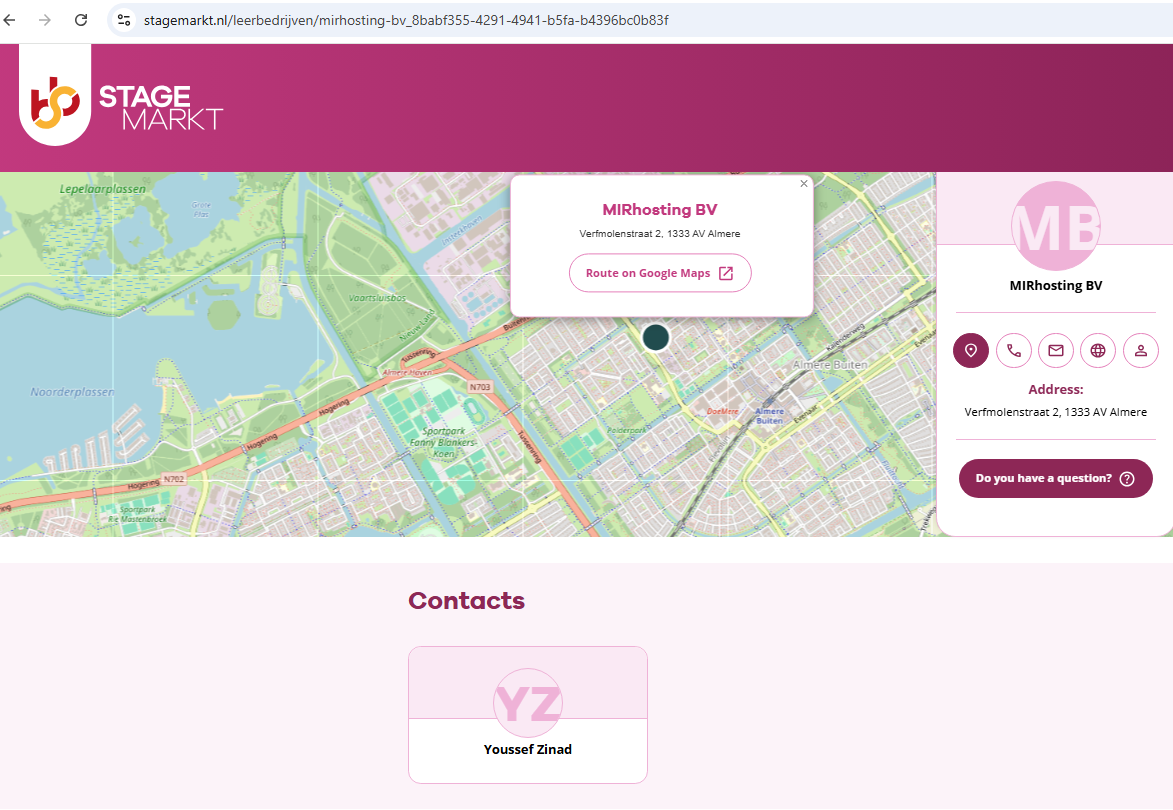
However, in previous emails to KrebsOnSecurity, Nesterenko carbon copied Mr. Zinad (who had a @mirhosting.com email), explaining that he was part of the company’s legal team. Also, the Dutch website stagemarkt[.]nl lists Youssef Zinad as an official contact for MIRhosting’s offices in Almere.

Mr. Zinad has never responded to requests for comment. Nor did de Volkskrant have any luck tracking him down. The publication said it repeatedly asked Mr. Zinad (referred to here as simply “Z”), but he reportedly avoided every form of contact.

“‘I am unavailable but will respond to your message as soon as possible,’ reads an automated reply on WhatsApp on 2 October 2025,” de Volkskrant reported. “It is the only response de Volkskrant would receive in months. He did not pick up his phone and did not call back. When an acquaintance asked him via LinkedIn to contact the reporter, he blocked access to his LinkedIn page. At an address in Almere where Z.’s personal limited company is registered, no one was present in April. The corner house’s blinds were drawn, and a pile of rubbish bags lay outside next to a container, as if someone had recently left. A neighbour said he knew the man but did not know where he was staying. Z. was later arrested at a residence in Amsterdam.”

❌