❌

Normal view

Frieze review – you’ll see more avant garde wonders in the Bake Off tent

15 October 2026 at 10:24

Regents Park, London
This year’s art fair is a jumble sale of mediocre paintings for the super-rich, while its Masters sibling hawks dinosaur skulls and sleazy 19th-century nudes. Welcome to the art market as its most grotesque

Naked people climb out of the earth and run around waving their arms and screaming, while someone with a bird’s head and wings plays the bagpipes. It’s my favourite artwork at this year’s Frieze but don’t go looking for this wildly imaginative outrage among the heaps of contemporary art at Frieze London. It’s a painting by a 16th-century follower of Hieronymus Bosch and is on view at Frieze Masters, the posher tent on the other side of Regent’s Park.

I’m sorry to say I was bored rigid in Frieze London. Many people attend, I imagine, hoping to be informed and excited by the newest, coolest art, but you’ll see more genuinely avant garde wonders in the Bake Off tent. There are endless paintings, none of which are much good, interspersed with photographs which tend to be a little better. The first thing here that held me at all was a two-metre-tall, inkjet print by Wolfgang Tillmans called Paul, nude, golf ball in which the naked Paul has his elbows on the floor and his close-cropped head bowed between them in apparent despair, while the white ball beside him eerily mirrors the pale flesh of his bony back. But it’s not new – it dates from 1994.

Continue reading...

© Photograph: Linda Nylind/Linda Nylind. Courtesy Frieze

© Photograph: Linda Nylind/Linda Nylind. Courtesy Frieze

© Photograph: Linda Nylind/Linda Nylind. Courtesy Frieze

Vermeer by Andrew Graham-Dixon audiobook review – a sharp and authoritative guide

15 October 2026 at 10:00

The author offers intriguing insights into the way this Dutch artist worked, including fresh perspectives on The Girl With the Pearl Earring

In the decades after the death of the Dutch artist Johannes Vermeer in 1675, few knew his name or work. He was so unknown that his paintings were sold with the forged signatures of more popular artists attached. All that changed in the mid-19th century, when his art was reassessed by French critics. Today Vermeer is one of the most admired painters in the world, although, says art historian Andrew Graham-Dixon, he has “proved stubbornly resistant to interpretation”.

Vermeer: A Life Lost and Found, Graham-Dixon’s biography which was six years in the writing, endeavours to answer some unresolved questions, among them: what was Vermeer’s life like? Why did he paint the way he did? What was the intent behind his paintings, of which only 36 exist? Unlike the Dutch genre painters of his time, the Delft-born Vermeer painted solemn yet luminous works featuring women in domestic settings and engaged in activities such as reading, writing, playing music or pouring milk. His ability to render light, and its softening effect on rooms and people, was unparalleled.

Continue reading...

© Photograph: Jiji Press/EPA

© Photograph: Jiji Press/EPA

© Photograph: Jiji Press/EPA

Pope.L review – savage satire from Y-fronts-wearing trickster famed for gruelling ‘crawl’ across New York

15 October 2026 at 07:00

Modern Art, London
The late American took on liberal presumptions and the commercialism of Black culture, even dressing in white bunny ears and underpants

Seven squares are pinned to the wall, each one painted in the high style of American minimalism: pure, austere variations on a theme. At the centre of each is printed the phrase “negro idea” followed by an apparently random number (51, 37, 666). What is Pope.L, the late, great trickster of contemporary American art, getting at?

Perhaps it is a critique of how minimalism, with its ethos of art-for-art’s sake, excluded politics from art? Or a comment on how racial categories are as constructed (and as subject to fashion) as the theories underpinning contemporary art? Or is it a riff on how the edifice of western modernism is built on stolen ideas? Then again, maybe the deployment of an outmoded racial category is simply designed to discomfort the liberal pieties of those people likely to visit this art gallery just off Piccadilly.

Continue reading...

© Photograph: Courtesy The Estate of Pope.L and Modern Art © The Estate of Pope.L

© Photograph: Courtesy The Estate of Pope.L and Modern Art © The Estate of Pope.L

© Photograph: Courtesy The Estate of Pope.L and Modern Art © The Estate of Pope.L

A tour around Amy Winehouse’s private junk: five free art exhibitions to see

15 October 2026 at 06:28

The Back to Black singer’s books, shoes and jigsaw puzzles have gone on display. Elsewhere, a leaky Barbican and some gloriously gloopy sculptures can be viewed in London galleries this week

Continue reading...

© Photograph: Eva Herzog/Courtesy the artist and the Nicoletta Fiorucci Foundation

© Photograph: Eva Herzog/Courtesy the artist and the Nicoletta Fiorucci Foundation

© Photograph: Eva Herzog/Courtesy the artist and the Nicoletta Fiorucci Foundation

Her royal heilness: Berlin show revisits the artist who turned the Queen into a Nazi

15 October 2026 at 02:00

The late Christoph Schlingensief was one of German art’s great provocateurs. Can his B-Movie horror aesthetics still shock us into thinking anew about media power, colonialism, and the far right?

Christoph Schlingensief certainly knew how to provoke. “Fury at German play that shows Queen as a Nazi,” read the Sunday Express’s headline after Kaprow City first premiered at Berlin’s Volksbühne theatre in 2006. Drawing on the happenings of US performance artist Allan Kaprow, the play turned its attention to Diana, Princess of Wales’s death. In one scene, the then queen performs a Hitler salute. Another re-enacts the paparazzi chase that led to Diana’s fatal crash. Diana appears in bed beside two men with Down’s syndrome; and Camilla is pelted with animal blood. Schlingensief insisted the work was not meant as provocation but as an investigation into how Diana turned into a modern icon. But his art thrived on outrage, exposing the absurdity of societies that glorify their idols while consuming their lives as entertainment.

Kaprow City is at the heart of a new Berlin show – It’s Not My Problem Anymore, Deal With Your Own Shit – that revisits the artist’s legacy. In the Gropius Bau’s grand neo-Renaissance atrium, visitors encounter remnants of the carousel-like rotating stage he called the “animatograph”. Looking at this installation today feels like a glimpse into Schlingensief’s mind: a messy collage of childhood memories, violent fantasies and royal glamour.

Continue reading...

© Photograph: © Estate of Christoph Schlingensief

© Photograph: © Estate of Christoph Schlingensief

© Photograph: © Estate of Christoph Schlingensief

Champions League: Mourinho’s Real Madrid stage wild comeback on Roma return

14 October 2026 at 17:43
  • Mourinho’s side score three late goals from 3-1 deficit

  • Dortmund latest team beaten in Norway by Bodø/Glimt

José Mourinho enjoyed a Roma reunion to remember as Real Madrid completed an astonishing comeback by scoring three late goals to claim a 4-3 away win in the Champions League on Wednesday.

Marten de Roon gave the hosts a deserved opener before Kylian Mbappé struck back on his 100th Champions League appearance to level the scores at the break. Two Donyell Malen strikes in the space of six minutes early in the second half seemed to take the game away from the 15-time European champions as Roma ran rampant.

Continue reading...

© Photograph: Guglielmo Mangiapane/Reuters

© Photograph: Guglielmo Mangiapane/Reuters

© Photograph: Guglielmo Mangiapane/Reuters

‘I must continue until I die’: inside the fight to bring Iran’s thriving art scene to the world

14 October 2026 at 10:00

Amid economic sanctions and ongoing conflict, a new initiative is returning Iran’s artists to the international spotlight

When the call came early one morning, Tehran resident Elham Issari knew it must be urgent. The voice on the line was offering something precious. “Miss Elham,” he said excitedly, “I have a single tube of white paint! It’s overpriced and I know it’s overpriced but, if you want it, you have to buy it right now because there’s this other guy in this other city who wants it and you have to tell me within the next five minutes.”

The tube of white paint would have cost Issari 5m tomans (about $36), she recalls. “I was like, I don’t think so, because that’s overpriced, and the next thing you know is it’s 4am and I’m on YouTube watching how to make lead white in your backyard without getting lead poisoning.”

Continue reading...

© Photograph: Courtesy of the artist and Continuum: Artist Relief for Iran, presented by Duran Art Projects. © Aryan Dabbagh, 2021.

© Photograph: Courtesy of the artist and Continuum: Artist Relief for Iran, presented by Duran Art Projects. © Aryan Dabbagh, 2021.

© Photograph: Courtesy of the artist and Continuum: Artist Relief for Iran, presented by Duran Art Projects. © Aryan Dabbagh, 2021.

A dominatrix and her tightly bound client: Giada Ripa’s best photograph

14 October 2026 at 09:39

‘Karen is a Japanese dominatrix and “rope artist” who ties up her clients in a way that echoes how samurai bound their prisoners. Clients are mostly men with high-pressure jobs’

Ten years ago, my dad called to say he had found these amazing images hidden under piles of maps and stuff in an attic in our family home in Piemonte, northern Italy. He had come across a leather-bound album of 53 black and white photographs: portraits of Japanese “native types”, reflecting the 19th-century colonial way of representing people, cultures and views of Japan.

It turned out we had a treasure in our hands: it was an album of photographs by Felice Beato, the first foreign photographer to arrive in Japan in 1863 at the end of the Edo period and on the eve of the Meiji era.

Continue reading...

© Photograph: Giada Ripa

© Photograph: Giada Ripa

© Photograph: Giada Ripa

Companies rushed in on AI. Now some are pulling back

13 October 2026 at 11:00

Rapid AI adoption left workers cleaning up a flood of errors and low-quality work

Employers around the globe are grappling with the fallout from rushing to adopt fast-changing artificial intelligence tools.

Meta has scaled back plans to axe staff and use more AI agents after the company found employees were spending more and more time cleaning up technical and security errors, Reuters reported. And after thinning its workforce, especially middle managers, in a 2023 efficiency push, the company is expanding its managerial ranks again, LinkedIn posts from workers show.

Continue reading...

© Composite: The Guardian/Getty Images

© Composite: The Guardian/Getty Images

© Composite: The Guardian/Getty Images

Larger Than Life review – Wallace, Gromit and the gang say cheeeese for hilarious Aardman origin story

13 October 2026 at 10:00

Lightroom, London
From Shaun’s barn to Gromit’s box, these immersive behind-the-scenes renderings of the wide-grinned, cheeky characters are joyful, enormous – and a bit hard to follow

Nothing is safe from the scourge of immersification. They’ve turned Gustav Klimt and Vincent Van Gogh into vast, projection-mapped digital environments; they’ve told the stories of the moon landings and the dinosaurs and David Bowie as floor-to-ceiling electronic spectacles; and now they’ve come for Aardman. For Wallace and Gromit and Shaun the Sheep, our national treasures. Is nothing sacred?

The latest immersive cinematic experience at Lightroom is a big, eye-popping celebration of Aardman Animations, the company behind the world’s favourite claymation films and TV shows. It moves between documentary storytelling, behind-the-scenes insight and dazzling immersive renderings of all your wide-grinned, cheeky northern favourites.

Continue reading...

© Photograph: Justin Sutcliffe/Justin Sutcliffe for LIghtroom KX

© Photograph: Justin Sutcliffe/Justin Sutcliffe for LIghtroom KX

© Photograph: Justin Sutcliffe/Justin Sutcliffe for LIghtroom KX

50 years on from Arts Britain Ignores: how much has changed for black and Asian artists?

Conference to explore legacy of Naseem Khan’s seminal 1976 report about exclusion of minority ethnic artists

It is 50 years since cultural historian Naseem Khan’s challenge to the British arts establishment was first published, and the question of who and what counts as British continues to be contested.

The Arts Britain Ignores – Khan’s groundbreaking 1976 report, commissioned by organisations including the then Arts Council of Great Britain, presented a vision of a pluralistic national culture, in which the creativity of Britons of diverse ethnic backgrounds – from bhangra music, to black painters and Ukrainian dance – should be recognised, supported and respected.

Continue reading...

© Photograph: Leesha Williams

© Photograph: Leesha Williams

© Photograph: Leesha Williams

Our Bodies Have Been Bridges review – riveting portraits and the story of the first woman on Earth

13 October 2026 at 07:12

Autograph, London
The three-person headline show looking at South American feminism is displayed alongside Charan Singh: Your Tongue in My Mouth, an intimate study of Indian trans communities

In the 1990s, the late Chicana artist Laura Aguilar was living with depression. A friend took her on a road trip to New Mexico, where Aguilar made some nude self-portraits in the mystical landscapes. Those photographs evolved into a pivotal series shot in desert environments across the American south-west, Aguilar’s notable 1996 Nature Self-Portrait – considered an early work of intersectional feminist art, before the word had entered academic discourse.

London gallery Autograph first worked on an exhibition of Aguilar’s in 1997, the year after she made Nature Self-Portrait, so this is something of a homecoming, a generation on. Aguilar’s contours, folds, and crevices sometimes disappear into the barren desert landscapes, assimilating the shapes of boulders or trees; at other times, her body is incongruous, soft flesh that can’t be held by the harsh, barren conditions. These images capture the paradox of a body that is both hypervisible and ignored.

Continue reading...

© Photograph: © Laura Aguilar

© Photograph: © Laura Aguilar

© Photograph: © Laura Aguilar

Tarek Atoui’s Turbine Hall review – hallelujah, it’s raining musical instruments!

12 October 2026 at 10:55

Tate Modern, London
The Lebanese artist has turned trumpets, drums, cones and voices into an ingenious, interconnected sonic beast with funny, sad and mystical results. Prepare to feel the earth move!

On the floor of the Turbine Hall, there are wide water basins and huge flattish rough-hewn rocks you might see on moorland or in a desert. You can sit or stand or climb on them. But if you look up, you won’t be able to stop looking up – because it’s raining musical instruments. Immense elongated brass trumpets and giant glowing drums seem to float in the air, suspended from the girders of the former power station’s roof.

If Lebanese artist Tarek Atoui had just left it at that, it would be an impressive, intriguing installation, but this is Tate Modern, honey, and Atoui hasn’t been asked to occupy its grandest space with mere physical objects. Instead, his sculptural creations and found stuff resonate and echo with an ever-changing, invisible art of noises. An earth-shaking bass note throbs from a hanging trumpet – or is it from that translucent cone rising out of the ground like an ethereal minaret? Then a drumbeat booms through the space and a woman’s plangent, achingly lovely voice sings notes of infinite nostalgia and melancholy.

Continue reading...

© Photograph: David Levene/The Guardian

© Photograph: David Levene/The Guardian

© Photograph: David Levene/The Guardian

Is it a plane or a tree? Amelia Earhart expedition aims to solve mystery of disappearance

12 October 2026 at 09:37

Researchers will head to remote Pacific atoll, but sceptics say satellite images unlikely to be of her aircraft

A team of US researchers is approaching a remote Pacific atoll where they suspect the famed aviator Amelia Earhart crash-landed in 1937, in the latest attempt to crack one of the biggest mysteries of the 20th century.

The 17-person expedition was inspired by satellite images taken over several years showing a submerged object in the uninhabited island’s sandy lagoon – evidence dismissed by other longtime Earhart sleuths who say it is probably a fallen tree.

Continue reading...

© Photograph: Albert Bresnik/AP

© Photograph: Albert Bresnik/AP

© Photograph: Albert Bresnik/AP

Prem Sahib: Chamber review – master of unease twists the city into terror and pleasure

12 October 2026 at 09:00

De La Warr Pavilion, Bexhill
There’s an atmosphere of sickly discomfort throughout this weird, intense mid-career survey for this brilliant artist

Prem Sahib turns the city inside out, twists it around and rips it apart. His show at the De La Warr Pavilion in Bexhill, a sort of mid-career survey for the 44-year-old English artist, is full of private spaces and urban nightmares that have been gutted and left on display. It’s minimal, claustrophobic, intense stuff.

A sodium street lamp hangs upside down from the ceiling, casting its sickly pale orange glow across the gallery. You feel like you’ve stumbled into some urban back alley where physics has been flipped, it has all the threat of an underpass, but surreal and inverted. Nearby, three puffer jackets have been squeezed between sheets of glass – are these the blokes who were waiting for you in the underpass? Or are they three strangers who you’ve caught mid-embrace?

Continue reading...

© Photograph: Ben Westoby/courtesy the artist and Phillida Reid, London

© Photograph: Ben Westoby/courtesy the artist and Phillida Reid, London

© Photograph: Ben Westoby/courtesy the artist and Phillida Reid, London

Gabrielle Goliath: Elegy review – devastating lament is a furious, single-note call to action

12 October 2026 at 07:13

Ibraaz, London
Too controversial for the Venice Biennale, this haunting video and audio work commemorates murders and genocides with an angry act of mourning

The sound of mourning spills out into the streets. A single, endless wailing note echoes out of the basement of Ibraaz, a relatively new cultural centre in London’s Fitzrovia. This is Gabrielle Goliath’s heart-wrenching Elegy, each of its three films featuring a woman singing just one note until their lungs falter and another woman steps up to fill in for her. Just as a note is about to die, it is sustained. It’s a haunting, shocking act of mourning for murder, injustice and genocide.

And it almost never made it.

Continue reading...

© Photograph: Ollie Hammick

© Photograph: Ollie Hammick

© Photograph: Ollie Hammick

Pine cones, glitter and a hip-hop head for sale: red-hot artists reveal their Frieze stunners

12 October 2026 at 00:00

As the sprawling art jamboree hits London, eight of the most exciting exhibiting artists share what their work means to them – and who they hope will buy it

First held in 2003, the Frieze art fair is a giant art supermarket that descends on Regent’s Park, London, every October. Some detest it for its blatant commercialism, others relish it as the opportunity to see a mind-boggling amount of contemporary art in one enormous tent. Here, eight British-based artists of the moment talk through what they’re showing.

Continue reading...

© Photograph: Linda Nylind/The Guardian

© Photograph: Linda Nylind/The Guardian

© Photograph: Linda Nylind/The Guardian

‘Enough of this suffering!’ Joana Vasconcelos on why she is fed up with women’s art defined by pain

11 October 2026 at 19:07

The Portuguese artist is famous for her monumental ceramic wedding cakes and gigantic chandeliers made of tampons. So why is a new show in Lisbon pairing her with Valentino’s size-zero catwalk dresses?

To interview the Portuguese artist Joana Vasconcelos is to jump on to a moving train. She is telling me why she uses needlework to make huge things: 15-metre doilies, say, or a tree 13.5 metres tall rustling with 150,000 hand-sewn leaves. “One day, I said to myself,” she says, “why not bring domestic detail into monumental sculpture? What do we know of works like this? OK, there’s Louise Bourgeois. But it wasn’t enormous. She worked in detail but on small things. There’s the beauty of Niki de Saint Phalle. But it’s always papier mache – a technique that’s very simple, very practical, but not chic.”

It takes a certain something to compare yourself to these two French giantesses of art. It takes something else to castigate Bourgeois and de Saint Phalle for not being big, bold and beautiful enough. But if there’s one female contemporary artist who can do it without coming across as delusional, it’s Vasconcelos. Born in Paris in 1971 into an artistic Portuguese family, Vasconcelos has established herself as one of her country’s leading contemporary artists – and one of the world’s most ambitious.

Continue reading...

© Photograph: Horacio Villalobos/Corbis/Getty Images

© Photograph: Horacio Villalobos/Corbis/Getty Images

© Photograph: Horacio Villalobos/Corbis/Getty Images

‘What could be discovered? What is new there?’: blockbuster exhibition celebrates Roy Lichtenstein

11 October 2026 at 05:00

The often-criticised pop artist is the focus of a monumental new survey including rarely seen pieces and ambitious new restagings at New York’s Whitney Museum

When the American artist Roy Lichtenstein created his monumental Greene Street Mural in 1983, he took inspiration from the Bayeux tapestry for its serial storytelling technique. But whereas the embroidery depicting the Norman conquest continues to delight after nearly 1,000 years, Lichtenstein’s site-specific mural was destroyed after six weeks, in accordance with his wishes.

More than four decades later, however, the monumental Greene Street Mural is to mesmerise art lovers once more. This week a 96ft (29-metre) recreation of the work will span the entire entryway to Roy Lichtenstein: Like New, the first major New York retrospective of the pop artist’s work in 33 years, at the Whitney Museum of American Art.

Continue reading...

© Photograph: Jason Lowrie/Estate of Roy Lichtenstein. Photograph by Jason Lowrie/BFA.com

© Photograph: Jason Lowrie/Estate of Roy Lichtenstein. Photograph by Jason Lowrie/BFA.com

© Photograph: Jason Lowrie/Estate of Roy Lichtenstein. Photograph by Jason Lowrie/BFA.com

Edge Control: the art exhibition using hidden camera images to explore race and beauty

10 October 2026 at 08:00

Artist Deana Lawson uses beauty supply store surveillance images to analyze power and personhood in her exhibition at the Gagosian in New York City

In her essay The Oppositional Gaze: Black Female Spectators, writer and philosopher bell hooks explains that the relationship between Black people and the act of “looking” has been traumatic since slavery. Black people, many of whom are still subject to the constant surveillance that originated during enslavement, have historically been punished with severe consequences, such as lynching, for looking back at those who subjugate them. Despite these risks, hooks writes, they rebelled by secretly looking at white people, as well as their surroundings, rejecting the white gaze as the singular framework of reality. We can, as bell hooks writes, “interrogate the gaze of the Other but also look back, and at one another, naming what we see”.

I thought of this analysis when I visited Edge Control, artist Deana Lawson’s latest photography exhibition at the Gagosian gallery in New York City. Edge control refers to the gels and pomades that slick the hairs along the edges of a Black woman’s hairline, but in Lawson’s exhibit, the phrase takes on an additional meaning. It’s at once a styling product for Black haircare devotees as well as a tool to examine the beauty industry, consumerism and how surveillance and race intersect.

Edge Control is on view at the Gagosian in New York City until 24 October

Continue reading...

© Photograph: Deana Lawson/Courtesy Gagosian

© Photograph: Deana Lawson/Courtesy Gagosian

© Photograph: Deana Lawson/Courtesy Gagosian

‘They looked like two curtain-twitchers, though not very subtle ones’: Peter Crome’s best phone picture

10 October 2026 at 06:00

The photographer was walking home in London when he caught the attention of a pair of canine snoops

Walking home after dropping his little girl at school, Peter Crome sensed he was being watched. A former professional ballet dancer now living in London, he had supplemented his income with photography work for 20 years. “But since having my daughter, my Nikon gear has sat idly by,” he says. “I got so used to lugging my heavy equipment around with me, it’s been quite refreshing to go somewhere just with a phone and still come back with wonderful pictures. My iPhone has also been a blessing for keeping in touch with family back home in Sydney,” Crome adds.

The cause of his disquiet that day was, to his happy surprise, these two dogs. “It was such a comical moment,” he says. “They looked like two curtain-twitchers, though not very subtle ones. I liked how they were perfectly framed with the different layers of window frames, and the brickwork and hedge provided some pleasing textures, but it was the disapproving expression on their faces that made the photo for me.”

Continue reading...

© Photograph: Peter Crome

© Photograph: Peter Crome

© Photograph: Peter Crome

From The Social Reckoning to Harriet Kemsley: your complete entertainment guide to the week ahead

10 October 2026 at 01:00

Jeremy Strong plays Mark Zuckerberg in Aaron Sorkin’s sequel to The Social Network, and the Last One Laughing star reckons with divorce in her new standup tour

The Social Reckoning
Out now
The David Fincher-directed The Social Network has only come to seem more canny over time, with the site co-founded by Mark Zuckerberg being held responsible for all manner of social ills. In this sequel from Aaron Sorkin (this time directing and writing) based on the incidents around the 2021 leak of internal Facebook memos, Zuck is embodied not by Jesse Eisenberg but Jeremy Strong.

Continue reading...

© Photograph: THE SOCIAL RECKONING, Jeremy Strong as Mark Zuckerberg, 2026. ph: Leah Gallo / © Columbia Pictures / courtesy Everett Collection/3F1J0TW THE SOCIAL RECKONING, Jeremy Strong as Mark Zuckerberg, 2026. ph: Leah Gallo / © Columbia Pictures / courtesy Everett Collection Film still

© Photograph: THE SOCIAL RECKONING, Jeremy Strong as Mark Zuckerberg, 2026. ph: Leah Gallo / © Columbia Pictures / courtesy Everett Collection/3F1J0TW THE SOCIAL RECKONING, Jeremy Strong as Mark Zuckerberg, 2026. ph: Leah Gallo / © Columbia Pictures / courtesy Everett Collection Film still

© Photograph: THE SOCIAL RECKONING, Jeremy Strong as Mark Zuckerberg, 2026. ph: Leah Gallo / © Columbia Pictures / courtesy Everett Collection/3F1J0TW THE SOCIAL RECKONING, Jeremy Strong as Mark Zuckerberg, 2026. ph: Leah Gallo / © Columbia Pictures / courtesy Everett Collection Film still

Remember Me review – narrow view of two photographic centuries is like a history of food in three ham sarnies

10 October 2026 at 00:00

Bourse de Commerce, Paris
There are 700 works from François Pinault’s collection on display – more than half of them by Irving Penn – but it’s a blinkered selection and annoyingly didactic

‘Beware … of assuming the sterile attitude of the spectator, for life is not a spectacle” scream the words of Aimé Césaire – writ large and bold by Barbara Kruger, in a giant installation, The History of Tears, that fills Bourse de Commerce’s spectacular Rotunda. Kruger’s angry, menacing, viscerally charged work – words as images, and large-scale video clips of people seething with self-hate – is a thrilling setup for Remember Me, an exhibition that promises a take on 200 years of photography through 700 works by more than 70 artists drawn from the collection of the French billionaire François Pinault. That excitement quickly dissipates as the exhibition moves on.

This is the biggest photography show ever held at the Bourse de Commerce. Remember Me has two main problems: first, it tries to say too much with too few artists. For a start, nearly 450 of the 700 or so works are by Irving Penn. It leans heavily on classical, conventional approaches, styles and familiar names, and that creates a very obvious skew in the perception of what photography is, does, and how it is presented.

Continue reading...

© Photograph: © Irving Penn, Condé Nast Pinault Collection

© Photograph: © Irving Penn, Condé Nast Pinault Collection

© Photograph: © Irving Penn, Condé Nast Pinault Collection

Candlelit theatre in Havana – in pictures

9 October 2026 at 08:15

Widespread blackouts have become increasingly common in Cuba since the US imposed energy sanctions in January. Outages frequently surpass 24 hours as the ageing grid fails. The Impulso theatre group has had to adapt as power cuts pose severe challenges for the performing arts

Continue reading...

© Photograph: Norlys Perez/Reuters

© Photograph: Norlys Perez/Reuters

© Photograph: Norlys Perez/Reuters

Tate sounds eerie, Frieze returns and Cindy Sherman takes surreal selfies – the week in art

9 October 2026 at 07:00

The Turbine Hall gets haunted by sound art and the colossal air fair opens its doors, while Sherman champions the fantastic and the grotesque – all in your weekly dispatch

Tarek Atoui
Sound art inspired by everyday objects and the eerie harmonies of history provides the latest artistic intervention in Tate Modern’s biggest space. Read more here.
• Turbine Hall, Tate Modern, London, from 13 October to 11 April

Continue reading...

© Photograph: Amer Ghazzal/Shutterstock

© Photograph: Amer Ghazzal/Shutterstock

© Photograph: Amer Ghazzal/Shutterstock

Willem de Kooning review – the artist’s lifelong rebellion against himself is thrilling to watch

8 October 2026 at 10:35

Rijksmuseum, Amsterdam
Marking a century since the Dutch artist stowed away to New York, this vast retrospective gloriously showcases the abstract expressionist’s fierce boundary-pushing

Willem de Kooning was the last great artist who really knew how to draw. More precisely, if less provocatively, he was the last truly transformative painter to have been schooled in the academic tradition that produces what is still recognised, by most people, as “good drawing”. Accurate in the sense of a photograph but, like a filter on your cameraphone, also subtly tidying up the world to meet the ideals of classical proportion. “Draw what you see and not what you think,” the young De Kooning was told. Raw personal emotion had no place – a far cry from what this master of abstract expressionism was to become.

The intense labour required to build a connection between eye, brain and hand so quick as to be instinctive is illustrated by the charcoal still life Dish With Jugs. Made when De Kooning was in his mid-teens, and so minutely rendered that you might mistake it for a sepia photograph, the catalogue estimates that it took 600 hours at the Rotterdam academy to complete. The aim of this exercise was not to produce a single picture so much as to ingrain a way of seeing and reconstructing the world to the point that it becomes inescapable.

Continue reading...

© Photograph: © 2026 The Willem de Kooning Foundation/ Pictoright, Amsterdam

© Photograph: © 2026 The Willem de Kooning Foundation/ Pictoright, Amsterdam

© Photograph: © 2026 The Willem de Kooning Foundation/ Pictoright, Amsterdam

The woman with the mattress: the radical, rage-fuelled history of anti-rape art

8 October 2026 at 10:19

A performance piece from 2014 has gone viral in response to an allegation of rape at Cornell University. But with such defiant pieces stretching back hundreds of years, will things ever change?

In September 2014, Emma Sulkowicz began to carry a blue mattress weighing 23kg around her university campus. The mattress was similar to the ones New York’s Columbia University used in its dorm rooms, where Sulkowicz said she had been raped by a fellow student two years earlier. Her performance/endurance artwork constituted her visual art senior thesis, drawing attention to the lack of criminal charges brought against her alleged attacker and his continued presence at the university. As she hauled it across campus, others could choose to assist her with her burden. Many did. She recorded responses to the piece in a diary.

“I could have taken my pillow,” she told the writer Jessica Valenti at the time. “But I want people to see how it weighs down a person to be ignored by the school administration and harassed by police.” Sulkowicz would carry the mattress, she said, for as long as her alleged attacker remained at Columbia. And so she ended up carrying it all the way to graduation where, helped by other women, she took it on stage. The university president refused to shake her hand, turning away from her instead.

Continue reading...

© Photograph: Andrew Burton/Getty Images

© Photograph: Andrew Burton/Getty Images

© Photograph: Andrew Burton/Getty Images

Lourdes gets a Vegas glow-up at Dublin theatre festival, where canvases are slashed

8 October 2026 at 07:23

A musical about a drama group’s pilgrimage and reflections on activist art join an intriguing show about lost languages

In a Dublin theatre festival programme tackling heavy themes of racism, conflict and prejudice, Lourdes! The Musical (★★★★☆) promises something effervescent. Xnthony Ltd, the creators of Oliver Cromwell Is Really Very Sorry, have turned their lightly quizzical gaze to the French pilgrimage town – “a holy Blackpool, a divine Las Vegas” and a site of hope or desperation for five unlikely travelling companions.

Back in his home village in “Countryland”, in 2008, following a diagnosis of HIV that punctures his dreams of Los Angeles, singer-songwriter Matthew (Riain Cash) lends his star power to a parish drama group taking a musical about Saint Bernadette to Lourdes. Interweaving this show-within-a-show and the pilgrimage strands, Xnthony’s lyrics and Matthew Floyd Jones’s score blend pop, club beats and soulful ballads. Directed by Sarah Meadows, the supercharged ensemble joining Cash as, variously, a droll priest (Iestyn Arwel), a terminally ill mother and her transgender daughter (Nichola MacEvilly and Danielle James) and an eager tour manager (Molly Lynch) carry the music’s tonal shifts effortlessly.

Continue reading...

© Photograph: Patricio Cassinoni

© Photograph: Patricio Cassinoni

© Photograph: Patricio Cassinoni

‘The weirdos were taking over!’ Tate Britain relives the 1990s – in pictures

8 October 2026 at 02:00

A new exhibition curated by Edward Enniful looks back on the thrilling decade before smartphones, when art, music and fashion came together with a bang

Continue reading...

© Photograph: Eddie Otchere

© Photograph: Eddie Otchere

© Photograph: Eddie Otchere

Crush-worthy photography, camp sci-fi and a centenarian’s florals: five free exhibitions to see

7 October 2026 at 11:16

A little exhibition of Daidō Moriyama at his artiest and strangest, like Warhol with added filth, is among the best on show in London’s free-entry commercial galleries this week

If it’s a crime to have a crush on an elderly avant garde Japanese street photographer then lock me up and throw away the key, because I have some seriously strong feelings for Daidō Moriyama. His ultra-confrontational, high contrast, aggressive take on photography just gets me blushing, what can I say.

Continue reading...

© Photograph: © Daidō Moriyama, Courtesy Hamiltons Gallery

© Photograph: © Daidō Moriyama, Courtesy Hamiltons Gallery

© Photograph: © Daidō Moriyama, Courtesy Hamiltons Gallery

Robert Ryman review – can your brain handle a show that only has white paintings?

7 October 2026 at 10:47

Barbican Art Gallery, London
What seem at first indistinguishable canvases offer challenges, revelations and transcendental effects – but only if you can give yourself over to them

Writing about painting is a futile exercise at the best of times. This is especially the case when, as with Robert Ryman, the paintings in question are variations on the theme of white. If that sounds pretentious – or like a tired joke – then it might also be understood as a reaction against the dependence of so much art on language (which is also to say, bullshit). Because these bare-bones paintings – white paint, a flat surface, wall fixtures – are the “real thing” in the most literal way: they are not trying to tell you a story, they do not require you to be familiar with any abstruse theories. There is just you and the materials, how the paint lies, how it scatters the light. So the question is: how much do you like looking at paint?

Happily for me, given that it is a non-negotiable part of my job, I really like looking at paint. If you also like looking at paint, then there is much in this exhibition that will take your breath away. Take The Painting of the Mysterious Shadow from the mid-60s, after Ryman had left his job as a guard at MoMA, having given up on a career as a jazz musician, and settled into the project that would occupy the rest of his life. Six thick white stripes run horizontally across the canvas, as close to each other as can be managed by a steady hand without overlapping. The fabric is stretched over a deep wooden frame, meaning that its surface sits about three inches off the wall, and casts a thin shadow upon it. That’s your lot.

Continue reading...

© Photograph: Robert Ryman / DACS, London. Photo: Bill Jacobson Studio, © The Greenwich Collection, New York.

© Photograph: Robert Ryman / DACS, London. Photo: Bill Jacobson Studio, © The Greenwich Collection, New York.

© Photograph: Robert Ryman / DACS, London. Photo: Bill Jacobson Studio, © The Greenwich Collection, New York.

The Orange Plague

7 October 2026 at 11:22
"At a busy thoroughfare inside the European Parliament, passing politicians are now confronted with a grotesque and gilded vision of American power: an 8.5-foot-tall statue of President Donald Trump, naked but for a thin layer of 23-karat gold leaf. 'Trump likes gold,' said Danish artist Jens Galschiøt, the statue's creator, over the phone after it was unveiled Tuesday. 'In a way, I think he would like this sculpture.'"

"Titled 'The Orange Plague,' the artwork has been installed in Strasbourg, France, the official seat of the European Parliament. The copper sculpture, also dubbed the 'King of Injustice,' imagines the US president on the shoulders of a frail smaller figure. His thighs and sagging belly wrap tightly around the man's head; his hands clutch at a long golf club and the scales of justice." "'I am sitting on the back of a man,' reads the text [a quote from Leo Tolstoy] on the statue's plinth. 'He is sinking under my burden. I will do anything to help him. Except step down from his back.'" "Galschiøt has exhibited 'The Orange Plague', [or in German, 'Die Orange Pest'] in public several times before, including at [the Danish Parliamentary building,] the Munich Security Conference, and last November's COP30 UN climate conference in Brazil. He also plans to display it at COP31 in Antalya, Turkey next month." "He said his decision to depict Trump naked alludes to Hans Christian Andersen's story "The Emperor's New Clothes," in which a vain emperor parades the city in the nude. 'Dictators don't like you laughing at them,' he explained." "The most recent temporary display is expected to remain on show until Thursday. It is accompanied by over 1,000 3D-printed miniatures of the sculpture, which are being made available to passersby as 'protest tokens.'"

The Failure of the Pandemic Novel

7 October 2026 at 04:39
That Will There, Transcription, and Down Time each tease out the confluence of ambivalence, exhaustion, and over-compensative compliance that underscored pandemic life is compelling. Their characters' lack of clarity about Covid and its consequences is, ironically, its own form of clear-sightedness. It speaks to a very contemporary feeling of unease about Covid and the recent past and what this ultimately says about where the culture is heading.

Women behind the lens: ‘I felt suspended between hope and giving up’

7 October 2026 at 02:00

The Ethiopian photographer Sosina Mengistu’s self-portraits draw on personal experience to reflect young people’s anxiety and frustration

This self-portrait is part of my project So I See Me, which I began in 2020 during the Covid-19 pandemic and continue to this day. The title reflects the central idea: using the camera to look at myself. But it also carries a subtle echo of my name, Sosina.

When the pandemic started, I was in my final year of an engineering degree at the University of Gondar in Ethiopia. I was excited to graduate and begin the next chapter of my life, then everything suddenly came to a halt. Thinking the travel restrictions would only last for a short time, I decided to stay with my uncle in Bahir Dar in the north rather than travel back to my home town, Asosa, more than 450 miles to the west. I ended up stuck there for eight months.

Continue reading...

© Photograph: Sosina Mengistu

© Photograph: Sosina Mengistu

© Photograph: Sosina Mengistu

Why this Sidney Nolan painting was a breakthrough moment for Australian modern art – video

Sidney Nolan’s famous Ned Kelly series is on display as part of an exhibition of work from the artist’s formative years, now showing at the Art Gallery of New South Wales. But senior curator Denise Mimmocchi walks us through the exhibition to highlight a lesser-known earlier work, which Nolan created when he was conscripted in the army, stationed at Victoria’s Wimmera region in 1943. Mimmocchi explains why Kiata was a breakthrough painting for Nolan, and also a breakthrough moment for Australian modern art

Continue reading...

© Photograph: The Guardian

© Photograph: The Guardian

© Photograph: The Guardian

Greek prime minister vows to ‘ramp up’ efforts to regain Parthenon marbles

6 October 2026 at 12:50

Kyriakos Mitsotakis says his UK counterpart, Andy Burnham, has been supportive of restitution efforts in the past

The Greek prime minister has vowed to “ramp up” his country’s claims to get back the Parthenon marbles from the British Museum, emphasising that his UK counterpart, Andy Burnham, was hugely supportive of restitution efforts before he moved into Downing Street.

Kyriakos Mitsotakis said he would raise the issue in the strongest of terms when he met Burnham, who was culture secretary in a previous Labour government.

Continue reading...

© Photograph: Andy Rain/EPA

© Photograph: Andy Rain/EPA

© Photograph: Andy Rain/EPA

‘My poetry won me asylum’: Cecilia Vicuña on exile life in ‘sad’ Britain after Pinochet’s coup

6 October 2026 at 10:28

Five decades after convincing judges she’d be killed if she returned to Chile, the artist is back with a politically charged retrospective in the country she grew to love

Cecilia Vicuña was 24 when she first arrived in London. She had come from Santiago on a British Council scholarship to study at the Slade School of Art, and her stay was supposed to be so brief that she didn’t even unpack her suitcase.

Then, in September 1973, General Augusto Pinochet’s military coup overthrew Chile’s democratically elected president, Salvador Allende. Vicuña was one of a handful of Chilean students in London immediately expelled from their universities and expected to leave Britain. At a Home Office hearing, her pro-bono lawyers argued that she would be killed if she returned to Chile, and showed the judges her recently published art and poetry book, Saborami, which documented the aftermath of the coup. The judges granted her asylum.

Continue reading...

© Photograph: David Levene/The Guardian

© Photograph: David Levene/The Guardian

© Photograph: David Levene/The Guardian

‘I’m bringing together women who nourish me’: French film-maker Alice Diop on her debut installation

6 October 2026 at 09:08

The Saint Omer director has gathered work by artists, writers, composers and poets for Geste de Consolation, set in the 60m-long central hall of the Palais d’Iena in Paris

Alice Diop has just returned to France from California when we speak. It’s a Zoom meeting with a bad connection, and Diop leans close to the camera, always in frame, barely moving. It’s like watching the characters in her documentaries and films, where her camera lingers on its subject with a slow, cool intensity.

Diop had been attending a two-week celebration of her work organised by the French department at University of California, Berkeley, in which academics pored over her documentaries (Nous (We), Vers La Tendresse (Towards Tenderness)) and her first feature film, Saint Omer, which received the Silver Lion in Venice in 2022. The courtroom drama was inspired by a real trial that Diop attended, of a Senegalese woman who had allowed her baby to drown in the sea. Over two hours, it explored the complexities of race, culture and motherhood in contemporary France. The film was the first by a black female director to be entered by France as its official entry in the 2023 Academy Awards.

Continue reading...

© Photograph: Miu Miu, Art Basel

© Photograph: Miu Miu, Art Basel

© Photograph: Miu Miu, Art Basel

The 90s: Art and Fashion review – this isn’t an exhibition, it’s a magazine spread

6 October 2026 at 05:54

Tate Britain, London
The Young British Art of the 1990s was brash and macabre but also intelligent and emotional. This breathlessly superficial show reduces it to a stylish pose

Jake and Dinos Chapman were dismissed by some even in the 1990s as overgrown adolescents selling shock for its own sake, and yet it is their work that brings this dismally shallow show closest to a moment of depth. Their sculpture Great Deeds Against the Dead, based on a print of Napoleonic war atrocities by Goya, is a display of dismembered, bleeding nude corpses hung on a tree. It asks questions about war and art, the representation of pain, whether art can have a moral purpose. The best British art of the 1990s was like that, coming on as brash, vulgar, macabre, yet also unexpectedly intelligent and emotional. Unfortunately this show is neither.

You’d think Tate Britain would want to do justice to a decade in which these Millbank premises played a starring role, staging the Turner prize in the years when bisected cows, concrete houses and elephant dung got the nation arguing. At the start of the 1990s no one thought Britain was a leader in contemporary art. By the millennium, we were better known for new art than new novels.

Continue reading...

© Photograph: Jake and Dinos Chapman/Jake and Dinos Chapman. All Rights Reserved, DACS Images

© Photograph: Jake and Dinos Chapman/Jake and Dinos Chapman. All Rights Reserved, DACS Images

© Photograph: Jake and Dinos Chapman/Jake and Dinos Chapman. All Rights Reserved, DACS Images

‘I call them erotic landscapes’: fashion photographer Tim Walker on his powerful tapestry of queer Britain

6 October 2026 at 00:00

He has shot everyone from Madonna to Rihanna, Kate Moss and Frank Ocean. Now Walker has turned his lens on the activists, artists, writers, models and everyday heroes of gay life

Six years ago, Tim Walker was walking in the Highbury Fields area of London when he came across a plaque on the side of a building. In 1970, at these now-converted public toilets, Louis Eakes, chairman of the Young Liberals, was arrested for importuning following a “pretty police” entrapment in which male officers posed as would-be sex partners.

It was here, the plaque told the photographer, that the first ever gay rights demonstration in Britain had taken place, organised by the Gay Liberation Front, in protest at Eakes’s arrest. But Walker was jolted by the date: 27 November 1970. It was the day he was born. So he wondered: “Who were those people out marching that day? Where are they now?”

Continue reading...

© Photograph: Courtesy Tim Walker

© Photograph: Courtesy Tim Walker

© Photograph: Courtesy Tim Walker

Sleeping Beauties by David Byrne review – a quirky journey through the afterlife of invention

5 October 2026 at 02:00

The Talking Heads frontman considers dormant ideas that made a comeback – from Indian irrigation to Kafka

There’s barely been a moment in  the last half-century when David Byrne hasn’t been zinging about, dancing forward, opting odd. The art-school dropout frontman of Talking Heads, he moved sideways into ballet, dance and experimental theatre, collaborated on the proto-ambient LP My Life in the Bush of Ghosts with his fellow polymath Brian Eno, directed films, wrote musicals (on – of course – Imelda Marcos), co-founded a label (Luaka Bop) that introduced the likes of Os Mutantes and William Onyeabor to a new generation, brought out books of tree drawings, and designed bicycle racks.

Byrne’s career – by most measures a remarkably successful one – has been built from code-switching, fidgety intelligence, stylistic infidelity. At first glance then, it’s surprising that Sleeping Beauties is devoted to failure – to artists who were ignored, laughed at, forgotten; to ideas deemed batty or heretical; to ways of thinking about the world – sustaining it, replenishing it – that, often for political reasons, were found wanting, and wiped from our collective memory banks. Sleeping beauties is (of course) a term he first encountered in an academic paper by Leiden University scientometrics professor Ton van Raan. That was in 2004: this book, like a lot of the ideas and energies it animates, needed time to ferment.

Continue reading...

© Photograph: Jody Rogac

© Photograph: Jody Rogac

© Photograph: Jody Rogac

Argentine court clears return of Nazi-looted portrait worth $400,000

29 September 2026 at 00:37
Argentine court clears return of Nazi-looted portrait worth $400,000 Australian. A portrait looted from a Jewish art dealer in WWII will be given back to the owner's heir, after a deal where the daughter of a fugitive Nazi official agreed to drop her claim. Portrait of a Lady, by Italian baroque painter Giacomo Ceruti, had been missing for eight decades. But its existence was revealed last year, after being photographed hanging in the home of the daughter of a senior Nazi officer, who had fled to Argentina after World War II.

The Expressions of Tethys

24 September 2026 at 10:19
Installation by Julius Von Bismarck . Die Mimik der Tethys (The Expressions of Tethys) "...a buoy hung over the Palais de Tokyo's Palier d'honneur, corroded by sea salt and covered by dry seaweed. In perpetual motion, the buoy reproduces the movements of its original setting, off the Atlantic coast. It is in this way that the visitors find themselves metaphorically under the ocean, and can directly perceive the sway of its waves, which can be either gentle, or wild." quoted from this article.

Photos from the artist's own site showing the making of the piece.

The woman who made Vincent van Gogh famous

21 September 2026 at 09:38
What makes art famous and valuable? Who makes art famous and valuable? Those questions can feel impossible to answer. But in the case of Vincent (someone often referred to by only his first name more than 125 years after his death), we know the answer. It was Jo (pronounced "Yo" in Dutch), his 28-year-old sister-in-law, who inherited hundreds of his paintings that, at the time, had little market value. Jo is the reason that we see Vincent's art absolutely everywhere today. We should all know her name.

1893 in the Margins

18 September 2026 at 17:05
Pamela Toler (History in the Margins, 9/5/26), "The Great Panic of 1893": "occasionally an event, or person, or book, or idea ... shows up in footnotes or casual asides ... if it's interesting or important enough, I share it ... Lately, the Great Panic of 1893 has become insistent." Neil Flanagan (The Birth of a Capital, 9/4/26), "How often do you think about the 1893 World's Fair?": "what draws us to an event, story, or image depends less on the context of the events than the context we inhabit." Photos / maps / VR of the fair. Foods, sweet treats, and "orange cider" of the fair. Pall Mall Magazine and RIBA Journal on the fair. And other magazines that began in 1893 feature Ida Tarbell on "Pasteur at Home," famous prints, rules for psychic / occult investigators, articles on orchidology and astronomy, "Last Week's Paris" followup on anarchists, and the first story of Sexton Blake.

Data Broker Radaris Loses Domains in Privacy Fight

16 September 2026 at 14:14

The consumer data broker Radaris.com has long had a reputation for ignoring requests to remove personal information from its vast empire of people-search services online. That reputation caught up with the company recently in a lawsuit alleging Radaris violated a New Jersey privacy law that provides for hefty fines against data brokers that publish personal information on state law enforcement officials. In the face of repeated stonewalling and prevarication by attorneys for Radaris, the judge in the case ordered that radaris.com and more than a dozen other data broker domains be transferred to the plaintiffs.

The radaris.com website, prior to the domain transfer to Atlas.

In February 2024, Radaris was sued by Atlas Data Privacy Corp, a company that has been pursuing data brokers alleged to be violating a New Jersey statute called Daniel’s Law. The statute allows state law enforcement officials, government personnel, judges and their families to have their information completely removed from commercial data brokers and people-search services, and provides for fines of $1,000 per violation against companies that ignore removal requests.

Less than a month after Atlas sued Radaris, KrebsOnSecurity published a deep dive into the Radaris co-founders — Igor and Dmitry Lubarsky (also spelled Lybarsky) — Russian-born brothers living in Massachusetts who operate a dizzying array of people-search companies as well as a number of Russian language dating services and affiliate programs.

Attorneys for the Lubarsky brothers threatened to sue for defamation if the story wasn’t removed and an apology issued. Their attorney asserted that our reporting was wildly inaccurate, and that the true owners of the company were Ukrainians living in Ukraine.

The Lubarsky brothers Dmitry or “Dan” (left) and Gary/Igor.

KrebsOnSecurity doubled down and showed how the Lubarsky brothers built and operated Radaris and other data broker companies using a fictitious CEO’s name. Our follow-up story noted that Radaris’s attorney — a lawyer with the Boston Law Group named Val Gurvits — admitted his clients had invented the CEO pseudonym “Gary Norden,” and that Radaris also had issued multiple press releases over the years that quoted the fake CEO while seeking money from potential investors.

Attorneys for Radaris waited until the last minute to appear in court and contest what was all but certain to be a default judgment in favor of the plaintiffs, and then told the court that Atlas had failed to serve the real owners and operators of Radaris and several of its sister data broker companies.

Atlas re-filed the lawsuit in June 2025, this time dramatically expanding the number of Radaris family data brokers accused of violating Daniel’s Law. Matt Adkisson, president and CEO of Atlas, said Radaris turned to a tried-and-true playbook: Delaying in court until the last possible minute, and playing shell games with Radaris’s true country of origin and the individuals listed as owners and operators of these sites.

“We refer to this period as their island-hopping phase. Privacy policies changed constantly, and new entities kept appearing from places like the Marshall Islands, the British Virgin Islands, and Seychelles,” Adkisson told KrebsOnSecurity. “Behind the scenes, it felt like a shell game. Defense lawyers told the court that certain entities merely operated the domains and were the proper parties to sue. But by the time a judgment neared, those entities would be discarded and new entities would appear. Meanwhile, the lawyers claimed the other entities that actually owned the domains should not be held responsible.”

Adkisson said when the defendants updated their terms of service to state that Radaris was suddenly managed by a company in the Marshall Islands, Atlas hired an investigator in that country and soon learned the brand new entity that Radaris claimed was managing the company didn’t even exist yet.

Mr. Gurvits stepped forward as Radaris’s attorney in a class action lawsuit the company temporarily lost in 2017 because it never contested the claim in court. When the plaintiffs told the judge they couldn’t collect on the $7.5 million default judgment, the court ordered the domain registry Verisign to transfer the radaris.com domain name to the plaintiffs.

Mr. Gurvits appealed that verdict, arguing the lawsuit hadn’t named the actual owners of the Radaris domain name — a Cyprus company called Bitseller Expert Limited — and thus taking the domain away would be a violation of their due process rights.

The judge in the 2017 case ruled in Radaris’ favor — halting the domain transfer — and told the plaintiffs they could refile their complaint. Soon after, the operator of Radaris changed from Bitseller to Andtop Company, an entity formed (PDF) in the Marshall Islands in Oct. 2020. The plaintiffs never re-filed their lawsuit.

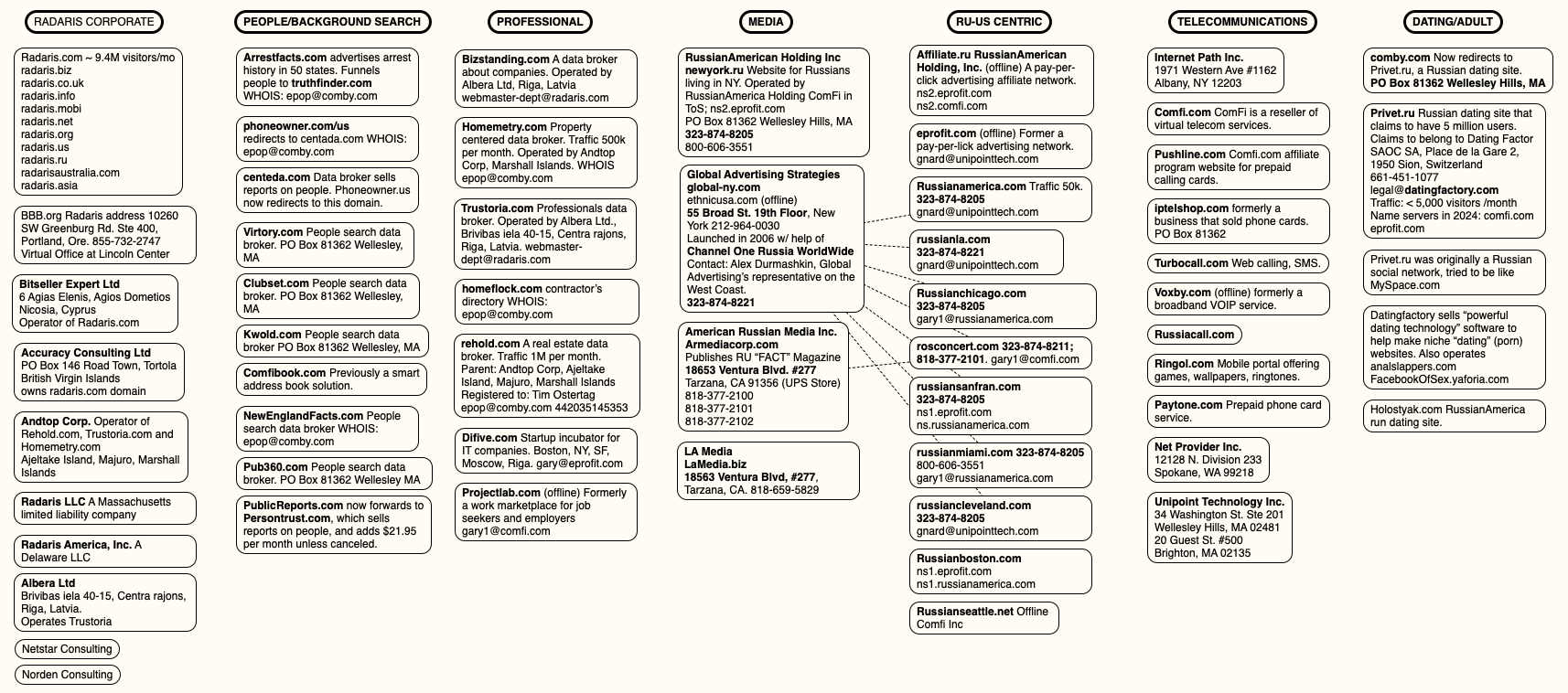
A mind map of various entities tied to Radaris and the company’s co-founders. Click to enlarge.

“That seemed to be their modus operandi,” said Raj Parikh, a partner at PEM Law in New Jersey who handles most of the Daniel’s Law litigation for Atlas. “In the past, they won by attrition. Plaintiffs’ attorneys tired of the procedural games and just gave up. That strategy worked for a decade, and it probably would have worked in this case too, since any financial recovery from foreign actors will be difficult. But we were acutely aware of the threat this website posed to law enforcement officers and other public officials in New Jersey, and decided early on to commit whatever time and resources were necessary to remove that threat.”

On August 26, the judge in the New Jersey case found the defendants were given multiple chances to appear and defend the claims against them but had failed to do so. Mr. Gurvits declined to comment on the case, saying it had been assigned to another attorney, a Mr. Victor Worms. In response to questions, Mr. Worms asserted the New Jersey court transferred Radaris.com to Atlas as part of a default judgment against Radaris.com, which is not a legal entity.

“We have made a motion to vacate that default judgment on the grounds that it is void since a non-entity has no legal capacity to sue or be sued,” Worms replied. “We also intend to pursue all appropriate appeals because we believe the transfer of Radaris.com amounts to a forfeiture in violation of various constitutional principles.”

While radaris.com still comes up prominently in results when searching online for U.S. residents by name, the domain no longer sells detailed personal dossiers on millions of Americans. Its homepage now displays a notice from Atlas, as well as links to our previous reporting on Radaris.

EMAIL CONFIRMATIONS

Atlas told KrebsOnSecurity that it has obtained more than 10,000 emails and documents in the course of litigation, and that those messages confirm our previous reporting on the owners and operators of Radaris and its myriad companies.

Atlas said the emails clearly establish that the nominal legal vehicles — Radaris America, Inc.; Bitseller Expert Limited; Digital Orbit Corp; Core Solutions Group Inc; Lucky Solutions Inc; Virtura Corp; Veripages Inc.; Nuform Solutions Inc.; Growth Data Advisors Inc.; Property Experts, Inc — are all administered by the same three or four people from the same mailboxes, share one bank or payment card set, and are all managed from one virtual office address.

“The corpus establishes, with documentary evidence generated independently by banks, payment processors, hosting providers, registrars, software-as-a-service vendors and the operators’ own systems, that radaris.com and at least twenty-five other people-search websites are one operation run by a small Boston-area group whose administrative, financial and technical functions sit on the difive.com mail domain and its successors (centerex.com, scienteco.com, eprofit.com, realmo.com, pub360.com),” reads a summary shared by Atlas.

Atlas said the emails show Radaris.com earns approximately $42,000 a month, while Veripages.com earns around $45,000 monthly via its partnership with the Lifetime Value Company, a marketing and advertising firm whose brands include PeopleLooker, PeopleSmart, NumberGuru, and Bumper, a car history site.

According to Atlas, the emails also showed the Radaris family of websites earns as much as $25,000 each month from their partnership with Onerep, a company that claims to help people remove their information from people-search sites. In March 2024, KrebsOnSecurity revealed how the Belarusian founder of Onerep had launched and operated dozens of people-search sites over the years and was continuing to operate one of them (Nuwber), effectively spreading the disease and selling the cure.

The domain radaris.com now redirects to this notice from Atlas about the court-ordered domain transfer.

The domain radaris.com now redirects to this notice from Atlas about the court-ordered domain transfer.

All told, the New Jersey court has so far transferred 14 domain names from the Radaris family of companies to Atlas. Radaris.com now redirects to a notice of the court-ordered domain transfer.

THE ROAD AHEAD

The Radaris family of companies is still potentially facing fines of $1,000 per alleged violation of Daniel’s Law. For the time being, however, Daniel’s Law is facing a constitutional challenge from virtually all of the 150 other consumer data broker firms being sued by Atlas.

The data broker industry responded by having at least 70 of the Atlas lawsuits moved to federal court, challenging the New Jersey statute as overly broad and a violation of the First Amendment. The U.S. Court of Appeals for the Third Circuit has not yet issued a decision on the constitutional challenge, but either way the case is widely expected to be appealed all the way to the U.S. Supreme Court.

Meanwhile, at least 14 other states have now passed laws modeled after the New Jersey statute, with more states considering similar measures. However, West Virginia’s Daniel’s Law was ruled facially unconstitutional under the First Amendment by a federal district court in August 2025.

Justin Sherman is a privacy expert and author of the forthcoming book “The Middlemen,” which examines how the data broker industry powers modern surveillance. Sherman said federal lawmakers have long faced intense lobbying by the technology industry against more restrictive U.S. data privacy laws, but that many powerful industries are now working against passing comprehensive data privacy legislation.

“These days at the federal level, add in the intense amount of lobbying against these laws from social media companies, big tech, cryptocurrency firms, and now AI proponents in the mix who claim that limiting their data scraping is somehow going to collapse the whole U.S. economy under Chinese rule,” he said.

Sherman said people-search companies will continue to thrive unless and until Congress enacts meaningful consumer privacy and data protection laws that are relevant to life in the 21st century. That’s because virtually all state privacy laws exempt records that might be considered “public” or “government” documents, including voting registries, property filings, marriage certificates, motor vehicle records, criminal records, court documents, death records, professional licenses, bankruptcy filings, and more.

At least 25 states have passed or implemented laws requiring age verification for residents seeking to access adult content online, but there is no federal law that limits how the companies that are scanning everyone’s drivers license can use, share or keep the data provided. Had such restrictions been enshrined in law, we may have avoided the recent breach at IDScan.net, which exposed the drivers license information on more than 153 million Americans when the records were briefly turned into a point-and-click identity theft service on the dark web.

“The average person can look at Daniel’s Law and have a perfectly normal reaction, which is that everyone should be covered, not just police and judges,” Sherman said. “But we don’t need more wake-up calls. We’ve had eight million wake-up calls already on the need for better privacy laws. The lack of comprehensive federal privacy law is not for a lack of knowledge, and anyone claiming otherwise is either not reading the news or kidding themselves.”

❌