Normal view

Received before yesterday

Google Sues to Disrupt Chinese SMS Phishing Triad

13 November 2025 at 09:47

Google is suing more than two dozen unnamed individuals allegedly involved in peddling a popular China-based mobile phishing service that helps scammers impersonate hundreds of trusted brands, blast out text message lures, and convert phished payment card data into mobile wallets from Apple and Google.

In a lawsuit filed in the Southern District of New York on November 12, Google sued to unmask and disrupt 25 “John Doe” defendants allegedly linked to the sale of Lighthouse, a sophisticated phishing kit that makes it simple for even novices to steal payment card data from mobile users. Google said Lighthouse has harmed more than a million victims across 120 countries.

A component of the Chinese phishing kit Lighthouse made to target customers of The Toll Roads, which refers to several state routes through Orange County, Calif.

Lighthouse is one of several prolific phishing-as-a-service operations known as the “Smishing Triad,” and collectively they are responsible for sending millions of text messages that spoof the U.S. Postal Service to supposedly collect some outstanding delivery fee, or that pretend to be a local toll road operator warning of a delinquent toll fee. More recently, Lighthouse has been used to spoof e-commerce websites, financial institutions and brokerage firms.

Regardless of the text message lure or brand used, the basic scam remains the same: After the visitor enters their payment information, the phishing site will automatically attempt to enroll the card as a mobile wallet from Apple or Google. The phishing site then tells the visitor that their bank is going to verify the transaction by sending a one-time code that needs to be entered into the payment page before the transaction can be completed.

If the recipient provides that one-time code, the scammers can link the victim’s card data to a mobile wallet on a device that they control. Researchers say the fraudsters usually load several stolen wallets onto each mobile device, and wait 7-10 days after that enrollment before selling the phones or using them for fraud.

Google called the scale of the Lighthouse phishing attacks “staggering.” A May 2025 report from Silent Push found the domains used by the Smishing Triad are rotated frequently, with approximately 25,000 phishing domains active during any 8-day period.

Google’s lawsuit alleges the purveyors of Lighthouse violated the company’s trademarks by including Google’s logos on countless phishing websites. The complaint says Lighthouse offers over 600 templates for phishing websites of more than 400 entities, and that Google’s logos were featured on at least a quarter of those templates.

Google is also pursuing Lighthouse under the Racketeer Influenced and Corrupt Organizations (RICO) Act, saying the Lighthouse phishing enterprise encompasses several connected threat actor groups that work together to design and implement complex criminal schemes targeting the general public.

According to Google, those threat actor teams include a “developer group” that supplies the phishing software and templates; a “data broker group” that provides a list of targets; a “spammer group” that provides the tools to send fraudulent text messages in volume; a “theft group,” in charge of monetizing the phished information; and an “administrative group,” which runs their Telegram support channels and discussion groups designed to facilitate collaboration and recruit new members.

“While different members of the Enterprise may play different roles in the Schemes, they all collaborate to execute phishing attacks that rely on the Lighthouse software,” Google’s complaint alleges. “None of the Enterprise’s Schemes can generate revenue without collaboration and cooperation among the members of the Enterprise. All of the threat actor groups are connected to one another through historical and current business ties, including through their use of Lighthouse and the online community supporting its use, which exists on both YouTube and Telegram channels.”

Silent Push’s May report observed that the Smishing Triad boasts it has “300+ front desk staff worldwide” involved in Lighthouse, staff that is mainly used to support various aspects of the group’s fraud and cash-out schemes.

An image shared by an SMS phishing group shows a panel of mobile phones responsible for mass-sending phishing messages. These panels require a live operator because the one-time codes being shared by phishing victims must be used quickly as they generally expire within a few minutes.

Google alleges that in addition to blasting out text messages spoofing known brands, Lighthouse makes it easy for customers to mass-create fake e-commerce websites that are advertised using Google Ads accounts (and paid for with stolen credit cards). These phony merchants collect payment card information at checkout, and then prompt the customer to expect and share a one-time code sent from their financial institution.

Once again, that one-time code is being sent by the bank because the fake e-commerce site has just attempted to enroll the victim’s payment card data in a mobile wallet. By the time a victim understands they will likely never receive the item they just purchased from the fake e-commerce shop, the scammers have already run through hundreds of dollars in fraudulent charges, often at high-end electronics stores or jewelers.

Ford Merrill works in security research at SecAlliance, a CSIS Security Group company, and he’s been tracking Chinese SMS phishing groups for several years. Merrill said many Lighthouse customers are now using the phishing kit to erect fake e-commerce websites that are advertised on Google and Meta platforms.

“You find this shop by searching for a particular product online or whatever, and you think you’re getting a good deal,” Merrill said. “But of course you never receive the product, and they will phish that one-time code at checkout.”

Merrill said some of the phishing templates include payment buttons for services like PayPal, and that victims who choose to pay through PayPal can also see their PayPal accounts hijacked.

A fake e-commerce site from the Smishing Triad spoofing PayPal on a mobile device.

“The main advantage of the fake e-commerce site is that it doesn’t require them to send out message lures,” Merrill said, noting that the fake vendor sites have more staying power than traditional phishing sites because it takes far longer for them to be flagged for fraud.

Merrill said Google’s legal action may temporarily disrupt the Lighthouse operators, and could make it easier for U.S. federal authorities to bring criminal charges against the group. But he said the Chinese mobile phishing market is so lucrative right now that it’s difficult to imagine a popular phishing service voluntarily turning out the lights.

Merrill said Google’s lawsuit also can help lay the groundwork for future disruptive actions against Lighthouse and other phishing-as-a-service entities that are operating almost entirely on Chinese networks. According to Silent Push, a majority of the phishing sites created with these kits are sitting at two Chinese hosting companies: Tencent (AS132203) and Alibaba (AS45102).

“Once Google has a default judgment against the Lighthouse guys in court, theoretically they could use that to go to Alibaba and Tencent and say, ‘These guys have been found guilty, here are their domains and IP addresses, we want you to shut these down or we’ll include you in the case.'”

If Google can bring that kind of legal pressure consistently over time, Merrill said, they might succeed in increasing costs for the phishers and more frequently disrupting their operations.

“If you take all of these Chinese phishing kit developers, I have to believe it’s tens of thousands of Chinese-speaking people involved,” he said. “The Lighthouse guys will probably burn down their Telegram channels and disappear for a while. They might call it something else or redevelop their service entirely. But I don’t believe for a minute they’re going to close up shop and leave forever.”
Threat Actors Weaponizing Open Source AdaptixC2 Tied to Russian Underworld

30 October 2025 at 09:39
Israel, hacktivist, Iran, hacker, hacking, hackers,

AdaptixC2, a legitimate and open red team tool used to assess an organization's security, is being repurposed by threat actors for use in their malicious campaigns. Threat researchers with Silent Push have linked the abuse of the technology back to a Russian-speaking bad actor who calls himself "RalfHacker."

The post Threat Actors Weaponizing Open Source AdaptixC2 Tied to Russian Underworld appeared first on Security Boulevard.

Affiliates Flock to ‘Soulless’ Scam Gambling Machine

28 August 2025 at 13:21

Last month, KrebsOnSecurity tracked the sudden emergence of hundreds of polished online gaming and wagering websites that lure people with free credits and eventually abscond with any cryptocurrency funds deposited by players. We’ve since learned that these scam gambling sites have proliferated thanks to a new Russian affiliate program called “Gambler Panel” that bills itself as a “soulless project that is made for profit.”

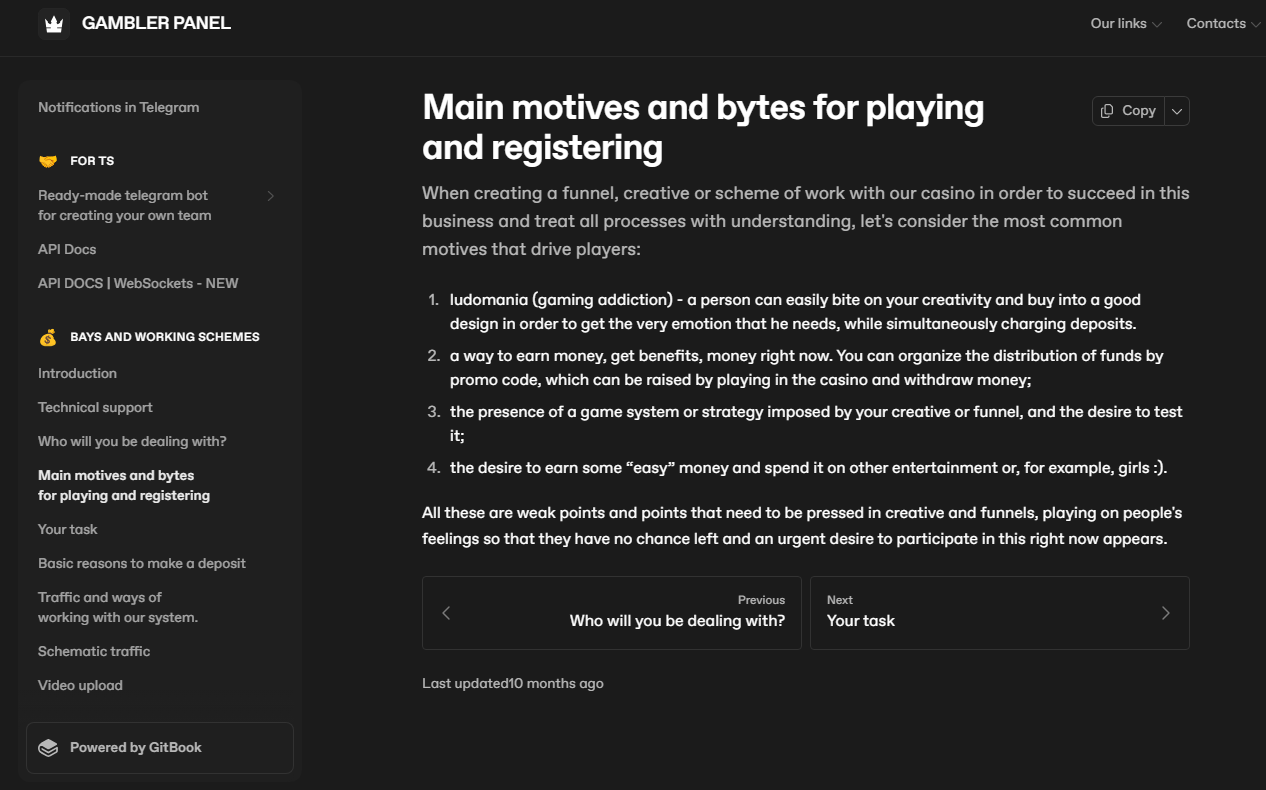
A machine-translated version of Gambler Panel’s affiliate website.

The scam begins with deceptive ads posted on social media that claim the wagering sites are working in partnership with popular athletes or social media personalities. The ads invariably state that by using a supplied “promo code,” interested players can claim a $2,500 credit on the advertised gaming website.

The gaming sites ask visitors to create a free account to claim their $2,500 credit, which they can use to play any number of extremely polished video games that ask users to bet on each action. However, when users try to cash out any “winnings” the gaming site will reject the request and prompt the user to make a “verification deposit” of cryptocurrency — typically around $100 — before any money can be distributed.

Those who deposit cryptocurrency funds are soon pressed into more wagering and making additional deposits. And — shocker alert — all players eventually lose everything they’ve invested in the platform.

The number of scam gambling or “scambling” sites has skyrocketed in the past month, and now we know why: The sites all pull their gaming content and detailed strategies for fleecing players straight from the playbook created by Gambler Panel, a Russian-language affiliate program that promises affiliates up to 70 percent of the profits.

Gambler Panel’s website gambler-panel[.]com links to a helpful wiki that explains the scam from cradle to grave, offering affiliates advice on how best to entice visitors, keep them gambling, and extract maximum profits from each victim.

“We have a completely self-written from scratch FAKE CASINO engine that has no competitors,” Gambler Panel’s wiki enthuses. “Carefully thought-out casino design in every pixel, a lot of audits, surveys of real people and test traffic floods were conducted, which allowed us to create something that has no doubts about the legitimacy and trustworthiness even for an inveterate gambling addict with many years of experience.”

Gambler Panel explains that the one and only goal of affiliates is to drive traffic to these scambling sites by any and all means possible.

A machine-translated portion of Gambler Panel’s singular instruction for affiliates: Drive traffic to these scambling sites by any means available.

“Unlike white gambling affiliates, we accept absolutely any type of traffic, regardless of origin, the only limitation is the CIS countries,” the wiki continued, referring to a common prohibition against scamming people in Russia and former Soviet republics in the Commonwealth of Independent States.

The program’s website claims it has more than 20,000 affiliates, who earn a minimum of $10 for each verification deposit. Interested new affiliates must first get approval from the group’s Telegram channel, which currently has around 2,500 active users.

The Gambler Panel channel is replete with images of affiliate panels showing the daily revenue of top affiliates, scantily-clad young women promoting the Gambler logo, and fast cars that top affiliates claimed they bought with their earnings.

A machine-translated version of the wiki for the affiliate program Gambler Panel.

The apparent popularity of this scambling niche is a consequence of the program’s ease of use and detailed instructions for successfully reproducing virtually every facet of the scam. Indeed, much of the tutorial focuses on advice and ready-made templates to help even novice affiliates drive traffic via social media websites, particularly on Instagram and TikTok.

Gambler Panel also walks affiliates through a range of possible responses to questions from users who are trying to withdraw funds from the platform. This section, titled “Rules for working in Live chat,” urges scammers to respond quickly to user requests (1-7 minutes), and includes numerous strategies for keeping the conversation professional and the user on the platform as long as possible.

A machine-translated version of the Gambler Panel’s instructions on managing chat support conversations with users.

The connection between Gambler Panel and the explosion in the number of scambling websites was made by a 17-year-old developer who operates multiple Discord servers that have been flooded lately with misleading ads for these sites.

The researcher, who asked to be identified only by the nickname “Thereallo,” said Gambler Panel has built a scalable business product for other criminals.

“The wiki is kinda like a ‘how to scam 101’ for criminals written with the clarity you would expect from a legitimate company,” Thereallo said. “It’s clean, has step by step guides, and treats their scam platform like a real product. You could swap out the content, and it could be any documentation for startups.”

“They’ve minimized their own risk — spreading the links on Discord / Facebook / YT Shorts, etc. — and outsourced it to a hungry affiliate network, just like a franchise,” Thereallo wrote in response to questions.

“A centralized platform that can serve over 1,200 domains with a shared user base, IP tracking, and a custom API is not at all a trivial thing to build,” Thereallo said. “It’s a scalable system designed to be a resilient foundation for thousands of disposable scam sites.”

The security firm Silent Push has compiled a list of the latest domains associated with the Gambler Panel, available here (.csv).

Scammers Unleash Flood of Slick Online Gaming Sites

30 July 2025 at 14:46

Fraudsters are flooding Discord and other social media platforms with ads for hundreds of polished online gaming and wagering websites that lure people with free credits and eventually abscond with any cryptocurrency funds deposited by players. Here’s a closer look at the social engineering tactics and remarkable traits of this sprawling network of more than 1,200 scam sites.

The scam begins with deceptive ads posted on social media that claim the wagering sites are working in partnership with popular social media personalities, such as Mr. Beast, who recently launched a gaming business called Beast Games. The ads invariably state that by using a supplied “promo code,” interested players can claim a $2,500 credit on the advertised gaming website.

An ad posted to a Discord channel for a scam gambling website that the proprietors falsely claim was operating in collaboration with the Internet personality Mr. Beast. Image: Reddit.com.

The gaming sites all require users to create a free account to claim their $2,500 credit, which they can use to play any number of extremely polished video games that ask users to bet on each action. At the scam website gamblerbeast[.]com, for example, visitors can pick from dozens of games like B-Ball Blitz, in which you play a basketball pro who is taking shots from the free throw line against a single opponent, and you bet on your ability to sink each shot.

The financial part of this scam begins when users try to cash out any “winnings.” At that point, the gaming site will reject the request and prompt the user to make a “verification deposit” of cryptocurrency — typically around $100 — before any money can be distributed. Those who deposit cryptocurrency funds are soon asked for additional payments.

However, any “winnings” displayed by these gaming sites are a complete fantasy, and players who deposit cryptocurrency funds will never see that money again. Compounding the problem, victims likely will soon be peppered with come-ons from “recovery experts” who peddle dubious claims on social media networks about being able to retrieve funds lost to such scams.

KrebsOnSecurity first learned about this network of phony betting sites from a Discord user who asked to be identified only by their screen name: “Thereallo” is a 17-year-old developer who operates multiple Discord servers and said they began digging deeper after users started complaining of being inundated with misleading spam messages promoting the sites.

“We were being spammed relentlessly by these scam posts from compromised or purchased [Discord] accounts,” Thereallo said. “I got frustrated with just banning and deleting, so I started to investigate the infrastructure behind the scam messages. This is not a one-off site, it’s a scalable criminal enterprise with a clear playbook, technical fingerprints, and financial infrastructure.”

After comparing the code on the gaming sites promoted via spam messages, Thereallo found they all invoked the same API key for an online chatbot that appears to be in limited use or else is custom-made. Indeed, a scan for that API key at the threat hunting platform Silent Push reveals at least 1,270 recently-registered and active domains whose names all invoke some type of gaming or wagering theme.

The “verification deposit” stage of the scam requires the user to deposit cryptocurrency in order to withdraw their “winnings.”

Thereallo said the operators of this scam empire appear to generate a unique Bitcoin wallet for each gaming domain they deploy.

“This is a decoy wallet,” Thereallo explained. “Once the victim deposits funds, they are never able to withdraw any money. Any attempts to contact the ‘Live Support’ are handled by a combination of AI and human operators who eventually block the user. The chat system is self-hosted, making it difficult to report to third-party service providers.”

Thereallo discovered another feature common to all of these scam gambling sites [hereafter referred to simply as “scambling” sites]: If you register at one of them and then very quickly try to register at a sister property of theirs from the same Internet address and device, the registration request is denied at the second site.

“I registered on one site, then hopped to another to register again,” Thereallo said. Instead, the second site returned an error stating that a new account couldn’t be created for another 10 minutes.

The scam gaming site spinora dot cc shares the same chatbot API as more than 1,200 similar fake gaming sites.

“They’re tracking my VPN IP across their entire network,” Thereallo explained. “My password manager also proved it. It tried to use my dummy email on a site I had never visited, and the site told me the account already existed. So it’s definitely one entity running a single platform with 1,200+ different domain names as front-ends. This explains how their support works, a central pool of agents handling all the sites. It also explains why they’re so strict about not giving out wallet addresses; it’s a network-wide policy.”

In many ways, these scambling sites borrow from the playbook of “pig butchering” schemes, a rampant and far more elaborate crime in which people are gradually lured by flirtatious strangers online into investing in fraudulent cryptocurrency trading platforms.

Pig butchering scams are typically powered by people in Asia who have been kidnapped and threatened with physical harm or worse unless they sit in a cubicle and scam Westerners on the Internet all day. In contrast, these scambling sites tend to steal far less money from individual victims, but their cookie-cutter nature and automated support components may enable their operators to extract payments from a large number of people in far less time, and with considerably less risk and up-front investment.

Silent Push’s Zach Edwards said the proprietors of this scambling empire are spending big money to make the sites look and feel like some fancy new type of casino.

“That’s a very odd type of pig butchering network and not like what we typically see, with much lower investments in the sites and lures,” Edwards said.

Here is a list of all domains that Silent Push found were using the scambling network’s chat API.

Inside a Dark Adtech Empire Fed by Fake CAPTCHAs

12 June 2025 at 18:14

Late last year, security researchers made a startling discovery: Kremlin-backed disinformation campaigns were bypassing moderation on social media platforms by leveraging the same malicious advertising technology that powers a sprawling ecosystem of online hucksters and website hackers. A new report on the fallout from that investigation finds this dark ad tech industry is far more resilient and incestuous than previously known.

Image: Infoblox.

In November 2024, researchers at the security firm Qurium published an investigation into “Doppelganger,” a disinformation network that promotes pro-Russian narratives and infiltrates Europe’s media landscape by pushing fake news through a network of cloned websites.

Doppelganger campaigns use specialized links that bounce the visitor’s browser through a long series of domains before the fake news content is served. Qurium found Doppelganger relies on a sophisticated “domain cloaking” service, a technology that allows websites to present different content to search engines compared to what regular visitors see. The use of cloaking services helps the disinformation sites remain online longer than they otherwise would, while ensuring that only the targeted audience gets to view the intended content.

Qurium discovered that Doppelganger’s cloaking service also promoted online dating sites, and shared much of the same infrastructure with VexTrio, which is thought to be the oldest malicious traffic distribution system (TDS) in existence. While TDSs are commonly used by legitimate advertising networks to manage traffic from disparate sources and to track who or what is behind each click, VexTrio’s TDS largely manages web traffic from victims of phishing, malware, and social engineering scams.

BREAKING BAD

Digging deeper, Qurium noticed Doppelganger’s cloaking service used an Internet provider in Switzerland as the first entry point in a chain of domain redirections. They also noticed the same infrastructure hosted a pair of co-branded affiliate marketing services that were driving traffic to sketchy adult dating sites: LosPollos[.]com and TacoLoco[.]co.

The LosPollos ad network incorporates many elements and references from the hit series “Breaking Bad,” mirroring the fictional “Los Pollos Hermanos” restaurant chain that served as a money laundering operation for a violent methamphetamine cartel.

The LosPollos advertising network invokes characters and themes from the hit show Breaking Bad. The logo for LosPollos (upper left) is the image of Gustavo Fring, the fictional chicken restaurant chain owner in the show.

Affiliates who sign up with LosPollos are given JavaScript-heavy “smartlinks” that drive traffic into the VexTrio TDS, which in turn distributes the traffic among a variety of advertising partners, including dating services, sweepstakes offers, bait-and-switch mobile apps, financial scams and malware download sites.

LosPollos affiliates typically stitch these smart links into WordPress websites that have been hacked via known vulnerabilities, and those affiliates will earn a small commission each time an Internet user referred by any of their hacked sites falls for one of these lures.

The Los Pollos advertising network promoting itself on LinkedIn.

According to Qurium, TacoLoco is a traffic monetization network that uses deceptive tactics to trick Internet users into enabling “push notifications,” a cross-platform browser standard that allows websites to show pop-up messages which appear outside of the browser. For example, on Microsoft Windows systems these notifications typically show up in the bottom right corner of the screen — just above the system clock.

In the case of VexTrio and TacoLoco, the notification approval requests themselves are deceptive — disguised as “CAPTCHA” challenges designed to distinguish automated bot traffic from real visitors. For years, VexTrio and its partners have successfully tricked countless users into enabling these site notifications, which are then used to continuously pepper the victim’s device with a variety of phony virus alerts and misleading pop-up messages.

Examples of VexTrio landing pages that lead users to accept push notifications on their device.

According to a December 2024 annual report from GoDaddy, nearly 40 percent of compromised websites in 2024 redirected visitors to VexTrio via LosPollos smartlinks.

ADSPRO AND TEKNOLOGY

On November 14, 2024, Qurium published research to support its findings that LosPollos and TacoLoco were services operated by Adspro Group, a company registered in the Czech Republic and Russia, and that Adspro runs its infrastructure at the Swiss hosting providers C41 and Teknology SA.

Qurium noted the LosPollos and TacoLoco sites state that their content is copyrighted by ByteCore AG and SkyForge Digital AG, both Swiss firms that are run by the owner of Teknology SA, Giulio Vitorrio Leonardo Cerutti. Further investigation revealed LosPollos and TacoLoco were apps developed by a company called Holacode, which lists Cerutti as its CEO.

The apps marketed by Holacode include numerous VPN services, as well as one called Spamshield that claims to stop unwanted push notifications. But in January, Infoblox said they tested the app on their own mobile devices, and found it hides the user’s notifications, and then after 24 hours stops hiding them and demands payment. Spamshield subsequently changed its developer name from Holacode to ApLabz, although Infoblox noted that the Terms of Service for several of the rebranded ApLabz apps still referenced Holacode in their terms of service.

Incredibly, Cerutti threatened to sue me for defamation before I’d even uttered his name or sent him a request for comment (Cerutti sent the unsolicited legal threat back in January after his company and my name were merely tagged in an Infoblox post on LinkedIn about VexTrio).

Asked to comment on the findings by Qurium and Infoblox, Cerutti vehemently denied being associated with VexTrio. Cerutti asserted that his companies all strictly adhere to the regulations of the countries in which they operate, and that they have been completely transparent about all of their operations.

“We are a group operating in the advertising and marketing space, with an affiliate network program,” Cerutti responded. “I am not [going] to say we are perfect, but I strongly declare we have no connection with VexTrio at all.”

“Unfortunately, as a big player in this space we also get to deal with plenty of publisher fraud, sketchy traffic, fake clicks, bots, hacked, listed and resold publisher accounts, etc, etc.,” Cerutti continued. “We bleed lots of money to such malpractices and conduct regular internal screenings and audits in a constant battle to remove bad traffic sources. It is also a highly competitive space, where some upstarts will often play dirty against more established mainstream players like us.”

Working with Qurium, researchers at the security firm Infoblox released details about VexTrio’s infrastructure to their industry partners. Just four days after Qurium published its findings, LosPollos announced it was suspending its push monetization service. Less than a month later, Adspro had rebranded to Aimed Global.

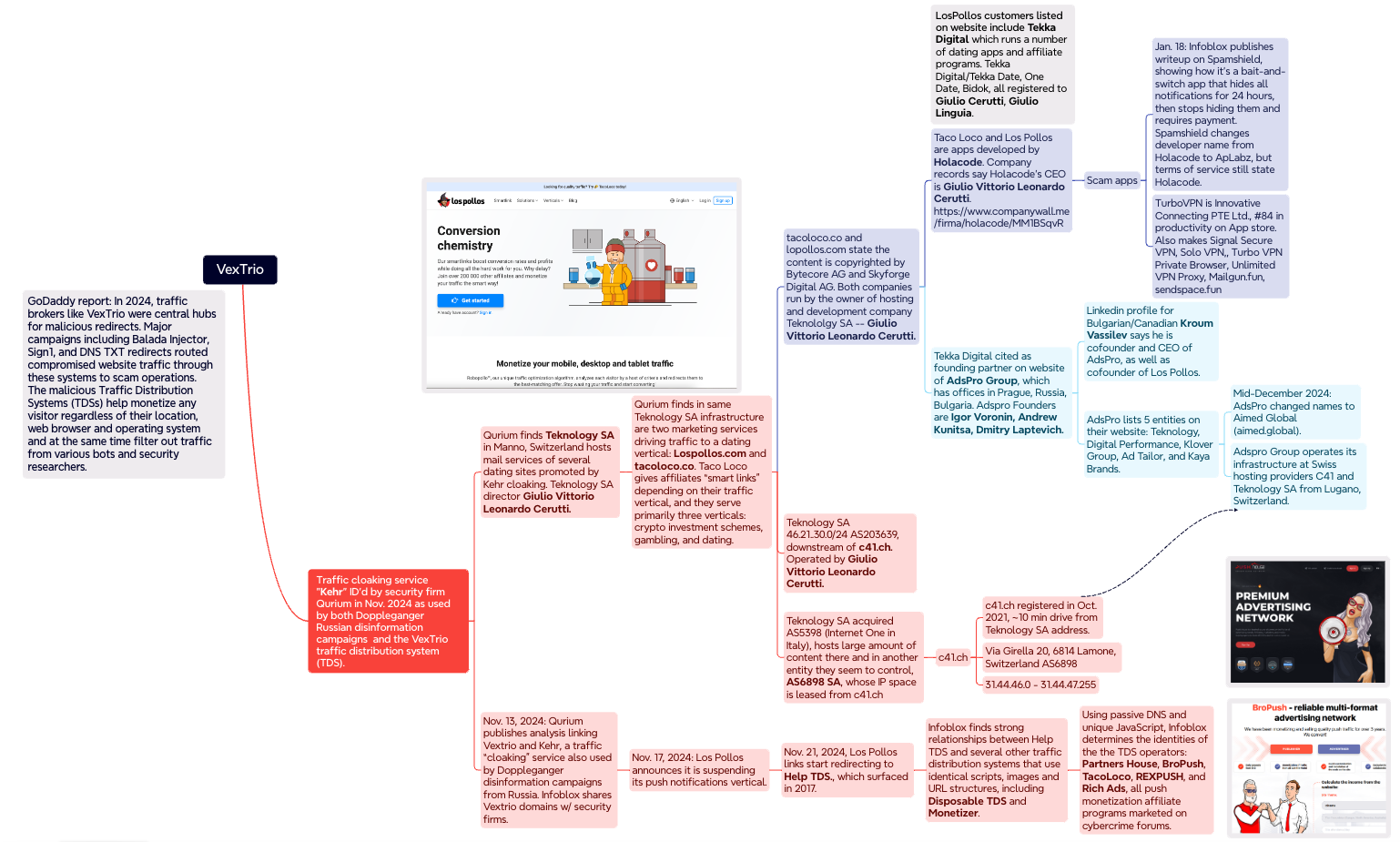
A mind map illustrating some of the key findings and connections in the Infoblox and Qurium investigations. Click to enlarge.

A REVEALING PIVOT

In March 2025, researchers at GoDaddy chronicled how DollyWay — a malware strain that has consistently redirected victims to VexTrio throughout its eight years of activity — suddenly stopped doing that on November 20, 2024. Virtually overnight, DollyWay and several other malware families that had previously used VexTrio began pushing their traffic through another TDS called Help TDS.

Digging further into historical DNS records and the unique code scripts used by the Help TDS, Infoblox determined it has long enjoyed an exclusive relationship with VexTrio (at least until LosPollos ended its push monetization service in November).

In a report released today, Infoblox said an exhaustive analysis of the JavaScript code, website lures, smartlinks and DNS patterns used by VexTrio and Help TDS linked them with at least four other TDS operators (not counting TacoLoco). Those four entities — Partners House, BroPush, RichAds and RexPush — are all Russia-based push monetization programs that pay affiliates to drive signups for a variety of schemes, but mostly online dating services.

“As Los Pollos push monetization ended, we’ve seen an increase in fake CAPTCHAs that drive user acceptance of push notifications, particularly from Partners House,” the Infoblox report reads. “The relationship of these commercial entities remains a mystery; while they are certainly long-time partners redirecting traffic to one another, and they all have a Russian nexus, there is no overt common ownership.”

Renee Burton, vice president of threat intelligence at Infoblox, said the security industry generally treats the deceptive methods used by VexTrio and other malicious TDSs as a kind of legally grey area that is mostly associated with less dangerous security threats, such as adware and scareware.

But Burton argues that this view is myopic, and helps perpetuate a dark adtech industry that also pushes plenty of straight-up malware, noting that hundreds of thousands of compromised websites around the world every year redirect victims to the tangled web of VexTrio and VexTrio-affiliate TDSs.

“These TDSs are a nefarious threat, because they’re the ones you can connect to the delivery of things like information stealers and scams that cost consumers billions of dollars a year,” Burton said. “From a larger strategic perspective, my takeaway is that Russian organized crime has control of malicious adtech, and these are just some of the many groups involved.”

WHAT CAN YOU DO?

As KrebsOnSecurity warned way back in 2020, it’s a good idea to be very sparing in approving notifications when browsing the Web. In many cases these notifications are benign, but as we’ve seen there are numerous dodgy firms that are paying site owners to install their notification scripts, and then reselling that communications pathway to scammers and online hucksters.

If you’d like to prevent sites from ever presenting notification requests, all of the major browser makers let you do this — either across the board or on a per-website basis. While it is true that blocking notifications entirely can break the functionality of some websites, doing this for any devices you manage on behalf of your less tech-savvy friends or family members might end up saving everyone a lot of headache down the road.

To modify site notification settings in Mozilla Firefox, navigate to Settings, Privacy & Security, Permissions, and click the “Settings” tab next to “Notifications.” That page will display any notifications already permitted and allow you to edit or delete any entries. Tick the box next to “Block new requests asking to allow notifications” to stop them altogether.

In Google Chrome, click the icon with the three dots to the right of the address bar, scroll all the way down to Settings, Privacy and Security, Site Settings, and Notifications. Select the “Don’t allow sites to send notifications” button if you want to banish notification requests forever.

In Apple’s Safari browser, go to Settings, Websites, and click on Notifications in the sidebar. Uncheck the option to “allow websites to ask for permission to send notifications” if you wish to turn off notification requests entirely.

U.S. Sanctions Cloud Provider ‘Funnull’ as Top Source of ‘Pig Butchering’ Scams

29 May 2025 at 21:55

Image: Shutterstock, ArtHead.

The U.S. government today imposed economic sanctions on Funnull Technology Inc., a Philippines-based company that provides computer infrastructure for hundreds of thousands of websites involved in virtual currency investment scams known as “pig butchering.” In January 2025, KrebsOnSecurity detailed how Funnull was being used as a content delivery network that catered to cybercriminals seeking to route their traffic through U.S.-based cloud providers.

“Americans lose billions of dollars annually to these cyber scams, with revenues generated from these crimes rising to record levels in 2024,” reads a statement from the U.S. Department of the Treasury, which sanctioned Funnull and its 40-year-old Chinese administrator Liu Lizhi. “Funnull has directly facilitated several of these schemes, resulting in over $200 million in U.S. victim-reported losses.”

The Treasury Department said Funnull’s operations are linked to the majority of virtual currency investment scam websites reported to the FBI. The agency said Funnull directly facilitated pig butchering and other schemes that resulted in more than $200 million in financial losses by Americans.

Pig butchering is a rampant form of fraud wherein people are lured by flirtatious strangers online into investing in fraudulent cryptocurrency trading platforms. Victims are coached to invest more and more money into what appears to be an extremely profitable trading platform, only to find their money is gone when they wish to cash out.

The scammers often insist that investors pay additional “taxes” on their crypto “earnings” before they can see their invested funds again (spoiler: they never do), and a shocking number of people have lost six figures or more through these pig butchering scams.

KrebsOnSecurity’s January story on Funnull was based on research from the security firm Silent Push, which discovered in October 2024 that a vast number of domains hosted via Funnull were promoting gambling sites that bore the logo of the Suncity Group, a Chinese entity named in a 2024 UN report (PDF) for laundering millions of dollars for the North Korean state-sponsored hacking group Lazarus.

Silent Push found Funnull was a criminal content delivery network (CDN) that carried a great deal of traffic tied to scam websites, funneling the traffic through a dizzying chain of auto-generated domain names and U.S.-based cloud providers before redirecting to malicious or phishous websites. The FBI has released a technical writeup (PDF) of the infrastructure used to manage the malicious Funnull domains between October 2023 and April 2025.

A graphic from the FBI explaining how Funnull generated a slew of new domains on a regular basis and mapped them to Internet addresses on U.S. cloud providers.

Silent Push revisited Funnull’s infrastructure in January 2025 and found Funnull was still using many of the same Amazon and Microsoft cloud Internet addresses identified as malicious in its October report. Both Amazon and Microsoft pledged to rid their networks of Funnull’s presence following that story, but according to Silent Push’s Zach Edwards only one of those companies has followed through.

Edwards said Silent Push no longer sees Microsoft Internet addresses showing up in Funnull’s infrastructure, while Amazon continues to struggle with removing Funnull servers, including one that appears to have first materialized in 2023.

“Amazon is doing a terrible job — every day since they made those claims to you and us in our public blog they have had IPs still mapped to Funnull, including some that have stayed mapped for inexplicable periods of time,” Edwards said.

Amazon said its Amazon Web Services (AWS) hosting platform actively counters abuse attempts.

“We have stopped hundreds of attempts this year related to this group and we are looking into the information you shared earlier today,” reads a statement shared by Amazon. “If anyone suspects that AWS resources are being used for abusive activity, they can report it to AWS Trust & Safety using the report abuse form here.”

U.S. based cloud providers remain an attractive home base for cybercriminal organizations because many organizations will not be overly aggressive in blocking traffic from U.S.-based cloud networks, as doing so can result in blocking access to many legitimate web destinations that are also on that same shared network segment or host.

What’s more, funneling their bad traffic so that it appears to be coming out of U.S. cloud Internet providers allows cybercriminals to connect to websites from web addresses that are geographically close(r) to their targets and victims (to sidestep location-based security controls by your bank, for example).

Funnull is not the only cybercriminal infrastructure-as-a-service provider that was sanctioned this month: On May 20, 2025, the European Union imposed sanctions on Stark Industries Solutions, an ISP that materialized at the start of Russia’s invasion of Ukraine and has been used as a global proxy network that conceals the true source of cyberattacks and disinformation campaigns against enemies of Russia.

In May 2024, KrebsOnSecurity published a deep dive on Stark Industries Solutions that found much of the malicious traffic traversing Stark’s network (e.g. vulnerability scanning and password brute force attacks) was being bounced through U.S.-based cloud providers. My reporting showed how deeply Stark had penetrated U.S. ISPs, and that its co-founder for many years sold “bulletproof” hosting services that told Russian cybercrime forum customers they would proudly ignore any abuse complaints or police inquiries.

The homepage of Stark Industries Solutions.

That story examined the history of Stark’s co-founders, Moldovan brothers Ivan and Yuri Neculiti, who each denied past involvement in cybercrime or any current involvement in assisting Russian disinformation efforts or cyberattacks. Nevertheless, the EU sanctioned both brothers as well.

The EU said Stark and the Neculti brothers “enabled various Russian state-sponsored and state-affiliated actors to conduct destabilising activities including coordinated information manipulation and interference and cyber-attacks against the Union and third countries by providing services intended to hide these activities from European law enforcement and security agencies.”

China-based SMS Phishing Triad Pivots to Banks

10 April 2025 at 11:31

China-based purveyors of SMS phishing kits are enjoying remarkable success converting phished payment card data into mobile wallets from Apple and Google. Until recently, the so-called “Smishing Triad” mainly impersonated toll road operators and shipping companies. But experts say these groups are now directly targeting customers of international financial institutions, while dramatically expanding their cybercrime infrastructure and support staff.

An image of an iPhone device farm shared on Telegram by one of the Smishing Triad members. Image: Prodaft.

If you own a mobile device, the chances are excellent that at some point in the past two years you’ve received at least one instant message that warns of a delinquent toll road fee, or a wayward package from the U.S. Postal Service (USPS). Those who click the promoted link are brought to a website that spoofs the USPS or a local toll road operator and asks for payment card information.

The site will then complain that the visitor’s bank needs to “verify” the transaction by sending a one-time code via SMS. In reality, the bank is sending that code to the mobile number on file for their customer because the fraudsters have just attempted to enroll that victim’s card details into a mobile wallet.

If the visitor supplies that one-time code, their payment card is then added to a new mobile wallet on an Apple or Google device that is physically controlled by the phishers. The phishing gangs typically load multiple stolen cards to digital wallets on a single Apple or Android device, and then sell those phones in bulk to scammers who use them for fraudulent e-commerce and tap-to-pay transactions.

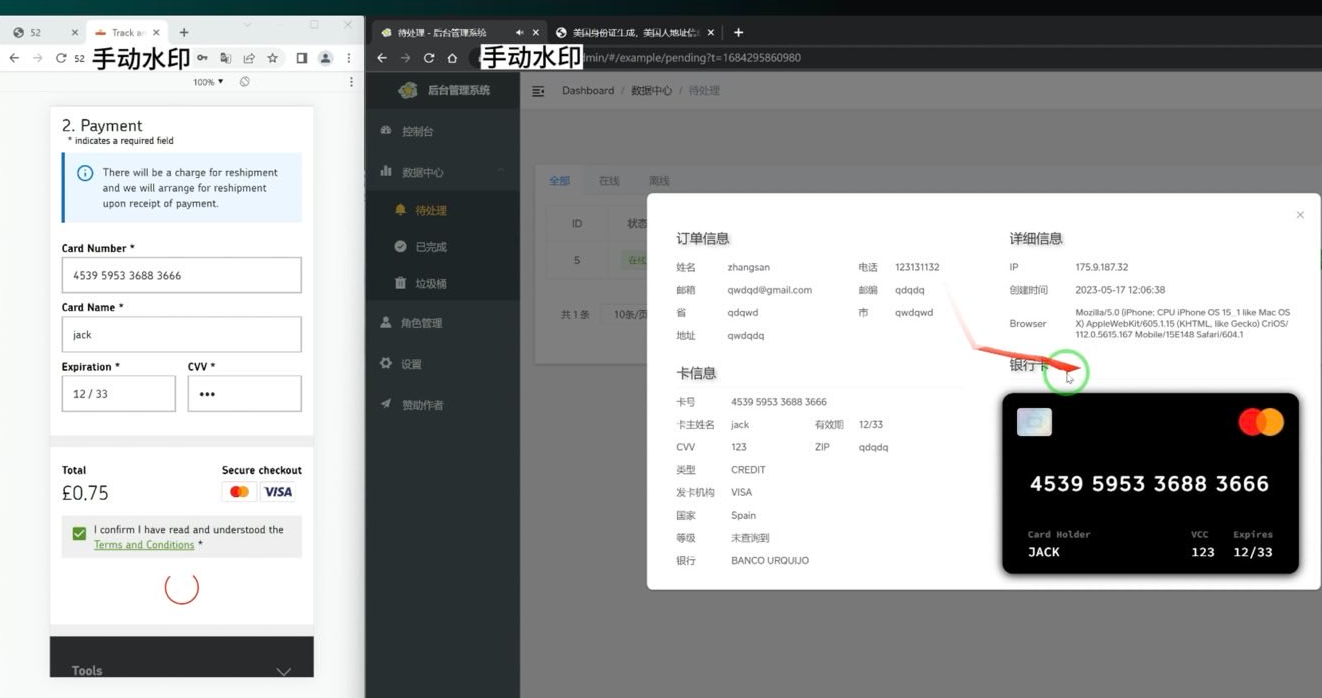
A screenshot of the administrative panel for a smishing kit. On the left is the (test) data entered at the phishing site. On the right we can see the phishing kit has superimposed the supplied card number onto an image of a payment card. When the phishing kit scans that created card image into Apple or Google Pay, it triggers the victim’s bank to send a one-time code. Image: Ford Merrill.

The moniker “Smishing Triad” comes from Resecurity, which was among the first to report in August 2023 on the emergence of three distinct mobile phishing groups based in China that appeared to share some infrastructure and innovative phishing techniques. But it is a bit of a misnomer because the phishing lures blasted out by these groups are not SMS or text messages in the conventional sense.

Rather, they are sent via iMessage to Apple device users, and via RCS on Google Android devices. Thus, the missives bypass the mobile phone networks entirely and enjoy near 100 percent delivery rate (at least until Apple and Google suspend the spammy accounts).

In a report published on March 24, the Swiss threat intelligence firm Prodaft detailed the rapid pace of innovation coming from the Smishing Triad, which it characterizes as a loosely federated group of Chinese phishing-as-a-service operators with names like Darcula, Lighthouse, and the Xinxin Group.

Prodaft said they’re seeing a significant shift in the underground economy, particularly among Chinese-speaking threat actors who have historically operated in the shadows compared to their Russian-speaking counterparts.

“Chinese-speaking actors are introducing innovative and cost-effective systems, enabling them to target larger user bases with sophisticated services,” Prodaft wrote. “Their approach marks a new era in underground business practices, emphasizing scalability and efficiency in cybercriminal operations.”

A new report from researchers at the security firm SilentPush finds the Smishing Triad members have expanded into selling mobile phishing kits targeting customers of global financial institutions like CitiGroup, MasterCard, PayPal, Stripe, and Visa, as well as banks in Canada, Latin America, Australia and the broader Asia-Pacific region.

Phishing lures from the Smishing Triad spoofing PayPal. Image: SilentPush.

SilentPush found the Smishing Triad now spoofs recognizable brands in a variety of industry verticals across at least 121 countries and a vast number of industries, including the postal, logistics, telecommunications, transportation, finance, retail and public sectors.

According to SilentPush, the domains used by the Smishing Triad are rotated frequently, with approximately 25,000 phishing domains active during any 8-day period and a majority of them sitting at two Chinese hosting companies: Tencent (AS132203) and Alibaba (AS45102).

“With nearly two-thirds of all countries in the world targeted by [the] Smishing Triad, it’s safe to say they are essentially targeting every country with modern infrastructure outside of Iran, North Korea, and Russia,” SilentPush wrote. “Our team has observed some potential targeting in Russia (such as domains that mentioned their country codes), but nothing definitive enough to indicate Russia is a persistent target. Interestingly, even though these are Chinese threat actors, we have seen instances of targeting aimed at Macau and Hong Kong, both special administrative regions of China.”

SilentPush’s Zach Edwards said his team found a vulnerability that exposed data from one of the Smishing Triad’s phishing pages, which revealed the number of visits each site received each day across thousands of phishing domains that were active at the time. Based on that data, SilentPush estimates those phishing pages received well more than a million visits within a 20-day time span.

The report notes the Smishing Triad boasts it has “300+ front desk staff worldwide” involved in one of their more popular phishing kits — Lighthouse — staff that is mainly used to support various aspects of the group’s fraud and cash-out schemes.

The Smishing Triad members maintain their own Chinese-language sales channels on Telegram, which frequently offer videos and photos of their staff hard at work. Some of those images include massive walls of phones used to send phishing messages, with human operators seated directly in front of them ready to receive any time-sensitive one-time codes.

As noted in February’s story How Phished Data Turns Into Apple and Google Wallets, one of those cash-out schemes involves an Android app called Z-NFC, which can relay a valid NFC transaction from one of these compromised digital wallets to anywhere in the world. For a $500 month subscription, the customer can wave their phone at any payment terminal that accepts Apple or Google pay, and the app will relay an NFC transaction over the Internet from a stolen wallet on a phone in China.

Chinese nationals were recently busted trying to use these NFC apps to buy high-end electronics in Singapore. And in the United States, authorities in California and Tennessee arrested Chinese nationals accused of using NFC apps to fraudulently purchase gift cards from retailers.

The Prodaft researchers said they were able to find a previously undocumented backend management panel for Lucid, a smishing-as-a-service operation tied to the XinXin Group. The panel included victim figures that suggest the smishing campaigns maintain an average success rate of approximately five percent, with some domains receiving over 500 visits per week.

“In one observed instance, a single phishing website captured 30 credit card records from 550 victim interactions over a 7-day period,” Prodaft wrote.

Prodaft’s report details how the Smishing Triad has achieved such success in sending their spam messages. For example, one phishing vendor appears to send out messages using dozens of Android device emulators running in parallel on a single machine.

Phishers using multiple virtualized Android devices to orchestrate and distribute RCS-based scam campaigns. Image: Prodaft.

According to Prodaft, the threat actors first acquire phone numbers through various means including data breaches, open-source intelligence, or purchased lists from underground markets. They then exploit technical gaps in sender ID validation within both messaging platforms.

“For iMessage, this involves creating temporary Apple IDs with impersonated display names, while RCS exploitation leverages carrier implementation inconsistencies in sender verification,” Prodaft wrote. “Message delivery occurs through automated platforms using VoIP numbers or compromised credentials, often deployed in precisely timed multi-wave campaigns to maximize effectiveness.

In addition, the phishing links embedded in these messages use time-limited single-use URLs that expire or redirect based on device fingerprinting to evade security analysis, they found.

“The economics strongly favor the attackers, as neither RCS nor iMessage messages incur per-message costs like traditional SMS, enabling high-volume campaigns at minimal operational expense,” Prodaft continued. “The overlap in templates, target pools, and tactics among these platforms underscores a unified threat landscape, with Chinese-speaking actors driving innovation in the underground economy. Their ability to scale operations globally and evasion techniques pose significant challenges to cybersecurity defenses.”

Ford Merrill works in security research at SecAlliance, a CSIS Security Group company. Merrill said he’s observed at least one video of a Windows binary that wraps a Chrome executable and can be used to load in target phone numbers and blast messages via RCS, iMessage, Amazon, Instagram, Facebook, and WhatsApp.

“The evidence we’ve observed suggests the ability for a single device to send approximately 100 messages per second,” Merrill said. “We also believe that there is capability to source country specific SIM cards in volume that allow them to register different online accounts that require validation with specific country codes, and even make those SIM cards available to the physical devices long-term so that services that rely on checks of the validity of the phone number or SIM card presence on a mobile network are thwarted.”

Experts say this fast-growing wave of card fraud persists because far too many financial institutions still default to sending one-time codes via SMS for validating card enrollment in mobile wallets from Apple or Google. KrebsOnSecurity interviewed multiple security executives at non-U.S. financial institutions who spoke on condition of anonymity because they were not authorized to speak to the press. Those banks have since done away with SMS-based one-time codes and are now requiring customers to log in to the bank’s mobile app before they can link their card to a digital wallet.

When Getting Phished Puts You in Mortal Danger

27 March 2025 at 12:39

Many successful phishing attacks result in a financial loss or malware infection. But falling for some phishing scams, like those currently targeting Russians searching online for organizations that are fighting the Kremlin war machine, can cost you your freedom or your life.

The real website of the Ukrainian paramilitary group “Freedom of Russia” legion. The text has been machine-translated from Russian.

Researchers at the security firm Silent Push mapped a network of several dozen phishing domains that spoof the recruitment websites of Ukrainian paramilitary groups, as well as Ukrainian government intelligence sites.

The website legiohliberty[.]army features a carbon copy of the homepage for the Freedom of Russia Legion (a.k.a. “Free Russia Legion”), a three-year-old Ukraine-based paramilitary unit made up of Russian citizens who oppose Vladimir Putin and his invasion of Ukraine.

The phony version of that website copies the legitimate site — legionliberty[.]army — providing an interactive Google Form where interested applicants can share their contact and personal details. The form asks visitors to provide their name, gender, age, email address and/or Telegram handle, country, citizenship, experience in the armed forces; political views; motivations for joining; and any bad habits.

“Participation in such anti-war actions is considered illegal in the Russian Federation, and participating citizens are regularly charged and arrested,” Silent Push wrote in a report released today. “All observed campaigns had similar traits and shared a common objective: collecting personal information from site-visiting victims. Our team believes it is likely that this campaign is the work of either Russian Intelligence Services or a threat actor with similarly aligned motives.”

Silent Push’s Zach Edwards said the fake Legion Liberty site shared multiple connections with rusvolcorps[.]net. That domain mimics the recruitment page for a Ukrainian far-right paramilitary group called the Russian Volunteer Corps (rusvolcorps[.]com), and uses a similar Google Forms page to collect information from would-be members.

Other domains Silent Push connected to the phishing scheme include: ciagov[.]icu, which mirrors the content on the official website of the U.S. Central Intelligence Agency; and hochuzhitlife[.]com, which spoofs the Ministry of Defense of Ukraine & General Directorate of Intelligence (whose actual domain is hochuzhit[.]com).

According to Edwards, there are no signs that these phishing sites are being advertised via email. Rather, it appears those responsible are promoting them by manipulating the search engine results shown when someone searches for one of these anti-Putin organizations.

In August 2024, security researcher Artem Tamoian posted on Twitter/X about how he received startlingly different results when he searched for “Freedom of Russia legion” in Russia’s largest domestic search engine Yandex versus Google.com. The top result returned by Google was the legion’s actual website, while the first result on Yandex was a phishing page targeting the group.

“I think at least some of them are surely promoted via search,” Tamoian said of the phishing domains. “My first thread on that accuses Yandex, but apart from Yandex those websites are consistently ranked above legitimate in DuckDuckGo and Bing. Initially, I didn’t realize the scale of it. They keep appearing to this day.”

Tamoian, a native Russian who left the country in 2019, is the founder of the cyber investigation platform malfors.com. He recently discovered two other sites impersonating the Ukrainian paramilitary groups — legionliberty[.]world and rusvolcorps[.]ru — and reported both to Cloudflare. When Cloudflare responded by blocking the sites with a phishing warning, the real Internet address of these sites was exposed as belonging to a known “bulletproof hosting” network called Stark Industries Solutions Ltd.

Stark Industries Solutions appeared two weeks before Russia invaded Ukraine in February 2022, materializing out of nowhere with hundreds of thousands of Internet addresses in its stable — many of them originally assigned to Russian government organizations. In May 2024, KrebsOnSecurity published a deep dive on Stark, which has repeatedly been used to host infrastructure for distributed denial-of-service (DDoS) attacks, phishing, malware and disinformation campaigns from Russian intelligence agencies and pro-Kremlin hacker groups.

In March 2023, Russia’s Supreme Court designated the Freedom of Russia legion as a terrorist organization, meaning that Russians caught communicating with the group could face between 10 and 20 years in prison.

Tamoian said those searching online for information about these paramilitary groups have become easy prey for Russian security services.

“I started looking into those phishing websites, because I kept stumbling upon news that someone gets arrested for trying to join [the] Ukrainian Army or for trying to help them,” Tamoian told KrebsOnSecurity. “I have also seen reports [of] FSB contacting people impersonating Ukrainian officers, as well as using fake Telegram bots, so I thought fake websites might be an option as well.”

Search results showing news articles about people in Russia being sentenced to lengthy prison terms for attempting to aid Ukrainian paramilitary groups.

Tamoian said reports surface regularly in Russia about people being arrested for trying carry out an action requested by a “Ukrainian recruiter,” with the courts unfailingly imposing harsh sentences regardless of the defendant’s age.

“This keeps happening regularly, but usually there are no details about how exactly the person gets caught,” he said. “All cases related to state treason [and] terrorism are classified, so there are barely any details.”

Tamoian said while he has no direct evidence linking any of the reported arrests and convictions to these phishing sites, he is certain the sites are part of a larger campaign by the Russian government.

“Considering that they keep them alive and keep spawning more, I assume it might be an efficient thing,” he said. “They are on top of DuckDuckGo and Yandex, so it unfortunately works.”

Further reading: Silent Push report, Russian Intelligence Targeting its Citizens and Informants.

❌