Google Is Silently Linking Your Phone Number Across All Signed-In Accounts
Read more of this story at Slashdot.
Safety researchers continue to warn that a large volume of AI-generated explicit content is spreading unchecked, while regulators do little to meaningfully stop it.
This non-consensual content is commonly shared in text and direct messages or stored in private clouds where it’s less likely to be detected or reported, a Google co-authored study of Internet users across the United States, Australia, and the United Kingdom found this July. That’s why the “most critical intervention point” remains at the source: the harmful AI tools used to make the fake sexual images, Google researchers concluded.
Yet red-teaming in recent months suggests that as some of the leading AI image generators from Google and OpenAI become more capable, they may be getting worse at blocking explicit outputs.


© Aurich Lawson | Getty Images
Read more of this story at Slashdot.
Google has already added a few AI features to the Play Store, but a lot more are coming. The previously released Ask Play feature is expanding to offer more AI-powered discovery options in Google's app store, and Google is also using AI to build a recommendation engine called Game Finder. For people who have embraced AI to build their own apps, the Play Store will soon offer a way to privately host and share those creations.
Google rolled out Ask Play in 2025 as a small chatbot interface on Play Store listings. It lets you ask questions about an app or game, either by typing it in manually or choosing from a list of suggested queries. Starting today, Ask Play is expanding into a more general way to search for apps and games. You ask the robot questions, and it generates recommendations that can include detailed comparison charts. Gemini will roll out a similar capability soon.
Google's other AI discovery announcement focuses on games. The new Game Finder feature leans on all the usage data Google's app platform has hoovered up over the years, featuring insights into the way 1.2 billion people play games on Android. It builds a profile called Gamer DNA and matches you with players who have similar DNA.


Google revealed Gemini 4 Argon a few weeks ago, saying that it needed to move cautiously toward a full release because of the potential for nefarious use. Google seems to have worked all that out pretty quickly, though. Argon is beginning its wide rollout today, but it's only coming to paying users at this time, and even those on lower-tier plans won't have full access.
Nothing about Gemini 4 Argon's capabilities has changed. Google still points to the benchmarks it published late last month as evidence of the model's advanced reasoning and agentic coding capabilities. The model is supposedly trained to refuse malicious instructions, and an automated misalignment monitor can stop processing if it detects an unintended workflow. Google claims Argon needs that because it's so capable.
The company has a few new examples of how Argon has helped inside Google, where it has been used by thousands of Googlers. Argon has reportedly been instrumental in making YouTube's comment system more efficient. Argon identified redundant emoji rendering that, when eliminated, dropped server load by 45 percent. Engineers also turned Gemini 4 loose on the proprietary drone physics simulator used in Project Wing, and the AI found critical bugs that had been in the codebase since 2018. Google also notes that Argon has advanced its robotics program, showing a measurable step increase in embodied reasoning.


Read more of this story at Slashdot.
Google is releasing its second Fitbit tracker of 2026, offering fans of the aging Charge 6 a more refined option. The new Fitbit Edge slots right in between the Pixel Watch 5 and the Fitbit Air, featuring a compact screen and more health sensors than the Air. You won't get all the apps and features of the Pixel Watch 5, but the Edge is only about half as expensive.
The Fitbit Edge is essentially a new Charge 6, but it has more of a Pixel Watch aesthetic. Squish Google's smartwatch from the sides, and you've got the Edge. It has a pill-shaped 1.34-inch OLED touch display inside a slender aluminum frame that is rated IP68 (5 ATM) for water and dust protection. Google says the screen has 46 percent more viewable area compared to the Charge 6. It's very close in overall size to the Fitbit Air and uses the same magnetic charging puck.
The Edge works with Android or iPhones via the Google Health app, and it can run for about seven days on a charge. If the tracker is away from your phone, it can still follow your activity all week with support for seven days of full health data storage (or 30 days of basic data). However, the generous weeklong battery life does not include always-on display mode. If you turn it on, battery life drops to about two days, barely longer than the Pixel Watch 5.


Appointment or renewal reminder appears in victims’ calendar to lure them into logging in to fake Google, Microsoft or PayPal page
You’re preparing for the week ahead and take a look at your Google calendar. There’s an entry for a meeting that you must have completely forgotten. The note that pops up when you click on it says you’ll be reviewing a project and includes a link to more details. Confused, you follow it to find out more; the website you land on asks for logon details, and you provide them.
Unfortunately, this was not a failure of your memory but a calendar phishing scam. You have handed your name and password to fraudsters who will sell it on in a batch with other people’s details, use it to break into your work email, or to persuade you that they are contacting you from your bank, or another institution.
Continue reading...
© Photograph: grinvalds/Getty Images

© Photograph: grinvalds/Getty Images

© Photograph: grinvalds/Getty Images
According to Google, attackers compromised infrastructure behind three country-code domain namespaces—.gh (Ghana), .sl (Sierra Leone), and .as (American Samoa)—and used it to obtain unauthorized HTTPS certificates for Google domains and other organizations. These domain endings aren’t limited to sites serving those countries, so the risk can extend to users elsewhere.
This wasn’t a break in encryption, and Google’s systems weren’t compromised. Instead, attackers manipulated the internet’s addressing infrastructure so they could pass the checks required to obtain certificates for domains they didn’t legitimately control.
The Domain Name System (DNS) helps direct internet traffic to the right destination. Control over DNS can also provide a way to demonstrate apparent control of a domain when requesting an HTTPS certificate.
An HTTPS certificate helps a browser authenticate the server it is connecting to. A trusted certificate authority issues the certificate after checking that the applicant controls the relevant domain.
By controlling DNS records, attackers can pass domain verification checks. The authority can then issue a genuine, signed certificate to someone who has hijacked the domain’s infrastructure.
Combined with the ability to redirect a victim’s traffic to an attacker-controlled server, that could enable cybercriminals to create a convincing impersonation of the real service.
Google initially blocked unauthorized certificates for its own properties in Chrome and worked with the issuing certificate authorities to revoke them. It later blocked suspicious certificates for other organizations in Chrome, too.
Google points out that its actions do not offer complete protection:
“Due to the complexity of DNS hijacks, we cannot guarantee that our analysis identified every affected domain, nor do Chrome interventions reliably protect non-Chrome users.”
At the base level, this is an infrastructure problem that requires an infrastructure-level response. But these precautions can help:
.gh, .sl, or .as, check for security notices from the provider before logging in, making payments, or sharing sensitive information.These precautions are not a complete defense. The lasting fix depends on domain operators restoring control, preventing further unauthorized certificates from being issued, and ensuring existing ones are revoked or blocked.
Stop threats before they can do any harm.
Malwarebytes Browser Guard blocks phishing pages and malicious sites automatically. Free, one click to install. Add it to your browser →
Move expected to make pump pricing more transparent and encourage competition after diesel hits record £2 a litre
Drivers will be able to see live petrol prices on Google Maps for the first time from Thursday, in a move that will help motorists shop around for the cheapest fuel.
Millions of motorists will be able to find the cheapest petrol and diesel prices by searching for a local forecourt in the Google app, in what could prove to be “a major development” in making fuel prices more fair, according to campaigners.
Continue reading...
© Photograph: Yui Mok/PA

© Photograph: Yui Mok/PA

© Photograph: Yui Mok/PA
Every piece of AI content from Google's Gemini models has a hidden SynthID label, which makes it very difficult to pass the content off as authentic. SynthID has also gotten buy-in from other major AI players, but actually checking for those invisible watermarks has been a convoluted process. It's going to be a little easier going forward, though. Google has announced that its SynthID detector now supports watermarks from all its partners, and it's available for anyone to use on a new dedicated website.
SynthID is an invisible signal encoded in the pixels of AI-generated images and videos, and in the waveform of AI audio. Google says Gemini alone has integrated SynthID with over 180 billion images and videos, plus 240,000 years of audio. Until now, the only way for those outside of Google's trusted tester program to check for SynthID was to ask Gemini. This is rather clunky, and the model's output could sometimes be confusing when you just wanted a simple "yes" or "no."
Now you can cut Gemini out of the loop. Starting today, you can go to the new SynthID.com website to check a piece of content for an AI watermark. A major limitation of Google's previous detector was that it only checked for Google's version of SynthID. Even though ChatGPT images, for example, have SynthID, they wouldn't be flagged in Google's detector. That's no longer a problem.


© Aurich Lawson
Order on two construction sites comes after Google failed to carry out environmental impact assessments
Google has been ordered to temporarily stop work on two datacentres in Finland after failing to do the necessary environmental impact assessments on its construction sites.
The planned datacentres in Muhos and Kajanni are part of a €13bn (£11bn) project across multiple sites in northern Finland by the technology company amid huge demand for space to house online infrastructure.
Continue reading...
© Photograph: Alessandro Rampazzo/AFP/Getty Images

© Photograph: Alessandro Rampazzo/AFP/Getty Images

© Photograph: Alessandro Rampazzo/AFP/Getty Images
Googlebooks are Google's latest attempt to carve out a piece of the premium laptop market, and tight integration with Android phones is a key part of that effort. Now that Googlebooks are available, we're learning of some frustrating limitations of that plan. For now, Googlebooks will only play nicely with your phone if you have a Pixel.
When Google announced the launch window for Googlebooks, it said the laptops were "engineered to work with your Android phone right out of the box." But as with many things Google, the truth is more convoluted. We have since learned that you need Android 17 for any of the nifty integrations to work. With a compatible Android 17 phone, you can seamlessly stream apps to your laptop, access files on your phone, mirror notifications, and continue where you left off in certain apps when switching from phone to laptop.
You might think that the latest Samsung phones, which shipped with Android 17, would be ready for this experience. You'd be wrong, though. Some early Googlebook adopters have complained that phones like the Z Fold 8 won't work with the laptops. While the devices appear to see each other, the phone doesn't stay connected. Google representatives have since confirmed that these "Better Together" features are not currently supported on even the latest Samsung phones. An update that brings support to Samsung phones will roll out in "the coming weeks."


![]()
Read more of this story at Slashdot.
In a setback for publishers worried about the effects of AI search, a US federal judge has dismissed lawsuits filed by Chegg and Penske Media against Google. The companies accused Google of antitrust violations in products like AI overviews, which have led to decreasing traffic at numerous sites. However, US District Judge Amit Mehta has ruled that Google's conduct is not illegal under antitrust law.
The lawsuits were filed in 2025, and Google requested a dismissal earlier this year. Chegg, an education and learning platform, claimed in its lawsuit that Google illegally scraped its educational content. This allowed Gemini models to essentially recreate that content and reduce the site's traffic. Penske, which owns publications like Rolling Stone and Variety, filed a similar case that alleged lost traffic. Specifically, the publisher claimed it was unfair that sites indexed for organic search would also have their content harvested for AI answers, with no way to opt out.
These arguments did not sway the judge, who noted that Google's implicit agreement with websites is not legally relevant. "Plaintiffs have pleaded only that they have an ‘expectation’ that Google will send them search traffic if they make their content available for free," wrote Mehta. "But an expectation is not an agreement. It is simply how a general search engine works."


© Ryan Whitwam
Read more of this story at Slashdot.
Google launched its Googlebooks platform a week ago, and a lot of people were wondering what this meant for Chrome OS and Chromebooks. Since Googlebooks and its Android-based Googlebook OS lack the management frameworks markets like schools require, Chromebooks will continue to be available for now, until such time Googlebooks catch up in that regard. However, in a support document, Google states that update support for all Chromebook devices will end in 2034:
ChromeOS devices will continue to receive regular updates and security patches through mid-2034. For qualifying devices purchased today whose 10-year support lifecycle extends beyond 2034, Google is committed to supporting your transition to Googlebook OS, with many devices offering direct migration paths.
↫ Google support document
Google promised 10 years of updates for all Chromebooks, and it’s now breaking that promise for anyone buying a Chromebook between now and whenever the last Chromebook rolls off the production line. Sadly, we live in a world where corporations are free to make and break whatever promises they want virtually free of consequences, and as society we’re so used to it that anti-consumer behaviour like this barely elicits a shrug.
Google does state that “many newer commercial Chromebook models will be capable of upgrading to Googlebook OS”, but that, too, is just another promise – and a vague, one at that – so who knows how many devices will actually be capable of upgrading out in the real world. On top of that, we have no idea if Googlebooks will just be yet another in a long line of quickly abandoned Google tablet/laptop projects, further adding to the uncertainty.
Stuff like this should not be legal.
Google promised Gemini 3.5 Pro in June, but it spent the summer trotting out smaller Flash models. Now, Google is ready to take on the frontier again with Gemini 4 Argon. The company claims this new AI offers industry-leading performance in coding, knowledge work, and cybersecurity, but you aren't allowed to use it yet.
While most of us will have to wait to test Gemini 4, Google says engineers inside the company are already using the new model extensively. Argon reportedly used "fleet-wide telemetry data" to help Google save 300 TiB of memory across its data centers. Meanwhile, Argon agents have been working to migrate C/C++ codebases to Rust across Google, including thousands of lines in the core re2 and libgav1 libraries and more than 800,000 lines in the Fuchsia OS Zircon kernel.
Google has also come armed with a raft of benchmarks to back up its claims. On the software engineering DeepSWE v1.1 benchmark, Gemini 4 Argon hits 77.9 percent, which is higher than GPT-6 Astra, Fable 5.1, and Opus 5.5. Google promises similar power across a range of long-horizon tasks, pointing to Argon's industry-leading score in the economic analysis Vals Index test.


© Aurich Lawson
Read more of this story at Slashdot.
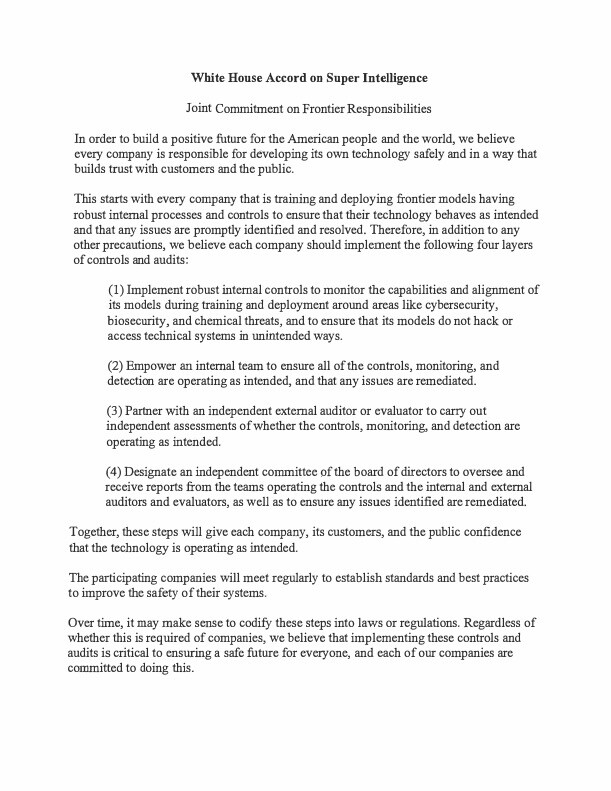
Amid escalating AI security incidents causing OpenAI to halt training and pause releases, Donald Trump continues to advocate for the AI industry to regulate itself as the best path to combat emerging risks when developing frontier AI.
In an agreement Tuesday, two dozen tech firms voluntarily committed to implementing controls recommended by the White House, including undergoing independent safety audits that will test whether firms’ internal controls, monitoring, and detecting are actually working. Key focuses for external reviews included “risks related to cybersecurity, biosecurity, chemical threats, and unintended actions by AI models.”
Firms also agreed to regularly meet to discuss best practices and set common AI safety standards and benchmarks. Among signers were leaders like Anthropic’s Dario Amodei, OpenAI’s Sam Altman, SpaceXAI’s Elon Musk, Nvidia’s Jensen Huang, Meta’s Mark Zuckerberg, and Alphabet/Google’s Sundar Pichai.


© Kevin Dietsch / Staff | Getty Images News
Google's shift to AI-powered search has upended the way the world's largest search engine generates web traffic, rankling large and small publishers alike. In recent months, the company has experimented with paying publishers when their content appears in AI answers, but a new report claims the payouts in this pilot program are miniscule. That has publishers in the program, as well as those watching from the sidelines, feeling skeptical.
According to The Information, Google has admitted about 100 publishers to the AI contribution pilot. The pitch is that websites can get payments from Google when their content materially contributes to Gemini-powered search results like an AI Overview. Google has long resisted the idea of direct payments to publishers, arguing that websites get traffic in exchange for allowing Google bots to scrape their content for use in search and knowledge graph tools. In the age of AI, that relationship is breaking down, hence the AI pilot.
So far, publishers aren't getting much for their trouble. The Information heard from several small and mid-sized publishers in the program that Google's AI payments are minuscule, equaling roughly one-tenth of one percent of their advertising revenue. These payments have been so disappointing that several larger publishers have reportedly declined to participate in the program. These publishers hope that by refusing to join the pilot, they can force Google to offer a more generous deal.


© Aurich Lawson
Read more of this story at Slashdot.
![]()
Google is changing how some links in its search results work.
Instead of linking directly to the destination, Google has started routing some search result links through opaque google.com/goto?url=... redirects. The url parameter does not show a readable version of the destination but uses a custom, Google-specific encoding.
Google confirmed the rollout to Search Engine Roundtable:
“We have a long history of deploying technical measures against evolving forms of abuse, and we regularly take steps to protect our services and users.”
Google has not said precisely what abuse the change is intended to prevent. However, the most likely reason is that the redirects are designed to make bulk extraction of destination URLs from Google search results more difficult and costly. Automated tools must now ask Google to resolve each result separately.
Since the rollout has apparently not reached my neck of the woods yet, I had to grab an image from another source.

Some Reddit users find the change ironic: Google built its search business by automatically collecting information from other websites, but is now making it harder for others to collect information from Google.
Other users have complained about the collateral damage to legitimate tools. Rank tracking, SEO auditing, research, archival, accessibility, and alternate-index services may all face the same rate limits and costs as abusive scrapers.
Search results data provider Autom reports that the final destination is viewable only through the redirect response’s Location header. This means bulk collectors must make an additional request for every result.
The first thing that popped into my one-track mind was the security downside. We often tell users to hover over a link before clicking it so they can check where it leads. That advice is less useful when hovering reveals an encoded Google redirect rather than the destination website.
Google still displays the claimed destination above each search result, but users can no longer use the link preview as an independent check.
So, Google, where does this leave our advice? We already tell people not to click Sponsored search results. Should we now tell them to avoid goto?url links too? Or will you give users an easy way to check where a link leads before they click it?
Passkeys were supposed to make stolen passwords a thing of the past. No password to phish, no secret to reuse, and no string of characters sitting in a database waiting to be leaked.
Over time, it’s thought that passkeys will replace passwords entirely. But what happens when malware steals the master key?
Researchers have found a way for malware to hijack passkey-protected accounts through Google Password Manager, highlighting an important exception: passkeys can be very secure but the software surrounding them still has weaknesses.
Passkeys are a password replacement based on public‑key cryptography. Instead of a secret you remember and type, each account gets a key pair where the private key never leaves your devices, and the website only ever sees the public key and signed challenges. Because there’s nothing reusable to phish or reuse on another site, passkeys are marketed as “phishing‑resistant” and safer than passwords stored in a browser or password manager.
By the end of 2024 Google reportedly said that 800 million Google accounts used passkeys.
Passkeys have a major advantage over passwords: there is nothing useful for a phishing site to steal. A passkey is also tied to the website it was created for, making it much harder to trick into authenticating to the wrong domain.
The other significant difference is that if malware steals a password vault, an attacker still often needs to get past a second factor on another device, such as an authenticator app on your phone, before they fully own the account. With passkeys, many services relying on them simply trust the passkey assertion, and in some cases even trust a single “user verified” flag without confirming whether a real biometric or PIN event occurred.
The researchers, however, started with a malware infected Windows computer and came up with three possible attack scenarios to steal Google synchronized passkeys. Google Password Manager can synchronize passkeys between devices, which is convenient since you don’t want to register a new passkey every time you buy a new computer. But it also opens them up to abuse.
From bad to worse the attacks are:
The researchers urge services to stop blindly trusting the user verification flag and to properly validate that a real User Verified event occurred before granting access. Google, in turn, is encouraged to harden device registration and recovery, and verify that new devices and keys are backed by genuine hardware rather than accepting them at face value.
For end users, passkeys still offer strong protection against classic phishing websites and credential stuffing attacks based on reused passwords. The weak point highlighted here is not so much the concept of passkeys, but the way they’re implemented, synchronized, and trusted without enough verification on the server side.
Until vendors close these gaps, basic anti‑malware hygiene remains critical. The best ways to prevent malware from using your passkeys are:
From reporting threats to removing them.
Cybersecurity risks should never spread beyond a headline. Keep threats off your devices by downloading Malwarebytes today.
Google has walked back an AI feature that allowed users to generate artificial images inside Google Earth, after a predictable flurry of deepfakes.
Google switched on the AI image generation feature inside Google Earth’s web version on July 30. It was available to everyone.
The system used Google’s Nano Banana 2 image generator to create its images. That tool can already generate images from simple text input, but the advantage of doing it in Google Earth is that it can use the real satellite images as the basis for its deepfake versions. That makes it easier to make AI pictures with real, accurate building and landscape details.
In its initial blog post on the launch, it said that students could use it to “bring history to life”, while realtors could use it to produce professional real estate plans. However, others warned that the system could be used to mislead people.
Within hours, researchers and press outlets demonstrated that the tool would happily produce photorealistic satellite imagery of things that did not happen in places where they did not happen.
Dutch open source intelligence researcher Henk van Ess explained: “I tried refugees at the Mexican border, a nuclear plant in Iran, a crash in Amsterdam, a hospital with a bomb crater in Gaza. Nothing was refused”.
Demonstrating what was possible with the new capability, NPR fabricated an image of fires in Iran, along with a deepfake of Washington, D.C. underwater. The BBC ran images of a collapsed Eiffel Tower and the Great Pyramid of Giza swallowed by a sinkhole. Even though the service had some guardrails in place, the BBC’s anti-disinformation Verify service was able to circumvent them by tinkering with basic AI prompts.
Google acknowledged the failure in a statement on X:
“We’ve seen geospatial professionals using this feature for a range of useful purposes, however we’ve also seen people sharing screenshots of generated imagery that appear to violate our policies. So we’re rolling back this feature in Google Earth while we work on implementing stronger guardrails.”
It didn’t commit to never re-introducing the idea.
Users were apparently unimpressed. “There is 0 chance that no one on your development team didn’t raise exactly this concern,” commented one. “You guys are living in a complete bubble,” accused another.
Google’s fallback safeguard was a SynthID watermark and the fact that generated images didn’t appear in the main Google Earth experience for others to see. SynthID is Google DeepMind’s watermarking system, an invisible signal baked into the pixels of AI-generated images so that a compatible detector can spot them later. Google positions it as one half of its provenance stack, sitting alongside the C2PA metadata standard the wider AI industry has settled on.
On paper, the signal is meant to hold up through compression and even social media re-uploads. However, these claims collapsed on contact with reality. The watermarks are detectable by Google’s AI services like Gemini. They are not visible to users, who can screenshot the images and share them anywhere. It’s unlikely that everyone will know to check for the provenance of an image. Researchers have also reported that Gemini could not reliably identify AI-generated images with a SynthID watermark.
Content creators were already producing fake AI images showing events that didn’t happen. Traditionally, satellite imagery has been a key component of open source journalism. Fake it convincingly and you are attacking the reference layer reporters use to check whether something actually happened.
This also comes at a time when trust in AI is measurably eroding. According to our own research, released in June, 88% of people said it’s becoming harder to tell what content online is genuinely human or real, with 84% saying that even “convincing video evidence” no longer feels like proof.
The practical advice is to take a breath whenever a disturbing satellite image of a disaster, a weapon strike, or a border crossing hits your timeline. Check whether a wire service with a named reporter has published it. Look for a caption identifying the imagery provider. If the source is an anonymous account posting a single dramatic frame, assume you might be looking at something assembled in a browser tab last night.
For more information on how to identify AI images, check out our guide.
The industry’s shipping model now apparently treats users as the test group. Critical media literacy is now the only reliable tool that readers and viewers have.
From reporting threats to removing them.
Cybersecurity risks should never spread beyond a headline. Keep threats off your devices by downloading Malwarebytes today.
And it’s personal information (alternate link):
The exposed data includes an AI-powered therapy app that someone appears to have vibe-coded, notes on meetings, and a dashboard someone made apparently to analyze medical billing data. Exposed chats reportedly include private cryptocurrency wallet keys and personal information like peoples’ addresses.
What seems to be the issue is a user setting about data sharing. Anthropic’s position is that it’s not their problem:
“We give people control over sharing their Claude conversations publicly, and in keeping with our privacy principles, we do not share chat directories or sitemaps with search engines like Google,” the company said in a statement. “These shareable links are not guessable or discoverable unless people choose to share them themselves. When someone shares a conversation, they are making that content publicly accessible, and like other public web content, it may be archived by third-party services.”
Here’s how to fix it.
We may all have a disdain for Chrome – OSNews users probably use Chrome a lot less than the average public – but that doesn’t mean the browser doesn’t sometimes do interesting things other browsers should copy. Chrome is in the the process of increasing its release cadence, but getting users to restart their browser more often than they already do to apply these higher number of updates is going to be a problem. As such, Google is working on something that seems quite obvious now that they’ve talking about it:
Investing in “dynamic patching” that will eliminate the need for a full browser restart in most cases. By leveraging Chrome’s multi-process architecture, dynamic patching sequentially replaces background child processes (like the Renderer and GPU) with updated binaries on the fly. Stay tuned to learn more as we research and develop this feature.
↫ Chrome Security Team
Chrome was the first browser to use multiple processes, isolating tabs from one another so that if one website or tab went haywire, your other tabs would be unaffected. It makes perfect sense to have the browser use new, updated binaries for new tabs you open as soon as they become available, in a sort of ship-of-Theseus kind of approach to updating. Of course, you can’t postpone the inevitable forever, but this should provide real-world benefits to users. Neat.
The linked blog post goes into much more detail about other things too, like various low-level mitigations to prevent bugs and security issues from causing too much harm.
Reddit users found that by using a specific Google search query, it was possible to find Claude conversations that users had shared.
This exposed sensitive material, including crypto wallet keys, names, addresses, work notes, and even erotic or otherwise policy-violating chats. Fortune says Anthropic appears to have fixed the Google indexing issue, but the shared links themselves were still live for people who already had them.
The exposure was tied to Claude’s Share feature, which creates a public web link to a snapshot of a conversation rather than leaving it inside a user’s private account. Reddit users found a search query that surfaced many of these shared chats, plus Claude Artifacts (interactive documents, apps, and other content created by Claude) in Google results. Wired reports that this is still true for Bing.
The main risk is that people use chatbots to think through work, health, legal, or personal matters without realizing that a shared link can behave like ordinary public web content.
This isn’t unique to Claude. We’ve previously seen Grok chats show up in Google search results, and Meta AI conversations can also become public by design. We have also written about the share option in ChatGPT that was swiftly removed after users unintentionally made thousands of conversations searchable.
Anthropic says Claude chats are private by default, and only conversations users explicitly chose to share were affected. But the incident is a reminder that a “share” button on an AI chat can be more like publishing than messaging, especially if search engines can discover the resulting URL.
The easy way out here is not to share your AI chatbot conversations with anyone, because you could end up reaching more people than you intended.
That’s because it’s harder to stop pages from being indexed than you might expect. And you don’t have those controls in your hands. The AI provider should take care of that.
But there are a few things you can do:
Let’s face it, an incognito window can only do so much.
Breaches, dark web trading, credit fraud. Malwarebytes Identity Theft Protection monitors for all of it, alerts you fast, and comes with identity theft insurance.
The Federal Bureau of Investigation (FBI) said today it worked with industry partners to seize hundreds of domains associated with NetNut, a sprawling residential proxy service operated by the publicly-traded Israeli company Alarum Technologies [NASDAQ: ALAR]. The action comes roughly two weeks after KrebsOnSecurity published findings from multiple security firms connecting NetNut to the Popa botnet, a collection of at least two million devices that have been compromised by malicious software with little or no consent from victims.
The NetNut homepage today was replaced by this seizure banner from the FBI.
On June 19, three different security firms issued similar findings: That NetNut is a residential proxy network which populates a botnet called Popa, and distributes software for devices commonly found in homes, such as smart TVs and streaming boxes. NetNut’s software turns those systems into always-on residential proxy nodes that are rented to others, who predominantly use them to relay abusive and intrusive Internet traffic, such as mass content scraping, advertising fraud, and account takeover activity.
Earlier today, NetNut’s homepage was replaced with a seizure notice from the FBI and the Internal Revenue Service Criminal Investigation division. The seizure notice thanked Google, Lumen, Shadowserver and other industry partners for their help in dismantling hundreds of domains tied to the Popa botnet, which experts say has long been synonymous with NetNut’s residential proxy infrastructure.
In a blog post published today, the Google Threat Intelligence Group (GTIG) said NetNut’s proxy network is widely resold and white-labeled by a number of third-party proxy providers, and that its services are heavily sought out by cybercriminals seeking to obfuscate the source of their malicious traffic. The GTIG said that in a single week during June 2026, they observed 316 distinct clusters of threat actors using suspected NetNut exit nodes, including cybercriminal and espionage groups.
“These bad actors can use NetNut to mask their origin IP address when accessing victim environments, accessing their own infrastructure, and conducting password spray attacks,” Google’s GTIG wrote. “Furthermore, when a consumer device becomes an exit node, unauthorized network traffic passes through it. This means bad actors can access other private devices on the same home network, effectively exposing them to Internet threats.”
Google said it disabled Google accounts and services used by NetNut for malware command and control, and that it shared technical intelligence on NetNut’s software development kits (SDKs) and backend infrastructure with platform providers, law enforcement and research firms. The company also disabled apps known to bundle NetNut’s various SDKs.
Omer Weiss, legal counsel for NetNut parent Alarum Technologies, said the company was aware of the FBI seizure and cooperating with investigators.
“Alarum takes this matter seriously and will fully cooperate with law enforcement to ensure any misuse of its infrastructure is thoroughly investigated and those responsible are held to account,” Weiss said in a written statement.
Benjamin Brundage is founder of the proxy tracking service Synthient, one of the companies that published evidence last month linking the Popa botnet to NetNut and Alarum Technologies. Brundage said the domain seizures appear to have disrupted both the Popa botnet and the NetNut proxy network that rides on top of it.
Brundage said NetNut’s apparent demise is likely to be a great disadvantage for the cybercrime community, which was already reeling from legal actions by Google earlier this year that seized infrastructure for NetNut’s biggest competitor — IPIDEA.
“I think this takedown is going to have a big impact, because NetNut gained significant popularity after the IPIDEA takedown,” he said. “Also NetNut has been incredibly common among resellers, and they were on par with IPIDEA in terms of their daily traffic, quality, size, price per gigabyte, all of it.”
NetNut’s infrastructure, in a nutshell. Image: Black Lotus Labs, Lumen.
The NetNut and Popa botnet takedown may have another added benefit, Brundage said: Lessening the impact of large distributed denial-of-service botnets that have been built on the backs of poorly configured residential proxy services. In January, Synthient revealed how cybercriminals had built the world’s largest DDoS botnet (Kimwolf) by tunneling through IPIDEA proxy connections into the local networks of TV box owners, and infecting other Android-based devices behind the victim’s firewall.
While many of the bigger proxy providers took steps to block this activity, resellers of the major proxy networks have been far slower to respond to the threat, Brundage said.
“In terms of all these TV box devices getting compromised from the proxy network, it will have an impact on the DDoS botnets out there,” he said.
For its part, Google reckons today’s actions have caused “significant degradation to NetNut’s proxy network and its business operations, reducing the available pool of devices for the proxy operator by millions.” But the company warns that proxy networks can rebuild themselves by effectively reselling other proxy services, as IPIDEA has done over the past few months.
“Google has high confidence that many popular residential proxy brands are in fact whitelabeling the NetNut botnet,” the GTIG report concludes. “While we expect this disruption to have a larger ripple effect across the residential proxy ecosystem, observations after the disruption of IPIDEA proved that individual networks can appear resilient. What we have observed is that when faced with the degradation of their own botnet, proxy operators begin buying capacity from their competitors, effectively becoming a reseller. We recognize that creating a lasting disruption in this fluid ecosystem means we must scale our efforts to target the infrastructure of several interconnected providers.”
As KrebsOnSecurity has warned repeatedly, most of the no-name TV streaming boxes for sale on the major e-commerce websites either come pre-installed with residential proxy software, or require the installation of proxy SDKs in order to use the device for its stated purpose (streaming pirated movies, sporting events and TV shows). Google’s advice here is sound: When it comes to TV boxes, stick to name brands from reputable manufacturers, and then be sparing and judicious with any apps you choose to install.
The sketchy TV boxes that are being commandeered by the Popa botnet and other threats all come with or require the user to install unofficial Android operating systems that do not operate within the confines of Google’s Official Play Protect store. Google says consumers can confirm whether or not a device is built with the official Android TV OS and Play Protect certification by following these instructions.
Even people without TV streaming boxes can find their smart TVs enrolled in residential proxy networks, just by installing one of thousands of apps available for download on Samsung and LG smart TVs. In a report released last month, the proxy tracking company Spur found 42 percent of apps available for download via the webOS operating system on LG smart TVs include SDKs that turn one’s television into an always-on residential proxy node. More than a quarter of the apps made for Samsung’s Tizen operating system had similar residential proxy components, Spur found.
Image: Spur.us.
Update, 4:24 p.m. ET: Included a statement shared post-publication from an attorney representing NetNut parent Alarum Technologies.
Update, July 8, 2:34 p.m. ET: The website for Alarum Technologies — alarum[.]io — now also features a seizure notice from the FBI. The company’s stock has taken a beating since the FBI action, and is currently trading at $2.62 a share, a roughly 67 percent decline over the past week.

Artificial intelligence platforms may be just as susceptible to social engineering as human beings, but they are proving remarkably good at finding security vulnerabilities in human-made computer code. That reality is on full display this month with some of the more widely-used software makers — including Apple, Google, Microsoft, Mozilla and Oracle — fixing near record volumes of security bugs, and/or quickening the tempo of their patch releases.
As it does on the second Tuesday of every month, Microsoft today released software updates to address at least 118 security vulnerabilities in its various Windows operating systems and other products. Remarkably, this is the first Patch Tuesday in nearly two years that Microsoft is not shipping any fixes to deal with emergency zero-day flaws that are already being exploited. Nor have any of the flaws fixed today been previously disclosed (potentially giving attackers a heads up in how to exploit the weakness).
Sixteen of the vulnerabilities earned Microsoft’s most-dire “critical” label, meaning malware or miscreants could abuse these bugs to seize remote control over a vulnerable Windows device with little or no help from the user. Rapid7 has done much of the heavy lifting in identifying some of the more concerning critical weaknesses this month, including:
May’s Patch Tuesday is a welcome respite from April, which saw Microsoft fix a near-record 167 security flaws. Microsoft was among a few dozen tech giants given access to a “Project Glasswing,” a much-hyped AI capability developed by Anthropic that appears quite effective at unearthing security vulnerabilities in code.
Apple, another early participant in Project Glasswing, typically fixes an average of 20 vulnerabilities each time it ships a security update for iOS devices, said Chris Goettl, vice president of product management at Ivanti. On May 11, Apple shipped updates to address at least 52 vulnerabilities and backported the changes all the way to iPhone 6s and iOS 15.
Last month, Mozilla released Firefox 150, which resolved a whopping 271 vulnerabilities that were reportedly discovered during the Glasswing evaluation.
“Since Firefox 150.0.0 released, they have been on a more aggressive weekly cadence for security updates including the release of Firefox 150.0.3 on May Patch Tuesday resolving between three to five CVEs in each release,” Goettl said.
The software giant Oracle likewise recently increased its patch pace in response to their work with Glasswing. In its most recent quarterly patch update, Oracle addressed at least 450 flaws, including more than 300 fixes for remotely exploitable, unauthenticated flaws. But at the end of April, Oracle announced it was switching to a monthly update cycle for critical security issues.
On May 8, Google started rolling out updates to its Chrome browser that fixed an astonishing 127 security flaws (up from just 30 the previous month). Chrome automagically downloads available security updates, but installing them requires fully restarting the browser.
If you encounter any weirdness applying the updates from Microsoft or any other vendor mentioned here, feel free to sound off in the comments below. Meantime, if you haven’t backed up your data and/or drive lately, doing that before updating is generally sound advice. For a more granular look at the Microsoft updates released today, checkout this inventory by the SANS Internet Storm Center.