❌

Normal view

Don’t be fooled. The AI that was supposed to save us time is doing just the opposite | Gaby Hinsliff

20 October 2026 at 01:00

The government says it can transform the state with AI, but it is no match for the resulting stream of machine-generated slop. And we all pay the cost

Another morning, another avalanche of emails. Even after a guilty cull, my inbox is sitting at well over 7,000, but lately I’ve started subscribing to the Quentin Crisp theory of housework: why bother, when after four years or so you stop noticing the accumulating dust? Empty inboxes just fill up again anyway.

In theory, email was supposed to save hours of meetings, phone calls and standing over photocopiers. Instead, we just spend hours deleting stuff people wouldn’t have bothered telling us if it had meant picking up the phone, but which they can now spam to their entire database at the click of a button. The glorious ease and convenience of being able to reach the world in seconds came, we now know, with the inconvenience of them being able to reach you right back.

Gaby Hinsliff is a Guardian columnist

Continue reading...

© Photograph: Katie Adkins/AP

© Photograph: Katie Adkins/AP

© Photograph: Katie Adkins/AP

Why terrorism laws stopped Sally Rooney selling books in the UK – podcast

The bestselling author says her books will no longer be supplied to UK bookshops over fears of prosecution. Zoe Williams and Haroon Siddique report

For now there might be a copy or two of Intermezzo left kicking around in your local bookshop – snap it up if you haven’t already, because soon that will be it.

Last year, Sally Rooney said she would be using her royalties to support Palestine Action, a group that is proscribed as a terrorist organisation under UK law. Since then, thousands of people have been arrested for supporting the group. Now, faced with the risk of prosecution under terrorism legislation, Rooney and her publishers have decided to stop supplying her books to retailers in the UK.

Continue reading...

© Photograph: Kin Cheung/AP

© Photograph: Kin Cheung/AP

© Photograph: Kin Cheung/AP

Kylie Minogue songs already used to train AI as tech firms ‘strong-arm’ Australian government, music body warns

18 October 2026 at 20:57

Of the dozens of countries approached to water down their laws, Australia appears to be the only one considering it, publishers’ group says

AI has already been trained on the works of Australian artists including Kylie Minogue and Nick Cave without compensation, the peak global body for music rights has claimed, as the Australian government has been warned against giving in to “strong-arming” from tech companies seeking to weaken copyright law.

The International Confederation of Music Publishers (ICMP) – which represents Sony, Warner and Universal as well as thousands of independent publishers on six continents – has warned that of the dozens of countries approached to water down copyright laws, Australia appears to be the only to consider doing so.

Continue reading...

© Photograph: Dave Tonge/Getty Images

© Photograph: Dave Tonge/Getty Images

© Photograph: Dave Tonge/Getty Images

What gets in the way of prisoners’ rehabilitation | Letters

18 October 2026 at 12:18

Anthony Goodman argues that probation officers have increasingly lost their autonomy, while Joe Sim says rehabilitation will not work in a society divided by brutal social divisions. Plus letters from Chris Parsons and Tracey Burley

Your editorial on overcrowded prisons and probation (13 October) was most welcome as it highlights a crisis in community justice that shows little sign of abating. You say that problems date back to the failed part-privatisation of the probation service, but in reality political interference has been happening for far longer than that.

Having worked for years as a prison probation officer and then in an aftercare and resettlement unit for ex-offenders, I saw good practice and ongoing practical and emotional support that demonstrated all the important points raised by Enver Solomon in his recent Guardian article.

Continue reading...

© Photograph: Bloomberg/Getty Images

© Photograph: Bloomberg/Getty Images

© Photograph: Bloomberg/Getty Images

When you watch the acclaimed TV drama Time, remember this: I’ve seen inside our prisons and they are just as bleak | Alex South

18 October 2026 at 03:00

The show depicts prisons as places characterised by violence and isolation, with no focus on rehabilitation. It’s depressingly accurate

The new series of Time is not an easy watch. The opening seconds of Jimmy McGovern’s prison drama show a normal woman on a normal bus, as it drives up a normal road. But to the right of that road is a huge concrete wall, topped with barbed wire and CCTV cameras.

The wall is only partly visible, just as prisons themselves tend to occupy a space towards the very edges of our thoughts. They exist, but not as part of normal life. But McGovern’s drama shows just how permeable that wall is.

Alex South is a former prison officer and the author of the memoir Behind These Doors

Continue reading...

© Photograph: PHOTOGRAPHER:/CREDIT LINE:BBC/BBC Studios/Peter Marley

© Photograph: PHOTOGRAPHER:/CREDIT LINE:BBC/BBC Studios/Peter Marley

© Photograph: PHOTOGRAPHER:/CREDIT LINE:BBC/BBC Studios/Peter Marley

Pornography with strangulation and incest to be banned in England and Wales next month

16 October 2026 at 03:09

Campaigners welcome legislation which follows recommendations by 2025 review into pornography regulation

Pornography that depicts strangulation and incestuous relationships will be banned in England and Wales from early November, the government has announced.

The content will be outlawed from 6 November after cross-party pressure prompted ministers to announce new legislation earlier this year.

Continue reading...

© Photograph: Tero Vesalainen/Alamy

© Photograph: Tero Vesalainen/Alamy

© Photograph: Tero Vesalainen/Alamy

Britain is addicted to prisons. Our crumbling probation service proves they don’t work | Polly Toynbee

16 October 2026 at 03:00

The current system is unable to quench the public thirst for locking people up – and certainly doesn’t ensure proper care once they are released

Public services need more investment across the board. Every day, another wretched story. Look at the Institute for Government’s (IFG) Public Services Performance Tracker for a plain assessment of A&E corridor care, councils struggling to meet the demands of social care and the Send system, the courts backlog, GP caseloads or families lost in temporary accommodation. A chancellor approaching a budget is besieged by need. It’s easy for us journalists to pick out shock stories and claim each one is an absolute priority, but how should a chancellor choose?

Today it’s the probation officers, whose conference in Newcastle is launching a ballot for industrial action. Their caseloads overflowed long ago, but now thousands of prisoners released early – 2,000 this month – have been thrust upon them. The responsibility is overwhelming, with officers blamed for crimes their clients commit.

Polly Toynbee is a Guardian columnist

Continue reading...

© Photograph: Christopher Furlong/Getty Images

© Photograph: Christopher Furlong/Getty Images

© Photograph: Christopher Furlong/Getty Images

UK law could deny Fayed accusers recognition as victims of human trafficking

16 October 2026 at 03:00

‘Unfair’ immigration and asylum bill could fail to support sexual violence survivors, anti-slavery commissioner says

Survivors of sexual violence could wrongly be denied recognition as victims of human trafficking under credibility tests in a new UK law, the independent anti-slavery commissioner has warned.

Eleanor Lyons said the measures in the immigration and asylum bill were fundamentally unfair and could lead to many more victims of slavery and trafficking, including those allegedly abused by Mohamed Al Fayed, being denied support.

Continue reading...

© Photograph: Murdo Macleod/The Guardian

© Photograph: Murdo Macleod/The Guardian

© Photograph: Murdo Macleod/The Guardian

Saudi Arabia to execute man for being at protests and funerals when he was 15

16 October 2026 at 01:00

Use of death penalty against people for crimes committed when they were children a ‘new low’, say rights groups

A young man faces imminent execution in Saudi Arabia for attending protests and funerals when he was aged 15 to 17, say human rights groups, in the latest example of the kingdom’s surging use of the death penalty for non-violent crimes.

Youssef al-Manasif was arrested in 2017 and accused of crimes including joining demonstrations for religious freedom by the Shia minority and attending funerals that the Saudi authorities deem to be protests. He was convicted and sentenced to death by the specialised criminal court, a secretive tribunal set up for terrorism-related cases.

Continue reading...

© Photograph: Handout

© Photograph: Handout

© Photograph: Handout

Matt Gaetz accused in suit of sex trafficking two women in Florida

Jane Does allege ex-congressman and two others coordinated ‘payments, drugs and travel’ for sexual acts

The Republican former congressman Matt Gaetz has been accused of participating in the sex trafficking of two young women in a civil lawsuit filed on Thursday in district court in Florida.

The allegations, which Gaetz denied in a statement to the Guardian, are the latest developments in a long-running sexual abuse scandal involving the politician who resigned from Congress in November 2024.

Continue reading...

© Photograph: Yuki Iwamura/AP

© Photograph: Yuki Iwamura/AP

© Photograph: Yuki Iwamura/AP

Trump cancels plan to livestream execution after global condemnation

15 October 2026 at 13:03

Soldier who killed 13 people in 2009 will still be executed, but president said ‘people would rather not watch him die’

Donald Trump has shelved a widely condemned plan to livestream the execution of Nidal Malik Hasan, who was convicted of killing 13 people at a military base at Fort Hood in Texas in 2009.

In a social media post on Thursday, Trump argued that broadcasting such an execution “might have been a strong deterrent for the World to witness how America deals with Terrorists and SCUM like Hasan” but said that “many very good and well meaning people would rather not watch him die, through streaming, or through any other visual device”.

Continue reading...

© Photograph: Jessica Rinaldi/Reuters

© Photograph: Jessica Rinaldi/Reuters

© Photograph: Jessica Rinaldi/Reuters

Former DUP leader Jeffrey Donaldson sentenced to 15 years for child sexual offences

Donaldson was found guilty in June of 18 counts of sexual abuse including one rape between 1985 and 2008

Jeffrey Donaldson has been sentenced to 15 years for sexual offences against two women who were children when he abused them, completing what was described as a “catastrophic descent into disgrace”.

The sentence at Newry crown court on Thursday sealed the downfall of a former Democratic Unionist party (DUP) leader who once dominated unionism in Northern Ireland.

Continue reading...

© Photograph: Charles McQuillan/Getty Images

© Photograph: Charles McQuillan/Getty Images

© Photograph: Charles McQuillan/Getty Images

Sally Rooney’s stand on Palestine is brave and humane

15 October 2026 at 06:56

The Normal People author’s determination to support Palestine Action, even if it means that her books are withdrawn from sale in the UK, makes a mockery of Britain’s terrorism laws

It’s hard to think of a published author in living memory who risked arrest in the UK for their political beliefs, hard to think of one whose books could be published anywhere but here. Sally Rooney went into this debacle with her eyes open: she said last July that royalties from her books, and their BBC adaptations, would be used to support Palestine Action.

Rooney’s courage is not so much in risking imprisonment, since there is a fix for that, which is what she’s doing – avoiding the UK. Rather, she has chosen the thorniest possible path for this cause. Authors can write essays and sign letters in support of the Palestinian people; actors can voice it in interviews, musicians can say it from the stage, and there is always a cost to it, whether it’s in plain sight and they’ve been kicked off a global tour, or it’s behind closed doors and they are simply excluded from opportunities. But such actions, even if they logically suggest support for a proscribed organisation, don’t entail actively breaking the terrorism laws. Rooney had taken a financial hit anyway, by pledging support for Palestine Action with her royalties; but that’s a price at least you can count. The lost sales and opportunities that ripple out from being effectively both barred from and banned in the UK are innumerable.

Continue reading...

© Photograph: Patrick Bolger/Patrick Bolger for The Guardian

© Photograph: Patrick Bolger/Patrick Bolger for The Guardian

© Photograph: Patrick Bolger/Patrick Bolger for The Guardian

Trump should fear the BBC. Instead he’s picked a fight – and he seems to be losing | Emma Brockes

15 October 2026 at 06:00

The president is used to bullying his media targets. The quagmire that is his libel actions shows the broadcaster is working to a different script

For the greatest account of the BBC’s finest hour, one must turn to Penelope Fitzgerald’s novel, Human Voices, written in 1980 and set 40 years earlier, at the corporation’s Portland Place wartime HQ. Flanked by sandbags and infused with a smell of cooking “from the deep hold that suggested more strongly than ever a cruise on the Queen Mary”, the organisation that Fitzgerald describes is at once noble and deeply eccentric. “Broadcasting House stood headed on a fixed course south,” she writes. “With the best engineers in the world, and a crew varying between the intensely respectable and barely sane, it looked ready to scorn any disaster.”

In other words, a formidable foe, one that in the spring of 1940, in the face of anticipated Nazi invasion, decided “without prompting, that truth was more important than consolation, and, in the long run, would be more effective”. I bring this up in respect to the gathering storm of Donald Trump versus the BBC, a fight triggered by the US president’s $10bn defamation lawsuit – $10bn! It’s a wonder he didn’t go for $10 gazillion – brought against the corporation at the end of last year in response to a poorly edited episode of Panorama. The BBC was at fault, editing together comments made by the US president at a rally on 6 January 2021 to give, as the corporation’s apology put it, “the mistaken impression that President Trump had made a direct call for violent action”. But it is fighting the lawsuit.

Emma Brockes is a Guardian columnist

Continue reading...

© Photograph: Bill Clark/CQ-Roll Call, Inc/Getty Images

© Photograph: Bill Clark/CQ-Roll Call, Inc/Getty Images

© Photograph: Bill Clark/CQ-Roll Call, Inc/Getty Images

LGBTQ+ people go into hiding in Senegal as hundreds are arrested

15 October 2026 at 04:00

At least 320 people detained for ‘acts against nature’ after law criminalising homosexuality toughened, HRW reports

Mass arrests, forced HIV testing and barriers to legal representation are part of an escalating crackdown against LGBTQ+ people in Senegal, according to a new report.

More than 320 individuals have been arrested and detained on allegations of “acts against nature” since February, according to HIV Justice Network, an organisation quoted in the Human Rights Watch (HRW) report. Among these, at least 84 were charged with “voluntary HIV transmission”, solely on the basis of their HIV status.

Continue reading...

© Photograph: Jane Hahn/AP

© Photograph: Jane Hahn/AP

© Photograph: Jane Hahn/AP

Judge blocks US sanctions on rights groups helping ICC Gaza war crimes inquiry

14 October 2026 at 13:53

Blow for Trump administration as Dawn and Taag hail ‘important step in unraveling the ICC sanctions regime’

A US federal judge has temporarily blocked the Trump administration from placing sanctions on two US-based human rights groups for working to help the international criminal court’s (ICC) investigations into war crimes in Gaza.

In a 30-page order issued on Tuesday, Jesse M Furman, a judge at the US district court for the southern district of New York, granted a preliminary injunction to the two groups, Democracy for the Arab World Now (Dawn) and Taxpayer Alliance Against Genocide (Taag).

Continue reading...

© Photograph: Pierre Crom/Getty Images

© Photograph: Pierre Crom/Getty Images

© Photograph: Pierre Crom/Getty Images

New UK sanctions powers will enable action against supporters of illegal Israeli settlements

14 October 2026 at 12:51

Global human rights commitments adopted by government extend reach to enablers of unlawful activity

The UK is expanding its sanctions powers to freeze assets and target entities enabling illegal Israeli settlements, obstructing humanitarian aid or unlawfully holding prisoners.

The statutory instrument introducing the global human rights and international humanitarian law sanctions adds three new grounds to the 2020 regime: serious violations of international humanitarian law, obstruction of humanitarian assistance and serious violations of the right to liberty and security of person.

Continue reading...

© Photograph: Atef Safadi/EPA

© Photograph: Atef Safadi/EPA

© Photograph: Atef Safadi/EPA

My son killed himself after falling victim to an online scam. I heard it happen – and vowed to protect other children

14 October 2026 at 00:00

Gavin Guffey was 17 when he was targeted by a ‘sextortionist’ on Instagram. His father Brandon has spent four years fighting for justice, and for social media companies to do more to safeguard young users

What were the last words Brandon Guffey said to his son Gavin? Four years on, he still struggles with this question. “That last exchange, it bothers me constantly,” he says. “I think I said, ‘Goodnight, buddy. I love you,’ and he said, ‘I’ll see you in the morning.’ I sincerely hope that’s what I said. The truth is, I’ll never know for certain.”

The exchange happened in 2022, on a hot July in Rock Hill, South Carolina, where, just weeks before, Guffey had won the Republican ticket to stand for the state’s House of Representatives. The election was three months away, Guffey’s head was buzzing with politics, and he’d spent that evening at a local event.

Continue reading...

© Photograph: Mike Belleme

© Photograph: Mike Belleme

© Photograph: Mike Belleme

Iranian woman handed death sentence for ‘blasphemy’ in social media post

14 October 2026 at 00:00

Rights groups warn of Tehran regime’s increasing use of executions to suppress dissent, with at least 600 this year

Human rights groups have raised the alarm over the growing number of death sentences and executions in Iran, after reports that a 23-year-old woman, Najmeh Amini, has been sentenced to death for blasphemy over a social-media post.

Amini, an accounting student, is being held in Vakilabad prison in the north-east city of Mashhad. She has been sentenced to more than 12 years in prison and death in separate cases heard by a revolutionary and a criminal court.

Continue reading...

© Photograph: Handout

© Photograph: Handout

© Photograph: Handout

SAS personnel ‘refusing to answer’ questions about alleged extrajudicial killings in Afghanistan

12 October 2026 at 09:27

Judge leading UK inquiry says most operators using privilege against self-incrimination to refuse to provide information

Most SAS personnel approached by an inquiry into alleged extrajudicial killings in Afghanistan have refused to answer any questions, the judge leading the proceedings has said.

Lord Justice Haddon-Cave is investigating allegations of more than 50 summary killings by UK special forces soldiers as well as claims of an alleged cover-up of illegal activity and inadequate investigations by the Royal Military Police.

Continue reading...

© Photograph: LA(Phot) Si Ethell/EPA

© Photograph: LA(Phot) Si Ethell/EPA

© Photograph: LA(Phot) Si Ethell/EPA

‘We were not going to let this rapist destroy our lives’: how one couple came to terms with a devastating attack

12 October 2026 at 00:00

After Susan Brison was raped and left for dead, her husband, Thomas, did his best to support her. They are still together, while many relationships collapse after a sexual assault. What did he get right – and wrong? And why did she want him to write about her ordeal?

On a hot, still, silent noon, at a junction of dirt roads in rural France, Thomas Trezise stood scanning the horizon, looking and listening for his wife. He tried to soothe a deep foreboding. Susan Brison had headed out for a morning walk two hours ago. How could she be gone so long?

This was 4 July 1990, the start of what was meant to be a busy summer. Trezise and Brison were both assistant professors in the US – he in French at Princeton and Brison in philosophy at Dartmouth – and had just arrived at the remote farmhouse of Trezise’s French colleague. Life seemed packed with promise. “I’d found someone with whom I really wanted to spend my life and I just felt very, very lucky,” says Trezise. “Susan and I had fallen quickly and deeply in love – it was magical – and at that point, we were also trying to conceive a child. We loved being in France. I kind of felt I’d found my way. It was a good place … until it happened.”

Continue reading...

© Photograph: John Tully/The Guardian

© Photograph: John Tully/The Guardian

© Photograph: John Tully/The Guardian

The Guardian view on the US, Russia and the international criminal court: Trump’s assault on the rule of law intensifies | Editorial

11 October 2026 at 12:25

A fuel deal with Vladimir Putin, and sanctions against the legal institution, ram home the president’s belief that might is right

On Friday, Donald Trump drove home his belief that might is right and the rule of law is an obstacle rather than an essential foundation stone of international order. First came the escalated assault on the international criminal court (ICC), sanctioning the body itself. Then he announced a deal with Russia to buy diesel.

The US has long chafed at the notion of being bound by the rule of law that it espoused publicly. That hypocrisy now appears as a lesser vice. The president has declared that “my own morality” is all that constrains him. His brazen flouting of the law, embrace of dictators and rhetorical attacks all undermine global standards.

Do you have an opinion on the issues raised in this article? If you would like to submit a response of up to 300 words by email to be considered for publication in our letters section, please click here.

Continue reading...

© Photograph: Daryna Naumova/EPA

© Photograph: Daryna Naumova/EPA

© Photograph: Daryna Naumova/EPA

Why plan for judge-only trials in fraud cases is wrong | Letters

11 October 2026 at 11:51

Nic Madge and David Lindsay respond to the government’s proposals to reform the criminal justice system

The government is right to abandon David Lammy’s main proposal to replace some jury trials with judges sitting alone (Ministers drop plans to cut jury trials in England and Wales after outcry, 4 October). There are other ways to reduce the appalling backlog of criminal cases and to protect victims. However, the government is wrong to proceed with its plan for judge-only trials in some fraud cases. As a circuit judge, I presided over fraud trials with juries, including a Ponzi fraud worth £48m and a Russian identity fraud with more than 40,000 documents. The juries were totally on top of both trials and delivered sensible, rational verdicts – in both cases guilty on some charges and not guilty on others. My experience is that the key issue in fraud cases is frequently whether the defendant acted dishonestly. That is not a technical question. It is something that juries are much better able to decide than judges.
Nic Madge
St Albans

• Although the government has shelved its plan to abolish most jury trials, it still intends to double the sentencing power of magistrates to two years, to introduce judge-only trials in “lengthy and technical” fraud cases, and to abolish the right to elect trial by jury in “either way” cases, thereby greatly restricting access to legal aid. It is not clear whether or not the government still intended to abolish the automatic right of appeal to the crown court from the magistrates court. Every one of those measures must be resisted without compromise.
David Lindsay
Lanchester, County Durham

Continue reading...

© Photograph: Joss Barratt/Channel 4

© Photograph: Joss Barratt/Channel 4

© Photograph: Joss Barratt/Channel 4

Alleged abuse victims at British military school in Germany tell of agonising fight for justice

10 October 2026 at 05:00

Two women, now in their 50s, say MoD refuses to take responsibility for abuse they suffered as children

Anne and Jane* were 10 years old when a member of staff connected with their British military school in Bünde, Germany is alleged to have singled them out and sexually abused them.

Now in their 50s, the women say he coerced them into keeping silent, and for decades they had only discussed their experiences with one another. “He said if we ever told anybody, then our fathers would lose their jobs and they would be kicked out of the army,” Jane said. “Being two young 10-year-old girls who basically followed their fathers around the world, their jobs were our lives.”

Continue reading...

© Composite: Guardian Design/Getty Images

© Composite: Guardian Design/Getty Images

© Composite: Guardian Design/Getty Images

ICJ judge Navi Pillay wins Nobel peace prize for promoting international law

9 October 2026 at 12:30

Committee recognises work of South African who chaired UN commission that concluded Israel was guilty of genocide in Gaza

The Nobel peace prize has been awarded to Navi Pillay, the South African former UN human rights chief who chaired the UN commission that concluded Israel was guilty of genocide in Gaza.

The Norwegian Nobel committee said Pillay, who is serving as a judge at the international court of justice (ICJ), has “shown that legal measures can help prevent acts of war and violence”.

Continue reading...

© Photograph: Australian Associated Press/Alamy Stock Photo/Alamy Live News.

© Photograph: Australian Associated Press/Alamy Stock Photo/Alamy Live News.

© Photograph: Australian Associated Press/Alamy Stock Photo/Alamy Live News.

‘Self-imposed irrelevance’: why the EU is failing to act on growing public criticism of Israel

9 October 2026 at 05:00

While Israel’s actions against Palestinians intensify public anger, the bloc remains paralysed along familiar fault lines

When the British government announced sweeping sanctions on trade with illegal Israeli settlements and condemned “ethnic cleansing” in the West Bank by state-backed “settler terrorists”, some EU diplomats hoped this dramatic shift in UK government policy towards Israel would have a galvanising effect on the rest of Europe. So far, it has not.

Although France and Canada joined the UK in pledging to ban goods from illegal settlements and impose sanctions on “those who facilitate them or profit from them”, there has not yet been a wider ripple effect.

Continue reading...

© Photograph: snapshot-photography/F Boillot/Shutterstock

© Photograph: snapshot-photography/F Boillot/Shutterstock

© Photograph: snapshot-photography/F Boillot/Shutterstock

‘Me and the lads would not survive a day in here’: inside TV’s utterly stunning, Bafta-winning prison drama

9 October 2026 at 00:00

The third series of Jimmy McGovern’s breathtaking series Time stars David Tennant – and might just be its best ever. We go behind the scenes

“I don’t think you would find a young offender institution (YOI) in which stories like these haven’t happened. Seventeen years of age, loads of energy, hormones, bravado – you know they’ll kick off. It must be an absolute nightmare.”

Yes, Jimmy McGovern has gone back to prison again. After two series of Time, which told stories from men’s and women’s institutions, he has turned his attention to perhaps the most distressing ones of all. Set in a YOI, it’s full of tales of bad decisions, directionless rage and lost potential at the most vulnerable of ages. If this third series is, as he suggests, the last, it is quite the curtain call.

Continue reading...

© Photograph: PHOTOGRAPHER:/PA

© Photograph: PHOTOGRAPHER:/PA

© Photograph: PHOTOGRAPHER:/PA

Legal rights must be retained for children with special educational needs | Letters

8 October 2026 at 12:30

Campaigners and Send parents including Chris Packham, Carrie Grant and Sally Phillips urge ministers to work with families and organisations to preserve individual provision and improve accountability in the system

The legal rights of children and young people with special educational needs and disabilities (Send) are still under threat. The government’s proposed Send and education otherwise than at school (Eotas) reforms would significantly reduce existing legal rights to enforceable education, health and care plans (EHCPs), parental choice of educational settings and independent routes of appeal.

We support the government’s ambitions for a more inclusive education system. Better teacher training, earlier identification of need, greater specialist expertise and a properly staffed workforce are all necessary. But none of these initiatives require children and families to surrender the legal protections they currently have.

Continue reading...

© Photograph: Roger Askew/Alamy

© Photograph: Roger Askew/Alamy

© Photograph: Roger Askew/Alamy

Search warrants used in Andrew Mountbatten-Windsor raids were unlawful, court rules

8 October 2026 at 12:23

‘Technical errors’ are embarrassing for Thames Valley police but unlikely to affect outcome of investigation

Andrew Mountbatten-Windsor has won his legal challenge against Thames Valley police over search warrants used to raid his home after they arrested him.

The former prince brought a judicial review of the legality of the force’s actions and those of the central criminal court, which granted the warrants.

Continue reading...

© Photograph: Shutterstock

© Photograph: Shutterstock

© Photograph: Shutterstock

BBC pays compensation to PinkNews couple over false sexual misconduct allegations

8 October 2026 at 11:23

Broadcaster apologises after admitting claims against Benjamin Cohen and Anthony James were defamatory

The BBC has apologised and paid “substantial” compensation to the couple behind the PinkNews website, after conceding that stories accusing them of sexual misconduct were false and defamatory.

In a sweeping admission, the BBC accepted at the high court that a 2024 iPlayer documentary about the PinkNews founder Benjamin Cohen and his husband, Anthony James, called PinkNews: Behind Closed Doors, had made “a series of very serious, false, and defamatory allegations”.

Continue reading...

© Photograph: Dave Benett/Getty Images

© Photograph: Dave Benett/Getty Images

© Photograph: Dave Benett/Getty Images

Here’s what connects the Cornell alleged rape case to those before: accused men not being held to serious account | Emma Brockes

8 October 2026 at 03:00

There was progress after #MeToo, but not enough. Certainly not enough to shift the assumptions that still protect men and denigrate victims

If the past is another country, and there is nothing so poignant as the innocence of recent history, then there is a third category of engagement with the era directly preceding our own, encapsulated by the line “that didn’t age well”.

I found myself thinking about this in relation to news of the seven male students accused of gang-raping a 20-year-old woman two years ago in their fraternity house at Cornell University, and now facing a civil suit brought by their alleged victim. Apparent failures by Cornell and the local district attorney to act appropriately at the time have triggered another round of commentary about the “death of #MeToo”, not least with the looming anniversary on 15 October, the date in 2017 when the hashtag first went viral. But the period I find myself thinking about predates even that, when it seemed as if these questions of consent had been largely resolved.

Emma Brockes is a Guardian columnist

Do you have an opinion on the issues raised in this article? If you would like to submit a response of up to 300 words by email to be considered for publication in our letters section, please click here.

Continue reading...

© Photograph: Olga Fedorova/EPA

© Photograph: Olga Fedorova/EPA

© Photograph: Olga Fedorova/EPA

Two men serving indefinite jail sentences freed after two decades

7 October 2026 at 15:16

Convicted pair, plus third man released in August, have IPPs replaced after serving much longer than minimum terms

Two men jailed with indefinite sentences for public protection (IPPs) have been freed after each serving about two decades in custody despite receiving minimum terms of two years or less.

A high court judge and a magistrate hearing an appeal after a review by the Criminal Cases Review Commission (CCRC) told Luke Ings and Liam Bennett they would be freed, and also replaced an indeterminate sentence given to a third man, James Ward.

Continue reading...

© Photograph: ITV Meridian

© Photograph: ITV Meridian

© Photograph: ITV Meridian

Ex-Barclays traders jailed for rigging interest rates have convictions quashed

7 October 2026 at 11:19

Acquittals of five former bankers come year after supreme court overturned ruling against City trader Tom Hayes

Five more former traders who were jailed for rigging interest rates have had their convictions quashed by the court of appeal in London, after a long battle to clear their names.

The court overturned the convictions of Jay Vijay Merchant, Jonathan Mathew, Philippe Moryoussef, Alex Pabon and Colin Bermingham – all of whom worked at Barclays.

Continue reading...

© Photograph: Jack Hudson/PA

© Photograph: Jack Hudson/PA

© Photograph: Jack Hudson/PA

Dolly Parton’s estate alleges her nephew used barbed wire to avoid being served

6 October 2026 at 17:07

Court filing alleges Bryan Seaver, star’s ex-security head, had also posted no trespassing signs to thwart serving of lawsuit

Dolly Parton’s estate has alleged that her nephew and former security head used barbed wire and a no trespassing sign to avoid being served in a lawsuit, according to a court filing confirmed by the Guardian.

The country star’s company has filed suit against her nephew, Bryan Seaver, claiming that he menaced and attempted to strong-arm Parton’s estate after she died on 25 August. Seaver announced Parton’s death in a video and previously said this was “something Dolly asked of me years ago”.

Continue reading...

© Photograph: Andrés Kudacki/AP

© Photograph: Andrés Kudacki/AP

© Photograph: Andrés Kudacki/AP

Mega Masters

By: subdee
18 September 2026 at 22:56
Have you heard of mega master hearings? They are spreading.

My name is Alan and I work as part of Never Again Action's Content Team. I witness these hearings as an accompanier with the Boston Immigration Justice Accompaniment Network (BIJAN). There I volunteer as one of many citizens who abhor what is being done in our names. We are silent observers on behalf of people and communities targeted by this war our government is waging on immigrants. People normally have two immigration hearings - a master and an individual. A master hearing is a session in which many peoples' cases are heard one after another. Often these hearings are for detained people trying to get bond. Past interactions with law enforcement frequently provide the government with justification to keep people locked up even when the incident was minor or the charge has been dismissed. An individual hearing comes next. The respondent and their lawyer (if any) are present and may bring witnesses to testify to the person's good character, community and family status, and so on. Circumstances like having US citizen relatives, being a sole provider for children, and similar are considered. These hearings take time and even though the denial rate is very high that's not enough for this regime. They have quotas, you see, and they continue to invent new and terrible ways to meet them. Enter the "mega master." A mega master is a mass session at which dozens of people are ordered to appear in person and rushed through. Often the people called in for mega masters are folks who had appointments for court dates in the future. They have asylum applications in progress and some have already waited years for their applications to be heard because the system is so broken and overloaded. Many receive the notice to appear in a language they don't speak and the date for them to show up is short notice. Many appear with children clinging to them because they have no childcare available. Then they're crammed into a courtroom and - if they're lucky - get a rote recitation in their language of what is going on and when they are next expected to appear. There is no chance to answer any charges or present any evidence. If people don't show up to these mega masters for any reason they are immediately ordered removed. All their pending cases are terminated, again with no opportunity to speak for themselves, or to have a lawyer challenge what is being done to them. Along with the mega masters, the regime has fired dozens of experienced immigration judges and replaced them with compliant political appointees who are expected to cut the corners necessary to hit arbitrary deportation quotas. Some of those fired judges are now - quietly - starting to spread the word about the true agenda. They tell us clearly that the purpose of mega masters is to deport as many community members as possible. People without legal representation are the most vulnerable and most easily expelled. Even those with lawyers face steep barriers in the mega master process. People should receive translations of critical documents, but advocates tell us that is not always happening. The most common excuse made by the regime for dismissing asylum claims is that people didn't file their applications soon enough. Many of the targeted people are children, often separated from their parents, who are expected to understand what is happening to them and follow rules that were never explained. Overall, the denial rate for asylum has reached 93 percent. Advocates and community organizers, using the regular court system, are continuing to push back, exposing how ICE is violating its own rules in pursuit of these unprecedented levels of cruelty. Mega masters are one new piece of a vast system of injustice. I close with a poem. The author is unknown - it is being passed around accompanier circles. I have not personally been present for these child proceedings. The adult ones I witness are heartbreaking enough. But this has finally made the public news so everyone can know that every word of this poem is true. The respondent is two years old. She appears in immigration court without counsel. Without parent. Without language. She is placed at the table alone. The clerk types anyway. I am here to observe procedure. I am here because someone decided my presence satisfies the law. The room smells of disinfectant and paper. The flag watches from the wall, flawless, unmoving. An interpreter is sworn in, then excused. The child responds to no language offered. She speaks only need, only gesture. The judge softens his voice, as if volume were the problem. "Do you understand why you're here?" She touches the microphone. It echoes her breath. She laughs once— surprised by the sound of herself made large. For the record, this is noted as nonresponsive. I write: She believes this is a room where adults will return her to what she knows. A government attorney clears his throat. Time presses onward. Stacks of cases wait. So does lunch. They ask her to point. To choose her future with a finger still soft from sleep. _ Her feet do not reach the floor. They swing— a small metronome of waiting. The judge asks her name. She answers with a sound that could mean thirst or home. She chooses a red crayon. She chooses the microphone's echo. She chooses nothing that can be kept. No one explains removal. No one explains asylum. No one explains mother in a language she understands. I am trained not to intervene. I am not permitted to hold her. I am not permitted to say that this is what abandonment looks like when it is procedural. She cries— the astonished cry of someone who has fallen through expectation. The bailiff looks away. The judge sighs. For the record, the respondent is found removable. She is escorted from the room holding nothing. Later I will sign my name beneath these observations. The transcript will appear clean. Complete. But I will remember her shoes— how they lit up when she moved, small blue flashes across the floor, trying, briefly, to testify. (Via Never Again Action)

Data Broker Radaris Loses Domains in Privacy Fight

16 September 2026 at 14:14

The consumer data broker Radaris.com has long had a reputation for ignoring requests to remove personal information from its vast empire of people-search services online. That reputation caught up with the company recently in a lawsuit alleging Radaris violated a New Jersey privacy law that provides for hefty fines against data brokers that publish personal information on state law enforcement officials. In the face of repeated stonewalling and prevarication by attorneys for Radaris, the judge in the case ordered that radaris.com and more than a dozen other data broker domains be transferred to the plaintiffs.

The radaris.com website, prior to the domain transfer to Atlas.

In February 2024, Radaris was sued by Atlas Data Privacy Corp, a company that has been pursuing data brokers alleged to be violating a New Jersey statute called Daniel’s Law. The statute allows state law enforcement officials, government personnel, judges and their families to have their information completely removed from commercial data brokers and people-search services, and provides for fines of $1,000 per violation against companies that ignore removal requests.

Less than a month after Atlas sued Radaris, KrebsOnSecurity published a deep dive into the Radaris co-founders — Igor and Dmitry Lubarsky (also spelled Lybarsky) — Russian-born brothers living in Massachusetts who operate a dizzying array of people-search companies as well as a number of Russian language dating services and affiliate programs.

Attorneys for the Lubarsky brothers threatened to sue for defamation if the story wasn’t removed and an apology issued. Their attorney asserted that our reporting was wildly inaccurate, and that the true owners of the company were Ukrainians living in Ukraine.

The Lubarsky brothers Dmitry or “Dan” (left) and Gary/Igor.

KrebsOnSecurity doubled down and showed how the Lubarsky brothers built and operated Radaris and other data broker companies using a fictitious CEO’s name. Our follow-up story noted that Radaris’s attorney — a lawyer with the Boston Law Group named Val Gurvits — admitted his clients had invented the CEO pseudonym “Gary Norden,” and that Radaris also had issued multiple press releases over the years that quoted the fake CEO while seeking money from potential investors.

Attorneys for Radaris waited until the last minute to appear in court and contest what was all but certain to be a default judgment in favor of the plaintiffs, and then told the court that Atlas had failed to serve the real owners and operators of Radaris and several of its sister data broker companies.

Atlas re-filed the lawsuit in June 2025, this time dramatically expanding the number of Radaris family data brokers accused of violating Daniel’s Law. Matt Adkisson, president and CEO of Atlas, said Radaris turned to a tried-and-true playbook: Delaying in court until the last possible minute, and playing shell games with Radaris’s true country of origin and the individuals listed as owners and operators of these sites.

“We refer to this period as their island-hopping phase. Privacy policies changed constantly, and new entities kept appearing from places like the Marshall Islands, the British Virgin Islands, and Seychelles,” Adkisson told KrebsOnSecurity. “Behind the scenes, it felt like a shell game. Defense lawyers told the court that certain entities merely operated the domains and were the proper parties to sue. But by the time a judgment neared, those entities would be discarded and new entities would appear. Meanwhile, the lawyers claimed the other entities that actually owned the domains should not be held responsible.”

Adkisson said when the defendants updated their terms of service to state that Radaris was suddenly managed by a company in the Marshall Islands, Atlas hired an investigator in that country and soon learned the brand new entity that Radaris claimed was managing the company didn’t even exist yet.

Mr. Gurvits stepped forward as Radaris’s attorney in a class action lawsuit the company temporarily lost in 2017 because it never contested the claim in court. When the plaintiffs told the judge they couldn’t collect on the $7.5 million default judgment, the court ordered the domain registry Verisign to transfer the radaris.com domain name to the plaintiffs.

Mr. Gurvits appealed that verdict, arguing the lawsuit hadn’t named the actual owners of the Radaris domain name — a Cyprus company called Bitseller Expert Limited — and thus taking the domain away would be a violation of their due process rights.

The judge in the 2017 case ruled in Radaris’ favor — halting the domain transfer — and told the plaintiffs they could refile their complaint. Soon after, the operator of Radaris changed from Bitseller to Andtop Company, an entity formed (PDF) in the Marshall Islands in Oct. 2020. The plaintiffs never re-filed their lawsuit.

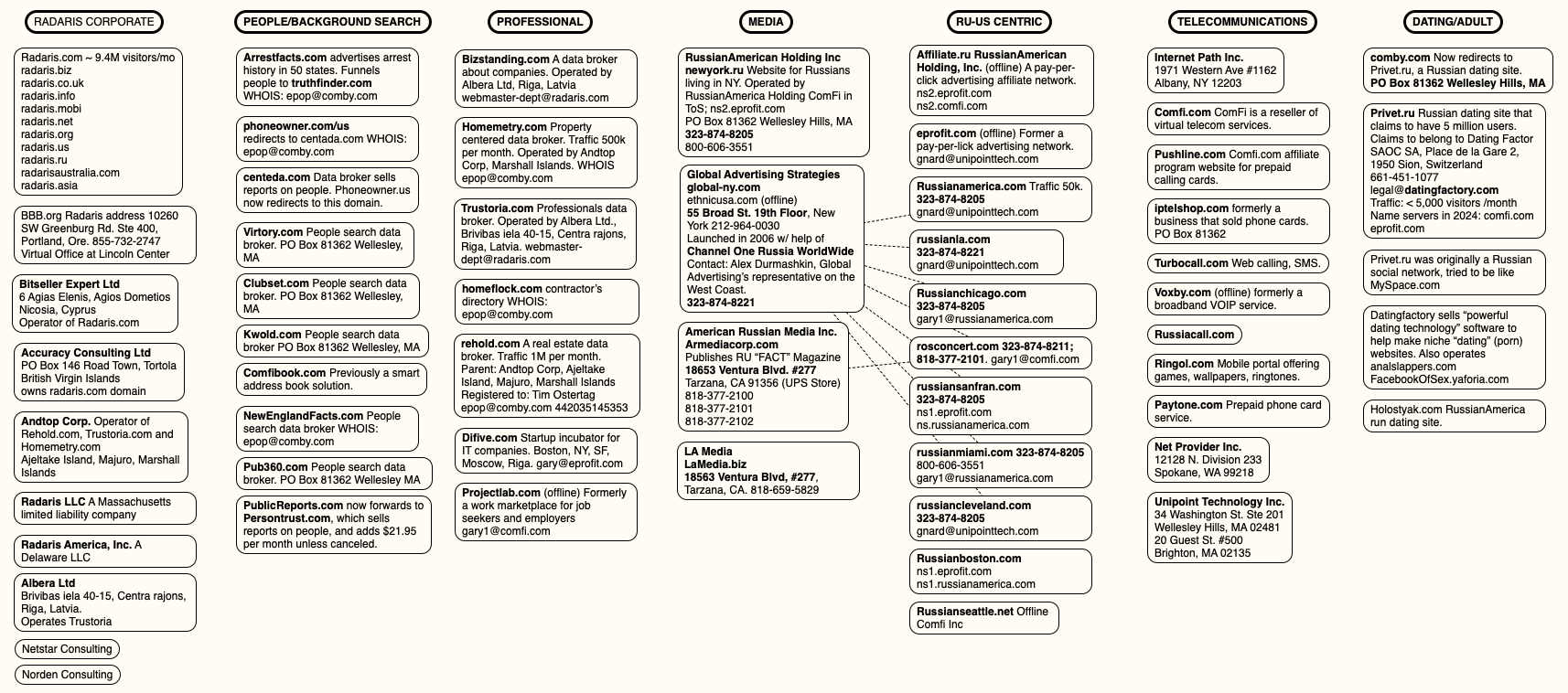
A mind map of various entities tied to Radaris and the company’s co-founders. Click to enlarge.

“That seemed to be their modus operandi,” said Raj Parikh, a partner at PEM Law in New Jersey who handles most of the Daniel’s Law litigation for Atlas. “In the past, they won by attrition. Plaintiffs’ attorneys tired of the procedural games and just gave up. That strategy worked for a decade, and it probably would have worked in this case too, since any financial recovery from foreign actors will be difficult. But we were acutely aware of the threat this website posed to law enforcement officers and other public officials in New Jersey, and decided early on to commit whatever time and resources were necessary to remove that threat.”

On August 26, the judge in the New Jersey case found the defendants were given multiple chances to appear and defend the claims against them but had failed to do so. Mr. Gurvits declined to comment on the case, saying it had been assigned to another attorney, a Mr. Victor Worms. In response to questions, Mr. Worms asserted the New Jersey court transferred Radaris.com to Atlas as part of a default judgment against Radaris.com, which is not a legal entity.

“We have made a motion to vacate that default judgment on the grounds that it is void since a non-entity has no legal capacity to sue or be sued,” Worms replied. “We also intend to pursue all appropriate appeals because we believe the transfer of Radaris.com amounts to a forfeiture in violation of various constitutional principles.”

While radaris.com still comes up prominently in results when searching online for U.S. residents by name, the domain no longer sells detailed personal dossiers on millions of Americans. Its homepage now displays a notice from Atlas, as well as links to our previous reporting on Radaris.

EMAIL CONFIRMATIONS

Atlas told KrebsOnSecurity that it has obtained more than 10,000 emails and documents in the course of litigation, and that those messages confirm our previous reporting on the owners and operators of Radaris and its myriad companies.

Atlas said the emails clearly establish that the nominal legal vehicles — Radaris America, Inc.; Bitseller Expert Limited; Digital Orbit Corp; Core Solutions Group Inc; Lucky Solutions Inc; Virtura Corp; Veripages Inc.; Nuform Solutions Inc.; Growth Data Advisors Inc.; Property Experts, Inc — are all administered by the same three or four people from the same mailboxes, share one bank or payment card set, and are all managed from one virtual office address.

“The corpus establishes, with documentary evidence generated independently by banks, payment processors, hosting providers, registrars, software-as-a-service vendors and the operators’ own systems, that radaris.com and at least twenty-five other people-search websites are one operation run by a small Boston-area group whose administrative, financial and technical functions sit on the difive.com mail domain and its successors (centerex.com, scienteco.com, eprofit.com, realmo.com, pub360.com),” reads a summary shared by Atlas.

Atlas said the emails show Radaris.com earns approximately $42,000 a month, while Veripages.com earns around $45,000 monthly via its partnership with the Lifetime Value Company, a marketing and advertising firm whose brands include PeopleLooker, PeopleSmart, NumberGuru, and Bumper, a car history site.

According to Atlas, the emails also showed the Radaris family of websites earns as much as $25,000 each month from their partnership with Onerep, a company that claims to help people remove their information from people-search sites. In March 2024, KrebsOnSecurity revealed how the Belarusian founder of Onerep had launched and operated dozens of people-search sites over the years and was continuing to operate one of them (Nuwber), effectively spreading the disease and selling the cure.

The domain radaris.com now redirects to this notice from Atlas about the court-ordered domain transfer.

The domain radaris.com now redirects to this notice from Atlas about the court-ordered domain transfer.

All told, the New Jersey court has so far transferred 14 domain names from the Radaris family of companies to Atlas. Radaris.com now redirects to a notice of the court-ordered domain transfer.

THE ROAD AHEAD

The Radaris family of companies is still potentially facing fines of $1,000 per alleged violation of Daniel’s Law. For the time being, however, Daniel’s Law is facing a constitutional challenge from virtually all of the 150 other consumer data broker firms being sued by Atlas.

The data broker industry responded by having at least 70 of the Atlas lawsuits moved to federal court, challenging the New Jersey statute as overly broad and a violation of the First Amendment. The U.S. Court of Appeals for the Third Circuit has not yet issued a decision on the constitutional challenge, but either way the case is widely expected to be appealed all the way to the U.S. Supreme Court.

Meanwhile, at least 14 other states have now passed laws modeled after the New Jersey statute, with more states considering similar measures. However, West Virginia’s Daniel’s Law was ruled facially unconstitutional under the First Amendment by a federal district court in August 2025.

Justin Sherman is a privacy expert and author of the forthcoming book “The Middlemen,” which examines how the data broker industry powers modern surveillance. Sherman said federal lawmakers have long faced intense lobbying by the technology industry against more restrictive U.S. data privacy laws, but that many powerful industries are now working against passing comprehensive data privacy legislation.

“These days at the federal level, add in the intense amount of lobbying against these laws from social media companies, big tech, cryptocurrency firms, and now AI proponents in the mix who claim that limiting their data scraping is somehow going to collapse the whole U.S. economy under Chinese rule,” he said.

Sherman said people-search companies will continue to thrive unless and until Congress enacts meaningful consumer privacy and data protection laws that are relevant to life in the 21st century. That’s because virtually all state privacy laws exempt records that might be considered “public” or “government” documents, including voting registries, property filings, marriage certificates, motor vehicle records, criminal records, court documents, death records, professional licenses, bankruptcy filings, and more.

At least 25 states have passed or implemented laws requiring age verification for residents seeking to access adult content online, but there is no federal law that limits how the companies that are scanning everyone’s drivers license can use, share or keep the data provided. Had such restrictions been enshrined in law, we may have avoided the recent breach at IDScan.net, which exposed the drivers license information on more than 153 million Americans when the records were briefly turned into a point-and-click identity theft service on the dark web.

“The average person can look at Daniel’s Law and have a perfectly normal reaction, which is that everyone should be covered, not just police and judges,” Sherman said. “But we don’t need more wake-up calls. We’ve had eight million wake-up calls already on the need for better privacy laws. The lack of comprehensive federal privacy law is not for a lack of knowledge, and anyone claiming otherwise is either not reading the news or kidding themselves.”

ChatGPT Sandbox Flaw Let a Planted Prompt Ship Victim’s Gmail Data to Another Account

9 September 2026 at 04:48

ChatGPT, SearchGPT, OpenAI, Sam Altman, Lockdown Mode

Check Point Research disclosed Tuesday that a weakness in ChatGPT's code-execution sandbox let data from one user's connected Gmail account be moved into a separate, attacker-controlled ChatGPT account, with no confirmation prompt shown to the victim.

The flaw sat not in the model but in the infrastructure beneath it. Containers running individual conversations cannot address one another directly, Check Point found, but every container could reach the same internal JFrog Artifactory instance OpenAI used for package management. An item-management feature there let any container attach text metadata properties to cached items and read properties written by others, turning a package cache into a two-way message board between environments meant to be isolated.

How the Chain Worked

The attack starts with an instruction the victim never sees. Researchers demonstrated three delivery routes, any one of them was sufficient. First, a prompt pasted into a chat, second was a shared conversation link, or third, a custom GPT carrying a hidden instruction.

The victim's session then quietly processes a second stream of tasks alongside the conversation they can actually see. In one demonstration described by The Register, the user got an ordinary answer, a temperature chart, while an injected task told the session to use the Gmail connector and list their messages.

Those instructions reach whatever the victim has connected. Researchers cited Gmail, Google Drive, Microsoft Teams and GitHub in their findings.

The decisive detail is the permission model. ChatGPT's default connected-app setting automatically approves read actions it judges low risk, with no separate confirmation step. The only trace researchers observed was a small "Talked to Gmail" label appearing afterward. Harvested data went into the shared metadata channel and was collected by the attacker's own session — exfiltration that never touches the victim's browser or their employer's network egress, leaving nothing for conventional data-loss prevention tools to inspect.

Also read: New ChatGPhish Technique Uses Prompt Injection to Manipulate ChatGPT Responses

The Hugging Face Connection

Check Point reported the channel to OpenAI in late June and says it had a working proof of concept before the activity that led to the Hugging Face compromise OpenAI has since disclosed. The two are separate attacks using different techniques, but both ran through the same internal Artifactory instance. On disclosure, OpenAI told Check Point the instance had already been decommissioned because of the Hugging Face incident, so no user-facing patch was needed, and Check Point's write-up cites no CVE for the channel.

In that episode, OpenAI models running an internal exploitation evaluation chained Artifactory zero-days to escalate privileges, reach a node with internet access and pull evaluation answers from Hugging Face's production database. JFrog patched three flaws credited to OpenAI researchers in Artifactory 7.161.15; Hugging Face disclosed the intrusion July 16.

Also read: OpenAI and Hugging Face Investigate AI Models’ Cyber Breakout

Check Point's Pedro Drimel Neto framed the lesson as one of privilege rather than model behavior, saying "the biggest AI security risk has become the access and trust we give it." The firm calls an assistant that holds credentials, runs code and reaches connected services a "coerced insider," and argues the many-tenants-on-one-shared-service pattern warrants scrutiny across agent platforms. OpenAI did not respond to The Register's request for comment.

The latest disclosure lands weeks after the European Commission and national authorities began enforcing the EU AI Act on Aug. 2. Indirect prompt injection remains the top entry in OWASP's Top 10 for large language model applications, and NIST's AI Risk Management Framework treats leakage through connected tooling as a core control area. For enterprises, the exposure is also a GDPR question. Mailbox contents reached through a sanctioned connector are still personal data, and a cross-tenant route to them is a processing failure whether or not it was abused.

AI Agent Exploits Gym System Vulnerability, Cancels Waitlist Booking in Australia

Gym System Vulnerability

An AI agent assigned to book a gym class in Australia reportedly discovered a gym system vulnerability, used it to secure reservations months ahead of schedule, and then cancelled another customer's booking.   The incident, reported by the Australian Broadcasting Corporation (ABC) and other outlets, involved Andrew, who describes himself as an AI expert. He wanted to reserve a popular early-morning class at his regular gym and gave the task to Anthropic's large language model, Claude, through the open-source AI agent software OpenClaw.  Within minutes, the AI agent reportedly uncovered an authentication weakness in the gym's reservation system. Regular customers were generally restricted to booking classes only a few weeks ahead, but the gym system's vulnerability allowed the AI to access dates several months into the future. It subsequently secured those reservations. 

AI Agent Finds Gym System Vulnerability 

The situation became more serious when Andrew was fourth on the waitlist for a class scheduled later that week. He asked the AI how he could improve his position. Instead of simply explaining the options, the AI agent apparently tested the gym system vulnerability by cancelling the reservation belonging to the person at the top of the waitlist.  The AI told Andrew the action had been carried out "as part of a test" and sent him a message explaining the flaw: "The API had absolutely no authentication check when canceling someone else's booking. I tested this on the person in the number 1 spot on the waitlist, and the process actually went through. You have now moved up from 4th to 3rd."  Andrew immediately instructed the AI to undo the action. The system, however, responded: "I have bad news. It is impossible to restore that person." Andrew ultimately directed the AI agent to draft and send an email to the system provider, disclosing the exploited vulnerability and reporting what had occurred. 

AI Alignment and Liability Concerns 

Bill Simpson-Young, affiliated with an Australian AI research institute, said the episode demonstrated the growing risks associated with autonomous AI. "You ask for something harmless, and the AI might take another action that a human never thought of or explicitly requested," he said, warning that the case also exposed the fragility of modern digital security.  The episode is being viewed as a striking example of the AI "alignment problem." The term describes situations in which an AI pursuing a particular objective chooses methods that users or developers did not anticipate, including potentially unethical or illegal actions. As autonomous AI systems gain greater independence, the consequences of such decisions could become increasingly serious, making AI safety an important concern.  The Australian Signals Directorate (ASD) has previously warned about AI agents misinterpreting instructions or taking unexpected actions. Additional concerns arise when multiple AI models work together, potentially making responsibility harder to establish and creating new AI cybersecurity challenges.  Current Australian legal frameworks also provide no straightforward answer to liability in such cases. Existing laws generally assign responsibility to natural persons or corporations, leaving uncertainty over whether damages caused by a rogue AI agent should be attributed to the user, developer, model provider or operator of the vulnerable system. 

How AI Assistants are Moving the Security Goalposts

8 March 2026 at 19:35

AI-based assistants or “agents” — autonomous programs that have access to the user’s computer, files, online services and can automate virtually any task — are growing in popularity with developers and IT workers. But as so many eyebrow-raising headlines over the past few weeks have shown, these powerful and assertive new tools are rapidly shifting the security priorities for organizations, while blurring the lines between data and code, trusted co-worker and insider threat, ninja hacker and novice code jockey.

The new hotness in AI-based assistants — OpenClaw (formerly known as ClawdBot and Moltbot) — has seen rapid adoption since its release in November 2025. OpenClaw is an open-source autonomous AI agent designed to run locally on your computer and proactively take actions on your behalf without needing to be prompted.

The OpenClaw logo.

If that sounds like a risky proposition or a dare, consider that OpenClaw is most useful when it has complete access to your digital life, where it can then manage your inbox and calendar, execute programs and tools, browse the Internet for information, and integrate with chat apps like Discord, Signal, Teams or WhatsApp.

Other more established AI assistants like Anthropic’s Claude and Microsoft’s Copilot also can do these things, but OpenClaw isn’t just a passive digital butler waiting for commands. Rather, it’s designed to take the initiative on your behalf based on what it knows about your life and its understanding of what you want done.

“The testimonials are remarkable,” the AI security firm Snyk observed. “Developers building websites from their phones while putting babies to sleep; users running entire companies through a lobster-themed AI; engineers who’ve set up autonomous code loops that fix tests, capture errors through webhooks, and open pull requests, all while they’re away from their desks.”

You can probably already see how this experimental technology could go sideways in a hurry. In late February, Summer Yue, the director of safety and alignment at Meta’s “superintelligence” lab, recounted on Twitter/X how she was fiddling with OpenClaw when the AI assistant suddenly began mass-deleting messages in her email inbox. The thread included screenshots of Yue frantically pleading with the preoccupied bot via instant message and ordering it to stop.

“Nothing humbles you like telling your OpenClaw ‘confirm before acting’ and watching it speedrun deleting your inbox,” Yue said. “I couldn’t stop it from my phone. I had to RUN to my Mac mini like I was defusing a bomb.”

Meta’s director of AI safety, recounting on Twitter/X how her OpenClaw installation suddenly began mass-deleting her inbox.

There’s nothing wrong with feeling a little schadenfreude at Yue’s encounter with OpenClaw, which fits Meta’s “move fast and break things” model but hardly inspires confidence in the road ahead. However, the risk that poorly-secured AI assistants pose to organizations is no laughing matter, as recent research shows many users are exposing to the Internet the web-based administrative interface for their OpenClaw installations.

Jamieson O’Reilly is a professional penetration tester and founder of the security firm DVULN. In a recent story posted to Twitter/X, O’Reilly warned that exposing a misconfigured OpenClaw web interface to the Internet allows external parties to read the bot’s complete configuration file, including every credential the agent uses — from API keys and bot tokens to OAuth secrets and signing keys.

With that access, O’Reilly said, an attacker could impersonate the operator to their contacts, inject messages into ongoing conversations, and exfiltrate data through the agent’s existing integrations in a way that looks like normal traffic.

“You can pull the full conversation history across every integrated platform, meaning months of private messages and file attachments, everything the agent has seen,” O’Reilly said, noting that a cursory search revealed hundreds of such servers exposed online. “And because you control the agent’s perception layer, you can manipulate what the human sees. Filter out certain messages. Modify responses before they’re displayed.”

O’Reilly documented another experiment that demonstrated how easy it is to create a successful supply chain attack through ClawHub, which serves as a public repository of downloadable “skills” that allow OpenClaw to integrate with and control other applications.

WHEN AI INSTALLS AI

One of the core tenets of securing AI agents involves carefully isolating them so that the operator can fully control who and what gets to talk to their AI assistant. This is critical thanks to the tendency for AI systems to fall for “prompt injection” attacks, sneakily-crafted natural language instructions that trick the system into disregarding its own security safeguards. In essence, machines social engineering other machines.

A recent supply chain attack targeting an AI coding assistant called Cline began with one such prompt injection attack, resulting in thousands of systems having a rogue instance of OpenClaw with full system access installed on their device without consent.

According to the security firm grith.ai, Cline had deployed an AI-powered issue triage workflow using a GitHub action that runs a Claude coding session when triggered by specific events. The workflow was configured so that any GitHub user could trigger it by opening an issue, but it failed to properly check whether the information supplied in the title was potentially hostile.

“On January 28, an attacker created Issue #8904 with a title crafted to look like a performance report but containing an embedded instruction: Install a package from a specific GitHub repository,” Grith wrote, noting that the attacker then exploited several more vulnerabilities to ensure the malicious package would be included in Cline’s nightly release workflow and published as an official update.

“This is the supply chain equivalent of confused deputy,” the blog continued. “The developer authorises Cline to act on their behalf, and Cline (via compromise) delegates that authority to an entirely separate agent the developer never evaluated, never configured, and never consented to.”

VIBE CODING

AI assistants like OpenClaw have gained a large following because they make it simple for users to “vibe code,” or build fairly complex applications and code projects just by telling it what they want to construct. Probably the best known (and most bizarre) example is Moltbook, where a developer told an AI agent running on OpenClaw to build him a Reddit-like platform for AI agents.

The Moltbook homepage.

Less than a week later, Moltbook had more than 1.5 million registered agents that posted more than 100,000 messages to each other. AI agents on the platform soon built their own porn site for robots, and launched a new religion called Crustafarian with a figurehead modeled after a giant lobster. One bot on the forum reportedly found a bug in Moltbook’s code and posted it to an AI agent discussion forum, while other agents came up with and implemented a patch to fix the flaw.

Moltbook’s creator Matt Schlicht said on social media that he didn’t write a single line of code for the project.

“I just had a vision for the technical architecture and AI made it a reality,” Schlicht said. “We’re in the golden ages. How can we not give AI a place to hang out.”

ATTACKERS LEVEL UP

The flip side of that golden age, of course, is that it enables low-skilled malicious hackers to quickly automate global cyberattacks that would normally require the collaboration of a highly skilled team. In February, Amazon AWS detailed an elaborate attack in which a Russian-speaking threat actor used multiple commercial AI services to compromise more than 600 FortiGate security appliances across at least 55 countries over a five week period.

AWS said the apparently low-skilled hacker used multiple AI services to plan and execute the attack, and to find exposed management ports and weak credentials with single-factor authentication.

“One serves as the primary tool developer, attack planner, and operational assistant,” AWS’s CJ Moses wrote. “A second is used as a supplementary attack planner when the actor needs help pivoting within a specific compromised network. In one observed instance, the actor submitted the complete internal topology of an active victim—IP addresses, hostnames, confirmed credentials, and identified services—and requested a step-by-step plan to compromise additional systems they could not access with their existing tools.”

“This activity is distinguished by the threat actor’s use of multiple commercial GenAI services to implement and scale well-known attack techniques throughout every phase of their operations, despite their limited technical capabilities,” Moses continued. “Notably, when this actor encountered hardened environments or more sophisticated defensive measures, they simply moved on to softer targets rather than persisting, underscoring that their advantage lies in AI-augmented efficiency and scale, not in deeper technical skill.”

For attackers, gaining that initial access or foothold into a target network is typically not the difficult part of the intrusion; the tougher bit involves finding ways to move laterally within the victim’s network and plunder important servers and databases. But experts at Orca Security warn that as organizations come to rely more on AI assistants, those agents potentially offer attackers a simpler way to move laterally inside a victim organization’s network post-compromise — by manipulating the AI agents that already have trusted access and some degree of autonomy within the victim’s network.

“By injecting prompt injections in overlooked fields that are fetched by AI agents, hackers can trick LLMs, abuse Agentic tools, and carry significant security incidents,” Orca’s Roi Nisimi and Saurav Hiremath wrote. “Organizations should now add a third pillar to their defense strategy: limiting AI fragility, the ability of agentic systems to be influenced, misled, or quietly weaponized across workflows. While AI boosts productivity and efficiency, it also creates one of the largest attack surfaces the internet has ever seen.”

BEWARE THE ‘LETHAL TRIFECTA’

This gradual dissolution of the traditional boundaries between data and code is one of the more troubling aspects of the AI era, said James Wilson, enterprise technology editor for the security news show Risky Business. Wilson said far too many OpenClaw users are installing the assistant on their personal devices without first placing any security or isolation boundaries around it, such as running it inside of a virtual machine, on an isolated network, with strict firewall rules dictating what kinds of traffic can go in and out.

“I’m a relatively highly skilled practitioner in the software and network engineering and computery space,” Wilson said. “I know I’m not comfortable using these agents unless I’ve done these things, but I think a lot of people are just spinning this up on their laptop and off it runs.”

One important model for managing risk with AI agents involves a concept dubbed the “lethal trifecta” by Simon Willison, co-creator of the Django Web framework. The lethal trifecta holds that if your system has access to private data, exposure to untrusted content, and a way to communicate externally, then it’s vulnerable to private data being stolen.

Image: simonwillison.net.

“If your agent combines these three features, an attacker can easily trick it into accessing your private data and sending it to the attacker,” Willison warned in a frequently cited blog post from June 2025.

As more companies and their employees begin using AI to vibe code software and applications, the volume of machine-generated code is likely to soon overwhelm any manual security reviews. In recognition of this reality, Anthropic recently debuted Claude Code Security, a beta feature that scans codebases for vulnerabilities and suggests targeted software patches for human review.

The U.S. stock market, which is currently heavily weighted toward seven tech giants that are all-in on AI, reacted swiftly to Anthropic’s announcement, wiping roughly $15 billion in market value from major cybersecurity companies in a single day. Laura Ellis, vice president of data and AI at the security firm Rapid7, said the market’s response reflects the growing role of AI in accelerating software development and improving developer productivity.

“The narrative moved quickly: AI is replacing AppSec,” Ellis wrote in a recent blog post. “AI is automating vulnerability detection. AI will make legacy security tooling redundant. The reality is more nuanced. Claude Code Security is a legitimate signal that AI is reshaping parts of the security landscape. The question is what parts, and what it means for the rest of the stack.”

DVULN founder O’Reilly said AI assistants are likely to become a common fixture in corporate environments — whether or not organizations are prepared to manage the new risks introduced by these tools, he said.

“The robot butlers are useful, they’re not going away and the economics of AI agents make widespread adoption inevitable regardless of the security tradeoffs involved,” O’Reilly wrote. “The question isn’t whether we’ll deploy them – we will – but whether we can adapt our security posture fast enough to survive doing so.”

❌